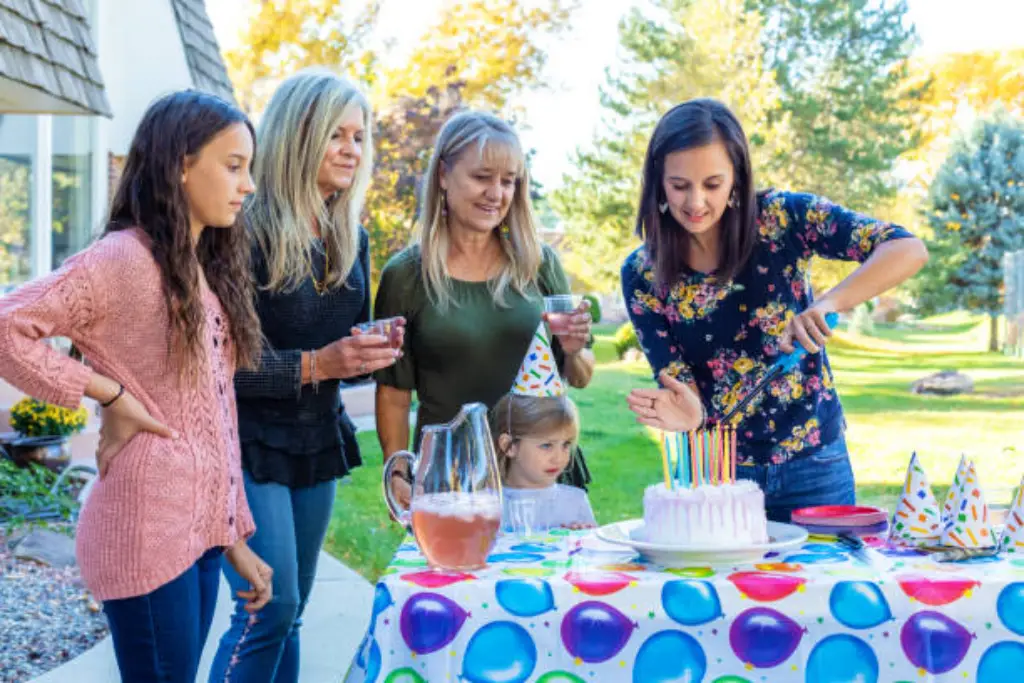
My mother stood up at the picnic table with a paper plate in her hand like it was a microphone, and the cheerful chaos of the family gathering quieted around her. It was my nephew Tyler’s turn to host what we called Cousins Day—a backyard cookout at my parents’ house in Mesa with balloons tied to fence posts, a folding table sagging under the weight of store-bought cupcakes, and a glittery banner stretched across the patio that spelled out every grandchild’s name in puffy paint letters.
Maya’s name was there too, tucked in the far corner in noticeably smaller letters than the others. I’d noticed it when we arrived, felt that familiar prickle of exclusion, and told myself not to make it a thing. Not to overreact. Not to be dramatic.
“Quick announcement, everyone,” Mom said, her voice bright with that particular enthusiasm she reserved for moments when she believed she was doing something generous and wise. “Your father and I have decided something important for the kids’ futures.”
The noise died down completely. Aunts and uncles turned from their conversations. My sister set down her phone. Even the younger cousins stopped chasing each other long enough to look up at Grandma with vague curiosity.
Maya, twelve years old and sitting beside me at the far end of the table, had barbecue sauce on her chin and a carefully folded napkin in her lap. She’d spent twenty minutes that morning making a card for my father—a hand-drawn lemon tree with careful shading and a message that said “Happy Cousins Day, Grandpa” in her neat, deliberate handwriting. She’d taped it to the cooler near where he was sitting. He hadn’t looked at it yet, though he’d reached past it three times for drinks.
Mom smiled at Tyler first. He’s sixteen now, tall and broad-shouldered in his varsity baseball hoodie, standing near the grill with his phone in one hand and a can of soda in the other.
“We’ve decided to consolidate the education funds,” Mom announced like she was revealing the winner of a raffle. “We’re moving the money from Maya’s college account into Tyler’s 529 plan. He has real potential for athletic scholarships, and the money will go much further for him since he’ll be eligible for matching programs and recruitment opportunities. Maya loves her art—” she said it like art was a phase, like finger painting “—so she won’t need as much for college anyway. This way we’re being smart about the family’s resources.”
For a moment, I didn’t understand what I was hearing. My brain felt half a second behind, struggling to process words that didn’t make sense arranged in that particular order.
I watched Maya’s fingers go tight around her napkin, the paper crinkling in her small fist. She stared down at my lap like she wanted to disappear into it, to fold herself small enough that no one would notice her anymore.
Someone clapped—Tyler’s mother, my sister, started to applaud reflexively before catching herself, her hands freezing mid-air as her eyes darted between me and Mom.
I didn’t stand up. I didn’t say anything. My hands were shaking under the table, trembling so badly I had to press my palms against my thighs. My throat felt too tight to swallow, too small to pull in air.
My father cleared his throat from his lawn chair, nodding slowly like this was all perfectly reasonable. “It’s for the good of the family,” he added, glancing at my brother-in-law with that male solidarity look they shared. “We all have to be practical about these things. Make smart investments.”
Maya’s voice came out so soft I almost didn’t hear it over the ambient noise of the backyard—the neighbor’s sprinkler, someone’s distant music, the buzz of a bee near the cupcake table.
“Did I do something wrong?”
The question cracked something open in my chest.
“No,” I said, forcing my voice to stay steady even as my heart pounded. “You didn’t do anything wrong.”
Mom spread her hands in that gesture of benevolent explanation she’d perfected over the years. “We’re being fair here. It’s still the family’s education fund—we’re just allocating it more strategically. We’ll still support Maya’s hobbies and interests, of course.”
Hobbies. Not her education. Not her future. Not her dreams or her potential or her worth.
Hobbies.
I felt something hot and sharp crawl up the back of my neck, flooding my face with heat.
Tyler’s mother—my sister Jennifer—jumped in eagerly. “Tyler made varsity as a sophomore, which is extremely rare. He’s already getting looks from college scouts. This is a real opportunity for the family.”
She nudged Tyler, who continued staring at his phone, looking vaguely uncomfortable but not uncomfortable enough to speak up.
My Aunt Lonnie, sitting across the table, had gone very still. Her face carried an expression I couldn’t quite read—something between horror and fury, held back by sheer force of will. She looked at me like she desperately wanted to say something but was physically restraining herself.
I blinked several times, looking around at all these familiar faces in my parents’ backyard, feeling like I’d stepped into an alternate reality where up was down and cruelty was disguised as practicality.
My daughter was sitting right there. Right there, six feet away from my mother, who was casually announcing that Maya’s future was being redistributed to someone who mattered more. Who had more potential. Who was more worth investing in.
I thought about all the times I’d stayed late at the hospital to pick up extra shifts, tucking money aside bit by bit. The overtime hours. The holiday coverage I’d volunteered for. The envelopes of cash I’d slipped under Mom’s ceramic rooster on the kitchen counter to cover “little things” that always seemed to come up.
“Okay,” I heard myself say, my voice coming out very quiet and oddly calm. “Okay.”
Maya didn’t cry. She was too well-trained for that by now, too practiced at making herself small and unobtrusive. She folded the napkin into a perfect square and placed it carefully on her plate, her movements deliberate and controlled.
The lemon tree card she’d made for my father slipped off the cooler at that moment, falling face-down into the grass. No one moved to pick it up. No one even noticed except me and Maya, whose eyes tracked its fall like she was watching a part of herself being discarded.
I picked up my purse from under the table, my hands still shaking. “We’ll head out after cake,” I told my mother, my voice sounding strange to my own ears—distant, like it was traveling through water.
Mom beamed at me, her smile warm and relieved. “You’re not upset, are you? We talked about this for weeks and really thought it through.”
No, we didn’t. She’d made comments, dropped hints, mentioned Tyler’s potential in passing—but nothing this explicit, nothing this final.
I nodded and reached for Maya’s hand under the table. Her fingers were cold despite the ninety-degree Arizona heat. I held her hand like it was the only thing anchoring me to my chair, keeping me from floating away into rage.
They cut the cake—vanilla with blue frosting and “Cousins Rock!” written in wobbly letters. Someone passed me a corner piece with extra frosting. I put it in my mouth and tasted nothing, my tongue numb, my throat unable to swallow properly.
I watched my daughter’s eyes, already learning at twelve how to make herself smaller so the adults around her could feel comfortable. Already understanding that her dreams mattered less than Tyler’s baseball statistics.
I should have known this was coming. I’d ignored every sign, made excuses for every slight, convinced myself they’d change or that I was overreacting or that family was family and you had to make allowances.
I’d been wrong.
My name is Lauren, though everyone calls me L. I’m thirty-eight years old, a clinical pharmacist at a hospital in downtown Phoenix, divorced, and the mother of one extraordinary daughter. I grew up in Mesa, the oldest of three children, in the beige stucco house with orange trees in the front yard where the air always smells like warm citrus and desert dust.
Five years ago, after my ex-husband and I split, Maya and I moved back into that beige house temporarily while I got my feet under me. The temporary arrangement turned into years—not because I couldn’t afford my own place, but because I’d convinced myself that having family support was better for Maya than being alone.
We took the spare bedroom with the low ceiling and the twin bed that was too small for me but that I slept in anyway. I brought my white IKEA bookshelf and the lemon-print curtains Maya had picked out at Target, and I told myself this was good. This was stability. This was what family meant.
I paid rent even when they insisted I didn’t need to. At first it was five hundred dollars a month, a token amount. Then one July my mother showed me the electric bill—four hundred twelve dollars—and I started covering utilities every month. I put the internet and water bills on autopay with my credit card. When the air conditioning died during a brutal heat wave, I wrote a check for twenty-eight hundred dollars to get it fixed the same day because my father said he didn’t do financing and we couldn’t wait.
When the roof needed patching, I hired the contractor and paid eighty-five hundred dollars from my savings because monsoon season was coming and Dad was waiting for his buddy to “get around to it.”
When Tyler’s travel baseball expenses came due—six hundred here, three hundred there—there was always a text from my sister. “Can you spot us just this once? We’ll pay you back next month.” They never did. I stopped expecting them to.
My mother and I had opened a joint account at the credit union called Family Savings, meant for emergencies. I deposited twelve hundred dollars initially, then set up automatic transfers every payday. The account was supposed to be for true emergencies, but it became the account for everything—their car insurance, my dad’s new tires, plumbing repairs, Thanksgiving groceries, the deposit for last summer’s beach rental that we all “shared” but that I alone paid for.
I kept meticulous records. I saved every receipt. I told myself this was my contribution, my way of being useful, my way of ensuring I’d always have a place to belong.
When Maya was born, my parents had opened a 529 college savings account in her name. Mom insisted it made more sense for the account to be in her name as the owner because she “understood these financial things” and wanted to feel involved. It made everyone feel good at Christmas to talk about Maya’s college fund, to drop cash into the glass jar on the mantel labeled “Maya’s Future” in my mother’s careful handwriting.
I’d added to it too, though not as much as I’d wanted to at first. Small checks here and there. Life was busy, and I trusted that my parents were handling it responsibly.
After the divorce, my mother started referring to it as “the education fund for all the grandkids,” as if it had always been a communal resource rather than specifically Maya’s. I’d blinked at the shift in language but let it slide, not wanting to seem difficult or ungrateful.
Meanwhile, Maya faded in that house in hundreds of small ways I’d tried not to notice.
On the “grandkids wall” in the hallway, my parents had hung one of those black collage frames with spaces for eight photos. Tyler and the younger cousins had their school pictures displayed—various ages, missing teeth, baseball jerseys, dance costumes. Maya’s second-grade photo had been up for a while, but at some point it disappeared. In its place was Tyler’s tournament photo where he held a trophy almost as big as his torso.
“We’re waiting for a new picture of Maya,” Mom had said when I’d asked about it, reaching for a dust rag to avoid eye contact.
I’d brought a new photo in a yellow frame the following week. It sat on the TV stand for three months, leaning against the remote control, never making it to the wall.
When they organized Cousins Day outings—trips to the aquarium, the science museum, the trampoline park—they texted the family group chat during my work hours. “Taking the kids to the zoo today!” I’d come home to find damp towels and gift shop bags on the counter.
“Oh, we thought you were working,” Mom would say, not quite meeting my eyes. “It would have been too complicated with your schedule.”
Maya’s shoes would be by the door. Dry. Unworn. Waiting.
Last Christmas, my sister had bought matching hoodies for all the grandkids—navy blue with “Cousins Squad” printed across the front in white letters. She’d distributed them on Christmas Eve with great ceremony. There were five hoodies. Six grandchildren in the photo.
“They didn’t have Maya’s size in stock,” Jennifer had said, not looking at me.
Maya had gone to her room. When she came back, she was wearing her plain navy school sweatshirt, smiling like it was fine, like it didn’t sting.
I kept writing checks. I bought a new sofa for the living room when the old one’s springs gave out—seven hundred ninety-nine dollars on my credit card. Mom called it “our” sofa, turned the cushions when company came, and said, “See how well we take care of things?”
But here’s what they didn’t know, what I’d never told them: I’m very, very good with money. I have to be.
Early in my career, I’d taken the night shifts that paid differential rates, and I’d kept careful spreadsheets of every dollar. When I sold the condo my ex and I had owned in Tempe—after the divorce was final, after the lawyers took their fees, after everything was split and settled—I walked away with one hundred ninety-two thousand dollars.
I’d put most of it into savings and investments. And I’d opened a second 529 account for Maya, this one solely in my name with Maya as the beneficiary. I’d structured it so my parents couldn’t access it, couldn’t control it, couldn’t even know about it.
I called it Lemon Tree in my head, after the trees in my parents’ front yard, after the card Maya had made for my father that now lay face-down in the grass.
I’d been adding to it steadily for years—two hundred dollars here, five hundred there, every bonus, every extra shift, every tax refund. It had grown quietly, steadily, invisibly.
My boss at the hospital knew about it because I’d needed someone to reality-check my financial planning. He’d looked at my spreadsheet and said, “You’re being smart. Keep it separate. Trust your instincts.”
I had trusted my instincts. And now, sitting at this picnic table listening to my mother announce that Maya’s college fund was being given to Tyler, I was grateful beyond words that I had.
We left after the cake was cut and distributed. I scraped frosting into a napkin and threw it away. Maya placed her plate carefully in the trash bin and walked across the grass to pick up her lemon tree card. The corner was damp from the grass, slightly torn. She flattened it gently between her palms like something precious.
No one called out goodbye as we walked to the car.
In my Honda, Maya stared out the window as I drove, watching the familiar Mesa streets slide past. The late afternoon sun cast everything in orange and gold. The car smelled like sunscreen and the faint vanilla of the air freshener hanging from the rearview mirror.
“You okay?” I asked, my voice careful.
She was quiet for a long moment before saying, “I don’t need college anyway.” It was phrased like a statement but it was really a question: Should I stop wanting things? Should I make myself smaller so this doesn’t hurt?
“You get to want whatever you want,” I said firmly. “And there’s something I should have told you a long time ago.”
I didn’t drive home. Instead, I turned into the parking lot of the library we visited every Thursday, the one with the good children’s section and the librarian who always saved new graphic novels for Maya.
We went inside to our favorite corner table, the one by the window overlooking the small courtyard garden. I opened my laptop and logged into my Vanguard account while Maya leaned in, her hair tickling my cheek.
I navigated to the account labeled “Lemon Tree – Maya Education Fund.”
The balance blinked on the screen: $340,712.44.
Maya’s mouth formed a small, surprised O. She looked at the screen, then at me, then back at the screen.
“Is that… yours?”
“It’s for your education,” I said quietly. “I set this up years ago in my name only. Your grandparents don’t control it. They don’t even know about it. They can’t touch it. This is yours.”
She blinked rapidly, processing. “When did you start this?”
“After we moved in with them. After I started noticing… things.” I’d told myself I was being paranoid back then, overprotective. Today I was profoundly grateful I hadn’t ignored my instincts.
Maya traced an invisible lemon on the edge of her ever-present notebook. “So they can’t take it away.”
“They can’t take it,” I confirmed. “They can do whatever they want with the account they control. But this one? This is ours. Mine and yours. Safe.”
“Thank you,” she whispered, and it came out like a prayer.
I closed the laptop and looked at her directly. “Pack your things when we get back to the house. We’re moving out.”
Her eyes went wide. “Where?”
“I found an apartment complex in Phoenix last week,” I said. “Sunny Slope Apartments, third floor, two bedrooms. There’s a balcony and good locks and a pool that actually gets cleaned. It’s closer to my work and closer to a really good middle school. I already have the lease ready—I was just waiting for the right moment, the right sign.”
Maya looked at me with something like wonder. “This was the sign.”
“This was absolutely the sign.”
I texted Aunt Lonnie from the parking lot: We’re okay. Moving out tonight. Please don’t come by—I’ll call you tomorrow.
Her response came within seconds: Oh thank God. I’m so sorry about today. That was cruel and wrong. Call me when you’re ready. I love you both.
Back at my parents’ house, Maya and I moved with surprising efficiency, as if we’d been practicing for this moment without knowing it. She rolled her socks into neat balls and tucked her pencils into a zippered pouch. I pulled down the lemon-print curtains in two long strips, folded them carefully, and placed them on top of a box marked “Bedroom.”
I left the white bookshelf—it had been my mother’s originally anyway, and I didn’t want anything that would make this feel like theft rather than departure.
I took the yellow-framed photo of Maya from the TV stand and slipped it into my backpack. The house was full of noise from the television and distant conversation from the patio. My parents and sister were outside with the cousins, their laughter carrying through the warm evening air.
The desert sunset threw pink and orange light through the kitchen window. On the counter, tucked under the ceramic rooster where I’d left so many envelopes of cash, was a bill for my father’s truck tires.
I left it there.
I slept restlessly that night, hyperaware of every sound. At six-thirty the next morning, Maya appeared in my doorway with her backpack already on.
“Ready,” she said, her lemon tree card sticking out of the side pocket.
I drove her to school and kissed the top of her head before she got out. “I’ll pick you up from the new apartment this afternoon,” I said.
Her eyes got bright. She nodded and ran toward the building, ponytail bouncing.
From the school, I drove directly to Desert Sun Credit Union. The branch had a mural of a saguaro on the exterior wall and smelled like old carpet and coffee inside. A woman with a nameplate reading “Rita” smiled at me from behind the counter.
“How can I help you today?”
“I need to close a joint account and withdraw my funds,” I said clearly. “The account is called Family Savings. My mother is the other account holder.”
Rita’s fingers moved across her keyboard. “I can help with that. Joint accounts can be closed by either party. Would you like the funds transferred or issued as a check?”
“Transfer to my checking account ending in 5412, please.”
She asked for my ID and debit card. I handed them over, my hands steady now.
She looked at her screen for a long moment. “There’s a scheduled transfer set for next Friday. Would you like me to cancel that as part of the closure?”
“Yes, please cancel it.”
“I also see several recurring debits on this account—SRP Electric, Cox Internet, Maricopa Water, State Farm Insurance. Do you want to contact those companies about alternative payment methods?”
“No,” I said. “The account closure will handle it.”
She processed the paperwork with quiet efficiency, sliding forms across the counter for my signature.
“The current balance is twenty-six thousand, eight hundred forty-one dollars,” she said. “The transfer should complete by end of business today. Your confirmation number is 77426.”
“Thank you,” I said.
I didn’t explain. I didn’t justify. I walked out into the bright morning sunshine feeling like I’d shed a heavy coat I’d been wearing so long I’d forgotten it was there.
I texted my boss that I’d be late. He responded immediately: Take whatever time you need.
I drove to Sunny Slope Apartments and signed the lease in the manager’s cramped office with its fake plant and bowl of peppermints. I handed over the cashier’s check for first and last month’s rent, received two keys on a sunflower keychain, and took a photo of the empty living room to send to Maya with a lemon emoji.
That afternoon, when I picked Maya up from school, her face transformed when I said, “Ready to see home?”
The apartment echoed when we laughed. We ate pizza sitting on the floor. We hung the lemon-print curtains with thumbtacks because I hadn’t bought a curtain rod yet. We made beds out of blankets and pillows. I placed the yellow-framed photo of Maya on the kitchen counter, right in the center where no one could miss it or move it or replace it.
We slept with the balcony door cracked to hear the pool filter humming three floors below.
They started calling around ten o’clock the next morning, right about when the bank transfer would have hit my checking account and the scheduled payment would have bounced.
First Mom. Then Dad. Then Jennifer. Then Mom again.
I watched my phone buzz on the kitchen counter of our empty new apartment. I let it buzz. I turned off the ringer.
By noon I had four voicemails.
Mom’s voice, clipped and sharp: “Lauren, call me immediately.”
Another message: “You emptied the family account without telling anyone. The mortgage payment is due.”
Dad: “This is incredibly petty. You’re punishing everyone because you’re jealous of Tyler.”
Jennifer: “Are you actually serious right now? That money was for all of us. You’re being so dramatic.”
I made sandwiches and brought them to where Maya sat on the floor with her sketchbook, drawing a lemon with tiny eyelashes.
“Are they angry?” she asked.
“They’re surprised,” I said. “They didn’t think I would make my own choices.”
Jennifer texted: Mom says you need to transfer $3000 back immediately for the next two weeks while we figure this out.
I replied: No.
Two minutes later: Why not?
I typed: Because my money is off your accounts now. I’m not your backup bank anymore.
Five minutes of silence, then: Wow. Just wow.
I put my phone face-down on the counter.
At three o’clock, there was a knock on the apartment door. Through the peephole, I saw Aunt Lonnie holding a foil-covered casserole dish.
I opened the door. She looked at me and her mouth pressed into a firm line, her eyes glistening.
“I know you said not to come last night,” she said. “But today’s different. I brought dinner—the lasagna with the ripple noodles you like.”
She set the dish on the counter, taking in the lemon curtains and the yellow-framed photo, the emptiness that was slowly becoming home.
“What your mother said yesterday was unkind,” Aunt Lonnie said, covering my hand with hers. “It was also completely untrue. Maya has all the potential in the world.”
“I know,” I said, my throat tight. “That’s why we left.”
She nodded. “Good. And you don’t owe them an explanation or an apology.”
My phone buzzed again. Mom had sent a photo of an old shut-off notice from three months ago with the caption: Look what happens when you act without thinking.
I didn’t engage.
At five o’clock, Jennifer called from a blocked number. I answered without thinking.
“Tyler’s baseball camp deposit is non-refundable and we needed that money,” she said without preamble. “You’re being completely selfish.”
“It’s not my responsibility to fund your son’s activities,” I said calmly. “Especially in a family where my daughter isn’t treated as equal.”
“This is about your vendetta against Mom. You’re letting Maya manipulate you.”
“I’m choosing to stop letting you and Mom manipulate me,” I said. “There’s a difference.”
“You stole from the family.”
“I withdrew my own money from a joint account I funded,” I corrected. “You can call the bank if you don’t believe me.”
She hung up.
That evening, one of the younger cousins, Hannah, texted Maya: That was really messed up what Grandma said. Are you okay? Want to come over?
Maya texted back: We moved. We have our own place now. And a pool.
Hannah sent back about fifty heart emojis.
The next day, my mother texted a long message about family duty and everything we’ve done for you over the years.
I typed and retyped responses, then deleted them all. Finally, I settled on something simple:
Maya and I won’t attend family events where she’s treated as less valuable than the other grandchildren. My money is not available for you to spend anymore. I’m not your backup bank. You’re off my accounts.
I read it aloud before sending it. It felt like folding a clean sheet—crisp, final, complete.
At work, my boss asked if I was okay. “You look different,” he said. “Lighter.”
“I slept,” I told him, smiling. “Really slept.”
Over the following weeks, I got automated emails about the insurance policies on my parents’ cars—payments declined. I forwarded them to my mother with a brief note: This seems like something you’ll need to handle directly.
When they realized I wasn’t going to fix it, the tone of their messages shifted. Mom sent a photo of Tyler in his baseball uniform: You’re destroying his opportunities because you’re stubborn.
Aunt Lonnie forwarded me a screenshot from a family group chat I wasn’t part of. The message was from my mother: Lauren is cutting off her nose to spite her face. We need to pray for her stubborn heart.
Lonnie’s separate message to me said: Don’t read that toxic garbage. Come over Sunday for lemonade. I’m proud of you.
Maya started her new school the following week. On her first day, I took a photo of her on the balcony with her backpack, the lemon card tucked carefully in the front pocket. She texted me at lunch—a picture of the school library with actual comfortable chairs and the word “QUIET” painted in coral letters on the wall.
They have a robotics club, she wrote.
I stood in the hospital pharmacy supply room grinning at my phone like an idiot.
We started our own tradition on the last Sunday of each month: Pizza and Paper Night. We’d eat slices on mismatched plates and spread our important documents across the floor—the lease, Maya’s school calendar, my budget printout, the latest 529 statement.
I taught Maya how to read the account balance and understand the growth. We had a rule: nobody gets embarrassed for asking what something means.
We left two chairs at the small thrift store table I’d bought for twenty-five dollars. Not because I expected my parents to come, but because it made the space feel honest—open but not desperate, welcoming but not naive.
I put a small potted lemon tree in the center of the table. Because of course I did.
Maya taped her lemon tree card above the kitchen sink with blue painter’s tape. It stayed there, visible and valued, exactly where she’d put it.
On Halloween, Hannah came over in a witch hat with a bag of Twizzlers. We watched a movie projected onto a sheet hung on the wall. Maya laughed so hard she got hiccups. I took a photo and sent it to Aunt Lonnie, who responded with a picture of perfect lemon bars and an invitation for Sunday.
At Christmas, we didn’t go to my parents’ house. We made tamales with a neighbor who showed us how to fold them properly. We set two extra plates on the counter under Maya’s photo—an open invitation.
I texted my mother at noon: You’re welcome to join us if you can treat Maya with respect and kindness.
They didn’t come. The chairs stayed empty, and it didn’t ruin anything.
In January, Maya brought home a paper from school—her drawing of our balcony had won honorable mention in an art show. She taped it next to her lemon tree card.
“It’s not a big deal,” she said with a shrug, but her eyes were bright.
We didn’t lose it in a drawer. We didn’t find it weeks later under junk mail. We celebrated it.
They still send me things sometimes. Links to family camp opportunities. Hints about the air conditioning needing replacement. Reminders about what they did for me when I was twenty-eight.
I don’t argue with the past anymore. When they ask for money, I reply with the same line every time, like a password that opens exactly one door: I’m not your backup bank. You’re off my accounts.
It’s not mean. It’s a boundary.
The family 529 they controlled is Tyler’s now. Good for him—I genuinely hope he uses it well and that the adults around him teach him his worth doesn’t require diminishing someone else. That’s not his lesson to learn.
The other 529, Lemon Tree, keeps growing. I update the spreadsheet monthly and show Maya the graph. We don’t count on anyone else to protect it or honor it.
When she asks if she can pursue art school or engineering or something she hasn’t named yet, I say, “Look at this. We have choices. We built them.”
I’m not the winner in this story. I’m just a mother who adjusted the chairs, checked the locks, and moved the money I earned to where my daughter is safe and valued.
I will not fund a family my daughter isn’t fully part of.
That’s not cruelty. That’s clarity.
And every night when I lock our apartment door, when I see Maya’s lemon tree card above the sink and her latest drawing taped to the wall, when I hear her laugh without that careful edge of making herself smaller—I know we made the right choice.
Some families are born. Some are chosen. And some you have to leave behind so you can build something better with the people who actually see you.
We’re building something better.
One lemon at a time.

Lila Hart is a dedicated Digital Archivist and Research Specialist with a keen eye for preserving and curating meaningful content. At TheArchivists, she specializes in organizing and managing digital archives, ensuring that valuable stories and historical moments are accessible for generations to come.
Lila earned her degree in History and Archival Studies from the University of Edinburgh, where she cultivated her passion for documenting the past and preserving cultural heritage. Her expertise lies in combining traditional archival techniques with modern digital tools, allowing her to create comprehensive and engaging collections that resonate with audiences worldwide.
At TheArchivists, Lila is known for her meticulous attention to detail and her ability to uncover hidden gems within extensive archives. Her work is praised for its depth, authenticity, and contribution to the preservation of knowledge in the digital age.
Driven by a commitment to preserving stories that matter, Lila is passionate about exploring the intersection of history and technology. Her goal is to ensure that every piece of content she handles reflects the richness of human experiences and remains a source of inspiration for years to come.