My name is Eloise Van, and at sixty-six years old, I truly believed I’d already lived through every kind of surprise a family could hand you. I’d buried a husband at forty-three, raised two sons as a single mother while working full-time as a school librarian, survived breast cancer at fifty-eight, and watched both my boys grow into men I was mostly proud of. Life had taught me to expect complications, to brace for disappointment, and to find small joys in quiet moments.
That October morning, the air carried that particular damp scent of early autumn—wet leaves and cold asphalt, the smell of neighbors raking too early and a sky that couldn’t decide whether to drizzle or shine. My son Marcus kept loading suitcases into the trunk of their glossy black SUV with the kind of rushed efficiency that suggested he was either very organized or very eager to leave.
“Mom, are you absolutely sure you can handle him for a week?” Marcus asked for what had to be the fourth time that morning, his voice carrying that soft, careful worry people use when they don’t want to sound rude but genuinely doubt your capabilities.
I tugged my cardigan tighter against the October chill and forced a smile I didn’t fully feel. “I raised babies before you were even born, Marcus. Jordan and I will be just fine.”
Jordan stood quietly at my side in his little dinosaur T-shirt and worn jeans, clutching the stuffed elephant he’d carried everywhere since he was two. He didn’t speak—he never spoke—didn’t react the way other children did when adults discussed him like he wasn’t there. He just watched the world from behind those dark, attentive eyes that always made me wonder what he was storing away in that silent mind of his.
My grandson had been diagnosed as selectively mute at age three, though the doctors couldn’t agree on whether it was psychological trauma, developmental delay, or something they didn’t have a proper name for yet. He’d never said a single word that anyone could recall. Not “mama,” not “no,” not even a cry for help when he’d fallen off the swing set last year and broken his wrist. He’d just held his arm at an odd angle and stared at it until Vanessa noticed.
Vanessa swept out of the house next, looking like she’d stepped directly from a salon into my driveway without a single platinum-blonde hair daring to move out of place. Her weave was flawless, her false lashes perfectly curled, her acrylic nails clicking when she gestured, and her smile practiced in a way that always made me think of actresses on talk shows—bright and engaged on the surface, but not quite reaching the eyes.
“Eloise,” she said in that sweet, honeyed voice that somehow never warmed the space between us, “I’ve prepared special tea for you. Chamomile—the kind you mentioned you like.”
She gestured toward the kitchen as if she owned it, which in a way she’d been trying to do for the past year since they’d moved back to town. “I’ve lined everything up on the counter. Enough for the whole week. Just add hot water. I wanted to make sure you stay relaxed while you’re helping us out.”
Her emphasis on “helping us out” didn’t escape my notice. As if caring for my own grandson was some enormous favor rather than a grandmother’s privilege.
“And remember,” Vanessa added, resting a manicured hand on my shoulder with the light pressure of a warning rather than affection, “Jordan’s schedule is very important. Bedtime at eight o’clock sharp. Strict routine. If he gets off track, he becomes nervous and difficult.”
Difficult. She always used that word to describe her own son, as if his silence was a behavior problem rather than a condition.
“I understand,” I told her, though something in my stomach tightened in a way I couldn’t quite name—the feeling you get when you know something’s wrong but can’t point to evidence.
Marcus gave me a quick hug, kissed Jordan on the head without waiting for any response, and climbed into the driver’s seat. Vanessa air-kissed near my cheek, leaving a cloud of expensive perfume, and slid into the passenger side. Their SUV pulled out of my driveway, turned onto Maple Street, and disappeared toward the highway that would take them to the cruise port and their week of floating buffets and carefully curated vacation photos.
The moment their car vanished from view, the house went quiet in a way that felt almost clean—like a constant background hum I’d gotten used to had suddenly switched off.
Jordan and I stood on the porch for a moment, just the two of us in the cool morning air. I looked down at him, and he looked up at me with those watchful eyes, and for just a second I could have sworn I saw relief wash across his small face.
“Well,” I said aloud, mostly to fill the silence, “how about we make this a good week, you and me?”
He didn’t respond, of course. He never did. But he reached for my hand with his small fingers, and we walked back inside together.
We spent the morning in the living room—me working a crossword puzzle at the coffee table while Jordan arranged his action figures on the carpet with careful, almost ceremonial focus. Usually he could stay engaged with one activity for hours, but that morning he kept pacing to the window, stopping, pacing back, rearranging his toys, then repeating the circuit like a small engine that couldn’t settle.
Around eleven o’clock, I decided to try the tea Vanessa had prepared. It was a thoughtful gesture, I told myself, even if Vanessa and I had never quite achieved the warm mother-daughter-in-law relationship I’d hoped for when Marcus first introduced her six years ago.
The kitchen counter held a neat row of individual tea packets, each one labeled in tidy handwriting: “Monday,” “Tuesday,” “Wednesday,” and so on through “Sunday.” They sat there like soldiers awaiting orders, organized and deliberate in a way that was very Vanessa—everything controlled, everything planned.
I picked up the packet labeled “Monday” and opened it, inhaling the dry chamomile scent. It smelled sweet and grassy, familiar and comforting. But underneath that pleasant aroma was something else—something faint and sharp, almost medicinal, like the sterile smell of a hospital corridor. It didn’t belong in a cup meant for comfort.
I told myself I was being paranoid. Vanessa was difficult, yes, and controlling, and we’d had our share of tense moments over how to handle Jordan’s condition. But she wouldn’t actually put something harmful in tea meant for her son’s grandmother.
Would she?
I filled the kettle with water and set it on the stove, trying to shake off the uneasy feeling. The kettle began to heat, that familiar sound of water starting to rumble and shift. I got out my favorite mug—the one with faded flowers that Marcus had given me for Mother’s Day when he was twelve—and placed it on the counter.
The kettle whistled, sharp and insistent in the quiet house. I poured the boiling water over the tea bag, watching it steep. The liquid darkened quickly, turning a deep amber that seemed too dark, too thick for simple chamomile. The color was wrong. The smell was wrong.
I reached for the honey anyway, because habits are stubborn things, and because part of me didn’t want to admit I was suddenly afraid of something as ordinary as tea.
That’s when I heard it.
“Grandma… don’t drink the tea.”
I froze completely, my hand hovering above the counter like it had forgotten how to move. The voice was soft but perfectly clear—an eight-year-old boy’s voice, real and steady, not a sound I’d imagined, not noise from the television, not a trick of the old pipes.
I turned slowly, my heart hammering against my ribs.
Jordan stood in the kitchen doorway, his stuffed elephant dangling from one hand, his eyes locked on mine with an intensity that made my chest feel too small to hold my breath. His fists were clenched, knuckles pale, like he was forcing himself to be brave.
“Jordan?” My own voice came out like a whisper I didn’t recognize. “Was that… you?”
He stepped closer, swallowed hard, and said it again—more firmly this time, like he knew I needed to hear it twice to believe it was real.
“Grandma, please. Don’t drink that tea. Mama put something in it.”
The mug slipped from my fingers and shattered on the tile floor, hot tea spreading across the kitchen in a dark stain that looked too much like blood. I didn’t flinch at the sound of breaking ceramic. I couldn’t move, couldn’t breathe, because all I could see was my grandson standing there speaking—after eight years of absolute silence—speaking the very second the door closed behind his parents, like he’d been holding his voice inside his chest all this time, waiting until it was finally safe to let it out.
“You can talk,” I whispered, still unable to fully process what I was witnessing. “Jordan, you can talk.”
He nodded, his small face serious and frightened. “I’ve always been able to talk, Grandma. I just can’t let Mama know. She said if I ever speak, something really bad will happen.”
My legs went weak, and I had to grip the counter to stay upright. “What do you mean something bad will happen? Sweetheart, what has she told you?”
Jordan’s eyes filled with tears, but he blinked them back with the determined control of a child who’d learned to hide his emotions. “Mama said if anyone knows I can talk, she’ll have to send me away to a special hospital where kids like me go. She said I’d never see you or Daddy again. She said it would be my fault for ruining everything.”
The words hit me like physical blows. I wanted to go to him, to hold him, but I was still trying to understand the magnitude of what he was telling me. “Jordan, why would she say something like that?”
“Because of the money,” he said simply, as if this should be obvious. “Mama gets money every month because I can’t talk. From the government. She calls it my ‘check.’ She told Daddy we need it for my special therapy, but I’ve never been to any therapy, Grandma. She just takes me to the doctor sometimes and tells them I still can’t say anything.”
The room tilted slightly. I knew Marcus and Vanessa received SSI benefits for Jordan’s disability—supplemental security income for children with special needs. But I’d assumed that money was genuinely going toward his care, toward specialists and treatments.
“How long have you known you shouldn’t speak?” I asked, my voice barely audible.
“Since I was really little. Three, maybe? Mama started telling me it was our special secret. She said if I stayed quiet and let the doctors think I couldn’t talk, we’d get money to buy nice things. She said Daddy works too hard and we needed help, and this was how I could help the family.”
He spoke with the matter-of-fact tone of a child who’d been thoroughly conditioned, who’d learned to accept an abnormal situation as simply the way things were.
“And the tea?” I managed to ask, looking at the brown stain spreading across my kitchen floor. “What did she put in the tea, Jordan?”
His voice dropped to almost a whisper. “I don’t know the name. But I saw her putting powder in the packets. She does it when she thinks I’m not watching. And Grandma…” He paused, his lower lip trembling. “She does it to your tea at our house too, whenever you visit. You always get really sleepy after. And sometimes you forget things.”
The memory rushed back—all those Sunday dinners at Marcus and Vanessa’s house over the past year, how I’d felt so exhausted afterward, how I’d had trouble remembering conversations, how I’d started to worry I was developing early dementia. The doctors had found nothing wrong with me, attributed it to normal aging and stress.
It hadn’t been aging at all.
“Why would she do that to me?” I asked, though I was already beginning to understand.
Jordan’s next words confirmed my darkest suspicion. “Because Daddy’s always talking about how you should move in with us, or how we should move in with you because you’re getting older and you have that big house. Mama doesn’t want that. She says you ask too many questions and you’d ruin everything. She said if you got too sick or too confused, Daddy would have to put you in a home and we could sell your house.”
I had to sit down. My legs simply gave out, and I found myself on the kitchen floor, not caring about the spilled tea soaking into my cardigan, not caring about the broken ceramic pieces around me.
My daughter-in-law had been systematically poisoning me to make me appear mentally incompetent. She’d been collecting disability fraud for years by forcing my grandson into silence through psychological abuse. And my son—my Marcus—either knew nothing about it or had chosen not to see.
“Jordan,” I said, reaching out to him. He came immediately, collapsing into my arms with a sob he’d probably been holding back for years. I held him tight, feeling his small body shake. “You are so brave. So incredibly brave. And I promise you—I absolutely promise you—that nothing bad is going to happen to you. We’re going to fix this.”
He pulled back slightly to look at me, hope and fear warring in his expression. “But what about Mama? She’ll be so angry.”
“Mama isn’t going to hurt anyone anymore,” I said with a certainty I needed to feel. “But I need your help, sweetheart. Can you tell me everything? Can you help me understand all of it?”
Over the next hour, sitting on my kitchen floor with my grandson finally, finally speaking to me, I learned the full scope of Vanessa’s manipulation. Jordan described how she’d coached him before every doctor’s appointment, every school meeting, every family gathering. How she’d reward his silence with treats and privileges, and punish any slip with threats of abandonment and institutional care. How she’d isolated him from other children who might notice inconsistencies, claiming his “condition” required limited social interaction.
He told me about the pills she sometimes gave him that made him sleepy and foggy—”to keep you calm,” she’d say—though he’d learned to hide them under his tongue and spit them out later. He described hearing her on the phone with someone, talking about “managing the situation” and “keeping up appearances” and “securing the income stream.”
And he told me about the tea, how he’d watched her mixing powder into packets late at night when she thought everyone was asleep, how he’d seen her check my reactions during Sunday dinners, how she’d once told Marcus that I seemed “really out of it lately” and maybe they should start thinking about my “long-term care options.”
By the time Jordan finished talking, I was crying—not from fear, but from rage, and from overwhelming love for this courageous child who’d protected himself the only way he knew how and was now trusting me to protect him properly.
“We need to call someone,” I said, wiping my eyes. “The police, or—”
“We need evidence,” Jordan interrupted, and I was startled by how clear-headed he sounded. “Mama’s really smart about covering up. If we just tell people, she’ll say I’m lying, or that I’m finally talking but confused, or something. We need proof.”
He was right, of course. An eight-year-old boy’s word against his mother’s, especially when that boy had been documented as non-verbal for years—it wouldn’t be enough.
“The tea packets,” I said. “We can have them tested.”
Jordan nodded. “And maybe we can record her? She’s supposed to call every day to check on me. Maybe if you pretend the tea is working, if you act really sleepy and confused, she’ll say something on the phone?”
I looked at my grandson with new eyes. He’d spent eight years observing, learning, understanding the game being played around him. He’d developed survival skills that broke my heart even as they gave me hope.
“You’re absolutely right,” I said. “But first, we need to make sure you’re completely safe. I’m going to call someone I trust—my friend Patricia. She’s a retired social worker. She’ll know exactly what to do and who to contact.”
Patricia arrived within the hour. She’d been my closest friend for twenty years, and when I called her with a brief “I need help with something serious involving Jordan,” she’d dropped everything. In my living room, while Jordan demonstrated his ability to speak by answering her gentle questions, Patricia’s professional composure cracked.
“Eloise, this is one of the most egregious cases of Munchausen by proxy I’ve encountered,” she said quietly, after Jordan had gone to play in the guest room. “Combined with disability fraud and what sounds like systematic drugging of an elderly person—this is serious criminal behavior.”
“I need to handle this carefully,” I said. “Marcus is on that cruise ship. I can’t reach him directly, and even if I could, I don’t know if he’s complicit or a victim of her manipulation too.”
Patricia pulled out her phone. “I’m calling Detective Sarah Chen. She specializes in family abuse cases and she’s discreet. We’ll document everything, test the tea, get Jordan’s statement on record. Then, when your son and his wife return, they’ll be met with evidence they can’t dispute.”
The next several days moved with surreal speed. Detective Chen arrived that evening with a child psychologist and a medical professional. Jordan, with remarkable composure, told his story again while I sat beside him holding his hand. The tea packets were collected as evidence and sent for expedited testing. A pediatrician examined Jordan and confirmed he showed signs of being given sedatives—though not recently, suggesting Vanessa had stopped medicating him before the cruise to avoid anyone noticing while she was gone.
The toxicology report on the tea came back within forty-eight hours: the packets contained a prescription sedative called zolpidem—Ambien—in doses strong enough to cause significant cognitive impairment, especially in older adults. Long-term exposure could cause exactly the symptoms I’d been experiencing.
Detective Chen obtained a warrant to search Marcus and Vanessa’s home. They found more evidence: medical records Vanessa had falsified, online searches about “making someone appear senile,” correspondence with disability services containing documented lies about Jordan’s condition, and a journal where Vanessa had tracked my “episodes of confusion” with dates and descriptions.
Most damning of all, they found a second phone—Vanessa’s “business phone,” she’d apparently called it—with text messages to an unknown number discussing “the old lady” and “keeping the kid quiet” and “that cruise better be worth it because maintaining this setup is exhausting.”
Patricia helped me arrange emergency temporary custody of Jordan, granted by the court based on evidence of abuse and fraud. My house became officially his safe space, at least until this nightmare resolved.
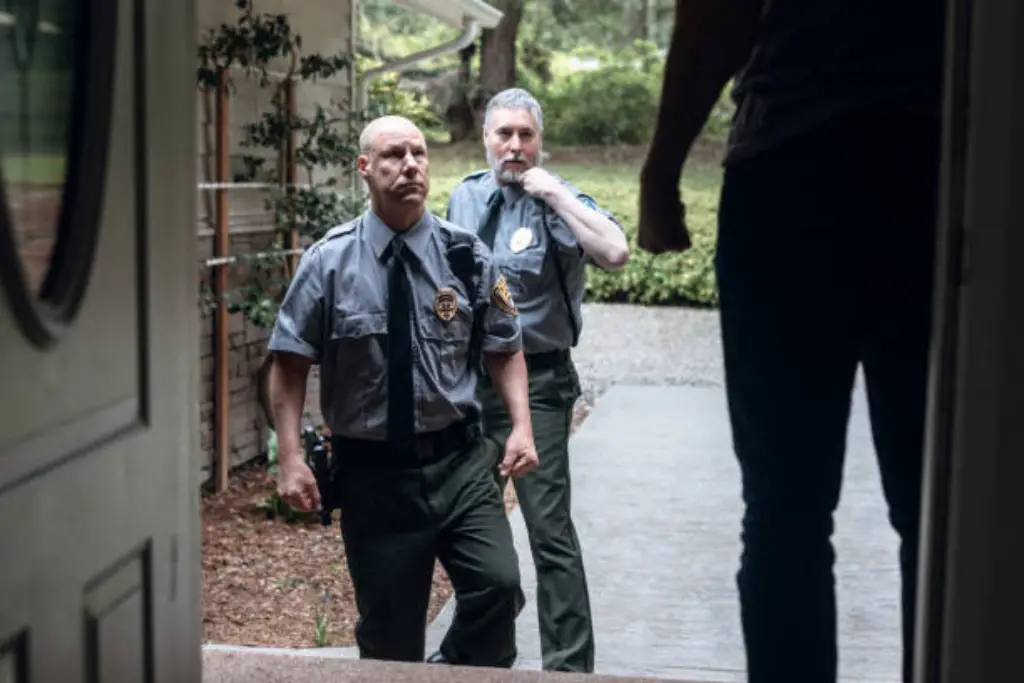
On Sunday evening, exactly one week after they’d left, Marcus and Vanessa’s cruise ship docked. They disembarked expecting to pick up Jordan and return to their normal life. Instead, they were met by Detective Chen and two uniformed officers.
I watched from my car in the parking lot as Vanessa’s expression shifted from confusion to outrage to something close to panic. Marcus just looked stunned, his face pale as Chen read them their rights. They were arrested separately—Vanessa for disability fraud, child abuse, and elder abuse; Marcus as an accessory, though I prayed the investigation would prove he’d been as much a victim of Vanessa’s manipulation as Jordan and I had been.
The trial took months to prepare, but when it finally came, the evidence was overwhelming. The toxicology reports. Jordan’s testimony, delivered in a clear, steady voice that shocked the courtroom. Medical experts explaining Munchausen by proxy. Financial records showing thousands of dollars in fraudulent disability payments. My own medical records documenting cognitive issues that had mysteriously improved the moment I stopped drinking Vanessa’s tea.
Vanessa was sentenced to twelve years in prison. Marcus, after cooperating fully with investigators and demonstrating he’d genuinely believed his wife’s lies about both Jordan’s condition and my health, received probation and mandatory counseling. He lost custody of Jordan, but maintained supervised visitation rights.
The day the sentencing was handed down, I sat in the courtroom with Jordan beside me, his small hand in mine. When it was over and we walked out into the afternoon sunlight, he looked up at me and said, “Is it really finished, Grandma?”
“The scary part is finished,” I told him. “Now comes the good part—living our lives without fear.”
And that’s exactly what we did.
I filed for legal guardianship of Jordan, and the court granted it without hesitation. My house became officially his home. We turned the guest room into his room, painting it the exact shade of blue he’d always wanted. We enrolled him in a new school where he could use his voice freely, where his teachers knew his whole story and supported his healing.
The first time I heard him laugh—really laugh, loud and uninhibited—I cried. The first time he called me “Grandma” in public, not whispering or hiding, just saying it naturally while we bought groceries, the woman behind us in line smiled and said, “What a sweet grandson you have.” And he was. He was sweet and smart and healing.
Marcus visited every other Saturday, supervised at first, then gradually earning back trust as he proved his commitment to his son’s wellbeing and his genuine horror at what Vanessa had done. Our relationship was damaged but not destroyed. He was my son, and he’d been manipulated by someone he loved. Forgiveness was complicated, but it was possible.
Two years after that October morning when Jordan first spoke to me in my kitchen, we were sitting together on the porch swing on a warm spring evening. He was reading aloud from a book for school—he loved reading aloud now, making up voices for characters, using the voice he’d kept silent for so long.
“Grandma?” he said, closing the book and looking at me with those dark, thoughtful eyes that didn’t hold secrets anymore, just questions.
“Yes, sweetheart?”
“I’m glad I told you about the tea.”
I pulled him close, kissing the top of his head. “I’m glad you trusted me enough to speak.”
“I always trusted you,” he said simply. “I just had to wait until it was safe.”
And now it was safe. Now he could speak and laugh and grow and become whoever he was meant to be, without fear, without silence, without the weight of secrets crushing his small shoulders.
My grandson found his voice the moment the door clicked shut behind his parents, and in doing so, he saved both of us. Not just from the poison in the tea, but from the poison of lies, manipulation, and fear that had infected our family.
Now we were healing. Now we were free. Now we were finally, truly safe.
And every single day, I thanked God for the bravery of a little boy who’d whispered four words that changed everything: “Grandma, don’t drink the tea.”

Ethan Blake is a skilled Creative Content Specialist with a talent for crafting engaging and thought-provoking narratives. With a strong background in storytelling and digital content creation, Ethan brings a unique perspective to his role at TheArchivists, where he curates and produces captivating content for a global audience.
Ethan holds a degree in Communications from Zurich University, where he developed his expertise in storytelling, media strategy, and audience engagement. Known for his ability to blend creativity with analytical precision, he excels at creating content that not only entertains but also connects deeply with readers.
At TheArchivists, Ethan specializes in uncovering compelling stories that reflect a wide range of human experiences. His work is celebrated for its authenticity, creativity, and ability to spark meaningful conversations, earning him recognition among peers and readers alike.
Passionate about the art of storytelling, Ethan enjoys exploring themes of culture, history, and personal growth, aiming to inspire and inform with every piece he creates. Dedicated to making a lasting impact, Ethan continues to push boundaries in the ever-evolving world of digital content.