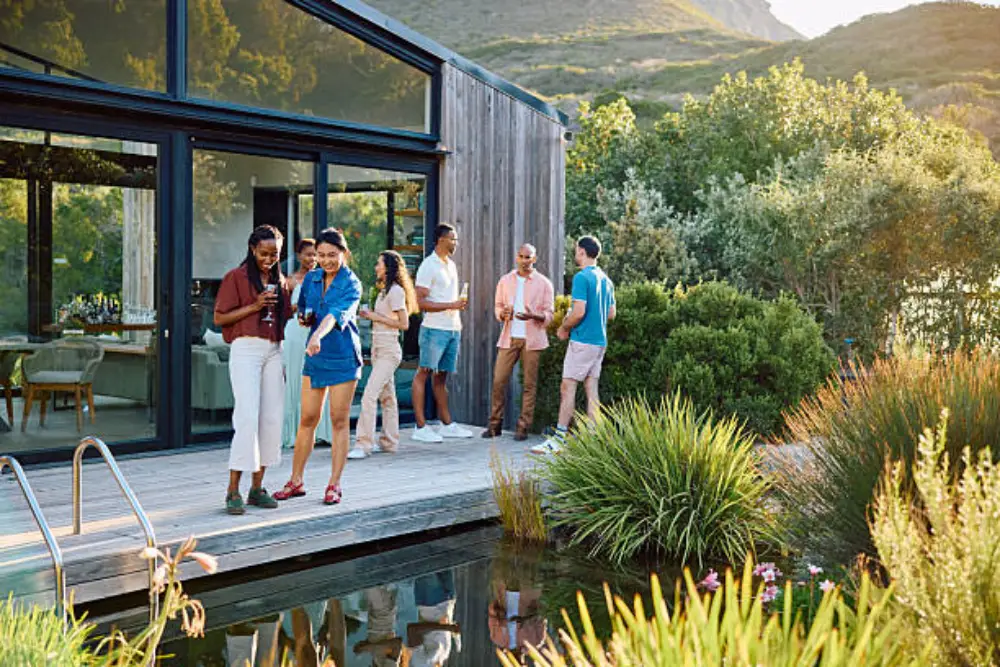
There’s a specific kind of silence you can only find at the edge of a lake just as the sun dips below the tree line. It’s not empty silence—it’s full of water lapping against dock pilings, crickets tuning their instruments, wind rustling through old pines. For me, that silence was expensive. It cost three years of weekends and nearly one hundred fifty thousand dollars of savings I’d earned through sweat and strategic career moves. But sitting on the deck I’d sanded and stained with my own hands, smelling fresh cedar and watching light dance on water, I knew it was worth every penny.
My name is Talia Brennan, I’m thirty-three, and I work as a landscape architect in Charlotte. Most people who know me professionally see someone organized, guarded, and extremely focused—the woman who manages contractor crews and designs six-figure gardens for wealthy clients. They don’t see the version of me that exists at the lakehouse, wearing paint-stained overalls and drinking cheap beer while admiring a perfectly leveled retaining wall. This property wasn’t always a sanctuary. When my grandmother passed four years ago, this place was barely a structure—a rotting cabin that hadn’t seen paint since the nineties, with a leaking roof, settling foundation, and interior that smelled like mildew and mothballs.
When the will was read, my family laughed. My younger sister Kylie got grandmother’s jewelry collection and the newer sedan. My parents Frank and Diane got the bulk of savings and the main family home. I got the lake property, which my father called “the money pit” with unconcealed amusement. “Good luck with that, Talia,” he’d said, clapping my shoulder with a smirk. “You’ll spend more on demolition than the land’s worth. Just sell the lot to a developer and be done with it.”
But I saw something in those rotting bones. As a landscape architect, I saw potential in the sloping yard leading to water, how morning light hit the kitchen window, and more than anything, I saw escape. A place that could be mine alone, where I wasn’t Frank and Diane’s disappointment or Kylie’s shadow. So I kept it. I took out a loan. I learned drywall installation and brick tuck-pointing. I spent Friday nights driving three hours from the city, working until my muscles screamed, sleeping on an air mattress, and driving back late Sunday. Friends stopped inviting me out because I was always working. My dating life withered because frankly, I was married to this renovation.
And now, finally, it was done. The deck was pristine. Inside, the open-concept living room featured a restored stone fireplace and floor-to-ceiling windows that framed the lake like a living painting. The kitchen had quartz countertops and custom cabinets I’d installed myself. The garden was a masterpiece of native plants and stone pathways. It was valued at nearly three times what I’d invested, but the value wasn’t in dollars—it was in peace. This was the only place on earth where I felt truly safe, where I didn’t feel like I was waiting for the other shoe to drop.
My phone buzzed aggressively against the wooden railing, shattering the twilight atmosphere. The screen showed “Mom” and my stomach did that familiar flip-flop, anxiety mixed with exhaustion I’d been conditioned to feel since childhood. I debated letting it go to voicemail, but I knew if I didn’t answer, she’d call Dad, and if Dad called angry, my entire week would be miserable. The peace was over. The leeches had found me.
“Hi, Mom.”
“Talia, why do you take so long to answer?” Her voice was shrill, cutting through the calm evening like a siren. “I’ve been texting for ten minutes.”
“I was outside. Is everything okay?”
“Everything is wonderful. We’re having a family dinner Sunday, five o’clock. Don’t be late.” It wasn’t a question. It was a summons.
“Mom, I’m at the lake. That’s three hours back. I have work early Monday.”
“Stop being dramatic,” she interrupted. “You can drive back Sunday morning. It’s important, Talia. A big announcement. Kylie and Jared will be there. We haven’t had the whole family together in months.”
A big announcement usually meant Kylie had done something and we were all expected to clap and hand over money. “Fine. I’ll be there.”
“Good. And wear something nice. Not those work clothes.” She hung up before I could respond.
This was the dynamic that had always existed. Growing up, there were two distinct roles. Kylie was the golden child—pretty, bubbly, could do no wrong. If she failed a test, it was the teacher’s fault. If she crashed the car, it was the other driver’s fault. Then there was me, the responsible one, the utility player, the scapegoat. If I got straight A’s, it was expected. If I needed help, I was being needy. I remembered my college graduation—I’d worked two jobs to pay tuition and avoid loans. My parents gave me a card and a fifty-dollar bookstore gift certificate. Two years later when Kylie barely graduated with a general studies degree, they bought her a brand new convertible because she’d “worked so hard.” I was still driving my fifteen-year-old Honda Civic.
When I asked why, Dad shrugged and said, “Kylie needs a reliable car for interviews. You’re already established, Talia. You can take care of yourself.” That had been the refrain of my life: Talia can take care of herself. It wasn’t just money—it was emotional real estate. When we were teenagers, Kylie decided she was afraid of the dark and couldn’t sleep in her room facing the woods. My parents made me switch with her. I gave up the master-sized bedroom with bay windows and moved into the small storage room near attic stairs. Kylie filled my old room with posters and never thanked me once.
Sunday arrived with suburban sunshine and my complete dread about what announcement awaited. My parents’ house always smelled of potpourri and judgment. When I pulled into the driveway at exactly four fifty-five, Kylie’s car was already there—a new SUV, of course. Her husband Jared was waxing it in the driveway. Jared was nice enough but had the spine of a jellyfish, working part-time at his uncle’s hardware store and spending the rest of his time on his novel or gaming. He fit perfectly into our family dynamic because he never challenged my father.
“Hey, Talia,” Jared waved, holding a microfiber cloth. “Long time no see. How’s the shack coming along?”
“It’s finished actually,” I said, grabbing my bag. “And it’s a house, Jared. Not a shack.”
Inside, the table was set with good china. This was serious. The roast chicken was dry as always, but we ate and complimented the chef as required by family law. Kylie was practically vibrating in her seat. Finally she couldn’t wait anymore. She stood and pulled a sonogram picture from her pocket, slamming it on the table.
“We’re pregnant!”
Mom shrieked with delight. Dad shook Jared’s hand vigorously. I put on my best smile. “Congratulations, Kylie. That’s amazing.” I meant it mostly—I loved kids and hoped motherhood would help Kylie grow up.
“Thank you,” Kylie beamed. “But that brings us to the second part of the discussion.” The room went quiet. Mom wiped a tear and sat down, her face turning serious as she held Kylie’s hand.
“We’ve been talking,” Mom started in that reasonable maternal tone she used before asking for something unreasonable. “Kylie and Jared are in a one-bedroom apartment downtown. Fourth floor walk-up, noisy, rough neighborhood. Absolutely no place to raise a baby.”
“Okay,” I said slowly. “So you’re looking for a new place?”
“We’ve looked,” Jared chimed in. “Everything’s so expensive. Interest rates are crazy. We can’t qualify for a mortgage with my current income situation.”
“Exactly,” Dad said, cutting his steak aggressively. “Family needs to step up.”
All three pairs of eyes turned to me. My fork froze halfway to my mouth.
“Honey,” Mom said with that sweet toxic smile, “you have that big house at the lake. Fully renovated now, right? Three bedrooms, two baths, big yard for a child to play in.”
“Yes,” I said, my blood running cold.
“And you’re single,” Dad stated. It wasn’t an observation—it was an accusation. “You live in your apartment in the city during the week. You only go there on weekends. It’s a waste.”
“It’s not a waste. It’s my home. I built it.”
“Nobody’s saying you didn’t work hard,” Mom soothed. “But Kylie is your sister. She’s bringing new life into this family. She needs a safe, beautiful home, and you have one just sitting there.”
“What are you asking?” I asked, though I already knew.
“We’re not asking,” Dad said, looking me dead in the eye. “We’ve decided it’s the right thing to do. You should deed the lakehouse to Kylie and Jared as a baby gift. A start for their new family.”
The silence was deafening. I looked at Kylie. She wasn’t embarrassed. She looked expectant, like she was waiting for me to hand over keys right there.
“You want me to give them my house? A house worth half a million dollars?”
“You can still visit,” Kylie chirped. “We’d keep the guest room for you. You can come up whenever you want. Well, maybe call first with the baby, but it’s still family property.”
“It’s not family property,” I said, standing on weak legs. “It’s my property. My name is on the deed. My money paid for materials. My sweat is in those walls.”
“Don’t be selfish, Talia,” Mom snapped, her facade dropping. “You have a good job. You can afford your apartment. Kylie has nothing. Do you want your niece or nephew growing up in a slum?”
“That’s not my problem,” I shouted—I’d never shouted at them before.
Dad slammed his hand on the table, making silverware jump. “Watch your tone. We’re a family. We help each other. You have more than you need and your sister is struggling. You will do this.”
“No,” I said. “I won’t.”
I grabbed my purse. “If you walk out that door,” Mom screamed, standing, “don’t think about coming back until you’ve come to your senses. You’re ruining this family’s joy. You’re a jealous, bitter little girl.”
“I’m thirty-three years old, Mom,” I said, hand on the doorknob. “And for the first time in my life, I’m acting like it.”
I walked out, got in my car, and drove away with hands shaking so hard I could barely hold the steering wheel. I didn’t know it then, but I’d just fired the first shot in a war I never wanted to fight. Little did I know, they had no intention of coming through me—they planned to go right around me.
The drive back to the city was a blur of tears and rage. I turned off my phone halfway home because notifications were coming so fast they distracted me. When I finally got to my apartment behind double-locked doors, I made the mistake of turning it back on. Thirty-seven missed calls, fourteen voicemails, sixty-two texts. It wasn’t just my parents—it was the flying monkeys. In narcissistic family dynamics, these are the enablers the abuser recruits to harass the victim.
My phone was full of messages from cousins I hadn’t spoken to in years, aunts who usually ignored my birthday, even some of Kylie’s friends. One text from Aunt Linda read: “I heard you made your mother cry. How can you be so heartless to a pregnant woman?” Another from a cousin: “Refusing to help your sister. That’s low, even for you.”
They were painting a narrative where I was the villain, the greedy dragon sitting on gold while poor Saint Kylie was being forced onto the streets. None mentioned that Kylie drove a luxury SUV or that my parents had just returned from a cruise two months ago. Facts didn’t matter. The narrative mattered.
Wednesday afternoon changed everything. I was in a meeting with a supplier in my office building lobby when I heard commotion near reception. “I’m her mother. You cannot stop me from seeing my daughter.”
My blood turned to ice. My mother Diane stood at the front desk wearing church clothes and a cardigan, but her face was twisted in righteous fury. The poor receptionist looked terrified.
“Mom,” I said, walking over quickly before my boss appeared. “What are you doing here?”
Mom spun around and her face instantly crumpled into loud theatrical sobs. “Talia! Oh Talia, thank God. Please, you have to listen to reason.” She lunged at me, grabbing my arms. The supplier I’d been meeting with watched with wide eyes.
“Mom, stop. This is my workplace. You need to leave.”
“We can’t let your sister be homeless,” she wailed loud enough for the entire office to hear. “How can you be so cruel? You have that big empty house just rotting while your sister suffers.”
“It’s not rotting and Kylie isn’t homeless. Please stop making a scene.”
“I won’t leave until you sign the papers.” She reached into her purse and pulled out a manila envelope. “Dad had the lawyer draw them up. Just a simple gift deed. Sign it, Talia. Sign it and prove you love us.”
She tried to shove the envelope into my hands. I stepped back and it fell, scattering papers across polished tile.
“Get out,” I said, voice shaking. “Get out right now or I’m calling security.”
She stopped crying instantly, eyes narrowing to slits. “You would call security on your own mother?”
“Yes,” I said. “I would.”
My boss Mr. Henderson stepped from his office. He was a stern man who tolerated zero drama. “Talia, is there a problem?”
“No, sir. My mother was just leaving.”
Mom looked at Henderson, then at me, realizing she’d lost this round. She smoothed her dress, bent to pick up papers, and glared at me with pure venom. “You’re a disappointment,” she whispered low enough that only I heard. “Your father was right about you.”
She marched out. I stood there feeling the stares of coworkers burning into my back, wanting to disappear but instead apologizing to the supplier and returning to work.
That’s when I realized this wasn’t going away. They were going to destroy my life piece by piece until I gave in.
Thursday brought the call that made everything click into terrifying focus. Walter Hayes, an old friend of my grandfather who’d been the realtor when my grandmother originally bought the lake property, called while I was at a job site. Walter was in his late sixties, gruff but kind, one of the few people in my hometown I actually trusted.
“Talia,” Walter’s voice sounded strained. “I had a visit from your father this morning.”
My stomach dropped. “What did he want?”
“He came asking for copies of survey maps and the original deed. Said you lost your copies and asked him to pick them up. Said you were preparing to transfer title to him for asset protection purposes.”
“That’s a lie,” I said, gripping the phone so hard my knuckles turned white. “I never said that. I have my deed in a safe deposit box.”
“I figured as much. I told him I couldn’t release client documents without the owner present. He got agitated. Mentioned something about having power of attorney on file.”
The world tilted. Power of attorney.
“Oh my god,” I whispered.
“Talia.”
“When I was twenty-two,” I stammered, my mind racing back, “I had back surgery. I was under anesthesia and in recovery for weeks. They made me sign power of attorney so they could handle my medical bills and banking while I was incapacitated.”
“Did you ever revoke it?” Walter asked gently.
“I… I don’t think so. I thought it expired. We never used it again.”
“Power of attorney documents don’t usually expire unless you specify a date or revoke them in writing,” Walter explained. “If they still have that document and if it was general durable power of attorney, Talia, they could legally sign a deed in your name. They could sell the house to themselves for one dollar and it would be technically legal.”
I felt like I was going to throw up. It wasn’t just a demand anymore. It was a heist. They were actively planning to steal my home using a piece of paper I’d signed when I was vulnerable and in pain a decade ago.
“What do I do, Walter?”
“You need to go to the county clerk’s office immediately and file a revocation. But Talia, if they’re this determined, a revocation might just slow them down. If they present that old document to a different title company before the revocation hits the system, they might push it through. Real estate fraud happens more often than you think.”
I looked around the peaceful garden I was building for a client, feeling a million miles from the chaos of my own life.
“If you want to save the equity in that house,” Walter said, his voice dropping, “you need to sell it to a third party. Once it’s sold to a bona fide purchaser, your parents can’t touch it. The money goes into your account and the house belongs to someone else.”
“Sell it.” The thought broke my heart. “I spent three years building that place, Walter. It’s my soul.”
“I know, kid. I know. But do you want to keep the house and fight a legal war with your parents for five years? Do you want them showing up every weekend, breaking windows, changing locks? Because that’s where this is headed. They feel entitled to it. They won’t stop.”
He was right. Even if I blocked the legal theft, they would destroy the peace. They would taint the sanctuary.
“Find me a buyer,” I said through tears. “But it has to be fast. Before they figure out I’m onto them.”
“I might have someone,” Walter said. “Came in yesterday looking for secluded property. He’s got cash and he’s in a hurry. But Talia, you’ll have to take a hit on the price for a quick close.”
“I don’t care about the price. I just want out.”
I left work early, drove straight to the county clerk’s office, and filed the revocation at four-fifteen. It was a shield, but thin. Then I drove to the lake, arriving well after dark. The house looked ominous in moonlight, shadows stretching like grasping fingers. I didn’t turn on main lights, didn’t want neighbors reporting to my parents.
Walter met me there at nine with a man beside him. “Talia, this is Officer Grant.”
Officer Grant stepped into the porch lantern’s faint light—an imposing man, at least six-foot-four with broad shoulders and a buzzcut that screamed law enforcement. He wore civilian clothes but carried himself with rigid, alert posture. He looked mid-forties with tired eyes and a face that had seen too much.
“Ma’am,” he nodded. “Walter tells me you have a situation.”
“That’s an understatement,” I said, unlocking the door. Inside, I explained everything—my family trying to steal the house, the old power of attorney, their belief it belonged to them.
Grant walked to the sliding glass doors and looked at the dark lake in silence. Finally he turned. “I’m a state trooper. Twenty years on the highway. I deal with aggressive people for a living. Frankly, I’m looking for a place where I can be left alone. If someone trespasses on my property, I know how to handle it.”
He studied me. “Walter says asking price is four-fifty.”
“Market value is five hundred,” Walter interjected. “But for cash deal, closing in three days—”
“I’ll give you four twenty-five,” Grant said. “Cash. We close Saturday. I waive inspections, survey. Take it as-is. Furniture included.”
My heart squeezed. Four hundred twenty-five thousand was substantial money—enough to pay off student loans, buy a car, start a business. But it meant walking away from everything I’d built. I looked at the kitchen cabinets I’d painted, the fireplace where I’d envisioned Christmas mornings, then thought about my mother screaming in my office, my father trying to forge my signature.
If I kept the house, they would win eventually. They would wear me down. But if I sold it—if I sold it to a state trooper—a dark satisfaction curled in my gut. If I couldn’t have it, they certainly wouldn’t. And watching them try to bully someone like Officer Grant would be poetic justice I’d savor forever.
“Deal,” I said, extending my hand.
Grant shook it, his grip like iron. “Saturday morning. Title company on Main Street.”
“One condition,” I said. “You cannot tell anyone who bought it until the deed is recorded. My parents have friends in town. If they find out I’m selling, they’ll try to file an injunction.”
“I value my privacy, ma’am,” Grant said. “Nobody will know until I move in.”
After they left, I spent twenty-four hours packing my personal life and erasing my existence from the property without being seen. Friday night I arrived with headlights off, parking behind the garage, and moved like a thief through my own house. Every object I touched triggered memories—the loose floorboard I’d fixed, the window I’d replaced. This wasn’t just a building. It was a diary of my resilience, proof I could build something beautiful without my parents’ help. And because of their greed, I had to erase myself from it.
Saturday morning I pulled up to the title company’s office at eight forty-five. The office was officially closed Saturdays, but Walter had called in a favor. Inside, the lights were dim, blinds drawn. It felt less like real estate transaction and more like covert operation. Grant was there looking different in daylight but just as intimidating.
The title agent shuffled papers toward me. “Sign here for deed transfer. Sign here for bill of sale. Sign here for affidavit of title.”
I signed and signed and signed. With every stroke, I felt a tether snapping. The house was no longer mine. The garden was no longer mine. The memories were no longer mine.
“Here’s confirmation of wire transfer,” the agent said. “Four hundred twenty-five thousand has been sent to your account.”
I slid the brass key ring across the table to Grant. “Front door, back door, garage, shed.”
“I need to warn you again,” I said. “My family doesn’t know I’ve sold it. They have a key hidden under the mat. I removed it last night, but they might try to use it.”
Grant nodded slowly. “If they have a key and use it, that’s one thing. If they break in because the key is gone, that’s another.”
“They might show up tomorrow. Sunday is their usual family day.”
“Let them come,” Grant said with a small cold smile. “I’ll be moving in boxes today. I’ll be there all weekend.”
“Please don’t hurt them,” I said automatically, old protective instinct kicking in. Then I paused. “Actually, just do what you have to do.”
“I follow the law, ma’am. I suggest you stay far away for a few days. If things go south, you don’t want to be in the blast radius.”
I walked out into cool morning air and checked my bank app. The pending deposit was there. The transaction was complete. I was technically homeless, rich, and terrified all at once.
I drove to a gas station near the highway and pulled out my phone. I knew my parents. They hated confrontation when I was present and angry. They preferred to strike when I was weak or absent. I needed to give them an opening, make them think the castle was unguarded.
I opened the family group chat I’d muted but not left and typed: “I can’t deal with this pressure. I’m going on a business trip to Chicago for the week to clear my head. Don’t contact me. I’ll be back next Saturday and we can talk then.”
I stared at the message. It was perfect bait. Business trip meant physically far away. Chicago was five hours, meaning I couldn’t rush back. “We can talk then” gave false hope I was wavering. But most importantly, it told them: the lakehouse is empty. Talia is gone. Now is your chance.
I hit send. Almost immediately, read receipts popped up. Five minutes later, Dad texted: “Good. You need time to think about your priorities. Drive safe.”
So patronizing, so dismissive. He didn’t care that I was upset. He just cared I was out of the way. I turned off my phone and pulled onto the highway, heading south to a spa resort three hours away. As miles rolled by, the knot in my chest loosened. For the first time in years, I wasn’t responsible for the lake house. And if a family of narcissists tried to break in, it definitely wasn’t my problem.
Sunday morning at the spa was surreal. While I was wrapped in a plush robe sipping cucumber water, my family was unknowingly driving straight into a buzzsaw. Around noon I checked my blocked messages folder. There was a text from Kylie at ten a.m.: “On our way to the lake. Mom packed a picnic. So excited to measure the nursery. Thanks for being away. Makes it less awkward.”
Then from Mom at eleven-thirty: “We’re stopping for gas. Dad is bringing his tool kit. Love you. Mean it.”
I put the phone away. The trap was set.
I later learned the exact timeline from the police report and Walter’s enthusiastic retelling. The family caravan arrived at twelve-fifteen—not just one car, but two. Dad and Mom in their sedan, Jared driving a rented U-Haul. A U-Haul. They hadn’t come to measure. They’d come to move in, planning to unload furniture and establish residency before I returned from my fake Chicago trip.
Dad got out looking like he owned the place, marching up the front steps with swagger. He lifted the welcome mat. He froze. He kicked it over. He checked the potted plant, the door frame. No key. They spent twenty minutes circling the house like vultures. Every window: locked. Sliding doors: locked and blocked with security bar.
According to the sheriff’s statement, the breaking point came at twelve forty-five. Frank was furious. In his mind, this was his family’s property. He decided he had the moral right to enter. He went to the U-Haul and retrieved a crowbar. Mrs. Gable next door watched from her window as my father walked to the beautiful French doors I’d spent two thousand dollars installing. He didn’t just pop the lock. He smashed the glass. The sound echoed across the quiet lake. He reached through the jagged hole, unlocked the latch, and threw the doors open.
“Come on,” he yelled to the family. “We’re in.”
They all piled in—Mom, Kylie, Jared. Shoes crunching on broken glass, probably feeling triumphant. They were inside. They’d won.
But they weren’t alone.
Officer Grant had been sitting in the living room armchair reading a book. He hadn’t moved when they knocked. He hadn’t moved when they circled. He hadn’t even moved when the glass broke. He waited until they were fully inside, trespassing on his property. Then he stood up.
Grant is a big man. In the confined space, he must have looked like a mountain. He was wearing his off-duty concealed carry holster visible on his hip.
“Can I help you?” Grant asked, his voice calm but booming.
My father, adrenaline pumping and fueled by entitlement, didn’t back down. “Who the hell are you? What are you doing in my daughter’s house? Get out before I call the cops.”
“I think you should go ahead and call them,” Grant replied coolly. “But I’m the owner of this house. And you just broke into it.”
“Liar!” Mom screamed. “My daughter owns this house. She’s in Chicago. You’re a squatter. Frank, get him out.”
Dad raised the crowbar—maybe just a threatening gesture, but to law enforcement, that’s a deadly threat.
“Drop the weapon,” Grant commanded, voice shifting into professional mode. “Drop it now.”
Dad hesitated. “You get out of—”
Grant didn’t wait. He closed the distance in two steps, grabbed Dad’s wrist, twisted it. The crowbar clattered to the floor. Before Dad could process what was happening, he was spun around and slammed face-first against the wall.
“You are under arrest for felony breaking and entering,” Grant announced.
Jared tried to run but tripped over his own feet. Kylie started screaming. Mom tried to grab Grant’s arm. “Don’t touch me, ma’am,” Grant barked. “Back up or you’re next.”
Grant pulled out his phone with one hand while holding Dad pinned with the other. He dialed 911. “This is State Trooper Grant, badge number 4922. I have an intruder in custody at my residence. Requesting local units for transport. Suspect is combative.”
The silence that followed as my family realized who they were dealing with must have been delicious.
I was walking out of massage therapy when my phone rang—local sheriff’s department. “Is this Talia Brennan?” a dispatcher asked.
“Yes.”
“We have a situation at your former property. Four individuals detained. They claim to be your family and say you gave them permission to enter.”
I took a deep breath. “I did not give anyone permission. I sold that property yesterday. The owner is Mr. Grant. If they’re in his house, they’re trespassing.”
“You sold it?” The dispatcher sounded surprised. “That matches Mr. Grant’s statement. One moment.”
Then Sergeant Miller, a local cop I knew from high school, came on the line. “Talia, it’s Miller. Look, it’s a mess. Your dad’s in cuffs screaming that you tricked him. Your mom’s crying. Your sister’s hysterical. Grant is pressing charges. He’s not budging.”
“Did my father break in?”
“Yeah. Smashed the back doors. Grant says your dad raised a crowbar at him. That’s assault on a peace officer technically. This is serious felony territory.”
“I see.”
“Do you want to come down? They’re asking for you. Your mom keeps saying you’ll clear this up.”
I looked out the spa window at the peaceful garden. I thought about three years of labor, the baby gift demand, the forged signature scheme.
“No,” I said firmly. “I’m in Chicago on business. Please tell Mr. Grant I’m sorry for the damage. As for the people you arrested, I can’t help them. They’re adults who broke into a stranger’s house.”
“Copy that, Talia,” Miller said, his voice softening. “Between you and me, they kind of deserve it.”
I hung up and sat on a bench in the spa hallway. My father was going to jail. My mother was humiliated. My sister didn’t get her house. I waited for guilt to hit me, waited to feel like a bad daughter. But the guilt didn’t come. Instead, I felt a massive weight lift off my shoulders—the weight of obligation, of being the good one who always fixed their messes. I wasn’t fixing this one.
I stood up, tightened my robe, and walked back to reception. “Excuse me,” I said to the attendant. “I’d like to add a facial to my package. I have plenty of time.”
While my father was being fingerprinted and processed, I was getting a mud mask. It was cold, calculating, and the most liberating afternoon of my life.
Six months have passed since what my Aunt June calls “the Sunday raid.” The family dynamic didn’t just shift—it completely imploded. Without the lakehouse and with credit ruined by legal fees, Kylie and Jared had nowhere to go. They moved into my parents’ house. It sounds like a sitcom but according to June, it’s a horror movie. My parents’ three-bedroom ranch couldn’t accommodate them properly, leaving Kylie and Jared squeezed into Kylie’s old teenage bedroom.
Kylie gave birth to a baby girl two months ago. I sent a card and savings bond—generic, polite, distant. I didn’t visit. The stress of a newborn combined with Frank being unemployed and angry was too much. Jared lasted four months before he and Frank got into a fistfight over the thermostat. Jared packed his bags that night and moved back with his own mother. He and Kylie are currently separated with divorce likely.
So now Kylie is a single mother living in her childhood bedroom, trapped with two bitter aging parents drowning in debt. The golden child has lost her shine. She’s no longer the princess—she’s another mouth to feed, another burden on their sinking ship. And who do they blame? Me.
They tell anyone who will listen that I’m a monster who manipulated them, stole their inheritance, destroyed Kylie’s marriage. “Talia is dead to us,” Mom told Mrs. Gable at the grocery store. When I heard that, I didn’t feel sad. I felt relieved. Being dead to them meant they’d stop trying to bleed me dry.
Officer Grant eventually dropped the assault charge after Dad pleaded guilty to criminal trespassing and agreed to two years probation. Dad had to pay restitution for the broken door. Frank lost his job when the arrest hit the local paper—at fifty-eight with a pending felony and bad back, he’s essentially unemployable. Grant still lives in the lakehouse. I drove by once from a distance and saw his patrol car in the driveway and a new, sturdier fence. It looked safe, protected. I was glad.
As for me, I’m writing this from a coffee shop patio in Savannah, Georgia. After the sale, I realized I couldn’t stay in the same city—the memories were too close. I needed a fresh start. I took the four hundred twenty-five thousand dollars, minus taxes, and made a plan. I paid off my student loans completely—forty thousand gone, and it felt amazing. Then I paid off my truck. With the remaining money, I didn’t buy a new house. I realized my obsession with the lakehouse had been about trying to build a fortress to protect myself. Now that the threat was gone, I didn’t need a fortress. I needed to live.
I bought a high-end fifth-wheel RV, packed up my life, quit my job, and hit the road. I’m working as a freelance garden designer, consulting via Zoom for clients across the country. I travel where the weather is nice, wake up to different views every week—mountains, oceans, deserts. I have money in the bank, zero debt, and for the first time in thirty-three years, I answer to no one.
Sometimes late at night I think about the lakehouse. I miss the cedar deck smell, the way light hit the water. It hurts knowing I poured my soul into that place only to sell it to escape my own family. But then I remember the alternative—the look on my mother’s face when she demanded I sign the deed, the feeling of being small and used, of being nothing more than a resource to be harvested. If I’d kept the house, I’d still be in that cycle, fighting them off every weekend, miserable.
I traded bricks and wood for my sanity. It was a steep price but a fair trade. My therapist—yes, I finally got one—says what I did was an act of radical self-preservation. She says sometimes you have to burn the bridge to stop the enemy from following you. I don’t know if my family will ever learn their lesson. Probably not. Narcissists rarely do. But that’s no longer my story to manage.
I have a new story now. It’s just me, the open road, and the silence. And this time, the silence isn’t expensive. It’s free. So here’s my question to you: was I wrong for setting a trap and letting them walk into a felony arrest? Or did they deserve exactly what they got for trying to steal my home?
I know my answer. They spent thirty-three years teaching me I was worth less than Kylie, that my work didn’t matter, that I existed to serve their needs. They demanded I hand over three years of labor and one hundred fifty thousand dollars in materials because Kylie was pregnant and I was single. They tried to forge legal documents to steal my property. When I refused to be their doormat anymore, they showed me exactly who they were—not the victims they painted themselves as, but entitled thieves who believed my life belonged to them.
The lakehouse was never just about square footage or property value. It was about proving I could build something beautiful without their help, that I had value independent of their approval. And when they tried to take that from me, I made a choice: if I couldn’t keep my sanctuary, I’d make absolutely certain they couldn’t have it either. I sold it to the one person who could protect it from them better than I ever could—a state trooper who doesn’t negotiate with bullies.
Some people might say I should have tried harder to maintain family relationships, that blood is thicker than water. But they forget the full quote: “The blood of the covenant is thicker than the water of the womb.” The bonds we choose are stronger than the bonds we’re born into. I chose freedom over obligation. I chose peace over performance. I chose myself.
And every morning when I wake up in a new place, when I watch sunrise over mountains or oceans or deserts, when I work with clients who value my expertise, when I live my life on my own terms without anyone trying to guilt me into handing over what I’ve earned—I know I made the right choice. My family taught me I was worthless. I spent three years building a house that proved them wrong. They tried to steal it. I burned it all down rather than let them win.
That’s not cruelty. That’s survival. That’s boundary-setting. That’s choosing yourself when everyone else wants to choose you last. And I’d make the same choice a thousand times over, because freedom—real freedom from manipulation and guilt and endless demands—is worth more than any house, any relationship, any approval from people who never truly saw me anyway.
The road stretches ahead, uncertain and wide open. And for the first time in my life, that doesn’t scare me. It feels like coming home.

Sophia Rivers is an experienced News Content Editor with a sharp eye for detail and a passion for delivering accurate and engaging news stories. At TheArchivists, she specializes in curating, editing, and presenting news content that informs and resonates with a global audience.
Sophia holds a degree in Journalism from the University of Toronto, where she developed her skills in news reporting, media ethics, and digital journalism. Her expertise lies in identifying key stories, crafting compelling narratives, and ensuring journalistic integrity in every piece she edits.
Known for her precision and dedication to the truth, Sophia thrives in the fast-paced world of news editing. At TheArchivists, she focuses on producing high-quality news content that keeps readers informed while maintaining a balanced and insightful perspective.
With a commitment to delivering impactful journalism, Sophia is passionate about bringing clarity to complex issues and amplifying voices that matter. Her work reflects her belief in the power of news to shape conversations and inspire change.