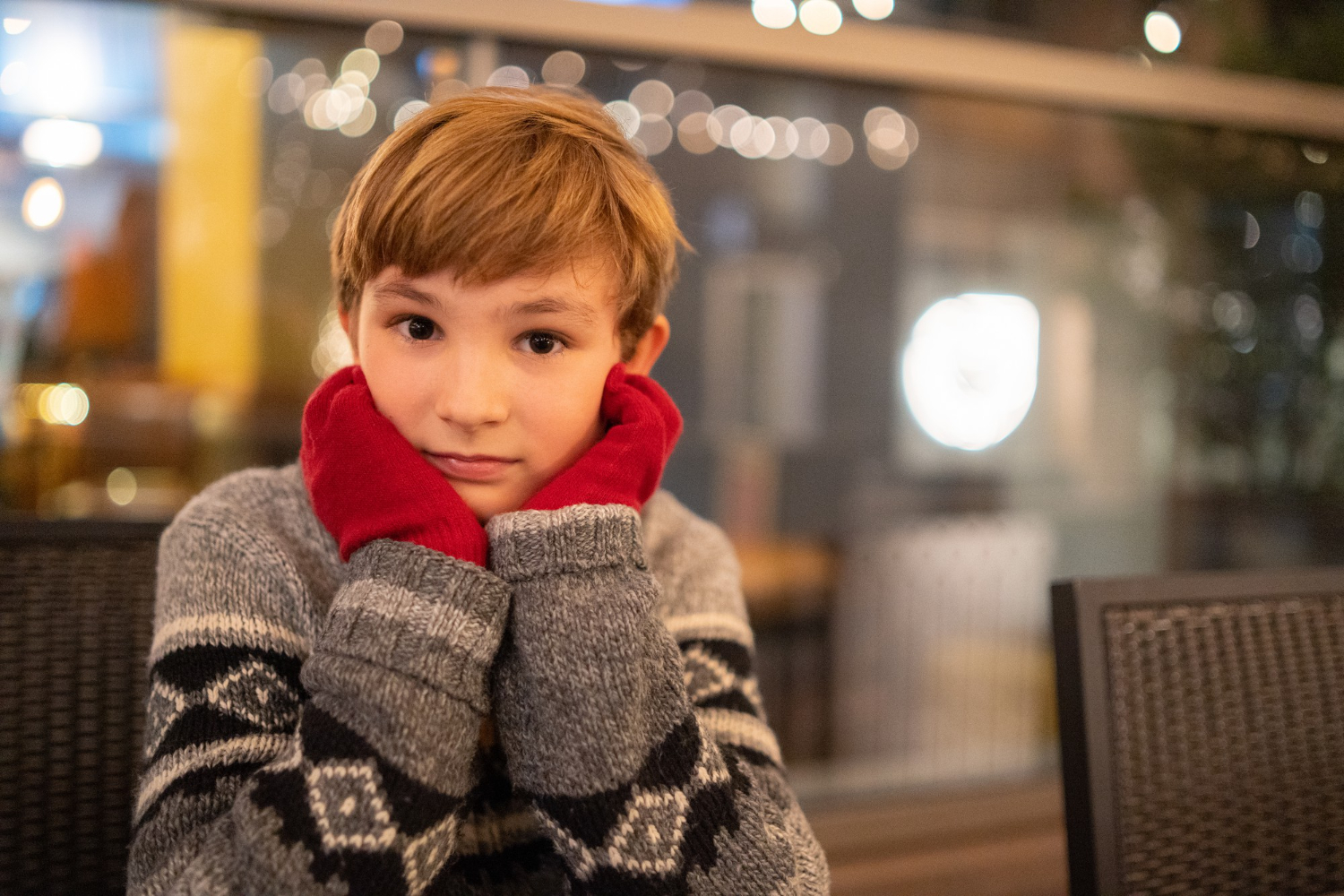
Some moments don’t announce themselves when they arrive. They slip into your life disguised as ordinary evenings, as family obligations you’ve fulfilled a hundred times before, as one more attempt to belong somewhere you were never truly wanted. The night my five-year-old son accidentally brushed against a cord and everything changed forever began exactly like that—with me standing in my childhood home, holding my breath without realizing it, waiting for disaster I couldn’t yet name.
It was Christmas in Westfield, Indiana, the kind of December cold that makes lights glow warmer and laughter sound closer than it really is. From the outside, my mother’s house looked like every other decorated home on the street—bright, welcoming, wrapped in twinkling white lights that promised something magical inside. Anyone passing by would have assumed it held a family full of love and joy, gathered around a perfect tree, sharing perfect memories. They would have been wrong about almost everything except the tree, which was indeed perfect in every calculated, soulless way my sister-in-law Kendra could make it.
I stood in the foyer holding my son Milo’s small, warm hand in mine, watching him bounce on his toes with the uncomplicated excitement only five-year-olds can manage. His eyes were already searching for presents, for lights, for anything that sparkled in that particular Christmas way that makes children believe in magic. I smiled for him, because that’s what mothers do—we choose calm for our children even when our instincts are screaming warnings we’ve been trained to ignore.
The smell of pine and cinnamon filled the air, mixing with something else I couldn’t quite identify—not cookies baking or dinner cooking, but rather the faint chemical scent of expensive candles strategically placed throughout the house. The Christmas tree dominated the living room like a shrine, every ornament spaced with mathematical precision, every ribbon angled just so, the lights shimmering in perfectly timed sequences that felt more like a retail display than a family gathering. It was beautiful, I had to admit, but it didn’t feel warm. It felt controlled, curated, like everything in Kendra’s carefully constructed world.
My husband Holden squeezed my hand before his phone buzzed in his pocket. He pulled it out, his expression shifting from relaxed to focused in the way I’d learned to recognize over seven years of marriage. Work. Always work, though I’d never resented it because Holden’s dedication to providing for us was part of what made him who he was. “I need to take this,” he said quietly, his voice apologetic. “Two minutes, I promise.” I nodded, trying to ignore the sudden tightening in my chest as I watched him step out onto the front porch, already absorbed in whatever crisis his business partner needed to discuss.
And just like that, the room felt colder, larger, more dangerous. I told myself I was being ridiculous, that nothing bad could happen at a family Christmas party with my mother and brother and relatives milling around talking about weather and sports and whatever benign topics people discuss when they’re pretending to be closer than they are. But the thing about growing up in a family where love came with conditions I could never quite identify is that you develop instincts—quiet, insistent voices that whisper warnings you spend years learning to dismiss. That night, those voices were nearly shouting, and I was still trying desperately not to listen.
My life before that Christmas had looked stable from the outside, enviable even. Holden and I lived in a modest but comfortable house on a tree-lined street where children rode bikes until sunset and neighbors waved without needing excuses. He worked in commercial lending, had built a solid reputation over years of careful decisions and reliable follow-through. I’d left my job as a teacher when Milo was born, a choice we’d made together, one that let me be present for the small moments I knew I’d never get back—first words, scraped knees, bedtime stories that somehow mattered more than any lesson plan I’d ever written.
Becoming Milo’s mother had changed something fundamental in me, had given me a fierce protectiveness I’d never experienced before. Watching him sleep, I’d sometimes feel overwhelmed by the responsibility of keeping this small, perfect person safe in a world that felt increasingly unpredictable. Our days fell into gentle rhythms—mornings with cereal and cartoons, afternoons at the park, evenings where Holden and I would talk quietly after Milo went to bed, planning small vacations we might take someday, discussing changes we’d make to the house, building a future that felt solid enough to trust.
But beneath that surface calm, I’d carried a wariness I couldn’t quite shake. Growing up, I’d never known where I stood in my own family, had spent my childhood and adolescence trying to decode rules that seemed to shift based on calculations I couldn’t see. My brother Brent had always been the favorite—not in ways anyone ever said out loud, but in the attention he received, the excuses made for his failures, the way my mother’s face would light up when he walked into a room. When I spoke, she nodded politely, already distracted. When he spoke, she listened like his words contained wisdom she’d been waiting to hear.
I’d learned to make myself smaller, quieter, less demanding. Emotional neglect doesn’t leave visible bruises, but it shapes you all the same. I’d stopped asking for reassurance, stopped expecting support, become expert at being low-maintenance because low-maintenance children are easier to tolerate even if they’re never quite loved. When I married Holden, I’d hoped things might shift—not dramatically, just enough to feel included, to feel seen. But the patterns had followed me into adulthood like shadows I couldn’t outrun. Family gatherings felt rehearsed. Conversations stayed shallow. Brent’s life remained the main topic, his struggles met with sympathy, his choices defended without question.
And then Kendra had entered the picture, had married my brother in a wedding my mother had planned with more enthusiasm than she’d shown for mine. Kendra was polished, confident, the kind of woman who filled rooms and demanded attention with her opinions about restaurants and vacation destinations and the precise way holiday decorations should be arranged. At first, I’d told myself her sharp edges were just personality, that some people needed to be seen and that was okay. But over time, I’d begun to notice the bitterness underneath, the way her smile never quite reached her eyes when she looked at Milo, the comments that started small and grew sharper each year.
She’d been married to Brent for years before I became a mother, long before Milo existed, long before anyone said the word aloud. And when the truth finally emerged that she couldn’t have children, it had changed something in her—or perhaps revealed what had always been there, buried under the performance of confidence. Infertility is a quiet kind of grief, I understood that. I’d tried to be careful around her, never talking too much about Milo’s milestones unless she asked, softening my joy the way I’d learned to soften everything about myself around my family. But no matter how gently I moved, Kendra seemed threatened by my son’s very existence.
Her comments had escalated from “he’s loud” and “kids these days don’t know boundaries” to sharper observations about how easy my life must be, how unfair the world was to some women. She never used my name when she said these things, but I always knew who she meant. I’d catch her staring at Milo when she thought no one was looking, her expression unreadable but her jaw clenched like she was holding back words that wanted to escape. What hurt most was how my mother and brother never corrected her, never defended my son, never suggested that maybe Kendra’s pain didn’t entitle her to cruelty toward a child who’d done nothing wrong except exist.
Silence doing the work words never had to, the same silence that had taught me as a child that I didn’t matter as much as Brent, that my feelings were less important, that my presence was something to be tolerated rather than celebrated. By the time Christmas arrived, the tension between Kendra and me had settled into something heavy and unresolved, something I kept trying to ignore because I’d been trained my entire life to keep the peace, to not make waves, to swallow discomfort so others could stay comfortable.
Standing in that foyer watching Milo’s eyes light up at the tree, I felt that familiar knot in my stomach, that sense of walking into a space where I’d never quite belonged but kept returning to anyway because what else do you do when it’s family? The invitation had come three days before Christmas, delivered through a phone call that felt more like an obligation than an offer. My mother’s voice had been calm, practiced, almost distant: “We’re doing Christmas at my place. Everyone will be here. You should come.” No warmth, no excitement, just expectation.
I’d considered saying no, had stood in my kitchen watching Milo color at the table, the word hovering on my tongue, heavy and tempting. But guilt had crept in the way it always did, reminding me that family is family, that holidays are important, that refusing could turn into a lifelong accusation. “It’s just one evening,” I’d told Holden, more to convince myself than him. “We’ll stay for a bit, for Milo.” Holden had looked at me with that careful expression he wore when he disagreed but respected my choice anyway. “You don’t have to go,” he’d said gently. “We can do Christmas here, just us.” But I’d shaken my head, already committed to this mistake I hadn’t yet recognized as one.
Now, standing in the controlled perfection of my mother’s living room with Holden outside on a work call and Kendra hovering near her precious tree like a guard watching for threats, I felt every instinct I’d been suppressing rise to the surface. Something was wrong. The air felt too thick, the smiles too tight, the decorations too perfect to accommodate the messy reality of a small child who wanted nothing more than to look at wrapped presents and maybe touch a shiny ornament.
Milo slipped free from my hand, drawn toward the gifts stacked beneath the tree in carefully coordinated wrapping paper that probably matched some Pinterest board Kendra had obsessed over for weeks. I watched him kneel down, his small hands hovering over the packages with a gentleness that made my heart ache. He wasn’t grabbing or pulling or doing anything wrong—he was just being five years old, being curious, being exactly what children should be at Christmas. But I saw Kendra’s eyes tracking his every movement, not with the warmth an aunt should feel but with something harder, more judgmental, like she was waiting for him to make a mistake that would justify whatever resentment she’d been carrying.
I moved closer to Milo, positioning myself between him and Kendra’s gaze, my protective instincts humming. “Be careful, sweetheart,” I said softly, more to acknowledge Kendra’s presence than because Milo was doing anything that needed correction. He smiled up at me, his face full of uncomplicated joy, completely unaware of the tension tightening my shoulders. The carpet beneath us was thick and cream-colored, the kind that showed every footprint, and I could see the cords snaking underneath, hidden but present, connecting all those perfectly arranged lights to the wall.
Through the window, I could see Holden pacing slightly on the porch, his face serious as he gestured while talking, absorbed in whatever problem needed solving. I wished desperately that he would finish the call, would come back inside, would stand beside me the way his presence always made everything feel more manageable. But he was still outside, and the room felt larger without him, the air heavier, my awareness of every glance and silence amplified in a way that made my skin prickle.
My mother drifted through the living room toward the kitchen, barely glancing at Milo, her attention focused on whatever hosting tasks she’d assigned herself. Brent stood near the dining room with a drink in his hand, making small talk with a cousin I barely knew, his laugh too loud, too performative. The house hummed with the sound of polite conversation and holiday music playing at a volume carefully calibrated not to interfere with talking, everything controlled, everything managed, everything perfect except for the growing sense that something terrible was about to happen.
And then it did.
Milo shifted his weight, a completely normal movement, the kind children make a hundred times a day without consequence. His foot brushed against something firm beneath the carpet, an extension cord I hadn’t noticed, hadn’t thought to warn him about because it was hidden, because homes should be safe for children, because accidents happen and that should be okay. There was a soft tug, not a yank or a pull, barely even noticeable except for what it caused. The Christmas tree lights blinked once, like they were considering staying on, and then disappeared completely. The soft glow vanished instantly, taking the room’s warmth with it, plunging the tree into shadow that made all those perfect ornaments look suddenly dull and lifeless.
The silence that followed felt like a held breath, like the entire house was waiting to see what would happen next. The holiday music that had been playing seemed suddenly too loud, jarring, until someone reached over and turned it off. No one spoke. I watched Milo freeze, his small body going completely still, his eyes widening as he looked up at me with an expression I knew too well—the fear of a child who’d just made a mistake and doesn’t know how bad the consequences will be. “Mom,” he whispered, his voice trembling, already sensing that something had gone very wrong.
I opened my mouth to tell him it was okay, that it was just an accident, that we’d fix it together and everything would be fine. But before I could speak, before I could offer him the reassurance every child deserves when they make an innocent mistake, Kendra’s voice cut through the silence like a blade. “Are you kidding me?” The words came out sharp and accusatory, loaded with a fury that seemed wildly disproportionate to what had actually happened. I pulled Milo closer instinctively, wrapping an arm around his shoulders, feeling his small body begin to tremble.
“It was an accident,” I said quickly, my voice steady despite my racing heart. “I’ll fix it. I’m sorry.” But apologies have a way of bouncing off people who are already angry, people who’ve been waiting for an excuse to unleash something they’ve been holding back for far too long. Kendra rushed past us to the wall, her heels clicking against the hardwood floor with sharp, aggressive sounds that made Milo flinch. She fumbled with the plug, jamming it back into the socket with movements that spoke of barely controlled rage, but the lights didn’t come back on immediately—probably a breaker had tripped, or the strand needed to be reset, something minor that could be fixed in minutes but was being treated like a catastrophe.
When the lights stayed dark, Kendra whirled around, her face flushed, her eyes wild with an anger that made my blood run cold. She wasn’t just frustrated or annoyed—she was enraged in a way that felt dangerous, unpredictable, aimed directly at my five-year-old son. “Do you have any idea how long that took?” she shouted, her voice rising to a pitch that echoed off the walls. “You don’t just touch things that don’t belong to you! You don’t get to ruin everything because you can’t follow simple rules!”
Milo shrank against me, his small body shaking, his fingers clutching my sleeve with desperate strength. “I didn’t mean to,” he whispered, his voice breaking in that way that makes every mother’s heart crack. “I’m sorry.” But his apology meant nothing to Kendra, who was already building momentum, her anger feeding on itself, growing larger and more dangerous with every breath. I knelt down beside Milo, pulling him fully into my arms, trying to shield him from words that were landing like physical blows.
“Hey,” I said softly, cupping his face, making him look at me instead of Kendra. “You didn’t do anything wrong. It was an accident. Accidents happen.” But even as I said it, I knew the words weren’t enough, couldn’t protect him from what was unfolding around us. The room had gone silent again, but it wasn’t a peaceful silence—it was the thick, uncomfortable silence of people watching something terrible happen and choosing not to intervene. I looked toward the door, desperate for Holden to come back inside, to step between us and this escalating situation, but he was still outside, still on his call, completely unaware that everything was falling apart.
Kendra’s rage didn’t diminish—it exploded into something even uglier. “This is exactly what I mean,” she yelled, her voice shaking. “You let him do whatever he wants. No discipline, no consequences, no respect for anyone else’s things. Every time you show up here, something gets broken, something gets ruined, and you just make excuses.” I tried to speak, tried to explain again that it was an accident, that Milo was five years old, that he hadn’t meant any harm. But my words were drowned out by Kendra’s tirade, by her need to make this about something bigger than unplugged Christmas lights.
“You always do this,” she continued, her face twisted with years of accumulated resentment. “You act like you’re so perfect, like your kid is so special, like we should all just accommodate whatever he does.” The accusation hung in the air, so wildly disconnected from reality that I couldn’t even process it. I’d spent years minimizing Milo’s presence around Kendra, keeping him quiet, keeping him close, trying desperately not to trigger whatever jealousy or pain or resentment she carried. And still, it hadn’t been enough. Nothing would have been enough, because the problem wasn’t Milo’s behavior—it was Kendra’s inability to separate her own pain from an innocent child’s existence.
“Kendra, stop,” I said, my voice trembling despite my efforts to stay calm. “You’re scaring him. Please.” But she wasn’t listening, wasn’t seeing anything except whatever narrative she’d constructed in her head about wrongs that needed to be avenged. Her eyes fixed on Milo with an intensity that made my protective instincts scream. And then, in a movement so fast I almost didn’t register it, she reached down and slipped one of her heels off her foot. The motion was deliberate, purposeful, and time seemed to slow in that horrible way it does when you see disaster approaching but can’t stop it.
“Kendra,” I said again, louder now, desperate. “Don’t. Please don’t.” But she was already raising her arm, her face set with a determination that made my blood freeze. I tried to move, tried to position myself between her and Milo, but I was kneeling, off-balance, and she was faster. The heel came down with a sound that wasn’t loud, wasn’t dramatic, just horrifyingly final—a dull thud followed immediately by Milo’s cry, sharp and piercing, cutting straight through my heart.
I don’t remember screaming, but I know I did. My body reacted before my mind could process what had just happened. I pulled Milo completely into my arms, cradling his head, rocking him as his sobs tore through the silence. His face was red and twisted with pain and confusion, his cries desperate in that way that tells you a child doesn’t understand why he’s been hurt, why someone would do this to him. “Stop!” I shouted at Kendra, my voice raw. “What is wrong with you? He’s a child!”
Kendra stood there breathing hard, the heel still clutched in her hand, her expression cycling through surprise, defensiveness, and then hardening back into anger as if she couldn’t admit even to herself that she’d crossed a line that should never have been crossed. For a split second, I saw something that might have been regret flicker across her face, but it vanished almost immediately, replaced by a stubborn righteousness that made me understand with terrible clarity that she didn’t think she’d done anything wrong.
The room felt unreal, like I was watching everything through glass, my hands shaking as I checked Milo frantically, whispering his name over and over, trying to calm him, trying to calm myself. He was conscious, breathing, clinging to me with a grip that would leave marks on my arms but I didn’t care. He was alive. The relief of that realization hit me so hard my vision blurred with tears I couldn’t let fall because I needed to stay strong for him, needed to be steady when his entire world had just become terrifyingly unsafe.
Something inside me broke in that moment, not loudly, not all at once, just a deep, irreversible crack in the foundation of who I’d been trying to be. The part of me that had spent thirty years trying to keep the peace, making excuses, believing that family meant safety—that part shattered completely. I looked up at Kendra, at this woman who’d just struck my child, and I knew with absolute certainty that this wasn’t just a loss of temper, wasn’t just a bad moment we could move past. This was the exposure of something rotten that had been growing underneath polite conversations and forced smiles, something that could never be hidden again.
And then, in the thick silence that followed Milo’s sobs, my mother spoke. “Talia, stop making such a scene.” Her voice was sharp, irritated, as if the problem wasn’t what had just happened but my reaction to it, as if a mother defending her injured child was somehow more offensive than the injury itself. I looked at her, stunned into a moment of complete disbelief. “She hit him,” I said, my voice shaking with an emotion I couldn’t name. “She hit my child with her shoe.”
My mother’s expression didn’t change, didn’t soften with concern or shock or any normal human response to seeing a grandchild hurt. “You’re blowing this out of proportion,” she said dismissively. “Kendra lost her temper for a second. That’s all.” For a second. As if violence against a five-year-old could be measured in seconds and found acceptable. As if the duration somehow mattered more than the act itself. Brent stepped forward then, his face tight not with concern for his nephew but with irritation at the disruption, at the scene being made in the perfect Christmas he’d been trying to enjoy.
“You’re overreacting,” he said, his tone suggesting I was being hysterical, unreasonable. “Kendra didn’t mean anything by it. Your kid messed up her decorations. She was upset.” The casual way he dismissed what had happened, the way he automatically defended his wife without even checking to see if Milo was okay, confirmed everything I’d known growing up but had kept trying to deny. My family had made their choice long ago, and it had never been me. It would never be my son. We were expendable, forgettable, less important than maintaining whatever fictional harmony they’d constructed around Brent and Kendra’s lives.
“If you actually watched your kid,” Kendra said, her voice cold and certain, “this wouldn’t have happened. My decorations were ruined because you don’t know how to control him.” The accusation was so cruel, so calculated, that for a moment I couldn’t even process it. She had just struck a child and was now blaming me for her violence, was suggesting that I’d somehow failed as a parent because my five-year-old had accidentally unplugged Christmas lights. The absurdity of it would have been laughable if it weren’t so devastating.
“So this is my fault,” I said quietly, not really a question, just a statement of the reality I was finally accepting. My mother sighed, the sound heavy with the kind of disappointment I’d heard my entire life, disappointment that was never about what I’d done but simply about who I was. “You always bring drama with you, Talia. Every holiday there’s something. Maybe if you taught your son some manners, we wouldn’t be dealing with this.” The words landed with the weight of every criticism I’d ever received, every way they’d found me lacking, every time they’d chosen Brent’s comfort over my pain.
I couldn’t listen anymore. My ears were ringing, my hands shaking, my entire body vibrating with an emotion I couldn’t name—not quite anger, not quite grief, something bigger and more final than either. I pressed my forehead to Milo’s hair, breathing in his familiar scent, grounding myself in the only thing in that room that still mattered, the only truth that couldn’t be twisted or denied. And then the front door opened, and Holden walked in.
He took in the scene in seconds—Milo crying in my arms, Kendra standing rigid and defensive, my mother’s cold expression, Brent’s crossed arms. His face didn’t change dramatically, but I knew him well enough to see the shift in his eyes, the way his jaw tightened, the absolute focus that came right before decisive action. “What happened?” he asked, his voice low and controlled in a way that made the room feel suddenly smaller. I didn’t answer because I couldn’t, because if I started speaking I might start screaming and never stop. Milo’s sobs were answer enough.
Kendra started talking immediately, her words rushing out in justification and defense. “He broke the lights. I just reacted. It wasn’t—” But Holden held up one hand, and she stopped mid-sentence, silenced by nothing more than a gesture. He walked over and knelt beside us, his hands gentle as he checked Milo carefully, thoroughly, his touch speaking the love his calm face wasn’t showing. When he looked back up at Kendra, his expression was terrifyingly controlled. “You’re done,” he said simply, with a finality that made the air feel thin.
My mother scoffed, the sound dismissive and incredulous. “Holden, don’t be dramatic. It was barely anything.” But Holden stood slowly, rising to his full height, and something in his posture made everyone in the room take a half-step back without realizing it. “What’s dramatic,” he said, his voice steady and quiet in a way that was more frightening than shouting, “is defending someone who attacked a child. What’s dramatic is that no one here—not one person—checked to see if he was okay. Not one person apologized. That told me everything I needed to know about this family.”
I stood up, my legs unsteady but my decision crystal clear. I looked at my mother one last time, really looked at her, searching for something I’d been looking for my entire life—some sign that she saw me, that she loved me, that I mattered at all. But there was nothing there except irritation and disappointment, the same expression she’d worn when I’d announced my engagement, when I’d told her I was pregnant, every time I’d dared to exist in a way that didn’t serve Brent’s narrative. “You’ve made your choice,” I said, my voice surprisingly steady. “So have I.”
I didn’t wait for a response, didn’t give them a chance to argue or justify or make this about anything other than what it was. Holden opened the door and cold air rushed in, clean and sharp, washing away the suffocating atmosphere of that house. I carried Milo outside, his small body still shaking with sobs, his arms wrapped around my neck with a trust I would protect with my life. Behind us, I heard my mother calling my name, heard Brent saying something about overreacting, heard Kendra’s voice rising in defense of her indefensible actions.
I didn’t turn around. Holden closed the door behind us, cutting off their voices, and we walked to the car in silence. The Christmas lights on the neighboring houses seemed suddenly garish, performative, false in their cheerfulness. I buckled Milo into his car seat with shaking hands, kissing his forehead, whispering that he was safe, that he’d done nothing wrong, that I loved him more than anything in the world. He’d stopped crying but his face was still red, his breathing still hitched with the aftershocks of sobbing, and I knew this night would mark him in ways I couldn’t yet see.
As Holden drove us home through the dark streets, I sat in the back seat with my hand on Milo’s leg, and felt the full weight of what had just happened settle over me. I’d just walked away from my entire family. From the people who’d raised me, who knew my history, who were supposed to love me unconditionally. And instead of grief, instead of regret, I felt something closer to relief—the relief of finally stopping the pretense, of admitting that I’d been holding onto something that had never really been there.
Time has a way of revealing truths that anger never could. After that night, silence settled into our lives, but it wasn’t the heavy, suffocating kind—it was the clean silence of a door finally closed, of a burden finally set down. Weeks passed, then months. We didn’t reach out to my family. They didn’t reach out to us. I focused on Milo, on helping him process what had happened in ways his five-year-old mind could understand, on rebuilding his sense of safety in a world that had briefly shown him violence where there should have been love.
His nightmares faded gradually. His laughter returned, tentative at first, then stronger. He stopped flinching when adults moved quickly near him, stopped asking in that heartbreaking small voice if he was in trouble, if he’d done something wrong. Holden was steady, present, protective in ways that didn’t require words or grand gestures—just the quiet consistency of a father who showed up every day, who meant what he said, who made promises he kept. Our house felt lighter without the weight of obligatory visits and forced smiles, without the constant vigilance of trying to keep Milo quiet enough, well-behaved enough, invisible enough to avoid triggering whatever resentment Kendra was carrying.
I thought that was the end of the story, thought we’d simply moved on to a life without them, built our own version of family from friends and neighbors and people who actually saw Milo as a gift rather than an inconvenience. But what I hadn’t fully understood—what I’d never asked about because Holden wasn’t the kind of man who bragged about his generosity—was how deeply he’d once tried to help my family, how much of his own resources he’d invested in their stability.
Years earlier, when Brent had talked excitedly about starting his own business, Holden had believed in him. Not because they were close, not because Brent had ever been particularly kind to me, but because Holden believed in giving people chances, in supporting family even when family didn’t quite deserve it. He hadn’t just offered advice or moral support—he’d put real money behind that belief, providing equipment financing, capital to stabilize cash flow during rough months, acting as a silent partner who asked nothing in return except that Brent make good on his potential.
It hadn’t been documented with heavy contracts or legal threats. It had been built on trust, on family connection, on the belief that Brent would honor the help he’d received. Without Holden’s investment, that business never would have survived its early years, never would have grown beyond a struggling startup into something profitable. But my family had never acknowledged that. They’d told themselves Brent’s success was entirely his own, that the business thrived because of his hard work and vision, conveniently forgetting the foundation someone else had built beneath him.
After what happened to Milo, after watching my family defend violence against a child rather than admit fault, Holden’s trust evaporated. He didn’t make announcements or give speeches. He simply withdrew his investment quietly, legally, cleanly, pulling support that had never been appreciated anyway. The paperwork was handled by lawyers, the timelines were reasonable, the decision was final. No shouting, no revenge speeches, no dramatic confrontations—just signatures and dates and consequences delivered with the same calm focus I’d seen in his eyes that night.
Within weeks, Brent’s business began to unravel. Bills that had always been paid suddenly went past due. Equipment that had been financed started getting repossessed. Loans that had been manageable became overwhelming. The stability Holden had provided vanished, and with it the illusion that Brent had built something successful entirely on his own merit. I heard through others—distant relatives who still spoke to me cautiously, as if contact might be contagious—that the collapse was swift and devastating. The business closed. The commercial lease was broken. Employees were let go. The house that Brent and Kendra had been so proud of, the one with the perfect yard and the expensive kitchen renovations, went up for sale.
The For Sale sign didn’t last long before it turned into foreclosure. Friends who’d surrounded them during good times disappeared during bad ones. Invitations to events stopped coming. The same family that had once looked at me with pity and dismissal now avoided eye contact in grocery stores, ashamed or angry or both. My mother’s friends stopped asking her about her successful son, stopped complimenting the grandchildren she didn’t have, stopped pretending the family was anything but fractured beyond repair.
And through it all, I felt nothing but a calm, clear certainty that this was exactly what should have happened. Not celebration, not triumph, not the satisfaction of revenge—just the quiet understanding that actions have consequences, that protecting a child means cutting off anyone who threatens him, no matter what DNA they share. I didn’t gloat. I didn’t spread the story around town. I simply lived my life with Holden and Milo, building new traditions, creating new memories, learning what family could be when it was chosen rather than assigned.
Then, almost a year after that Christmas, my phone rang with a number I hadn’t seen in months. I recognized my mother’s digits immediately, felt my heart rate pick up despite the time that had passed, despite the healing that had happened. I let it ring longer than I should have, watching the screen light up and vibrate on the kitchen counter while I made myself a cup of tea, forced myself to breathe slowly, reminded myself that I was a different person than I’d been a year ago.
When I finally answered, my voice was steady, neutral. “Hello.” My mother’s voice on the other end was different—smaller somehow, lacking the confidence and subtle criticism I’d known my entire life. “Talia,” she said, and there was something in the way she said my name that told me this wasn’t a casual call, wasn’t an attempt at reconciliation. “We need to talk. We need help.” The words hung between us, loaded with assumptions she had no right to make.
“What kind of help?” I asked, though I already knew. She launched into an explanation that was clearly rehearsed, a litany of bad luck and unfortunate circumstances and how everything had gone wrong so quickly. The business failing, the house being lost, Brent struggling to find work, Kendra’s mental health deteriorating under the stress of losing everything they’d built. She talked about creditors calling, about their age and inability to start over, about how difficult things had become. She painted a picture of devastation that was supposed to move me, supposed to trigger the instincts I’d spent a lifetime developing—the need to fix, to help, to sacrifice myself so others could be comfortable.
But as she talked, I noticed what she didn’t say. Not once did she mention Milo. Not once did she acknowledge what Kendra had done, what she’d defended, what she’d dismissed as “overreacting.” Not once did she apologize or admit that maybe, just maybe, they’d been wrong to protect someone who’d hurt a child. Her entire speech was about their suffering, their needs, their problems—as if I existed only to solve them, as if my child’s trauma was less important than their financial difficulties.
When she finally paused, waiting for me to respond with the immediate agreement she’d always received before, I felt surprisingly calm. “No,” I said simply. Just that one word, flat and final. There was a beat of shocked silence before she tried again, her voice taking on that familiar pleading tone that had once made me feel guilty for having boundaries, for wanting my own life, for expecting anything resembling respect. “Talia, we’re family. You can’t just abandon us when things get hard. We raised you, we—”
“You raised me,” I interrupted, my voice still steady, “to believe I was less important than Brent, to think my feelings didn’t matter, to accept scraps of affection while he got unconditional love. You watched someone strike my child and told me I was overreacting. You chose to defend the person who hurt him instead of protecting him. Those were your choices. Now I’m making mine.”
She started crying then, the kind of manipulative tears I’d seen before, deployed strategically when logic failed to get what she wanted. “How can you be so cold? We’re desperate. We’re family. We’ve lost everything.” Her voice cracked dramatically, but all I could think about was Milo’s face that night, twisted with pain and confusion, asking me why his aunt had hurt him, why no one had stopped her. “I can’t help you,” I said quietly. “I won’t.”
“But—” she started, but I didn’t let her finish. “You need to understand something,” I said, and for the first time in my life, I wasn’t trying to soften the truth, wasn’t trying to make it easier for her to hear. “You taught me very clearly what family means to you. It means protecting the people you favor, no matter what they’ve done. It means dismissing pain that’s inconvenient. It means expecting help from the people you’ve never helped. I’m not going to teach my son those same lessons. I’m not going to show him that love means accepting cruelty, that family means sacrificing yourself for people who wouldn’t do the same for you.”
The silence on the other end was absolute. Then, quietly, desperately: “You’re really not going to help us.” It wasn’t a question. “No,” I confirmed. “I’m not.” I heard her take a shaky breath. “Then I hope you can live with yourself,” she said, the words meant to cut, to make me feel guilty, to haunt me. But they just made me sad—sad that she still didn’t understand, still couldn’t see that her choices had led here, that consequences weren’t the same as cruelty.
“I can,” I said simply. “Goodbye, Mom.” I ended the call and set my phone down gently on the counter. My hands weren’t shaking. My heart wasn’t racing. I felt no triumph, no satisfaction, no second-guessing. Just peace—the deep, genuine peace that comes from finally choosing the right thing over the easy thing, from protecting your child over pleasing people who never really loved you. Holden came into the kitchen a moment later, saw my face, and understood without asking. He wrapped his arms around me and I leaned into that steady warmth, grateful beyond words for a man who’d shown me what family could actually be.
That Christmas, we started new traditions. We decorated our own tree—imperfectly, joyfully, with Milo placing ornaments wherever he wanted without fear of criticism. We baked cookies that were sometimes burnt, wrapped presents in paper that didn’t match, played music too loudly and laughed even louder. Friends came over—people who’d proven themselves trustworthy, who treated Milo with kindness, who showed up not because they had to but because they wanted to. It wasn’t the Christmas I’d imagined growing up, wasn’t the reunion of a perfect family around a perfect tree.
It was better. Because it was real. Because it was chosen. Because nobody had to walk on eggshells or hide their joy or apologize for existing. Watching Milo’s face light up with genuine happiness, hearing his laughter echo through our house without worry, seeing him relax into the understanding that this was safe—that was worth more than any relationship I’d lost. Justice didn’t come with sirens or courtrooms or dramatic confrontations. It came with boundaries firmly held, with consequences naturally following actions, with choosing my child’s wellbeing over the comfort of people who’d never chosen me.
That night taught me something I’ll carry forever: you don’t need to destroy people to survive them. Sometimes you just walk away and let truth do the rest. Sometimes the best revenge is building a life so full of genuine love that you forget to care about the people who never knew how to give it. My family lost their business, their house, their carefully constructed image of success—not because I sought vengeance, but because they’d been standing on a foundation someone else built, and that someone finally withdrew his support.
They made their choices. We made ours. And now, years later, watching Milo grow strong and confident and kind, surrounded by people who celebrate rather than tolerate him, I know with absolute certainty that I chose right. Because the measure of family isn’t blood or obligation or shared history—it’s who shows up when things are hard, who protects the vulnerable, who chooses love over pride. By that measure, the family I built with Holden is worth infinitely more than the one I left behind. And Milo will grow up knowing he’s worthy of protection, that adults should be safe, that love doesn’t come with conditions or cruelty.
That’s the legacy I’m building now—not one of perfect Christmas trees or forced smiles or keeping the peace at any cost, but one of boundaries honored, consequences accepted, and children protected above all else. The lights may have gone out that night, but what emerged in the darkness was something far more valuable than any decoration could ever be: clarity, courage, and the unshakeable knowledge that sometimes the bravest thing you can do is walk away.

Ethan Blake is a skilled Creative Content Specialist with a talent for crafting engaging and thought-provoking narratives. With a strong background in storytelling and digital content creation, Ethan brings a unique perspective to his role at TheArchivists, where he curates and produces captivating content for a global audience.
Ethan holds a degree in Communications from Zurich University, where he developed his expertise in storytelling, media strategy, and audience engagement. Known for his ability to blend creativity with analytical precision, he excels at creating content that not only entertains but also connects deeply with readers.
At TheArchivists, Ethan specializes in uncovering compelling stories that reflect a wide range of human experiences. His work is celebrated for its authenticity, creativity, and ability to spark meaningful conversations, earning him recognition among peers and readers alike.
Passionate about the art of storytelling, Ethan enjoys exploring themes of culture, history, and personal growth, aiming to inspire and inform with every piece he creates. Dedicated to making a lasting impact, Ethan continues to push boundaries in the ever-evolving world of digital content.