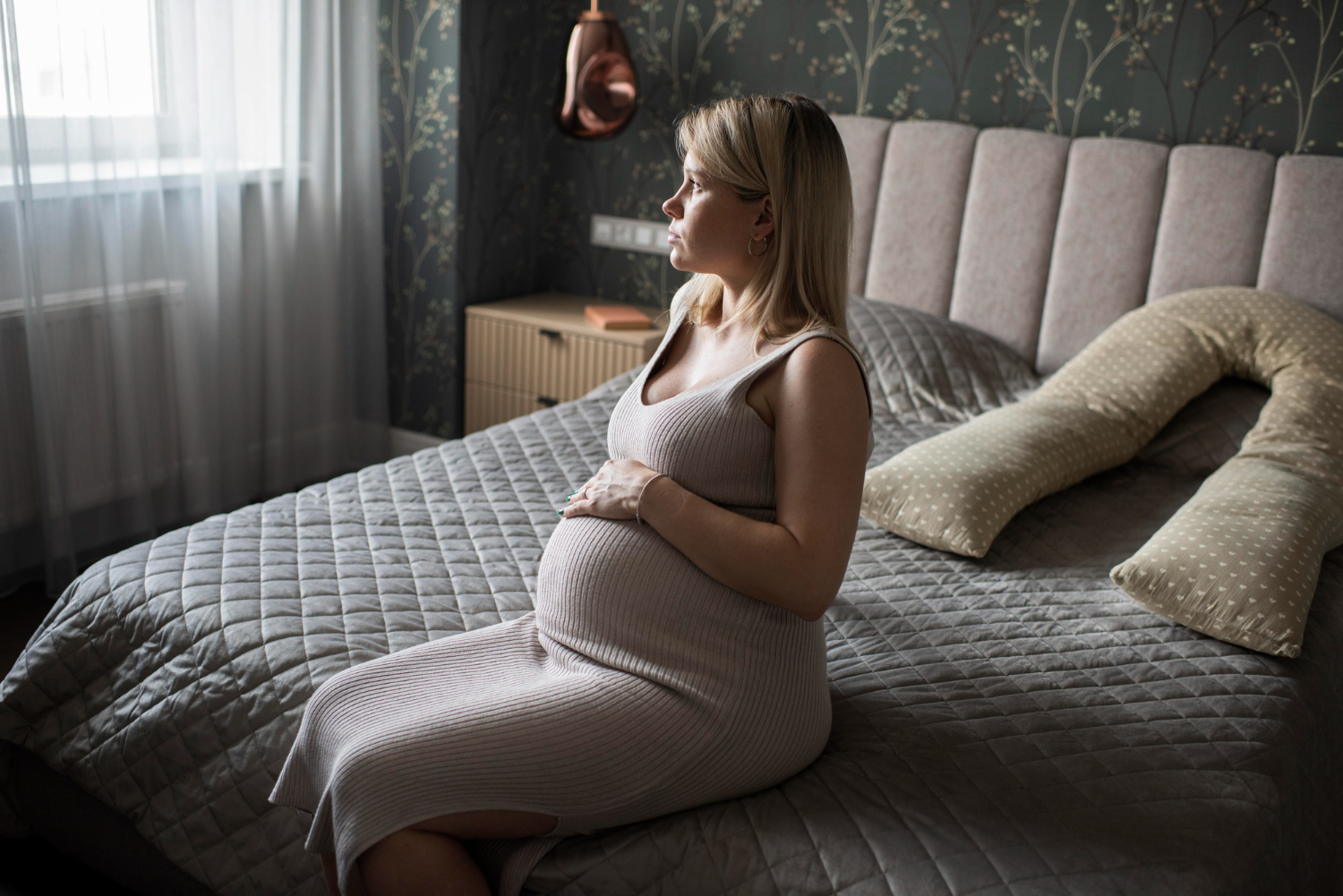
The house on Elm Street wore its cheerful yellow paint like a mask. To the neighbors watering their lawns and walking their dogs, we were the picture of suburban success—Daniel, the charming architect with his easy smile and firm handshake; me, Sarah, the graphic designer who worked from the converted sunroom; and his parents, Agnes and Victor, the doting soon-to-be grandparents who visited often to “help prepare for the baby.”
But masks are fragile things, and mine was about to shatter at five o’clock in the morning.
I lay awake at 4:55 a.m., staring at the ceiling fan that rotated slowly above our bed, counting each revolution like a prisoner marking days on a cell wall. At six months pregnant, sleep had become a rare and precious commodity. My back ached constantly, my ankles were swollen to twice their normal size, and the baby—my secret Miles, though Daniel insisted we wait to choose a name—kicked and rolled inside me at all hours. But it wasn’t physical discomfort that kept me awake on this particular morning. It was fear, cold and heavy, settling into my bones like winter frost.
The breathing beside me was steady, rhythmic. In sleep, Daniel looked like the man I’d married four years ago—the man who brought me coffee in bed on Saturday mornings, who laughed at my terrible puns, who cried during our wedding vows. But that man had been a carefully constructed illusion, and I’d been too young, too hopeful, too naive to see the cracks in the foundation.
For the past week, his parents had been staying with us, ostensibly to help prepare the nursery and support us before the baby’s arrival. Agnes and Victor occupied the guest room down the hall, and Daniel’s younger sister, Lauren, slept on the pull-out couch in the den. Their presence filled the house with a toxic energy that made my skin crawl. Every meal became a performance. Every conversation felt like a test I was designed to fail.
My alarm was set for six o’clock, which would give me time to shower, dress, and start breakfast before everyone else woke. I’d learned through painful trial and error that Daniel expected a full breakfast on the table by seven—eggs, bacon, pancakes, fresh coffee, the works. His mother had raised him to expect this level of service, and he’d made it abundantly clear that pregnancy was no excuse for what he called “laziness.”
But at exactly five o’clock, the bedroom door exploded inward with such force that it slammed against the wall, leaving what I knew would be yet another dent in the drywall.
The overhead light blazed to life, blinding me. I threw my arm across my eyes, my heart hammering so hard I felt it in my throat.
“Get up!”
The voice didn’t sound human. It was a roar, primal and furious, the kind of sound you’d expect from something cornered and dangerous. Daniel stood at the foot of the bed, already fully dressed in his gardening clothes—old jeans and a flannel shirt. His eyes were bloodshot, wild, darting around the room like he was searching for something to destroy.
I sat up slowly, clutching the duvet to my chest, my mind racing through possible explanations. Had something happened? Was there an emergency? A fire?
“Daniel?” My voice came out as barely a whisper. “What’s wrong? Is everything okay?”
“Okay?” He laughed, a sound like breaking glass. “Does this house look okay to you? It’s filthy! There are dishes in the sink from last night. The floor needs mopping. And my parents—” He paused, his face contorting with rage. “My parents are awake. They’re hungry. And where are you? Lying in bed like some kind of princess while they wait.”
I glanced at the alarm clock on the nightstand, its red numbers glowing accusingly: 5:03 a.m.
“It’s five in the morning,” I said, hating the tremor in my voice. “I was going to get up at six. I’m exhausted, Daniel. The baby was kicking all night, and my back—”
“Your back?” He advanced toward the bed, his footsteps heavy on the hardwood floor. “You think you’re special because you’re pregnant? Women have been doing this for thousands of years, Sarah. In fields. In caves. During wars and famines. And you can’t even walk down the stairs to make eggs for my family?”
He grabbed the duvet and ripped it off me with such violence that I gasped. The cold morning air hit my skin, raising goosebumps along my arms and legs. I was wearing an oversized t-shirt that barely covered my swollen belly, and I felt exposed, vulnerable.
“Get downstairs. Now.”
I knew better than to argue. I’d learned that lesson months ago, after the first time he’d shoved me against the kitchen counter for “talking back.” If I complied quickly, stayed quiet, did exactly what he wanted, sometimes—sometimes—he would calm down. If I fought, if I defended myself, it would only get worse.
I swung my legs over the edge of the bed, my movements slow and careful. Every joint ached. My feet had swollen so much that even my house slippers felt tight. I stood, steadying myself against the nightstand as a wave of dizziness washed over me. The baby kicked hard, as if protesting the sudden movement.
Daniel stayed close behind me as I made my way to the door, so close I could feel his breath on the back of my neck, could smell the coffee he’d apparently already made for himself. I walked down the hallway, past the framed photos of our wedding day that now felt like evidence of a crime, past the guest room where I could hear Agnes and Victor’s voices murmuring, past Lauren’s makeshift bedroom where the door was carefully closed.
When I reached the kitchen, I stopped so abruptly that Daniel almost ran into me.
Agnes and Victor sat at the dining table, but they weren’t eating. There were no plates set out, no glasses of juice, no indication that they’d actually wanted breakfast. They sat with their arms crossed, matching expressions of smug satisfaction on their faces. Agnes’s lips were curved into a small, cruel smile. Victor checked his watch ostentatiously, as if I were late for an important appointment.
Lauren stood near the counter, her arms wrapped around herself, staring at the floor. She was biting her lower lip so hard I could see a spot of blood.
“Finally,” Agnes said, her voice dripping with theatrical disdain. “The princess descends from her tower. We’ve been waiting for nearly half an hour.”
I glanced at the clock on the microwave: 5:08 a.m.
“Twenty-three minutes, to be exact,” Victor added, tapping his watch. “Daniel, son, you need to maintain better control of your household. In my day, a wife knew her responsibilities.”
“I’m trying, Dad,” Daniel said, and his voice changed completely—from the rage-filled roar to a childish whine, desperate for approval. “She’s just difficult. Stubborn. The pregnancy has made her think she’s entitled to special treatment.”
I walked to the stove on shaking legs, gripping the edge of the counter to steady myself. My hands trembled as I reached for the large cast-iron skillet hanging above the stove.
“What would you like?” I managed to ask, my throat tight.
“Everything,” Daniel said from behind me. “Pancakes, scrambled eggs, bacon, sausage, hash browns, toast. And coffee, of course. And don’t burn it like you did last time, or you’ll be eating the burned portions yourself.”
I nodded, reaching for the carton of eggs in the refrigerator. As I straightened up, the kitchen tilted violently to the left. Black spots danced across my vision like static on an old television screen. My ears rang with a high-pitched whine. The egg carton slipped from my fingers and hit the floor, eggs rolling in all directions.
I gripped the counter with both hands, trying to breathe, trying to focus, but the room kept spinning. My doctor had warned me about this—preeclampsia, dangerously high blood pressure, the risk of seizures and stroke. She’d told me to avoid stress, to rest, to monitor myself carefully for symptoms like dizziness and blurred vision.
“Daniel,” I gasped. “I need to sit down. Just for a minute. I’m dizzy. Something’s wrong.”
The room went silent. Even the refrigerator’s hum seemed to pause.
I slid down to the floor, my back against the cabinet, the cold tile pressing against my bare legs. I put my head between my knees, trying to stop the spinning, trying to breathe. The baby kicked frantically, sensing my distress.
Heavy footsteps approached. I looked up to see Daniel standing over me, his face twisted with contempt. But instead of offering help, instead of calling 911 or even asking if I was okay, he turned and walked to the back door.
Through my blurred vision, I watched him open the door to the small mudroom where we kept gardening supplies. He reached for something, and when he turned back around, he was holding the thick wooden stake he used to support the tomato plants in the garden. It was solid oak, nearly four feet long, knotted and heavy.
My blood turned to ice.
“I said,” he repeated slowly, walking back toward me with the stake gripped in both hands, “get up and make breakfast for my parents.”
“Daniel, please,” I whispered. “I’m not feeling well. Something’s wrong with the baby. I need to see a doctor. Please.”
He raised the stake above his head.
I curled into a ball instinctively, wrapping my arms around my belly, tucking my legs up to protect the baby as much as I could. Every maternal instinct I possessed focused on one thing: shield him. Protect Miles.
The stake came down with a sound like a gunshot. The impact against my thigh and ribs drove the air from my lungs. Pain exploded through my body, white-hot and all-consuming. I couldn’t breathe. I couldn’t think. I could only feel the agony radiating from the point of impact.
I screamed, a raw, animal sound I didn’t recognize as my own voice.
From the dining table, Agnes laughed—actually laughed, a high-pitched cackle that echoed off the kitchen walls. “Serves her right,” she said, her voice full of satisfaction. “She thinks being pregnant makes her a queen. She needs to learn her place in this family.”
“Pathetic,” Lauren muttered from somewhere to my right. I looked at her through my tears, silently begging for help, for intervention, for anything. But she just stood there, her hands shaking, her face pale, watching. Not helping. Not calling for help. Just watching.
Daniel raised the stake again.
“Please,” I sobbed, my voice breaking. “The baby. Daniel, please, think about the baby.”
“You care more about that thing inside you than you do about respecting me!” he screamed, his face purple with rage. “About respecting my family! About being a proper wife!”
He kicked me hard in the hip. I slid across the smooth kitchen floor, my shoulder slamming into the island cabinet. My phone—my phone had fallen out of my pajama pocket when I first collapsed. I could see it, just three feet away, under the lip of the cabinet.
I had seconds. Maybe less. Daniel was winding up for another strike. His parents were urging him on like spectators at a gladiator match. Victor had stood up from the table, the better to watch the show.
I lunged for the phone.
“Don’t let her call anyone!” Victor shouted. “Grab it, Daniel!”
My fingers closed around the phone. I didn’t dial 911—I knew the operator would ask questions, would want to know my location, would take too long. Instead, I opened my text messages with trembling hands and found the thread with my brother, Ethan.
Ethan was an ex-Marine who lived ten minutes away. He worked night shifts as a security supervisor at a warehouse. He would be awake. He would come.
I typed two words.
Help. Please.
Send.
Daniel’s hand clamped around my wrist like a vice, wrenching the phone from my grasp. He threw it against the wall with such force that it shattered into pieces, the screen going dark, plastic and glass scattering across the floor.
“You think your brother can save you?” he hissed, crouching down so his face was inches from mine. His breath was hot and sour. “By the time he gets here, you’ll be cleaned up, apologized, and making breakfast like nothing happened. Because if you say one word about this to anyone, I’ll make sure you never see that baby after it’s born. I’ll take him. My parents will help me prove you’re an unfit mother. We have money. We have lawyers. You have nothing.”
He grabbed my hair and yanked my head back, forcing me to look at him. “Now,” he whispered. “Let’s try this again. Get up and make breakfast.”
But I couldn’t get up. The pain in my ribs was overwhelming. The room spun faster. Black spots multiplied across my vision until they merged into solid darkness.
Hold on, Miles, I thought, saying the secret name I’d been too afraid to speak aloud. Just hold on.
Then everything went black.
The first sensation that broke through the darkness was sound—a steady, rhythmic beeping that seemed to come from very far away. Then came voices, muffled at first, then clearer. Someone was shouting.
“If you let him in this room, if you let any of them near her, I will burn this hospital to the ground! Do you understand me?”
That was Ethan’s voice, deeper and more dangerous than I’d ever heard it.
I tried to open my eyes, but the light was too bright, stabbing into my skull like knives. I managed to crack them open just slightly.
I was in a hospital bed. Pale green walls. Fluorescent lights. IVs in both arms, connected to bags hanging on a metal stand. My chest was wrapped in tight bandages. A blood pressure cuff squeezed my arm automatically every few minutes. And beside the bed, a monitor showed a steady heartbeat—but not mine.
The baby’s.
“Sarah?”
Ethan’s face appeared above me, and I was shocked by what I saw. Ethan was thirty-two years old, six-foot-three, built like the Marine he’d been. He had a tattoo of a eagle on his forearm and a scar through his left eyebrow from a bar fight when he was twenty. I’d never seen him cry. Not when our parents died. Not at his wedding. Not ever.
But he was crying now.
“The baby?” I croaked. My throat felt like I’d swallowed broken glass.
“He’s okay,” Ethan said, gripping my hand so tightly I thought the bones might crack. “The heartbeat is strong. The doctors checked everything. You have two broken ribs, a severe concussion, bruising over forty percent of your body, and they’re monitoring you for preeclampsia complications. But the placenta is intact. He’s safe. He’s safe, Sarah.”
I let out a sob that made my broken ribs scream with pain.
“Daniel?” I managed to ask.
Ethan’s jaw tightened, muscles flexing beneath his skin. “In custody. I got there five minutes after you texted. I kicked the front door clean off its hinges.”
He paused, looking away, his hand trembling in mine.
“I found you on the floor, unconscious. Daniel was trying to drag you up by your arms. He was screaming at you to stop faking it, to get up and finish breakfast. His mother was standing over you with a pitcher of water, pouring it on your face like you were a plant that needed watering. His father was telling him to get you cleaned up before anyone saw.”
Ethan’s voice dropped to barely a whisper. “I wanted to kill him, Sarah. God forgive me, I wanted to put my hands around his throat and squeeze until his eyes popped out of his skull. But I knew you needed him alive. You needed him in prison, not a morgue. So I broke his nose instead, shattered it across his face, and held him down until the police arrived.”
“And his parents?”
“They tried to spin a story,” Ethan said, his voice hard. “Told the cops you’d fallen down the stairs. Said you were hysterical, unstable, that pregnancy hormones had made you paranoid and clumsy. But the responding officers saw the oak stake with your blood on it. They saw the destroyed phone. They saw you unconscious on the floor. They arrested all three of them on the spot.”
Just then, the door opened. A police officer entered, a middle-aged man with kind eyes and a weary expression. His badge read “Officer Miller.”
“Mrs. Mercer,” he said gently, pulling up a chair beside the bed. “I’m sorry to disturb you while you’re recovering. But I need to take your statement, and I need to tell you something important.”
I nodded, bracing myself.
“The hospital filed a mandatory abuse report, which started our investigation. But we got something else, something that changes everything.” He pulled out a tablet and showed me a still image from a video. “Your neighbor, Mr. Grayson? The elderly gentleman who lives next door?”
I knew him. He was eighty-two years old, a widower who spent his days reading on his porch and feeding the birds.
“He has a security camera mounted on his front porch,” Officer Miller continued. “It’s angled in such a way that it captures your kitchen window. The blinds were open yesterday morning.”
My heart stopped.
“He saw everything. The camera records audio too. We have Daniel screaming at you to get up. We have his mother laughing. We have the sound of the impact when he struck you. We have his father encouraging it. Everything, Mrs. Mercer. We have everything.”
Tears streamed down my face, and I didn’t try to stop them. For years, Daniel had told me I was crazy. That I imagined the cruelty. That I provoked him. That if I just tried harder to be a better wife, he would be the man he used to be.
“I’m not crazy,” I whispered.
“No, ma’am,” Officer Miller said firmly. “You are a victim of a brutal assault. And we are going to make sure Daniel Mercer pays for what he’s done.”
The weeks leading up to the trial passed in a blur of physical therapy sessions, legal depositions, and sleepless nights. I moved in with Ethan and his wife, Clara, refusing to even drive past the yellow house on Elm Street. Clara set up the guest room for me, hanging blackout curtains and buying a pregnancy pillow. She made me chamomile tea and sat with me during the panic attacks that came without warning.
But safety was an illusion. Daniel had been released on bail within forty-eight hours. His parents had posted the $200,000 bond immediately, hiring an expensive lawyer named Richard Sterling who specialized in what he called “defending men falsely accused in the era of #MeToo.”
The smear campaign began almost instantly. Anonymous social media accounts appeared, posting photos of me with captions like “Gold digger accuses successful architect of abuse to steal his money.” Flowers were delivered to Ethan’s house with notes that said “Liars get what they deserve” and “Karma is coming for you.” Someone posted my work email online, and I received hundreds of messages calling me a liar, a whore, a manipulator.
Daniel was trying to break me before we ever set foot in the courtroom. But he’d made one crucial mistake. He’d underestimated me.
I was a graphic designer. I’d built my career working with digital files, cloud storage, backup systems. And Daniel, in his arrogance, had never changed any of the passwords to our shared accounts because he’d assumed I was too stupid, too technologically incompetent to access them.
One night, unable to sleep, I logged into our family cloud account from Clara’s laptop. I wasn’t looking for photos. I was looking for backups from Daniel’s phone.
What I found made me vomit twice into the trash can beside the desk.
I found a group chat called “Family First” that included Daniel, Agnes, and Victor. The messages went back six months, starting shortly after I’d announced my pregnancy.
Agnes: She’s getting too mouthy lately. You need to remind her who pays the mortgage. Don’t be afraid to be firm with her.
Daniel: I know. I’m waiting for the right moment. She’s been complaining about being tired a lot. If she loses the pregnancy, we can try again with a surrogate who isn’t so weak and difficult.
Victor: Remember what I taught you. Never leave marks on the face. The body heals and bruises fade. The face shows in photographs.
Agnes: Once the baby comes, she’ll be trapped. No judge will take a newborn away from its mother, but we can make sure she’s too exhausted and isolated to leave. Then you’ll have complete control.
There were dozens more messages, a detailed blueprint for psychological and physical abuse. They’d discussed isolating me from my friends, monitoring my spending, making me doubt my own sanity. This wasn’t impulsive rage. This was premeditated torture.
I saved everything. I printed the most damning messages. I copied them to three different flash drives, mailing one to my lawyer, one to Ethan, and hiding one in a safety deposit box at the bank.
Then I called the prosecutor.
The day of the trial arrived cold and gray, the sky threatening rain. The courthouse was a imposing building of granite and glass, its steps crowded with reporters and photographers. Ethan had to shield me from the cameras, his broad body blocking the worst of the flashing lights.
Inside the courtroom, the air felt thick, suffocating. Daniel sat at the defense table looking polished and professional in a navy suit that probably cost more than my car. His hair was perfectly styled. He looked like a young professional, successful and wrongly accused. He didn’t look like a man who’d beaten his pregnant wife on a kitchen floor.
Behind him sat Agnes and Victor, dressed as if they were attending church. Agnes clutched a bible, dabbing at her eyes with a handkerchief. Victor sat with his hands folded, the picture of dignified concern.
Lauren sat at the end of their row, looking pale and thin, her eyes red-rimmed.
Judge Kimberly Holt entered, a woman in her sixties known for her sharp intellect and zero tolerance for courtroom theatrics. “All rise.”
The trial began with opening statements. Daniel’s lawyer, Mr. Sterling, painted a picture of a hormonal, unstable woman who’d attacked her husband in a rage.
“Sarah Mercer has a documented history of anxiety,” Sterling declared, his voice booming through the courtroom. “The stress of pregnancy overwhelmed her. On the morning in question, she became hysterical, attacked her husband when he asked her to contribute to household duties. He pushed her away in self-defense. Tragic? Yes. Criminal? Absolutely not.”
Then it was the prosecution’s turn. My lawyer, Ms. Rachel Darden, stood. She was a small woman, barely five feet tall, but she commanded the room.
“Your Honor, the defense will tell you stories,” she said quietly. “We prefer to show you the truth.”
The prosecution called witnesses. The ER nurse described my injuries in clinical detail, explaining that the bruise pattern on my thigh was consistent with being struck by a cylindrical object, not with falling down stairs. The doctor who’d examined me testified about the severity of my concussion, the broken ribs, the risk to my pregnancy.
Then Mr. Grayson took the stand, walking slowly with his cane. He described what he’d seen through his window, his voice shaking. “I heard screaming,” he said. “Terrible screaming. I looked out and saw Daniel swinging that stick like he was chopping wood. And his parents—they were smiling. Like they were watching their favorite television program.”
“Objection!” Sterling shouted. “Speculation!”
“Overruled,” Judge Holt said coldly, her eyes fixed on Agnes.
But the turning point came when Ms. Darden wheeled in the audiovisual equipment. “Your Honor, the defense claims this was a momentary loss of control, self-defense against an aggressive, unstable woman. We have evidence that proves otherwise.”
The courtroom lights dimmed. The video from Mr. Grayson’s security camera played on large monitors. The audio was grainy but undeniable.
“Get up and make breakfast!”
The sickening thud of wood striking flesh.
My scream.
Agnes’s voice, clear as a bell: “Serves her right.”
The courtroom fell absolutely silent. Several jury members looked sick. Daniel’s smirk vanished completely.
“And now,” Ms. Darden continued, “the text messages recovered from the defendant’s cloud backup.”
The messages appeared on the screen, enlarged so everyone could read them. The collective gasp that swept through the courtroom was audible. Two jury members covered their mouths. One woman in the gallery began to cry.
This wasn’t a crime of passion. This was a conspiracy.
Daniel’s face drained of all color. His lawyer was frantically scribbling notes, clearly trying to salvage an unsalvageable case.
Agnes stood up, her mask of pious concern finally cracking. “Those are fake! She edited them! She’s a graphic designer—she knows how to manipulate digital files!”
“Sit down, Mrs. Mercer!” Judge Holt’s voice cracked like a whip. “One more outburst and you will be removed from this courtroom and charged with contempt!”
Then came the moment no one expected. Lauren stood up in the gallery, her whole body trembling.
“I want to testify,” she said, her voice barely above a whisper.
“Lauren, sit down right now!” Victor hissed, reaching for her arm.
She yanked away from him. “No! I’m not going to jail for you people!”
Judge Holt looked at her intently. “Approach the bench.”
Lauren was sworn in. She sat in the witness chair, her hands clasped so tightly in her lap that her knuckles were white.
Ms. Darden approached her gently. “Lauren, please tell the court what you witnessed on the morning of the assault.”
Lauren took a shaky breath. “They planned it,” she said, her voice growing stronger. “Mom told Daniel the night before to wake Sarah up early, before dawn. She said Sarah needed to be ‘broken’ before the baby came so she would be obedient afterward. They wanted to turn her into a servant.”
She looked directly at me, tears streaming down her face. “I watched him hit you. I stood there and did nothing because I was terrified he would hit me next. He used to hit me when we were kids. Mom always let him. She said it was how boys learned to be men.”
She turned to face Daniel, who was staring at her with pure, undiluted hatred.
“You’re a monster, Daniel. And Mom and Dad made you into one.”
The jury deliberated for forty-seven minutes.
When they returned, the foreman wouldn’t look at Daniel.
“We find the defendant, Daniel Mercer, guilty on all counts.”
Judge Holt didn’t wait for a sentencing hearing. “Daniel Mercer, you have shown not one shred of remorse for your actions. You conspired with your family to torture a pregnant woman. You are a danger to society. I sentence you to nine years in state prison, with no possibility of parole for at least five years.”
Daniel slammed his fist on the table. “She’s lying! She’s a gold-digger! I make all the money! She’s nothing without me!”
Ms. Darden spoke up calmly. “For the record, Your Honor, we submitted tax returns showing Mrs. Mercer earns thirty percent more annually than the defendant.”
Quiet laughter rippled through the gallery.
Judge Holt turned her attention to the seats behind Daniel. “Agnes and Victor Mercer, based on the evidence presented, I am ordering you taken into custody to face charges of conspiracy to commit assault and obstruction of justice.”
“No!” Agnes shrieked as the bailiff approached. “I’m a mother! I was protecting my son!”
“You were protecting an abuser,” Judge Holt said. “Take them away.”
As they led Daniel out in handcuffs, he looked at me one last time. Not with remorse. With fury that his property had dared to rebel.
I held his gaze until the door closed behind him.
Two months later, I lay in a different hospital bed, this one in the bright, clean delivery room at St. Mary’s Hospital. Ethan held my left hand. Clara held my right.
“One more push, Sarah! You’re almost there!”
This pain was different. It wasn’t the pain of a stick cracking against my ribs. It was the pain of life, of creation, of bringing something beautiful into the world.
And then I heard it—the cry that made everything worth it.
They placed him on my chest, warm and wet and absolutely perfect. Ten fingers. Ten toes. A shock of dark hair.
“Hi,” I whispered, kissing his forehead. “Hi, Miles.”
I named him Miles because of the distance we’d traveled to get here. Miles away from the yellow house. Miles away from fear. Miles toward freedom.
“He looks like you,” Ethan said, his voice thick with emotion.
“Good,” I said, pulling my son closer. “He’s going to be kind. I’ll make sure of it.”
Rebuilding a life is harder than destroying one, but I learned that broken things can be made stronger. The nightmares came for months, but they faded. The fear of footsteps behind me gradually loosened its grip. I started a blog about surviving domestic abuse during pregnancy, and it found an audience I never expected—women from all corners of the world who recognized their own stories in mine.
Lauren became an unexpected ally, testifying against her parents in their trial and slowly unlearning decades of toxic patterns. She visits Miles every Sunday, bringing books and toys, learning how to be the aunt she never had the chance to be a daughter.
One spring afternoon, I sat on a park bench watching Miles, now two years old, chase butterflies through the grass. He fell down, his lip trembling as he looked at me, waiting to see how I would react.
I walked over, knelt down, and brushed the grass from his knees.
“It’s okay,” I said, hugging him close. “You just fell. We get back up.”
He giggled and ran off again, the fall already forgotten.
I sat back on the bench, breathing in the spring air, watching my son play in the sunshine. I thought about Daniel in his prison cell, still blaming everyone but himself. I thought about Agnes and Victor, their reputations destroyed, living in exile in another state.
And then I looked at Miles, running and laughing, free.
They tried to break me to build a cage for him. Instead, I broke the cage and built a world.
My phone buzzed. An email from a publisher who wanted to turn my blog into a book.
Tomorrow morning, I will wake at dawn. Not because I have to make breakfast for monsters, but because Miles might need me. Or because I want to watch the sunrise.
That choice—that simple, beautiful freedom to choose—is the greatest luxury of all.
And I will never take it for granted again.

Ethan Blake is a skilled Creative Content Specialist with a talent for crafting engaging and thought-provoking narratives. With a strong background in storytelling and digital content creation, Ethan brings a unique perspective to his role at TheArchivists, where he curates and produces captivating content for a global audience.
Ethan holds a degree in Communications from Zurich University, where he developed his expertise in storytelling, media strategy, and audience engagement. Known for his ability to blend creativity with analytical precision, he excels at creating content that not only entertains but also connects deeply with readers.
At TheArchivists, Ethan specializes in uncovering compelling stories that reflect a wide range of human experiences. His work is celebrated for its authenticity, creativity, and ability to spark meaningful conversations, earning him recognition among peers and readers alike.
Passionate about the art of storytelling, Ethan enjoys exploring themes of culture, history, and personal growth, aiming to inspire and inform with every piece he creates. Dedicated to making a lasting impact, Ethan continues to push boundaries in the ever-evolving world of digital content.