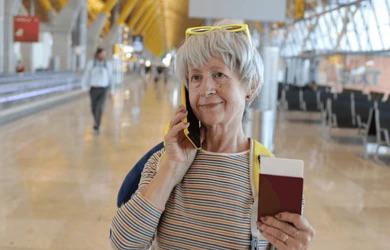
The Ticket That Was Never Forgotten
That morning at the airport had started out so normal it almost felt harmless—the steady rattle of suitcase wheels across polished tile, the burnt-coffee smell drifting from a kiosk near gate B7, the overhead voice repeating gate changes like a lullaby that nobody actually listened to.
My aunt Patricia was fussing with everyone’s documents like she was running a school field trip, checking passports and boarding passes twice, three times, her efficiency bordering on aggressive. My cousins—Jake and Emma, both in their twenties and both permanently attached to their phones—didn’t look up from their screens. Nobody looked up for my grandma either, not really. Not in a way that meant they were actually seeing her.
My name is Riley. I’m twenty-six years old, and I was the youngest person on what was supposed to be our big family trip to Europe. Two weeks in France and Italy, the kind of vacation that gets planned for months, that gets talked about at every holiday dinner until it stops being a maybe and becomes a when.
Grandma Hazel was the kind of woman who still kept paper plates under the sink for church potlucks and wrote grocery lists on the back of old envelopes because “perfectly good paper shouldn’t go to waste.” She lived in a quiet Tennessee town called Millbrook where neighbors waved from porches and the mailbox row felt like a tiny daily roll call—everyone knew everyone, and if you were sick, three people would show up with casseroles before you even thought to ask.
She’d worked for years as a bookkeeper at a local accounting firm, retired at sixty-eight, and lived on her Social Security and a modest pension. She saved quietly, never complained, never asked her kids for anything—not help with bills, not rides to appointments, not even company when the holidays stretched out too long and too empty.
So when my parents announced a big Europe trip last November and said it would be “the whole family,” she lit up in a way I hadn’t seen since I was little, since before Grandpa died and the light in her went a little dimmer.
“All of us?” she’d asked at Thanksgiving dinner, her voice careful, like she didn’t want to assume too much. “Even me?”
“Of course, Mom,” my dad had said, his arm around her shoulders in that performative way he had when other people were watching. “Whole family means whole family.”
She’d cried a little. Happy tears, she said, wiping them away with her napkin. “I’ve always wanted to see Paris,” she admitted. “Your grandfather and I, we always said someday, but someday never came.”
My mom had smiled and patted her hand. “Well, now it’s coming.”
Grandma had started saving immediately. Not from some secret fortune—she didn’t have one. She took on extra work hemming pants for a local tailor shop. She stopped her weekly dinners out with her church friends. She cut her grocery budget so thin I watched her buy store-brand everything and skip the small luxuries she usually allowed herself.
By March, she’d saved thirty thousand dollars. Thirty thousand dollars from a woman who lived on less than three thousand a month.
She’d presented the money to my dad at Easter dinner, in an envelope with “Europe Trip” written on it in her careful handwriting. “I know it’s expensive,” she’d said. “I want to pay my share.”
My dad had hugged her. Told her she was generous. Told her this trip was going to be amazing.
Then came the strange part: the sudden sweetness.
My dad started calling her more—twice a week instead of twice a month. My mom’s voice softened into something almost rehearsed whenever she talked to Grandma, asking about her day, her health, her garden. Even my aunt sent gifts and long messages, the kind that ended with, We’re finally doing this together. I’m so glad we’re all going to make these memories.
I told myself it meant they were making up for lost time. I wanted to believe that. I wanted Grandma to believe it more, because she deserved to believe her children loved her enough to actually include her, not just tolerate her presence at mandatory holiday gatherings.
At the check-in counter at Nashville International Airport on a bright June morning, the lie showed its face.
We’d all arrived together—my parents, my aunt and her husband, my two cousins, and Grandma. Eight people total, supposedly all heading to Paris for the start of our grand European adventure.
The counter agent was efficient and friendly, scanning passports and boarding passes with the practiced ease of someone who’d done this ten thousand times. One by one, we checked in. My parents. My aunt and uncle. My cousins. Me.
Then Grandma stepped forward with her old green suitcase—the same one she’d had since before I was born—and asked, polite as always, “Where’s my ticket?”
My dad didn’t panic. He didn’t scramble through his bag looking for it. He didn’t check his phone or his pockets or show any sign of someone who’d made an honest mistake.
He sighed like she’d asked for something inconvenient and said, “I forgot your ticket—just go home.”
Five words. Delivered like he was telling her he’d forgotten to pick up milk.
It wasn’t the sentence that shattered me first. It was the silence after it.
My mom stared at her phone like the screen could save her from having to meet Grandma’s eyes. My aunt adjusted her purse strap and looked over Grandma’s shoulder at literally nothing. My uncle studied the departures board like he’d never seen one before. My cousins suddenly found the floor very interesting, their phones forgotten in their hands.
No one met Grandma’s eyes. No one said, Wait—this isn’t right. This can’t be right. Let’s figure this out.
The counter agent looked uncomfortable. “Sir, if you don’t have her ticket, I can help you purchase—”
“That won’t be necessary,” my dad said smoothly. “She’s not coming. It was a miscommunication.”
Miscommunication. Not mistake. Not accident. Miscommunication—as if Grandma had somehow misunderstood what “whole family” meant.
Grandma’s fingers tightened around the suitcase handle, her knuckles going white. Her shoulders moved once, the smallest tremor, and then she made that soft, careful smile people wear when they refuse to fall apart in public. “Oh,” she said quietly. “I see. I must have… I must have gotten confused.”
She was giving them an out. Even now, even standing there being humiliated in front of strangers, she was trying to protect them from embarrassment.
“I can help her change her flight,” I said suddenly, surprising myself with how steady my voice sounded. “We can figure something out.”
“Riley, don’t be ridiculous,” my mom said, her voice sharp. “The flight leaves in two hours. There’s no time. Grandma can just go home and we’ll… we’ll make it up to her when we get back.”
Make it up to her. With what? A refrigerator magnet from the Eiffel Tower? A postcard with a half-hearted apology?
I looked at my family—really looked at them—and in that moment, I understood something ugly: this wasn’t a mistake. It was a plan everyone knew about except Grandma. And maybe except me, because I was apparently the only one stupid enough to think they’d actually meant “whole family.”
They’d taken her thirty thousand dollars. They’d let her save and sacrifice and believe she was finally going to be included. They’d let her pack her old green suitcase and wake up at 4 AM to make this flight.
And they’d never had any intention of bringing her.
“I’m not going,” I said.
My dad turned to me, impatient now. “Riley, don’t make this a thing.”
“Make this a thing? You just told your mother to go home after she spent thirty thousand dollars on this trip.”
“It’s complicated—”
“It’s theft,” I said flatly. “She gave you money for a trip you never planned to take her on. That’s theft.”
My mom’s face flushed. “Your grandmother is confused. She’s elderly. She sometimes misunderstands—”
“She’s sixty-nine years old, not ninety. And she’s sharper than any of us. Stop lying.”
People were staring now. Other travelers, the gate agents, the family waiting behind us. My aunt looked mortified—not because of what they’d done to Grandma, but because we were causing a scene.
“Riley, we’ll discuss this when we get back,” my dad said, his voice low and threatening. “Get on the plane.”
“No.”
“Excuse me?”
“I said no. I’m not going anywhere without Grandma.”
So I stayed.
I didn’t argue any more in the terminal. I didn’t give anyone the satisfaction of a scene. I just picked up Grandma’s suitcase, gently guided her away from the counter, and got her out of that bright, unforgiving space.
Behind me, I heard my mom hiss, “Let her stay. She’ll regret this when she realizes what she’s missing.”
On the ride back to Grandma’s house—forty minutes of highway and country roads—she stared out at the interstate like it had answers. She didn’t cry. She didn’t ask for an apology. She didn’t even ask why.
That quiet was heavier than any shouting.
Finally, as we pulled into her driveway, she spoke. “You should have gone with them.”
“No,” I said. “I really shouldn’t have.”
“They’re your family.”
“So are you.”
She was quiet for a long moment. Then, so softly I almost didn’t hear it: “Thank you, baby.”
The next three weeks felt like a different life.
We fell into routines. Morning tea on her porch, watching the neighborhood wake up. Afternoons in her garden, where she taught me about tomatoes and roses and the right way to deadhead petunias. Evenings watching old movies, the kind filmed in black and white where everyone spoke in that clipped, theatrical way.
The neighborhood so calm it made the betrayal feel louder.
One afternoon, I opened her mailbox and found a glossy travel flyer wedged inside like a cosmic joke—DISCOVER PARIS in bold letters above a photo of the Eiffel Tower at sunset. Grandma didn’t comment. She only folded it once—neat, precise—and set it on the kitchen table like she was putting away a feeling.
I wanted her to rage. I wanted her to call my parents and demand her money back. I wanted her to cry and scream and acknowledge how completely, cruelly they’d betrayed her.
But she just folded the flyer.
During those weeks, I did some research. I called the credit card company and learned that yes, Grandma could dispute the charges. I spoke to a lawyer friend who said yes, this probably constituted fraud or theft by deception. I built a case in my head, prepared arguments, planned confrontations.
But I also did something else.
I called someone I’d met at a legal conference two years ago. A prosecutor named Michael Chen who specialized in elder abuse cases. We’d stayed in touch—occasional emails, the odd coffee when he was in town—and I knew he’d be interested in this.
Very interested.
We met for lunch in Nashville the second week Grandma and I were together. I told him everything—the promises, the money, the airport betrayal, the complete absence of any intention to actually bring her along.
“That’s textbook exploitation of an elderly person,” he said, his expression grim. “Financial abuse. Fraud. Possibly conspiracy if multiple family members were involved in planning it.”
“Can you do anything?”
“Can I? Yes. Should I?” He looked at me carefully. “Riley, if we pursue this, it’s not going to be quiet. It’s going to be official. It’s going to involve investigations and possibly criminal charges. Your family will know you’re behind it. Are you prepared for that?”
I thought about Grandma folding that travel flyer. About her careful smile at the airport. About thirty thousand dollars she’d saved by skipping dinners and hemming pants for five dollars each.
“Yes,” I said. “I’m prepared.”
“Then let me make some calls.”
Three weeks after the airport, my family returned from Europe.
I’d gotten updates from my mom throughout their trip—photos of the Eiffel Tower, the Colosseum, the Amalfi Coast, all posted on Facebook with captions about “amazing family memories” and “so grateful for this time together.” Not one mention of Grandma. Not one acknowledgment that their “whole family trip” was missing someone.
The comments on those posts made me sick. Friends and distant relatives writing So beautiful! and You all look so happy! and Family is everything!
I didn’t comment. I didn’t like or share. I just watched and waited.
When their flight landed at Nashville International on a Thursday afternoon, I went to the arrivals area. Alone.
Well, not entirely alone.
Families stood around with balloons and cardboard signs. People cheered when their loved ones appeared. Luggage thumped on the floor. A child laughed near the sliding doors.
And I stood there, still as a post, with a man beside me—pressed shirt, calm eyes, a lanyard clipped cleanly at his waist that identified him as an investigator with the Tennessee District Attorney’s Office. His posture was so steady it made my heartbeat feel loud.
Michael Chen had done exactly what he’d promised. He’d made calls. He’d opened an investigation. And now he was here, professionally cordial, waiting to introduce himself to my family.
When my parents and aunt finally walked out with their suitcases, they were laughing—already mid-story, already reliving their trip, tanned and relaxed and completely unprepared for what was about to happen.
Then they saw me.
And then they saw him.
My dad’s smile didn’t fade slowly. It snapped off like someone had flipped a switch. My mom’s hand tightened around her bag strap, knuckles white. My aunt stopped walking like her feet forgot what to do next.
The man beside me didn’t rush. He didn’t raise his voice. He simply shifted one small step forward—just enough to make them understand this wasn’t going to be waved away like a “mix-up” anymore.
And right before he spoke, the whole family went perfectly, painfully still.
“Mr. Foster?” Michael said, his voice professional and calm. “I’m Michael Chen with the District Attorney’s Office. I need to speak with you about some financial transactions involving your mother, Hazel Foster. Specifically, thirty thousand dollars paid to you for a European vacation she was not permitted to attend.”
The color drained from my dad’s face. “I—what? This is—”
“We’re conducting an investigation into possible elder financial abuse and fraud. I’d like you to come with me to answer some questions. Your wife and sister as well, since they were also involved in the planning and execution of this trip.”
“This is ridiculous,” my aunt said, her voice shrill. “This is a family matter—”
“Financial exploitation of vulnerable adults is a criminal matter, ma’am. Not a family matter.”
My mom was staring at me with something between shock and fury. “Riley. What did you do?”
“I protected Grandma,” I said simply. “Something you should have done instead of stealing from her.”
“We didn’t steal—”
“You took thirty thousand dollars from a woman living on a fixed income, promised her she was included in a family trip, and then abandoned her at the airport. That’s theft by deception at minimum. Possibly elder abuse depending on how the investigation goes.”
People were staring now. Other travelers slowing down, watching this scene unfold, probably wondering what kind of terrible people got confronted by investigators at the airport.
“You’re destroying this family,” my dad said, his voice low and furious.
“No,” I said. “You did that when you lied to your own mother and stole her savings. I’m just making sure there are consequences.”
Michael stepped forward again, his hand moving to his belt where his badge was clipped. “Mr. Foster, Mrs. Foster, Ms. Patterson—I’m going to need you to come with me. You’re not under arrest at this time, but we do need to conduct formal interviews. You have the right to have an attorney present.”
My uncle—who’d been silent this whole time—finally spoke. “Patricia, call our lawyer. Now.”
As they were being led away, my mom turned back to me one last time. “When this is over, Riley, don’t expect to be welcome in this family anymore.”
“I’ll manage,” I said.
The investigation took four months.
During that time, I lived with Grandma. We’d become not just grandmother and granddaughter, but roommates, friends, allies against a family that had proven itself unworthy of loyalty.
Michael kept us updated throughout the process. The investigation uncovered some things even I hadn’t known—that my parents had specifically chosen an expensive trip knowing Grandma would contribute significantly, that they’d discussed among themselves (in text messages the investigation subpoenaed) how to “handle the Grandma situation” at the airport, that my aunt had suggested they just “let her think she’s coming until the last minute so she doesn’t have time to back out.”
Premeditated. Planned. Cruel.
The district attorney offered them a deal: return the thirty thousand dollars plus interest, perform community service, attend financial counseling, and accept probation. In exchange, they’d avoid jail time and felony charges.
They took the deal.
Grandma got her money back—all thirty thousand plus another five thousand in interest and damages. She cried when the check came. Not sad tears. Vindicated tears.
“I didn’t think anyone would believe me,” she admitted. “I thought they’d just say I was confused, that I misunderstood, that old people get things mixed up.”
“You were never confused,” I said. “They were just counting on everyone thinking you were.”
My family didn’t speak to me after that. Not at all. I was blocked on phones, blocked on social media, uninvited from holidays. My cousins sent a joint message saying they were “disappointed” in me for “airing family business” and “getting lawyers involved in something that could have been handled privately.”
I blocked them back.
Because here’s what I learned during those three weeks with Grandma, during those four months of investigation, during all the quiet mornings and garden afternoons and evening movies:
Family isn’t about DNA. It’s about who shows up. It’s about who protects you when you’re vulnerable instead of exploiting you. It’s about who sees you as a person worthy of respect instead of a resource to be extracted from.
My parents, my aunt, my cousins—they’d shown me exactly who they were. People who’d steal from an elderly woman and then get angry when there were consequences. People who valued a vacation more than their mother’s dignity. People who thought “family” meant a shield against accountability rather than a bond of mutual care.
They weren’t my family anymore. Not in any way that mattered.
But Grandma was. Grandma, who taught me about roses. Who made me tea every morning. Who told me stories about my grandfather. Who folded that travel flyer with such careful dignity instead of crumpling it in rage.
She was my family. The only family I needed.
Six months after the airport, Grandma and I took a trip.
Not to Europe—she said she didn’t need that anymore, that Paris had lost its shine. “I’ve seen enough pictures,” she said. “I think I’d rather see something else.”
So we went to New Mexico. Stayed in a little bed-and-breakfast in Santa Fe. Visited art galleries and museums. Hiked in the desert (slowly, at Grandma’s pace). Ate green chile everything.
We didn’t talk about my parents. We didn’t talk about the investigation or the money or the betrayal.
We just existed together, two people who’d chosen each other, who’d proven that chosen family is often stronger than biological family.
On our last night, sitting on the patio watching the sunset turn the desert pink and gold, Grandma reached over and squeezed my hand.
“Thank you,” she said.
“For what?”
“For staying. At the airport. You could have gone to Paris. You could have had that whole trip. But you stayed with me.”
“Of course I stayed. You’re my grandma.”
“No.” She squeezed my hand again. “I’m your family. There’s a difference.”
And there was. There really, really was.
A year after the airport incident, I got a wedding invitation.
My cousin Emma was getting married. The envelope was addressed just to me—no plus-one, no acknowledgment that I might bring Grandma. Inside was a note in my aunt’s handwriting:
We hope you’ll join us in celebrating Emma’s special day. It’s time to put the past behind us and be a family again.
I showed it to Grandma. She read it carefully, then handed it back.
“Are you going to go?” she asked.
“No,” I said. “Are you kidding? They still haven’t apologized to you. Not really. Returning the money wasn’t an apology—it was a legal requirement. They’ve never actually acknowledged what they did was wrong, only that they got caught.”
“They’re your parents, Riley. Your aunt. Your cousins.”
“They’re people who hurt you and then got mad at me for protecting you. That’s not family. That’s just biology.”
She smiled—that soft, careful smile that I’d learned meant she was holding back emotion. “I’m proud of you, you know. You’re twice the person they’ll ever be.”
I tore up the invitation.
Two years after the airport, Grandma and I went to Paris.
For real this time. A proper trip with actual tickets and reservations and all the planning I’d learned my family had never done for her. We stayed in a little hotel in the Marais. We visited the Louvre. We had coffee at sidewalk cafés and watched people and tried (badly) to speak French.
We stood at the top of the Eiffel Tower at sunset, watching the city turn gold below us, and Grandma cried.
“Your grandfather would have loved this,” she said.
“He would have loved that you got to see it,” I said. “Even if it took longer than you planned.”
She looked at me, really looked at me, with those sharp eyes that had never been confused, never been elderly in the way my parents had tried to paint her. “I’m glad I waited. If I’d come before, I wouldn’t have come with you. And this—” she gestured at Paris, at us, at everything “—this is better than any trip I could have taken with them.”
I hugged her there, at the top of the Eiffel Tower, while tourists moved around us and the city sparkled and the sun set on the life we’d left behind.
“Thank you for staying,” she whispered.
“Thank you for being worth staying for,” I whispered back.
Grandma is seventy-two now. I’m twenty-nine. We still live together in her house in Millbrook, Tennessee, where neighbors wave from porches and the mailbox feels like a daily roll call.
We’ve taken three more trips—Seattle, Colorado, Maine. We’re planning Iceland for next spring.
My parents tried to reach out once, about a year ago. A letter from my mom saying they “hoped we could reconcile” and that “family should forgive.”
Notice what she didn’t say: “I’m sorry.” “We were wrong.” “What we did was cruel and unforgivable.”
Just “family should forgive,” as if forgiveness was something owed rather than earned.
I didn’t respond.
Sometimes people ask if I regret it—giving up my relationship with my parents, with my aunt, with my cousins. If I regret missing that Europe trip, missing family gatherings, being cut off from people I’d known my whole life.
And the answer is no.
Not even a little bit.
Because I didn’t give up a relationship with family. I gave up a relationship with people who stole from an elderly woman and then expected everyone to pretend it never happened.
I didn’t miss a trip to Europe. I missed being complicit in elder abuse.
I didn’t lose my family. I found out who my real family was.
And she’s sitting on the porch right now, drinking tea, writing grocery lists on the back of old envelopes, saving for our next adventure—not because she has to, but because she wants to, because now she has someone to share it with.
Someone who stayed at the airport.
Someone who chose her.
Someone who understood that sometimes family isn’t about who raised you—it’s about who respects you enough to tell the truth and stand beside you when everyone else walks away.
The man at the airport that day, Michael Chen, still sends us Christmas cards. He includes photos of his own grandmother, who he says inspired him to specialize in elder abuse cases.
Last year, his card said: Thank you for reminding me why this work matters.
I sent one back that said: Thank you for making accountability possible.
Because that’s what happened at that airport. Not revenge. Not drama. Just accountability.
My family stole from an elderly woman, and they faced consequences.
I stayed with that woman, and I found something better than the family I was born into.
I found the family I chose.
And we’re going to Paris again next month, because Grandma wants to show me the neighborhood she didn’t get to see last time.
She’s already making lists on the backs of old envelopes, already planning which museums we’ll visit, already practicing her French pronunciation.
And I’ll be there beside her.
The way family should be.
THE END

Sophia Rivers is an experienced News Content Editor with a sharp eye for detail and a passion for delivering accurate and engaging news stories. At TheArchivists, she specializes in curating, editing, and presenting news content that informs and resonates with a global audience.
Sophia holds a degree in Journalism from the University of Toronto, where she developed her skills in news reporting, media ethics, and digital journalism. Her expertise lies in identifying key stories, crafting compelling narratives, and ensuring journalistic integrity in every piece she edits.
Known for her precision and dedication to the truth, Sophia thrives in the fast-paced world of news editing. At TheArchivists, she focuses on producing high-quality news content that keeps readers informed while maintaining a balanced and insightful perspective.
With a commitment to delivering impactful journalism, Sophia is passionate about bringing clarity to complex issues and amplifying voices that matter. Her work reflects her belief in the power of news to shape conversations and inspire change.