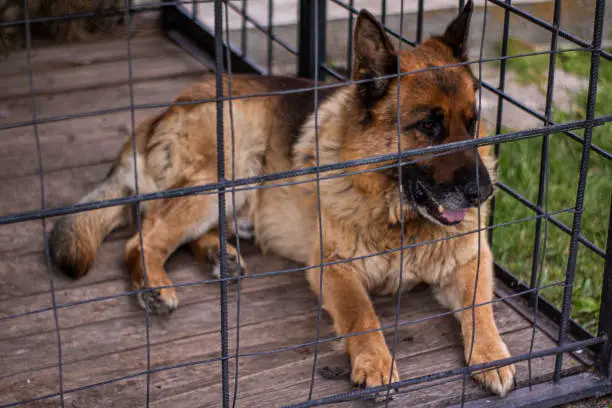
The Last Chance in Cage 402
The shelter staff called it “The Red Zone.” It was the last hallway on the left, where the air smelled of bleach and hopelessness. That’s where they kept the dogs that weren’t going home.
PART 1: THE MONSTER IN CAGE 402
Officer Caleb Hart had walked into plenty of dangerous situations—drug busts, domestic disputes, bar fights that spilled out into the street with broken bottles and rage—but nothing made his stomach knot quite like the sound coming from Cage 402.
It wasn’t a bark. It was a guttural, wet snarl that vibrated through the concrete floor and seemed to shake the very walls of the county animal shelter.
“I’m telling you, Officer,” the shelter volunteer, a young woman named Sarah with kind eyes that had seen too much suffering, said with a tremor in her voice. “You don’t want to go back there. He’s been returned three times in two months. He bit a handler yesterday. Drew blood. He’s… he’s scheduled to be put down on Friday.”
Friday. Three days from now. Seventy-two hours before they’d inject chemicals into the veins of a creature who’d done nothing wrong except be born with teeth and the will to use them.
Caleb didn’t stop walking. He couldn’t.
Behind him, the soft whir of electric wheelchair wheels hummed against the scuffed linoleum floor—a sound that had become the soundtrack to Caleb’s life over the past five years.
“Keep moving,” the rough, gravelly voice of his father, Retired Sergeant Major Luke Hart, commanded from the chair.
Luke hadn’t left his house in six months. He hadn’t smiled in five years. Not since the IED in Kandahar took his legs, his career, and apparently every reason he had to keep living. The VA had tried everything: therapy, medication, group sessions. Luke had sat through them all with the same dead expression, the same thousand-yard stare that looked through people instead of at them.
But three days ago, Caleb had found something in the back of his dad’s garage while looking for a socket wrench.
It was an old, chewed-up leather collar. Military grade. Worn smooth in places where a dog’s neck had rubbed against it for years. It was wrapped carefully—almost reverently—in a dress uniform jacket that smelled of mothballs and memories.
Stamped into the leather in faded letters was a name: “GUNNER.”
Gunner had been Luke’s military working dog overseas. A Belgian Malinois who’d saved Luke’s unit seven times before stepping on the same IED that took Luke’s legs. The dog had died in Luke’s arms, and Luke had carried that death with him every single day since.
Caleb had put the collar in his father’s lap without saying a word. He expected his dad to yell, to throw it away, to retreat back into the silence that had become his armor.
Instead, the old man had wept. Silently at first, his shoulders shaking with a grief so heavy it sucked the air out of the room. Then audibly, with great heaving sobs that sounded like they were being torn from somewhere deep in his chest.
“We’re going to the shelter,” Luke had said the next morning. It was the first decision he’d made in years.
Now, they stood in front of Cage 402.
Inside, a massive German Shepherd was throwing himself against the chain-link fence with such force that the metal rattled and bent. His teeth were bared in a snarl that exposed every incisor, saliva flying in strings, eyes rolling back white in a frenzy of pure, unadulterated rage. Most people saw a monster. Most people saw a liability, a lawsuit waiting to happen, a headline about another dangerous dog attack.
Caleb put his hand on his holster, instinct taking over from years of training. “Dad, this isn’t safe. Let’s look at the labs in Building B. Or those retrievers Sarah showed us. The golden mix looked sweet—”
Luke ignored him. He rolled his wheelchair right up to the bright orange “DANGER: DO NOT ENTER” sign that had been zip-tied to the cage door.
The dog froze mid-lunge. He locked eyes with the man in the chair, and something passed between them—some recognition that Caleb couldn’t see but could feel in the sudden electric silence.
The Shepherd’s hackles were raised, a ridge of dark fur standing straight up along his spine like the dorsal fin of a shark. He let out a low, rumbling growl that sounded like thunder before a storm.
“Open it,” Luke said quietly.
Sarah, the volunteer, actually dropped her clipboard. It clattered to the concrete floor. “Sir, I can’t. Liability protocols. Insurance. If I open that gate and he attacks you, the shelter could be sued into oblivion. I could lose my job. You could lose your life.”
“He won’t attack,” Luke said softly. The hardness in his voice—the sergeant major’s bark that could make grown men snap to attention—was gone, replaced by something Caleb hadn’t heard since he was a kid listening to bedtime stories. Curiosity. Wonder. “Look at his eyes, Caleb. Really look.”
Caleb looked. He tried to see past the teeth and the noise and the violence. And then, for a split second, he saw it.
The dog wasn’t looking at them with malice. He was trembling. His tail was tucked so far between his legs it was touching his stomach. His pupils were dilated, his breathing rapid and shallow. He wasn’t guarding his territory.
He was terrified.
“He’s wearing a uniform,” Luke whispered, nodding at Caleb’s police blues. “That’s why he hates you. But he’s looking at me different. See how his ears keep flicking toward me? How he’s not trying to go through the fence, just make noise?”
“Dad, if that dog latches onto you…” Caleb started, sweat pricking his hairline despite the cool air of the shelter.
“Open the damn gate,” Luke ordered, the Sergeant Major tone returning. “That’s an order, son. If he wanted to kill me, he’d be trying to go over the fence. He’s trying to back into the corner. He’s defending a position. He’s waiting for orders.”
Reluctantly, terrified of what she was about to do, Sarah pulled the heavy key ring from her belt. Her hands shook as she fitted the key into the padlock.
Clack.
The sound echoed like a gunshot in the concrete hallway.
The gate swung open three inches.
The German Shepherd stopped growling. The silence was sudden and deafening, like the moment after an explosion when your ears are ringing and the world feels muffled and wrong.
The dog lowered his head, his amber eyes—the color of whiskey and fire—flicking between the open gap and the man in the wheelchair.
Luke didn’t flinch. He didn’t pull back. He did the one thing you are never, ever supposed to do with an aggressive dog.
He leaned forward, exposing his throat, and extended a scarred, trembling hand into the gap.
“Dad!” Caleb hissed, his hand moving to his weapon.
“Hush,” Luke murmured, his voice dropping to barely above a whisper. “Come here, soldier. Report in. It’s okay. You’re okay now.”
PART 2: THE HAND TEST
The air in the shelter hallway was so thick with tension you could have cut it with a knife. Sarah had her hands pressed over her mouth, her eyes wide with the certainty of impending disaster. Caleb had shifted his stance, weight on the balls of his feet, ready to kick the gate shut or draw his weapon if the animal lunged.
But inside the cage, time seemed to warp and stretch like taffy.
Luke Hart sat motionless in his wheelchair, his hand hovering in the dead air between safety and violence. He didn’t make a sound. He didn’t make direct eye contact, which dogs perceive as a challenge, a threat. He looked slightly to the side, his peripheral vision locked on the animal.
“Easy now,” Luke whispered. It was a sound that didn’t just come from his throat; it came from his chest, his diaphragm, a deep resonant rumble that he used to use in the dusty, chaotic streets of Kandahar when approaching scared civilians or wounded soldiers. “I know. I know they hurt you. I know you’re tired of fighting. I’m tired too.”
The German Shepherd stared at the hand. Up close, Caleb could see the damage that had been done to this animal. A scar ran down the side of the dog’s snout—a jagged line of pink skin where fur refused to grow. Someone had hit this dog. Recently. And often. His ribs showed through his coat. His paws were raw, the pads cracked and bleeding from pacing on concrete.
The dog let out a sharp exhalation of air through his nose. A huff that sounded almost like a question.
He took one step forward. Then another.
Caleb held his breath. Don’t snap. Please God, don’t snap.
The dog stretched his neck, sniffing the air around Luke’s fingers. He smelled the gun oil that Luke used to clean the pistol he kept in his nightstand but never talked about. The old tobacco from the pipe Luke hadn’t smoked in years but still carried in his jacket pocket. The faint medical scent of the VA hospital that always clung to Luke’s clothes no matter how many times they were washed.
But mostly, he smelled the absence of fear.
Animals know when you’re afraid. It triggers their prey drive, their fight response. Fear smells like adrenaline and sweat and the chemical change in human breath. But Luke Hart had nothing left to fear. He had lost his legs, his friends, his purpose, his will to live. A dog bite was nothing compared to the ghosts he lived with every single day.
The Shepherd lowered his head. His ears, previously pinned back flat against his skull in aggression, swiveled forward.
And then, slowly, agonizingly, he pressed his wet nose into the palm of Luke’s hand.
A collective breath released in the hallway. Sarah let out a small sob.
Luke didn’t pull away. He didn’t cheer or move suddenly. He simply curled his fingers gently, scratching the thick fur behind the dog’s ear with the kind of automatic muscle memory that comes from doing something a thousand times before.
“There you are,” Luke whispered, a single tear cutting a track through the gray stubble on his cheek. “You were just waiting for backup, weren’t you? Just holding the position until your unit came back.”
The dog let out a long, shuddering sigh—the kind of breath you take when you’ve been holding tension for so long you forgot what it felt like to relax—and leaned his entire body weight against the chain-link fence, pressing as close to Luke as the barrier would allow.
“What’s his name?” Luke asked, his voice rough with emotion.
Sarah lowered her hands, stunned into stillness. “The paperwork says ‘Brutus.’ But… he never responds to it. The first family that adopted him said the previous owner called him that. He was surrendered after attacking a meter reader.”
Luke scoffed, a sound of disgust. “Brutus. That’s a name for a bully, for a fighting dog. This isn’t a bully. This is a shadow. Look at him. He’s just trying to hide in the dark, trying to disappear.”
Luke looked up at Caleb, and for the first time in five years, there was life in his eyes. Purpose.
“Get the leash, son. Shadow is coming home.”
PART 3: THE PAPERWORK
The paperwork took an hour and felt like a trial. They had to sign waivers acknowledging that Shadow was a “Level 3 Bite Risk”—the highest category short of immediate euthanasia. They had to agree to muzzle laws, to posted warnings on their property, to immediate reporting of any incidents. Sarah kept apologizing, kept giving them chances to back out.
“Most people change their minds,” she said softly as they signed the tenth form. “When they see everything in writing, when they realize the liability, the responsibility. Most people walk away.”
“Most people aren’t us,” Luke said simply.
Getting Shadow into the truck was a military operation. The dog refused to let Caleb near him. The moment Caleb, in his police uniform, stepped within five feet, Shadow’s lip curled and the low growl returned—a sound like an engine idling, ready to roar into action.
“Back off, Caleb,” Luke said. “Take off the uniform shirt.”
“Dad, it’s freezing out here.”
“Take it off.”
Caleb stripped down to his white undershirt in the parking lot, the January wind cutting through the thin fabric. He tossed the uniform into the truck bed, where Shadow couldn’t see it.
“Now open the door,” Luke commanded.
Luke wheeled himself to the open door of the modified van—the one with the ramp and the wheelchair locks that had cost more than Caleb’s first car. He patted the passenger seat. “Load up, Shadow. Time to go home.”
The dog hesitated, looking at the open space, at the unfamiliar interior, then at the wheelchair. His whole body was shaking, not from aggression now, but from fear. Fear of the unknown. Fear of another betrayal.
“I know,” Luke said quietly. “I know you’ve been hurt. But we’re not going to hurt you. I promise you that. On Gunner’s memory, I promise.”
With a surprisingly graceful leap for a malnourished animal, Shadow jumped into the van. He didn’t sit on the seat. He curled up on the floorboard, directly next to where Luke’s wheelchair locked into place, making himself as small as possible.
PART 4: THE FIRST NIGHT
The drive home was forty-five minutes of silence. Caleb drove carefully, watching the rearview mirror more than the road. Shadow didn’t sleep. His eyes were open, scanning the passing cars, scanning Caleb’s movements, but always returning to rest on Luke’s paralyzed legs.
“He was abused by a cop,” Caleb said finally, breaking the silence. “Or a security guard. Someone in a uniform with authority who hurt him.”
“Yeah,” Luke replied, staring out the window at the strip malls and gas stations rolling past. “Or maybe he just saw too many men in uniforms doing bad things. It happens. In war, in peace. Uniforms can mean safety or they can mean violence. Depends on who’s wearing them.”
“Dad, are you sure about this? I work twelve-hour shifts. Sometimes sixteen with overtime. You’re alone in the house most of the time. If he turns on you, if something triggers him…”
“He won’t turn,” Luke said firmly, with absolute certainty. “He needs a mission, Caleb. Dogs like this… they die without a job. His job right now is figuring out if he’s safe. My job is showing him he is.”
They pulled into the driveway of the small ranch house on Maple Street. It was the house Caleb had grown up in, the house his mother had loved before cancer took her eight years ago. The house that had felt like a tomb since Luke came home from Walter Reed in a wheelchair.
The first night was a disaster.
Shadow refused to enter the house. He paced the perimeter of the backyard, panting, eyes darting at the shadows of the oak trees, at the fence line, at the dark windows of the neighboring houses. Every time a car drove past on the main road, he barked—a sharp, defensive sound that echoed through the quiet suburban street.
Caleb tried to coax him in with steak—a good ribeye that he’d been saving for a special occasion. Shadow ignored it.
“Leave the back door open,” Luke said.
“Dad, the bugs. The heat bill. It’s January.”
“Leave it open.”
Luke parked his wheelchair in the living room, facing the open sliding glass door. He turned off the TV that had been running nonstop for months, playing old westerns and war movies that Luke never really watched. He turned off all the lights. He just sat there in the dark, waiting.
Caleb went upstairs to his room but didn’t sleep. He sat on the edge of his bed, still in his undershirt and jeans, listening. He had his service weapon on the nightstand—a grim precaution he hated himself for taking, but after seeing Shadow’s teeth, after watching him throw himself against that cage, he couldn’t shake the fear that his father had brought home something too broken to fix.
Around 2:00 AM, the pacing stopped.
The sudden silence was more alarming than the noise. Caleb crept to the landing and looked down into the living room.
The moonlight spilled through the open door, painting everything in shades of silver and blue. Luke had fallen asleep in his chair, his head lolling to the side, his mouth slightly open, snoring softly. And there, lying at the foot of the wheelchair, facing outward toward the door like a gargoyle guarding a castle, was Shadow.
The dog wasn’t sleeping. His ears were swiveling like radar dishes, tracking sounds Caleb couldn’t hear. He was on guard duty. Protecting his position. Watching over the man in the chair.
For the first time in years, Luke Hart wasn’t alone in the dark.
PART 5: THE MINEFIELD
The first week was a minefield of triggers and trauma. Shadow was jumpy. If Caleb dropped a spoon in the kitchen, Shadow would scramble, claws clicking frantically on the hardwood, trying to find a corner to back into. If someone rang the doorbell, Shadow would go into full alert mode, barking until Luke called him off.
But slowly, patterns emerged. Shadow wouldn’t eat unless Luke ate first. He wouldn’t go outside unless Luke went outside. He slept with one eye open, always watching, always ready.
“He thinks he’s working,” Luke explained to Caleb on Day 5. “Military working dogs don’t retire in their heads. They’re always on duty. Shadow’s just waiting for orders.”
“What orders, Dad? He’s not in the military. He’s a pet.”
Luke looked at his son with something close to pity. “He’s not a pet, Caleb. He’s a soldier without a war. That’s the most dangerous kind.”
But the real test came on Day 10.
It was the Fourth of July weekend. Caleb had forgotten—he’d been so focused on Shadow and his father that the holiday had completely slipped his mind.
He was in the kitchen making coffee, watching the morning news, when the neighbor’s kids—the Morrison twins who were always causing trouble—set off a string of Black Cat firecrackers in their driveway.
POP-POP-POP-POP-BANG!
The sound was unmistakable. Indistinguishable from small arms fire.
In the living room, Luke screamed.
It wasn’t a scream of pain. It was the scream of a man being transported back to a dusty road in Helmand Province, to the moment when his Humvee hit the pressure plate and the world exploded in fire and shrapnel. Luke threw his hands over his head, curling forward in his wheelchair, hyperventilating, his face going pale.
“Get down! Incoming! Get down! Medic! I need a medic!”
Caleb dropped his mug. It shattered on the tile floor, sending coffee and ceramic shards everywhere. He ran toward the living room, his heart pounding.
“Dad! Dad, it’s just fireworks! You’re home! You’re safe!”
But before Caleb could reach him, before he could get to his father’s side, a blur of black and tan fur intercepted him.
Shadow slammed into Caleb’s chest with the force of a linebacker, barking ferociously, driving him backward.
“Shadow, no!” Caleb yelled, raising his hands defensively, terror flooding his system. This is it. This is where he attacks. Where everything falls apart.
But the dog wasn’t attacking Caleb.
He was blocking him.
Shadow spun around and rushed to Luke, his movements purposeful and precise.
Caleb watched, stunned, as the “dangerous” dog did something extraordinary.
Shadow didn’t cower. He didn’t hide. He didn’t add to the chaos.
He crawled under the footrests of the wheelchair and pressed his heavy body hard against Luke’s calves—against legs that couldn’t feel touch but could feel pressure, weight, presence. He let out a low, constant whine—not a sound of distress, but a grounding sound, a tether to reality.
Luke was shaking, sobbing, lost in a flashback that had dragged him back to Afghanistan.
“I can’t feel my legs… I can’t move… Rogers is down, Rogers is down…”
Shadow stood up on his hind legs, placing his front paws gently on Luke’s knees. He licked the tears streaming down the old soldier’s face. He nudged Luke’s hands away from his head, forcing Luke to touch his fur, to feel the solid warmth of a living creature.
“He’s here, Dad,” Caleb whispered from the doorway, understanding flooding through him. “Shadow’s here. He’s grounding you. He’s bringing you back.”
Luke’s fingers tangled in the coarse fur. He gasped for air, his eyes focusing slowly on the amber eyes of the dog staring up at him. The terror of the memory began to recede, replaced by the warm, living reality of the animal in front of him.
“Shadow,” Luke choked out, his voice breaking. “I’m okay. I’m okay. We’re home.”
The dog didn’t move until Luke’s breathing slowed, until the trembling stopped, until the old soldier’s hands steadied. Only then did Shadow step down, circle the wheelchair once in a protective perimeter check, and sit down, leaning his back against the wheel.
Caleb stood in the doorway, tears streaming down his own face, watching a rescue dog rescue the man who’d saved him.
PART 6: PUBLIC ENEMY
Word got around the neighborhood fast. Small towns are like that—information spreads faster than wildfire. The “crazy old man in the wheelchair” had a “killer wolf dog.” People crossed the street when they saw Luke wheeling down the sidewalk with Shadow trotting perfectly at his heel. Parents pulled their children closer. The HOA sent a letter about “dangerous animals” and “property values.”
One afternoon, three weeks after bringing Shadow home, they were at the small community park near the library. Caleb was there, out of uniform for once, wearing jeans and a Blackhawks jersey, tossing a tennis ball that Shadow had finally learned to chase instead of just stare at suspiciously.
A group of teenagers was skating nearby, practicing kickflips and ollies on the half-pipe. One of them—a loud kid with a skateboard covered in band stickers—lost control. The board shot out from under his feet and rolled loudly across the pavement, slamming into the metal rim of Luke’s wheelchair with a loud CLANG.
The sound was sharp, sudden, metallic.
Luke jerked. Shadow moved instantly.
The dog placed himself between the wheelchair and the approaching teenager, who was running over to retrieve his board. Shadow didn’t bark. He didn’t growl. He stood “tall”—chest out, ears forward, weight balanced, a silent imposing wall of muscle and teeth.
The teenager froze mid-step, his eyes going wide.
“Whoa, dude. Call off your beast.”
Caleb started to run over, worried Shadow would bite, that they’d end up in court, that everything would fall apart.
“Stand down, Shadow,” Luke said calmly. His voice was steady. Confident. Command voice.
The dog immediately sat. He didn’t take his eyes off the boy—still tracking, still assessing the threat level—but the aggressive posture was gone.
The teenager blinked, looking between the dog and the man in the wheelchair.
“That dog is trained, man. Like, seriously trained. I thought he was supposed to be crazy. My mom said you had a dangerous dog.”
Luke smiled—a real smile, one that reached his eyes and showed teeth.
“He’s not crazy, son. He’s a veteran. He’s just protecting his unit. That’s his job.”
The boy looked at the wheelchair, then at the dog, then at Luke. Understanding crossed his young face.
“Cool,” he muttered, picking up his skateboard. “Sorry about the noise, sir. I didn’t mean to scare you.”
“You didn’t scare me,” Luke said. “You startled me. There’s a difference. Shadow knows the difference too.”
After the kid left, Caleb sat down on the bench next to his father’s wheelchair.
“He called you ‘sir,'” Caleb said quietly.
“Yeah. He did.” Luke was scratching Shadow behind the ears, and the dog’s eyes were half-closed in contentment.
“You’re different, Dad. Since Shadow. You’re… here again.”
Luke was quiet for a long moment, watching the teenagers skate, watching the mothers push strollers, watching normal life happen in a world that had felt unreachable for so long.
“When I lost my legs,” Luke said finally, “I lost my purpose. I wasn’t a soldier anymore. I couldn’t deploy. Couldn’t lead men. Couldn’t serve. I was just… broken. Taking up space.”
He looked down at Shadow, who was now lying at his feet, watchful and calm.
“Shadow was broken too. The world wanted to throw us both away. Defective parts. But he gave me a mission again, Caleb. I wake up every morning because he needs me. I leave the house because he needs exercise. I talk to people because they ask about him. He didn’t fix me. But he gave me a reason to try.”
PART 7: THE TEST
Six months later.
The snow was falling in thick drifts outside, covering the Chicago suburbs in a blanket of white that muffled sound and made everything feel distant and peaceful. Inside the Hart home, the fireplace was crackling, throwing orange light across the living room.
Caleb walked in from a double shift at the precinct—sixteen hours of traffic stops, domestics, and paperwork. He was exhausted, his feet aching, his mind foggy. Usually, he would change in the garage to avoid upsetting Shadow, would strip off his uniform before entering the house.
But tonight, he was too tired. He just wanted to sit down, to eat something, to sleep.
He walked into the living room in his full uniform. Tactical vest with the badge gleaming. Radio crackling with dispatch chatter. Service weapon on his hip.
Luke was reading a book by the fire—some Tom Clancy thriller he’d read three times before. Shadow was asleep on the rug, his body stretched out in a position that would have been unthinkable six months ago when every muscle was coiled tight with tension.
When Caleb entered, Shadow lifted his head. He looked at the uniform—the dark blue that had once triggered rage and fear. He looked at the badge that caught the firelight. He looked at the gun on Caleb’s hip.
For a long moment, nobody moved.
Then, for the first time since that day in the shelter, Shadow’s tail moved.
Not a wag exactly. Just a small thump against the rug.
Shadow stood up, stretched in that long elegant way dogs do, and walked over to Caleb. He sniffed his boots—the ones that had walked through crime scenes and homeless camps and the worst parts of the city. He sniffed the gun oil and the coffee and the fast food Caleb had grabbed at midnight.
And then Shadow’s tail wagged. A full wag. Side to side. Happy.
“He knows you’re one of the good ones now,” Luke said from his chair, not looking up from his book but smiling.
Caleb knelt down, ignoring the stiffness in his knees, ignoring the protest of his tired muscles. He wrapped his arms around the dog’s thick neck. Shadow leaned in, resting his heavy head on Caleb’s shoulder, his breath warm against Caleb’s ear.
“You saved him, Dad,” Caleb said, his voice thick with emotion.
Luke closed his book. He looked at his legs—useless and still, the source of so much grief and anger—and then at the vibrant, powerful animal that had given him a reason to wake up every morning.
“No,” Luke said softly. “I didn’t save him. We saved each other. The world wanted to throw us both away, Caleb. Broken parts. Defective gear. Too damaged to be useful.”
Luke whistled—a low, two-note sound—and Shadow trotted back to his side, resting his chin on Luke’s knee, looking up at him with those amber eyes full of trust and love.
“But the thing about broken parts,” Luke added, reaching down to scratch Shadow’s ears, “is that sometimes, they fit together to make something stronger than either one was before. Sometimes being broken is just the first step to being whole again.”
Caleb stood up and watched them—the old soldier and the discarded dog. Two warriors who had walked through the fire and found peace in the ashes. Two souls who had been deemed unworthy by a world that measures value in productivity and profit, but who had found worth in each other.
Outside, the snow continued to fall, covering the world in silence and peace.
Inside, a retired sergeant and a rescue dog sat by the fire, neither one alone anymore.
EPILOGUE: ONE YEAR LATER
The county shelter held a fundraiser every year—a “Second Chances” gala where they honored people who’d adopted animals from the Red Zone.
Luke didn’t want to go. He hated crowds, hated attention, hated the pitying looks people gave him when they saw the wheelchair.
But Caleb convinced him. “Shadow deserves the recognition, Dad. He saved your life. Let people see what second chances look like.”
They arrived at the community center on a warm September evening. The parking lot was full. Inside, there were speeches and slideshows and stories about dogs and cats who’d found homes.
When they called Luke’s name, asking him to come to the stage to accept an award for “Most Inspiring Adoption,” Luke wheeled himself to the front of the room. Shadow walked beside him, off-leash, perfectly heeled.
Luke looked out at the crowd—a hundred faces looking back at him with curiosity and expectation.
“A year ago,” Luke began, his voice steady but soft, “I was ready to die. Not dramatically. Not with a gun or pills. Just slowly. Fading away in a house that felt like a tomb. I had nothing to live for. Nothing to fight for.”
He looked down at Shadow, who was sitting perfectly still, watching the crowd with calm alert eyes.
“They told me this dog was dangerous. That he was aggressive. That he’d been returned three times and had bitten someone. They told me he was scheduled to be put down because he was too broken to save.”
Luke smiled.
“But the thing is, dangerous and damaged aren’t the same thing. Shadow wasn’t trying to hurt people. He was trying to survive people who’d hurt him. There’s a difference.”
The room was silent.
“When I saw him in that cage, throwing himself at the fence, I didn’t see a monster. I saw a soldier holding a position, waiting for his unit to come back. I saw myself.”
Luke’s voice cracked, but he pushed through.
“We’re taught to throw away broken things. Broken machines. Broken bodies. Broken minds. It’s easier than fixing them. Cheaper than trying. But Shadow taught me that broken doesn’t mean worthless. It just means you need the right person to see your value.”
He looked up at the crowd.
“I didn’t save Shadow. He saved me. He gave me a mission when I thought my service was over. He gave me purpose when I thought I was useless. He showed me that the fight isn’t over just because you’ve been wounded.”
Luke whistled, and Shadow stood, placing one paw on Luke’s knee.
“So if you’re thinking about adopting from the Red Zone, if you’re looking at a dog everyone else has given up on, I want you to know something: that dog might be the best decision you ever make. Because sometimes the most broken things make the strongest bonds. Sometimes the animals nobody wants are exactly what we need.”
The room erupted in applause.
But Luke didn’t hear it.
He was looking at Shadow, at the dog who’d been hours away from death, and seeing a future neither of them thought they’d have.
Later that night, after the awards and the photos and the handshakes, Caleb drove them home. Shadow was in his usual spot—on the floorboard next to Luke’s wheelchair, head resting on his paws, eyes half-closed.
“You did good tonight, Dad,” Caleb said.
“Shadow did good,” Luke corrected. “I just told the truth.”
When they got home, Luke wheeled himself to the backyard. It was a clear night, stars visible despite the city lights. Shadow followed, as he always did.
Luke looked up at the sky, at the same stars he’d looked at in Afghanistan when the world was burning and the future felt impossible.
“I hope you can see this, Gunner,” Luke whispered to the night. “I hope you know I didn’t forget you. I never could. But Shadow needed me. And I needed him. And I think maybe you sent him to me. One last mission.”
Shadow pressed against his leg—the one that couldn’t feel but somehow did.
They sat there together, a man and a dog, two survivors of different wars, sharing the silence and the stars.
And for the first time in years, Luke Hart felt something he thought he’d lost forever.
Hope.
THE END
Sometimes the things we rescue end up rescuing us. Sometimes the most damaged souls make the strongest healers. And sometimes, the dog everyone gives up on is exactly the miracle someone needs.

Lila Hart is a dedicated Digital Archivist and Research Specialist with a keen eye for preserving and curating meaningful content. At TheArchivists, she specializes in organizing and managing digital archives, ensuring that valuable stories and historical moments are accessible for generations to come.
Lila earned her degree in History and Archival Studies from the University of Edinburgh, where she cultivated her passion for documenting the past and preserving cultural heritage. Her expertise lies in combining traditional archival techniques with modern digital tools, allowing her to create comprehensive and engaging collections that resonate with audiences worldwide.
At TheArchivists, Lila is known for her meticulous attention to detail and her ability to uncover hidden gems within extensive archives. Her work is praised for its depth, authenticity, and contribution to the preservation of knowledge in the digital age.
Driven by a commitment to preserving stories that matter, Lila is passionate about exploring the intersection of history and technology. Her goal is to ensure that every piece of content she handles reflects the richness of human experiences and remains a source of inspiration for years to come.