The call to end my final mission came faster than I expected. One moment I was reviewing security protocols at our base in Afghanistan; the next, I was packing my duffel bag. Forty years in uniform had taught me to move quickly, but this felt different. I wasn’t just leaving a mission—I was leaving behind the only life I’d known since I was eighteen.
After four decades of service, Colonel Shirley Grant was officially retiring, and I hadn’t told anyone, not even my son, Mark.
The overnight flight to Miami stretched like an endless ribbon of darkness. I stared out at the thin line of dawn across the Atlantic, wondering if Mark would be at work when I knocked on his door. I hadn’t seen him in nearly two years—our schedules always pulling in opposite directions. I pictured his smile, the way his eyes crinkled at the corners just like his father’s had.
When the taxi pulled onto Mark’s street in Naples, something in me shifted. The well-maintained homes looked peaceful in the morning light, but Mark’s house stood out immediately. The grass had grown wild, the mailbox tilted sideways and stuffed with envelopes, all the curtains drawn tight. The cheerful blue paint I’d helped him choose years ago now peeled in places.
It didn’t look like a home. It looked abandoned.
“Colonel Grant? Is that you?”
Mrs. Wilson—Mark’s neighbor—stood in her driveway, her face pale. “I thought I’d surprise Mark,” I said, walking toward her.
“Oh, Shirley,” she said, my first name strange on her lips after years of calling me Colonel. “You don’t know, do you?”
My fingers tightened around my father’s pocket watch in my jacket. “Know what?”
“Mark’s been in the ICU for two weeks. They took him by ambulance in the middle of the night.” She hesitated, disgust flashing across her face. “And Jennifer’s been on a yacht in the Keys, posting pictures all over Facebook—parties, shopping sprees. All while Mark’s been…”
Her voice trailed off, unable to finish.
I don’t remember getting back into the taxi. One moment I was standing in Mrs. Wilson’s garden; the next, I was pushing through Naples General Hospital’s sliding doors.
At the fifth floor ICU, a nurse gave Mark’s name with recognition, something in her expression making my stomach drop. “Room 512,” she said quietly. “He asked about his wife every day that first week.”
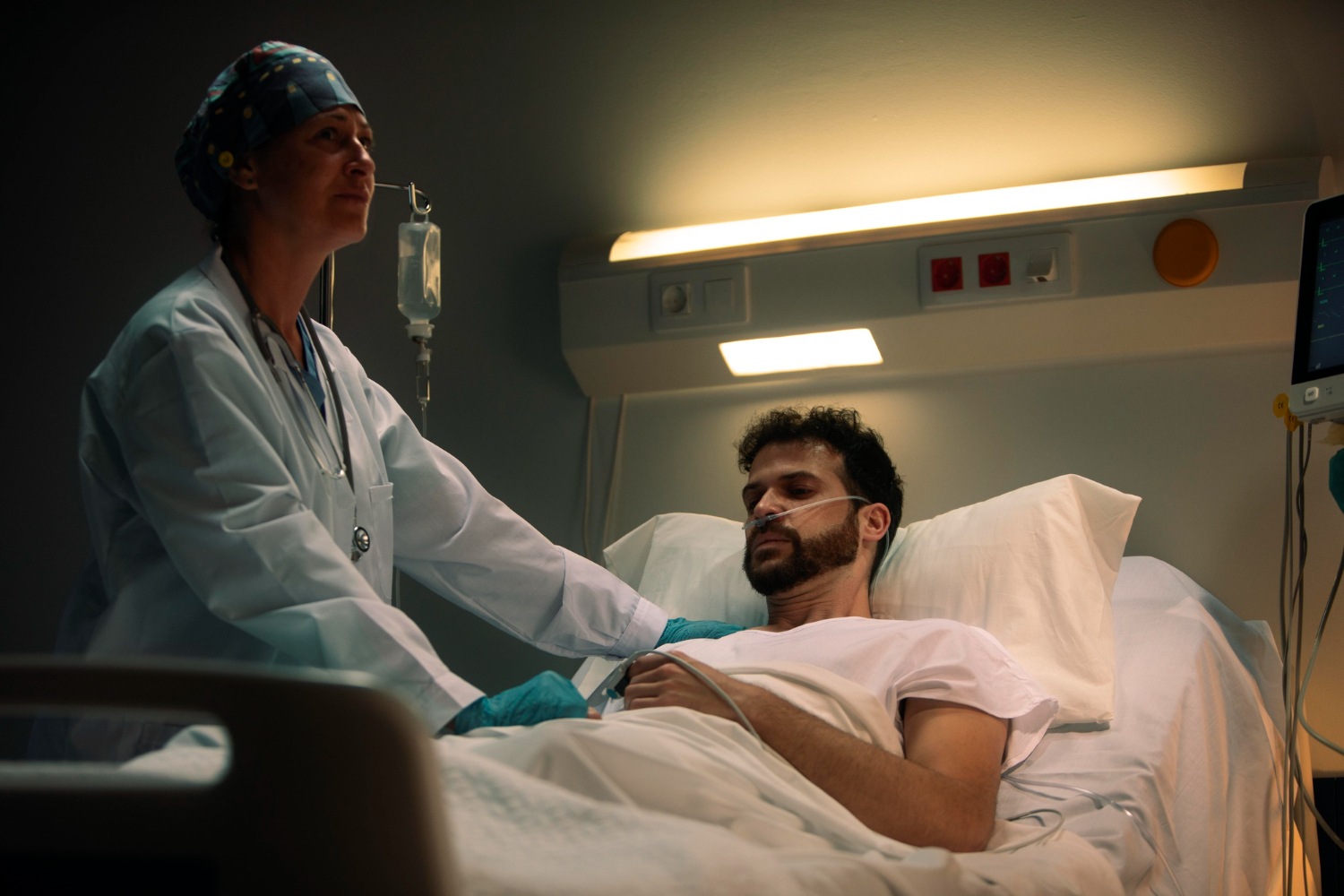
When I stepped into the room, my son lay on the bed, his skin sallow and stretched too tight across his cheekbones. His frame—once broad and strong like his father’s—seemed shrunken beneath the hospital gown. Tubes and wires traced over him like a cruel map.
Dr. Thomas Reynolds turned from the monitor. “I’m his mother,” I managed. “What happened to my son?”
“Mr. Grant has advanced gastric cancer,” he said bluntly. “Terminal. It’s metastasized to his liver and lymph nodes. He’s been here two weeks. No visitors.”
He paused. “We’ve called his wife multiple times. The first few days, she said she was out of town. After that, straight to voicemail.”
I took Mark’s cold hand. His eyelids fluttered open—the same hazel eyes I’d watched light up when he was a boy.
“Mom,” he whispered. “You’re really here.”
“I’m here, Mark. I’m not going anywhere.”
His eyes locked with mine, sudden clarity shining through. “I love you, Mom.”
Before I could answer, the monitor’s steady beeping turned into one long, piercing tone. Dr. Reynolds moved with practiced urgency. Someone guided me into the hall.
“Code blue, ICU, room 512.”
I stood frozen, hearing the flurry of commands, the thud of hands against my son’s chest. Minutes later, Dr. Reynolds stepped out, shoulders slumped.
“I’m sorry, Colonel Grant. We did everything we could.”
I had come home too late.
The taxi driver kept glancing at me in the rearview mirror as we drove to Mark’s house. The hospital had given me Mark’s personal effects in a plastic bag: his wallet, his phone with a dead battery, his wedding band.
The keys felt foreign in my hand as I stepped onto the porch. Inside, the air was stale. Empty glasses sat on the coffee table covered in dust. A half-empty bottle of scotch stood beside them.
The framed photos I remembered—Mark’s graduation, our fishing trip, his wedding day—were gone from the mantle.
In the kitchen, takeout containers filled the sink. On the counter, I found mail Mrs. Wilson had brought in: utility shutoff warnings, overdue credit cards, late mortgage notices. Mark had never been careless with money.
Among the papers, I found receipts. A yacht rental in Key West: seventy-five thousand dollars, dated days after Mark was admitted to the ICU. Cartier jewelry: fifty thousand. Oceanfront dinners, luxury boutiques—all charged to Mark’s credit card while he lay dying alone.
Jennifer’s face filled my mind—the smile from their wedding photo, the laugh I’d heard during our few video calls. I had trusted her to stand beside my son.
I found Mark’s phone charger and powered on his phone. In an archived folder, a screenshot of a text conversation between Jennifer and someone named Alicia made my blood run cold.
Alicia: How much longer are you going to play housewife?
Jennifer: Might as well enjoy his money while I can. Doctor says he won’t last long. Already started moving funds to my personal account.
The timestamp was from five weeks ago.
I pulled out my phone and called Jennifer. It rang once, then connected to video.
Jennifer’s face appeared, framed by blinding yacht deck white. Music thumped in the background. She wore oversized sunglasses, holding a bright orange drink.
“Well, look who finally decided to call,” she said, smiling.
“Mark’s gone,” I said flatly.
Her smile faltered for a heartbeat. Then she shrugged, taking a sip. “It was inevitable. You know he’d been sick for a while.”
“And the charges on his card? The yacht rentals. The jewelry.”
She laughed. “I’m his wife, Shirley. What’s his is mine. That’s how marriage works.”
I studied her face, memorizing every detail. “Enjoy the view while it lasts. That was your last party on my dime.”
I ended the call.
Setting the phone down, I reached for my father’s pocket watch. It was time to make sure Jennifer never touched another cent.
I called Colonel Richard Hayes, my former commanding officer who’d moved into military financial administration after retirement. Within an hour, I was in his Tampa office with Mark’s power of attorney—signed eighteen months ago, properly notarized, never revoked.
“These were charged while he was in the ICU, unable to pick up a phone,” I said, showing him the yacht receipt.
Richard flipped through the papers, his brow tightening. “You don’t have to explain further. Let’s get to work.”
For the next forty minutes, he made call after call. He had connections at three major banks and knew exactly which phrases would cut through bureaucratic delays.
“Yes, I understand this is unusual,” he said to one bank manager. “But we have clear evidence of exploitation of an incapacitated individual and a valid power of attorney. I can have JAG counsel on the line in five minutes if you prefer.”
One by one, the accounts froze. Credit cards canceled. Automated payments suspended.
Before I even left the parking lot, my phone lit up with Jennifer’s name. I let it ring. The voicemails began—first angry rants, then softer, almost pleading.
“Shirley, please. I know you’re upset, but I just need access to cover some expenses. We can work this out.”
Not once did she say Mark’s name.
Back at Mark’s house, I searched systematically. In the study closet, I found a fireproof safe. The combination was my birth date—so like Mark it made my throat tighten.
Inside were USB drives labeled by year. I plugged in the most recent and found a video file dated three weeks ago.
Mark’s face filled the screen, gaunt and shadowed with pain.
“Hi, Mom. If you’re watching this, things have gone badly. I’ve been sick for a while—stage four gastric cancer. I should have told you, but you were finishing your deployment.”
He took a sip of water, wincing. “Jennifer’s not who I thought she was. I found out she’s been stealing from me. When I confronted her about my diagnosis, she asked how long I had left and if my life insurance was paid up.”
His voice broke, then strengthened. “I’ve gathered evidence. Account numbers, transfer records, recordings. It’s all on this drive. I’ve updated my will carefully so she wouldn’t find out. Contact the lawyer in the file named ‘Gibraltar.'”
He leaned closer, eyes fierce despite his weakness. “Mom, I know you’ll do what needs to be done. I love you. Always have.”
The video ended.
I sat motionless, the pain intense. Then, drawing on decades of discipline, I opened the Gibraltar file.
Inside was contact information for an estate fraud specialist, account numbers for trusts Mark had established, and recorded conversations where Jennifer all but admitted her intentions.
The most damning was an audio recording from hidden devices in their home.
Jennifer’s voice was unmistakable: “I don’t care what the doctor said. Now it’s too late, and I’m stuck watching you die slowly.”
Mark’s voice, weak but steady: “Is that all I am to you? A bank account?”
Jennifer’s cold laugh: “Don’t be dramatic. I married you for financial security. Your mother’s going to be so surprised when she finds out her perfect son didn’t leave her a penny.”
I called attorney Edward Martinez immediately. When he arrived an hour later, I played everything.
“This is extraordinary,” he said. “With this evidence, we can go after Jennifer for fraud, theft, and abuse of a disabled adult.”
The hearing for emergency control of Mark’s estate came swiftly. Jennifer sat across the courtroom in a black dress, the perfect grieving widow.
When Martinez played the recording of Jennifer discussing moving funds while Mark was dying, a murmur ran through the room. Judge Winters’s expression sharpened.
After both attorneys finished, the judge looked up. “Based on the evidence presented and the valid power of attorney, the court grants temporary control of all estate assets to Colonel Shirley Grant. Mrs. Jennifer Grant is prohibited from accessing any property or funds until further order.”
The gavel came down sharp and final.
Jennifer shot to her feet, her facade evaporating. “You can’t do this! That money is mine!”
“Control yourself, Mrs. Grant,” Judge Winters warned, “or I’ll hold you in contempt.”
Jennifer turned to me, eyes burning. “You’ll regret this.”
By the time we returned to Mark’s house, Jennifer had already broken in. The front door stood open, sounds of destruction inside.
She was throwing items into boxes and bags, the living room in chaos.
“Just collecting my things,” she sneered when she saw me. She deliberately dropped a framed photo of Mark. The glass shattered.
“The police are on their way,” Martinez said behind me. “And you’re trespassing on property you’ve been legally barred from entering.”
Jennifer’s face contorted with fury. “This house? It’s mortgaged to the hilt. I made sure of that. Good luck paying it off on your pension, Colonel.”
She stalked past me, pausing. “Mark was pathetic anyway—weak, just like his father probably was.”
The police arrived minutes later, filing charges for violating the court order.
Days later, Detective James Morales from the Financial Crimes Unit contacted me. “Your son may not have been the first victim. We’ve been tracking a pattern of similar cases across Florida.”
He showed me photographs of three women bearing striking resemblances to Jennifer with different hair colors.
“We believe she’s part of an organized group that targets vulnerable individuals with significant assets. Facial recognition flagged Mrs. Grant from your attorney’s report.”
The clinical description made my skin crawl. “What happens to the victims?”
Morales’s expression was grim. “In most cases, they die—sometimes from their existing condition, sometimes under circumstances that raise questions.”
“Are you saying Jennifer might have—”
“We’re requesting Mark’s medical records,” Morales said carefully. “Cancer creates a convenient cover.”
I thought of the prescription bottles in Mark’s bathroom, some nearly full when they should have been empty.
“I want to help,” I said. “Whatever you need.”
Detective Morales proposed I wear a wire when Jennifer inevitably tried to negotiate. Two days later, she showed up at Mark’s house with a conciliatory offer.
“We could settle this simply,” she said, sitting on my couch. “You keep some sentimental items. I maintain the lifestyle Mark wanted me to have.”
Her proposal was breathtaking: she would take the house, investments, and life insurance. I would receive fifty thousand dollars and personal effects.
“That seems uneven,” I said carefully.
“Mark and I were building a life together,” she explained smoothly. “He’d want me taken care of.”
I let her talk, steering the conversation where Morales had instructed.
“And the recordings where you discussed spending his money while he was dying?” I finally asked.
Jennifer’s facade cracked. “Those recordings are fake. You turned Mark against me.”
“So Mark wasn’t of sound mind when he made those recordings?” I pressed. “When exactly did his mental capacity become compromised, Jennifer? Before or after you started moving his money offshore?”
She stood abruptly. “This was a mistake.”
“The police are very interested in your previous identities and the other men who died after marrying you,” I said calmly.
The color drained from her face. “You’re bluffing.”
“Detective Morales sends his regards. He’s particularly interested in your connection to operations targeting wealthy, ill individuals across Florida.”
Raw panic flashed across her features before she composed herself. “Prove it. You have nothing but a mother’s desperate grief.”
“Perhaps. But the FBI doesn’t need to prove everything in court to freeze assets connected to organized crime. Those offshore accounts are already flagged.”
It was a calculated bluff, but Jennifer’s reaction confirmed its accuracy.
“This isn’t over,” she hissed. “You have no idea who you’re dealing with.”
“Actually, I think I do. You’re not the first predator I’ve encountered, Jennifer. Just the first who made the mistake of targeting my family.”
Jennifer was arrested the following morning on charges of grand theft, fraud, and exploitation of a vulnerable adult. The search of her hotel room yielded multiple phones, identification documents under different names, and evidence linking her to similar schemes in other states.
Three days later, Mark’s funeral filled the chapel at Naples Memorial Gardens. To my surprise, the pews were crowded with colleagues, neighbors, clients, and unexpectedly, a group of teenagers wearing pins shaped like drafting compasses.
After the service, a tall man in his forties approached. “Colonel Grant, I’m David Foster. I run the architecture mentorship program Mark was involved with.”
He gestured toward the teens. “These are some of his students. They asked to pay their respects.”
One by one, the teenagers shared stories about Mark’s influence. A girl named Maya showed me a sustainable housing design he’d helped her develop. A boy called Jamal described shadowing professionals at Mark’s firm.
“He believed in us,” Maya said simply. “When everyone else saw kids from the wrong side of town, he saw future architects.”
Foster handed me a card. “When you’re ready, we’d love to talk about continuing Mark’s legacy.”
For the first time since arriving in Naples, I felt a genuine connection to the life Mark had built—not the assets Jennifer had coveted, but the meaningful relationships and positive impact he’d created.
With Jennifer in custody awaiting trial and the estate matters resolved, I found myself at a crossroads. My retirement plan had been vague—perhaps travel, reconnect with old friends. Now those plans felt empty.
One morning, I found myself driving to the address on David Foster’s card. The Foster Architecture Mentorship Program operated from a renovated warehouse—an impressive space with walls covered in drawings and photographs.
Throughout the building, Mark appeared in many images: directing teens at drawing tables, examining models, laughing with students.
“We’re facing a challenge,” Foster explained. “The building owner is selling. Our lease ends in three months. Mark was helping us find new space and had started designing renovations for a potential replacement.”
Mark had mentioned the program in his final letter, calling it important unfinished business.
An idea began forming. Mark had established a trust for architectural education before he died. I was the executor. Perhaps there was a way to honor his wishes that helped the program continue.
Within a month, we had identified a suitable building. Using Mark’s preliminary designs, the project began taking shape. I found myself applying military logistical skills to civilian purposes: coordinating contractors, managing timelines, ensuring budgets were respected.
The work gave purpose to days that might otherwise have been consumed by grief.
Three months into the renovation, Thomas Wilson—Mrs. Wilson’s son—arrived with an unexpected request about veterans transitioning to civilian construction careers needing training opportunities.
Soon, a team of veterans was working alongside contractors, learning skills while contributing to a project that honored both Mark and the values of service we shared.
As the Mark Grant Center for Architectural Education neared completion, I received a visit from Dr. Chen, the oncologist who’d initially diagnosed Mark.
“There was one thing that always bothered me,” she said as we toured the center. “His condition deteriorated much faster than expected. I’ve reviewed his case several times.”
“The police investigation found evidence his medication was tampered with,” I told her quietly.
Dr. Chen’s expression darkened. “That would explain the unusual rate of decline.”
As she prepared to leave, she mentioned a patient at the pediatric oncology unit. “Eight years old with acute lymphoblastic leukemia. Ethan Chen—no relation. He’s responding well to treatment, but he has no family support. His mother passed away, his father is unavailable. He’s in foster care, but with his medical needs, placement is challenging.”
The story tugged at something in me, but before I could respond, Foster called me over to meet donors.
The following week, I found myself at Naples Children’s Hospital asking about volunteer opportunities. As the nurse explained the program, a thin boy in a wheelchair rounded the corner—dark hair cropped close, NASA T-shirt hanging loose, bright blue sneakers.
“Ethan, you’re supposed to be resting,” the nurse scolded.
“I am resting, just resting while moving,” he protested.
His spirit reminded me suddenly of Mark at that age—the same determination, the same gentle defiance.
“You were in the military,” Ethan said, studying me. “Real military.”
“Real military. Army. Forty years.”
His eyes widened. “Did you ever jump out of airplanes?”
“Seventeen times.”
“Cool. I want to be an astronaut. That’s why I have to beat this stupid cancer.”
The matter-of-fact way he discussed his illness struck me deeply. This was resilience in its purest form.
Before I knew it, I was reading The Right Stuff to Ethan and other children. That first visit became a regular commitment: three afternoons a week.
Six weeks later, Dr. Chen told me Ethan was approaching a critical phase requiring more intensive support. “The foster system is struggling to find appropriate placement.”
The unspoken question hung between us.
That evening in Mark’s study, I confronted the question directly. Was I capable of offering a child like Ethan what he needed?
My military pension provided financial stability. Mark’s house offered space. The center created a support network. And most importantly, my retirement meant I had the one thing I’d never had during Mark’s childhood: time.
The decision crystallized not as emotional impulse, but as practical assessment—capabilities matched to needs.
The process was extensive: background checks, home studies, training, evaluations. My military background expedited some aspects while complicating others.
“You’ve moved frequently,” the social worker noted. “Stability is crucial.”
“My career is concluded,” I replied. “I’ve established roots here. I’m not going anywhere.”
Three months later, I stood in Mark’s guest room—now transformed with deep blue walls, glow-in-the-dark constellations, bookshelves full of space exploration volumes, and Mark’s old telescope by the window.
When the day arrived to bring Ethan home, I was unexpectedly nervous. But when he wheeled himself in, his face lighting up as he explored, those doubts receded.
That first evening on the back patio, Ethan asked about Mark.
I told him about my son: the architect who loved designing spaces, the mentor who believed in young people, the man who faced illness with courage.
“His room is my room now?” Ethan asked.
“No. His room is still his room. Your room was made especially for you.”
Ethan considered this, then nodded seriously. “That’s good. People shouldn’t be replaced, but there can be new people, too.”
In that simple statement was wisdom that pierced to the heart of what I’d been learning: that grief and new beginnings could coexist.
The weeks brought challenges. Ethan’s treatment schedule was demanding—hospital visits three times weekly, days of nausea and exhaustion, nights of pain. But there were also triumphs: his first swim in the Gulf, his introduction to the Foster Center teens, his growing collection of books.
Six months after Ethan moved in, Martinez brought news of Jennifer’s final plea deal: twenty-five years for fraud, exploitation, and medical tampering based on forensic evidence. The investigation had identified seven other victims, with additional charges pending against her co-conspirators.
“It’s over,” Martinez said. “Justice—as much as the system can provide.”
That evening, Ethan and I walked to the beach at sunset, carrying a small frame with Mark’s photograph—a candid shot of him laughing at the Foster Center.
We found a spot where the tide kissed the sand. I set the frame down gently. Ethan placed a smooth stone beside it.
We stood there for a long while, letting the waves speak for us. I thought about how loss had led me to something I didn’t know I needed, how grief had opened doors rather than closing them.
When the horizon glowed with pink and gold, Ethan slipped his hand into mine.
“Ready to go home?” I asked.
Ethan nodded, his gaze still on the photograph and endless water. “Yeah. I think he’d like what we did with the place.”
Turning toward home, I knew the house we returned to was more than walls and windows. It was a place held together by new beginnings, built on honored endings—a foundation strong enough to support whatever came next.
And for the first time in a long time, that was enough.

Adrian Hawthorne is a celebrated author and dedicated archivist who finds inspiration in the hidden stories of the past. Educated at Oxford, he now works at the National Archives, where preserving history fuels his evocative writing. Balancing archival precision with creative storytelling, Adrian founded the Hawthorne Institute of Literary Arts to mentor emerging writers and honor the timeless art of narrative.
A very powerful story