The Unexpected Daughter
The school called.
“Your daughter hasn’t been picked up. It’s been three hours.”
My name is Lena Hail. I’m twenty-eight years old. I’m an architect in Portland, Oregon. I always thought I was ordinary, the kind of woman whose life could be reduced to blueprints, coffee stains, and rain streaks on office windows.
Then one phone call rewrote my entire life.
It came on a Tuesday at 6:42 p.m. I was at my desk in our downtown studio, fingers black with charcoal from a sketch. I was designing a library, a quiet, safe building with wide windows and warm Pacific Northwest light, a place where nothing bad was supposed to happen. My phone buzzed on the corner of my desk, next to a paper cup from Starbucks that had gone cold hours ago.
Unknown number.
“This is Lena Hail,” I answered.
A woman’s voice, tight with frustration. “Ms. Hail, this is Crestview Elementary. Your daughter hasn’t been picked up. It’s been three hours.”
I stopped breathing. The charcoal pencil rolled off my desk and snapped on the polished concrete floor.
“You have the wrong number,” I said. “I don’t have a daughter.”
Silence. Then a sigh, so tired it hurt through the line.
“Is this Lena Hail? 4500 Westland Drive, unit 3B?”
“Yes, but—”
“Then she’s your daughter. She’s right here. She’s the last one, Ms. Hail. We’ve been calling for hours.”
My first thought: a prank. My second: why did she sound so sure?
“I’m telling you, I don’t have a child,” I said again. My voice was shaking.
“She’s asking for you,” the woman said quietly. “By name.”
I hung up. I stared at the exposed brick wall in front of my desk. My heart was a hammer in my chest. I didn’t have a daughter. I knew my own life. I knew where every year had gone.
But my hand moved on its own. I grabbed my keys. I don’t know why. I just knew I had to see. I had to see the face of the lie.
The School
The drive to the school was only fifteen minutes from my apartment along wet Portland streets lined with maples and parked Subarus. It felt like an hour. My knuckles were white on the steering wheel. The rain was heavy, the kind that turns everything into smeared lights and reflections, and the windshield wipers made a terrible screaming rhythm.
Screech. Thump. Screech. Thump.
“This is a mistake,” I kept whispering. “A stupid clerical error. Someone with the same name. It happens.”
But the woman’s voice would not leave my head. She’s asking for you by name.
How could a child I’d never met ask for me?
I pulled into the parking lot. It was almost empty, just a few painted lines glistening in the floodlights and one red sedan parked near the entrance. The building was mostly dark, a single-story brick box with a faded American flag hanging limp from a pole by the front steps. Only one light was on: the main office.
I sat in my car for a full minute, engine ticking, rain drumming on the roof. My heart was high in my throat. I felt cold, despite the heater.
Go in. Prove them wrong. Go home.
I got out of the car. The rain hit my face like needles. I didn’t have an umbrella. I ran to the glass doors and pulled.
Locked.
I knocked. A moment later, the woman from the phone appeared, framed in the harsh fluorescent glow of the lobby. She looked at me, then unlocked the door.
“Thank God,” she said, stepping back. She was in her fifties, with tired brown hair pulled into a low knot and a gray cardigan over a school polo. There was a sign on the wall behind her announcing the Fall Book Fair in bright construction-paper letters.
“I’m Mrs. Davies,” she said.
“I’m Lena Hail,” I answered, water dripping from my hair onto the tile. “I think there’s a serious mistake. I am not a mother. I don’t have a child.”
Mrs. Davies didn’t look surprised. She just looked sad. She crossed her arms, the way people do when they’re bracing themselves.
“You’re telling me you’ve never seen her before?” she asked.
“Seen who? I don’t know who you’re talking about.”
“She’s been here all day,” Mrs. Davies said. Now there was anger under the exhaustion, the kind of anger reserved for parents who break promises. “She had a normal day. She went to class. At 3:30, no one came. We called the number on the emergency form. We called your number.”
I felt like I’d stepped into someone else’s nightmare.
“What form?” I whispered. “I never filled out any form.”
“She’s just down the hall,” Mrs. Davies said. She pointed toward the dark corridor. “See for yourself.”
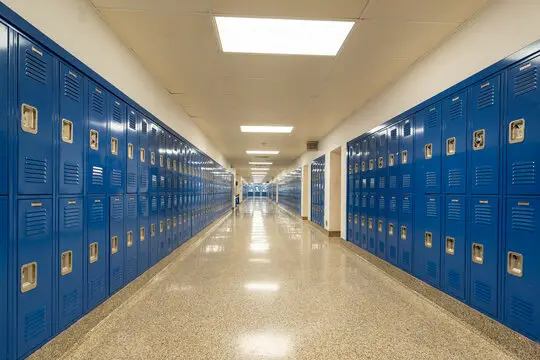
I looked past her. The school hallway was dim, lit only by a few motion-sensor lights. The lockers were a dull gray-green. The smell was floor wax, wet rain, and that faint sweet shadow of cafeteria food that never really leaves a building like this. And at the end of the hall, on a long wooden bench, sat a little girl.
She was tiny. She was sitting perfectly still, her knees tucked up to her chest. Her feet in little pink sneakers didn’t touch the floor. She wore jeans and a purple jacket. Beside her on the bench was a backpack shaped like a white rabbit.
I didn’t move.
Mrs. Davies stood behind me, watching, waiting. “Go on,” she said gently.
I took a step. My shoes squeaked on the tile.
Squeak. Squeak.
The sound made the little girl look up. Her head lifted. She turned, and all the air left my body.
I stopped. I couldn’t move. I couldn’t breathe.
It was my face.
It was my face looking back at me. My blonde hair. My bone structure. My eyes—my green eyes, the exact same shade people always called too bright, too sharp. And then I saw it, just above her lip on the left side.
A tiny white scar. A vertical line.
I got that scar when I was six. I was on the swing set at my grandmother’s house in Eugene. I tried to jump off. I fell. I hit my face on the metal pole. I have seen that scar in the mirror every single day of my life.
And this little girl had it.
My hand flew up to my own mouth. I touched my scar. The little girl just watched me. She wasn’t scared. She looked relieved, like someone finally showed up.
She stood up from the bench. She took one step toward me and whispered, “Mommy.”
It was not a question. It was a statement.
“No,” I whispered. I took a step back. I bumped into Mrs. Davies. “No,” I said louder. “I don’t know you. This isn’t—this isn’t possible.”
The little girl’s face crumpled. She didn’t cry. She just looked lost. Her eyes filled with tears, but they didn’t fall. She looked at me like I was the one who was crazy.
“But Daddy said you would come,” she whispered.
A man came out of the office. He was wearing a shirt and tie, his staff ID badge swinging on a lanyard.
“Mr. Henderson,” Mrs. Davies said, her voice flat. “The principal,” she added for me.
“Ms. Hail,” he said. His voice was gentle. “I’m glad you’re here. We were very worried about Lily.”
“Lily,” I repeated. The name meant nothing. “I am not her mother,” I said. My voice was shaking. Panic was rising; the walls felt too close. “I have never seen this child before. This is a mistake or a crime. I don’t know what it is, but she is not mine.”
Mr. Henderson frowned. He looked at Mrs. Davies, then back at me.
“Ms. Hail, I understand you’re upset,” he said carefully, “but she was enrolled here last August by a man who listed you as the primary guardian.”
“A man who?” My mouth was dry.
“He’s listed as the father,” Mr. Henderson said. He turned and walked back into the office. I followed him on unsteady legs. The little girl—Lily—stayed by the bench, clutching her rabbit backpack.
He opened a file drawer, pulled out a thick folder, and set it on the counter. “This is the enrollment packet.”
He turned it around to face me, and I saw it. All the forms, neatly stacked. Emergency contacts. Medical history. Authorization to pick up. And at the top, in the box labeled Mother / Guardian, was my name.
Lena Hail.
My address. My new Portland address on Westland Drive. My cell phone number. And my written name at the bottom, the way I always sign it—fast sharp L, high cross on the H.
It was my handwriting.
But I had never, ever written it.
I stared at the paper. I felt the blood drain from my face. I put my hand on the edge of the desk to stay standing.
“Who—who brought this in?” I whispered.
“I don’t know,” Mr. Henderson said. “It was in her file when she transferred here. We assumed it was you.”
“This is a forgery,” I breathed. “Someone copied the way I write my own name.”
“Ms. Hail,” he said, his voice firm but still kind, “that’s a very serious accusation. The fact is, this child is here. She says you are her mother. Your name and information are on this form. We’ve been calling you all afternoon. As far as the school is concerned, you are her guardian. I cannot let her go home with anyone else. And I cannot keep her here.”
He was right. He was trapped. And in three sentences, he trapped me too.
I turned and looked back down the hall. The little girl—Lily—was watching me, waiting as if she knew I was her only ride out of this building.
What could I do? Call the police? I would sound insane.
I couldn’t leave her here. They would call child services and—
And what if she was…?
No. I had to solve this. And I couldn’t solve it in a school lobby.
I took a deep breath.
“Okay,” I said. My voice sounded dead in my own ears. “I’ll take her.”
Mrs. Davies let out a long breath, her shoulders sagging. “Thank you. Just… just sign her out for us.”
She handed me a clipboard. I picked up the pen and wrote my name—my real signature—right next to the fake one on the enrollment form. They looked exactly the same.
I walked back down the hall to the bench. The girl looked up at me.
“Hi,” I said. My voice was a croak.
“Hi, Mommy,” she said softly.
“My name is Lena,” I managed. “You can… you can call me Lena.”
She looked confused. “Okay.”
I reached out my hand. “Let’s go.”
She put her small, warm hand in mine. It fit perfectly.
The First Night
I walked out of that elementary school with rain blowing sideways across the empty parking lot, holding the hand of a stranger who had my face. We got into my car. I buckled her into the back seat. I didn’t have a booster or car seat. I didn’t even think about it. I just drove.
The drive home was silent, just the screech-thump of the wipers and the soft hum of my hybrid engine. In the rearview mirror, I watched her. She stared out the window at the wet sidewalks and glowing traffic lights.
“Are you hungry?” I asked. The silence was too much.
“Yes,” she whispered.
“What do you like to eat?”
“Macaroni.”
I pulled into a grocery store—fluorescent lights, automatic doors breathing warm air at us. I ran in with her. I grabbed a blue box of macaroni and cheese, a gallon of milk, a bottle of apple juice, a box of cookies. We rolled through the self-checkout. The cashier glanced at us and smiled from the next lane.
“She’s beautiful,” the woman said. “Looks just like you. A mini-me.”
I just nodded. I couldn’t speak.
I paid. We left. I drove us to my clean, quiet adult apartment on Westland Drive—the one with glass tables and white walls, my blueprints stacked neatly on one side of the living room, charcoal sketches taped to a pinboard.
My life.
I opened the door and held it for a child who called me Mommy. She stepped inside, leaving little wet footprints on my polished hardwood floor.
My apartment felt wrong, like a model unit in a catalog. It was too quiet. The gray minimalist furniture looked cold and sharp. This was not a place for a child.
Lily stood in the entryway, water dripping from her purple jacket onto the mat. She held her rabbit backpack in front of her like a shield.
“You can put your bag down,” I said. I sounded like a stranger in my own mouth.
She set the backpack by the door.
“Are you… are you really hungry?” I tried again.
She nodded.
“Okay. Macaroni. I can do that.”
I went into my kitchen, my beautiful steel kitchen with the high-end appliances I almost never used. I found the pot I’d bought three years ago and never used. I filled it with water. I opened the blue box. There were instructions printed in cheerful font.
Boil water. Add pasta. Stir.
It felt stupid. My world was ending and I was boiling water.
I could feel her watching me. I turned.
She was sitting at my small glass dining table, legs swinging, hands folded in her lap like a guest at a very formal dinner.
“What’s your name?” I asked again, needing to hear it from her own mouth.
“Lily,” she said.
“Lily. That’s a pretty name. What’s your last name?”
She looked down at her shoes. “Carver,” she said.
The wooden spoon slipped from my fingers and clattered into the sink.
Carver.
No. It couldn’t be. But the scar. The eyes. The forged enrollment paperwork.
“Lily,” I said, and my voice came out too sharp. She flinched.
I tried again, softer. “Who usually picks you up from school?”
“Daddy,” she said.
“What… what is your daddy’s name?” My hands were shaking.
She looked up at me, green eyes meeting mine. “Daniel,” she said.
The name hit me. It wasn’t a sound. It was a physical blow.
The room spun. I had to grab the back of a dining chair to stay upright.
Daniel.
Daniel Carver.
Not a ghost. A bomb.
My past had just exploded in my kitchen.
The Ghost Returns
Daniel Carver wasn’t just someone I dated. He was the man I was going to marry.
I met him six years ago. We were both young architects at a firm in Seattle, arguing over floor loads and glass facades in a downtown office that looked out at the Space Needle. We fell in love over blueprints and cheap wine in a Capitol Hill walk-up, eating takeout Thai on the floor because we couldn’t afford a couch.
He was brilliant. He was funny. He was everything. He knew me. He knew every story. He was the one I told about the swing set incident. He had traced the scar on my lip with his finger and said, “This is my favorite part.”
He knew my handwriting. We used to practice signing each other’s names, laughing about it.
“I could be you,” he’d said once, our signatures looping over a bar napkin.
He was my life.
And then, five years ago, he vanished.
It was a Tuesday, just like today. I came home from a work trip. Our apartment was empty. His clothes were gone. His books were gone. His drafting tools were gone. The framed prints he loved were gone.
There was a note on the kitchen counter.
I’m sorry. This is for the best.
I didn’t understand. I called his phone. Disconnected. I went to the firm the next morning. Our boss looked at me with pity.
“Lena, he quit a week ago,” he said gently. “He said he was moving.”
“Moving where?”
“He didn’t say. He just left.”
He evaporated. He took five years of my life and turned them into smoke.
I grieved. I was broken. I cried in my car in parking garages. I went to work. I went home. I stared at the ceiling. Then I got angry. I rebuilt my life. I moved to Portland. I started my own small studio. I buried the name Daniel Carver so deep it was nothing but a bad memory.
Now he was back, and he had sent a child.
I looked at Lily. She was watching me, scared and small.
“How… how old are you, Lily?” I asked.
“I’m four,” she said.
Four.
He left five years ago.
The math was simple. And it was impossible.
The macaroni pot was boiling over. Water hissed onto the stove, steam rising.
I grabbed the pot, burning my hand. I dropped it. Scalding water and half-cooked pasta scattered everywhere.
I just stared at the mess.
Lily started to cry. The sound snapped me back into my body.
“It’s okay,” I said, dropping to my knees. My voice was shaking. “It’s okay. I’m sorry. I’m just… surprised.”
I cleaned up the mess with shaking hands. I gave up on macaroni and made her a peanut butter sandwich with the emergency jar in my pantry. She ate it at the table, small bites, eyes flicking up at me.
I sat across from her. My mind was a storm.
Daniel. The school. The forged forms.
He had signed my name. He had enrolled this child in a school, listed me as the guardian, and then disappeared again. He had left her the way he left me.
“Lily,” I said gently. “What did… what did Daniel tell you about me?”
She finished her bite and swung her legs.
“He said you were my mommy,” she said. “But you were far away. He said you were very, very busy at your work. He said you were sick for a long time, but that you loved me.”
My stomach turned.
“He had pictures of you,” she added. “In a box. He said you were a secret. He said I couldn’t meet you. Not yet. But he said if he ever had to go away on a long trip, you would come for me.”
The lies. The careful, calculated lies.
He’d built a mythology around me. He didn’t just take my name. He took my story. He made me the absent mother. The tragic, busy, sick woman who couldn’t be there. He turned me into the villain in her life. And he made himself the hero who stayed.
Until today.
That night, I made her a bed on my sofa. I used my best sheets. I covered her with my favorite soft gray blanket. She was asleep in five minutes, rabbit tucked under her chin.
I sat at my desk, laptop open, the only light in the apartment a blue glow from the screen and the city beyond my window. My hands were shaking, but not from fear anymore.
It was rage.
My old life was over. My new one had just begun.
I am an architect. I solve problems. I analyze structures. I find the flaws. I find the truth.
This was a structure. A structure of lies.
Daniel built it. I was going to tear it down.
The Investigation
I started with my own life. I had to prove I was sane. I had to prove I was right.
I opened my work calendar and scrolled back five years, to the year he left. August 2020. Seattle Tower project. I was working eighty-hour weeks. I was not pregnant. I went forward. September, October, November—site visits, client meetings, deadlines.
Then I looked at the following spring. April 2021. Nine months after he disappeared. The month Lily would have been born.
My calendar was full. On April 10–15, a note: Chicago pitch – K-Tower project. I remembered that trip. It was my first big project after moving to Portland. We flew into O’Hare, stayed near the Loop, pitched a glass tower to a board of men in suits. We won the bid.
I was in Chicago.
I had plane tickets in my email. Hotel receipts. Photos on my phone from a dinner at a deep-dish place. I was not in a hospital bed. I was not having a baby.
This was my alibi. My anchor to reality.
So how—
I kept digging. I logged into my old credit card, the one I’d opened in Seattle and barely used after I moved. I scrolled through the statements.
January. February. March. Nothing weird.
April.
April 12, 2021.
A charge.
St. Mary’s Hospital – copay $50.
I froze.
St. Mary’s. I never go to St. Mary’s. But the date. April 12. The week Lily would have been born.
I was in Chicago.
How could my card be at a Seattle hospital while I was in another state?
It was two in the morning. The apartment was silent except for the hum of the fridge and Lily’s faint breathing from the sofa.
Then I remembered a conversation six years ago in Seattle. We were in our old apartment, sitting on the floor with pizza boxes and wine.
“I’m worried,” I’d said.
“About what?” he asked.
“My career,” I said. “I want to build something. I want to be a partner. But I want a family, too. I’m scared I’ll wait too long.”
He took my hand. “We have time.”
“I know, but I was thinking maybe I should freeze my eggs,” I said. “Just as an insurance policy.”
I remembered his smile. “That’s my practical Lena,” he said. “Always building. Even a backup plan.”
I went to a fertility clinic a few weeks later for a consultation. I filled out forms. So many forms. I wrote my name over and over.
Daniel was with me. He held my hand in the waiting room. “Whatever you decide, Lena, I’m with you,” he’d said.
I never went back. I got busy. The K-Tower pitch came up. The Seattle Tower job exploded. Life moved.
I never had the procedure.
Did I?
Oh God.
He knew the clinic. He knew the doctor. He knew I’d signed the consent forms. I could hear his voice in my head: I could be you.
He hadn’t just forged my name on a school form. He hadn’t just hired an actress to go to a hospital.
He had taken my genetic material. He had found a surrogate. He had created a child with my DNA, without my knowledge.
He manufactured my child without my consent.
This wasn’t a custody battle. This was theft.
The next morning, I called my boss and told him I needed time off for a family emergency. Then I did what I should have done from the beginning.
I bought a DNA test kit.
The pharmacy was fluorescent and clinical. Lily held my hand as we walked past vitamins and Band-Aids. I also grabbed crayons and a coloring book to distract from what I was really doing.
At home, I gave Lily the coloring book. She sat on the floor, happily coloring, her tongue peeking out between her teeth in concentration.
I went into the kitchen. I opened the DNA kit box. My hands shook.
I needed her DNA and mine.
“Hey, Lily,” I called. “Can we play a silly science game?”
She looked up. “What game?”
“The ‘Who Are You?’ game,” I said, kneeling beside her. “I just have to rub this on your cheek. It’s silly. It tickles.”
She giggled. “Okay.”
I swabbed the inside of her cheek. My hand trembled.
Then I went into the bathroom and swabbed my own cheek. I sealed both samples in their envelopes. I put them in the prepaid mailer.
I walked to the blue mailbox on the corner. I held the envelope over the slot.
If I dropped this in, there was no going back.
I let it go. The envelope thudded to the bottom.
The website said two weeks.
It became the longest two weeks of my life.
I had to work. I had to be a person. I had to take care of Lily.
I bought her a bed at IKEA and assembled it in my spare room. We painted one wall pink. My gray, sterile apartment was invaded—by toys, by small shoes, by the sound of cartoons, by drawings taped over my floor plans.
We fell into a routine. Breakfast. Cartoons. I worked. She drew. She was smart. Stubborn. Funny. She refused to eat tomatoes. She loved music and would sway when a commercial jingle came on.
She was a person, not just a mystery.
And I was terrified of the answer.
The Truth
The email came on a Tuesday morning. Of course it did.
Subject: Your Results Are Ready.
I was in my car in a grocery store parking lot. I couldn’t open it in the apartment with Lily nearby. My hands were so cold I could barely unlock my phone.
I logged in. I clicked the link.
Maternity test results:
Mother: Lena Hail.
Child: Lily Carver.
I scrolled past the science, the charts, the comparison lines. I looked for the number.
Probability of maternity: 99.98%.
I didn’t cry. I just sat in my car, watching people push carts through drizzle.
She was mine.
She was mine.
He took her from me before I even knew she existed.
The confusion was gone. The fear was gone. All that was left was rage, so cold it felt like ice in my veins.
I wasn’t confused anymore. I wasn’t a victim.
I was a mother.
And I was going to get my daughter.
The next day, I hired a private investigator to find Daniel. His name was Caris, an ex-cop with a dusty office downtown. I gave him Daniel’s name and what information I had.
He found him in twenty-four hours.
“He’s in Lake Oswego,” Caris said over the phone. “Fourteen Cherry Blossom Lane. White house. He moved there two days after you picked up the girl.”
Of course he did. He was hiding.
I drove to the address. My heart wasn’t pounding. It was slow, heavy. A single drumbeat.
The house was perfect. White fence, manicured lawn, two chairs on the porch. A perfect postcard. A perfect lie.
I rang the doorbell.
The door opened.
He stood there. Smaller. Thinner. Grayer. Not the brilliant man I remembered. Just a man in an undershirt and jeans, barefoot in a borrowed house.
He saw me and he wasn’t surprised.
“Lena,” he said.
“Hello, Daniel,” I answered.
He tried to smile. It was terrible. “You found her,” he said.
Not you found me.
“She’s not a secret, Daniel,” I said. “She’s a person. And she’s not ours. She’s mine. She’s my daughter.”
“Lena,” he said, stepping back to let me in.
The house was mostly empty. Just boxes against walls, a couch, a card table. He was ready to run again.
“I’m the one who raised her,” he said. “I’m the one who was there.”
“You’re the one who took her,” I said. “You’re the one who took me out of the picture.”
I walked into the bare living room. “The clinic,” I said. “Seattle. 2019. How did you do it?”
He looked away. “You… you signed the forms. We both did the consultation. You said you wanted a backup plan.”
“I never went back,” I said. “I never had the procedure.”
“You didn’t have to,” he whispered. “The consent was signed. For retrieval. For fertilization. For surrogacy. You were so busy, you just signed everything.”
I felt sick.
“I told them we were proceeding,” he said. “I paid for it. I found a surrogate. I… I wanted her, Lena. I wanted a family.”
“You wanted my family,” I said. “You wanted my child without me.”
“Because you wouldn’t have done it,” he shouted. “You would have chosen your job. You would have waited until it was too late. I did it for us.”
“You did it for you,” I said.
He stepped toward me. “I had to take her and keep her safe.”
“Safe?” I laughed. “Safe from what?”
“From you,” he said.
The word hung in the air.
“You were never stable, Lena,” he said. “You were obsessed. Your work. Your ambition. You’re cold. You wouldn’t have wanted her.”
He was using my ambition against me. Turning it into a weapon.
“You think I’m cold, Daniel?” I asked quietly.
I watched him. This man who had built an entire story, faked hospital records, told his daughter I was unstable.
“I was never dangerous,” I said, stepping closer.
He flinched. He took a step back.
“I was never dangerous,” I repeated. “Until now.”
I turned and walked out.
“Lena, wait,” he yelled. “What are you going to do?”
I stopped on the step but didn’t turn.
“I’m going to fix your mistake,” I said.
The Resolution
I didn’t go to the police. If I did, he would be arrested. It would be a circus. It would be on the news. And Lily would be in the middle, labeled the stolen child forever.
I wouldn’t do that to her.
I am an architect. I don’t use a hammer when I need a blueprint.
I found the best family lawyer in Portland. Her name was Helen Brody, and her office was on the fortieth floor of a glass tower downtown.
I sat across from her and presented my case.
I laid out the documents one by one. The DNA test showing I was Lily’s mother. The hospital records from St. Mary’s showing someone else gave birth using my name. My work itinerary proving I was in Chicago. The PI report showing Daniel’s location. An affidavit from the fertility clinic confirming my genetic material was used without my full consent.
Helen read everything slowly. She took off her glasses.
“In twenty-five years of family law,” she said, “I have never seen anything like this.”
“What can I do?” I asked.
“What do you want?” Helen asked.
“I want full custody,” I said. “I want his name off her birth certificate. I want him to have no rights. I want him legally erased from her life.”
Helen smiled. It was cold and sharp.
“That I can do,” she said.
She drafted two documents. One was a fifty-page petition for sole custody detailing every crime. The other was a simple two-page termination of parental rights.
I drove back to Lake Oswego with both documents.
When Daniel opened the door and saw the folder in my hand, his throat bobbed.
“What is this?” he whispered.
“Paperwork,” I said.
I handed him the big petition. He opened it and saw the charges: kidnapping, fraud, conspiracy. His face drained of color.
“You… you can’t,” he stammered.
“I already did,” I lied. “It’s filed.”
Pages scattered across his floor.
“Lena, please,” he begged. “She’s my whole life.”
“You took her,” I said. “You took me. You don’t get to talk about taking.”
I pulled out the second document. “This is your choice. Voluntary surrender of parental rights. You sign it, you agree to everything, you never see her again unless I allow it.”
“Or what?” he whispered.
“Or you go to prison,” I said.
He looked at the pen. He looked at me.
“You’re a monster,” he said.
“No, Daniel,” I said. “I’m a mother. You just taught me how to be one.”
He took the pen. His hand shook, but he signed.
I took the paper and walked away.
Three weeks later, the court hearing was a formality. The judge looked at my evidence, looked at Daniel’s signed surrender, and raised her gavel.
“Full custody awarded to Ms. Lena Hail,” she said. “All parental rights of Mr. Daniel Carver are terminated.”
The gavel struck.
Thud.
It was the loudest sound I’d ever heard. The sound of my old life closing and my new one opening.
It was done.
The New Life
Months passed. Then a year.
My clean gray apartment disappeared. My drafting table was pushed into the corner. The living room turned pink. There was a plastic castle in the middle of the floor. There was a little white table covered in crayons and glitter.
My fridge was covered in drawings. Drawings of me and her. Of a yellow house with a big yard.
My life, once so controlled, was now a beautiful, colorful mess.
I was still an architect. But now I left at 5:00 p.m. I designed playgrounds knowing how high slides should be, how easy steps needed to be for small legs.
I was a mother, and I was getting to know my daughter.
Lily laughs like her father sometimes. That part is hard. But her eyes are mine. When she gets frustrated, she doesn’t cry. She gets quiet. She focuses.
That’s me.
She loves to build with blocks, making organized towers and cities.
She is my daughter.
She had nightmares. She would wake up crying.
“I want Daddy,” she would sob.
Those were the hardest nights. I would hold her.
“He’s on his trip, honey,” I would say. “He’s not coming back.”
“Why?” she would whisper.
“He had to go,” I said. “This was not your fault. You’re perfect.”
Then one day, we were at the park. She was on the swings.
“Mommy?” she said.
“Yes?”
“Why didn’t you come for me sooner?”
There it was—the real question.
“Oh, Lily,” I said, kneeling in front of her. “I didn’t come sooner because I didn’t know where to look.”
It was the simplest truth.
“But Daddy said you knew about me,” she said.
“Your dad made a big mistake,” I said. “He didn’t tell me where you were. The second I found out you were here, the second I got that phone call from your school, I ran. I ran as fast as I could.”
I put my hand over her heart.
“I will always come,” I said.
She looked into my eyes, searching.
She believed me.
“I love you, Mommy,” she said.
“I love you, Lily.”
Another year passed. It was Lily’s fifth birthday. My apartment was a disaster. Pink streamers, flour everywhere. I was baking a cake. Lily was “helping,” which meant frosting on her face.
My phone buzzed. Daniel Carver.
He called sometimes. Once every few months.
I looked at Lily—her green eyes, my eyes. I looked back at the phone.
“Who is it, Mommy?” she asked.
“No one important, honey,” I said.
I pressed decline. The screen went dark.
“Now,” I said, “do we put the sprinkles on?”
“Sprinkles!” she shrieked.
That night, after the party, I tucked Lily into bed. I stood in her doorway watching her sleep.
She was curled up, rabbit tucked under her arm. Small, steady breaths. Safe.
I thought about Daniel. He thought he was stealing something from me. He thought he was punishing me for being ambitious.
He was wrong.
He didn’t steal my life. He gave me one.
He didn’t take my future. He gave me my future.
Because in the end, I didn’t lose a daughter.
I found the only piece of my life no one could steal.
I found me.
I quietly pulled her door almost shut, leaving a small crack of hallway light. I walked to my room. I got into bed.
And for the first time in five years, I slept. A deep, dreamless, peaceful sleep.
The nightmare was over.

Lila Hart is a dedicated Digital Archivist and Research Specialist with a keen eye for preserving and curating meaningful content. At TheArchivists, she specializes in organizing and managing digital archives, ensuring that valuable stories and historical moments are accessible for generations to come.
Lila earned her degree in History and Archival Studies from the University of Edinburgh, where she cultivated her passion for documenting the past and preserving cultural heritage. Her expertise lies in combining traditional archival techniques with modern digital tools, allowing her to create comprehensive and engaging collections that resonate with audiences worldwide.
At TheArchivists, Lila is known for her meticulous attention to detail and her ability to uncover hidden gems within extensive archives. Her work is praised for its depth, authenticity, and contribution to the preservation of knowledge in the digital age.
Driven by a commitment to preserving stories that matter, Lila is passionate about exploring the intersection of history and technology. Her goal is to ensure that every piece of content she handles reflects the richness of human experiences and remains a source of inspiration for years to come.