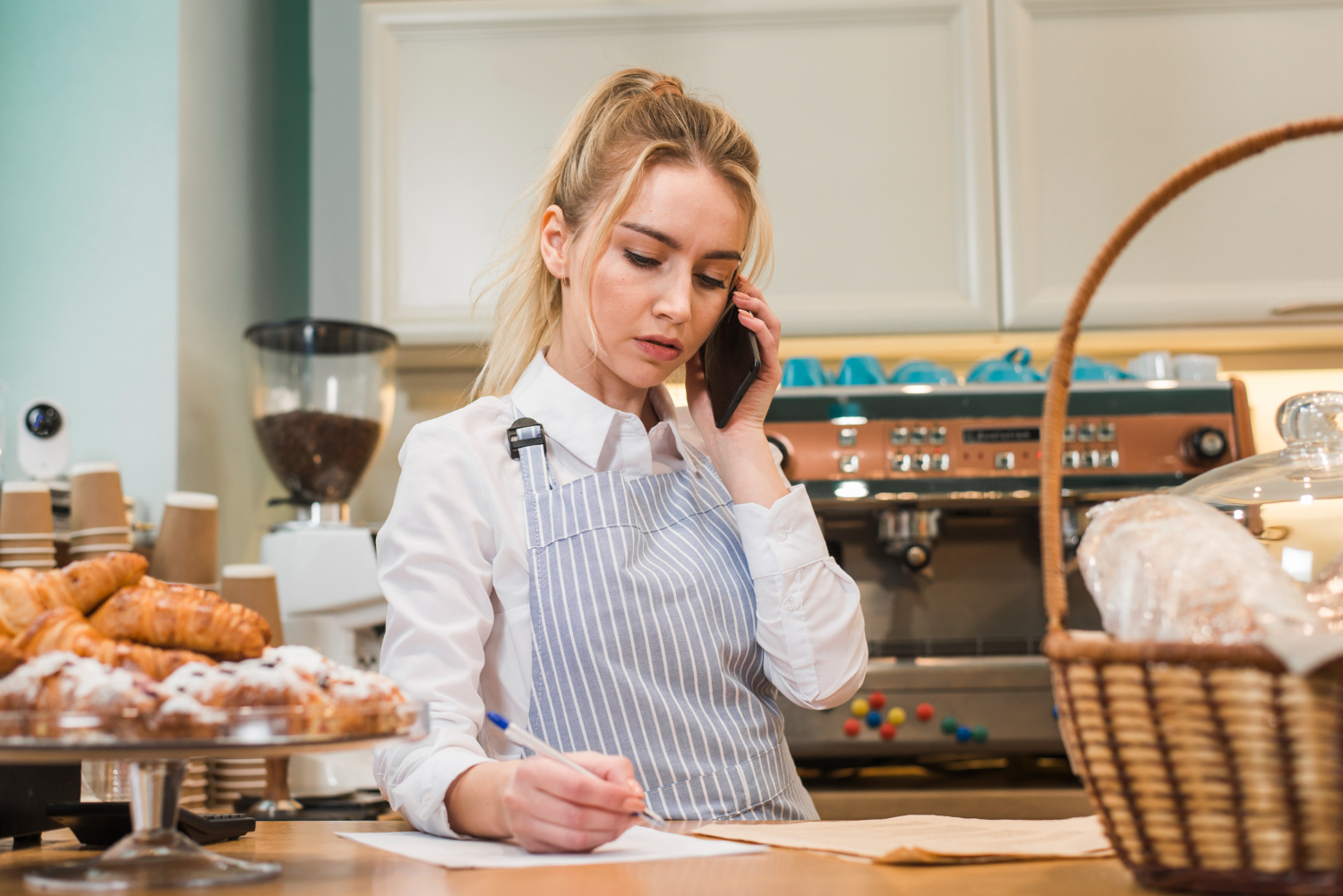
The heat from the oven always hit like a physical force—a wall of air so thick it made breathing feel like work. I was three trays deep into my Friday sourdough run when my phone buzzed against the stainless steel counter, the vibration cutting through the symphony of timers and humming mixers that filled The Gilded Crumb every afternoon.
I almost ignored it. Friday afternoons weren’t phone time—they were survival time. The line was already snaking toward the door, customers clutching numbered tickets like golden passes, and Marcus was calling out orders from the front with the rapid-fire precision of an auctioneer. But when I glanced down and saw my mother’s name glowing on the screen, something in my chest tightened.
I wiped flour-dusted hands on my apron and answered, phone wedged between my shoulder and ear while I adjusted the spacing on a tray of croissants. “Hey, Mom. Can I call you back in an hour? We’re slammed.”
She didn’t bother with pleasantries. “Haley wants everything perfect for tonight. Very curated, you know. Old Boston aesthetic—refined, minimal, the whole thing.”
I pulled open the second oven, and a fresh wave of heat rolled over me, prickling the constellation of burn scars that decorated my forearms like a chaotic star map. “Sure, I can do dessert. Just tell me what she wants and I’ll—”
“That’s actually what I’m calling about,” my mother interrupted, her voice taking on that careful tone she used when she was about to deliver bad news dressed as reason. “About you coming tonight.”
My hand froze halfway to the pain au chocolat. Behind me, Marcus shouted, “Chef, we need two more pistachio eclairs!” and I responded automatically—”On it!”—even as ice water seemed to replace the blood in my veins.
“What about me coming?” I asked slowly.
She sighed, the sound carrying years of practiced disappointment. “Haley’s worked so hard on this dinner, sweetheart. Jonathan’s business partners will be there, and she’s going for a very specific atmosphere. Refined. Minimal. Very old money Beacon Hill, you understand.”
I stared at the perfectly golden croissants in front of me, each one a small miracle of butter and patience and precise temperature control. “I bought a dress. It’s simple, black. I’ll shower after work. I won’t show up in flour if that’s—”
“It’s not the dress.” Her voice sharpened slightly. “It’s the smell, Abigail. You always carry that yeast scent, and your hands…” She made a small noise of distaste. “They’re always stained. Rough. I know it’s not your fault, but it doesn’t quite fit the aesthetic she’s created.”
I looked down at my hands. Raspberry filling stained my thumb. Sugar crystals clung to the fine hairs on my arms. My nails were short and practical, scrubbed clean but never quite free of the chocolate embedded in my knuckles or the caramel that darkened my cuticles.
“You look like a peasant, sweetheart.”
The word landed soft as cake flour but hit like a punch. “Like a… what?”
“A peasant. A worker.” She said it almost fondly, like she was describing a charming quirk. “And that’s fine—noble, even. But these dinners, people notice everything. Haley’s put so much effort into the flowers and the table settings, and it’s all very cohesive. She doesn’t want anything that might seem like… clutter.”
The bakery noise faded to white static. “You’re uninviting me from my sister’s engagement dinner.”
“Don’t be dramatic. It’s not personal—it’s about the vibe. You’ll still be invited to the wedding, of course. We can do something more casual later. Maybe brunch.”
I thought about the last five years. The four a.m. alarms. The culinary school loans that still sat like a stone in my bank account. The food truck I’d run solo because I couldn’t afford staff. The months I’d paid rent late so my employees could cash their checks on time. The burns that layered over each other until my forearms looked like a battlefield. The five thousand dollars I transferred to my parents’ account on the first of every month, regular as clockwork, for five straight years.
“Okay,” I whispered. “I understand.”
“Good girl. We’ll order something nice for the dessert. Don’t stress—you’re always so sensitive about these things.”
She hung up before I could respond. I stood there, phone in hand, staring at my reflection in the polished steel of the oven door. Flour dusted my dark curls. Chocolate smeared my chin. My eyes looked too bright, rimmed with the kind of exhaustion that comes from burning yourself up to keep everyone else warm.
Across the bakery, a customer bit into one of my croissants and her whole face transformed—shoulders dropping, eyes closing, a small sound of pure pleasure escaping. That moment, that tiny instant of joy I’d created with my scarred hands and peasant smell, was what I lived for.
But to my family, I was an embarrassment. An aesthetic problem to be solved.
“Chef?” Marcus appeared at my elbow, concern creasing his forehead. “You good?”
I swallowed the lump in my throat and forced myself to move. “Yeah. We’re good.”
But I wasn’t good. Not even close.
My name is Abigail, I’m thirty-one, and I’m a pastry chef. By most measurements, I’m successful—The Gilded Crumb has lines around the block most weekends and a waiting list for my signature midnight cronuts that stretches three months long. Food bloggers write sonnets about my kouign-amann. My brioche has made grown men weep.
But to my family, none of it mattered. My culinary degree wasn’t “real” education. My bakery wasn’t a “serious” business. It was a cute hobby that happened to generate inconvenient amounts of attention and even more inconvenient amounts of cash—cash they’d been helping themselves to for years.
I grew up in a Beacon Hill brownstone, the kind tourists photograph for Instagram—gas lamps, brick sidewalks, flower boxes with perfect geraniums. My parents, Brian and Margaret, loved saying “Our family’s been in Boston for generations,” even though the reality was my grandfather bought property cheap in the seventies and got lucky when the neighborhood gentrified.
But image was everything to them. We belonged to a country club where I never knew what to do with my hands. My mother had a pearl rotation for different outfits. My father had opinions about scotch and pocket squares. They talked about “maintaining appearances” like it was a religion.
And then there was Haley.
My sister is three years younger and has the kind of beauty that makes strangers stop and stare. Golden hair that waves instead of frizzes. Blue eyes that photograph like jewels. Dimples that appear on command. She learned early that the right tilt of her head could get her anything.
I wasn’t that child. I was tall too early, all awkward angles and crooked glasses. My hair was dark and thick and refused to behave. Teachers called me “intense.” My mother called me “difficult.”
But the kitchen liked me.
My earliest memories are standing on a stool watching our housekeeper Rosa bake cookies, learning the language of butter and eggs and heat before I learned algebra. The way cake batter loosens when sugar dissolves. The exact moment meringue shifts from glossy to grainy. The smell of yeast coming alive.
When I told my parents I wanted culinary school, my father laughed. He actually thought I was joking.
“Don’t be ridiculous, Abby. You’re smart—you can do law school, business school, something respectable. Not kitchen work.”
My mother tried gentler manipulation. “Cooking is a lovely hobby, but you don’t need to waste a degree on it. Think about your future.”
I did think about it. I thought about fluorescent-lit offices and contract negotiations and the slow suffocation of a life spent doing work I didn’t love. Then I thought about the warmth of an oven, the quiet focus of decorating a tart, the pure satisfaction of feeding people well.
I chose the heat.
They grudgingly agreed to cover tuition only if I treated it as a “phase” before doing something real. So I took out massive loans, got a partial scholarship, and worked nights in a chain bakery that thawed frozen croissants and called them fresh. I fell asleep on the subway with cooling rack patterns pressed into my forearms.
That’s where the burn scars started. In professional kitchens, you stop flinching when caramel splashes you. You learn to keep moving when you brush against a four-hundred-degree pan. The first burns hurt terribly. After a while, they just become part of the landscape of your skin—a record of repetition, mastery, survival.
I graduated with honors and debt so massive it didn’t feel real. My parents didn’t attend the ceremony. They were “busy with a fundraiser” and sent flowers.
By then, Haley had discovered Instagram.
She came home from college with a ring light and a vocabulary that made my parents glow with confused pride. “Brand deals,” she’d say, twirling in gifted dresses. “Engagement metrics. I’m building something.”
What she was building was a carefully curated mirage—other people’s possessions arranged in perfect squares, her life staged and filtered until it barely resembled reality. She learned to speak in breathy tones about “morning routines” and “wellness hacks” while my mother repainted the living room in neutral tones because “bold colors don’t photograph well.”
“Isn’t it wonderful?” my mother would gush, showing me Haley’s posts. “She’s really made something of herself.”
I thought there was room in the world for both of us—the girl with the camera and the girl with the burns. I was wrong.
Everything changed in 2020 when my father lost a fortune in cryptocurrency. He’d listened to a golf buddy promising easy money and liquidated chunks of his retirement. When the market crashed, it took their financial security with it. Suddenly there were second mortgages, maxed credit cards, quiet calls from creditors—all threatening the one thing my parents worshiped above all else: appearances.
My father came to me looking smaller than I’d ever seen him. “You know we’re proud of you, right? The bakery and all.” It wasn’t true, but I let him have it. He talked for fifteen minutes before getting to the point: they needed help. Just a few thousand. Temporarily. Until things bounced back.
I didn’t have a few thousand sitting idle. What I had was a bakery barely breaking even. But I also had a deep, bone-deep belief that you took care of family, even when they didn’t deserve it.
So I did the math. Cut my own salary to nearly nothing. Started transferring five thousand dollars every month to my parents’ account. “Just until things bounce back,” my father said.
They never bounced back. But my transfers became as regular as my morning alarm.
The thing about being the family’s invisible wallet is you start disappearing in other ways too. I picked up every dinner check while my father joked with waiters—”Let her pay, she’s the big shot chef!” My mother gushed about “our daughter’s artisan bread” to friends but pulled me aside at parties to hiss, “Couldn’t you have changed first?”
When Haley needed a new camera because the old one didn’t make her skin look “dewy enough,” my mother called. “She’s too embarrassed to ask, so I’m doing it. You know how important this is for her career.” I said yes while watching my checking account dip dangerously low.
There was always a reason. The heating system. The roof. A new couch because “the old one looks cheap on her feed.” Little by little, my life became a series of one-time favors that never ended.
This is what you do, I told myself. This is what good people do.
I didn’t know that everything was about to implode.
The morning after my mother uninvited me, I was elbow-deep in laminating dough when the bakery door didn’t chime—it rattled, like someone had thrown it open.
My entire family stormed in.
My father in his weekend blazer. My mother clutching her pearls. Haley immaculate in cream cashmere and boots that had never seen real weather. They brought their world with them—expensive perfume cutting through the warm smell of baking bread, looking completely out of place among the flour and stainless steel.
“Abigail, thank God,” my mother gasped, already theatrical.
No hello. No apology. Just crisis.
Marcus stuck his head out from the kitchen, eyebrows lifting at the invasion. “Everything okay, Chef?”
I wiped my hands on my apron, flour and butter grinding into the stained fabric. “What’s going on?”
“The caterer canceled,” Haley announced, examining her reflection in the pastry case instead of looking at me. “Family emergency. Can you imagine? Today of all days.”
My mother jumped in. “We need you to fix it.”
I stared. “Fix what?”
“The desserts.” Haley finally turned, her smile tight and brittle. “Five dozen midnight cronuts with gold leaf and a three-tier vanilla cake with raspberry filling. Delivered by four.”
I glanced at the clock. Ten a.m. Six hours to do three days of work.
“Haley, those cronuts take forty-eight hours minimum. The cake needs time to cool or the frosting will slide right off. It’s physically impossible.”
My father wandered behind my counter, touching my industrial mixer like he was inspecting it. “You always find a way, Abby. This is for your sister. Jonathan’s business partners will be there. We need the best.” His voice deepened with false authority. “That’s you.”
My mother clasped her hands together. “You can do this, darling.”
It hit me then—the way they were looking at me. Not as a daughter. Not even as a person. As a resource. A tool. A walking combination of skills and bank account they could deploy whenever convenient.
Haley wasn’t even pretending to see me. She was angling herself toward a customer with a phone, automatically posing, her face slipping into influencer mode.
I watched her and something clicked into place. Haley used people as mirrors, reflecting back whatever image served her best. I was just another prop in her carefully staged life. An inconvenience when I didn’t fit the aesthetic, useful when she needed free labor.
“I can’t do it,” I said.
Silence crashed into the bakery like a wave. The ovens hummed. The espresso machine hissed. Customers murmured. All of it felt suddenly distant.
“What do you mean you can’t?” My mother’s voice pitched up, sharp with disbelief. “You have flour, you have ovens. Just make them.”
“The dough isn’t magic,” I said carefully. “It’s chemistry. Time. If I rush it, it will be terrible, and your ‘old Boston aesthetic’ will feature greasy, underproofed cronuts and a collapsing cake.”
“You’re just being selfish.” Haley’s face contorted, ugliness bleeding through her careful makeup. “You’re punishing me because Mom uninvited you yesterday. That’s what this is.”
“I’m not punishing you,” I said. “Physics doesn’t care about your engagement party.”
My father slammed his palm on the prep table hard enough to make my ganache bowl wobble. “Enough. You will figure this out, Abigail. I don’t care if you buy them somewhere else and repackage them. You will fix this.”
His eyes met mine and for the first time, I saw it clearly: I wasn’t his daughter. I was a problem-solving machine that occasionally needed maintenance.
I opened my mouth to respond when the bell chimed again.
This time it didn’t rattle. It rang—clean and decisive.
All three of them turned, faces snapping into polished smiles like masks dropping into place.
The man who stepped inside wore a charcoal suit that fit like it had been made for him. Silver touched his temples. His eyes swept the room efficiently, taking in everything—the line, the pastries, my family clustered around my counter like vultures.
Haley made a strangled sound of delight. “Jonathan! You’re not supposed to see me before the party!” She rushed toward him, arms outstretched, voice climbing into that breathy register she used for cameras and wealthy men.
He sidestepped her embrace without breaking stride.
“Mr. Reed,” my father began, suddenly obsequious. “We weren’t expecting—”
But Jonathan Reed—billionaire hotel mogul, the man my sister was supposedly marrying—walked right past him. Past my mother’s outstretched hand. Past Haley’s open arms.
He walked straight to me.
“Are you Abigail?” he asked.
His voice was low and clear. He wasn’t rushed or breathless. He looked like a man who did everything deliberately.
“Yes,” I said, wiping my palm on my apron before offering it. “I’m Abigail.”
Relief flashed across his face. His shoulders dropped slightly. “Good. I’ve been trying to meet you for six months. I’m Jonathan Reed. I own the Atlas Hotel Group.”
I nodded. I knew who he was—Boston society treated him like a new restaurant opening, thrilling and intimidating and obscenely expensive.
“We exclusively contract with your bakery for our VIP suites,” he continued. “Your brioche is the only reason our Paris location maintains a five-star breakfast rating. Our guests write poetry about your croissants. Your kouign-amann nearly caused a riot last spring.”
He smiled, and it wasn’t the polished grin from magazine photos. It was smaller, more genuine. “I heard about the caterer crisis. Your father called my assistant asking if I knew anyone who could help. When I realized that meant you might be here, I came myself.” He paused. “I wanted to find out why you’ve been ignoring my partnership offers.”
The world tilted. “Ignoring what?”
He blinked. “The emails? We sent several proposals. My team followed up at least five times. We thought you weren’t interested in expanding.”
A strange buzzing filled my ears. “I haven’t gotten any emails from you. I check my inbox every night. I would never ignore—” I stopped, my heart hammering.
Jonathan pulled out his phone, tapped a few times, then turned the screen toward me. There it was—an email thread with my bakery’s domain. Partnership Proposal: Atlas Tokyo Flagship. Follow-up. Gentle Reminder. Final Attempt.
The original address was mine. But the replies… the forwarding address…
“That’s my father’s email,” I said quietly. “He helped set up the domain when I started.”
Every eye in the room swung to Brian.
He’d gone pale as old paper. Sweat beaded at his hairline.
“I was protecting you,” he blurted. “You’re not ready for that pressure, Abby. Tokyo, global expansion—these things chew people up. We need you here. Your mother needs you. Haley needs you. Besides, those emails were full of legal jargon. I was just vetting them.”
Jonathan let out a short, humorless laugh. “You intercepted a multimillion-dollar partnership offer because you wanted her available to run errands.”
“It’s not like that,” my father protested. “She’s always been impulsive. She runs herself ragged. I was trying to keep the family together.”
Family. The word landed like a slap.
Haley grabbed Jonathan’s arm, nails digging into his sleeve. “Babe, it doesn’t matter. It was a misunderstanding. Abigail can just bake the desserts for tonight, and we’ll talk business after, okay? Family first.”
Jonathan looked at her hand like it was something unpleasant he’d found on his shoe. Then he looked at my parents, pressed together like guilty children. Then at me.
“I don’t think there are going to be any pastries,” he said finally.
My mother gasped. “But she said—”
“Actually,” I interrupted, my voice surprisingly steady. “There’s something you should know about the midnight cronuts.”
Three pairs of eyes bored into me. I kept mine on Jonathan.
“They sell out three months in advance. There’s a waiting list. The batch from this morning—the ones Haley wanted—I already gave them away.”
My mother blinked. “You what?”
“I donate them every Friday,” I said. “To the women’s shelter on Fourth Street. The cupboard is bare there. Here…” I gestured at the gleaming pastry case, the line of customers. “It’s full.”
Silence stretched taut.
“To a shelter?” Haley shrieked. “You gave away my engagement pastries to a bunch of—” She stopped herself, teeth snapping together.
In that moment I saw myself from outside: flour-smudged apron, escaping hair, arms crisscrossed with burn scars. Tears pricked behind my eyes but didn’t fall. I was too tired to cry.
Haley’s composure cracked like sugar glass. “You’re jealous,” she spat. “You’ve always been jealous of me. You can’t stand that for once I’m doing better than you, getting married, getting attention, getting everything.” Her voice climbed higher. “You’re just a baker, Abigail. You play with flour while I build a brand. You’re sabotaging my happiness because you’re bitter and ugly and miserable. You’re ruining my life.”
The words should have gutted me. Instead, they felt like confirmation—proof of something I’d suspected all along.
My parents rushed to comfort her, murmuring soothing nonsense. “She didn’t mean it, she’s stressed,” my mother said quickly, shooting me a warning look.
I looked at Jonathan.
He was very still, watching Haley’s meltdown with detached focus. Then slowly, his eyes shifted to me.
He saw the burns. The flour. The apron. The way I was standing there, rooted to my spot. He’d just watched my sister strip away every layer of performance, revealing the raw selfishness underneath.
I didn’t defend myself. I didn’t make a speech. When someone is determined to light themselves on fire, you don’t wrestle the matches away. You step back and let reality do what it does.
I was the first to move.
My fingers went to the knot at the back of my neck. The apron tie had hardened with old sugar. I untied it slowly, lifted it over my head, and folded it with care—corners aligned, edges squared. Muscle memory. Care, even now.
I set it on the counter.
Then I pulled out the spare key—the one my father had used to let himself in this morning without asking—and set it on top of the folded apron. The small metallic click sounded like a door closing.
I took out my phone and opened my contacts. Mom. Block. Dad. Block. Haley. Block. It took maybe twelve seconds. The most important twelve seconds of my adult life.
“What are you doing?” my mother whispered, her voice shaking for the first time. “Abigail, don’t be dramatic. We’re family. You can’t just—”
“I’m clocking out,” I said softly.
I turned. “Marcus?”
“Yes, Chef?”
“You’re in charge. Close early today. Everyone gets paid for the full shift.”
His chin lifted. “Yes, Chef.”
I stepped around my father, who couldn’t look at me. Around my mother clutching her pearls. Around my sister, who had sunk onto a stool with mascara streaking her face.
I stopped in front of Jonathan. “I’m going to get coffee. You’re welcome to join me.”
He didn’t look back at his almost-fiancée or his would-be in-laws or the carefully curated life he’d nearly attached himself to.
“After you,” he said.
We walked out into the cold Boston street together. The bell chimed one last time behind us.
The air outside was sharp and clean, smelling like snow and exhaust and a world beyond ovens and brownstones. I inhaled and something in my chest loosened—a knot I hadn’t realized I’d been carrying for years.
For the first time I could remember, my shoulders felt light.
We ended up at a tiny coffee shop two blocks away, the kind with mismatched chairs and chalk menus. No one knew me there. No one recognized him. We were just two people trying to figure out what came next.
“Are you okay?” he asked after we’d both wrapped our hands around paper cups like anchors.
“No,” I said. Then, after a beat: “But I will be.”
He nodded like he approved of the answer.
“I’m sorry,” he said. “For all of that.”
“It’s not your fault. You didn’t intercept your own emails.”
He smiled slightly. “No. But I should have insisted on a face-to-face weeks ago.”
We sat in silence, watching people hurry past the window—coats buttoned, scarves wrapped tight, life indifferently continuing.
“What now?” I asked. “For you, I mean. The engagement party…”
He shook his head once. “There won’t be a party. There definitely won’t be a wedding.”
Guilt flickered. “Because of what she said?”
“Because of what she is,” he corrected gently. “Today just made it impossible to ignore. I’ve spent my career evaluating partnerships. When someone shows you how they treat people who can’t do anything for them, you believe them.”
I thought of Haley screaming. My parents standing silent. Years of small cruelties adding up to this moment.
I nodded. “Fair.”
He studied me over his cup. “What about you? What do you want?”
No one had asked me that in years. Not without adding “for the bakery” or “for the family” or “for the menu.”
“I want…” I started slowly, tasting the words. “I want to build something that’s mine. Really mine. Not feeding people who use me as a utility. I want to bake for people who see me as more than an ATM or a pair of hands.”
He listened, head tilted slightly.
“I also want to not feel like a terrible person for cutting my family off,” I admitted. “Even though I know it’s the right thing.”
“That part takes time,” he said. “And practice.”
I raised an eyebrow. “You sound familiar with it.”
He smiled wryly. “Let’s just say I didn’t grow up with model boundaries. It took expensive therapy to figure out that ‘family’ isn’t a hall pass for abuse.”
I huffed a laugh. “Relatable.”
He set down his cup. “I meant what I said about the partnership offers. We’re opening a flagship hotel in Tokyo next year. I want The Gilded Crumb inside it. Your pastries. Your name. Your vision.”
My breath caught. “Tokyo?”
“Yes. And eventually London. Maybe Dubai. But I’ll be honest—it’s a lot. New country, new language, different regulations. It would change your life.”
“My father told you I wasn’t interested,” I said slowly.
“He did. He said you were overwhelmed, that if the offer was still available in a year, he’d bring it to you.”
I let out a short, bitter laugh. “That coward.”
The anger flared hot and clean. For once, I didn’t try to squash it.
“I’m very interested,” I said. “I just need to figure out how.”
“Then that’s where we start,” he said simply.
We talked for an hour about logistics—visas, supply chains, quality control, training. He didn’t talk down to me or gloss over challenges. He treated me like a professional, a potential equal.
By the time we finished, I had notes filling my phone and something I hadn’t felt in years: hope that wasn’t tied to someone else’s approval.
The fallout happened fast.
Jonathan broke off the engagement that evening. Haley tried to control the narrative on Instagram, posting tearful videos about being “blindsided” and “betrayed,” hinting that jealousy played a role. She never said my name, but she didn’t have to. The internet did what it always does—half sympathized, half asked questions. Why had she never tagged her baker sister? Why claim to be “self-made” when screenshots showed my catering at her parties?
The shine wore off. Brand deals dried up without Jonathan’s money. Venue lawyers came calling. Credit card bills arrived.
My parents hit their own wall. Without my monthly transfers, the second mortgage became a chokehold. The club membership went. The cleaning service went. In February, the heat was shut off—that’s how my aunt found out, walking into a sixty-degree living room with my mother wearing three sweaters.
“They want me to talk you into helping them,” my aunt told me later.
I was sitting at my kitchen table with Tokyo contracts spread around me. “What did you say?”
“That I’m not your middleman. And that I’m proud of you.”
I pressed my fingers against my eyes. “They’re going to lose the house.”
“That’s their house, Abby. Not your responsibility. You didn’t gamble away their retirement.”
The guilt tried to surge back, but underneath it something solid had taken root. The memory of the key on the counter. The cold Boston air in my lungs. Jonathan asking what I wanted and meaning it.
“I’m not going back,” I said.
“I know,” she answered. “And I’m glad.”
My parents sent letters, emails, messages through distant cousins urging me to “be reasonable” and “remember that blood is thicker than water.”
But I remembered something else: my mother calling me a peasant. My father’s eyes sliding away when Jonathan showed me the intercepted emails. Haley screaming that I was ruining her life.
I ignored every message.
The last time I saw any of them was in my bakery, the morning I set my apron on the counter. I decided that would never change.
No reconciliation. No dramatic reunion. Just absence.
You’re allowed to choose that, even if no one ever told you so.
Six months later, The Gilded Crumb was busier than ever. If anything, the drama had boosted business. I sat Marcus down one morning and slid a folder across the table.
“I’m moving to Tokyo,” I said. “And I’m signing majority ownership to you.”
His eyes filled with tears. “Abby, I can’t—”
“You can,” I said. “You’ve earned it. You’re family—the kind you choose.”
We signed the documents that afternoon. It felt less like giving something away and more like setting it free.
A year later, I stood in front of a glass storefront half a world away. Tokyo in winter was a study in contrasts—neon and snow, ancient temples between skyscrapers, trains running precisely on time. The street buzzed with life, smelling like grilled yakitori and roasted coffee.
Above the door, in elegant backlit lettering: The Gilded Crumb.
Inside, my staff—half local bakers I’d trained, half imports from Boston—moved with focused energy. We’d spent six months perfecting recipes, adapting to different butter, flour, even water. The kouign-amann caramelized perfectly. The croissants shattered into golden flakes. The anpan-inspired brioche we’d created with a local baker made me close my eyes and swear softly in two languages.
Jonathan stood beside me holding ceremonial scissors, looking less guarded than when we’d met. We’d become partners in the truest sense—respecting each other’s expertise, overlapping where it mattered.
“Ready?” he asked, nodding toward the crowd. Hotel guests. Food writers. Regulars from Boston who’d flown in. And three women from the shelter on Fourth Street, flown here at my expense, their awe contagious.
“As I’ll ever be,” I said.
We cut the ribbon together. Cameras flashed. Doors opened. People spilled inside, eyes searching the pastry case.
“Places, everyone,” I called. “Let’s feed some people.”
We moved like choreography. Trays in and out. Orders called in Japanese and English. Laughter and the universal language of that first perfect bite.
I watched one of the shelter women lift a croissant to her mouth and saw that familiar transformation—shoulders softening, eyes closing in surprised pleasure.
This. This was why I’d endured burns and debt and years of being dismissed as “just a baker.” So I could stand here and watch someone taste freedom I’d made with my hands.
Later, when the rush subsided, I stepped outside with a fresh croissant. The city buzzed around me. The hotel’s glass facade reflected a version of me I barely recognized—hair tied back with purpose, face lined with fatigue and joy, arms still marked with old burns.
I tore the croissant in half. Steam rose, fragrant and warm. Layers pulled apart in translucent sheets.
I took a bite.
It tasted like butter and patience and salt. Like a thousand repetitions and a hundred failures and one yes that finally outweighed all the unspoken nos.
Mostly, it tasted like freedom.
I thought of my parents sometimes, wondered where they ended up. A smaller condo probably, quieter than the brownstone. I didn’t imagine them often or long. My life didn’t orbit theirs anymore.
I thought of Haley, her following dwindled, sponsorships gone. Maybe she’d figure out who she was without everyone else’s admiration. Maybe not. It wasn’t my job to find out.
My family now was different. Marcus sending pictures of the Boston bakery decorated for Christmas, his toddler on the counter with flour on his nose. My Tokyo staff trading techniques like kids swap stickers. The women from the shelter, now part of a scholarship program we’d created, learning skills that could lift them out of shadows.
It was the people who lined up outside my door every morning, trusting me to feed them something real.
If there’s one thing I want you to take from this, it’s this: if you’re the one keeping the lights on for people who would leave you in the dark, they will never hand you the switch. They won’t wake up one day and say you’ve done enough. They won’t suddenly see your burns and call them beautiful. They’re too busy enjoying the glow.
You have to turn the switch off yourself.
Will it be dark for a while? Yes. You’ll stumble. You’ll second-guess. You’ll feel like a monster for not setting yourself on fire to keep everyone else warm.
But give your eyes a minute.
Once they adjust, you’ll see something you couldn’t before when everyone else’s needs blinded you.
You’ll see the stars.
And if you’re anything like me, you might realize your hands—scarred, stained, and strong—were never meant to be shackles.
They were meant to build a table where you’re allowed to sit.

Ethan Blake is a skilled Creative Content Specialist with a talent for crafting engaging and thought-provoking narratives. With a strong background in storytelling and digital content creation, Ethan brings a unique perspective to his role at TheArchivists, where he curates and produces captivating content for a global audience.
Ethan holds a degree in Communications from Zurich University, where he developed his expertise in storytelling, media strategy, and audience engagement. Known for his ability to blend creativity with analytical precision, he excels at creating content that not only entertains but also connects deeply with readers.
At TheArchivists, Ethan specializes in uncovering compelling stories that reflect a wide range of human experiences. His work is celebrated for its authenticity, creativity, and ability to spark meaningful conversations, earning him recognition among peers and readers alike.
Passionate about the art of storytelling, Ethan enjoys exploring themes of culture, history, and personal growth, aiming to inspire and inform with every piece he creates. Dedicated to making a lasting impact, Ethan continues to push boundaries in the ever-evolving world of digital content.