The Portrait That Revealed a Hidden Life: A Story of Twins Separated by Fate
The radio crackled with static at 11:42 PM on a Tuesday night that had already stretched longer than Rachel Martinez could bear. After a twelve-hour shift at Mercy General Hospital, she was counting down the minutes until she could drive home to her small apartment, heat up leftover takeout, and fall asleep to the sound of late-night television.
But the emergency medical services radio had other plans.
“Unit 47, we have a priority call,” the dispatcher’s voice cut through the ambulance bay with the kind of urgency that made tired paramedics and nurses snap to attention. “Male, age 67, chest pains and difficulty breathing. Address is 2847 Maple Ridge Drive in Westfield Heights.”
Rachel groaned internally. Westfield Heights was the kind of neighborhood where property values started at two million and went up from there—a world of gated communities, private security, and people who considered a medical emergency to be more of an inconvenience than a crisis.
“That’s the old Blackwood estate,” said Tom, her partner for the evening shift. “Haven’t been out there in years. Heard it sold for some astronomical amount last summer.”
The ambulance wound through increasingly upscale neighborhoods as they climbed into the hills overlooking the city. Rachel stared out the window at houses that looked more like small palaces, each one set back behind elaborate landscaping and security gates that cost more than she made in a year.
She’d been working as an emergency response nurse for eight years, ever since graduating from the state university’s nursing program with student loans that still felt crushing despite her steady income. She’d seen every kind of medical emergency in every kind of environment—from drug overdoses in abandoned buildings to heart attacks in corporate boardrooms. She prided herself on staying professional and focused regardless of the circumstances.
But nothing had prepared her for what she was about to discover.
The gates to 2847 Maple Ridge Drive opened automatically as their ambulance approached, revealing a circular driveway that led to a mansion that looked like something from a movie about European royalty. The house was three stories of cream-colored stone and elegant arches, with perfectly manicured gardens that probably required a full-time staff to maintain.
“Jesus,” muttered Steve, their driver. “How much money does it take to live like this?”
“More than we’ll see in three lifetimes,” Rachel replied, grabbing her medical bag and following Tom toward the imposing front entrance.
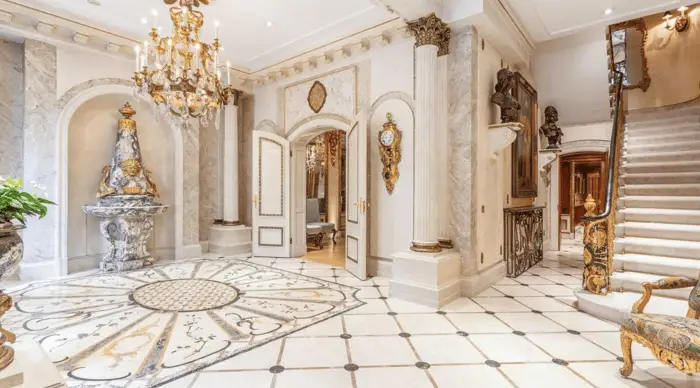
The door was answered by a woman in her fifties wearing the kind of understated designer clothing that screamed expensive taste and unlimited budget. She introduced herself as Mrs. Hartwell, the housekeeper, and led them through a foyer dominated by a crystal chandelier and marble floors that reflected their footsteps back at them in echoes.
“Mr. Blackwood is upstairs in the master suite,” Mrs. Hartwell explained as they climbed a staircase wide enough to accommodate a small parade. “He began experiencing chest discomfort about forty minutes ago, along with shortness of breath and some dizziness.”
The master bedroom was larger than Rachel’s entire apartment, furnished with antiques that belonged in a museum and artwork that probably cost more than most people’s houses. Alexander Blackwood lay propped up in a bed that could have accommodated six people, looking pale but alert.
He was a distinguished man in his late sixties, with silver hair and the kind of bearing that suggested a lifetime of commanding rooms and making decisions that affected other people’s lives. Even in obvious discomfort, he maintained a dignity that spoke of old money and older breeding.
“Good evening,” he said as Rachel and Tom approached his bedside. “I apologize for calling so late. I wasn’t sure if this warranted emergency attention, but Mrs. Hartwell insisted.”
Rachel immediately began her assessment, checking his vital signs while Tom prepared the portable EKG machine. Alexander’s blood pressure was elevated but not dangerously so, his pulse was irregular but strong, and his oxygen saturation was within normal range.
“Mr. Blackwood, can you describe exactly what you’re feeling?” Rachel asked, wrapping the blood pressure cuff around his arm for a second reading.
“Tightness in my chest, like someone is sitting on my ribcage,” he replied. “Some difficulty catching my breath, and a general feeling of… unease. I’ve had minor heart episodes before, but this felt different somehow.”
As Rachel worked, she found herself glancing around the magnificent bedroom. The walls were covered with oil paintings in elaborate gold frames—landscapes, portraits of stern-looking ancestors, still lifes of flowers and fruit rendered with museum-quality skill.
That’s when she saw it.
On the far wall, positioned where it would be the first thing someone saw upon entering the room, hung a portrait that made Rachel’s hands freeze in the middle of checking Alexander’s pulse.
It was a wedding portrait of a woman in an elaborate white gown, her dark hair styled in an elegant updo, her hands folded gracefully in her lap. The painting was exquisite, capturing every detail with photographic precision—from the intricate beadwork on the dress to the subtle shadows that gave the subject’s face dimension and life.
The woman in the portrait looked exactly like Rachel.
Not similar. Not reminiscent. Exactly like her.
Rachel stared at the painting, her medical training temporarily forgotten as her mind tried to process what she was seeing. The facial features, the bone structure, the shape of the eyes and mouth—every detail was identical to her own reflection.
“Is everything all right, miss?” Alexander asked, noticing that she’d stopped moving entirely.
Rachel forced herself to refocus on her patient, completing the examination with professional efficiency despite the chaos in her mind. Alexander’s condition appeared to be stress-related rather than a serious cardiac event, probably triggered by a combination of work pressure and too much caffeine. She recommended rest, prescribed a mild anti-anxiety medication, and suggested he follow up with his personal physician in the morning.
But as she packed up her equipment, she couldn’t stop stealing glances at the portrait.
“Mr. Blackwood,” she finally said, her voice carefully neutral, “that painting on the wall—it’s beautiful. Is it a family member?”
Alexander followed her gaze to the portrait, and his expression softened with what looked like old sadness.
“That was my wife, Isabella,” he said quietly. “She passed away five years ago. The portrait was commissioned for our wedding twenty-eight years ago.”
Rachel’s mind reeled. This man had been married to someone who looked exactly like her—someone who would now be approximately her age if she were still alive.
“I’m sorry for your loss,” Rachel managed to say. “She was very beautiful.”
“She was everything to me,” Alexander replied. “When I bought this house last year, the previous owners had left some of their artwork behind. I was going to have it removed, but when I saw that portrait… I couldn’t bear to take it down. She reminded me so much of my Isabella.”
Rachel completed her paperwork in a daze, barely able to concentrate on the medical details she was supposed to be recording. As they prepared to leave, she found herself taking one more long look at the portrait of the woman who wore her face.
The drive back to the hospital passed in a blur of racing thoughts and impossible questions. Tom and Steve chatted about their upcoming schedules and weekend plans, but Rachel barely heard them. She was trying to make sense of what she’d experienced, searching for rational explanations that simply didn’t exist.
Identical strangers weren’t unheard of—the world was full of people who resembled each other without being related. But this wasn’t resemblance. This was like looking at a photograph of herself dressed in clothing she’d never worn, posing for a picture she’d never taken.
Back at the hospital, Rachel couldn’t concentrate on finishing her shift reports. She kept thinking about the portrait, about the impossible similarity, about the questions that had no logical answers.
At 2 AM, she finally drove home to her apartment, but sleep was impossible. She paced around her small living room, trying to come up with explanations that made sense. Maybe she was more tired than she’d realized. Maybe the lighting in the mansion had played tricks on her perception. Maybe the stress of long hours was making her imagine things that weren’t really there.
But deep in her heart, she knew what she’d seen was real.
The next morning, Rachel sat across from her mother at the small kitchen table where they’d shared countless meals and conversations over the years. Elena Martinez was a practical woman who’d raised Rachel as a single parent, working two jobs to provide for them and never once complaining about the challenges of their circumstances.
“Mom,” Rachel said carefully, “I need to ask you something, and I need you to be completely honest with me.”
Elena looked up from her coffee, immediately sensing the seriousness in her daughter’s tone.
“Did I have a twin sister?”
The silence that followed was deafening. Elena’s face went pale, her hand trembling slightly as she set down her coffee cup. For several long moments, she stared at the table as if trying to decide whether to speak or flee.
“Why would you ask me that?” Elena finally whispered.
“Because yesterday I saw a portrait of a woman who looked exactly like me. Not similar, Mom. Exactly like me. And I need to know if there’s something about my birth that you haven’t told me.”
Elena’s composure crumbled. Tears began streaming down her cheeks as twenty-nine years of carefully guarded secrets finally demanded to be spoken.
“I was seventeen when I got pregnant,” Elena began, her voice barely audible. “Your father was already gone, and I was living with my sister in a studio apartment that barely had room for one person. When the doctor told me I was carrying twins…”
She stopped, unable to continue for a moment.
“I knew I couldn’t provide for two babies. I could barely take care of myself, much less two children. The pregnancy was difficult, and I was working at a diner making minimum wage with no health insurance, no family support, no resources at all.”
Rachel listened in stunned silence as her mother revealed the truth she’d been carrying alone for nearly three decades.
“There was a couple who came to the clinic where I was receiving prenatal care,” Elena continued. “The Ashfords. They were wealthy, older, and had been trying to have children for years. They offered to pay for my medical expenses and provide a good home for one of the babies.”
The words hung in the air like a confession of a crime that had never been prosecuted.
“I made the most difficult decision of my life,” Elena whispered. “I kept you because… because you were born first, and somehow that felt like a sign. But your sister, Isabella, went home with the Ashfords when you were both three days old.”
Rachel felt like the floor was falling away beneath her. “You gave away my twin sister?”
“I gave her a chance at a life I couldn’t provide,” Elena said, her voice breaking. “The Ashfords were good people with money and education and everything a child needed to succeed. I was a teenage mother with no future and no way to support even one child properly.”
Rachel’s mind was racing, trying to process the magnitude of what she was learning. “Have you ever seen her since? Ever tried to contact her?”
Elena shook her head. “It was a closed adoption. The Ashfords moved away, and I never knew where. I tried to put it out of my mind and focus on raising you. Some nights I would lie awake wondering about her, but I told myself I’d done the right thing.”
“Her name was Isabella?” Rachel asked.
“Isabella Maria Ashford. That’s what they planned to call her.”
Rachel’s heart was pounding. The woman in the portrait was named Isabella. Alexander Blackwood’s deceased wife was named Isabella. The timeline matched perfectly.
“Mom, I think I found her. I think I know what happened to her.”
Over the next hour, Rachel told her mother about the emergency call, the mansion, the portrait, and Alexander Blackwood’s story about his wife who had died five years earlier. Elena listened with growing amazement and sorrow as she realized that the daughter she’d given up for adoption had lived a life of luxury and love, but had died far too young.
“She was happy,” Elena said through her tears. “She was loved. That’s what I wanted for her.”
“But she’s gone,” Rachel said. “And I never got to know her. We never got to meet.”
That afternoon, Rachel made a decision that would have terrified her twenty-four hours earlier. She drove back to Westfield Heights and rang the bell at 2847 Maple Ridge Drive.
Mrs. Hartwell answered the door, her eyebrows rising in surprise. “Miss Martinez? Is everything all right? Is Mr. Blackwood having another episode?”
“No, he’s fine as far as I know,” Rachel replied. “I was wondering if I could speak with him about something personal. I know this is unusual, but it’s important.”
Alexander Blackwood met her in the same elegant sitting room where his wife’s portrait dominated the wall. He looked puzzled but gracious, offering her tea and asking how he could help.
“Mr. Blackwood,” Rachel began, “yesterday when I was here, you mentioned that your wife’s name was Isabella and that she passed away five years ago. I know this will sound strange, but I believe she may have been my twin sister.”
Alexander’s face went through a series of expressions—confusion, disbelief, and finally, a dawning wonder as he studied Rachel’s features more carefully.
“Isabella was adopted as an infant,” he said slowly. “She never knew her birth family. She often wondered about her biological parents, but the adoption had been closed and there were no records she could access.”
Rachel told him about her conversation with her mother, about the timeline of the adoption, about the name Isabella Maria Ashford that matched what Elena remembered.
“She talked about feeling incomplete sometimes,” Alexander said, his voice thick with emotion. “Like she was missing a piece of herself. She used to say she felt like she was supposed to be part of a pair.”
For the next three hours, Alexander shared stories about Isabella—her love of art and music, her work with children’s charities, her kindness to everyone she met, her dream of becoming a mother herself. Rachel learned that her twin sister had lived a life filled with love and purpose, but had died in a car accident while returning home from a charity fundraiser.
“She would have loved knowing about you,” Alexander said as the afternoon light faded through the mansion’s tall windows. “She always felt like something was missing from her life, even though she was happy. I think you were what was missing.”
Alexander showed Rachel through the house, pointing out things that had belonged to Isabella—her art supplies, her photographs, her books filled with margin notes in handwriting that looked remarkably similar to Rachel’s own.
In Isabella’s former studio, Rachel found dozens of paintings her sister had created—landscapes and portraits that revealed a talent Rachel had always wished she possessed but never developed.
“She painted that portrait of herself,” Alexander explained, gesturing toward the wedding painting that had started this entire revelation. “She said she wanted to capture the happiest moment of her life so she could look at it whenever she felt sad.”
As evening approached, Alexander made an offer that left Rachel speechless.
“I know this might seem presumptuous,” he said, “but I’d like you to have some of Isabella’s things. Her art supplies, her jewelry, her books. They’re just gathering dust here, and I think she would have wanted her sister to have them.”
Rachel spent the following weeks learning about the life her twin sister had lived. Through Alexander’s memories and Isabella’s personal belongings, she discovered a woman who had been loved deeply and had loved others in return, who had used her privileged circumstances to help people less fortunate, and who had always carried a sense of incompleteness that now made perfect sense.
The most profound discovery came in a journal Isabella had kept during the last year of her life. In it, she’d written extensively about dreams she’d been having—dreams about a woman who looked exactly like her, who worked in a hospital, who lived alone but seemed content.
“I dream about her almost every night,” one entry read. “She feels so real, so familiar. I wake up feeling like I’ve been talking to someone I’ve known my whole life, but I can’t remember her name or how I know her. It’s the strangest thing.”
Another entry, written just weeks before her death, was even more startling: “I’ve been thinking about trying to find my birth family again. I know the adoption was closed, but I can’t shake the feeling that there’s someone out there who’s supposed to be part of my life. Someone who would understand me in a way that no one else does.”
Rachel realized that even separated by adoption, even living completely different lives, she and Isabella had maintained some kind of connection that transcended physical distance. They’d been dreaming about each other without knowing why.
Six months after that first emergency call, Rachel made another life-changing decision. She enrolled in art classes, discovering that she had inherited the same talent that had brought Isabella so much joy. She found that painting gave her a sense of connection to the sister she’d never known, a way of honoring Isabella’s memory while exploring her own creative potential.
Alexander became an unexpected father figure in her life, sharing stories about Isabella and helping Rachel understand the woman her twin sister had become. He established a scholarship fund in Isabella’s name, administered through the hospital where Rachel worked, to help young women from disadvantaged backgrounds pursue careers in healthcare.
Elena, initially overwhelmed by guilt about her long-ago decision, found peace in learning that both her daughters had grown up to be successful, caring women. She began volunteering with pregnant teenagers facing difficult decisions, offering support and understanding that only someone who’d walked that path could provide.
On the first anniversary of discovering the truth about her sister, Rachel stood before Isabella’s portrait in Alexander’s mansion—a portrait she’d inherited along with the house itself when Alexander passed away peacefully in his sleep eight months later.
In his will, Alexander had left the mansion to Rachel with a simple explanation: “Isabella always said this house felt like it was waiting for someone. I believe it was waiting for you.”
Rachel had quit her job at the hospital and opened a medical clinic in the mansion’s converted carriage house, providing healthcare services to undocumented immigrants and others who couldn’t afford traditional medical care. She used Isabella’s inheritance to fund the clinic, creating the kind of legacy she believed her sister would have wanted.
But the most meaningful inheritance wasn’t money or property or artwork.
It was the understanding that love transcends time, distance, and even death. That connections forged in the womb can survive decades of separation. That family is about more than shared experiences—it’s about shared souls that recognize each other even across impossible circumstances.
Every evening, Rachel sat in the studio where Isabella had painted, working on her own artistic projects while surrounded by her sister’s creations. Sometimes, she felt like she wasn’t alone—like Isabella was somehow present, guiding her hands, sharing the creative joy they should have experienced together.
The portrait that had started this incredible journey now hung in the clinic’s waiting room, where patients often commented on the beautiful woman who seemed to radiate kindness and peace. Rachel would smile and say, “That’s my sister. She watches over this place.”
In the end, Rachel learned that some reunions happen not in life, but in understanding. That love doesn’t require presence to be real. And that sometimes the most profound relationships are with people we never get to meet, but who shape our lives in ways we’re only beginning to understand.
Isabella’s final journal entry, written the day before she died, seemed almost prophetic: “I had the most vivid dream last night about my sister—because I’m sure now that’s who she is. We were working together, helping people, making a difference in the world. When I woke up, I felt more peaceful than I have in years. Whatever happens, I know she’s out there somewhere, and I know we’ll find each other eventually.”
Rachel kept that journal entry framed on her desk as a reminder that love is stronger than separation, that family bonds transcend physical existence, and that sometimes the most beautiful reunions are the ones that happen in the heart rather than in person.
The mansion on Maple Ridge Drive became known throughout the community as a place of healing and hope, where a nurse honored her twin sister’s memory by carrying on the work of love and service that had defined both their lives.
And every morning, as Rachel began another day of caring for those who needed help most, she would look at Isabella’s self-portrait and whisper, “Thank you for showing me the way home, sister. Thank you for teaching me that love never really dies.”

Sophia Rivers is an experienced News Content Editor with a sharp eye for detail and a passion for delivering accurate and engaging news stories. At TheArchivists, she specializes in curating, editing, and presenting news content that informs and resonates with a global audience.
Sophia holds a degree in Journalism from the University of Toronto, where she developed her skills in news reporting, media ethics, and digital journalism. Her expertise lies in identifying key stories, crafting compelling narratives, and ensuring journalistic integrity in every piece she edits.
Known for her precision and dedication to the truth, Sophia thrives in the fast-paced world of news editing. At TheArchivists, she focuses on producing high-quality news content that keeps readers informed while maintaining a balanced and insightful perspective.
With a commitment to delivering impactful journalism, Sophia is passionate about bringing clarity to complex issues and amplifying voices that matter. Her work reflects her belief in the power of news to shape conversations and inspire change.