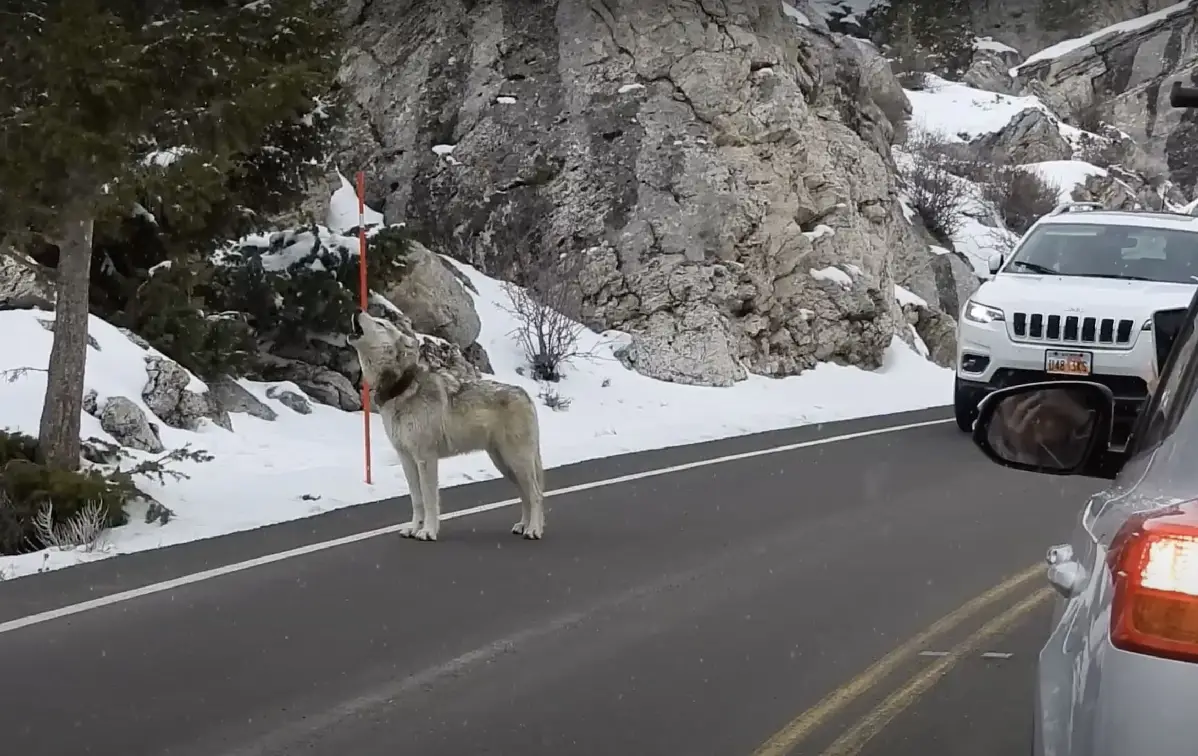
The Night the Alpha Saved My Life: When Death Wore Fur and Fangs
The blizzard had been raging for six hours when I finally decided to risk the drive home. Looking back now, that decision should have killed me. Instead, it led to the most extraordinary encounter of my life—a moment that changed everything I thought I knew about the thin line between civilization and the wild.
My name is David Chen, and I’m a wildlife photographer who’s spent the better part of fifteen years documenting predators in their natural habitats. I’ve been charged by grizzly bears in Alaska, stalked by mountain lions in Colorado, and surrounded by coyote packs in Nevada. I thought I understood the language of wild animals, the subtle communications that separate curiosity from aggression, territory marking from hunting behavior.
I was wrong.
The evening of December 18th started ordinarily enough. I’d been returning from a three-day assignment in the Cascade Mountains, photographing winter wildlife for a National Geographic feature on climate change impacts on predator behavior. My equipment bags were loaded with memory cards full of images—elk moving through deep snow, the tracks of lynx and wolverine, the haunting beauty of a landscape locked in winter’s grip.
The storm had caught everyone off guard. What meteorologists had predicted as “light snow flurries” had transformed into a full-scale blizzard with sixty-mile-per-hour winds and visibility that dropped to less than fifty feet. Highway 20, normally a well-maintained route through the national forest, had become a treacherous ribbon of ice and accumulated snow.
I should have stopped at the ranger station and waited it out. Should have found a motel in the last town I’d passed through. Should have listened to the voice in my head that whispered warnings about traveling mountain roads in conditions like these.
Instead, I pressed on, driven by the kind of stubborn determination that had gotten me some of my best photographs and nearly gotten me killed more times than I cared to count.
The highway cut through old-growth forest that had stood for centuries, massive Douglas firs and western hemlocks creating a cathedral of shadows on either side of the road. In daylight, it was beautiful. In the middle of a blizzard at 9:30 PM, it felt like driving through the mouth of some enormous beast.
My headlights barely penetrated the swirling snow. The radio had been crackling with static for the past hour, and my cell phone showed no signal. I was alone in a way that city dwellers never truly experience—completely isolated, dependent entirely on my own resources and judgment.
That’s when I saw the brake lights ahead.
A pickup truck, maybe two hundred yards in front of me, had suddenly stopped. Not the gradual slowing of someone being cautious, but the sharp, urgent stop of someone who’d encountered an immediate obstacle.
I pumped my brakes carefully, feeling the slight slide of tires on ice before the anti-lock system kicked in. My SUV came to a stop maybe thirty feet behind the pickup, close enough to see the driver’s silhouette in his rear window.
He wasn’t moving. He was just sitting there, his hands gripping his steering wheel, staring straight ahead.
That’s when I followed his gaze and understood why he’d stopped.
Wolves.
Not a couple of stragglers or a family unit, but a full pack. They emerged from the tree line on both sides of the highway like gray ghosts materializing from the storm. One by one, then in groups, until I counted at least fifteen animals moving with the coordinated precision of a military unit.
In my years of wildlife photography, I’d encountered wolves exactly three times, always at a distance, always in situations where they’d detected my presence and melted back into the forest before I could get more than a few shots. They were creatures of legend more than reality for most people—intelligent, elusive, and generally terrified of human contact.
These wolves were different.
They moved onto the highway with deliberate purpose, spreading out to form a loose semicircle around our vehicles. Their body language wasn’t aggressive, exactly, but it was confident in a way that sent ice through my veins. These were animals that had made a decision, and that decision involved us.
The wolf that positioned itself directly in front of my windshield was magnificent and terrifying. Its coat was a mixture of gray and black, thick with winter fur that made it look massive in my headlights. When it looked at me through the glass, its yellow eyes reflected the light with an intelligence that was almost human.
We stared at each other for what felt like hours but was probably only seconds. In that moment, I felt like I was being evaluated, measured, judged by criteria I couldn’t begin to understand.
I reached for my camera—instinct born from years of photographing wildlife—but my hands were shaking too badly to operate the controls. This wasn’t a photo opportunity. This was something else entirely.
More wolves appeared in my peripheral vision. I could see them in my side mirrors, moving between the trees, their eyes catching my headlight beams like dozens of small fires in the darkness. My vehicle was surrounded.
The pickup truck ahead of me wasn’t moving either. I could see the driver’s head turning frantically as he tried to assess the situation, probably running through the same mental calculations I was: How fast could wolves run compared to a vehicle on icy roads? Could they break windows if they really wanted to? What did they want?
That last question was answered in the most terrifying way possible.
The wolf in front of my SUV suddenly crouched, its muscles coiling like springs. Before I could process what was happening, it launched itself forward with explosive power.
The impact when it landed on my hood was tremendous—a metallic boom that reverberated through the vehicle’s frame. The animal’s weight caused my SUV to rock back on its springs, and I could hear its claws scrabbling for purchase on the painted metal.
Through the windshield, less than three feet from my face, was two hundred pounds of apex predator. Its lips were pulled back slightly, revealing teeth that could crush bone. Its breath fogged the glass between us. The sound it made—not quite a growl, not quite a whine—was something primal that reached into the deepest, most ancient parts of my brain and screamed danger.
I couldn’t move. Couldn’t breathe. Couldn’t think beyond the absolute certainty that I was about to die in a way that would make headlines: “Wildlife Photographer Killed by Wolf Pack on Mountain Highway.”
The animal on my hood pressed its face closer to the windshield, studying me with an intensity that was almost surgical. I could see every detail—the black leather of its nose, the amber flecks in its yellow eyes, the scars that marked its muzzle from years of survival in the wild.
I was hyperventilating, my vision starting to tunnel, when everything changed.
From deep in the forest came a sound unlike anything I’d ever heard. It wasn’t a howl—howls are high-pitched, mournful, meant to carry long distances. This was low, powerful, resonant. It seemed to come from the earth itself, a vibration that I felt in my bones more than heard with my ears.
The effect on the wolves was immediate and absolute.
The animal on my hood froze, its ears swiveling toward the forest. Every wolf visible in my headlight beams had the same reaction—sudden stillness, complete attention focused on whatever had made that sound.
Then he appeared.
The alpha emerged from between the trees with the unhurried confidence of someone who’d never had his authority questioned. He was larger than the others, but size wasn’t what made him imposing. It was his bearing, the way he carried himself, the absolute certainty in every movement that marked him as the undisputed leader.
His coat was darker than the others, almost black, with silver threading through the fur around his face and shoulders. Battle scars marked his muzzle and ears—evidence of the fights he’d won to earn and maintain his position. When he looked at the scene on the highway, his expression was calm, calculating, and utterly in control.
He stopped in the center of the road, maybe twenty feet from my vehicle, and made that sound again. This time I could see it coming from deep in his chest, a vocalization that carried authority in every vibration.
The wolf on my hood immediately jumped down, landing with surprising grace considering the ice and snow. It moved to the side of the road and stood still, waiting.
The alpha’s gaze swept over the entire pack, and wherever his eyes fell, wolves began to retreat. Not in panic or haste, but with organized precision. This wasn’t a rout—it was a tactical withdrawal ordered by a leader who’d made a command decision.
As the pack melted back into the forest, the alpha remained on the highway. For several long moments, he looked directly at me through the windshield. His yellow eyes held mine with an intelligence that was almost conversational, as if he were trying to communicate something important.
In that look, I understood what had just happened. The pack hadn’t been hunting. They’d been investigating, following their curiosity about these strange metal creatures that traveled through their territory. The younger wolf’s aggressive behavior had been excitement, exploration, the kind of boundary-testing that happens in any social group.
But the alpha had recognized the situation for what it was—a potential disaster that would end badly for everyone involved. He’d called off his pack not out of fear, but out of wisdom. He understood that dead humans meant helicopters, hunters, and the kind of attention that could destroy his family.
The alpha held my gaze for another moment, then turned and walked calmly back toward the tree line. Just before he disappeared into the shadows, he paused and looked back once more—not a threat, not a warning, but something that felt almost like acknowledgment.
Then he was gone, and the highway was empty except for two vehicles and the swirling snow.
I sat in my SUV for another ten minutes, hands trembling, trying to process what had just happened. The pickup truck ahead of me finally began moving, creeping forward at maybe five miles per hour. I followed, my own speed barely above a crawl, constantly checking my mirrors for any sign of returning wolves.
The rest of the drive passed without incident, but I couldn’t stop thinking about those final moments when the alpha had looked at me. There had been something in his expression that transcended species boundaries—a recognition that we were both intelligent beings trying to navigate a dangerous world, both leaders responsible for the safety of our respective groups.
When I finally reached home three hours later, I immediately uploaded the few photos I’d managed to take with my dashboard camera. The images were grainy, taken through a windshield in poor light, but they clearly showed the encounter. The wolf on my hood was visible in stark detail, and in the background, you could just make out the alpha’s imposing silhouette.
I spent the next week researching everything I could find about the wolf pack that inhabited that section of the Cascade Mountains. What I discovered was fascinating and sobering.
The pack had been studied by wildlife biologists for seven years. The alpha—a male estimated to be nine years old—had been tagged and tracked, designated as Wolf M-47 in the research database. He’d successfully led his pack through some of the harshest winters on record, had fathered multiple generations of cubs, and had never been involved in a negative encounter with humans.
According to the research data, M-47’s pack had been under increasing pressure due to shrinking territory and human encroachment. Highway development, logging operations, and residential expansion had fragmented their traditional hunting grounds, forcing them to travel farther and take greater risks to find food.
The night I encountered them, they’d likely been moving between territory sections, crossing the highway as they’d done hundreds of times before. My vehicle and the pickup truck had simply been in the wrong place at the wrong time, creating a situation that could have gone very differently.
Three months after my encounter, I received a call from Dr. Sarah Martinez, the lead biologist studying the Cascade wolf population. She’d seen my photos and wanted to interview me about the encounter.
“What you experienced was remarkable,” she told me during our conversation. “M-47 has been observed demonstrating unusual restraint and decision-making abilities, but what you described goes beyond anything we’ve documented. He essentially prevented what could have been a tragic situation for both humans and wolves.”
Dr. Martinez explained that wolf attacks on humans are extraordinarily rare, but when they do occur, they usually result in hunting campaigns that can devastate entire populations. M-47’s intervention had likely saved not just my life, but the lives of his entire pack.
“He’s what we call a super-alpha,” she said. “Not just dominant within his pack, but demonstrating intelligence and judgment that suggests he understands the larger consequences of his decisions. He’s been keeping his pack away from human conflicts for years.”
Six months later, I returned to the Cascade Mountains with a formal research permit, hoping to photograph M-47’s pack for the National Geographic feature. I spent two weeks in the field, using remote cameras and tracking techniques I’d learned over years of wildlife photography.
I never saw them directly, but I found evidence of their presence everywhere—tracks in the snow, scent markings on trees, the remains of deer they’d hunted with surgical precision. They knew I was there, but they kept their distance, moving through their territory like ghosts.
On my last day in the field, I found something that took my breath away. Pressed into the snow beside one of my remote camera stations was a single, perfect wolf print—much larger than the others I’d been tracking. Next to it was a second print, and then a third, creating a trail that led directly past my camera before vanishing into the deep forest.
M-47 had known exactly where my equipment was positioned. He’d deliberately walked past it, close enough to be photographed but apparently during a time when the camera wasn’t triggered. It was like he’d been saying hello while making sure I understood the boundaries.
The photos I eventually published in National Geographic told the story of a species struggling to survive in an increasingly human-dominated landscape. But for me, they also told the story of a single moment when two apex predators—one human, one wolf—had looked into each other’s eyes and found understanding instead of conflict.
A year later, I learned that M-47 had been killed by a poacher who’d illegally entered the national forest. His death devastated the pack structure, and within months, the group had scattered. Some joined other packs, some died trying to establish new territories, and a few simply disappeared into the vast wilderness.
The news hit me harder than I’d expected. I’d only encountered M-47 for a few minutes, but in that time, he’d taught me something profound about leadership, wisdom, and the possibility of communication across species boundaries.
I still drive Highway 20 several times a year, usually on assignment but sometimes just to remember. The road looks different now—wider, with better lighting and improved snow removal. Development has crept closer to the forest edge, and the wilderness that once seemed infinite feels smaller, more fragmented.
I’ve never seen wolves there again.
But sometimes, on nights when the snow is falling and the forest is deep with shadows, I slow down and remember the moment when a wild alpha looked into my eyes and chose mercy over instinct, wisdom over aggression.
In a world that often feels divided between human civilization and wild nature, M-47 reminded me that intelligence, compassion, and good judgment aren’t uniquely human traits. Sometimes the most powerful leaders are those who choose not to use their power, who understand that true strength lies in knowing when to step back rather than step forward.
That night on Highway 20, a wolf saved my life not by fighting, but by choosing peace. It’s a lesson I carry with me every day, and one I hope others might find in their own encounters with the wild world that still exists at the edges of our carefully controlled lives.
The alpha is gone now, but his wisdom remains: sometimes the greatest act of leadership is knowing when to walk away.

Sophia Rivers is an experienced News Content Editor with a sharp eye for detail and a passion for delivering accurate and engaging news stories. At TheArchivists, she specializes in curating, editing, and presenting news content that informs and resonates with a global audience.
Sophia holds a degree in Journalism from the University of Toronto, where she developed her skills in news reporting, media ethics, and digital journalism. Her expertise lies in identifying key stories, crafting compelling narratives, and ensuring journalistic integrity in every piece she edits.
Known for her precision and dedication to the truth, Sophia thrives in the fast-paced world of news editing. At TheArchivists, she focuses on producing high-quality news content that keeps readers informed while maintaining a balanced and insightful perspective.
With a commitment to delivering impactful journalism, Sophia is passionate about bringing clarity to complex issues and amplifying voices that matter. Her work reflects her belief in the power of news to shape conversations and inspire change.