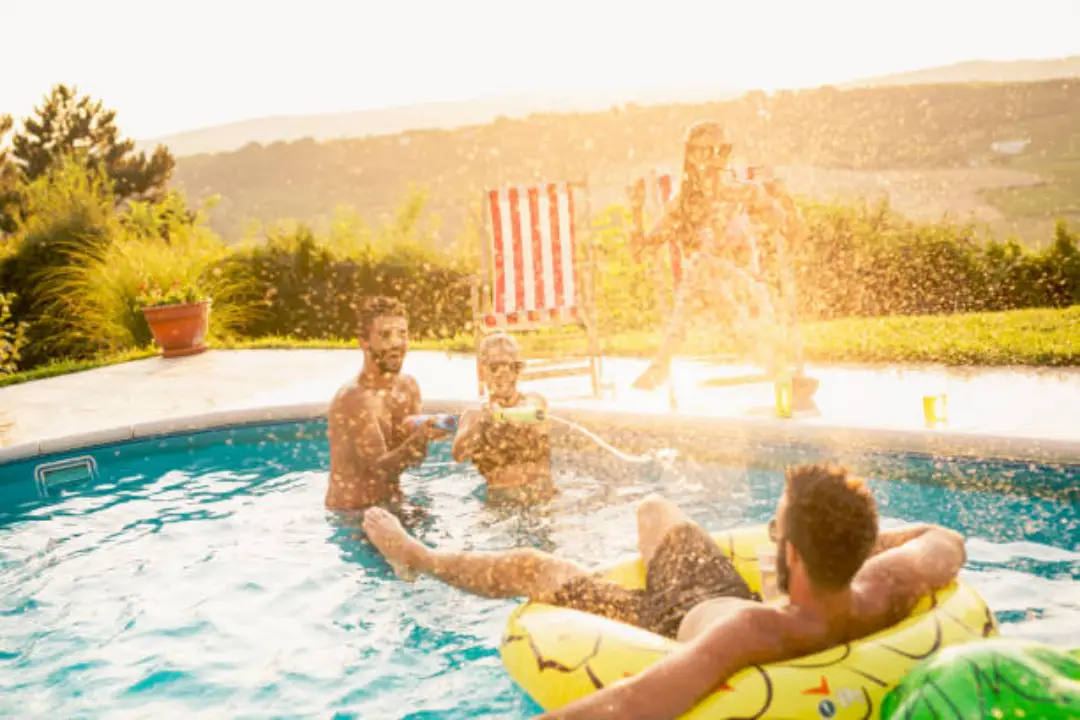
I was standing at the grill in Harper’s parents’ backyard, flipping burgers with the practiced ease of someone who’d been designated the unofficial barbecue chef, when her sister Vanessa pulled into the driveway with her new boyfriend. The moment Craig stepped out of the passenger seat, I could tell this was going to be an interesting afternoon.
He walked into the yard like he was entering a stage, and within thirty seconds of arriving, he’d already launched into a monologue about the pool he’d just installed at his house. The words “basically built for someone like me” and “pretty much a professional swimmer” floated across the patio before he’d even greeted Harper’s parents properly.
Harper squeezed my hand and leaned in close, her voice low enough that only I could hear. “Wow, so impressive,” she whispered, her eyes dancing with amusement. She knew about my four years on the Olympic swim team—we’d been dating long enough that those stories had come out naturally over late-night conversations and lazy Sunday mornings. But I’d never mentioned it to her family. I didn’t want to be that guy who peaked in college, pulling out old achievements at dinner parties like parlor tricks, name-dropping Stanford and the Olympic trials like they were my entire personality.
Craig found me at the grill about twenty minutes into the barbecue, beer already in hand, and started holding court about his swimming prowess. “I actually had to get kicked out of the club pool last month,” he announced, his voice carrying across the patio loud enough for everyone to hear. “The other swimmers complained to management that I was making them uncomfortable because I was so much faster than everyone else. I mean, when you’re lapping people twice in a single session, it gets embarrassing for them, you know?”
He looked at me expectantly, like I should applaud or ask for his autograph.
I nodded politely and turned my attention back to the burgers, making sure they didn’t burn. Beside me, Harper rolled her eyes so dramatically I thought they might actually fall out of her head and land in the cooler.
Craig took a long drink from his beer and then looked me up and down with the kind of assessment usually reserved for livestock auctions. “You ever swim, Dylan?” The question came out casual, but his eyes were already making judgments. “No offense, but you don’t really have the body for it anymore. I mean, look at these shoulders.” He rotated his arms to demonstrate, showing off his physique like he was modeling for a protein powder commercial. “Swimming is all about the wingspan and the core. You’ve got more of a softball build going on.”
He laughed at his own observation, clearly pleased with his wit.
I just smiled and shrugged, focusing on arranging the cheese slices. The truth was, my swimmer’s build had softened over five years of retirement. The six-pack had given way to something more comfortable, the razor-sharp definition replaced by the body of someone who enjoyed good food and didn’t spend six hours a day in the pool anymore. I was fine with it—more than fine, actually. Those years of obsessive training had been rewarding but exhausting, and I didn’t miss the constant hunger or the chlorine-damaged skin.
Vanessa tried to steer the conversation toward safer topics, asking her mother about the potato salad recipe, but Craig was just getting warmed up. He’d found an audience, and he wasn’t about to let it go.
“It’s not your fault, man,” he continued, settling into what sounded like a well-rehearsed lecture. “Black guys just aren’t built for swimming. It’s a scientific fact—something about bone density or muscle fibers or center of gravity. That’s why you never see them in the Olympics.”
The patio went quiet. Harper’s jaw dropped open, and I could see her forming words, ready to tear into him, but I touched her arm gently and leaned close. “Let him talk,” I whispered. “This is actually hilarious.”
Craig must have taken my silence as agreement, or maybe he was just too drunk and self-absorbed to notice the shock rippling through the gathering. “I’m not being racist or anything,” he added, as people who are absolutely about to say something racist always do. “It’s just biology. Facts don’t care about feelings, right? When’s the last time you saw a Black swimmer win anything major? Michael Phelps, Ryan Lochte, all those Australian guys—all the greats are white. It’s just how evolution works.”
He shrugged like he’d just explained gravity or the water cycle, like he was doing me some kind of favor by enlightening me about my own supposed biological limitations.
Even Harper’s father, usually the most diplomatic person in any room, looked deeply uncomfortable. He opened his mouth to say something, then closed it again, glancing at me to gauge my reaction. I kept that same easy smile on my face, flipping burgers with steady hands.
After a few more beers, Craig decided to demonstrate his perfect butterfly technique right there on the grass. He dropped to the ground and started flopping around like a fish out of water, his arms windmilling through the air while he grunted with effort. “See, Dylan, it’s all about the dolphin kick,” he explained between exaggerated movements. “I bet you don’t even know what that is. My coach—back when I trained seriously—said I had natural talent you can’t teach. Some people have it, some don’t. It’s genetic.”
He stood up with grass stains smeared across his polo shirt, completely serious about the athletic demonstration he believed he’d just performed. A few people exchanged glances, trying to determine if this was performance art or genuine delusion.
When Harper casually mentioned, “Dylan used to swim in college,” Craig laughed so hard he nearly choked on his beer. He had to pound his chest a few times before he could speak. “Community college had a swim team? That’s adorable. Let me guess—you guys did doggy paddle relays?”
The condescension dripped from every word. Harper’s expression shifted from amusement to genuine anger, her cheeks flushing red.
Then Craig turned to Vanessa with a smirk that made me want to throw him in the pool myself. “No wonder Harper’s dating him. She’s always had a thing for charity cases. Remember that guy with the limp from last year?”
Harper’s face went from red to white with fury. “Dylan went to Stanford, you absolute ass,” she snapped, her voice cutting through the afternoon like a blade.
I just touched her arm and said quietly, “Harper, it’s fine. Really.”
Craig pulled out his phone, already scrolling through his camera roll with the enthusiasm of someone about to show vacation photos to a captive audience. “Let me show you guys some of my races,” he announced, and for the next ten minutes, he narrated a series of videos like he was providing commentary for an Olympic broadcast. “This is me destroying everyone at my gym. See that guy I just lapped? He told me he swam Division III in college. Pathetic.” He turned to me with a grin that was probably meant to be friendly but came across as purely antagonistic. “Dylan probably thinks the shallow end is an accomplishment. Different leagues, bro. I’m talking real swimming, not whatever you did at the YMCA.”
The videos were clearly sped up—I could tell from the way the water moved and the unnatural jerkiness of his stroke—but I didn’t bother pointing it out. What would be the point?
The afternoon deteriorated further when Craig started citing his race times, claiming he could swim a fifty-meter freestyle in under twenty seconds. For context, the world record was around twenty seconds flat, set by the fastest swimmers on the planet using starting blocks and in perfectly controlled conditions. Craig was either lying, delusional, or both.
“I never went pro because I make too much money in sales,” he explained, gesturing with his beer bottle like it was a pointer in a business presentation. “Why make pennies swimming laps when I can afford my own pool? Dylan, what do you do for work again?”
Harper mentioned something about me coaching kids at the community center, and Craig laughed like she’d just told him I trained hamsters to do backflips. “What do you coach them in? Burger flipping?” He gestured at the grill and laughed again, clearly delighted with his own humor. “That’s sweet, though—giving back to the community since you never made it yourself. Very noble.”
I actually laughed at that one, because the irony was too perfect to ignore.
Finally, after enough liquid courage to fell a small horse, Craig had drunk enough to issue his challenge. He stood up from his lawn chair, swaying slightly, and announced to the entire gathering, “You know what? Let’s settle this right now. Dylan, race me. Get in my pool right now and race me—unless you’re too scared to lose in front of your girlfriend.”
He pulled off his shirt with theatrical flair, revealing a physique that was decent but nowhere near athletic. “Come on, man. One lap. Unless you want to admit you can’t swim and that I’m superior in every way.” He spread his arms wide, addressing the crowd like a Roman emperor. “What’s it gonna be, Dylan? You gonna hide behind Harper, or are you gonna be a man about this?”
Harper looked at me with an expression that was equal parts exasperation and anticipation. “Oh my God,” she said, deadpan. “Just do it already.” She knew exactly what was about to happen, and I could see the gleeful anticipation building in her eyes.
Craig stood there smirking, chest puffed out, absolutely convinced he was about to humiliate me in front of everyone who mattered to Harper. He had no idea he’d just challenged someone with four NCAA titles and an Olympic trials record in the 200-meter freestyle that still hadn’t been broken after five years.
I set down my spatula and wiped my hands on a towel. “Sure, man,” I said calmly. “One lap sounds good.”
The drive to Craig’s house became a small convoy. Harper’s father, recognizing that Craig had consumed enough beer to pickle a small animal, took the keys from his hand before he could protest. “Nobody’s riding with someone who’s been drinking that much,” he said firmly, and nobody argued with him. Craig protested briefly, puffing up like an angry rooster, but his girlfriend—clearly mortified by his behavior—grabbed his arm and steered him toward her car.
Harper and I climbed into mine, her hand finding mine across the console. “I can’t wait to see his face,” she whispered, squeezing my fingers. “This is going to be beautiful.”
I kept my eyes on the road, following Vanessa’s car through the suburban streets, focusing on staying calm and keeping my competitive instincts in check. Because even though it had been five years since I’d competed seriously, my body still remembered what it felt like to destroy someone in the water. That muscle memory didn’t fade—it just waited, dormant, for moments exactly like this.
Craig’s house materialized after about ten minutes of driving, and I had to admit his pool setup was actually impressive. The pool stretched a proper twenty-five yards with lane lines and everything, though I could tell from the way the lane ropes sagged that he probably never bothered setting them up correctly. It was the pool of someone who liked the idea of swimming more than the actual discipline of it.
Craig immediately launched into a tour, explaining how he’d personally designed every aspect for optimal training conditions and maximum speed development. He pointed out the shallow end where “beginners usually stay,” then gestured grandly at the deep end where “real swimmers train.” He went on about the filtration system, the Italian tiles he’d special-ordered, and how the depth was calibrated perfectly for generating the right kind of wave resistance.
Everyone just wanted to see the race happen, but Craig kept talking, clearly in love with the sound of his own voice.
I walked over to check the water temperature while he pontificated, and suggested we should probably establish some ground rules for safety, since he’d been drinking heavily all afternoon.
Craig waved his hand dismissively. “Real swimmers don’t need rules,” he declared. “The water is our natural element.”
Harper’s father stepped forward, his voice firm enough to cut through Craig’s bravado. “We absolutely need to be smart about this. Nobody’s getting in that pool without some basic safety measures in place.”
Craig rolled his eyes like a teenager being told to clean his room, but Vanessa backed up Harper’s father, so he had to concede.
That’s when things got awkward. Craig started stripping off his clothes right there on the pool deck, and I realized with dawning horror that he was going down to his underwear because he didn’t actually own swim trunks at his own house—at the pool he’d supposedly installed for serious training.
The discomfort rippled through the gathered crowd like a wave. Vanessa finally convinced him to at least keep his shorts on, though he complained loudly that the fabric would create drag and slow him down, ruining the integrity of the race.
I suggested we should have someone neutral time us to make sure everything was fair and official.
Craig scoffed immediately. “Already making excuses before we’ve even started,” he said. “That’s not a good look, buddy.”
Still, several people agreed that an official timekeeper made sense, and Harper’s mother volunteered, saying she didn’t care who won and would be completely impartial.
Craig started his warm-up routine, which consisted of aggressive arm swings that looked more like he was fighting invisible enemies than preparing his muscles for athletic performance. He grunted loudly with each movement, checking constantly to make sure everyone was watching his display.
Meanwhile, I quietly stretched my shoulders the way I’d done thousands of times before competitions—gentle rotations, careful lengthening of the muscles, nothing showy or dramatic. I knelt down and dipped my hand into the water to check the temperature, which was colder than ideal but manageable.
Harper had her phone out, recording everything. “I want to remember this moment forever,” she said loud enough for everyone to hear.
Craig heard that and immediately flexed for the camera. “You can use the video to show people what peak performance looks like,” he said without a trace of irony.
Vanessa pulled me aside while Craig was distracted by his own reflection in the pool water. Her face was miserable, and I could see the exact moment she realized her boyfriend was about to embarrass himself in front of her entire family. “I’m so sorry about everything he said,” she whispered. “The racist stuff especially. I had no idea he was like this.”
I told her it wasn’t her fault, that Craig clearly had some issues he needed to work through, but she still looked like she wanted to disappear into the ground.
Craig called me back over and began explaining the rules like I was five years old and had never seen a pool before. He used his hands to demonstrate that one lap meant down to the other end and back, and that we’d be doing freestyle, which meant any stroke as long as I didn’t touch the bottom or the lane lines.
I nodded along patiently while Harper stood behind him, her hand pressed to her mouth, trying desperately not to laugh at the absurdity of this entire situation.
More people from the original barbecue started arriving, word having spread about the impromptu race. Craig immediately played to the growing audience, announcing that he’d try not to lap me but sometimes his competitive nature just took over.
We both got in the water at opposite ends to prepare for push starts. The cold hit me immediately, my muscles tensing for a second before adjusting. Craig started complaining that the temperature was throwing off his rhythm, that his muscles weren’t responding right, that maybe we should wait for the water to warm up.
Harper’s father said we were doing this now or not at all, his patience clearly wearing thin.
So Craig stopped complaining and got into position. I pushed off in a slow practice start just to demonstrate the motion, and my body remembered instantly—the explosive drive off the wall, the streamlined glide underwater, the moment of surfacing into the first stroke. I made it halfway across the pool before stopping, my technique smooth despite the years away from serious training.
Craig watched, then attempted his own practice start, which was basically a clumsy shove off the wall while his arms flailed randomly. He came up sputtering after three strokes, water streaming from his nose. “Just warming up,” he gasped. “The real one will be completely different.”
A neighbor named Ed Gilmore appeared at the fence, asking what all the commotion was about. When someone explained we were having a swimming race, he disappeared briefly and returned with an actual stopwatch from his garage. “I used to time my grandson’s swim meets,” he explained, offering to help as a completely neutral party.
Now we had two official timekeepers, which made this absurd situation feel almost legitimate.
A couple of teenagers started clearing pool toys and floating beer cans from the lanes while Craig and I took a few easy strokes to adjust to the water. My warm-up was smooth, controlled freestyle, just getting a feel for the temperature and distance. Craig’s looked like he was trying to beat the water into submission, his strokes sending huge splashes everywhere, his legs kicking so wide he nearly hit the lane divider.
Harper’s father gathered everyone and requested this stay respectful, with no trash talk during the actual race. Vanessa looked grateful for the intervention, though Craig muttered something about not needing anyone to protect him.
Then Craig started up again with his ignorant theories about race and swimming, offering to give me a five-second head start because of my supposed biological disadvantages.
Before I could respond, a woman named Immani Wade—one of Harper’s family friends—shut him down hard with actual facts. She talked about Cullen Jones winning Olympic gold, about Simone Manuel breaking records that had stood for decades, about Anthony Ervin and his comeback story. She told Craig his “science” was just ignorance dressed up in pseudo-intellectual language, and that maybe he should learn some actual history before opening his mouth.
Craig’s face went red, and he mumbled something about exceptions proving the rule, but everyone was clearly done listening to him.
The crowd had grown to about fifteen people standing around the pool edge, waiting to see what would happen. Craig kept stretching and posing like he was preparing for the Olympic finals while I stood quietly in the water, controlling my breathing, feeling my heart rate settle into that familiar pre-race calm.
Ed and Immani synchronized their timing devices while Harper’s father asked one final time if we were both ready to do this safely.
“I was born ready,” Craig announced dramatically.
I just nodded and got into position at the wall, my hands gripping the pool edge the same way they had hundreds of times before in competitions that actually mattered—NCAA championships, Olympic trials, international meets where the pressure was real and the stakes were high. Craig tried to copy my position, but his form was completely wrong—his hips too high, his head angled up instead of down, his shoulders tense instead of loose.
The entire crowd went quiet as Harper’s father raised his hand to start the countdown.
And I felt that familiar calm wash over me, the kind that always came right before the gun went off and the world narrowed to just me and the water.
Craig suddenly stood up and started pounding his chest with both fists, making loud whooping noises that echoed across the pool area and probably woke up half the neighborhood. Everyone stared in stunned silence as he beat his chest harder and harder, his face turning red from the effort and the alcohol. He threw his arms up and let out a primal scream that set off a dog barking two houses over.
He stumbled slightly getting back into position, still breathing heavy from his performance.
Harper’s father cleared his throat and raised his hand again. “On your marks,” he said clearly.
We both gripped the pool edge.
“Get set.”
I coiled my muscles like a spring, every part of my body ready to explode forward. Craig crouched awkwardly, his form falling apart before we’d even started.
Harper’s father started to say “Go,” but Craig launched himself into the water before the word fully left his mouth, creating a massive splash.
Ed immediately called out, “False start!” and waved his arms to stop everything.
Craig came up sputtering and started arguing that he definitely heard the complete word, even though literally everyone was shaking their heads.
We reset. Harper’s father made sure to speak even louder and clearer this time.
“On your marks. Get set. Go!”
This time, we both pushed off clean and legal.
My body remembered exactly what to do. The explosive drive off the wall, the tight streamline underwater, the breakout into my first stroke—it all came back like I’d never stopped. The water felt perfect against my skin as I pulled through with my right arm, then my left, finding that rhythm I’d practiced ten thousand times. My breathing was controlled, my rotation smooth, my kick steady and powerful.
Next to me, Craig was creating chaos—massive splashes, his arms windmilling through the water with no technique or control.
By my fifth stroke, muscle memory had completely taken over. My body knew what to do without my brain having to direct it. I could hear muffled cheers from above the water as I glided through each stroke, years of training condensed into this single moment.
Craig’s splashing got louder and more desperate as I pulled ahead. His breathing turned ragged, gasping with every attempted stroke.
I touched the wall with a smooth reach and stood up calmly, water streaming from my hair. Craig was still struggling through the last few yards, his technique completely falling apart. He finally slapped the wall with both hands, gasping and wheezing like he’d just run a marathon instead of swimming twenty-five yards.
Ed called out the times clearly for everyone to hear. Mine was actually respectable considering I hadn’t trained seriously in five years. Craig’s was about what you’d expect from someone whose only swimming experience came from vacation pools and too much alcohol.
Craig grabbed the pool edge, trying to catch his breath between excuses. “The beer threw off my balance,” he wheezed. “And I ate too many burgers. Got a cramp halfway through.”
Before anyone could respond, Craig pushed off the wall and declared that freestyle wasn’t his best stroke anyway. “Butterfly,” he announced, still breathing heavily. “That’s my signature stroke. Let’s go again.”
Vanessa tried to grab his arm and convince him to stop, but he was already insisting that butterfly was where his true talent showed. Several people pointed out that butterfly while intoxicated could actually be dangerous, but Craig waved them off.
Harper’s father suggested we only race the width of the pool for safety—about fifteen feet instead of the full twenty-five yards. Craig complained this gave me an advantage somehow, but eventually agreed when everyone insisted.
We repositioned at the side of the pool. Craig kept trying to demonstrate his butterfly technique while standing, his arms slapping the water’s surface with loud smacks that had no resemblance to proper form.
Harper’s father gave the countdown, and we pushed off.
I kept my butterfly tight and controlled, my arms sweeping forward together in the classic motion, my legs executing the dolphin kick I’d perfected over years of training. Craig managed maybe two actual butterfly strokes before his coordination completely collapsed. Then he started doing something that looked like a combination of doggy paddle and genuine drowning.
I touched the far wall without even needing to take a breath while Craig was still thrashing in the middle of the pool. He finally made it to the wall and clung to it with both hands, coughing and spitting out water.
The time difference was so dramatic that even Craig couldn’t argue with it, though he tried, yelling that Ed must have messed up the timing. Ed calmly showed him both stopwatches, and Craig went quiet, his face bright red from exertion and embarrassment.
Vanessa finally had enough. She grabbed Craig by the arm and pulled him away from the pool while water dripped everywhere. We could all hear her voice carrying across the yard, telling him he’d embarrassed both of them in front of her entire family.
Craig kept insisting the pool dimensions must be wrong, which made no sense to anyone. Harper came over as I climbed out, someone handing me a towel. She whispered that I shouldn’t mention my Olympic background yet—she wanted Craig to stew in his loss without having that excuse to fall back on.
I grabbed a beer from the cooler and walked back to where we’d left the grill, letting the moment settle. Everyone stayed by the pool, their voices carrying as Craig continued making excuses about measurements and false starts and water temperature.
A few minutes later, Craig stumbled over to where I stood drying off, his face still red. He cleared his throat and said, “I mean, I swam pretty good for someone who never competed seriously.”
I set my beer down and looked him directly in the eye. I told him calmly that his comments about Black swimmers were racist and completely wrong. The group went dead quiet as I explained, voice steady, that claiming Black people can’t swim because of biology was ignorant and harmful.
Immani stepped forward and backed me up immediately, suggesting Craig should apologize for the racist garbage he’d been spewing.
Harper’s father moved closer, his voice firm. “There won’t be any more comments like that,” he said. “Not at my house. Not anywhere. Racism isn’t welcome here. Period.”
Craig looked around for support but found none—even his own girlfriend had turned away from him.
Someone turned the music back on, and people started drifting away from the pool area, reforming in small groups around the food and the grill. The tension began to dissipate as conversations resumed.
I went back to the grill and picked up the spatula, focusing on the burgers that had been sitting there neglected. People came up to me quietly, one by one, saying they were impressed with how I’d handled everything. A couple of Harper’s cousins admitted they had no idea I could swim like that. Her aunt patted my shoulder and whispered that Craig had it coming.
Later that evening, Ed came over while I was plating burgers. He thanked me for keeping things safe and mentioned he ran a small swimming clinic for neighborhood kids on Saturday mornings. He’d clearly recognized my technique and suggested I might want to help out sometime if I was interested.
I told him I’d think about it, genuinely considering the idea. He gave me his number and said no pressure, that he just thought I might enjoy teaching kids who actually wanted to learn.
The party wound down as the sun started setting. Harper and I stayed to help clean up, and people kept bringing up the race, shaking their heads at Craig’s behavior and complimenting how I’d handled myself.
The next morning, I woke up to a text from Ed about his swimming clinic. He explained it was a program for kids who couldn’t afford regular swim lessons, meeting every Saturday at the community center pool. I texted back that I’d stop by next Saturday to check it out.
Later that afternoon, Harper’s father sent me a message that surprised me. He thanked me for handling Craig with class and said he was always impressed by people who didn’t need to brag about their abilities. He mentioned that Harper seemed happy with me, and that meant something to him.
Three days later, Vanessa texted to say she and Craig were taking some space. Seeing him act that way had opened her eyes to other things she’d been ignoring. I texted back that she didn’t need to apologize and that I hoped things worked out however was best for her.
Two weeks later, at the next family dinner, Craig’s usual spot stayed empty. Harper’s mom asked about my swimming background, and I told her I swam at Stanford for four years and had some good races there. Her dad nodded knowingly, and I left it at that, changing the subject to Harper’s work.
That same week, I signed up for a monthly pass at the community center and started swimming three mornings a week before work. The first time back felt strange after five years, but my body remembered. I wasn’t training for anything—just moving through the water at whatever pace felt good, rediscovering what I’d loved about swimming before it became about times and medals.
A month later, at another family barbecue, someone had printed out joke pool rules and taped them to the fence: “No racing under the influence” and “No biology lessons required.” Everyone laughed, and Harper’s dad started calling me Coach, a nickname that stuck.
Vanessa showed up alone that day, looking more relaxed than I’d seen her in months. She thanked me for being cool about everything and mentioned that she and Craig had officially broken up.
The afternoon went smoothly—kids splashing in the pool, adults talking about normal things. Nobody brought up racing or swimming records, and I was perfectly content keeping my Olympic background to myself. Because I’d learned something that day with Craig, something I’d known intellectually but hadn’t quite felt in my bones until then: the water remembers even when you try to forget, and some victories matter more than medals ever could.

Lila Hart is a dedicated Digital Archivist and Research Specialist with a keen eye for preserving and curating meaningful content. At TheArchivists, she specializes in organizing and managing digital archives, ensuring that valuable stories and historical moments are accessible for generations to come.
Lila earned her degree in History and Archival Studies from the University of Edinburgh, where she cultivated her passion for documenting the past and preserving cultural heritage. Her expertise lies in combining traditional archival techniques with modern digital tools, allowing her to create comprehensive and engaging collections that resonate with audiences worldwide.
At TheArchivists, Lila is known for her meticulous attention to detail and her ability to uncover hidden gems within extensive archives. Her work is praised for its depth, authenticity, and contribution to the preservation of knowledge in the digital age.
Driven by a commitment to preserving stories that matter, Lila is passionate about exploring the intersection of history and technology. Her goal is to ensure that every piece of content she handles reflects the richness of human experiences and remains a source of inspiration for years to come.