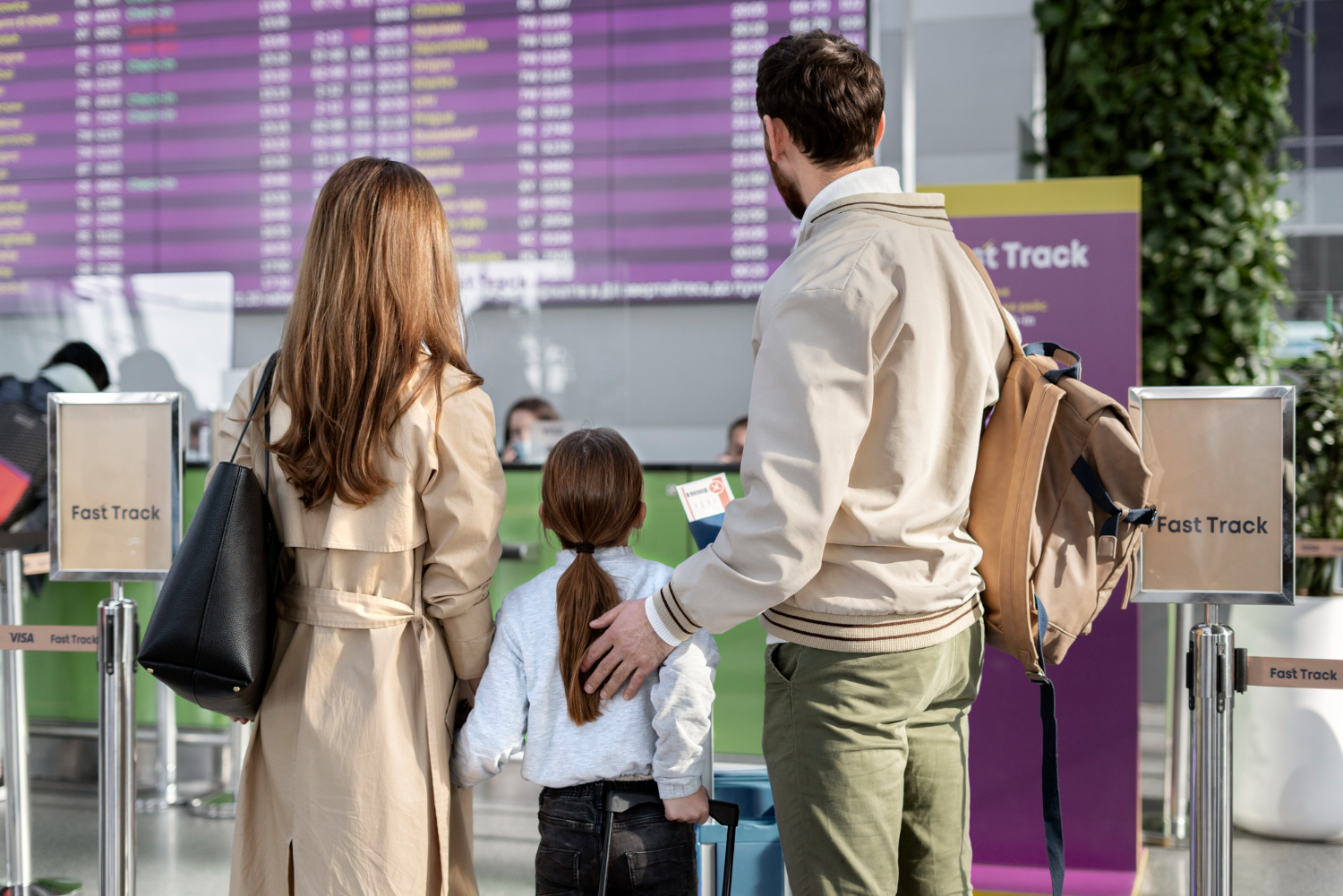
The gate agent’s voice echoed through the terminal, cheerful and routine. “We’re now boarding all passengers for Flight 1847 to San Diego. Please have your boarding passes ready.”
I stood with Daniel, Amanda, and Sophia near the gate entrance, watching other families gather their belongings and form an orderly line. Our family was about to board together for a week-long California vacation—beach days, zoo visits, Legoland adventures with Sophia. At least, that’s what I’d believed until that moment, standing in the fluorescent brightness of Gate 47 with my carry-on at my feet and my heart beginning to understand what my mind didn’t want to accept.
Daniel held all four boarding passes fanned out in his hand like playing cards in some cruel game. I could see them clearly—the familiar airline logo, the black bars of the barcodes, the bold “GROUP A” designation we’d all received. But something was profoundly wrong. The energy had been off all morning, I realized now, though I’d tried to ignore it. In the car during the forty-minute drive to the airport, when Daniel had been unusually quiet and Amanda had kept her eyes fixed on her phone. Through security, when Amanda had moved through the line ahead of me without waiting, without the casual family togetherness I’d expected. During our forty-minute wait at the gate, when they’d stood apart from me, having whispered conversations I couldn’t hear, exchanging looks I wasn’t meant to understand.
Amanda stood slightly apart from me, her body angled toward Daniel and Sophia, creating a triangle that deliberately excluded me. Daniel avoided my eyes, looking at his phone, at the boarding passes, at the gate agent, anywhere but at me. Sophia kept reaching for my hand, but Amanda kept pulling her closer, redirecting her attention.
“Mommy, I want to sit with Grandma on the plane,” Sophia said, her four-year-old voice carrying in the quiet gate area.
“We’ll see, sweetie. Let’s just get through boarding first.”
The gate agent called Group A—our group. I’d seen the boarding passes when Daniel printed them that morning. All four of us were Group A. I stepped forward with my carry-on, ready to board.
Daniel finally looked at me, and in that look I saw everything: discomfort, guilt, reluctance. He didn’t want me here. Or more accurately, Amanda didn’t want me here, and he wasn’t going to fight it.
“Mom,” he started, his voice careful and measured, “maybe we should—”
“Daniel,” Amanda interrupted, her voice quiet but firm. “We talked about this.”
They’d talked about something. About me. Without me.
I looked at the boarding passes in Daniel’s hand, then at Amanda’s face—cold, closed, waiting for me to make this difficult—then at my son, my only child, the man I’d raised alone after Paul died. And I understood with sudden, painful clarity: they didn’t want me on this trip.
“Daniel,” I said quietly, keeping my voice steady despite the tremor I could feel building in my chest, “can I speak with you for a moment? Privately?”
“Mom, we’re going to miss boarding.” His voice had that tight quality that came when he was uncomfortable, when he wanted to avoid something unpleasant.
“It’ll take thirty seconds.”
Amanda’s eyes narrowed, and for a moment I thought she might object, might insist we all board together and deal with whatever this was in the cramped quarters of an airplane. But she nodded curtly, and Daniel followed me a few steps away from the gate, away from Amanda and Sophia, away from the other passengers filing past us toward their destinations.
We stood near a window overlooking the tarmac, planes lined up like patient beasts waiting their turn. The morning sun streamed through the glass, warm on my face, incongruously cheerful.
“What’s going on?” I asked. Direct. Clear. No games. I’d raised this man, changed his diapers, nursed him through childhood illnesses, helped him with homework, sent him off to college. I knew when he was hiding something, and I wasn’t going to let him slide past this with vague reassurances.
“What do you mean?” But he couldn’t quite pull off innocent confusion. His eyes darted away from mine, fixed on something over my shoulder.
“Daniel, I’m sixty-seven years old. I’ve known you for thirty-eight years—known you better than anyone else on this planet except maybe Amanda. Don’t insult my intelligence by pretending nothing is wrong. Something is very wrong. Tell me what it is.”
He couldn’t meet my eyes. His shoulders hunched forward, his hands shoved deep in his pockets—the exact posture he’d had as a teenager when he’d crashed the car or failed a test or broken something valuable. The posture of a man who’d been dreading this conversation and hoped desperately it wouldn’t happen.
The silence stretched between us. Behind him, through the window, I watched a plane taxi toward the runway. I thought about all the times I’d flown—with Paul when he was alive, visiting Daniel at college, traveling to conferences for my nursing work. Flying had always felt like possibility, like adventure. Now it felt like rejection crystallizing in the air between us.
“It’s just…” He started, stopped, rubbed the back of his neck. “This trip. Amanda feels like it would be better if it was just the three of them.”
There it was. She doesn’t want me to come.
“It’s not that she doesn’t want you—” he started.
“Yes, it is,” I said calmly. “That’s exactly what it is.”
He was silent, his jaw working like he was trying to find words that would make this less awful. There weren’t any.
“How long have you known this?” I asked.
“A few weeks.”
A few weeks. He’d known for weeks that I wasn’t welcome, and he’d said nothing. He’d let me pack, let me prepare, let me cancel my plans for the week, let me drive to the airport, let me get all the way to the boarding gate before telling me I wasn’t actually wanted.
“So you’re telling me now? At the gate?”
“I didn’t know how to tell you earlier. You were so excited.”
“So you let me get all the way here before letting me figure it out.” My voice remained steady, which surprised me. I felt the hurt like a physical thing in my chest, but my voice stayed calm. “You hoped I’d just understand and make this easy for everyone.”
“Mom, please don’t make this harder.”
“I’m not making anything harder, Daniel. I’m understanding the situation.”
Behind him, I could see Amanda watching us. Sophia was crying, reaching toward me, and Amanda held her firmly in place. The gate agent made another announcement: “Final call for Group A boarding.”
I looked at my son—at the man who’d invited me on this trip three months ago, at the man who’d let his wife change those plans without telling me, at the man who’d hoped I’d just accept being excluded—and I made a decision.
“Go,” I said.
“Mom—”
“Go board your flight. Have your family vacation.”
“You could still come. We have your boarding pass.” But even as he said it, his voice was hollow. He didn’t mean it.
“No, Daniel. I’m not going to force myself onto a trip where I’m clearly not wanted. That’s not how this works. You go. Amanda and Sophia are waiting.”
“Mom, we’ll talk about this when I get back. We’ll figure this out.”
“There’s nothing to figure out. You’ve made your choice. I respect that choice. Now go.”
I turned and walked away before he could offer more empty promises, before he could say anything else that would make this harder, before I could change my mind. My feet moved automatically, one in front of the other, carrying me away from the gate, away from my son, away from the vacation I’d been planning for three months.
Behind me, I heard Sophia crying. “Grandma! Grandma, wait!” Her voice was high and desperate, the way children sound when they don’t understand why the adults are acting strange, when their safe world suddenly doesn’t make sense. Each cry felt like a small knife between my ribs, but I didn’t turn around. Turning around would break me, and I needed to do this with dignity intact.
I kept walking through the terminal, my carry-on rolling behind me with its familiar rumble over the carpet, my purse strap cutting into my shoulder. Past the gate. Past the windows overlooking the runway where planes climbed into the bright morning sky. Past other passengers—couples holding hands, families with excited children, business travelers buried in their phones. Normal people having normal travel days, unaware that I’d just been uninvited from my own family vacation at the boarding gate.
People stared. I could feel their eyes on me, could see them in my peripheral vision turning to watch me pass. Some had been close enough to hear our exchange at the gate, close enough to understand what had happened. A grandmother left behind by her own family. I caught fragments of whispered conversation: “Did you hear that?” “Poor woman.” “Can you imagine?”
I didn’t care. Or rather, I forced myself not to care. I kept my head high, my pace steady, my expression neutral. I wouldn’t give them the spectacle of a crying old woman. I wouldn’t give Daniel and Amanda the satisfaction of seeing me crumble. I kept walking—calm, dignified, deliberate—because I had chosen this. Not them. Me.
I’d chosen not to board a flight where I wasn’t wanted. I’d chosen not to spend a week with people who’d rather I wasn’t there. I’d chosen not to make everyone uncomfortable by forcing my presence, by insisting on my right to be included when clearly my presence was a burden they’d rather not carry.
I chose myself, and that felt like power, not defeat. That felt like self-respect in action, not weakness.
The terminal stretched endlessly. Gate after gate, restaurant after restaurant, bookstore and gift shop and coffee cart. The sounds washed over me—announcements crackling over speakers, children laughing, the beep of airport carts warning pedestrians. The smell of coffee and cinnamon rolls from a nearby bakery. The artificial chill of over-aggressive air conditioning. All of it felt surreal, like I was moving through a dream, watching myself from outside my body.
I found a quiet bench near a window overlooking the runway and sat down, setting my carry-on beside me. My hands were shaking now that I’d stopped moving, now that there was nothing to do but sit with what had just happened. I clasped them in my lap and stared out at the planes taking off and landing in their endless ballet.
My name is Katherine Helen Carter. I’m sixty-seven years old, a widow for eight years since my husband Paul died of pancreatic cancer—a brutal six months from diagnosis to death that left me hollowed out and adrift. I have one son, Daniel, who’s thirty-eight, married to Amanda for seven years, with a four-year-old daughter named Sophia who has her grandfather’s eyes and her father’s dimpled smile.
This morning had started like any vacation morning should. I’d been up since five, too excited to sleep, double-checking that I’d packed everything. Sunscreen, check. Beach hat, check. New swimsuit suitable for a grandmother, check. The guidebook to San Diego I’d bought and annotated with things Sophia might enjoy. The small wrapped gifts I’d planned to give her on the plane—coloring books and new crayons to keep her occupied during the flight.
I’d stood on my front porch at six-fifteen when Daniel’s car pulled up, my suitcase already at the curb, my heart full of anticipation for a week with my family. My only family, really. Margaret has her large, chaotic clan—three children, seven grandchildren, a house always full of noise and life. But Daniel is my only child, and Sophia my only grandchild. This trip had felt like a gift, an invitation back into the inner circle of their lives after years of feeling progressively more distant.
Now I was alone in an airport terminal, my carry-on beside me, processing what had just happened. Not just the rejection at the gate, but the pattern I was finally forcing myself to see—the pattern I’d been ignoring for years because acknowledging it meant acknowledging how little I mattered to the people I loved most.
My phone buzzed, pulling me from my thoughts. My sister Margaret: “Have a wonderful trip! Send pictures!”
I stared at the message, my thumb hovering over the keyboard. How did I explain this? How did I put into words what had just happened without sounding pathetic, without inviting pity I didn’t want?
I typed: “Change of plans. I decided not to go. I’ll call you later.”
Her response was immediate: “What? Are you okay?”
“I will be,” I typed back and put my phone away, unable to face more questions yet.
Through the window, I watched planes taking off one after another, carrying people to their destinations—including eventually the one carrying Daniel, Amanda, and Sophia without me. I’d chosen that. Not them. Me. And somehow, that made all the difference.
I called for a ride home. Thirty minutes later, I was in a stranger’s car with my luggage, heading back to the house that was supposed to be empty for a week. When the driver helped me carry my suitcase to my front door, he asked, “You sure you’re okay, ma’am?”
“I’m fine,” I said. “Thank you.”
Inside my empty house, I made tea and sat at my kitchen table, letting myself finally feel it all—the hurt of not being wanted, the clarity of recognizing it, the strength it took to walk away. My phone rang. Margaret again. This time I answered and told her everything.
“And they just let you leave?” Her voice was incredulous.
“I didn’t give them much choice. I told Daniel I wasn’t going to force myself where I wasn’t wanted. And then I left.”
“I’m coming over,” Margaret said. “You shouldn’t be alone.”
Twenty minutes later, she was at my door, pulling me into a fierce hug. “You did the right thing,” she said. “But it still hurts.”
“Yes,” I agreed. “It does.”
That week—the week I was supposed to be in California building sandcastles with Sophia and mending bridges with Amanda—I did a lot of thinking about my relationship with Daniel and his family. About how I’d gotten here, about what I’d missed or chosen not to see, about the thousand small moments that had led to standing alone at Gate 47.
The signs had been there for years. I’d just chosen not to see them, chosen to make excuses, chosen to believe that if I just tried harder, was more available, more helpful, more accommodating, things would get better.
Amanda had never been warm to me. From the day Daniel brought her home to meet me seven years ago, she’d kept me at arm’s length—polite but distant, formal but cold. I remembered that first dinner vividly. I’d made Paul’s favorite pot roast, set the table with my good china, tried so hard to make her feel welcome. She’d smiled and said all the right things, but her eyes had been calculating, measuring me against some internal standard I didn’t understand and apparently didn’t meet.
I’d tried. God knows I’d tried. Sunday dinners at my house, cooked with love and care. Gifts for every occasion—birthdays, Christmas, anniversaries—chosen thoughtfully, wrapped beautifully. Offering to babysit Sophia whenever they needed it, rearranging my schedule at a moment’s notice. Complimenting Amanda’s parenting, her home decorating choices, her career successes. Biting my tongue when I disagreed with their decisions, keeping my opinions to myself unless explicitly asked.
But Amanda had never softened. If anything, she’d grown more distant over time, more guarded, more quick to find fault in innocent comments.
And Daniel—my sweet, conflict-avoidant Daniel—had changed after he married her. He used to call me several times a week just to chat, to share news about his day, to ask my advice on things, to stay connected. After the wedding, those calls became weekly, then bi-weekly, then monthly. And when we did talk, the conversations felt perfunctory, obligatory, like items being checked off a to-do list.
“Sorry, Mom. Amanda and I are just really busy,” he’d say when I asked why he hadn’t called.
“No problem. I understand,” I’d reply, making it easy for him, never pushing, never demanding, always accommodating.
I’d made excuses for them both. Young couple. New baby. Demanding jobs. They’re just overwhelmed. Give them time. Give them space. Don’t be that pushy mother-in-law. Don’t be a burden.
But it wasn’t about being busy. It was that I’d become inconvenient. Something to manage, to include out of obligation rather than desire. A duty to be performed rather than a relationship to be nurtured.
Sitting in my quiet house that week, I made some uncomfortable discoveries about myself. Discoveries that hurt but were necessary.
Discovery one: I’d been organizing my entire life around Daniel’s family. Every Sunday for seven years, I’d hosted dinner, prepared elaborate meals, cleaned my house until it gleamed, baked Sophia’s favorite cookies. Even when they canceled last minute—which happened increasingly often—even when Amanda made thin excuses about Sophia being tired or them having other plans, even when Daniel sounded reluctant on the phone, I’d kept doing it. Kept trying. Kept hoping that if I just made the meal special enough, the atmosphere warm enough, the dessert tempting enough, they’d want to come. They’d want to spend time with me.
But they hadn’t wanted to come. They’d been doing it out of obligation, enduring my Sunday dinners because saying no felt too cruel.
Discovery two: I’d been making myself too available, training them to take me for granted. Every time Daniel or Amanda needed something—babysitting Sophia on short notice, advice on some problem, help with a project—I’d drop everything. Rearranged my schedule, canceled my own plans, made myself available without question or hesitation.
Five days into their California trip, Daniel texted: “Mom, we need to talk.”
I stared at the message—the first contact since the gate. I didn’t respond immediately. An hour later, he texted again: “Mom, I know you’re upset and you have every right to be, but please—can we talk when I get home?”
I finally replied: “I’m not upset, Daniel. I made a choice at the airport. A choice that was right for me. We can talk when you get back if you want, but I’m not the one who needs to explain anything.”
“What do you mean?”
“You knew Amanda didn’t want me on this trip. You knew it for weeks. And you said nothing until we were at the gate. That was your choice. Now you have to live with it.”
“It’s more complicated than that.”
“It’s really not. You chose to avoid a difficult conversation. I chose not to force my presence where I wasn’t wanted. Both of our choices have consequences.”
He didn’t respond after that.
They returned from California on Saturday. Margaret had been monitoring social media for me. Amanda posted pictures—beach, zoo, Legoland, the three of them looking happy. Good for them.
Sunday afternoon, Daniel called. “Mom, can I come over? We need to talk.”
“Fine. When?”
“This afternoon around two?”
“I’ll be here.”
He arrived alone at exactly two, looking exhausted. I let him in and we sat in my living room—the room where he’d grown up, where we’d had countless conversations. But this one was different.
“Tell me why,” I said. “Why did it happen the way it did?”
He rubbed his face. “Amanda has been feeling like you’re too involved in our lives. In everything. In Sophia’s life, in our marriage. She feels like you’re always there, always offering opinions, always hovering.”
That hit like a physical blow. “I’m Sophia’s grandmother. Of course I’m involved.”
“I know. But Amanda feels like you’re criticizing her. Her parenting, her choices, the way she runs our household.”
“I’ve never criticized Amanda.”
“Not directly. But the suggestions you make—Amanda experiences those as judgment. She told me a month ago she didn’t want you on the trip. I should have told you then, but I kept hoping she’d change her mind. And then it was the morning we picked you up, and she gave me an ultimatum. Either tell you at the gate or she would.”
“So you told me at the gate. Or rather, you let me figure it out myself.”
“I was trying to avoid hurting you.”
“Daniel, you hurt me more by avoiding it. If you’d told me a month ago, I would have been disappointed but at least it would have been honest. Instead, you let me prepare, get excited, get all the way to the airport.”
“I know,” he said, eyes filling with tears. “And I’m so sorry.”
“Are you? Or are you just sorry it was uncomfortable?” I paused. “Here’s what’s going to happen. Things are going to change between us. I’m done organizing my life around you and Amanda. No more Sunday dinners unless you explicitly invite me. No more automatic yes to babysitting. If you want to see me, you invite me. But I’m done organizing my life around you when it’s clear I’m not a priority.”
“You are a priority.”
“No, I’m not. If I was, you wouldn’t have let things get to the airport gate. So you need to decide, Daniel. Do you want me in your life or not? Because I can’t keep doing this dance.”
“Of course I want you in my life.”
“Then act like it. Find a way to have both your wife and your mother. Set boundaries with Amanda about me the same way you’re asking me to respect hers. But stop choosing the path of least resistance.”
“You’re asking me to choose between my wife and my mother.”
“No. I’m asking you to find a way to have both. Either you want me there or you don’t. And you need to decide which it is, because I’m done living in this limbo.”
He left looking devastated, but I felt clear for the first time in months.
The next two weeks passed in silence. Then Amanda called, saying she wanted to apologize, but when she came over, I realized she was apologizing because people had found out what happened and were judging them. Someone at the airport that day had witnessed the scene and told people. The story had spread.
“Are you apologizing because you’re actually sorry?” I asked. “Or because people are judging you?”
She looked down. “Both.”
“If no one had found out, would you be here?”
She didn’t answer, and that was my answer. She left without another word.
A week later, Daniel came back. “What do you want from us?”
“I want you to decide. Do you want me in your life or not?”
“Of course I do.”
“Then stop letting Amanda dictate everything. Stop excluding me to keep her happy.”
“I don’t know if I can do that without destroying my marriage.”
“Then you’ve made your choice.”
Six months after the airport gate incident, my phone rang at midnight. Daniel’s voice was shaking. “I need your help. Sophia’s in the hospital. High fever. They think it might be meningitis.”
Everything else disappeared—the hurt, the anger, the boundaries. “Which hospital?”
“St. Michael’s. Can you come?”
“I’m on my way.”
I threw on clothes, drove to the hospital breaking speed limits, found them in the emergency room. Sophia was pale and scared on a hospital bed. Amanda sat beside her, tears streaming. Daniel paced like a caged animal.
“Grandma,” Sophia whispered weakly when she saw me.
I went straight to her and took her hand. “I’m here, sweetheart.”
Over the next four hours, I sat with Sophia through tests, sang to her during the lumbar puncture that made her cry, held her hand while Amanda and Daniel clung to each other in the corner, terrified.
Finally, the doctor returned. “Good news. Not meningitis. Severe viral infection. She’ll need to stay overnight but should recover fully.”
The relief was overwhelming. Amanda sobbed. Daniel hugged her tight. And I stood there realizing something profound: in a crisis, I was who they’d called. Not Amanda’s parents. Not their friends. Me. Because when it really mattered, I was the person they needed.
The next morning, after Sophia fell asleep in her hospital room, Daniel found me in the waiting area. “Mom, thank you for coming. After everything that’s happened, I wouldn’t have blamed you if you didn’t.”
“I’m hurt about the airport. But I love Sophia. That never changed.”
He sat beside me. “I’ve been in therapy for three months. My therapist helped me see I’ve been conflict-avoidant my entire life. That I’d rather avoid difficult conversations than address things directly.”
“Why didn’t you just tell me Amanda didn’t want me there?”
“Because I was ashamed. Because I knew it was wrong. Because I wanted you there even if Amanda didn’t. And I kept hoping if I avoided it, somehow it would work out.”
“It made everything worse.”
“I know. Mom, I’m asking if we can start over slowly, with clear boundaries and honest communication.”
I thought about Sophia in that hospital bed, about the reality that life is short and families are complicated, about choosing between being right and being in relationship.
“I’m willing to try. But things will be different. I won’t assume I’m invited. You want me there, you invite me clearly and in advance. If Amanda has issues with me, she talks to me directly. And you never put me in a position like that airport gate again.”
“I swear.”
“Then we can try.”
Later that day, Amanda came to my house alone. “Last night when Sophia was sick, you came immediately. No hesitation. You just came. And I’ve been so focused on feeling judged by you that I couldn’t see it. You’re a good mother and grandmother. I projected all my issues with my own mother onto you, and I’m sorry.”
“Okay.”
“I want to rebuild our relationship. But I need to work through my own issues first. Daniel’s therapist suggested I might benefit from therapy too.”
“I think that’s wise. And Amanda—if something I say or do bothers you, tell me directly. We can’t build a relationship on unspoken resentment.”
“I will. I’ll try.”
Over the next months, we slowly rebuilt. Amanda started therapy, working through her issues with her mother. She began communicating more directly with me. Daniel invited me to dinner explicitly, with advance notice. Sophia and I had our Saturday mornings again.
Small steps. But significant ones.
One year after the airport gate, Daniel came to my house. “Mom, I need to say something clearly. What I did was unforgivable. I should have been honest weeks earlier. I should have stood up to Amanda. I should have protected you. You’re my mother. You raised me alone after Dad died. And I repaid that by letting you stand at an airport gate and figure out you weren’t wanted. I’m ashamed of that.”
“I appreciate you saying that.”
“I need you to know something else. When you chose to walk away at that gate instead of forcing the issue or making a scene, that taught me something. Dignity. Self-respect. You didn’t beg or guilt us. You just chose yourself. And that took more strength than I understood at the time.”
“I walked away because I refused to force myself somewhere I wasn’t wanted.”
“I know. But it taught me anyway. It forced me to examine myself, to get help, to become better.”
“Are we okay?” he asked. “Really okay?”
“We’re getting there. It takes time to rebuild trust, but yes—I think we’re okay.”
Eighteen months after the airport gate, I’m at Daniel and Amanda’s house for Sunday dinner. But it’s different now. I was invited explicitly three days in advance. The energy is light, warm, easy. During dinner, Amanda asks my opinion about Sophia’s schooling—actually wanting my input, not waiting for unsolicited advice.
We have a real conversation about education and Sophia’s needs. No tension. No defensiveness. Just family conversation.
After dinner, Daniel walks me to my car. “Thanks for coming, Mom.”
“Thanks for inviting me. It was lovely.”
“You’re always welcome, you know.”
“I do now. But I appreciate you saying it anyway.”
As I drive home, I think about that day at the airport gate—about choosing to walk away with dignity rather than force my presence, about the pain of the months that followed, and about how that moment of choosing myself eventually led to something better. Not the same as before, but better.
Because now our relationship is built on honesty instead of obligation, on explicit invitations instead of assumptions, on mutual respect instead of taking each other for granted. That day at the gate, I lost my assumed place in their lives. But by stepping back quietly, by choosing myself when they wouldn’t choose me, I eventually found a better place—a place I was genuinely invited to, a place I was actually wanted, a place built on truth instead of pretense.
And somehow, that made the pain of that airport gate worth it. Because I learned something that day I’ll never forget: that choosing yourself—even when it’s painful, even when it’s lonely—is sometimes the only way to find your way back to the people you love. Not by forcing it, not by accepting less than you deserve, but by stepping back quietly with dignity and letting that moment speak for itself.

Sophia Rivers is an experienced News Content Editor with a sharp eye for detail and a passion for delivering accurate and engaging news stories. At TheArchivists, she specializes in curating, editing, and presenting news content that informs and resonates with a global audience.
Sophia holds a degree in Journalism from the University of Toronto, where she developed her skills in news reporting, media ethics, and digital journalism. Her expertise lies in identifying key stories, crafting compelling narratives, and ensuring journalistic integrity in every piece she edits.
Known for her precision and dedication to the truth, Sophia thrives in the fast-paced world of news editing. At TheArchivists, she focuses on producing high-quality news content that keeps readers informed while maintaining a balanced and insightful perspective.
With a commitment to delivering impactful journalism, Sophia is passionate about bringing clarity to complex issues and amplifying voices that matter. Her work reflects her belief in the power of news to shape conversations and inspire change.