The Night the Kitchen Cook Played Her Way to Freedom
The dinner service at Le Bernardin was in full swing when Anna Petrov felt someone’s fingers dig into her wrist hard enough to leave bruises. She’d been carrying a tray of perfectly plated beef wellington to table twelve when the grip stopped her mid-step, causing the sauce to slosh dangerously close to the rim of the porcelain.
“Stop.”
The voice belonged to Marcus Whitmore, owner of the most prestigious restaurant in the city’s financial district. Marcus was the kind of man who wore his wealth like armor—Italian suits that cost more than most people’s monthly rent, a watch that could fund a small business, and the casual arrogance that came from never having to worry about paying bills or wondering where the next meal would come from.
Anna had been working in his kitchen for three years, invisible to everyone except when something went wrong and someone needed to blame the help. She was thirty-four years old, had been cooking professionally since she was sixteen, and sent half her paycheck to her elderly mother in Queens every month. To Marcus and his clientele, she was part of the restaurant’s machinery—necessary but forgettable, like the industrial refrigerators or the commercial-grade stoves.
“What did you just say about the piano?” Marcus asked, his voice carrying the edge he used when dealing with suppliers who’d disappointed him.
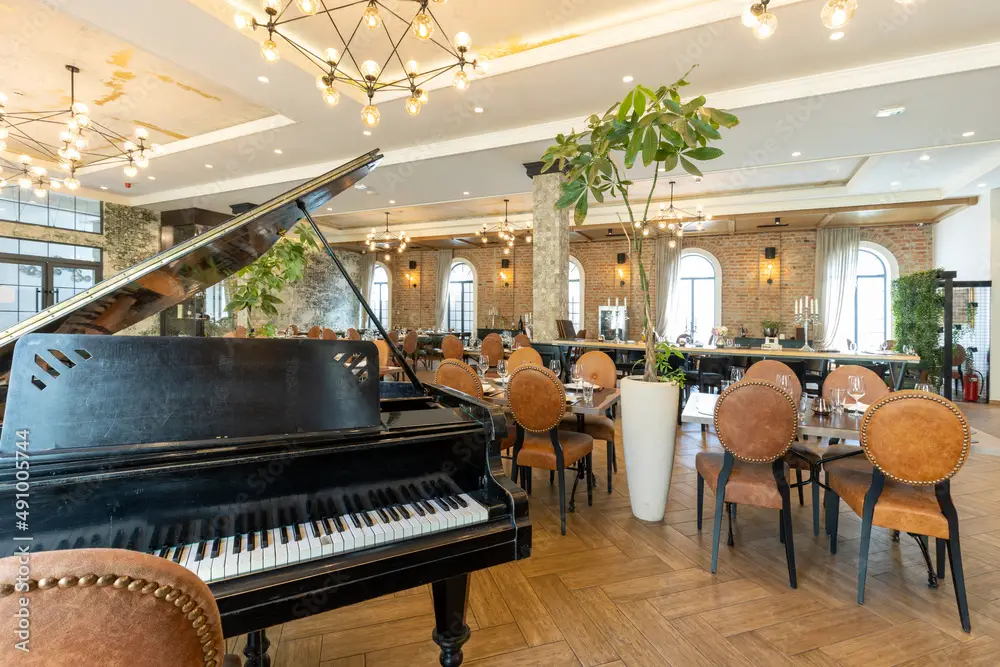
Anna blinked in confusion. During her break ten minutes earlier, she’d mentioned to one of the servers that the restaurant’s antique Steinway grand piano—a showpiece that dominated the dining room’s center—was noticeably out of tune. It was an offhand comment, the kind of observation someone might make about a crooked painting or a flickering light bulb.
“I… I just said the piano needs tuning,” Anna replied quietly, trying to pull her wrist free without dropping the tray.
Marcus’s eyes lit up with the predatory gleam he got when he sensed an opportunity to assert his dominance. He released her wrist and turned toward the dining room, his voice rising to carry over the gentle murmur of conversation.
“Ladies and gentlemen,” Marcus announced, clapping his hands to ensure he had everyone’s attention. “Our cook here has just informed me that she’s not only a master in the kitchen, but apparently an expert on musical instruments as well.”
Forty-three of the city’s wealthiest diners turned to look at Anna, their expressions ranging from polite curiosity to barely concealed amusement. She recognized several faces from the society pages—hedge fund managers, real estate developers, the kind of people who considered a three-hundred-dollar dinner to be a casual Tuesday evening.
“Tell me, Anna,” Marcus continued, savoring her discomfort like fine wine. “Did you perhaps study music at Juilliard? Manhattan School of Music? I’m sure our guests would love to hear about your impressive musical background.”
The dining room was completely silent now, all conversations stopped to watch what was clearly going to be an entertaining display of a working-class woman being put in her place.
“No,” Anna said, her voice barely above a whisper.
“No?” Marcus pressed, his tone dripping with mock surprise. “How strange. Then how exactly do you know enough about pianos to judge the tuning of a Steinway that cost more than you make in five years?”
Before Anna could answer, a young woman emerged from the cluster of diners near the bar. This was Emma Whitmore, Marcus’s twenty-six-year-old daughter, who moved through the room with the fluid confidence of someone who’d never doubted her place in the world.
Emma was beautiful in the way that money makes possible—perfect teeth straightened by the best orthodontists, hair styled by colorists who charged more per session than Anna made in a week, wearing a dress that had probably been featured in Vogue before she bought it. She was also, by all accounts, a genuinely talented pianist who’d studied at prestigious conservatories in Europe and had performed in concerts that attracted international attention.
“Daddy,” Emma said, sliding her arm through her father’s with practiced grace, “what’s all the excitement about?”
Marcus beamed at his daughter with the pride of a man showing off his most prized possession. “Emma, darling, our cook here apparently knows enough about music to critique our piano. I thought perhaps she’d like to demonstrate her expertise for our guests.”
He gestured toward the Steinway with theatrical flourish. “I have a proposition, Anna. Since you seem so confident in your musical opinions, why don’t you prove them? Emma will play something first—she just returned from a concert tour in Vienna, so she’s in excellent form. Then you’ll play.”
The room was so quiet Anna could hear her own heartbeat.
“If you can play better than Emma,” Marcus continued, his voice taking on the tone of a game show host announcing prizes, “I’ll buy you your own restaurant. Not a job—ownership. Your name on the door, complete control, everything you could ever want.”
He paused for maximum dramatic effect.
“But if you can’t…” His smile turned cold. “You’re fired. Tonight. No final paycheck, no references, nothing. You leave here with exactly what you brought—which, let’s be honest, wasn’t much to begin with.”
The challenge hung in the air like smoke from an expensive cigar. Anna could feel forty-three pairs of eyes studying her, waiting to see whether she’d accept the humiliation or try to defend herself. Either choice would provide entertainment for people who were bored with their lives of effortless privilege.
Anna looked at the piano—a magnificent instrument that probably hadn’t been played properly in months, used mainly as an expensive conversation piece and status symbol. She thought about her mother’s medical bills, about the rent on her studio apartment, about the three years she’d spent being treated like furniture in this gleaming temple to wealth and status.
She slowly untied her apron, set down the tray she’d been carrying, and walked toward the piano.
The whispers started immediately. Someone laughed. A woman near the bar whispered loudly enough to be heard, “This should be entertaining. I love when they don’t know their place.”
Emma took her position at the piano first, adjusting her dress and cracking her knuckles with the confidence of someone who’d been performing for audiences since childhood. She began with Chopin’s “Fantaisie-Impromptu”—a technically demanding piece that showcased her classical training and precise technique.
It was undeniably good. Clean, precise, professional. The kind of performance that demonstrated years of expensive lessons and rigorous practice. When she finished, the dining room erupted in polite applause and murmurs of appreciation.
“Magnificent, as always,” Marcus said, kissing his daughter’s cheek. “Now, Anna, let’s see what three decades of washing dishes has taught you about music.”
Anna approached the piano bench, her heart pounding not with nervousness but with something that felt like coming home after a long, difficult journey. She sat down, placed her fingers on the keys, and closed her eyes for a moment.
Then she began to play.
The first notes of Rachmaninoff’s Piano Concerto No. 2 filled the room, but it wasn’t the notes themselves that created the magic. It was the way Anna played them—not as an exhibition of technical skill, but as an conversation between her soul and the instrument.
Every phrase carried emotion that couldn’t be taught in conservatories or purchased with tuition payments. She played with the kind of depth that comes only from understanding loss, struggle, and the weight of dreams deferred but never abandoned.
The dining room fell completely silent. Not the polite quiet of people watching a performance, but the breathless silence of people witnessing something transcendent.
Anna’s fingers moved across the keys with a fluidity that made the complex composition look effortless, but it was her interpretation that left the audience spellbound. She found nuances in the music that revealed not just technical mastery, but an understanding of what the composer had been trying to express when he wrote those notes in desperation and hope.
When the final notes faded into silence, no one moved. The applause, when it finally came, was different from what Emma had received—not polite appreciation, but genuine awe.
Marcus stared at Anna as if seeing her for the first time in three years. “That’s… that’s impossible. Where did you learn to play like that?”
Anna stood up from the piano bench, smoothing her chef’s whites with hands that still trembled slightly from the music she’d just channeled.
“My grandmother taught me,” she said simply. “She was the principal pianist for the Moscow Philharmonic before she fled Russia in 1962. She came to America with nothing but her memories and her music.”
The room was so quiet you could hear the kitchen staff moving around in the back, unaware that their colleague had just redefined everyone’s understanding of talent and worth.
“She worked as a seamstress in Brooklyn for forty years to support our family,” Anna continued, her voice growing stronger. “But every evening, she’d sit at the old upright piano in our apartment and teach me everything she’d learned. She said music was the one thing that couldn’t be taken away from you, no matter how poor you were or how hard life became.”
She looked directly at Marcus. “She died when I was eighteen. I couldn’t afford to continue studying music, so I learned to cook because kitchens always need workers and the pay was steady. But I never stopped playing. Every night after work, I go to the community center and practice on their old piano for two hours.”
The dining room remained silent as people processed the magnitude of what they’d just witnessed—not just musical brilliance, but the revelation that they’d been sharing space with genius and treating it like hired help.
Emma, who’d been standing frozen beside the piano, finally found her voice. “Anna, I… I had no idea. You’re extraordinary.”
“Your grandmother would have been proud,” said an elderly woman from table seven. “I studied music myself, and I’ve never heard anything quite like what you just played.”
Marcus looked around the room at his guests, all of whom were staring at him with expressions that ranged from admiration for Anna to uncomfortable awareness that they’d just witnessed three years of spectacular blindness and waste.
“Well,” he said finally, his voice lacking its usual commanding confidence. “I suppose I made a promise.”
He cleared his throat, looking like a man who’d just realized he’d been playing chess while everyone else was playing a different game entirely.
“Ladies and gentlemen,” Marcus announced, “it appears I’ve just acquired a new business partner. Anna, effective immediately, you own fifty percent of this restaurant.”
The applause that followed was thunderous, but Anna barely heard it. She was thinking about her grandmother’s hands guiding her fingers across piano keys in a cramped Brooklyn apartment, about all the nights she’d practiced alone at the community center, about the dreams that had never died despite years of being treated as invisible.
“There’s one condition,” Anna said, her voice carrying clearly through the room.
Marcus raised an eyebrow. “Condition?”
“We get the piano tuned properly. If we’re going to have live music here, it should sound the way it’s meant to sound.”
The laughter that rippled through the dining room was warm and genuine, not the cruel entertainment they’d expected when the evening began.
Six months later, Le Bernardin had been transformed into something unprecedented in the city’s restaurant scene—a place where extraordinary food was served alongside live classical music performed by Anna herself three nights a week. The waiting list for tables stretched six months out, and food critics were calling it “a revolutionary combination of culinary and musical artistry.”
Anna had hired a full staff of immigrant cooks, many of whom had similar stories of hidden talents and deferred dreams. The kitchen became a place where people were valued for their skills and creativity rather than their accents or documentation status.
Emma, initially humbled by the experience, had asked Anna to teach her about playing with emotion rather than just technical precision. Their lessons had evolved into a genuine friendship and mutual respect between two women who understood the difference between performing music and living it.
Marcus, forced to confront his own prejudices and blindness, had begun treating his entire staff with the respect due to human beings rather than replaceable equipment. The restaurant’s atmosphere changed as employees who felt valued began providing service that reflected their pride in their work.
But the most profound change was in Anna herself. For the first time since her grandmother’s death, she was able to live as both a chef and a musician, honoring both parts of her identity without having to choose between financial security and artistic fulfillment.
On the anniversary of that transformative evening, Anna stood before the piano—now perfectly tuned and played regularly—and thought about how a single moment of courage had changed not just her life, but the lives of everyone around her.
She’d learned that talent has no address, that genius can wear work clothes, and that the most beautiful music often comes from people who’ve earned every note through struggle and sacrifice.
The restaurant continued to thrive, not just as a business, but as a place where the artificial barriers between “us” and “them” had dissolved in recognition of shared humanity and mutual respect.
And every evening, as Anna played the piano for diners who now knew her story, she whispered a thank you to her grandmother—the woman who’d taught her that music, like dignity, could never truly be taken away from someone who understood its value.
The kitchen cook had played her way to freedom, but more importantly, she’d played her way home to herself.

Lila Hart is a dedicated Digital Archivist and Research Specialist with a keen eye for preserving and curating meaningful content. At TheArchivists, she specializes in organizing and managing digital archives, ensuring that valuable stories and historical moments are accessible for generations to come.
Lila earned her degree in History and Archival Studies from the University of Edinburgh, where she cultivated her passion for documenting the past and preserving cultural heritage. Her expertise lies in combining traditional archival techniques with modern digital tools, allowing her to create comprehensive and engaging collections that resonate with audiences worldwide.
At TheArchivists, Lila is known for her meticulous attention to detail and her ability to uncover hidden gems within extensive archives. Her work is praised for its depth, authenticity, and contribution to the preservation of knowledge in the digital age.
Driven by a commitment to preserving stories that matter, Lila is passionate about exploring the intersection of history and technology. Her goal is to ensure that every piece of content she handles reflects the richness of human experiences and remains a source of inspiration for years to come.