The call came on a Tuesday afternoon, right after my last piano lesson of the day. My father’s voice on the other end was clipped and businesslike, stripped of any warmth that might have softened the blow.
“Eleanor’s had another heart attack. She’s stable, but they’re moving her to hospice. Family meeting at the hospital in an hour.”
I dropped everything—the sheet music I’d been organizing, the cup of tea growing cold on my desk, the plans I’d had for a quiet evening. By the time I arrived at the hospital, my parents and my sister Megan were already huddled in a corner of the waiting room, speaking in the kind of low voices that suggested I wasn’t meant to hear what they were discussing.
My father, Richard Thompson, stood with his arms crossed in that stance I’d known my whole life—the posture of a man who had already made all the decisions and was simply waiting for everyone else to fall in line. My mother, Diane, clutched her designer purse like a talisman. And Megan, four years younger and perpetually favored, scrolled through her phone with the casual indifference of someone who’d never had to fight for attention.
“Good, you’re here,” my father said when he noticed me. Not “How are you holding up?” or “This must be hard for you.” Just the stark efficiency of task delegation. “We need to divide responsibilities. Someone needs to visit Mother daily. Diane and I have the business to run, and Megan’s in a critical phase with Daniel’s family.”
Daniel Harrison—Megan’s boyfriend of eight months, son of my father’s most important business partner, and apparently the axis around which all family decisions now rotated.
“So, Annabelle.” My father looked at me the way someone might look at a particularly useful piece of furniture. “You’ll handle the visits. Your schedule is flexible. Teachers don’t exactly work overtime.”
I wanted to say that I taught music to thirty-seven children every week, that I ran after-school programs, that my time had value too. But I’d learned long ago that defending myself only made things worse. The family had cast me in the role of the accommodating one, the invisible daughter who asked for nothing and received less, and breaking character never ended well.
“Of course,” I said quietly. “I want to be with her anyway.”
“Perfect.” My father was already turning away, the matter settled in his mind. “Keep us updated if anything changes.”
As I walked toward Grandma Eleanor’s room, I heard my mother’s voice drift down the hallway—meant for Megan’s ears alone but perfectly audible to mine.
“At least she’s useful for something.”
I kept walking. Not because I didn’t hear it, but because I’d heard variations of that sentiment my entire life, and turning around to confront it would change nothing. Some hurts become so familiar they stop feeling like wounds and start feeling like weather—something you simply endure because you have no choice.
Grandma Eleanor’s hospice room smelled like lavender and old books, a combination she’d insisted upon despite the staff’s protests about hospital protocol.
“They try to make everything smell like antiseptic,” she told me on my first visit, her voice still strong despite the oxygen tube in her nose. “I refuse. If I’m going to die, I’ll die surrounded by things I love.”
She was seventy-six, sharp as a blade, and dying of congestive heart failure. The doctors gave her weeks, maybe a month if she was lucky. I visited every day after school, and we talked about music, about her years performing in concert halls across the Northeast, about my students who couldn’t yet read notes but already felt rhythm in their bones.
One evening about a week into her hospice stay, she reached for my hand. Her grip was weaker than I remembered, but her eyes were fierce with the kind of clarity that comes when someone knows their time is measured.
“Annabelle, I need you to know something.”
“Anything, Grandma.”
“The Steinway.” She paused, letting the words settle between us like a sacred vow. “My mother’s piano. The one from 1892.”
I knew it intimately. I’d learned my first scales on those ivory keys when I was seven years old, my small fingers stretching to reach octaves that seemed impossibly wide. That piano had been the soundtrack of my childhood, the only place in the family ecosystem where I felt truly seen, truly valued.
“It’s yours,” she said with absolute finality. “I’ve already told Richard and Diane. Told them last month in front of everyone at Sunday dinner. That piano belongs to you.”
I remembered that conversation. My father’s jaw tightening almost imperceptibly. My mother exchanging a loaded glance with Megan. My sister rolling her eyes and muttering something about “sentimental junk” that wasn’t worth the space it occupied.
“Grandma, you don’t have to—”
“I want to.” She squeezed my hand with surprising strength. “You’re the only one who understands what it means. You’re the only one who hears the music it holds. Promise me you’ll take care of it.”
“I promise.”
She smiled then, a knowing expression that seemed to hold secrets I couldn’t yet see, mysteries that would only reveal themselves with time.
“There are some things more valuable than money, child. And some people who need to learn that lesson the hard way.”
Two weeks later, on a rain-soaked Thursday afternoon, everything changed.
Grandma had asked me to bring some old photographs from her house—images of her performing days, pictures she wanted to see one last time before the morphine made everything too hazy to matter. I still had a key, so I drove over after school, navigating streets made slick by autumn rain that felt colder than the temperature warranted.
The house was quiet when I entered. Too quiet. The kind of silence that feels wrong in a space that should be filled with the accumulated noise of decades of living.
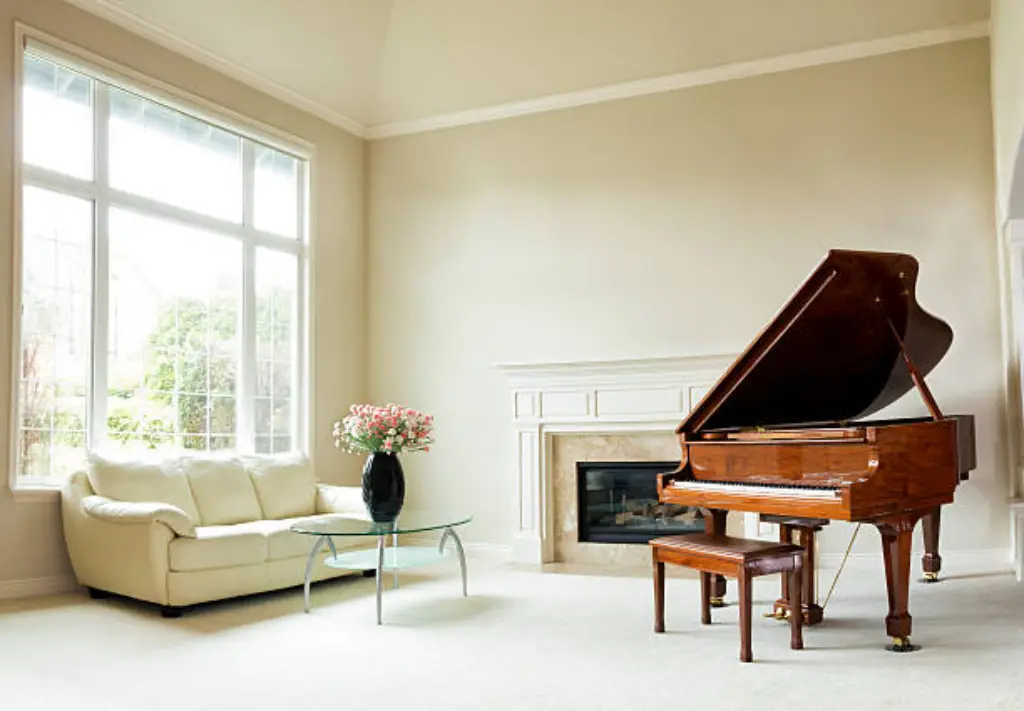
I walked through the foyer, past the dining room where family dinners had once been held with something approximating warmth, and into the living room where the Steinway had stood for thirty years, its polished wood catching sunlight through the bay windows, its presence as permanent as the walls themselves.
The space was empty.
Not just empty—violated. Where the piano should have been, there was nothing but a rectangular indent in the carpet, a ghost outline of something that had lived there so long it had left its mark on the very fibers of the room. Someone had tried to fluff the carpet to hide the evidence, but the compression was still visible, a testimony to the weight of what had been stolen.
My hands were shaking as I pulled out my phone, barely able to press the right buttons as rain hammered against the windows like an accusation.
“Mom.” My voice cracked, breaking on the single syllable. “Where’s Grandma’s piano?”
A pause on the other end, then my mother’s voice came through with that particular brand of dismissiveness she reserved for my concerns, my questions, my very existence.
“Your father handled it. Adult matters, Anna. You don’t need to worry about it.”
Handled it. As if disposing of someone else’s most precious possession was equivalent to taking out the trash or scheduling a dentist appointment.
“What does that mean? Where is it?”
“I said don’t worry about it.” Her tone sharpened into something cutting. “We’re in the middle of dinner preparations. I don’t have time for this.”
Click. She hung up on me.
I stood in that empty living room for what might have been minutes or hours—time had gone strange and elastic, refusing to move properly. The rain continued its assault on the windows, and somewhere in the distance, thunder rolled like a warning that came too late.
I drove to my parents’ house that evening, my hands white-knuckled on the steering wheel, my mind spinning through possibilities that all led to the same devastating conclusion. When my father answered the door with a glass of scotch in his hand, looking vaguely annoyed at the interruption of his evening routine, I knew I’d been right to be afraid.
“The piano,” I said without preamble. “What did you do with it?”
He didn’t even have the decency to look uncomfortable.
“Sold it. Got ninety-five thousand for it. Excellent price, actually. I had three dealers bidding against each other.”
The world tilted sideways. I grabbed the doorframe to steady myself, certain I must have misheard, that my brain had somehow scrambled the words into something that couldn’t possibly be real.
“You sold it? Grandma said it was mine.”
“Grandma’s dying, Anna.” He took a leisurely sip of his scotch, as if we were discussing the weather and not the destruction of someone’s dying wishes. “She doesn’t need a piano. And neither do you.”
Behind him, I heard the jingle of car keys, cheerful and obscene in their normalcy. Megan appeared in the hallway, practically glowing with self-satisfaction.
“New keys for a new car!” She held them up like a trophy, like proof of her superiority.
The pieces fell into place with sickening clarity. “You bought her a car? With Grandma’s piano?”
My father shrugged as if the answer should have been obvious. “Mercedes-Benz. Megan needs to make the right impression on the Harrisons. Daniel’s family is particular about appearances, and we need to show them that our daughter comes from quality.”
“That piano was supposed to be mine.”
“And what would you do with it?” My mother materialized behind my father, arms crossed in judgment. “You teach children’s music classes, Anna. You don’t perform. You don’t have the space. You barely have a career. Megan needed that money for her future.”
“Her future.” I tasted the words, bitter as ash. “And mine?”
Megan sauntered into the foyer, swinging her new keys with deliberate provocation. “Don’t be jealous, Anna. It’s not a good look. Maybe if you’d picked a better career, you could afford nice things too. But you chose to play piano for six-year-olds, so here we are.”
I looked at my parents, at my sister, at the casual cruelty they wore like designer clothing, expensive and thoughtlessly displayed. “Does Grandma know?”
The silence that followed was answer enough.
“Does she know you sold her piano?”
My mother’s face hardened into something cold and threatening. “She’s in hospice, Annabelle. She’s on morphine half the time. She doesn’t need to know anything that might upset her.”
“You mean you don’t want her to know.”
“I mean,” my mother stepped closer, her voice dropping to something that felt like a knife pressed against skin, “that if you tell her and it causes her stress and something happens to her heart, that will be on you. Do you want to be responsible for killing your grandmother?”
The accusation hung in the air like poison gas, designed to paralyze, to silence, to maintain the status quo where I swallowed every injustice because the alternative was unthinkable.
I should have backed down. The old Annabelle would have. But something had shifted inside me, some fundamental structure that had been bending for twenty-eight years and had finally, irrevocably, broken.
“Grandma has a right to know what happened to her property,” I said quietly. “And I won’t lie to her.”
I turned and walked out before they could respond, before my mother’s threats could wrap around my throat and choke the words back down.
That night, I sat on my second-hand couch in my modest one-bedroom apartment—the apartment my parents had always mocked as proof of my poor life choices—and stared at a framed photograph on the bookshelf. Grandma Eleanor at her final concert twenty years ago, her fingers poised above the Steinway’s keys, her face luminous with purpose and passion.
My mother’s words circled in my head like vultures: “If something happens, that will be on you.”
Was she right? Would telling Grandma the truth be cruel, a burden she shouldn’t have to carry in her final days? Or was protecting her from it just another form of the lies that had defined our family for as long as I could remember?
By three in the morning, I’d made my decision. Grandma deserved the truth. She deserved to know that her son had stolen from her, lied to her, and assumed she was too weak to matter anymore. And maybe I deserved to stop apologizing for existing, for wanting things, for believing that my feelings had value.
I set my alarm for early morning. I would go to hospice before school. I would tell her everything.
Grandma was awake when I arrived, propped up against her pillows, watching the sunrise through the window with the kind of attention people reserve for things they won’t see many more times.
“You look like you haven’t slept,” she said softly.
“I haven’t.”
I pulled a chair close to her bed and took her hand, marveling at how fragile it felt, this hand that had once commanded concert halls, that had played for presidents and dignitaries, that had guided my own small fingers across the keys when I was learning that music could be a language more honest than words.
“Grandma, I have to tell you something, and it’s going to hurt.”
Her eyes, still sharp despite everything, studied my face with the intensity of someone who already knew the shape of the wound but needed to hear it spoken aloud to make it real.
“Then tell me.”
So I did. I told her about the empty space in her living room, about the ninety-five thousand dollars, about the Mercedes-Benz gleaming in Megan’s driveway like a monument to betrayal. I told her about my father’s casual dismissal, my mother’s threat, my sister’s mockery. I told her everything, bracing myself for tears, for shock, for the kind of devastation that might shatter what was left of her weakening heart.
Instead, Grandma Eleanor let out a long, slow breath—not a gasp of pain or a cry of betrayal, but a sigh that sounded like recognition, like someone watching a prediction come true.
“I knew this might happen, sweetheart.”
“You knew?”
“I know my son.” Her voice was steady, almost resigned. “I’ve watched him become this person for forty years. I hoped he’d change. But I also prepared for the possibility that he wouldn’t.”
My mind raced, trying to make sense of her words. “Prepared how?”
She didn’t answer directly. Instead, she reached toward her bedside table with deliberate purpose. “Hand me my phone, would you?”
I passed it to her, confused and suddenly frightened by the calm certainty in her expression.
She scrolled through her contacts with surprising dexterity for someone so ill, found a name, and pressed call. Then she put it on speaker, laying the phone on the blanket between us where I could hear every word.
Three rings. Then a man’s voice, deep and measured, professional but warm.
“Eleanor. How are you feeling?”
“I’m dying, Harold. But I’m clear-headed, and it’s time.”
A pause that somehow conveyed both understanding and readiness. “I understand. When?”
“Sunday. Diane’s birthday party. At my house.”
“I’ll prepare the documents.”
“Thank you, old friend.”
She ended the call and looked at me with a small, knowing smile that contained multitudes.
“Grandma.” I stared at her, trying to process what I’d just heard. “Who is Harold?”
“Harold Jennings. He’s been my attorney for thirty years.”
“You have your own attorney?”
“I have many things your father doesn’t know about, Annabelle.” Her eyes twinkled despite the exhaustion etched into every line of her face. “Richard assumes he understands everything about my affairs. He’s always assumed that. It’s his greatest weakness—believing that silence means agreement, that passivity means consent.”
I felt like I was standing at the edge of something vast, looking down into depths I couldn’t measure. “What’s happening on Sunday?”
“Justice.” She squeezed my hand with what little strength she had left. “Delayed perhaps, but justice nonetheless.”
Sunday arrived with pale winter sunlight and air so crisp it hurt to breathe. The house—my parents’ borrowed house, though they didn’t know it yet—looked almost festive. Someone had hung a “Happy 60th Birthday” banner across the porch, and cars lined the driveway, spilling onto the street in a display of social success that would soon reveal itself to be built on sand.
Inside, about thirty guests milled about with champagne glasses and polite conversation. I recognized Mr. Harrison near the fireplace, his son Daniel standing beside him with Megan on his arm, my sister glowing with the kind of confidence that comes from believing the world will always arrange itself in your favor.
The living room corner where the Steinway had stood for thirty years was empty except for a large potted plant, a pathetic attempt to fill a void that couldn’t be filled. My mother floated through the crowd in a red designer dress, accepting compliments like tribute. My father worked the room with practiced charm, the consummate businessman who’d built an empire on appearances.
And in the far corner, almost invisible among the celebration, sat Harold Jennings with his leather briefcase resting beside his chair.
When he caught my eye across the room, he gave the smallest nod. I nodded back, my heart pounding so hard I was certain everyone could hear it.
My father called for attention midway through the party, his voice carrying easily over the conversations. “Everyone, if I could have your attention please.”
The room quieted, faces turning expectantly toward him.
“Today we celebrate sixty wonderful years of Diane Thompson,” he said, raising his crystal glass. “And I also want to share some exciting family news.”
My stomach dropped.
“As some of you know, our daughter Megan has been seeing Daniel Harrison, son of my dear friend and partner James.” He gestured toward Daniel, who smiled politely, professionally, like someone who’d been coached in how to perform for an audience. “And to celebrate her bright future, we wanted to do something special.”
He led the entire party outside where a gleaming silver Mercedes-Benz sat in the driveway, adorned with an enormous red bow that caught the sunlight like an obscenity.
“A gift,” my father announced proudly, “made possible by Grandma Eleanor’s generosity. She sold her antique piano to invest in Megan’s future.”
The lie was so perfectly crafted, so confidently delivered, that several guests actually applauded. Megan squealed, threw her arms around my father, and posed for photographs beside the car like she’d earned it through merit rather than theft.
I stood frozen on the porch, watching my family perform for their audience, rewriting history in real-time to make themselves the heroes of a story where they were actually the villains.
Behind me, I heard the distinctive click of a briefcase opening.
My Aunt Margaret, Grandma’s younger sister, blocked my father’s path as everyone began filing back inside. “Richard, I need to ask you something.”
My father’s smile didn’t waver, though I saw irritation flash in his eyes. “Can it wait, Margaret? We’re in the middle of—”
“Did you ask Eleanor before you sold that piano?”
The question landed like a stone in still water, and the ripples spread quickly. Nearby conversations stuttered to a halt.
“Mother is in hospice,” my father said smoothly, the lie polished from repetition. “She’s not in a condition to make these kinds of decisions. We did what was best for the family.”
“I spoke with her this morning.” Aunt Margaret’s voice grew stronger, louder. “She’s completely lucid, Richard. And she told me you never asked her permission. You never even told her.”
More people were listening now, conversations dying as the drama became more interesting than small talk.
My mother pushed forward, face flushed with anger and embarrassment. “Margaret, this is my birthday. Let’s not make a scene.”
“A scene?” Aunt Margaret laughed without humor. “Diane, your husband sold Eleanor’s most precious possession without her knowledge and used the money to buy your daughter a car. If anyone’s making a scene, it’s not me.”
The room had gone completely quiet, thirty pairs of eyes witnessing something that couldn’t be unseen, couldn’t be explained away.
“This is a family matter,” my father said, his composure cracking just slightly. “It doesn’t need to be discussed in public.”
“Actually,” a new voice said from behind us, calm and authoritative, “I think public is exactly where it needs to be discussed.”
Harold Jennings was standing now, his briefcase open, a folder of documents in his hand. He walked toward the center of the room with the unhurried confidence of someone who’d done this a thousand times before.
“Good afternoon, everyone. My name is Harold Jennings. I’m Eleanor Whitmore’s attorney.”
My father’s face went white. My mother grabbed the back of a chair for support. Megan looked between them, confusion giving way to panic.
Harold positioned himself near the empty corner where the piano used to stand—a choice that felt deliberate, symbolic. “I apologize for interrupting the celebration, but Eleanor Whitmore has asked me to address some urgent matters regarding her estate. Given the circumstances, she felt it was important that her family and those close to them hear this directly.”
“My mother has had the same attorney for forty years,” my father said weakly. “I don’t know who you are, but—”
“I’ve represented Eleanor for thirty years, Richard,” Harold interrupted gently. “I also represented your father before he passed. You would know this if you’d ever bothered to ask about her legal affairs instead of simply assuming you understood them.”
He opened his folder and removed a document. “Now, I understand there’s been some confusion about property ownership, so let me clarify something.”
He held up the paper so the room could see the official seal, the legal weight of it. “This is the deed to the house we are currently standing in. Notice the name on the deed: Eleanor Whitmore. Not Richard Thompson. Not Diane Thompson.”
The room erupted in whispers. My father grabbed the edge of a table.
“This house has never been transferred,” Harold continued calmly. “It was never gifted. Your parents have been living here rent-free for ten years at Eleanor’s generosity. You are, legally speaking, tenants at will. Nothing more.”
My father found his voice, though it came out strangled. “This is impossible. Mother promised—”
“She promised you could live here,” Harold said. “She never promised ownership. There’s a significant legal difference.”
He let that sink in before continuing. “For ten years, you’ve enjoyed this property without paying rent, utilities, or property taxes—all covered by Eleanor’s accounts. You’ve treated it as your own, even made modifications without permission.” His gaze swept to the modern light fixtures my mother had installed last year.
“But there’s more,” Harold said, pulling out another document. “Five years ago, Eleanor Whitmore established a trust independent of the will shared with the family. This trust was created specifically to protect her most valuable assets in the event of financial misconduct by family members.”
He looked up, and his gaze settled directly on me. “The sole beneficiary of this trust is Annabelle Rose Thompson.”
The silence that followed was absolute, a vacuum that sucked all sound from the room.
Then Megan shrieked, “What? This is insane!”
My father’s face twisted with rage. “She was manipulated—”
“Richard.” Harold’s voice turned to ice. “I would choose your next words very carefully. Everything said here today has been witnessed by over thirty people.”
He continued methodically, dispassionately, laying out the truth like evidence in a courtroom. The trust included the house, Grandma’s financial accounts, and all items of sentimental value—including the 1892 Steinway piano that had been sold without the trustee’s consent.
“Since the piano was part of the trust and Annabelle is the designated beneficiary, the sale conducted without Eleanor’s authorization constitutes unauthorized disposal of trust assets,” Harold explained. “The ninety-five thousand dollars must be returned to the trust within ninety days.”
“We don’t have ninety-five thousand dollars,” my father said hoarsely. “The money went to the car.”
“Then I suggest you liquidate that asset,” Harold replied, nodding toward the Mercedes still visible through the window. “The dealer might accept a return, though you’ll likely take a significant loss.”
I watched Megan turn to Daniel for support, but he had already stepped away from her, his expression carefully neutral. His father whispered something in his ear, and neither of them looked sympathetic. The social calculation had already been made—the Thompson family was no longer an asset.
In the chaos that followed, with my family scrambling for explanations that didn’t exist and guests quietly extracting themselves from a party that had become a public execution, Harold pulled me aside.
“Your grandmother wanted me to tell you something,” he said quietly. “She’s very proud of you. And she’s sorry she didn’t act sooner.”
Two weeks later, I sat beside Grandma’s bed in the hospice, holding her hand as the morning light filtered through the curtains. Her breathing was shallow, her face peaceful. She’d spent her last conscious hours making sure I understood the trust, the house, the future she’d protected for me.
“I’m sorry I wasn’t stronger,” she whispered. “Sorry I let him hurt you for so long.”
“You saved me,” I said, tears streaming down my face. “You protected me when no one else would.”
“Play music,” she said, her voice fading. “Be happy. That’s how you thank me.”
She passed that evening with my hand in hers, surrounded by lavender and old books, choosing dignity even in death.
Six months later, I sit at my new Yamaha grand piano in the living room of the house that’s now legally mine. Through the window, I can see the garden Grandma planted, now blooming with spring flowers. My parents moved out two months after the funeral, unable to bear living somewhere that reminded them of their mistakes. We don’t speak. The silence between us is no longer painful—it’s simply space, and I’ve learned to appreciate the room to breathe.
Megan called last week. She’s in therapy now, working through what it means to have been the favorite child in a family that valued appearance over substance. I listened without judgment, without anger. Some doors, once closed, can open again slowly. But trust takes time.
I teach piano to forty-three students now, including Aunt Margaret’s granddaughter. In the evenings, I play until the stars come out—sometimes Chopin, sometimes Bach, sometimes just improvised melodies that go nowhere and everywhere. Grandma’s presence lingers in those moments, in the smell of lavender, in the creak of old floorboards, in the way light falls through windows at sunset.
I don’t have the original Steinway. I don’t have the family I thought I had. But I have something better: I have myself, whole and undiminished. I have boundaries that protect rather than imprison. And I have a life built on truth instead of silence.
That’s the real inheritance Grandma left me—not the house or the money or even the piano that was sold. She left me the knowledge that I was worth protecting, worth fighting for, worth the trouble of choosing right over easy.
And that’s worth more than any antique could ever be.

Adrian Hawthorne is a celebrated author and dedicated archivist who finds inspiration in the hidden stories of the past. Educated at Oxford, he now works at the National Archives, where preserving history fuels his evocative writing. Balancing archival precision with creative storytelling, Adrian founded the Hawthorne Institute of Literary Arts to mentor emerging writers and honor the timeless art of narrative.