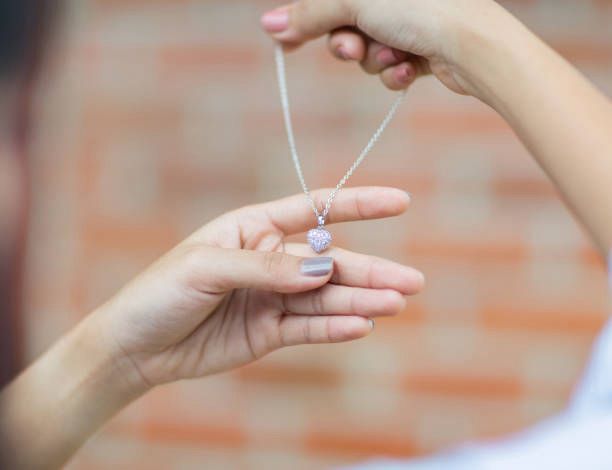
The necklace wasn’t valuable because of the gold. It mattered because it was the last thing I’d kept close after my wife passed, the one possession I couldn’t bring myself to pack away or redistribute among well-meaning relatives who thought they were helping by clearing out her closet.
In the months following Sarah’s death, our home had been subjected to a kind of organized dismantling. Her sister had arrived with plastic bins and packing tape, methodically sorting through decades of accumulated life with the efficiency of someone who’d done this before. Sweaters went into donation bags. Books were distributed to friends who’d admired them. Photo albums were carefully archived and labeled. Everyone had been so helpful, so determined to ease my burden, that I’d let them do it, standing aside while they made decisions I couldn’t face making myself.
But the necklace—a simple gold chain with a small oval pendant that had belonged to Sarah’s grandmother—I’d claimed that immediately. When her sister had reached for the jewelry box on the dresser, I’d intercepted her hand gently but firmly and said, “Not that one.” She’d nodded with understanding, patted my shoulder, and moved on to the next drawer.
I’d kept the necklace in its small velvet box on my nightstand, exactly where Sarah had always returned it each evening before bed. Sometimes, in those first raw weeks, I’d open the box just to look at it, to touch something she’d touched, to hold onto something that still carried the weight of her presence. The gold had warmed in her hands countless times. The clasp had rested against the back of her neck. It was a tangible connection when everything else felt impossibly distant.
That’s why I noticed immediately when something was wrong.
It was a Tuesday morning, six months after the funeral. I’d developed certain rituals to get through each day—coffee at exactly six-thirty, a walk around the neighborhood before the Phoenix heat became unbearable, then breakfast while reading the paper. Small structures to hold myself upright. Before my walk, I’d reached for the velvet box, something I did most mornings, just to reassure myself it was still there.
The moment I picked it up, my stomach dropped. The weight was wrong. Too light. Empty-light.
I opened it anyway, some desperate part of my brain insisting I must be mistaken, that grief was playing tricks on my perception. But the cream-colored satin lining stared back at me, unmarked and vacant. The small indentation where the pendant usually rested showed no golden gleam.
For several long seconds, I stood frozen, the empty box balanced in my palm while my mind scrambled for explanations. You moved it. You’re tired. You put it somewhere safe and forgot. These were the same gentle lies grief had been offering me for months, the comforting narratives that helped me function when reality became too sharp.
I searched anyway. Methodically at first—the nightstand drawer, my dresser, the pockets of jackets I hadn’t worn in weeks. Then more frantically, pulling out drawers completely, checking under furniture, even looking in places that made no logical sense. The bathroom cabinet. The kitchen junk drawer. Behind books on the shelf.
Outside my bedroom window, the neighborhood was waking up with its usual Tuesday indifference. Mrs. Chen was retrieving her newspaper from the driveway in her bathrobe. The Johnsons’ sprinkler system clicked on with its familiar rhythmic hiss. A car engine started somewhere down the street. The world continued its ordinary rotations while mine tilted dangerously off-axis.
When I finally descended the stairs, still hoping against hope that I’d somehow carried the necklace down in some fog of grief and distraction, I found the house in a state I hadn’t left it in the night before.
The television was on in the living room, tuned to one of those morning shows Sarah used to watch. Coffee had been made—I could smell it, though I hadn’t started the pot. On the kitchen counter sat a stack of disposable plates, the kind you buy in bulk from warehouse stores, alongside plastic cups and cutlery still in their packaging. Someone had decided that washing dishes was too much effort.
My daughter Jennifer was at the kitchen table, scrolling through her phone with one hand while holding a piece of toast in the other. She’d moved back in three months ago, ostensibly to help me manage the house, to provide company, to make sure I was eating properly and not drowning in grief. At forty-two years old, she’d framed it as a temporary arrangement—just until she got back on her feet after her divorce, just until she figured out her next step.
Three months had stretched and settled into what was starting to feel permanent.
“Have you seen your mother’s necklace?” I asked, keeping my voice level. “The one with the oval pendant?”
She didn’t look up from her phone immediately. Her thumb continued scrolling for another few seconds before she glanced up, her expression mildly curious, as if I’d asked about a missing pen or a misplaced magazine.
“Oh,” she said. “I sold it.”
The words landed without weight, casual and simple, like she was commenting on the weather.
I waited for the rest of the sentence. An explanation. A reason. An apology. Surely there was more to this statement than those three words.
“You… what?” I managed.
“I sold it to a pawn shop on McDowell.” She took a bite of her toast, chewed, swallowed. “I needed money for a vacation. Stephanie and I are going to Sedona this weekend. There’s this retreat—meditation, hot stone massages, the whole thing. It’s supposed to be really healing.”
She said this as if it were perfectly reasonable, as if pawning her dead mother’s necklace for a spa weekend was a minor logistical decision, no different than choosing which credit card to use.
“That was your mother’s,” I said quietly. “The only thing I kept.”
Jennifer shrugged, a small, dismissive gesture that sent ice through my veins. “Dad, it was just sitting in that box. You weren’t wearing it. Mom’s gone—she doesn’t need it. I figured it might as well do someone some good. Besides, they gave me four hundred dollars for it. That’s pretty good for a used necklace.”
Four hundred dollars. For something priceless.
I waited for something to shift in her expression. For recognition to dawn. For some indication that she understood what she’d done. We’d buried Sarah six months ago. Six months. And already her belongings were being converted into cash for weekend getaways.
But Jennifer just looked at me with that same mild curiosity, perhaps slightly annoyed that I was making a thing of this when she had clearly moved on, when she had healing retreats to plan and massages to schedule.
“Which pawn shop?” I asked.
She told me the address without hesitation, without apparent guilt, already returning her attention to her phone.
I didn’t raise my voice. I didn’t argue. Instead, I turned and walked back upstairs, my legs feeling mechanical, my chest tight with a grief that had suddenly gained new dimensions. In my bedroom, I sat on the edge of the bed—Sarah’s side, where I still sometimes sat when missing her became unbearable—and picked up my phone.
The empty velvet box sat beside me on the nightstand, accusatory in its lightness.
The pawn shop answered on the third ring. A man’s voice, older, with the careful courtesy of someone who’d spent years negotiating delicate transactions.
I explained the situation as clearly as I could, my voice surprisingly steady. A gold necklace with an oval pendant. Brought in this morning by my daughter. My late wife’s. A mistake. I wanted to buy it back.
There was a pause on the other end of the line, longer than seemed necessary for such a straightforward request.
“Are you family?” the man asked carefully.
“I’m her husband,” I said. “Was. I’m her widower.”
Another pause, and this one carried a different weight. I could hear him breathing, could sense him choosing his words with unusual care.
“Sir,” he said slowly, “this is… well, this is a bit unusual. I think you should come by the shop. There’s something inside the pendant you should see.”
My hand tightened around the phone. “Inside the pendant?”
“It opens,” he said gently. “There’s a small compartment. Your daughter didn’t check it—she was in quite a hurry. But I always examine items carefully before completing transactions. This is something you need to see in person.”
The room felt suddenly smaller, the air thinner. “What’s inside it?”
“I’d prefer you come by, sir. Can you make it here this morning?”
He gave me the address—the same one Jennifer had provided, though hearing it from him made it feel real in a way it hadn’t before. I told him I’d be there within the hour and ended the call.
For a long moment, I just sat there, staring at the empty velvet box, my mind spinning through possibilities. I’d worn that necklace close to my heart through forty-seven years of marriage. Sarah had worn it to our wedding, to the births of our children, to countless ordinary days that had somehow added up to an extraordinary life. And I’d never known it could open.
What had she hidden inside it?
I drove to the pawn shop in a kind of trance, barely registering the familiar Phoenix streets, the strip malls and traffic lights and desert landscaping that usually anchored me in the present. My mind was already elsewhere, in the past, scanning through memories of Sarah wearing that necklace, searching for clues I might have missed, signs I should have seen.
The pawn shop occupied a narrow storefront between a check-cashing place and a Mexican restaurant, its windows barred and cluttered with guitars, watches, and tools. A bell chimed as I pushed through the door into air-conditioned dimness that smelled of metal, old leather, and something else—time, maybe, or the accumulated weight of other people’s desperate decisions.
The man behind the counter looked to be in his seventies, with wire-rimmed glasses and the kind of weathered face that suggested he’d heard every sob story, every excuse, every rationalization the human mind could produce. But when he looked at me, his expression was neither cynical nor pitying. It was something else. Something like concern.
“Mr. Patterson?” he asked.
I nodded, not trusting my voice.
He reached under the counter and produced a small cloth bundle, setting it gently on the glass between us. His movements were deliberate, almost ceremonial.
“I want to say first,” he began carefully, “that I’m not trying to alarm you. But when I examined this piece, I found something that I believe was placed there very intentionally. By someone who knew it might eventually find its way to a place like this.”
He unwrapped the cloth slowly, revealing the necklace I’d seen every day for months, the familiar gold chain and oval pendant catching the fluorescent light. But instead of simply returning it to me, he used a small tool to press on the edge of the pendant.
It clicked open like a locket.
Inside, pressed against the tiny interior space, was a folded piece of paper, so thin it was almost transparent.
My hands were shaking as I reached for it. The man stepped back, giving me space, giving me privacy for whatever this moment was about to become.
I unfolded the paper with fingers that felt numb and distant. The creases were sharp, deliberate. Someone had folded this very carefully, working to make it fit in that tiny space.
The handwriting was Sarah’s. I would have recognized it anywhere—the slight forward slant, the way she crossed her t’s, the particular loop of her g’s. Handwriting I’d seen on grocery lists and birthday cards and love notes tucked into my lunch bag.
But this note wasn’t a love letter.
It was a single sentence, pressed hard enough that the pen had nearly broken through the paper in places:
“If Jennifer brings this here, don’t trust her.”
I read it three times. Four. The words didn’t change. They sat there on that fragile paper, brutal in their simplicity, impossible in their implications.
“Did my daughter see this?” I asked, my voice coming from somewhere far away.
The man shook his head. “No, sir. She didn’t look inside. She was in quite a hurry—said she had somewhere to be. She handed me the necklace, we agreed on a price, she took the cash and left. The whole transaction took maybe five minutes.”
That should have eased my mind. Jennifer didn’t know about the note. She hadn’t seen her mother’s warning. This could still be contained somehow, explained away, rationalized.
But instead, my unease deepened, spreading through my chest like cold water.
Because if Sarah had hidden this message, and if she’d specifically mentioned Jennifer, and if she’d anticipated that this exact scenario might unfold—the necklace being pawned, probably after her death—then she’d been preparing for something. Planning for something.
Warning me about something.
“How long ago did she write this, do you think?” I asked the pawn shop owner.
He lifted his shoulders. “The paper’s aged some. Maybe a year or two? Hard to say for certain.”
A year or two. While Sarah was still alive. While she was still healthy, still walking and talking and going about her daily life. Before the cancer. Before the diagnosis that came so suddenly and progressed so quickly.
She’d hidden this warning while she was well.
Which meant she’d seen something. Known something. Feared something.
About our daughter.
I looked up at the man, who was watching me with professional concern. “What do I owe you for the necklace?”
“Nothing,” he said quietly. “This feels like something that needs to go home. I couldn’t in good conscience charge you.”
I tried to protest, but he waved me off. “I’ve been in this business thirty years. Some transactions aren’t about money. Take it. And sir? Whatever this is about—be careful.”
I drove home with the necklace in my pocket and the note in my wallet, pressing against my driver’s license like a secret identity. My hands were steady on the wheel, but my mind was racing through memories, re-examining years of interactions with Jennifer through this new, terrible lens.
The money that went missing from our safe three years ago, right before Jennifer’s last vacation to Hawaii. Sarah had been so upset, had wanted to confront Jennifer, but I’d talked her down. These things happen, I’d said. We probably miscounted. Don’t create family drama over a misunderstanding.
The credit card that appeared in my name last year, the one I never applied for, maxed out with charges in Jennifer’s city before I caught it. Jennifer had been so apologetic, had promised to pay it all back, had explained it as a desperate moment during her divorce. I’d believed her. Had covered the charges myself rather than involve the authorities.
The small valuables that had disappeared over the years—Sarah’s other jewelry, my grandfather’s watch, a silver picture frame that had been in my family for generations. All dismissed as misplaced, lost in moves, accidentally donated.
And Sarah had seen the pattern. Had recognized what I’d been too naive or too loving to acknowledge.
Our daughter was stealing from us. Had been stealing from us. And not out of desperate need, but out of casual entitlement, converting our belongings into her pleasures without guilt or hesitation.
When I walked back into the house, Jennifer was still at the kitchen table, though now she had her laptop open, scrolling through spa treatments with the four hundred dollars she’d gotten for her mother’s necklace.
“Did you get it back?” she asked without looking up.
“Yes,” I said.
“Good. I’m glad that worked out.” Her tone suggested she’d already moved on, already filed this away as a resolved inconvenience.
I stood in the doorway, studying my daughter—her expensive manicure, her designer workout clothes, the new phone that cost more than most people’s rent—all funded by a job she’d lost six months ago and an apparent unwillingness to find another.
“I’m going to need you to move out,” I said quietly.
Now she looked up. “What?”
“I’ve been letting you stay here to help you get back on your feet. But I think it’s time you find your own place.”
Her expression shifted through several emotions—surprise, confusion, then settling into indignation. “Are you seriously kicking me out over a necklace? Dad, I said I’m sorry—”
“You didn’t say you were sorry,” I interrupted. “You haven’t apologized. And this isn’t about the necklace.”
“Then what is it about?”
I could have told her about the note. Could have confronted her with her mother’s warning, demanded explanations, forced some kind of reckoning. But looking at her now—at the practiced innocence in her expression, the ready excuses I could already see forming—I realized Sarah had been right about more than just the stealing.
She’d been right that I couldn’t trust Jennifer. Couldn’t trust her to tell the truth, to take responsibility, to change.
And maybe, after years of enabling and excusing and hoping for better, the kindest thing I could do was stop. Stop providing the soft landing that let her continue without consequences. Stop sacrificing my own peace for her convenience.
“It’s about the fact that your mother died six months ago, and you’ve already sold her belongings for a spa weekend,” I said. “It’s about the disposable plates, the unpaid rent, the promises to look for work that never materialize. It’s about me realizing that help only works when someone wants to help themselves.”
“I can’t believe you’re doing this,” Jennifer said, her voice rising. “Mom wouldn’t want this. She’d want us to stay together as a family.”
For a moment, I almost wavered. Almost let the guilt and grief pull me back into old patterns. But then I felt the weight of the necklace in my pocket, the note in my wallet, Sarah’s careful handwriting protecting me even now.
“Your mother,” I said gently, “knew exactly who you were. And she loved you anyway. But she also knew I needed to see it for myself.”
I gave Jennifer two weeks to find a new place. She raged, she pleaded, she tried manipulation and guilt in equal measures. But I held firm, anchored by Sarah’s final gift—not the necklace itself, but the truth she’d preserved inside it.
On the day Jennifer moved out, taking far more of our household belongings than she’d arrived with, I returned the necklace to its velvet box on my nightstand. The note I kept in my wallet, Sarah’s handwriting a reminder that love sometimes means warnings as much as warmth.
The house felt emptier after Jennifer left, but it also felt lighter, as if some weight I hadn’t known I was carrying had been lifted. I resumed my routines—coffee at six-thirty, morning walks, breakfast with the paper—but now they felt like choices rather than survival mechanisms.
Sometimes, in the evenings, I’d open the velvet box and hold the necklace, running my thumb over the pendant’s smooth surface. I’d think about Sarah—her kindness and her wisdom, her ability to see people clearly without ceasing to love them, her final act of protection disguised as a piece of jewelry.
She’d known. Maybe not the specifics, maybe not the exact scenario. But she’d known enough to leave me a warning, to prepare me for a moment when I’d need to choose between comfortable denial and difficult truth.
And in doing so, she’d given me one last gift: the strength to protect what mattered, the courage to set boundaries, the wisdom to understand that sometimes love means letting go.
The necklace sits on my nightstand still, in its velvet box, right where Sarah always returned it. But now I know its secret—that it holds more than just gold and memory. It holds the truth. And sometimes, that’s the most valuable inheritance of all.

Lila Hart is a dedicated Digital Archivist and Research Specialist with a keen eye for preserving and curating meaningful content. At TheArchivists, she specializes in organizing and managing digital archives, ensuring that valuable stories and historical moments are accessible for generations to come.
Lila earned her degree in History and Archival Studies from the University of Edinburgh, where she cultivated her passion for documenting the past and preserving cultural heritage. Her expertise lies in combining traditional archival techniques with modern digital tools, allowing her to create comprehensive and engaging collections that resonate with audiences worldwide.
At TheArchivists, Lila is known for her meticulous attention to detail and her ability to uncover hidden gems within extensive archives. Her work is praised for its depth, authenticity, and contribution to the preservation of knowledge in the digital age.
Driven by a commitment to preserving stories that matter, Lila is passionate about exploring the intersection of history and technology. Her goal is to ensure that every piece of content she handles reflects the richness of human experiences and remains a source of inspiration for years to come.