The Day My Family Tried to Steal My House
I stood on the sidewalk in front of my own home, watching a scene that felt like it had been ripped from someone else’s nightmare. The moving truck idling in the street. My sister directing strangers carrying boxes toward my front door. My father standing on my porch like a sentry. A locksmith with tools in hand, preparing to change the locks on a house he had no legal right to touch.
For a moment, I couldn’t move. Couldn’t speak. Couldn’t process what I was seeing.
This wasn’t happening. This couldn’t be happening.
But it was.
My name is Daniel Brooks. I’m thirty-four years old, and until that Tuesday afternoon in late September, I thought I understood the boundaries of family conflict. I thought I knew where the lines were drawn, what was negotiable and what wasn’t. I thought—naively, stupidly—that ownership meant something. That legality meant something. That the fact that I’d spent ten years saving every spare dollar, working double shifts, skipping vacations, eating ramen for dinner more nights than I could count, all to buy this modest three-bedroom house in a quiet Indianapolis suburb, would mean something to the people who were supposed to love me.
I was wrong.
The House That Sacrifice Built
Let me back up and tell you about the house first, because the house matters. It’s not impressive by most standards. No granite countertops or hardwood floors. No open concept kitchen or master suite with a spa bathroom. It’s a 1,200-square-foot ranch built in 1987, with beige siding that needs repainting, a yard that’s more weeds than grass, and a driveway with cracks I keep meaning to seal.
But it’s mine.
I bought it five years ago for $142,000, which was actually a steal even then because it needed work. The previous owners had let things slide—peeling wallpaper, outdated fixtures, a kitchen from the early ’90s that looked like it had never been updated. Most buyers took one look and moved on to something more turnkey.
I saw potential. More importantly, I saw possibility.
I’d been saving for a down payment since I was twenty-four. While my friends were taking trips to Cancun and buying new cars and going out to bars every weekend, I was putting twenty percent of every paycheck into a high-yield savings account. I worked as a network administrator for a mid-sized insurance company during the day, and I picked up freelance IT work on nights and weekends. Tax season, I did data entry. Holidays, I worked retail.
For ten years, my life revolved around one goal: own a home. Have something that was mine, that nobody could take away, that represented stability in a life that had never felt particularly stable.
My mom died when I was nineteen. Pancreatic cancer, diagnosed in March and gone by August. After she passed, my dad sort of… folded in on himself. He kept working, kept paying bills, kept the house running, but the emotional infrastructure of our family just collapsed. My sister Melissa was sixteen then, angry and grieving and acting out in ways that my father couldn’t seem to manage.
I moved out at twenty, not because I wanted to abandon them, but because staying felt like drowning. I got a tiny studio apartment, worked my jobs, visited when I could, and tried to build something that felt like a future.
When I finally had enough saved for a down payment, when I finally found this house and made an offer and signed papers and got the keys, I sat in the empty living room and cried. Not sad tears. Relief tears. Achievement tears. The kind of tears that come when you’ve been carrying something heavy for so long that setting it down feels almost painful.
This house represented every sacrifice I’d made. Every concert I’d skipped, every vacation I’d forwent, every time I’d said no to something fun because I had a goal that mattered more.
And now my family was trying to take it.
The Sister Who Always Needed Saving
Melissa is thirty-one now, three years younger than me, and she’s spent most of her adult life in crisis mode. I don’t say that to be cruel. I say it because it’s true, and pretending otherwise hasn’t helped anyone.
She got pregnant at nineteen with her high school boyfriend, Kyle. They tried to make it work, living in my dad’s basement with baby Emma, but Kyle was in and out of jobs and Melissa was in and out of patience. They split when Emma was two.
Then came Marcus, boyfriend number two, father of kids two and three—Jayden and Sophia, born thirteen months apart. Marcus was around for a while, long enough that I thought maybe Melissa had found some stability. But he left when Sophia was a year old, moved to Arizona for a job opportunity, and sends child support irregularly at best.
Melissa has worked various jobs over the years—retail, food service, a brief stint as a home health aide—but nothing ever sticks. She’s not lazy, exactly. She’s just chaotic. She’ll get hired somewhere, work for three months, have some conflict with a manager or a coworker, quit in a dramatic fashion, and then spend the next few weeks explaining to everyone who will listen why it wasn’t her fault.
The kids—Emma is now twelve, Jayden is nine, and Sophia is eight—are good kids caught in a bad situation. I care about them. I’ve helped where I could over the years: birthday gifts, school supplies, groceries when things were tight. But I learned early on that helping Melissa directly was like pouring water into a bucket with no bottom. The need was endless, and the gratitude was temporary.
For the past three years, she’s been living in a rental house about twenty minutes from me. It’s small, kind of run-down, in a neighborhood that’s seen better days. The rent is cheap—$850 a month—but Melissa’s been late on payments more often than not. Last I heard, she was two months behind and her landlord was losing patience.
My dad has bailed her out before. Covered rent, bought groceries, paid utility bills. He’s on a fixed income now—retired from the postal service with a modest pension and Social Security—but he stretches it to help Melissa whenever she asks. Which is often.
I’ve told him, gently and not-so-gently, that he’s not helping her by constantly rescuing her from the consequences of her choices. He always says the same thing: “What am I supposed to do? Let my grandkids suffer?”
It’s a trap of an argument because no, obviously, I don’t want the kids to suffer. But there’s a difference between helping children and enabling an adult who refuses to take responsibility for her own life.
Dad doesn’t see that difference. Or maybe he does and just can’t bear to acknowledge it.
The Sunday Intervention
They showed up on a Sunday afternoon, three weeks before the moving truck incident. I was in my garage, halfway through an oil change on my car, when I heard the doorbell.
I wasn’t expecting anyone. I had plans to finish the car, make dinner, watch the Colts game, and go to bed early before another work week. Simple. Peaceful.
I wiped my hands on a rag and went to the door. Dad and Melissa stood on my porch, both looking serious in a way that immediately put me on edge.
“Hey,” I said. “What’s going on?”
“Can we come in?” Dad asked. “We need to talk to you about something important.”
I should have said no. I should have felt the ambush coming. But family conditioning is a powerful thing, so I stepped aside and let them in.
We sat at my kitchen table—the same table I’d found at a yard sale and refinished myself, one of those small accomplishments that made this place feel like home. Dad sat across from me, hands folded. Melissa sat next to him, looking everywhere except at me.
“Daniel,” Dad started, using his serious voice, the one that used to precede lectures about responsibility and doing the right thing, “your sister is in trouble.”
“What kind of trouble?” I asked, though I could guess. Melissa was always in some kind of trouble.
“Her landlord is evicting her,” Melissa said quietly. “I’m three months behind on rent. He gave me until the end of the month to catch up or get out.”
I felt bad for her—genuinely bad, especially for the kids. But I also felt the familiar exhaustion that came with Melissa’s crises. “I’m sorry to hear that. Have you looked into rental assistance programs? There are resources—”
“We’re not here to ask for money,” Dad interrupted.
I should have been relieved. Instead, I felt a spike of anxiety because if they weren’t asking for money, what were they asking for?
Dad cleared his throat. “Your sister needs this house more than you do.”
The words hung in the air like smoke. I actually laughed—a short, sharp sound that was more surprise than amusement.
“What?”
“This house,” Dad said, gesturing around my kitchen like it was community property. “It’s too big for just you. Three bedrooms for one person. Meanwhile, Melissa and the kids are about to be homeless.”
I stared at him, waiting for the punchline. There wasn’t one.
Melissa finally looked at me, her eyes already welling with tears. “I have kids, Daniel. Three kids who need stability, who need a safe place to live. You don’t have anyone depending on you. You could rent a one-bedroom apartment somewhere and be fine.”
“This is my house,” I said slowly, carefully, like I was explaining something to a child. “I bought it. I pay the mortgage. I’ve put thousands of dollars into fixing it up—”
“And you’ve done a great job,” Dad said, his tone patronizing in a way that made my skin prickle. “You should be proud of yourself. But now it’s time to think about family. Think about what Mom would have wanted.”
There it was. The Mom card. The ultimate guilt weapon in our family’s arsenal.
“Mom would have wanted me to have a stable home,” I said. “She would have been proud that I worked hard and achieved a goal.”
“She would have wanted you to help your sister,” Dad countered.
“I have helped Melissa. I’ve helped her for years. But this—” I gestured around us, “—this is insane. You’re asking me to give up my house.”
“Not give up,” Melissa said quickly. “Just… let us live here. The mortgage would probably be less than rent anyway. You could rent somewhere cheap—”
“No,” I said. The word came out harder than I intended, but I didn’t soften it. “The answer is no.”
The temperature in the room dropped immediately. Melissa’s tears spilled over. Dad’s face hardened.
“So you’re going to let your nieces and nephew live on the street?” Melissa asked, her voice breaking.
“You’re not going to be on the street. There are shelters, there are assistance programs, there are—”
“Shelters?” Melissa’s voice rose. “You want my kids in a shelter?”
“I want you to take responsibility for your situation instead of expecting me to fix it by giving up everything I’ve worked for!”
Dad stood up abruptly. “I raised you better than this, Daniel. I raised you to care about family, to sacrifice when necessary, to be a man who does the right thing.”
“The right thing isn’t giving Melissa my house!”
“She needs it more than you do!” Dad’s voice was loud now, filling my small kitchen. “Family should sacrifice. Blood matters more than paperwork, more than property, more than your selfish need to have something that’s ‘yours.'”
The way he said “yours,” with verbal quotation marks dripping with disdain, made something snap inside me.
“Get out,” I said quietly.
“Daniel—”
“Get out of my house. Now.”
Melissa was crying harder now, and Dad looked at me like I was a stranger. Like I’d become someone he didn’t recognize and didn’t particularly like.
“If you don’t do the right thing voluntarily,” Dad said, his voice cold now, “we’ll figure something else out.”
It sounded like a threat. At the time, I thought it was just anger talking. Just Dad being dramatic and hoping to scare me into compliance.
I should have taken it more seriously.
The Aftermath: A Family United Against Me
After they left, I sat at my kitchen table for a long time, trying to process what had just happened. Trying to understand how my father and sister could possibly think their request was reasonable.
The more I thought about it, the angrier I got. Not just at the audacity of asking me to hand over my house, but at the underlying assumption that my life, my goals, my achievements mattered less because I didn’t have kids. That somehow being single and childfree meant I was less deserving of stability and security.
I texted my dad that evening: “I love you and I love Melissa and the kids, but I’m not giving up my house. Please don’t ask me again.”
He didn’t respond.
Melissa did, though. A long, rambling message about how disappointed she was in me, how she’d always thought I was a good person but clearly she was wrong, how she hoped I was happy with my “big empty house” while her children suffered.
I didn’t respond.
Then the extended family got involved.
My aunt Carol—Dad’s sister—called the next day. “I heard what’s going on with Melissa and the house,” she said, her tone carefully neutral. “That’s a tough situation.”
“It’s not a tough situation,” I said. “It’s an inappropriate request that I’ve declined.”
“Well, I can see both sides—”
“There aren’t two sides, Aunt Carol. It’s my house. I bought it. The end.”
“I’m just saying, if I had extra space and family needed help—”
“Then you should offer Melissa your spare bedroom.”
Silence. Then: “Well, our situation is different. We don’t have a whole house that’s sitting mostly empty—”
“Neither do I. I live here. This is my home.”
She tried a few more gentle persuasions before giving up and ending the call. But she wasn’t the last.
Over the next few days, I got calls, texts, and Facebook messages from relatives I barely spoke to. My cousin Jennifer. My uncle Mark. People who hadn’t reached out in years suddenly had opinions about my moral obligations.
The narrative was always the same: Melissa has kids. You don’t. She needs it more. Family helps family. Don’t be selfish.
Notably, none of them offered to house Melissa themselves. None of them volunteered their spare rooms or their guest houses or their basement apartments. They just wanted me to sacrifice. From a safe distance, it was easy for them to be generous with my property.
I stopped answering calls from numbers I recognized. I posted nothing on social media. I told myself that this would blow over, that eventually Melissa would find another rental, that Dad would cool off and we could repair our relationship.
I was wrong about that too.
The Moving Truck
Four days after the kitchen table confrontation, I came home from work around 5:30 PM on a Tuesday. It had been a long day—a server migration that had gone sideways, requiring me to stay late troubleshooting with increasingly frustrated colleagues. I was tired, hungry, and looking forward to a quiet evening.
I turned onto my street and immediately knew something was wrong.
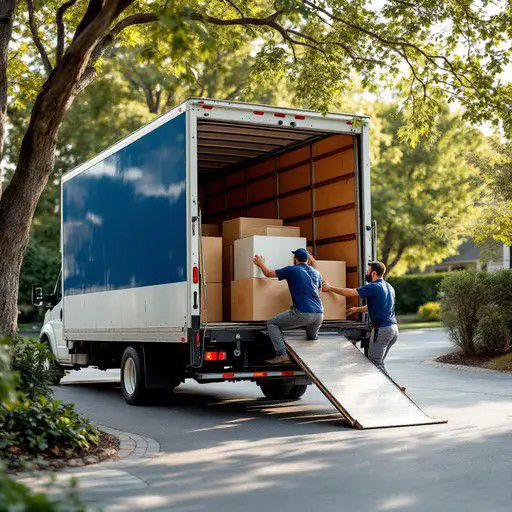
There was a Budget moving truck parked in front of my house. Not near my house. Not in the general vicinity. Directly in front of it, at the curb, amber hazard lights blinking.
My first thought, genuinely, was that I’d somehow gotten the wrong street. That in my exhaustion, I’d autopiloted to some other neighborhood that looked like mine.
But no. That was my house. The beige siding I kept meaning to paint. The crooked mailbox I’d been meaning to straighten. The small oak tree in the front yard that I’d planted two years ago.
And parked in my driveway—MY driveway—was Melissa’s beat-up Honda Accord.
I pulled to the curb half a block down, my heart starting to pound in a way that felt both panicked and surreal. This couldn’t be what it looked like. There had to be an explanation that didn’t involve my family actively trying to steal my house.
I got out of my car and walked toward the scene, my legs feeling strange and disconnected, like I was watching myself in a movie.
Dad was on my porch. Just standing there, arms crossed, like he was waiting for something. Or someone.
Melissa was directing two men—movers, clearly, in Budget company shirts—who were unloading boxes from the truck. Boxes labeled “Kitchen” and “Emma’s Room” and “Bathroom.”
And standing next to my father, toolbox in hand, was a middle-aged man I didn’t recognize. He had a drill. A key cutting machine. The unmistakable tools of a locksmith.
They were going to change my locks.
They were going to move Melissa into my house.
While I was at work.
Without my permission.
Without my knowledge.
Like I didn’t matter. Like my ownership didn’t matter. Like the law didn’t matter.
I stood there for a moment, frozen in a kind of shocked paralysis. Part of my brain was screaming that this couldn’t be real, that there had to be some misunderstanding, that my father—the man who’d taught me to ride a bike, who’d sat with me in the hospital when I broke my arm at ten, who’d cried at my high school graduation—couldn’t possibly be participating in something this egregiously wrong.
But he was.
Dad saw me first. His face shifted—not to guilt or shame, but to something like relief. Like my arrival was going to make this easier somehow.
“Good,” he called out, his voice carrying across my lawn. “You’re here. Let’s not make this harder than it has to be.”
That’s when the locksmith took a step toward my front door, drill in hand, and the paralysis broke.
The Confrontation
I walked up my driveway—my driveway, on my property, toward my house—with a strange kind of calm that I would later recognize as shock.
“Stop,” I said. Not loud. Not aggressive. Just clear.
The locksmith paused, looking between me and my father, obviously confused about who was actually in charge here.
“It’s fine,” Dad said to him. “He’s just—”
“I own this house,” I said, looking directly at the locksmith. “Do you have my permission to change these locks?”
The locksmith looked uncomfortable now. “I was hired by—”
“Did I hire you?”
“No, but—”
“Then you’re trespassing. And if you drill a single hole in my door, I’ll call the police and have you arrested.”
“Daniel,” Dad said, his voice taking on that warning tone. “Don’t be dramatic.”
I turned to face him fully for the first time. “Dramatic? You hired a locksmith to break into my house!”
“It’s not breaking in when it’s family,” Melissa chimed in from near the moving truck. She’d stopped directing the movers and was walking toward us now, her face flushed. “We’re trying to help you see reason—”
“By stealing my house?” My voice was rising now, the shock wearing off and being replaced by something hotter. “That’s your plan? Just move in while I’m at work?”
“You weren’t giving us any choice!” Melissa shouted. “My kids need a place to live!”
“So you decided to commit a crime?”
“It’s not a crime when it’s family!” Dad interjected. “This is about doing what’s right, what’s moral—”
“What’s legal,” I corrected. “This is my house. My name is on the deed. My name is on the mortgage. You have no right—”
“We have every right!” Melissa was crying now, but they were angry tears. “You’re sitting in this big house all by yourself while my children are about to be homeless!”
“Then maybe you should have made better choices!” The words were out before I could stop them, harsh and true and cruel all at once.
Melissa flinched like I’d slapped her. Dad’s face went red.
“How dare you,” he said quietly. “How dare you speak to your sister that way.”
“How dare YOU try to steal my house!”
We were shouting now, all of us, standing in my front yard creating a scene that I’m sure my neighbors were watching from behind curtains. The movers had stopped working and were standing awkwardly by the truck, clearly wanting no part of whatever family drama they’d stumbled into.
The locksmith cleared his throat. “Listen, I don’t know what’s going on here, but if there’s a dispute about ownership—”
“There’s no dispute,” I said firmly. “I own this house. I can show you the deed right now. These people are trying to move in without my permission.”
“We’re family!” Melissa insisted. “He’s just being selfish!”
The locksmith looked deeply uncomfortable now. “Yeah, I’m… I’m not getting involved in this. You folks need to work this out amongst yourselves.” He started packing up his tools.
“Wait!” Dad called out. “We hired you—”
“And I’m unhiring myself,” the locksmith said flatly. “I’m not changing locks on a property when the owner is standing right here telling me not to. That’s a lawsuit waiting to happen.”
He loaded his stuff into his van, which was parked behind the moving truck, and drove away without looking back.
That should have been the end of it. That should have been the moment when reality set in and my father and sister realized they’d crossed a line they couldn’t uncross.
But Dad wasn’t done.
“The locksmith is gone,” he said, his voice hard. “Fine. But Melissa and the kids are still moving in. You can either accept that and work with us, or you can make this ugly. But either way, this is happening.”
I stared at him, this man who was supposed to be my father, and realized that I didn’t recognize him at all.
“If you don’t leave my property in the next sixty seconds,” I said, pulling out my phone, “I’m calling the police.”
“You wouldn’t.”
“Try me.”
We locked eyes. For a moment, I thought he might back down. I thought maybe some part of him would remember that this was insane, that you can’t just take someone’s house because you’ve decided it would be more convenient for someone else to have it.
But Melissa made the decision for him. “Fine!” she screamed. “Call the police! Let them see what kind of person you really are! Let them see you choose property over your own family!”
So I dialed 911.
The Police Arrive
The 911 operator was calm and professional, asking me to describe the situation. I explained as clearly as I could: my father and sister were attempting to move into my house without my permission, there was a moving truck in front of my property, and they were refusing to leave despite my explicit instructions.
“Are you in danger?” the operator asked.
I looked at my father and sister, both glaring at me with identical expressions of betrayed fury, and said honestly, “I don’t know.”
She told me units were on their way and to stay on the line.
Dad’s face had gone pale. “You actually called them. You actually called the police on your own family.”
“You’re attempting to burglarize my house,” I said flatly. “What did you think I would do?”
“We’re not burglarizing anything!” Melissa shouted. “This is family business!”
“No,” I said. “This is criminal trespass. This is attempted theft. This is—”
Two police cruisers pulled up before I could finish. Four officers—two per car—got out with that particular brand of casual alertness that comes with not knowing what kind of situation they’re walking into.
The lead officer, a woman in her forties with gray streaking her dark hair, approached us. “Who called?”
“I did,” I said. “I’m Daniel Brooks. This is my house.” I gestured to the property behind us. “These are my father and sister, and they’re attempting to move into my home without my permission.”
The officer looked at Dad and Melissa, then at the moving truck, then back at me. “Can you prove you own the property?”
“Yes.” I pulled out my wallet, showed her my driver’s license with this address, then pulled up the digital copy of my deed on my phone—something I’d saved to my cloud storage years ago, never imagining I’d need it for something like this.
She examined both, then looked at Dad. “Sir, is this your property?”
“It should be family property,” Dad said stubbornly. “His sister has three children who need—”
“Sir, I need a yes or no answer. Is your name on the deed to this house?”
Dad’s jaw worked. “No.”
“Ma’am?” The officer turned to Melissa. “Is your name on the deed?”
Melissa was crying again. “No, but my brother doesn’t need—”
“Then you’re trespassing,” the officer said simply. “And you need to remove your belongings and leave the property.”
“This is ridiculous!” Dad protested. “He’s our family! We’re not strangers!”
Another officer, younger and male, stepped forward. “Sir, family or not, this gentleman owns the property and he’s asking you to leave. You need to comply.”
“What about squatter’s rights?” Melissa asked desperately. “I’ve heard about squatter’s rights—”
“That’s not how that works,” the female officer said, not unkindly. “Squatter’s rights require occupancy over a long period of time without the owner’s knowledge or objection. You just got here, and the owner is very clearly objecting.”
She turned to the movers, who were still standing by the truck looking miserable. “Gentlemen, I suggest you reload whatever you’ve unloaded and leave before you become accessories to a crime.”
The movers didn’t need to be told twice. They started grabbing boxes and loading them back into the truck with impressive speed.
“This is insane,” Melissa said, but her voice had lost its fight. “You’re really doing this. You’re really choosing a house over your family.”
“You chose to try to steal my house instead of respecting my boundaries,” I said quietly. “I didn’t create this situation. You did.”
Dad stepped toward me, and for a moment I thought he might try to hug me, might finally see reason. But instead, he pointed a finger at my chest and said, “You’ll regret this. When you’re old and alone and you need family, you’ll remember this day and you’ll regret it.”
Then he turned and walked to his car—a sedan parked down the street that I hadn’t even noticed—and drove away.
Melissa stood there a moment longer, mascara streaking down her face, looking smaller somehow than she had when she’d arrived. “I hope you’re happy,” she said. Not shouted. Just said, flat and exhausted.
Then she got in her car and left too, following the moving truck as it pulled away from my house.
The officers stayed a bit longer, making sure the property was clear, asking if I wanted to file a formal report. I said yes. They took statements, took photos of the scene, gave me a case number.
The female officer, whose nameplate said “Rodriguez,” gave me a card before she left. “If they come back, call immediately. And you might want to consider a restraining order if this behavior continues.”
I thanked her. They left.
And I stood in my driveway, in front of my house, in the fading evening light, completely alone.
The Quiet After
That night, I couldn’t sleep. I kept replaying the scene—Dad’s face, Melissa’s tears, the locksmith’s awkward exit, the police presence. I kept thinking about how it had gotten to this point, how my refusal to hand over my house had escalated into attempted theft, into police intervention, into what felt like the complete destruction of my family.
I thought about calling Dad. Trying to explain, trying to make him understand. But every time I picked up my phone, I remembered his words: “We’ll figure something else out.” This wasn’t a spontaneous act of desperation. This was planned. They’d hired movers. They’d hired a locksmith. They’d coordinated this, probably spent days planning it.
They’d thought they could just take what was mine because they’d decided they needed it more.
Around 2 AM, my phone buzzed. A text from an unknown number: “You destroyed your family over a house. I hope it was worth it.”
I blocked the number. Then I blocked three more that came through over the next hour with similar messages.
Someone—Melissa, probably, or one of her friends—had posted about the situation on Facebook. I knew because I started getting messages from old high school friends, distant relatives, people I hadn’t spoken to in years.
Most were supportive, shocked that my family would try something so outrageous. A few were judgmental, parroting the “family should help family” line like it was some kind of trump card that overwrote property rights and basic decency.
I deactivated my Facebook account. I didn’t have the energy to defend myself to people who’d already made up their minds.
The Legal Aftermath
The next morning, I called in sick to work—the first time I’d done so in over a year—and met with a lawyer. Her name was Jennifer Chen, and she specialized in property law and family disputes.
I told her everything. She listened without interrupting, taking notes, nodding occasionally.
When I finished, she sat back and said, “You did everything right. The police involvement was smart. The documentation is solid. But I need to ask you a difficult question: How far are you willing to go if your family doesn’t back down?”
“What do you mean?”
“I mean, are you prepared to get a restraining order against your father and sister if necessary? Are you prepared to prosecute if they attempt this again? Because people who do what they did rarely stop after one failed attempt. They tend to escalate.”
I hadn’t thought about that. I’d assumed—hoped—that the police intervention would be enough of a wake-up call.
“I don’t want to hurt them,” I said. “I just want them to leave me and my house alone.”
“I understand,” Jennifer said gently. “But sometimes protecting yourself means taking actions that feel hurtful. Think about it. In the meantime, I recommend some immediate steps.”
She outlined a plan: Document everything. Save all texts, voicemails, Facebook messages. Consider security cameras for the property. Change my locks anyway—just in case someone had made a copy of my key at some point. File for a restraining order if there were any further incidents.
I agreed to all of it.
That afternoon, I had new locks installed. I set up a Ring doorbell and two additional cameras covering the driveway and backyard. I opened a new file on my computer labeled “Family Incident Documentation” and started uploading screenshots, saving messages, organizing the police report.
It felt paranoid. It felt sad. But it also felt necessary.
The Extended Family Weighs In
Over the next week, the family reaction evolved in waves.
First came the angry phase. Aunt Carol called and left a voicemail calling me heartless. Uncle Mark sent a long email about family values and disappointment. Cousins I barely knew posted vague Facebook statuses about “selfish people” and “forgetting where you come from.”
Then came the bargaining phase. Dad called—I didn’t answer, but he left a message: “Let’s talk about this like adults. Maybe we can work out some kind of arrangement. Melissa could rent from you at a reduced rate. We can all sit down and figure this out.”
I didn’t respond because there was nothing to figure out. I didn’t want Melissa as a tenant. I didn’t want my father negotiating access to my property. I wanted boundaries that were clear and respected.
Then, surprisingly, came support from an unexpected source.
My Uncle Jim—my mother’s brother, someone I’d always liked but rarely saw—called me directly. “I heard what happened,” he said. “Want to tell me your side?”
I did. All of it. He listened quietly.
“Your dad’s lost his mind,” he said when I finished. “I love him, he’s family, but trying to take your house? That’s not okay. That’s not even close to okay.”
“Thank you,” I said, and meant it. Having one person in my family validate my reality felt like oxygen after being underwater.
“Your mom would be furious about this,” Jim continued. “She worked so hard to make sure you kids had opportunities, that you could build your own lives. She’d be proud you bought a house. She sure as hell wouldn’t want you giving it away because Robert’s decided to enable Melissa into oblivion.”
That made me cry—not sad tears, but the kind that come with recognition, with someone seeing you clearly.
Uncle Jim became my one family ally. He didn’t badmouth Dad or Melissa to others, but he checked in on me regularly, offered support, reminded me that I wasn’t crazy for maintaining boundaries.
Melissa’s Next Move
Two weeks after the moving truck incident, I got a certified letter. Legal-looking envelope, return address from a law office I didn’t recognize.
My stomach dropped. Was Melissa actually suing me?
I opened it carefully. It was a letter from a lawyer representing Melissa, claiming that I had made “verbal agreements” to provide housing for her and her children, that I had “encouraged her to leave her previous residence” with assurances of alternative housing, and that my “sudden refusal” to honor these agreements had caused her financial and emotional harm.
It was complete fiction. Every word.
I’d never offered her housing. I’d never encouraged her to leave her rental. I’d never made any agreements, verbal or otherwise.
But it was officially threatening. The letter demanded I either provide housing or pay damages for breach of verbal contract—damages they estimated at $50,000.
I immediately forwarded it to Jennifer Chen.
She called me within the hour. “This is frivolous,” she said flatly. “They don’t have a case. Verbal contracts about real property transfers generally aren’t enforceable, and even if they were, they’d need to prove the agreement existed. Which they can’t, because it didn’t.”
“So what do I do?”
“I’ll draft a response. We’ll reject their claims, reiterate your position, and make it clear that any further harassment will result in counter-claims. Most likely, this is a scare tactic. They’re hoping you’ll settle to avoid legal fees and hassle.”
“I’m not settling.”
“Good. Because you shouldn’t.”
Jennifer’s response was professional and devastating. It outlined the facts: I owned the property. There was no agreement. The attempted move-in was documented by police. Any continued legal harassment would be met with counter-suits for abuse of process and potentially a restraining order.
Melissa’s lawyer—if they were a real lawyer and not just a friend doing a favor—must have advised her to drop it because I never heard another word about it.
But the damage was done. Even a frivolous threat of lawsuit put me on edge, made me question whether this nightmare would ever actually end.

Lila Hart is a dedicated Digital Archivist and Research Specialist with a keen eye for preserving and curating meaningful content. At TheArchivists, she specializes in organizing and managing digital archives, ensuring that valuable stories and historical moments are accessible for generations to come.
Lila earned her degree in History and Archival Studies from the University of Edinburgh, where she cultivated her passion for documenting the past and preserving cultural heritage. Her expertise lies in combining traditional archival techniques with modern digital tools, allowing her to create comprehensive and engaging collections that resonate with audiences worldwide.
At TheArchivists, Lila is known for her meticulous attention to detail and her ability to uncover hidden gems within extensive archives. Her work is praised for its depth, authenticity, and contribution to the preservation of knowledge in the digital age.
Driven by a commitment to preserving stories that matter, Lila is passionate about exploring the intersection of history and technology. Her goal is to ensure that every piece of content she handles reflects the richness of human experiences and remains a source of inspiration for years to come.