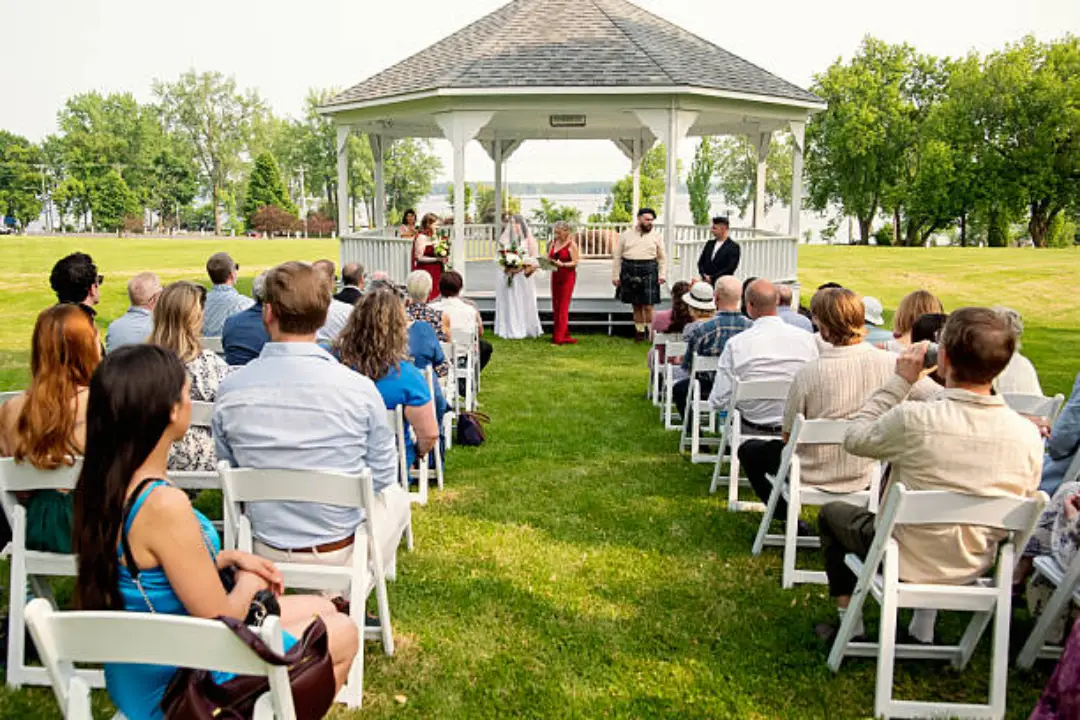
The wedding coordinator had trembling hands and a headset that kept slipping down her temple when she walked me past the front rows like I was furniture being delivered to the wrong room. She pointed to a chair so far back I could smell the parking lot gravel heating in the July sun.
“Mrs. Hargrove asked that you sit here,” she whispered, not meeting my eyes.
Mrs. Hargrove. That was Darlene Hargrove, my future daughter-in-law’s mother—the woman who said “class” the way some people say “oxygen,” like it was something you either had or you suffocated without.
I looked at the chair. It wasn’t even part of the main seating. It was a spare row behind a tall arrangement of white hydrangeas and the second photographer’s tripod. If I leaned forward, I could see the aisle. If I sat back, all I’d see were flower stems and strangers’ shoulders.
The coordinator’s smile was the kind people use when they want you to accept humiliation without making them feel guilty for delivering it.
“I’m the groom’s mother,” I said softly.
She nodded quickly, as if that were unfortunate. “I know. But Mrs. Hargrove insisted the front rows are reserved.”
Reserved for whom? Her accountant? Her tennis partners? The country club couples who knew which fork belonged to which course?
I almost laughed. Instead, I sat down carefully, smoothing my navy dress so it wouldn’t wrinkle. It wasn’t new. Not designer. But it was clean, pressed, and the nicest thing I owned—purchased last year on clearance after months of saving because I wanted to look “proper” at Evan’s wedding.
Evan. My son. My whole life. The boy I carried through fevers and scraped knees, the young man I worked overtime for, the adult I defended when he made mistakes I didn’t understand.
I’d pictured this day for years—maybe not this grand, but warm. A mother in the front row. A proud smile. A squeeze of the hand before vows. A look that said, I see you. I know what you gave up. I’m grateful.
Instead, I had this chair and a clear message: Sit down. Don’t ruin the picture.
Three days earlier, I’d seen the seating chart at Darlene’s house—the kind of house where every surface gleamed and the air smelled like lemon polish and money. She’d laid the chart on a marble island like a legal document.
My future daughter-in-law Blaire stood beside her mother in a fitted ivory outfit that looked magazine-ready. Blaire was beautiful in a way that made rooms fall quiet. She also smiled without warmth.
She tapped the paper with a manicured fingernail. “We’ve kept you toward the back. It’ll be less distracting.”
Distracting. To whom?
Blaire’s eyes had swept over my shoes, my purse, my hair. She didn’t have to say what she meant. She meant the guests, the pictures, the look of things.
“It’s just better,” she said. “You understand.”
I’d looked at Evan, expecting him to defend me the way he had all his life when someone treated me unfairly.
He stood there. Quiet. Avoiding my gaze. Like a child hoping the grownups would stop arguing.
“Evan?” I’d asked softly.
He cleared his throat. “Mom, please don’t turn this into a thing.”
A thing. That was what my dignity had become—a potential inconvenience on his big day.
Now, sitting in the back row on the wedding morning, the humiliation had a chair.
The venue was gorgeous—a historic Savannah estate with oak-lined paths and Spanish moss hanging like lace. White chairs, white flowers, a string quartet warming up under a tent. Guests gliding in with champagne flutes, wearing pale linen and pastel dresses and shoes too delicate for grass.
I watched them from my exile as they arrived, laughing softly. Some glanced at me and looked away quickly. A few stared too long, trying to place me in the story.
“Who’s that?” one woman whispered.
“I think that’s… his mom?” another replied, making it sound like a question and a pity simultaneously.
I kept my face still. I kept my chin up. I told myself: Don’t cry. Don’t beg. Don’t fight. Just get through it.
I’d buried my husband Frank three years earlier, watched machines breathe for him until they didn’t, walked out of the funeral home holding paperwork and a hollow heart. If I could survive that, I could survive one wedding.
The music began—soft strings, too perfect. The officiant took his place. Evan stepped up front in a tailored suit, posture confident, looking like he belonged in the life he’d chosen.
My chest tightened with pride anyway, because mothers are stubborn like that. We love even when love costs us.
Then Evan turned slightly and looked over the guests. His gaze passed over the front rows, the smiling faces, the expensive outfits… and slid past me like I wasn’t there.
I felt something drop in my stomach.
Then—quietly, without fanfare—the empty chair beside me filled.
A man sat down as if he had every right to be there. Not loud. Not flashy. Just present.
I noticed him first by the way the air changed. People sat straighter. Heads turned. The whispering shifted.
He wore a charcoal suit that fit like it had been built for him. No shiny accessories. No attention-seeking watch. Just clean lines, calm confidence. Silver at the temples. Steady hands.
He leaned slightly toward me and said in a voice low enough that only I could hear: “Keep your eyes forward. Don’t shrink. Just act like you came with me.”
I froze. I don’t know this man, I thought. Why would anyone like this sit here?
Before I could answer, his hand covered mine gently—warm, sure, familiar in a way that made my breath catch. Not possessive. Not theatrical. Just protective.
The whispers around us turned sharp. “Is that—?” “Why is he sitting back there?” “Who is she with?”
I felt my skin heat. For years, I’d learned to be invisible on purpose. Being noticed like this felt dangerous.
Up front, Evan turned again—this time for real. He saw our hands. His face changed instantly, like someone had pulled a rug from under him. He leaned slightly, searching, as if he couldn’t believe what he was seeing.
Blaire followed his gaze and stiffened. Darlene stared openly, her smile faltering for the first time all day.
The man beside me smiled faintly, like he’d expected that reaction. “Good. Let them wonder.”
I tried to pull my hand back out of pure panic. He held it gently—not forcing, but not letting the moment break.
“Who are you?” I whispered, barely moving my lips.
He didn’t answer right away. Instead, he looked forward, watching my son at the altar as if observing something complicated.
Then he said quietly, “Someone who should’ve been beside you a long time ago.”
My heart thudded hard.
The officiant began speaking. Guests rose. Music swelled. Blaire walked down the aisle in lace and satin, radiant and rehearsed.
I should have focused on the ceremony, on my son, on the vows. But my body was locked into one truth: the hand holding mine felt like a memory.
As Blaire reached the front, the man leaned closer and spoke a single name—soft and devastating.
“Mari.”
Nobody had called me that in fifty years. Not since I was seventeen and reckless and in love.
My breath left my lungs. I turned slowly.
His eyes—dark, steady, edged with years—met mine. And the world narrowed.
Because I knew him. Not as he was now, but as he had been: sunburned and laughing, standing outside a diner with coffee in hand, telling me I deserved more than the small life I’d been taught to accept.
His name back then was Gideon Shaw. My first love. The boy who left for an internship in New York one summer and never came back—at least not to me.
I stared at him until my eyes blurred. “You disappeared.”
His jaw tightened. He didn’t look away. “I didn’t. Not by choice.”
The ceremony continued around us—words, music, applause fading into background noise. I couldn’t hear anything except my heartbeat and the quiet force in his voice.
The vows ended. People cheered. Cameras clicked. Evan kissed Blaire under a shower of petals. And through it all, Gideon’s hand stayed on mine like an anchor.
When everyone rose to move toward the reception tent, Gideon stood first and offered his arm like a gentleman from another era.
“Come with me,” he said. “We’ll talk where nobody can listen.”
I hesitated. Then I stood. And for the first time that day, I didn’t feel like I needed permission.
We walked slowly past guests who stared too long, past Darlene who looked like her lungs had stopped working. Evan’s eyes tracked us, panicked. Blaire’s smile was wire-tight.
We moved beyond the tent toward a quiet garden shaded by magnolias, away from champagne and chatter.
The moment we were alone, I turned to Gideon fully. My hands were trembling. Years fell away so fast it made me dizzy.
“You left,” I said, raw. “I waited. I wrote. I—”
“I wrote too,” he cut in, voice controlled but thick. “Dozens of times.”
I blinked hard. “I never got anything.”
His expression hardened—not at me, but at something old. “Your mother met me at the door the summer I came back.”
My stomach clenched. My mother’s face rose in my mind—sharp lipstick, tight smile, eyes full of decisions.
“She told me you were engaged,” Gideon continued. “She said you were embarrassed by me. She said you wanted a ‘stable’ life. She said I was a distraction.”
My throat tightened. “That’s not true. That was never true.”
He nodded once, as if he’d known that for years but still needed to hear it aloud. “I figured it out too late. By the time I tracked you down, you were married. You had a baby. And I didn’t want to be the man who ruined your life because he couldn’t let go.”
I stared at him. My hands were cold. “My mother,” I whispered, almost to myself. “She intercepted them.”
Sick clarity spread through me. My mother had always disliked Gideon. He came from money—big money. His family had a name people recognized. To her, he wasn’t love—he was danger, change, instability. She wanted me safe. Controlled. Married to the right kind of man.
And I’d been young and obedient and heartbroken enough to accept silence as rejection.
“Fifty years,” I whispered, voice shaking. “All that time…”
Gideon’s eyes softened, and for a moment I saw the boy again. “I looked for you. I never stopped.”
My chest tightened so hard it hurt.
Before I could respond, we heard footsteps. Fast. Angry.
Evan appeared first, face flushed. Blaire followed, and behind her, Darlene moved like a storm in pearls.
“Mom,” Evan hissed, keeping his voice low but sharp, “what is going on?”
His eyes flicked to Gideon like he expected to recognize him and couldn’t.
Blaire’s gaze swept Gideon’s suit, his posture, the quiet way he stood like he owned any space he occupied. “Who are you?” she asked tightly.
Gideon didn’t flinch. He extended his hand politely. “Gideon Shaw.”
Blaire’s expression shifted. The name hit something. Darlene’s face went pale.
Evan blinked. “Shaw… as in—”
“Shaw Holdings,” Gideon finished calmly. “Yes.”
The air went brittle.
Blaire swallowed hard. “Why are you here?”
Gideon glanced at me, and I felt warmth at the silent question in his eyes: Do you want me to speak?
I gave the smallest nod.
He turned back. “I came quietly. I was invited.”
Darlene’s eyes widened. “Invited by whom?”
Gideon’s gaze didn’t move. “By Mr. Hargrove.”
That made Darlene’s mouth tighten. Blaire’s father, Ray Hargrove, was the kind of businessman who used “legacy” the way Darlene used “class.” His world was property, leases, buildings with names on them.
Evan looked confused. “I don’t understand.”
Gideon’s voice stayed steady. “I arrived early. I sat in the back because I didn’t want attention. Then I watched how you treated your mother.”
Evan’s face flushed deeper.
Blaire lifted her chin defensively. “This is a family event. We have a certain… arrangement.”
Gideon’s eyes narrowed slightly. “Arrangement. Is that what you call humiliation?”
Darlene stepped forward, voice tight with forced politeness. “Mr. Shaw, with respect, you don’t know the situation.”
“I know exactly what I saw,” Gideon replied.
Evan’s voice cracked. “Mom, why didn’t you tell me you knew him?”
I stared at my son—my only child. “Because you didn’t ask.”
That landed harder than yelling ever could. Evan blinked, stunned, as if it had never occurred to him that silence was also a choice.
Blaire’s mouth tightened. “This is ridiculous. We’re not going to let some stranger cause drama on our wedding day.”
Gideon didn’t react emotionally. He didn’t raise his voice. He simply looked at her like she was a problem he’d already solved.
“Blaire,” he said calmly, “you should call your father.”
Darlene’s breath caught. Blaire stiffened. “Why?”
“Because,” Gideon said, “I closed on the Riverside Commerce portfolio two weeks ago.”
The words sounded boring—like business jargon—until Darlene’s face changed.
Because Riverside Commerce wasn’t just any portfolio. It was Ray Hargrove’s crown jewel. It included the building Ray bragged about at every fundraiser, the one with the name plaque and corner offices—the building he planned to hand down like an heirloom.
Blaire’s eyes widened. “That’s—no. That’s not—”
“It is,” Gideon said. “My firm now holds controlling interest. The lease negotiations are mine.”
Darlene looked like her knees might buckle. Evan stared, helpless. Blaire’s mouth opened, then closed.
“I didn’t come here to threaten anyone,” Gideon continued. “I came to sit quietly. But I won’t sit quietly while a woman is treated like she’s disposable.”
Darlene’s voice shook. “This is not the time—”
“It’s exactly the time,” Gideon cut in, still calm. “Because this is when your character is visible.”
Blaire’s perfect composure cracked. “You can’t—”
Gideon stepped closer, not aggressive, just unmovable. “I can. And I already did.”
Silence.
Then Gideon turned to me. “Mari, do you want to stay here? Or do you want to leave?”
I looked at Evan. I looked at the people who had decided my worth based on my purse and shoes and quietness. I realized something that surprised me: I wasn’t afraid of them anymore.
“I want to leave,” I said.
Gideon offered his arm again. And I took it.
We walked away from the reception tent without rushing, without drama—just a steady exit that said: You don’t get to own me.
Behind us, I heard Evan call my name. “Mom—wait!”
I didn’t turn around. Not because I didn’t love him. Because I finally loved myself enough not to chase someone who had chosen to hide me.
Gideon drove us to a small restaurant overlooking the river—warm lighting, linen napkins, soft conversation. Not a celebrity hotspot. Just peaceful.
I sat across from him still feeling like I’d stepped out of my own life. He ordered tea for me without asking.
I blinked. “How did you know?”
He gave a faint smile. “You always got tea when you were nervous. Chamomile. Two sugars. You pretended it was for the taste.”
My throat tightened. I stared down at my hands—working hands that had scrubbed floors, folded laundry, signed timecards, held my husband’s hand as he faded, held my son when he had nightmares. Nobody in the Hargrove world would’ve framed them in gold.
Gideon watched me carefully. “I’m sorry.”
“For what?” I whispered.
“For not finding you sooner. For letting the silence win.”
I swallowed hard. “I built a life. It wasn’t the life I imagined. But I built it.”
“I know,” he said. “I read about Frank. I’m sorry.”
I flinched at the name. Frank. My safe choice. My good man. My husband. Not perfect, but kind. He had loved me in his own steady way.
“I didn’t come to erase your past,” Gideon said, as if reading my thoughts. “I came because I saw your name on a charity list connected to the wedding. I saw Evan’s announcement. I saw a photo of you.” He paused. “And I couldn’t stand the thought of you walking into that day alone.”
My chest ached. “Why didn’t you contact me before?”
He exhaled slowly. “Because people don’t like their past showing up uninvited. And I didn’t know if you’d hate me.”
I laughed once—small, bitter. “Hate you? I spent years thinking you didn’t want me. You have no idea what that did to a girl like me.”
His jaw tightened. “I know. That’s why I’m here.”
We talked for hours. I told him about raising Evan, about years when money was thin, about nights I ate cereal for dinner so Evan could have real food. About Frank’s death. About how loneliness doesn’t always look dramatic—sometimes it looks like eating dinner alone in silence for three years straight.
Gideon listened like every word mattered.
Halfway through, my phone buzzed.
Evan: Mom please call me. Evan: Do you know who that is?? Evan: Blaire’s dad is panicking. Mom please help us.
I stared at the screen. Gideon saw the messages and gave a quiet, almost sad smile. “Amazing what power does to a man’s memory.”
I didn’t answer. Because the truth was, Evan remembered me just fine. He just didn’t want me visible.
“Are you going to ruin them?” I asked finally.
Gideon’s eyes held mine, steady. “No. I’m not interested in revenge.” I let out a breath I didn’t realize I’d been holding. “Then what?”
“I’m interested in respect,” he said. He paused. “And accountability.”
Two weeks later, Evan and Blaire invited me to dinner at the Hargrove Country Club—because of course it had to be a place where everything was polished and watched.
The invitation was stiff. Formal. Like a business meeting dressed as family.
I didn’t want to go. But Gideon asked quietly, “Do you want closure?”
I didn’t know what closure looked like at sixty-nine. So I went. Gideon came with me.
Darlene was there in pearls. Ray Hargrove was there in a navy blazer, smiling too hard. Blaire looked like she hadn’t slept well since the wedding. Evan looked shaken.
They sat us in the best seats. Smiling staff. Perfect service. The same people who pushed me behind flower stands now acted like they’d always honored me.
I didn’t smile back.
Ray cleared his throat, voice warm and practiced. “Marianne, we want to put the past behind us.”
Gideon didn’t speak. He just watched me, letting me lead.
Blaire jumped in quickly. “There was a misunderstanding. The seating was—”
“Intentional,” I said calmly.
The table went still. Evan’s eyes flicked to me, surprised by the firmness in my voice.
“You didn’t misplace me,” I continued, simple and clear. “You placed me where you thought I belonged.”
Blaire’s cheeks flushed. Darlene’s smile tightened painfully. Ray turned to Gideon.
“Mr. Shaw, we’d like to discuss the Riverside property. We’ve been there for decades. That building is—”
“An asset,” Gideon finished politely. “Yes. I know.”
Ray’s jaw tightened. “We want our lease renewed.”
Gideon nodded once, as if considering. Then he turned to me. “Mari, what do you think?”
The table held its breath. Blaire stared like she couldn’t believe he was asking me. Evan looked down, ashamed.
I folded my hands neatly. “Mercy is earned.”
Darlene’s lips parted in outrage. Ray’s face hardened. “What does that mean?”
“It means,” I said, still calm, “you don’t get to insult someone and then ask for favors.”
Ray’s smile returned—thin. “We can apologize. We’re happy to apologize.”
Blaire’s eyes widened like she’d been slapped. Evan looked like he wanted to disappear.
I nodded once. “Good. Because there will be conditions.”
Ray stiffened. “Conditions?”
Gideon took out a folder—quiet, prepared. He slid it across the table. Ray opened it and began reading. His face changed line by line.
Blaire leaned in, eyes scanning. Darlene’s mouth tightened. Evan’s hands clenched.
Ray looked up sharply. “This clause says the lease terminates if there’s ‘verified disrespect’ toward you.”
“Yes,” I said.
Blaire’s voice rose. “That’s insane. ‘Verified disrespect’ is subjective.”
“It’s not,” I replied. “Not when you’ve already shown what you’re willing to do.”
Darlene snapped, unable to hold back. “This is humiliating.”
I looked at her. “So was the back row.”
Silence.
Gideon’s voice stayed calm. “Any tenant can follow a code of conduct. If they can’t, they shouldn’t be tenants.”
Ray’s face tightened. “And this second part?”
I smiled slightly—no sweetness, no cruelty. Just truth. “A public apology.”
Blaire’s eyes widened in horror. Evan finally looked up. “Mom, please—”
I held his gaze. “No. Not ‘please.’ Not today.”
Evan’s face broke a little. Blaire swallowed hard. Ray looked like he might explode, but he couldn’t—not when the building he relied on was no longer his.
He forced the words through clenched teeth. “Fine. A public apology. Where?”
Gideon’s mouth curved faintly. “At your charity gala next month. The one you host. The one where your friends and donors watch.”
Darlene made a small sound of outrage. Blaire stared at her napkin like she wanted to vanish. Evan looked at me like he was seeing me for the first time in years.
And maybe he was.
The gala was as grand as expected. Black-tie. Crystal glasses. A ballroom full of people who had never carried groceries up apartment stairs and didn’t know how lucky they were.
I wore a simple black dress. Gideon wore the same calm confidence he always did. We arrived together, hand in hand.
The whispers started immediately. The same people who ignored me at the wedding now watched me like I was news.
On stage, Ray Hargrove welcomed everyone with a practiced smile. Then he introduced Blaire. “She’d like to say a few words.”
Blaire walked to the microphone like she was walking to an execution. Her face was pale. Her smile trembled.
She looked out at the crowd, then—very briefly—at me.
And I watched something shift in her expression. Not warmth. Not kindness. But recognition that she could not bully her way through this.
She took a breath. “I want to address something. At my wedding… I behaved poorly.”
The room went quiet. Darlene sat rigid, eyes sharp with humiliation. Evan stared forward, jaw clenched.
Blaire continued, words careful. “I made choices that disrespected Evan’s mother. I seated her where she didn’t belong. I treated her like an inconvenience.” A murmur ran through the crowd.
Blaire’s voice cracked. “I apologize. Publicly. Without excuses. Mrs. Keller… I’m sorry.”
The silence held. Then Ray cleared his throat quickly and tried to move on—
But Gideon stood. Not dramatically. Not loudly. Just rising. It made the room pause again.
He looked at me. “Mari, do you want to respond?”
My heart pounded. For years, I’d been trained to swallow things. To keep peace. To accept “that’s just how it is.”
But that night, under the weight of their attention, I felt something simple and powerful: I wasn’t small anymore.
I stood. I walked to the microphone slowly. Calmly. I looked at Blaire, then at Evan, then at Darlene, then at the crowd.
And I said, in a steady voice: “Your apology is noted.”
That’s all. I did not say forgiven. I did not say it was fine. I did not soften it to make anyone comfortable.
Then I stepped away.
The room exhaled like it had been holding its breath. Gideon offered his hand as I returned to our table. I took it.
And I felt, truly, like I had my spine back.
Life didn’t become a fairy tale after that. Evan didn’t suddenly transform into the son I’d always wanted. Blaire didn’t become sweet overnight. Darlene didn’t stop being Darlene.
But something changed anyway. They learned that I was not a decoration for their aesthetic. I was a person. And people have limits.
Evan began calling more. At first, the calls were stiff, awkward, like he didn’t know what language to use with me now that I wasn’t automatically agreeing.
One night, he said quietly, “Mom… I didn’t realize how bad it looked.”
I almost laughed. “Evan, you didn’t realize because you didn’t look.”
Silence. Then he said, voice smaller than I’d heard in years, “I’m sorry.”
That apology mattered more than Blaire’s, because Evan’s wasn’t forced by leases and business pressure. It was forced by shame. And shame, when it’s real, can become change. Sometimes.
Gideon and I took things slowly. We weren’t teenagers anymore. We didn’t need drama or grand gestures. We needed truth.
We took walks. We ate dinners that weren’t performative. He showed me a box one afternoon—old letters, yellowed envelopes, some marked “RETURN TO SENDER.”
“My assistant tracked down what your mother did,” he said quietly. “She had them redirected. Some never even left town.”
I stared at those envelopes until my hands shook. So much life, rerouted by someone else’s fear.
Gideon covered my hand again, the same way he had at the wedding. “None of this was your fault.”
I didn’t answer right away. Then I whispered, “I know.” And for the first time in my life, I meant it.
Now, Evan still invites me to dinner. Sometimes I go. Sometimes I don’t. Not because I’m bitter—because I’m free.
Blaire is polite now. Careful. Respectful in that slightly stiff way people become when they’ve learned consequences. Darlene barely looks at me, but when she does, she doesn’t smirk anymore. Ray renegotiated his lease, signed every clause, and learned that the world doesn’t revolve around his name plaque.
And me? I sit wherever I want. Front row. Back row. Middle. On the aisle. Next to the person who sees me.
Because here’s the strange truth life teaches you late, if you’re lucky: They can try to place you in the last row. But they can’t keep you there once you remember who you are.
They thought my worth depended on money. They were wrong. My worth depended on the part of me that survived everything and still stood up.
And the man who sat beside me—after fifty years of silence—didn’t just bring power into that wedding. He brought me back to myself.

Lila Hart is a dedicated Digital Archivist and Research Specialist with a keen eye for preserving and curating meaningful content. At TheArchivists, she specializes in organizing and managing digital archives, ensuring that valuable stories and historical moments are accessible for generations to come.
Lila earned her degree in History and Archival Studies from the University of Edinburgh, where she cultivated her passion for documenting the past and preserving cultural heritage. Her expertise lies in combining traditional archival techniques with modern digital tools, allowing her to create comprehensive and engaging collections that resonate with audiences worldwide.
At TheArchivists, Lila is known for her meticulous attention to detail and her ability to uncover hidden gems within extensive archives. Her work is praised for its depth, authenticity, and contribution to the preservation of knowledge in the digital age.
Driven by a commitment to preserving stories that matter, Lila is passionate about exploring the intersection of history and technology. Her goal is to ensure that every piece of content she handles reflects the richness of human experiences and remains a source of inspiration for years to come.