I pushed through the lobby door of my apartment building at six-fifteen on a Wednesday evening, my laptop bag digging into my shoulder and my keys already in my hand. All I wanted was to collapse on my couch with a cup of tea and forget about the presentation that had gone sideways at work.
Mrs. Rodriguez from 4B was waiting by the mailboxes, and the look on her face told me this wasn’t going to be a quick exchange of pleasantries.
“Jessica,” she said, stepping directly into my path. “I need to talk to you.”
My name is Jessica Chen. I’m thirty-one years old, a graphic designer who works downtown, and I live alone in a one-bedroom apartment on the fourth floor of a converted brownstone in Boston. I’ve been renting from Mr. Dalton for eight months, and until this moment, I thought my life was pretty ordinary.
“What’s up, Mrs. Rodriguez?” I asked, though her expression already had my stomach clenching with anxiety.
“There’s been too much noise coming from your apartment during the day,” she said, crossing her arms. “A man yelling. Shouting about things being messy, complaining about this and that. It’s been going on for weeks.”
I blinked at her. “I’m sorry, what?”
“A man’s voice. Around lunchtime, usually. Sometimes earlier. Yesterday it was so loud I knocked on your door, but nobody answered.”
My mouth went dry. “Mrs. Rodriguez, that’s impossible. I live alone, and I’m at work all day. There’s no man in my apartment.”
She shook her head firmly. “I know what I heard. Mrs. Patterson from 4C heard it too. A man’s voice, clear as day, talking about cleaning up messes and taking care of the place properly.”
“Maybe I left the TV on?” I suggested weakly, even though I knew I hadn’t. I always double-checked everything before leaving for work.
“This wasn’t a TV,” Mrs. Rodriguez said. “This was someone actually in there, walking around, opening cabinets. Real footsteps. Real voice.”
I forced a smile that felt like plastic on my face. “I’ll look into it. Thanks for letting me know.”
But as I climbed the stairs to my apartment, her words echoed in my head. A man’s voice. Walking around. Opening cabinets.
I unlocked my door and stepped inside, immediately scanning every corner of the living room. Everything looked exactly as I’d left it that morning—coffee mug in the sink, throw blanket folded on the couch, stack of design magazines on the coffee table.
I walked through the entire apartment methodically. Kitchen: clean, organized, nothing out of place. Bathroom: towels hung neatly, toothbrush in its holder. Bedroom: bed made, clothes in the hamper, laptop charging on the nightstand.
All the windows were locked from the inside. The door showed no signs of forced entry. Nothing was missing. Nothing was disturbed.
But something felt wrong.
It was subtle—the kind of wrongness you feel in your bones rather than see with your eyes. The air felt different, like someone else had been breathing it. The apartment smelled faintly of cologne, something woody and masculine that definitely wasn’t mine.
That night, I barely slept. Every small sound—the building settling, pipes creaking, neighbors walking overhead—made me sit up in bed, heart pounding. By morning, I’d convinced myself that Mrs. Rodriguez had either misheard something or gotten my apartment confused with someone else’s.
But at work, I couldn’t concentrate. I kept thinking about her certainty, the specific details she’d mentioned. Real footsteps. Opening cabinets.
Around ten-thirty, I made a decision that felt both crazy and necessary.
I called my supervisor. “Hi, Linda? I’m feeling pretty sick. I think I should head home before I get worse.”
“Of course,” she said. “Feel better.”
I gathered my things and left the office, but instead of going straight home, I drove to a coffee shop three blocks from my apartment. I needed to think through what I was about to do.
The plan was simple, if insane. I would return to my building, make sure the neighbors saw me leave again, then sneak back in through the building’s side entrance and hide in my own apartment.
If there was nothing to find, I’d know Mrs. Rodriguez was mistaken. If there was something… well, I’d deal with that when it happened.
I drove home and parked in my usual spot. Mrs. Rodriguez was outside watering her small garden plot, and I made sure she saw me walk to my car and drive away. I circled the block twice, then parked on the street behind the building.
The side entrance required a key, but it was less visible from the street. I slipped inside and climbed the back stairwell to the fourth floor, my heart hammering against my ribs.
Inside my apartment, I stood in the living room for a moment, listening to the silence. This was ridiculous. I was hiding in my own home because my neighbor thought she heard voices.
But I was already here, so I might as well commit to the plan.
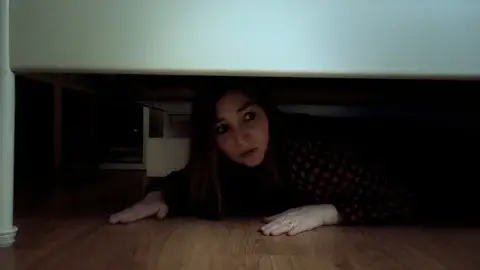
I went into my bedroom and crawled under the bed, pulling the bedspread down to create a dark, enclosed space. The hardwood floor was cold against my cheek, and dust bunnies tickled my nose. I checked my phone: 11:47 AM.
Time moved like cold honey. My legs cramped from staying in one position. My mind started playing tricks on me, turning the building’s normal sounds into footsteps and voices. Twice I almost crawled out, convinced this was all elaborate paranoia.
Then, at exactly 12:23 PM, I heard my front door open.
The sound of my key turning in my lock was unmistakable—I’d heard it thousands of times. But I was under my bed, and my keys were in my purse beside me.
Footsteps moved down the hallway. Not hurried or furtive like a burglar might move, but casual and confident. Like someone who belonged here.
The footsteps came into my bedroom.
I held my breath, my heart pounding so loudly I was sure whoever it was could hear it.
Then I heard a man’s voice, low and irritated: “You’ve made a mess again, Jessica.”
The voice was familiar in a way that made my skin crawl. I knew that voice, but I couldn’t immediately place it.
I heard him moving around the room, opening my dresser drawers.
“How hard is it to put your clothes away properly?” the voice continued. “This is why renters can’t have nice things.”
Renters.
My blood turned to ice water.
Mr. Dalton. My landlord.
I heard him walk into the kitchen, opening cabinets and the refrigerator.
“At least she bought decent coffee this time,” he muttered.
The casual way he moved through my space, the proprietary tone in his voice when he talked about my belongings—it was clear this wasn’t his first visit. This was a routine.
I lay under my bed, paralyzed with a mixture of terror and rage. My landlord had been coming into my apartment every day. Walking through my bedroom while I slept in it at night. Using my kitchen, my bathroom, commenting on my housekeeping like he was grading a hotel room.
I heard the TV turn on in the living room, heard him settle into my couch with what sounded like a bag of my chips.
“Can’t even keep the place dusted,” he said to no one. “No respect for property.”
For the next hour, I listened to him make himself at home in my space. He used my bathroom. He made coffee with my coffee maker. He watched my Netflix account, complaining about my watch history.
“Romantic comedies,” he said with disgust. “Typical.”
At 1:30, I heard him get up, turn off the TV, and walk back toward the front door.
“See you tomorrow, Jessica,” he said cheerfully, like he was talking to an old friend.
The door closed. The lock clicked.
I waited another ten minutes before crawling out from under the bed, my entire body shaking.
I sat on my bedroom floor and stared at my phone, trying to figure out what to do. Call the police? Call a lawyer? Call my parents and tell them their daughter had been living with an invisible roommate for eight months?
First, I needed evidence.
I spent the rest of the afternoon setting up my laptop to record video, positioning it so it would capture anyone entering my living room. I also called a locksmith and made an appointment for the next morning, claiming I’d lost my keys.
That night, I didn’t sleep at all. I kept thinking about all the times I’d felt like someone had been in my apartment. The faint smell of cologne. The way my things sometimes seemed slightly out of place. The sense that someone had been watching me.
How long had this been going on? Had he been coming here since the day I moved in?
The locksmith arrived at eight AM and changed both my door locks and my deadbolt. It cost me three hundred dollars, but it felt like the best money I’d ever spent.
At work, I couldn’t concentrate on anything. I kept checking my phone, waiting for the notification that my laptop had started recording.
It came at 12:15 PM.
I watched the video live from my office computer, my hands clenched into fists as I saw Mr. Dalton walk into my living room like he owned the place. He was a tall man in his fifties, wearing khakis and a polo shirt, carrying what looked like a sandwich in a brown bag.
He sat on my couch and ate his lunch while watching my TV. He got up and examined my bookshelves, pulling out titles and shaking his head disapprovingly.
“Genre fiction,” he said with the same tone someone might use to say “sewage.”
He went into my kitchen and helped himself to a yogurt from my refrigerator, complaining about my grocery choices. He opened mail that had been sitting on my counter, reading through my credit card statement.
“Spending too much on coffee shops,” he observed. “Financial irresponsibility.”
But the worst part was when he went into my bedroom. He opened my dresser drawers and pawed through my clothes, holding up items and making comments about my style choices. He opened my jewelry box and examined each piece.
Then he lay down on my bed.
Just lay there on my sheets, hands behind his head, staring at the ceiling like he was thinking deep thoughts.
“Much better mattress than the old tenant had,” he said to himself.
I felt sick watching it. This man had been violating my privacy in the most intimate way possible, treating my home like his personal entertainment center and my belongings like his property.
At 1:45, he got up, straightened the bedspread, and headed for the door. But this time, instead of his usual cheerful goodbye, he stopped and looked around with a frown.
He tried the door handle several times, then pulled out a key ring and tried different keys.
“What the hell?” he muttered.
He spent five minutes trying to get his keys to work, getting increasingly agitated. Finally, he pulled out his phone and made a call.
“Yeah, it’s Richard Dalton. I need you to meet me at the Maple Street property this afternoon. Tenant seems to have changed the locks without permission. Yes, I know that’s a violation of the lease terms.”
I saved the video file and called the police.
Two officers met me at my apartment at four PM. I showed them the video, explained the situation, and handed over copies of all my documentation.
“This is pretty clear-cut breaking and entering,” Officer Martinez said. “The fact that he’s your landlord doesn’t give him the right to enter without notice or permission.”
“How long do you think this has been going on?” I asked.
Officer Chen looked at the timestamps on various video clips I’d managed to capture. “Based on what your neighbor told you, probably since you moved in. This looks like an established routine.”
They arrested Mr. Dalton at his office two hours later. According to the police report, he was genuinely baffled about why he was being charged with anything.
“It’s my property,” he kept saying. “I have keys. I was just checking to make sure everything was being maintained properly.”
The police found master keys to twelve different rental properties in his possession.
“Chances are you’re not his only victim,” Officer Martinez told me when she called with an update. “We’re interviewing other tenants.”
They were right. Over the next week, five other renters came forward with similar stories. Strange smells in their apartments. Items moved or missing. The feeling that someone had been there while they were away.
One woman, Sarah, had been so disturbed by the sensation that someone was watching her that she’d moved out after three months, forfeiting her security deposit.
Another tenant, Mike, had installed security cameras after expensive wine bottles kept disappearing from his collection. The footage showed Mr. Dalton sampling different bottles and taking some home.
“I kept telling myself I must have drunk them and forgotten,” Mike told the police. “This guy had me questioning my own sanity.”
Mr. Dalton was charged with multiple counts of breaking and entering, theft, and violation of privacy. His lawyer tried to argue that as the property owner, he had the right to inspect his rentals, but the district attorney pointed out that he’d never given proper notice and had been taking personal items.
The trial was a nightmare. Sitting in that courtroom, listening to the details of how he’d violated my privacy, felt like being invaded all over again. But I testified anyway, because I wanted other people to know this could happen to them.
“He treated my home like his personal playground,” I told the court. “He went through my mail, my clothes, my most personal belongings. He lay on my bed and ate my food and watched my TV like he was a guest I’d invited.”
Mr. Dalton was sentenced to two years in prison and five years of probation. He was also ordered to pay restitution to all his victims and surrender his property management licenses.
But the legal victory didn’t erase the violation. I moved out of that apartment two weeks after his arrest, even though it meant breaking my lease and losing my security deposit. I couldn’t sleep there anymore, couldn’t shower there without wondering what he’d done while I was away.
My new landlord, Mrs. Kim, thought I was paranoid when I insisted on changing the locks on my first day, installing additional security cameras, and requiring written notice for any inspections.
“Honey,” she said gently, “I understand you’ve had a bad experience. But most landlords are decent people who respect boundaries.”
I knew she was right, but I also knew that most tenants never imagine their landlord might have a key to their most private spaces and feel entitled to use it.
Six months later, I got a letter from the district attorney’s office. Mr. Dalton was being released early for good behavior, but he was required to stay away from all his former tenants.
I kept that letter in a folder with all the other documents from the case—police reports, court transcripts, photos of my apartment taken as evidence. I told myself it was for legal reasons, in case I needed them later.
But really, I kept them because sometimes I still had trouble believing it had actually happened. Sometimes I wondered if I’d imagined the whole thing, if I’d been as paranoid and crazy as I felt during those weeks of investigation.
The documents reminded me that my instincts had been right. That the feeling of being watched, the sense that someone else had been in my space, the subtle wrongness that I couldn’t quite name—all of it had been real.
I learned to trust those feelings. When something feels wrong, it usually is, even if you can’t immediately explain why.
I also learned that privacy is something you have to protect actively. It’s not enough to assume that other people will respect your boundaries—you have to enforce them.
Most importantly, I learned that home isn’t just about the physical space you inhabit. It’s about feeling safe and secure in that space, knowing that it’s truly yours, that you can be vulnerable there without being violated.
It took me a long time to feel at home anywhere again. But eventually, I did. And when I finally found that feeling again—the deep peace of being in your own space, surrounded by your own things, with your own key in your own lock—I protected it fiercely.
Because home is supposed to be the one place in the world where you can let your guard down. Where you can trust that you’re safe, that you’re alone when you want to be alone, that your privacy is respected.
Everyone deserves that sanctuary. And anyone who violates it deserves exactly what Mr. Dalton got—to lose the privilege of being trusted with other people’s safety.
The voices Mrs. Rodriguez heard weren’t ghosts or imagination.
They were worse. They were the sound of someone who thought he owned not just my apartment, but me.
He was wrong about both.

Adrian Hawthorne is a celebrated author and dedicated archivist who finds inspiration in the hidden stories of the past. Educated at Oxford, he now works at the National Archives, where preserving history fuels his evocative writing. Balancing archival precision with creative storytelling, Adrian founded the Hawthorne Institute of Literary Arts to mentor emerging writers and honor the timeless art of narrative.