THE GOLDEN FACADE
The phone call came on a Tuesday afternoon in early December, while I was folding laundry in our small bedroom and listening to Marcus work in his shop below. The rhythmic sound of his hand plane shaving wood had become the soundtrack of our life together—steady, methodical, purposeful. It was a sound my mother had once described as “quaint,” which was her particular way of saying “beneath us.”
“Sienna, darling, I have the most wonderful news!” My mother’s voice carried that particular brightness she reserved for announcements about my sister’s life. “Derek and Vivien just closed on the most stunning brownstone in Brooklyn. Four stories, original details, a garden—can you imagine? Derek’s year-end bonus made it possible. That man just keeps climbing.”
I pressed the phone between my shoulder and ear, continuing to fold one of Marcus’s work shirts—soft flannel, worn at the elbows, smelling faintly of sawdust and lemon oil.
“That’s great, Mom. I’m happy for them.”
The pause that followed was weighted, familiar. I’d learned to recognize these pauses over the years—the breath before the cut, the moment my mother took to sharpen her disappointment into something that sounded like concern.
“I just wish you’d aimed a little higher, sweetheart. Don’t misunderstand me—Marcus is a nice man. But nice doesn’t pay for retirement, does it? Nice doesn’t build security.”
I looked out the window at our backyard, where Marcus had built a pergola last summer, each joint fitted so precisely that it would stand for generations. Nice, I thought, didn’t begin to cover what Marcus was.
“We’re doing fine, Mom.”
“Fine.” She repeated the word like it tasted bitter. “Well, fine is relative, I suppose. Anyway, we’re expecting you both for Christmas Eve, usual time. Your father is already planning his questions for Derek about the new house. He does so enjoy their conversations about investments and market trends. It gives him someone to talk to on his level.”
The implication hung in the air like smoke. Marcus, with his high school education and his woodworking shop, was not on my father’s level. Would never be on my father’s level. Should never have been allowed near their family’s carefully cultivated tree of achievement.
“We’ll be there,” I said quietly, and after a few more pleasantries that felt like small cuts, I hung up.
My name is Sienna Hudson. I’m thirty-two years old, and I’d spent eight years watching my parents worship my sister’s husband while treating mine like a charity case who’d wandered into the wrong tax bracket.
The Foundation of Judgment
It hadn’t always been quite this bad. In the beginning, my parents had at least tried to be welcoming to Marcus, even if their warmth had the quality of people being polite to someone from a different culture—interested but fundamentally certain of their own superiority.
I’d met Marcus nine years ago at a gallery opening in the city. I’d been there for work—I managed marketing for a small publishing house—and he’d been there because one of his pieces was on display. A chair. Just a simple wooden chair, but crafted with such precision and artistry that it looked like it had grown rather than been built. I’d stood in front of it for ten minutes, running my hand over the armrest, marveling at how something so functional could be so beautiful.
“It’s walnut,” a voice had said behind me. “Took about four months from rough lumber to what you’re seeing.”
I’d turned to find a man in his late twenties, tall and lean, with sawdust still caught in his dark hair and calluses visible on his hands. He’d looked nothing like the men I usually dated—the ambitious professionals my mother approved of, the ones who talked about their careers like they were climbing Everest and expected applause for every base camp reached.
Marcus had talked about wood grain like it was poetry. About the patience required to work with natural materials, about respecting what the wood wanted to become rather than forcing it into something it wasn’t. He’d been passionate without being performative, knowledgeable without being arrogant, completely comfortable with silence when words weren’t needed.
I’d fallen in love somewhere between him explaining the difference between quarter-sawn and flat-sawn lumber and him laughing at himself for “talking your ear off about tree corpses.”
My parents had been less enchanted.
The first time I’d brought Marcus home for Thanksgiving, he’d carried in a rocking chair he’d spent months crafting—a gift for my mother, made from walnut with delicate spindles and a seat shaped to cradle the body perfectly. The joinery was invisible. The finish glowed. It was a piece that belonged in a museum, offered with genuine generosity to a woman he barely knew.
My mother had smiled, run her hand over it once, and called it “rustic.”
Then she’d turned immediately to Derek, my sister Vivien’s boyfriend at the time, and asked him to continue his story about arguing a case before the state supreme court. Derek had obliged, speaking with the practiced cadence of someone used to holding a room’s attention, while the rocking chair sat ignored in the corner and Marcus grew quieter beside me.
That had set the pattern for every family gathering that followed.
Derek had graduated from Harvard Law. Marcus had a high school diploma and an apprenticeship with a master craftsman who’d taught him a dying art.
Derek worked at Brennan, Chase & Associates, one of the city’s most prestigious firms, and was on the partner track. Marcus owned a small woodworking shop where he took custom commissions and taught weekend classes to hobbyists and serious students alike.
Derek wore tailored suits and Italian shoes. Marcus wore flannel shirts and work boots with soles worn smooth from standing at his bench.
Derek talked about cases, clients, billable hours, and the intricate politics of his firm. Marcus talked about wood and tools and the satisfaction of making something that would outlast him.
And my parents had decided, based on these surface comparisons, that Derek represented success while Marcus represented settling.
The Slow Erosion
The comparisons were never overt or cruel—at least not in a way that would allow me to call them out without seeming defensive or overly sensitive. They came in questions, in tones, in the allocation of attention and interest.
My father would ask Derek detailed questions about his work, leaning forward with genuine engagement, occasionally jotting notes about investment strategies or legal precedents Derek mentioned. Then he’d turn to Marcus and ask vague pleasantries—”Keeping busy?” “Business okay?”—with the same energy someone might ask a child about their day at school.
My mother would praise Derek constantly. His new car, his promotion, his insights on politics or culture, the way he treated Vivien, his taste in wine. “Derek was just saying…” became a phrase she used to introduce wisdom, as if Derek’s Harvard education had granted him special access to truth. Meanwhile, she’d smile at Marcus with a kind of indulgent patience, the way you might smile at someone’s harmless but slightly embarrassing hobby.
Vivien, my younger sister by three years, had absorbed this hierarchy without question. She’d beam when our parents praised Derek, occasionally throwing me sympathetic looks as if to say, “Sorry you didn’t do as well, but it’s not too late to upgrade.” She’d never been cruel about it—Vivien wasn’t cruel by nature—but she’d accepted the family narrative that she’d won the husband lottery while I’d settled for the consolation prize.
And Marcus, patient Marcus, had absorbed it all without complaint. He’d answer my father’s dismissive questions politely. He’d listen to Derek’s stories without competing. He’d help clean up after meals while Derek relaxed with my father over scotch. He’d carry in his handmade gifts—a jewelry box for my mother, a bookshelf for my father, a cradle when Vivien got pregnant—and watch them be appreciated briefly before the conversation returned to Derek’s latest achievement.
Each holiday, he spoke less. Each drive home, the silence between us grew heavier with things we weren’t saying.
I’d told myself I was keeping the peace. That family was important. That Marcus was strong enough to handle it, that he understood my parents’ generation had different values, that it didn’t really matter what they thought as long as we were happy.
But the truth, which I’d been avoiding for years, was that I’d been choosing my own comfort over my husband’s dignity. I’d been allowing my family to diminish him because confronting them would be awkward and uncomfortable and would disrupt the pleasant fiction that we were all one big happy family.
I’d been a coward, and Marcus had been paying the price.
The Breaking Point
Two weeks before Christmas, my mother’s comment about “aiming higher” finally crystallized something inside me that had been forming for years. I stood in our kitchen after hanging up the phone, looking out at Marcus in his shop, and felt a wave of shame so intense it was physically painful.
This man had never asked me to defend him. Never complained about my family’s treatment. Never suggested we skip holidays or reduce contact. He’d simply absorbed their judgment with quiet grace, the same way he absorbed splinters and sore muscles and the inevitable failures that came with learning a craft—as part of the cost of making something worthwhile.
But I’d seen the way he’d started to shrink around my family. The way his shoulders curved inward when my father asked about “business.” The way he’d stopped bringing up his work unless directly asked. The way he’d developed this habit of standing slightly behind me at family gatherings, as if making himself smaller might make their judgment less painful.
I’d done that to him. Not my parents—me. By staying silent, by prioritizing superficial peace over his worth, by treating their contempt as something to be managed rather than confronted.
That evening, after dinner, I found Marcus in the shop putting the final touches on a jewelry box he was making for my mother’s Christmas gift. It was made from birds-eye maple with ebony inlays, the corners joined with perfect dovetails, the lid fitted so precisely that closing it created a gentle whoosh of displaced air. It was exquisite. It was a work of art. And my mother would probably glance at it, call it “lovely,” and return immediately to asking Derek about his cases.
“We don’t have to go to Christmas,” I said suddenly.
Marcus looked up, surprised. “What?”
“To my parents’ house. We could skip it this year. Or go somewhere else. Just us.”
He set down the piece he was sanding, studying my face. “Sienna, it’s fine. It’s just one day.”
“It’s not fine. The way they treat you—the way they’ve always treated you—it’s not fine, and I’ve been letting it happen because it was easier than confronting them. But I’m done. I’m done watching them compare you to Derek like Derek’s resume makes him a better man. I’m done listening to my mother’s little digs about your work. I’m done watching my father dismiss you.”
“They don’t dismiss me,” Marcus said quietly, but his eyes told a different story.
“They absolutely do. And I’ve let them. I’ve enabled it. I’ve prioritized my relationship with them over my relationship with you, and that ends now.”
Marcus crossed the workshop and took my hands in his—rough, calloused, capable hands that had built most of the furniture in our home. “I don’t need them to see my value. I know what I do matters. I know what we have matters. Their opinion doesn’t change that.”
“But it hurts you anyway. I can see it, Marcus. Every holiday, you come back a little more quiet, a little more withdrawn. And I’ve been telling myself it doesn’t matter, but it does. It matters because you matter. And I should have been standing up for you all along.”
He pulled me into his arms, and I felt the steady beating of his heart against my cheek. “So what do you want to do?”
“I want to go to Christmas. But I want to be different this time. I want to stop smoothing things over and staying quiet. If they make comparisons or dismissive comments, I’m going to call them out. Politely, clearly, but I’m going to call them out. No more pretending it’s fine.”
“That’s going to make things uncomfortable.”
“Good. Maybe uncomfortable is what we need. Maybe we’ve all been too comfortable with a dynamic that’s fundamentally disrespectful.”
Marcus pulled back to look at me, and there was something in his expression I hadn’t seen in a while around my family—a kind of relaxed confidence, like he could finally exhale. “Okay. Let’s do it.”
Christmas Eve
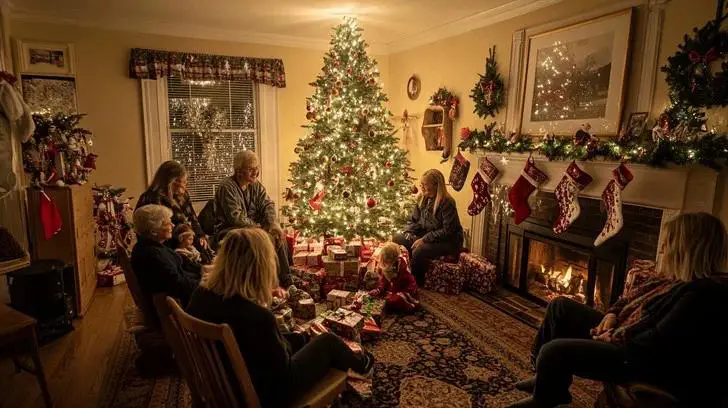
My parents’ house was exactly as I expected—perfectly decorated with tasteful wreaths, white lights, and a real tree that had probably cost more than most people’s monthly rent. The smell of roasted turkey and cinnamon filled the air. Classical music played softly in the background. Everything was designed to project success, stability, tradition.
Derek and Vivien were already there when we arrived, Derek holding court in the living room with my father while Vivien helped my mother in the kitchen. Derek wore a navy cashmere sweater and designer jeans that probably cost more than Marcus’s entire wardrobe. He stood when we entered, all practiced charm and firm handshake.
“Marcus! Good to see you, man. How’s the, uh, the woodworking going?”
The slight pause before “woodworking,” the way he said it like someone might say “hobby” or “pastime”—it was subtle, but it was there. A small dismissal wrapped in friendly interest.
Marcus, to his credit, answered with genuine warmth. “Really well, actually. Just finished a commission for a client in Boston—a dining table in white oak, seats twelve. One of the most challenging pieces I’ve done, but it came out beautifully.”
“That’s great,” Derek said, already turning back to my father to continue whatever conversation we’d interrupted. “Anyway, Dad, as I was saying about the commercial real estate market…”
I watched Marcus’s expression shift—not hurt, exactly, but a kind of resigned acceptance. This was the pattern. This was what always happened.
Not this time.
“Actually, Derek,” I said clearly, “I’d love to hear more about Marcus’s table. Marcus, you were saying the joinery was particularly complex?”
Marcus looked at me, surprised, then launched into a detailed explanation of the mortise-and-tenon joints he’d used, the way he’d matched the grain across the breadboard ends, the finish he’d developed to highlight the wood’s natural cathedral patterns. He spoke with passion and precision, describing craftsmanship that required years of study and practice to master.
My father and Derek listened with polite expressions that barely masked their boredom. My mother appeared from the kitchen, assessed the situation, and smoothly redirected.
“That sounds lovely, dear. Marcus, you’re so talented with your hands.” The compliment had a pat-on-the-head quality. “Now, Derek, tell everyone about the house! Vivien showed me photos—it’s absolutely stunning.”
And there it was. The pivot. The redirection away from Marcus’s work toward Derek’s achievement.
Before, I would have let it go. Let the conversation flow where my mother steered it, let Marcus be sidelined, kept the peace.
Not anymore.
“Mom, Marcus wasn’t finished talking. And I’d actually prefer to hear about his table than about real estate right now.” I said it pleasantly but firmly, the way you might correct a minor breach of etiquette.
The room went very still. My mother’s smile held, but I could see the confusion behind it—this wasn’t how I usually behaved. I was supposed to be the accommodating one, the peacekeeper, the daughter who didn’t make waves.
“Of course, sweetheart. I didn’t mean to interrupt.” But her tone suggested I was being unnecessarily difficult.
Derek laughed, trying to lighten the moment. “No worries, there’s plenty of time to talk about everyone’s stuff. It’s Christmas—we’re all family here.”
We moved into the dining room for dinner, and I noticed immediately that the seating arrangement had placed Derek at my father’s right hand—the position of honor—while Marcus was relegated to the far end of the table, next to my mother’s friend Carol who’d been invited to “round out the numbers.”
Another small slight. Another subtle communication about who mattered and who didn’t.
Before we sat down, I quietly rearranged the place cards, putting Marcus next to my father and moving Carol to the end. My mother noticed, opened her mouth to object, then thought better of it when she saw my expression.
Dinner proceeded with the usual rhythm of my family gatherings—my father and Derek discussing politics and economics, my mother and Vivien talking about decorating and social obligations, Carol asking polite questions that no one really answered. But every time the conversation threatened to become the Derek and Dad Show, I found ways to redirect, to include Marcus, to give his voice equal weight.
“What do you think about that, Marcus?”
“Marcus was just reading an interesting article about sustainable forestry—”
“Actually, Marcus has a really insightful perspective on that—”
It wasn’t aggressive. It wasn’t confrontational. But it was deliberate, and everyone noticed.
Derek started looking slightly uncomfortable, as if he sensed the usual dynamic shifting in ways he didn’t understand. My mother developed a small line between her eyebrows that appeared whenever things weren’t going according to her plan. My father kept shooting me confused glances, clearly wondering what had gotten into his usually compliant eldest daughter.
But Vivien—Vivien was watching me with an expression I couldn’t quite read. Not annoyance, exactly. Something more like curiosity, or maybe recognition, as if she was seeing something she hadn’t noticed before.
The Gift
After dinner, we moved to the living room for the gift exchange. This was always my mother’s favorite part—the chance to display thoughtfulness and taste, to exclaim over presents, to create Instagram-worthy moments of family togetherness.
Marcus had brought the jewelry box he’d spent weeks perfecting. He handed it to my mother with genuine pleasure, explaining that he’d chosen birds-eye maple because the grain pattern reminded him of something she’d once said about loving unexpected beauty in simple things.
My mother opened it, and even she couldn’t hide her immediate reaction. The box was objectively stunning—the kind of piece you’d find in a high-end gallery, not a homemade gift. The wood glowed in the lamplight. The inlays created a geometric pattern that was both modern and timeless. The interior was lined with felt that Marcus had hand-dyed to match my mother’s favorite shade of blue.
“Oh,” she said, and for a moment, her carefully maintained composure slipped. “Marcus, this is… this is really beautiful.”
Then, almost immediately, she recovered. The wall came back up. The dismissive tone returned.
“It’s so cute. You’re so clever with your little projects.”
Little projects. As if the jewelry box wasn’t worth more in skill and artistry than anything money could buy in a store. As if months of work and mastery and care could be reduced to a hobby, a cute pastime, something less than real work.
I felt something inside me finally snap.
“Mom, stop.”
Everyone turned to look at me.
“Stop what, dear?” My mother’s voice was carefully pleasant, but her eyes were wary.
“Stop diminishing what Marcus does. That’s not a ‘little project.’ That’s a piece of functional art that required years of training and months of work to create. The joinery alone takes a level of precision that most people couldn’t achieve with a lifetime of practice. You’re holding something that will outlast all of us, something beautiful and meaningful that Marcus made specifically for you, and you’re calling it ‘cute’ like it’s a child’s craft project.”
The silence that followed was absolute. My mother’s face had gone pale, then flushed. My father looked like he’d been slapped. Derek’s practiced smile was frozen in place.
“Sienna, I didn’t mean—”
“Yes, you did. You meant exactly what you said. You meant to diminish it, to diminish him, the same way you have at every single family gathering for eight years.” I wasn’t yelling. My voice was calm, clear, impossible to laugh off or dismiss. “You’ve spent nearly a decade making Marcus feel like he’s less than Derek because his work doesn’t come with a prestigious title or a six-figure salary. You’ve compared them constantly, always with Derek as the standard of success and Marcus as the cautionary tale of what happens when you don’t ‘aim higher.'”
“That’s not fair—” my mother started.
“It’s completely fair. You asked me two weeks ago why I didn’t aim higher, as if the man I married—the man who treats me with respect and kindness, who works with integrity and passion, who creates beauty with his hands—as if he’s somehow beneath us because he didn’t go to an Ivy League school.”
My father found his voice. “Sienna, we’ve always been perfectly pleasant to Marcus—”
“Pleasant isn’t respect, Dad. You’ve been polite while making it abundantly clear that you consider him inferior. You ask Derek detailed questions about his work and Marcus vague pleasantries. You frame Derek’s salary as success and Marcus’s craftsmanship as a nice hobby. You’ve created a hierarchy in this family where the only thing that matters is prestige and money, and anyone who doesn’t fit that mold is treated like they’re less than.”
Vivien had gone very still. Derek’s jaw was tight.
“I’m not asking you to become different people,” I continued. “But I am telling you that I won’t participate in this anymore. Marcus is my husband. He’s brilliant at what he does. He’s kind, ethical, talented, and worthy of respect. And if you can’t treat him with the basic dignity he deserves, then we won’t be coming to family gatherings anymore. It’s that simple.”
The room was silent except for the soft classical music still playing in the background—some Christmas concerto that suddenly felt absurd, a soundtrack to a performance that had finally been called out.
My mother opened her mouth, closed it, opened it again. “I never realized… I didn’t think we were…”
“I know you didn’t. That’s part of the problem. It’s been so casual, so constant, that you don’t even see it anymore. But Marcus sees it. I see it. And it stops now.”
The Crack in the Facade
Vivien stood up suddenly, her chair scraping against the hardwood floor. “I need some air.”
She moved toward the French doors that led to the back patio, and as she passed under the bright kitchen lights, I saw it—a dark bruise on her wrist, partially hidden by her sleeve but visible for just a moment. A bruise that hadn’t been there at Thanksgiving.
She must have realized I’d seen it because her hand immediately moved to cover it, tugging the sleeve down. Our eyes met for a fraction of a second, and what I saw in her expression made my stomach drop. Fear. Shame. And underneath it, a desperate plea not to say anything.
“Vivien, wait—” Derek stood quickly, reaching for her arm—the same arm with the bruise. She flinched, actually flinched away from his touch, and something passed across her face that I’d never seen before in all the years she’d been with him. Something broken and scared.
“I’m fine,” she said, too quickly, too brightly. “Just need some fresh air. Too much wine.”
She fumbled with the door handle, and her phone slipped from her pocket, clattering onto the floor. Derek moved like a snake striking—fast, smooth, practiced—and scooped it up before she could reach it. The motion was so automatic, so reflexive, that it was clear this wasn’t the first time. This was a pattern, a habit, a routine he didn’t even have to think about.
“Got it, babe,” he said, his voice warm but his hand tight around the phone. “I’ll hold onto it for you. You’re a little tipsy—wouldn’t want you dropping it.”
Vivien’s expression shuttered completely. “Thanks.”
She went outside, and for a moment, no one moved. My mother looked confused. My father frowned. Derek smiled his practiced smile, but there was something brittle in it now, something that didn’t quite reach his eyes.
Marcus, who’d been silent through my entire speech, was watching Derek with an expression I’d never seen before—not angry, exactly, but intensely focused. Observant. Like he was seeing something he recognized, something that set off alarm bells.
“I should check on her,” I said, standing.
“She’s fine,” Derek said quickly. “She just needs a minute. You know Vivien—she gets overwhelmed at family things sometimes.”
I ignored him and walked toward the French doors. Behind me, I heard my father say something to Derek about the Knicks, trying to restore normalcy, to smooth over the tension I’d created.
Let him try. Some things shouldn’t be smoothed over.
Outside in the Cold
Vivien was standing by the garden wall, hugging herself against the December cold, staring at nothing. I approached slowly, giving her space to run if she wanted to.
“Viv?”
She didn’t turn around. “You should go back inside.”
“Not until you tell me about that bruise.”
Her shoulders tensed. “I don’t know what you’re talking about.”
“Yes, you do.” I moved to stand beside her, not looking at her directly, giving her room to breathe. “On your wrist. I saw it when you walked past.”
Silence. Then, barely audible: “I fell.”
“Vivien.”
“I did. I’m clumsy. You know how I am.”
“You’re one of the most coordinated people I know. You did ballet for fifteen years. Try again.”
More silence. I could see her trying to decide—the calculation playing across her face, weighing the cost of honesty against the cost of continuing the lie.
“It’s not what you think,” she finally said.
“What do I think?”
“That Derek did something. But it’s more complicated than that. He’s under so much stress at work, and sometimes I push his buttons when I shouldn’t, and—”
“Stop.” I turned to face her fully now. “Listen to yourself. You’re making excuses for him hurting you.”
“He doesn’t hurt me. Not really. It’s not like—it’s not constant or anything. It’s just sometimes, when he’s had a bad day or when I’m being difficult—”
“Vivien, there is no amount of ‘difficult’ that justifies someone putting their hands on you. There is no level of stress that makes it okay. You know this. You’re a smart woman. Why are you making excuses for him?”
Tears were streaming down her face now. “Because if I don’t, then I have to admit that I made a mistake. That the perfect man Mom and Dad are so proud of, the man everyone compares all other men to, the man I’ve been defending and bragging about for eight years—that he’s not who everyone thinks he is.”
The truth of it hung in the cold air between us, brutal and undeniable.
“How long?” I asked quietly.
“About two years. It started small—grabbing my arm too hard when he was upset, raising his voice, punching walls. Then it escalated. Nothing that would show, nothing I couldn’t explain away. He’s very careful about that.”
“Vivien, you need to leave him.”
She laughed, a broken sound. “And go where? And tell everyone what? That I was wrong about him? That the marriage everyone envies is actually a nightmare? That I’ve been lying to all of you for two years?”
“Yes. Exactly that. Because the alternative is staying with someone who hurts you, and that’s not sustainable. It’s not safe.”
“But Mom and Dad—”
“Will support you. Will help you. Will feel terrible that they’ve been praising someone who’s been abusing their daughter.” I paused. “And if they don’t, if they care more about appearances than your safety, then that tells you something important about them too.”
Before Vivien could respond, the French doors opened and Derek stepped out, his expression concerned and solicitous, every inch the devoted husband worried about his wife.
“Everything okay out here? Vivien, you’re shivering—you should come inside.”
There was something in his voice—a warmth that didn’t match his eyes, a care that felt performed rather than genuine. And underneath it, barely perceptible, was something harder. A warning, maybe, or a reminder.
“I’m fine,” Vivien said automatically, and I watched her shrink slightly, the way Marcus used to shrink around my family. The same protective hunching, the same effort to make herself smaller, less threatening, less likely to provoke.
“We were just talking,” I said, keeping my voice light. “Sister stuff.”
Derek smiled, but it was tight around the edges. “Well, don’t freeze to death doing it. Come on, Viv. Your mom’s asking about dessert plans.”
He held out his hand to her—a gesture that looked affectionate but that I now recognized as controlling. Come now. When I say. How I want.
Vivien took his hand automatically, and they started walking back toward the house. But she looked back at me over her shoulder, and in that glance was everything she couldn’t say out loud: Help me. I don’t know how to do this alone. I’m scared.
I followed them inside, my mind already racing through options, resources, things I knew about domestic violence from friends who’d been through it, organizations that could help. But I needed more information. I needed to understand the full scope of what was happening.
The Unraveling
Back in the living room, Derek had positioned himself next to Vivien on the couch, his arm draped across the back in what looked like a casual, affectionate pose but that I now saw kept her subtly pinned in place. His body language said “devoted husband” while actually functioning as a cage.
My father was asking Derek about his holiday plans, and Derek was responding with his usual charm, describing a ski trip to Aspen he’d planned for New Year’s, talking about the private lodge he’d booked, the exclusive slopes they’d have access to.
“Vivien’s been so excited about it,” he said, squeezing her shoulder. “Haven’t you, babe?”
“Yes,” Vivien said quietly. “Very excited.”
But she didn’t look excited. She looked exhausted.
The conversation continued, my parents asking questions, Derek providing entertaining answers. But I noticed things I’d missed before, patterns that suddenly felt sinister with new context.
The way Derek answered questions that were directed at Vivien.
The way he touched her constantly—hand on her knee, arm around her shoulders, fingers playing with her hair—in ways that looked affectionate but never let her forget he was there, monitoring, controlling.
The way Vivien checked his expression before expressing any opinion, gauging his reaction, adjusting her response accordingly.
The way Derek’s charm had a brittle quality now, like he was working harder than usual to maintain it.
Marcus had noticed too. I could see it in the way he was watching Derek—not obviously, but with the same quiet attention he gave to a piece of wood before cutting it, assessing grain and flaws and hidden weaknesses.
“Derek,” Marcus said suddenly, his voice casual, “Vivien mentioned you’ve been working a lot of late nights lately. That’s got to be tough on both of you.”
It was an innocuous comment, the kind of sympathetic observation anyone might make. But I saw Derek’s jaw tighten fractionally before he responded.
“It comes with the territory at a firm like mine. Vivien understands. She knew what she was signing up for when she married a lawyer on the partner track.”
“Still,” Marcus continued, “it’s important to make time for each other. To make sure you’re both getting what you need from the relationship.”
There was something in the way Marcus said it—not accusatory, but pointed. Like he was sending a message, or testing something.
Derek’s smile became sharper. “We make plenty of time for each other. In fact, we probably spend more quality time together than most couples. I like to know where Vivien is, what she’s doing. It’s important to me that we’re connected.”
Connected. Or controlled.
“That’s… intense,” I said carefully. “Do you track each other’s locations or something?”
“We have each other’s passwords, access to each other’s phones and accounts. Complete transparency.” Derek said it like it was a virtue, a sign of trust and intimacy. “No secrets between us. Isn’t that right, Viv?”
Vivien nodded, not meeting anyone’s eyes.
“Wow,” I said. “Marcus and I don’t do that. We trust each other to have privacy.”
“Different strokes,” Derek said lightly, but there was an edge in his voice now. “I just think in a real partnership, you shouldn’t need privacy. What’s yours is mine, what’s mine is yours.”
“What’s yours is mine,” Marcus repeated thoughtfully. “That’s an interesting way to put it. Makes it sound kind of one-directional.”
The room had gone quiet. My parents were looking confused, sensing tension but not understanding its source. Vivien had gone very pale.
Derek’s phone started buzzing in his pocket. Once, then again, then again—multiple messages coming in rapid succession, the kind of urgent notification pattern that suggested something important or alarming was happening.
He pulled it out, glanced at the screen, and his entire expression changed. The charm dropped away completely, replaced by something cold and calculating. His thumb moved quickly across the screen, and I saw Vivien watch the motion with an expression that looked like fear.
“Everything okay?” my father asked.
“Fine,” Derek said shortly, standing up. “Work emergency. I need to make a call.”
He started toward the hallway, still holding his phone, but then stopped and looked back at Vivien. “Come with me for a second, babe. I need you to help me find something in the car.”
It wasn’t a request. It was a command disguised as a request.
Vivien stood automatically, moving toward him, and I saw her hand trembling. Whatever was happening, whatever those messages had said, Derek wanted to deal with it away from witnesses, away from people who might see him drop the mask.
“Actually,” my father said, and his voice had an edge I’d never heard before, “I think you should answer it here, Derek. We’re all family.”
Derek turned slowly, and the smile he gave my father was predatory. “This is a private work matter, Dad. Not appropriate for the dinner table.”
“Humor me,” my father said, and suddenly the retired banker who’d spent decades navigating corporate politics was present in the room—shrewd, observant, no longer willing to be charmed. “Answer it.”
For a long moment, Derek and my father stared at each other. The classical music had stopped. No one was moving.
Then Derek’s phone buzzed again, and Vivien made a small sound—not quite a gasp, but close.
“Derek,” she whispered, “those are from the girl at your firm, aren’t they? The associate you said was just a colleague?”
His head whipped toward her. “Vivien, not now—”
“How many others have there been?” Her voice was shaking but getting stronger. “How many women have you been texting while telling me I’m paranoid, that I’m imagining things, that I’m crazy for questioning you?”
“You are crazy,” Derek snapped, the mask slipping entirely now. “You’re unstable, you’re controlling, you go through my things—”
“Because you gaslight me!” Vivien’s voice broke. “
Because you hurt me and then tell me I’m remembering it wrong, that it was my fault, that I provoked you! Because you isolate me from everyone and then tell me it’s because you love me so much!”
The room erupted.
My mother stood, hand over her mouth, finally seeing what had been right in front of her. My father’s face had gone red with fury, his eyes fixed on Derek like he’d suddenly recognized a threat. Marcus had moved to stand beside me, solid and steady, his hand finding mine.
And Derek—golden, perfect, Harvard-educated Derek—stood in the center of it all as his carefully constructed facade finally shattered.
His phone wouldn’t stop buzzing. Message after message, probably from the other woman, probably explicit, probably damning.
“Let me see it,” my father said, his voice like iron.
“This is ridiculous—”
“Let. Me. See. It.”
Derek looked around the room—at my father’s fury, at my mother’s horror, at Vivien’s tears, at Marcus’s steady gaze, at me standing witness to his unmasking. He was calculating, trying to find an angle, a way to spin this, to regain control.
But there wasn’t one. Not anymore.
His hands were shaking as he unlocked his phone and handed it to my father. And as my father began scrolling through messages—his expression growing darker with each swipe—I put my arm around Vivien and felt her finally, finally let herself collapse against me.
“You’re safe now,” I whispered. “We’ve got you. You’re safe.”
Behind us, I heard my father say something to Derek in a voice so quiet and deadly that I couldn’t make out the words. I heard Derek try to respond, try to explain, try to charm his way out one more time.
But no one was listening to him anymore.
The golden son-in-law had fallen, and there was no coming back from this.
Three Months Later
Vivien filed for divorce in January. She moved back in with our parents while she got on her feet, and gradually the full story emerged—the emotional abuse that had started almost immediately after the wedding, the physical violence that had escalated over time, the financial control, the isolation, the constant surveillance disguised as devotion.
The messages my father had found on Derek’s phone had been from multiple women—colleagues, clients, even a law school friend of Vivien’s that Derek had pursued behind her back. He’d been cheating for years while simultaneously accusing Vivien of being untrustworthy, a classic abuser’s tactic to maintain control.
His firm, once they learned about the affairs with junior associates and clients, quietly asked him to resign. His reputation in legal circles, once impeccable, became toxic overnight. The brownstone in Brooklyn went on the market.
And my parents—my parents went through their own reckoning.
They apologized to Marcus, genuinely apologized, for years of dismissive treatment and implicit comparisons to a man who’d turned out to be a monster. My father, in particular, seemed shaken by how thoroughly he’d been fooled, how he’d valued the wrong things and missed what actually mattered.
“I thought success meant credentials and money,” he told Marcus one Sunday afternoon when we were all having dinner together—at our house this time, around the table Marcus had built. “I thought I was teaching my daughters to aim high. But I was teaching them to value appearance over substance. I’m sorry.”
Marcus, gracious as always, had accepted the apology and moved forward without holding grudges.
My mother had been more complicated. She’d been devastated by her failure to see what was happening to Vivien, wracked with guilt over praising a man who was hurting her daughter. But she was also genuinely trying to change, to examine her own values, to understand how she’d contributed to a culture that enabled abuse by celebrating charm over character.
She and Vivien started going to therapy together, working through layers of complicated family dynamics and internalized priorities. It was hard, messy work, but they were both committed to doing it.
As for Vivien, she was healing. Slowly, painfully, but genuinely. She was back in school getting her MBA, something she’d put on hold when Derek had convinced her his career should take priority. She was making friends, rebuilding her sense of self, learning to trust her own judgment again.
And she and I had grown closer than we’d ever been. The shared experience of calling out family dysfunction, of standing up against the pressure to keep silent, had created a bond between us that felt unbreakable.
“Thank you,” she said to me one evening when we were sitting on my porch while Marcus worked in his shop. “For speaking up at Christmas. For not letting them keep diminishing Marcus. If you hadn’t done that, if you hadn’t shown me it was possible to push back against their expectations—I might still be with Derek. I might still be making excuses.”
“I should have done it years earlier,” I said. “I’m sorry I waited so long.”
“You did it when you could. That’s what matters.”
We sat in comfortable silence for a while, listening to the sound of Marcus’s hand plane creating long, curled shavings from a piece of cherry wood.
“He’s really talented, isn’t he?” Vivien said. “I never really paid attention before. I was so caught up in the narrative about Derek being successful that I didn’t see what was right in front of me. Marcus creates beauty. He makes things that will last for generations. What did Derek ever make besides misery?”
I smiled. “Better late than never.”
“Yeah. Better late than never.”
Inside the house, I could see my mother helping Marcus’s apprentice—a young woman named Jade who was learning the craft—set up his workbench for an upcoming class. My mother was asking questions, genuinely interested, taking notes about different types of wood and their properties.
She was trying. They were all trying.
It wasn’t perfect. Family rarely is. But it was honest now, built on truth instead of performance, on character instead of credentials.
And in our small house, surrounded by furniture Marcus had built and a garden he’d planted and a life we’d created together based on mutual respect and genuine partnership—I felt something I’d never quite felt in my parents’ perfect house with its perfect decorations and perfect facade.
I felt at home.
END.

Adrian Hawthorne is a celebrated author and dedicated archivist who finds inspiration in the hidden stories of the past. Educated at Oxford, he now works at the National Archives, where preserving history fuels his evocative writing. Balancing archival precision with creative storytelling, Adrian founded the Hawthorne Institute of Literary Arts to mentor emerging writers and honor the timeless art of narrative.