The words hung in the air like a death sentence, delivered with the casual cruelty of someone ordering coffee. My mother-in-law, Patricia, stood in her immaculate kitchen, her perfectly manicured nails drumming against the granite countertop, and spoke the words that would shatter what remained of my already fractured world.
“If you don’t give my son a boy this time, you and your girls can crawl back to your parents. I won’t have Derek trapped in a house full of females.”
I was thirty-three years old, five months pregnant with my fourth child, standing barefoot on the cold tile floor of a house that would never be mine, no matter how many years I lived there. My hand instinctively moved to my rounded belly, as if I could shield this unborn child from the poison that seemed to seep through every wall of this place.
Derek, my husband of nine years, sat at the kitchen table scrolling through his phone with the detached interest of someone watching a mildly entertaining television show. He didn’t look shocked by his mother’s ultimatum. He didn’t look uncomfortable. If anything, there was a slight smirk playing at the corners of his mouth, the same expression he wore when he’d successfully cornered me in an argument.
I turned off the stove where I’d been preparing dinner—their dinner, always their preferences, their schedules—and slowly turned to face my husband. My voice came out smaller than I wanted it to, already defeated before the battle had truly begun.
“You’re okay with that?”
Derek finally looked up from his phone, and the entertainment in his eyes made my stomach twist. He leaned back in his chair with an exaggerated casualness, crossing his arms over his chest like a king surveying his kingdom.
“So when are you leaving?” he asked, that smirk widening into something uglier.
My legs went weak. I gripped the edge of the counter to steady myself, feeling the baby shift inside me as if sensing the danger we were in. In that moment, standing in that kitchen with the smell of half-cooked vegetables in the air and my husband’s cruel smile burning into my memory, I understood something I’d been refusing to see for years: I had married a stranger. Or perhaps worse, I had married exactly who he’d always been, and I’d simply been too in love, too hopeful, too naive to recognize it.
“Seriously?” The word came out as barely a whisper. “You’re fine with your mom talking like our daughters aren’t enough?”
Derek shrugged with an indifference that cut deeper than any shout could have. “I’m thirty-five, Claire. I need a son.”
Something inside me didn’t just crack—it shattered completely. But in that shattering, in that moment of absolute devastation, a small seed of something else began to take root. Something that felt like anger. Like clarity. Like the first breath after being underwater too long.
This story didn’t begin in that kitchen, though. It began nine years earlier, when I was a hopeful twenty-four-year-old who believed love could conquer anything, including a mother-in-law who’d looked at me during our engagement party and said, with a smile that never reached her eyes, “Let’s hope you don’t ruin this family line, honey.”
I should have paid attention to that warning. I should have noticed how Derek laughed it off instead of defending me. I should have recognized the red flags that were practically forming a parade in front of me. But I was young and in love, and I believed that once we started our own family, once we had our own home, everything would be different.
We lived in our own apartment for the first few years. It was small, cramped, and the heater never worked quite right, but it was ours. When I got pregnant with our first child, I decorated a tiny nursery in what had been our storage closet, painting clouds on the ceiling and hanging delicate mobiles that caught the afternoon light. I imagined Derek’s face when he held our baby for the first time, imagined how parenthood would deepen our bond, make us a team against the world.
Mason was born on a Tuesday morning in April, arriving after fourteen hours of labor that left me exhausted and elated in equal measure. She was perfect—eight pounds, two ounces of pure miracle with Derek’s dark hair and my nose. I counted her fingers and toes, marveled at her tiny fingernails, fell completely and irrevocably in love with this person I’d only just met.
Patricia arrived at the hospital that afternoon, her heels clicking importantly down the corridor. She swept into the room, glanced at the pink blanket wrapped around my daughter, and sighed—actually sighed—before saying, “Well, next time.”
Not congratulations. Not “she’s beautiful.” Not even a acknowledgment that I’d just spent the better part of a day bringing her granddaughter into the world. Just a dismissive sigh and a clear message: this child, my precious daughter, was already a disappointment.
Derek shifted uncomfortably in the chair beside my bed, but he said nothing. He didn’t tell his mother to leave. He didn’t defend our daughter. He just gave me an apologetic shrug, as if his mother’s cruelty was simply one of those things we all had to tolerate, like bad weather or traffic jams.
I told myself it didn’t matter. I told myself that Patricia would fall in love with Mason once she got to know her, once she held her and looked into those beautiful dark eyes. I told myself a lot of lies in those early days.
When Mason was eight months old, I got pregnant again. Derek’s first response wasn’t excitement—it was “Maybe this time we’ll get a boy.” Not hope for a healthy baby. Not joy at expanding our family. Just the implication that our daughter, currently napping in the next room, wasn’t quite what we’d ordered.
Lily arrived two years after Mason, another perfect, healthy girl with blonde curls and a laugh that sounded like music. Patricia’s comment at the hospital: “Some women just aren’t built for sons. Maybe it’s your side.”
By the time I was pregnant with our third daughter, Harper, Patricia had stopped even pretending to be pleased. She’d pat the girls’ heads with the distant affection someone might show a neighbor’s pet and say things like “Three girls. Bless her heart,” in that particular Southern way that sounds sympathetic but means the opposite.
Derek had started making jokes. “Three strikes,” he’d say. “Good thing baseball gives you four chances.” Or “Maybe the fourth time’s the charm.” Always delivered with a laugh, always couched as humor, but the underlying message was clear: our daughters were failures, and so was I.
We moved in with Derek’s parents when Harper was six months old. Officially, it was to save money for a house. Derek sold it to me as a temporary arrangement, six months at most, just until we could afford a down payment on something in a good school district. We’d have our own space, he promised. We’d save so much money, he assured me. It would be good for the girls to spend more time with their grandparents, he insisted.
What he didn’t say was that he missed being the center of attention. He missed being Patricia’s golden boy, the only son, the heir to a family legacy that seemed to consist primarily of disappointment and impossible expectations. He missed having his mother cook his favorite meals and do his laundry and tell him how special he was.
Six months turned into a year. A year turned into two. Every time I brought up looking for our own place, Derek had an excuse. The market was bad. We didn’t have enough saved. The girls were settled here. His parents enjoyed having us. On and on, an endless loop of reasons why we needed to stay in a house where my daughters were treated like consolation prizes and I was viewed as a defective appliance that kept producing the wrong results.
The house itself was beautiful, I had to admit. A sprawling ranch-style home in a quiet suburb, with a manicured lawn and a three-car garage. Patricia kept it spotless, everything in its designated place, every surface gleaming. There were rules, of course. Shoes off at the door. No toys in the common areas. Dinner at six sharp. Everything had to be just so, and I was expected to enforce these rules with my daughters while simultaneously being reminded that none of this was mine.
My father-in-law, Michael, was the only person in that house who treated my daughters like they mattered. He was a quiet man, tall and broad-shouldered from years of construction work, with weathered hands and kind eyes that seemed to see more than he said. He worked long shifts, often leaving before dawn and returning after dark, but when he was home, he made time for the girls.
He’d get down on the floor and listen to Mason explain the complex social hierarchies of her third-grade classroom. He’d let Lily show him her latest drawings, praising each one as if it belonged in a museum. He’d carry Harper around on his shoulders, making her giggle with delight. He never once suggested they were somehow less valuable because they weren’t boys. He never once made me feel like I’d failed.
Sometimes I’d catch him watching Patricia and Derek interact with the girls, and I’d see something flicker across his face—disappointment, maybe, or regret. But Michael was a man of few words, and whatever he thought about the situation, he kept largely to himself. I wondered sometimes if he disagreed with his wife’s treatment of us, but if he did, he never said so. Not then, anyway.
When I got pregnant the fourth time, I knew before I even took the test. I recognized the exhaustion, the nausea, the way certain smells suddenly became unbearable. I sat on the bathroom floor at six in the morning, staring at the positive test, and instead of joy, I felt dread.
I knew what was coming. I knew Patricia would see this pregnancy as one last chance for me to “get it right.” I knew Derek would ramp up the pressure, would start making plans around an assumed boy, would treat this pregnancy like a business transaction with a very specific desired outcome.
I was right about all of it, but I underestimated just how bad it would get.
Patricia started referring to the baby as “the heir” when I was only six weeks along. She sent Derek links to articles about gender selection and old wives’ tales for conceiving boys, as if my previous three pregnancies had been some kind of controllable experiment where I’d simply chosen wrong. She’d look at me with thinly veiled contempt and say things like, “If you can’t give Derek what he needs, maybe you should move aside for a woman who can.”
Derek didn’t flinch at these comments. In fact, he seemed to take them as permission. At dinner, he’d joke, “Fourth time’s the charm. Don’t screw this one up, Claire.” When I objected, when I tried to explain that our daughters could hear these comments, that they were internalizing the message that they weren’t good enough, he’d roll his eyes and tell me I was being too emotional.
“This house is a hormone bomb,” he’d say, dismissing my concerns with a wave of his hand. “Relax. Mom just wants a grandson. Every man needs a son. That’s reality.”
“And what if this one’s a girl?” I asked him one night, alone in our room—though it wasn’t really our room, was it? It was a guest room in his parents’ house, filled with furniture Patricia had chosen, with walls I wasn’t allowed to paint.
He looked at me with cold certainty. “Then we’ve got a problem, don’t we?”
It felt like ice water in my veins. This was the man I’d married, the father of my children, and he was telling me that another daughter would be a problem. Not a blessing. Not a person. A problem to be solved.
The girls started to notice. Mason, my observant eight-year-old, began growing quieter around Patricia and Derek. I’d catch her watching her father with cautious eyes, as if trying to figure out what she’d done wrong, why she wasn’t enough. One night, she climbed into bed with me and whispered, “Mom, is Daddy mad we’re not boys?”
I pulled her close, feeling her small body against mine, and swallowed my own rage and heartbreak to reassure her. “Daddy loves you,” I said, though the words felt hollow even as I spoke them. “Being a girl is not something to be sorry for.”
But I could see she didn’t quite believe me. How could she, when every day she was surrounded by evidence to the contrary?
Patricia’s comments grew more pointed as my pregnancy progressed. She’d say things in front of the girls, loud enough for everyone to hear: “Girls are cute, but they don’t carry the name. Boys build the family.” She’d talk about how disappointed Derek must be, how hard it was for a man to not have a son, how some women just couldn’t deliver what their husbands needed.
I felt myself shrinking under the weight of it all. I stopped fighting back, stopped objecting, because every time I did, Derek would accuse me of causing drama or being oversensitive. I became smaller and smaller, trying to take up less space, trying to be less of a burden, trying desperately to hold together a family that was already broken beyond repair.
The ultimatum in the kitchen, when it finally came, felt almost like a relief. At least now the threat was spoken out loud. At least now I knew exactly where I stood.
After that day, Patricia and Derek didn’t even try to hide their intentions anymore. Patricia started leaving empty cardboard boxes in the hallway. “Just getting ready,” she’d say with a smile that was all teeth and no warmth. “No point waiting until the last minute.”
She’d walk into our room when Derek was there and say, loud enough for me to hear from the hallway, “When she’s gone, we’ll make this blue. A real boy’s room.”
If I cried—and I cried a lot during those weeks—Derek would sneer and say, “Maybe all that estrogen made you weak.” He’d laugh as if he’d made a clever joke, never mind that his pregnant wife was falling apart, never mind that his daughters were watching their mother be systematically broken down.
I started crying in the shower where no one could hear me. I’d sit on the tile floor, hot water streaming over me, and whisper apologies to my unborn baby. “I’m trying,” I’d say to my belly. “I’m sorry. I’m so sorry.”
Sorry for bringing them into this. Sorry for not being stronger. Sorry for not leaving sooner. Sorry for choosing a man who cared more about outdated ideas of legacy than about the actual human beings he’d helped create.
Then came the day that changed everything.
Michael had an early shift that morning. I heard his truck pull out of the driveway before the sun was fully up, the familiar rumble of the engine fading into the distance. By mid-morning, with Michael gone and just Patricia, Derek, and me in the house, the atmosphere felt different. Dangerous.
I was in the living room folding laundry—their laundry, always their laundry, because I was expected to earn my keep even while pregnant and caring for three children. The girls were on the floor playing with their dolls, their sweet voices creating imaginary worlds where everyone was kind and nobody got kicked out for being born the wrong gender.
Patricia walked in carrying black trash bags.
My stomach dropped before my brain fully processed what I was seeing. Some part of me, some instinct I didn’t know I had, recognized danger when it appeared in the form of a well-dressed woman carrying garbage bags with obvious purpose.
“What are you doing?” I asked, though I already knew. God help me, I already knew.
She smiled at me, and it was the cruelest smile I’d ever seen. “Helping you.”
She marched straight to our bedroom, and I followed on shaky legs, my pregnant belly making me slower than I wanted to be. She yanked open my dresser drawers and started grabbing my clothes—shirts, underwear, pajamas—and shoving them into the bags. No folding. No care. Just grabbing and stuffing like she was cleaning up garbage.
“Stop,” I said, my voice rising. “Those are my things. Stop.”
She didn’t even pause. “You won’t need them here.”
Then she moved to the girls’ closet. She pulled down their little jackets, their backpacks with cartoon characters on them, their favorite sweaters, and tossed everything on top of my clothes in a jumbled heap of rejection.
I grabbed one of the bags, trying to pull it away from her. “You can’t do this.”
She yanked it back with surprising strength. “Watch me.”
“Derek!” I called out, my voice cracking with desperation. “Come here! Now!”
He appeared in the doorway, phone still in his hand, and I thought—I actually thought—that seeing his mother packing up his wife and children’s belongings might shock him into some kind of action. That some remaining shred of the man I’d married might surface and put a stop to this insanity.
“Tell her to stop,” I said, tears already starting to stream down my face. “Right now.”
He looked at the bags. He looked at his mother. He looked at me.
“Why?” he said, his voice flat and disinterested. “You’re leaving anyway.”
It was like being punched in the chest. All the air left my lungs. My vision narrowed to just his face, that indifferent expression, those cold eyes that had once looked at me with something resembling love.
“We did not agree to this,” I managed to say.
He shrugged. “You knew the deal.”
Patricia grabbed my prenatal vitamins from the nightstand and dropped them into the bag like they were trash, like my health and the baby’s health meant absolutely nothing. I wanted to scream. I wanted to fight. But I was pregnant and exhausted and so completely broken that I could barely stand.
Mason appeared behind her father, her eight-year-old eyes huge with confusion and fear. “Mom?” she said in a small voice. “Why is Grandma taking our stuff?”
I tried to smile, tried to keep my voice steady. “Go wait in the living room, baby. It’s okay.”
But it wasn’t okay. Nothing about this was okay.
Patricia dragged the bags to the front door with me following helplessly behind. She flung the door open, letting in the cool morning air, and called out in a sing-song voice that made my skin crawl.
“Girls! Come tell Mommy goodbye! She’s going back to her parents!”
Lily, my sensitive five-year-old, started sobbing immediately. Harper, only three and not fully understanding what was happening, wrapped herself around my leg with desperate strength. Mason stood frozen, her jaw tight, trying so hard not to cry because she thought she needed to be brave.
I grabbed Derek’s arm one last time, all my pride gone, willing to beg if that’s what it took. “Please,” I whispered. “Look at them. Don’t do this.”
He leaned in close, so close I could smell his coffee breath, and hissed, “You should’ve thought about that before you kept failing.”
Then he straightened up and folded his arms across his chest, standing there like a judge watching a sentence being carried out, like a man who’d made his choice and was comfortable with it.
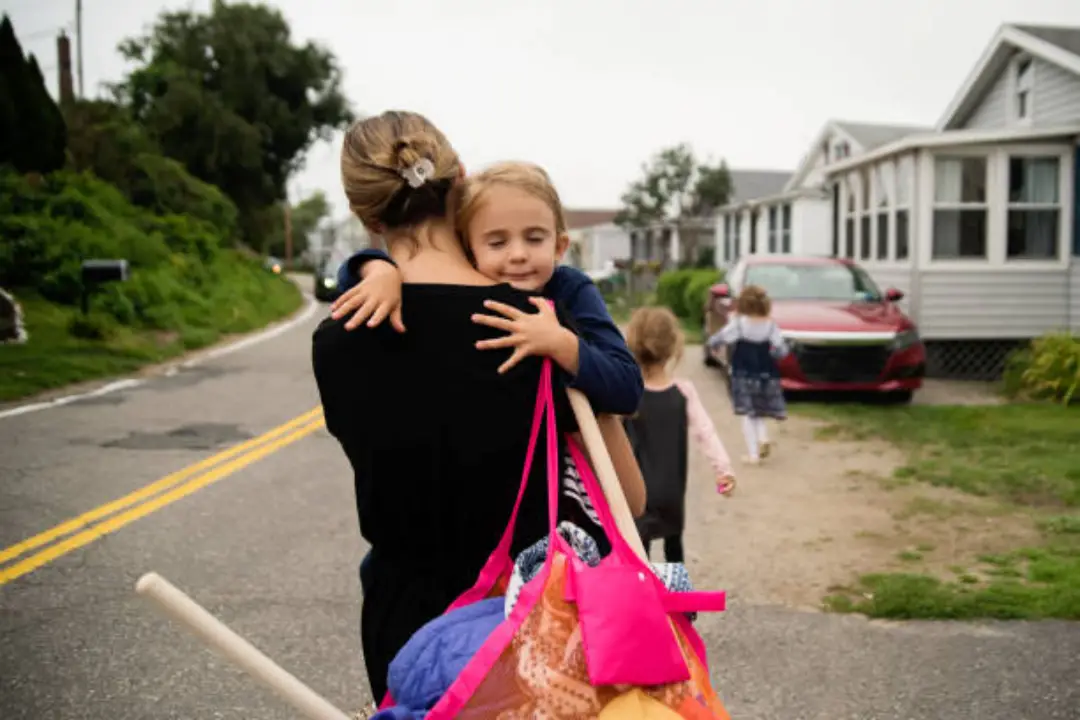
I grabbed my phone with shaking hands. I grabbed the diaper bag. I grabbed whatever jackets I could reach for the girls. Twenty minutes later—twenty minutes that felt like hours and seconds all at once—I stood barefoot on that porch with three little girls crying around me and our entire lives stuffed into trash bags like we were exactly what Patricia had always thought we were: garbage to be disposed of.
Patricia slammed the door. I heard the lock click into place.
Derek didn’t come out. Didn’t even look through the window.
I called my mother, barely able to speak through my tears. “Can we come stay with you? Please.”
She didn’t ask questions. She didn’t lecture. She just said, “Text me where you are. I’m on my way.”
We waited on that porch for forty-five minutes, though it felt like forever. The girls huddled against me, confused and scared. I rubbed my belly and whispered more apologies to the baby who was going to be born into this mess.
When my mom’s car pulled up, I’d never been so relieved to see anyone in my life. She got out, took one look at us, and her face hardened with a fury I rarely saw. But she didn’t say anything. She just helped load the girls and the trash bags into her car, buckled everyone in, and drove us to the home I’d grown up in.
That night, we slept on a mattress in my old childhood bedroom. My mom had pulled it out of storage and made it up with fresh sheets that smelled like lavender. The girls pressed against me on all sides, their small bodies seeking comfort I wasn’t sure I could provide. My belly felt like it might crack from the stress. I had cramps that terrified me, making me wonder if the baby was okay, if all this trauma was going to cost me even more.
I stared at the ceiling—the same ceiling I’d stared at as a teenager, dreaming about my future, imagining my perfect life—and whispered to my baby, “I’m sorry. I should’ve left sooner. I’m sorry I let them talk about you like you were a test.”
I had no plan. No apartment of my own. No lawyer. No money that wasn’t in a joint account Derek could freeze whenever he wanted. I just had three traumatized children, a fourth on the way, and a broken heart that felt like it might never heal.
The next afternoon, there was a knock on my parents’ door.
My dad was at work. My mom was in the kitchen making grilled cheese sandwiches for the girls, trying to restore some normalcy to their shattered world. I opened the door cautiously, half-afraid it would be Derek or Patricia coming to finish what they’d started.
It was Michael.
He wasn’t in his work uniform. He was wearing jeans and a flannel shirt, and he looked tired in a way that went beyond just needing sleep. He looked tired in his soul. And he looked furious.
“Hi,” I said, already bracing for whatever was coming.
His eyes moved past me, taking in the scene behind me—the trash bags still unpacked in the corner, the girls sitting quietly at the table, the defeated slump of my shoulders.
His jaw tightened. “Get in the car, sweetheart,” he said quietly. “We’re going to show Derek and Patricia what’s really coming for them.”
I took a step back, shaking my head. “I’m not going back there. I can’t.”
“You’re not going back to beg,” he said, and his voice was gentle but absolutely firm. “You’re coming with me. There’s a difference.”
My mom came up behind me, protective instinct kicking in. “If you’re here to drag her back to that house—”
“I’m not,” he cut her off. “They told me she ‘stormed out.’ Then I got home and saw four pairs of shoes missing and her vitamins in the trash. I’m not stupid.”
Something in his voice made me trust him. Or maybe I was just so broken that I was willing to grasp at any possibility of resolution. Either way, fifteen minutes later, we were loading the girls into his truck—two car seats, one booster, everyone buckled in carefully. I climbed into the front passenger seat, my heart pounding, one hand protectively on my belly.
We drove in silence for a while. The girls were quiet in the back, sensing the tension.
“What did they say?” I finally asked. “When you got home?”
His hands tightened on the steering wheel. “They said you ran home to your parents to sulk. Said you couldn’t handle ‘consequences.'”
I laughed, but it was a bitter sound with no humor in it. “Consequences for what? Having daughters?”
He shook his head slowly. “No. Consequences for them.”
When we pulled into the driveway of the house I’d been thrown out of less than twenty-four hours earlier, I felt sick. But Michael reached over and squeezed my hand once, briefly. “Stay behind me,” he said.
He opened the front door without knocking—it was his house, after all—and walked in with the confident stride of a man who owned the place. I followed with the girls clustering around my legs.
Patricia was at the kitchen table reading a magazine. Derek was on the couch playing video games, looking completely relaxed, like he hadn’t just destroyed his family the day before.
Patricia’s face twisted into a smug smile when she saw me. “Oh,” she said, her voice dripping with satisfaction. “You brought her back. Good. Maybe now she’s ready to behave.”
Michael didn’t look at her. His eyes were fixed on Derek. “Did you put my granddaughters and my pregnant daughter-in-law on the porch?” he asked, his voice calm but carrying an edge I’d never heard before.
Derek paused his game but didn’t turn around. “She left. Mom just helped her pack. She’s being dramatic.”
Michael stepped closer to his son. “That’s not what I asked.”
Derek finally turned, and I saw confusion flicker across his face. He wasn’t used to his father challenging him. “I’m done, Dad. She’s had four chances. I need a son. She can go back to her parents if she can’t do her job.”
“Her job,” Michael repeated slowly. “You mean giving you a boy.”
Patricia jumped in, clearly sensing that this wasn’t going the way she’d expected. “He deserves an heir, Michael. You always said—”
“I know what I said,” he cut her off, his voice sharp. “I was wrong.”
The room went completely silent. Even Derek’s video game music seemed to fade into the background.
Michael looked at my daughters, really looked at them. Mason, trying so hard to be brave. Lily, tears already streaming down her face. Harper, clutching her favorite stuffed animal like a lifeline. Then he looked back at Patricia and Derek.
“You threw them out,” he said, and every word was measured, deliberate. “Like trash.”
Patricia rolled her eyes in that dismissive way she had perfected over years of getting her way. “Stop being dramatic. They’re fine. She needed a lesson.”
Michael’s face went completely flat, emotionless in a way that was somehow more frightening than anger. “Pack your things, Patricia.”
She laughed, actually laughed. “What?”
“You heard me,” he said calmly. “You don’t throw my grandchildren out of this house and stay in it.”
Derek stood up, his confidence finally cracking. “Dad, you can’t be serious.”
Michael turned on his son, and I saw something I’d never seen before—disappointment so profound it seemed to fill the entire room. “I am,” he said. “You’ve got a choice. You grow up, get help, treat your wife and kids like human beings… or you leave with your mother. But you will not treat them like failures under my roof.”
“This is because she’s pregnant,” Derek said, his voice rising. “If that baby’s a boy, you’ll all look stupid.”
I found my voice then. It came from somewhere deep inside me, from that place where I’d stored all my anger and hurt and determination to protect my children. “If this baby’s a boy,” I said clearly, “he’ll grow up knowing his sisters are the reason I finally left a place that didn’t deserve any of us.”
Michael nodded once, a gesture of approval.
Patricia sputtered, her face turning red. “You’re choosing her over your own son?”
“No,” Michael said. “I’m choosing decency over cruelty.”
What followed was chaos. Patricia screaming that she’d done everything for Derek, that she’d sacrificed everything, that Michael was a traitor to his own family. Derek pacing, swearing, throwing things, demanding that Michael “be reasonable.” Both of them trying every manipulation tactic in the book to make Michael back down.
He didn’t.
While the yelling continued, Michael calmly walked to the kitchen and poured cereal for my girls. He set them up at the table with bowls and milk like nothing else was happening, like the entire world wasn’t exploding around us.
“Eat up, girls,” he said gently. “Everything’s going to be okay now.”
That night, Patricia left to stay with her sister, still insisting that Michael would “come to his senses.” Derek went with her, shooting me a look of pure hatred as he walked out the door.
Michael helped me load those trash bags back into his truck. But instead of taking us back into that house with all its painful memories, he drove us across town to a small apartment complex.
“I’ve been looking at places,” he said as we pulled into the parking lot. “Found this one yesterday. Two bedrooms. Safe neighborhood. Near a good elementary school.”
I stared at him, not understanding.
“I’ll cover the first few months,” he continued. “Security deposit, first and last month’s rent. After that, it’s yours. Not because you owe me. Because my grandkids deserve a door that doesn’t move on them. A place that’s really theirs.”
I started crying then, really crying, for the first time since this whole nightmare began. Not tears of sadness or fear, but of relief and gratitude and the overwhelming sensation of someone finally, finally being on my side.
“Thank you,” I whispered. “Thank you.”
He helped me set up the apartment over the next few days. He brought furniture from storage—a couch, beds, a kitchen table. He hung curtains. He assembled a crib for the baby who hadn’t arrived yet. He never made me feel like I owed him anything. He just showed up, day after day, and helped me build a new life.
I had the baby in that apartment four months later. It was a boy.
Everyone always asks about that. People say, “Did Derek come back when he found out?” Like the gender of my baby was some kind of vindication for him, some proof that he’d been right all along.
He sent one text: “Guess you finally got it right.”
I blocked his number.
Because by then, I’d figured something out. The win wasn’t having a boy. The win wasn’t proving anything to Derek or Patricia. The win was that all four of my children now lived in a home where no one threatened to kick them out for being born “wrong.” Where their value wasn’t determined by their gender. Where they could just be kids.
Michael visits every Sunday. He brings donuts—always remembering which kind each kid likes. He calls my daughters “my girls” with such warmth and pride. He calls my son “little man” with the same affection. No hierarchy. No heir talk. No favorite. Just equal love for all his grandchildren.
Sometimes, when I watch him on the floor playing with the kids, I think about that moment when he stood in his own house and chose us over the son he’d raised, over the wife he’d been married to for forty years. I think about the courage it took to admit he’d been wrong, to stand up against his own family’s toxic traditions.
I think about him showing up at my parents’ door and saying, “Get in the car, sweetheart. We’re going to show Derek and Patricia what’s really coming for them.”
They thought “what was coming” would be a grandson to carry on their precious family name. They thought it would be vindication for all their cruelty.
But what came for them was consequences. Real consequences for treating human beings as disposable. For teaching a son that his children’s worth was determined by their chromosomes. For creating such a toxic environment that a good man finally said “enough.”
I’m not going to pretend it’s been easy. Single motherhood never is. There are hard days when the kids are sick or bills are tight or I’m exhausted from working and parenting and trying to heal from years of emotional abuse.
But every night, I lock our door—our door, in our home—and I know that no one can throw us out. No one can pack our belongings into trash bags and leave us on a porch. No one can tell my daughters they’re disappointments or make my son think he’s more valuable than his sisters.
Derek eventually divorced me. He’s remarried now, I heard, to a woman ten years younger who’s apparently already pregnant. I wonder sometimes if he learned anything. I doubt it. But that’s not my problem anymore.
Patricia still doesn’t speak to Michael. She considers him a traitor. He considers the loss of that relationship a small price to pay for doing the right thing.
And me? I’m rebuilding. I’m in therapy. I’m rediscovering who I am outside of being someone’s disappointing wife. I’m teaching my daughters that their worth isn’t determined by anyone else’s expectations. I’m teaching my son that his sisters are just as important, just as valuable, just as worthy of respect as he is.
Sometimes, late at night when the kids are asleep, I sit in our little living room and remember that day in Patricia’s kitchen. I remember how small I felt, how defeated, how certain that I had no choices left.
And then I remember Michael’s words: “You’re not going back to beg. You’re coming with me. There’s a difference.”
There was a difference. Between begging and reclaiming. Between accepting cruelty and demanding decency. Between staying in a place that diminished me and walking toward a life where my children and I could finally breathe.
The moment that changed everything wasn’t when Patricia issued her ultimatum or when Derek asked when I was leaving. It wasn’t even when they threw me out.
It was when Michael chose us. When he looked at his own family’s dysfunction and said, “No more.”
When he proved that blood doesn’t always determine who shows up for you when everything falls apart.
That’s the story I’ll tell my kids someday, when they’re old enough to understand. Not that their grandfather saved us—though he did. But that sometimes the family that matters most isn’t the one you’re born into, but the one that chooses you when it counts.

Sophia Rivers is an experienced News Content Editor with a sharp eye for detail and a passion for delivering accurate and engaging news stories. At TheArchivists, she specializes in curating, editing, and presenting news content that informs and resonates with a global audience.
Sophia holds a degree in Journalism from the University of Toronto, where she developed her skills in news reporting, media ethics, and digital journalism. Her expertise lies in identifying key stories, crafting compelling narratives, and ensuring journalistic integrity in every piece she edits.
Known for her precision and dedication to the truth, Sophia thrives in the fast-paced world of news editing. At TheArchivists, she focuses on producing high-quality news content that keeps readers informed while maintaining a balanced and insightful perspective.
With a commitment to delivering impactful journalism, Sophia is passionate about bringing clarity to complex issues and amplifying voices that matter. Her work reflects her belief in the power of news to shape conversations and inspire change.