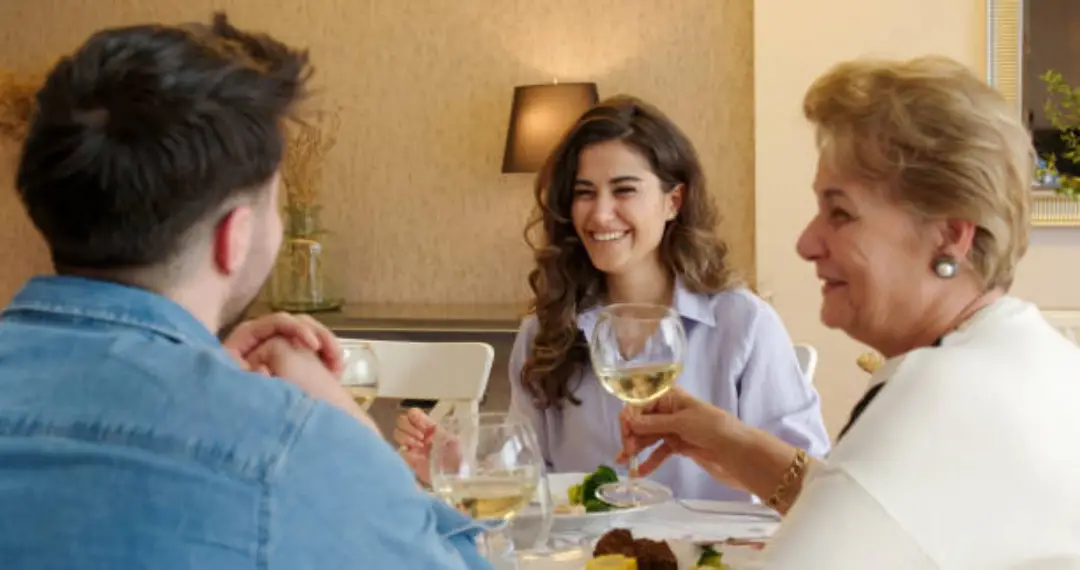
My son’s fiancée called me an ugly cow in French, thinking I couldn’t understand. I smiled politely and poured her more wine. Three hours later, I casually mentioned that immigration authorities would be very interested in our conversation.
Let me back up and tell you how I discovered my future daughter-in-law was nothing more than a gold-digging fraud with a charming accent.
It started on a crisp October evening in Austin when my son David—thirty-five and finally serious about someone—brought home the mysterious French woman he’d been dating for six months. Camille Dubois was everything I’d expected from his breathless descriptions. Petite, elegant, with that effortless style French women seem to master in the womb. Her English was impeccable, tinged with just enough accent to be charming rather than difficult.
“Mrs. Thompson,” she said, taking my hands in both of hers. “David has told me so much about you. I’m so excited to finally meet the woman who raised such a wonderful man.”
I warmed to her immediately. After David’s string of vapid girlfriends who couldn’t be bothered to remember my name, Camille’s genuine interest in our family history felt like a blessing. She asked thoughtful questions about the photos on my mantel, complimented my cooking with sincere appreciation, and even helped clear the table without being asked.
David beamed throughout dinner, clearly smitten. “Camille speaks five languages,” he boasted, squeezing her hand. “She’s been teaching me French, though I’m hopeless at it.”
“Oh, you’re being modest,” Camille laughed, eyes twinkling. “His pronunciation is—how do you say—endearing?”
We all laughed, and I found myself thinking David had finally found someone worthy of him. Someone with substance, intelligence, and genuine warmth.
That feeling lasted exactly forty-seven minutes.
After dinner, David excused himself to take an important work call. I was in the kitchen loading the dishwasher when Camille’s phone rang. She answered in rapid French, her voice carrying from the living room with the casual assumption that comes from believing you’re speaking a private language.
Here’s the thing about assumptions—they can make you sloppy.
I spent four years of my youth in Lyon, working as an au pair to pay for college. My French might be rusty, but it’s far from dead.
“Oui, maman. Elle a l’air inoffensive,” Camille was saying. “Vieille, clairement désespérée de garder son fils heureux. Elle sera facile à gérer une fois qu’on sera mariés.”
I froze, a dinner plate suspended halfway between the counter and the dishwasher. She’d just told her mother I looked harmless. Old, clearly desperate to keep my son happy. Easy to manage once they were married.
“The house is lovely—bigger than David described—and yes, there are definitely family assets to consider,” she continued, her laugh musical and cold. “His father left them very comfortable. Don’t worry, I’ve already started working on the inheritance angle. Americans are so sentimental about family legacy.”
My hands began to shake, but I forced myself to keep moving, to maintain the normal sounds of cleaning while I listened to my future daughter-in-law dissect my family like specimens in a lab.
“David is perfect for this. Naïve, generous, and completely infatuated. The green card will be simple once we’re married, and the divorce even simpler once I have what I need. Two years maximum. Then I’ll be free to return to Paris with American citizenship and enough money to live exactly as I choose.”
The plate slipped from my numb fingers and shattered against the tile.
“Mrs. Thompson, are you all right?” Camille appeared in the doorway, her face a mask of concern. Perfect performance—if I hadn’t just heard her true colors in crystal-clear French.
“Just clumsy,” I managed, kneeling to collect the pieces. “These old hands aren’t what they used to be.”
She hurried to help me, movements graceful and considerate. “Please let me do this. You shouldn’t be cleaning up after hosting such a wonderful dinner.”
The irony was suffocating. This woman had just explained to her mother how she planned to manipulate and eventually rob my son, and now she was helping me clean up broken dishes with the tenderness of an actual caring daughter-in-law.
David returned from his call, apologizing profusely. “Sorry about that. Crisis at the site, but it’s handled now.” He surveyed us cleaning together, and his face lit up like Christmas morning. “Look at you two already acting like family.”
Camille stood, disposing of broken porcelain delicately. “Your mother is wonderful, David. So warm and welcoming. I feel very lucky.”
She was good. Professionally good. Every gesture, every expression, every carefully chosen word was designed to reinforce the narrative she’d constructed—the grateful foreign girl, charmed by American family values and eager to belong.
I found my voice somehow. “Well, aren’t you sweet? David’s right. You do seem like family already.”
That night, I didn’t sleep. Instead, I sat in my late husband’s study, surrounded by forty years of financial documents and family records, trying to understand exactly what Camille thought she was targeting. Robert had been a careful man. Our assets weren’t flashy, but they were substantial. The house alone was worth close to eight hundred thousand dollars, sitting on two acres in one of Austin’s most desirable neighborhoods. The investment portfolios, retirement accounts, and life insurance policies painted a picture of comfortable upper-middle-class wealth.
Nothing extravagant. But certainly enough to tempt someone with Camille’s agenda.
What chilled me most was how efficiently she’d assessed our situation. One dinner and she’d already calculated inheritance angles and timeline strategies. This wasn’t impulsive opportunism. This was professional predation.
By dawn, I’d made two decisions. First, I would not tell David what I’d overheard—not yet. He was so deeply infatuated that any accusation from me would only drive him closer to her, cast me as the jealous mother who couldn’t accept her son’s happiness.
Second, I needed to know exactly who Camille Dubois really was.
I started with the basics: Facebook, Instagram, LinkedIn. Her social media presence was polished but thin, mostly photos from the last eighteen months. No deep history. No childhood friends or family members tagged in old posts. The few pictures from France were generic tourist shots that could have been taken by anyone.
Her LinkedIn claimed she worked in hospitality management in Paris, but the company names were vague and there were no colleague connections or recommendations. For someone supposedly in her late twenties with a career in hospitality, her professional network was remarkably sparse.
The next day, David called. “Thanks again for last night. Camille couldn’t stop talking about how wonderful you were.”
“I bet she couldn’t,” I said.
“I’m thinking about proposing soon. Maybe Christmas. I know it’s fast, but when it’s right, it’s right.”
Christmas was two months away. My stomach turned. If they married quickly after the holidays, she’d have her green card application filed by spring. Two years later, eligible for permanent residency. Two years after that, citizenship. Then the divorce, carefully timed to maximize her take from community property.
Four years. She was planning to systematically destroy my son’s life over four years.
“Have you met her family yet?” I asked carefully.
“Not in person, but we video chat with them sometimes. They live in Marseille. Her father’s a retired teacher. Her mother works in local government. Very traditional family.”
Traditional family. If they truly existed, they were probably in on the scheme.
“Actually, they’re planning to visit us next month,” David continued. “Camille wanted them to meet you before we make anything official. She values family approval.”
Of course she did. Meet the marks’ family. Charm the mother. Establish herself as the perfect future daughter-in-law. Then spring the engagement and rush toward marriage before anyone had time to ask difficult questions.
After David hung up, I remembered my sister’s youngest daughter, Clare, who worked in visa services. Over lunch at my favorite café, I told her everything.
“There are red flags,” Clare admitted when I finished. “The timeline is aggressive. The background seems superficial. And frankly, the whole narrative sounds like something straight out of the manual on marriage-fraud indicators.”
“There’s a manual?”
“Oh, honey, there are several.” She showed me a government checklist. As we went through the indicators together, my heart sank. Camille wasn’t just suspicious—she was practically a case study.
“If she’s doing this professionally, David probably isn’t her first target,” Clare said carefully. “These operations often work the same territories. There might be other victims.”
Other sons. Other families. Other lives ruined by Camille’s calculated charm.
“How would I find them?”
“Very carefully. But if there are patterns of behavior, they leave traces. It’s all public information if you know where to look.”
That afternoon, I made three phone calls. The first was to a private investigator Clare recommended. The second was to my attorney. The third was the most important.
“David, sweetheart, I’ve been thinking about Camille’s parents visiting next month. I’d love to host them for dinner. And you know what? I think I should brush up on my French before they arrive. I’d hate for them to think I wasn’t making an effort.”
The investigator’s name was Marcus Webb, and he looked nothing like what I expected—no trench coat, no fedora. Just a mild-mannered man in his fifties who could have been anyone’s accountant. Which, as it turned out, was exactly the point.
Two weeks later, he sat across from my kitchen table with a manila folder. “Let’s start with what we know for certain. Camille Dubois entered the United States on a tourist visa eight months ago. The address she listed on her arrival documents is a short-term rental she vacated after six weeks—right around the time she would’ve met your son.”
He pulled out photographs. “These are from her social media activity. In the month before she left France, she was researching American dating apps, joining international relationship sites, and participating in forums about American immigration law.”
My coffee grew cold as he laid it out. Fabricated employment history. No verifiable address in France for the past two years. And most damning, a pattern of social-media connections suggesting she’d been in contact with other American men before settling on David.
“There’s more,” he said quietly. “I found evidence of at least two previous attempts at marriage-based immigration fraud. Different names, different stories, but the same face and the same methods.”
He slid two more photographs across the table. The first showed “Camille” with a man in his forties outside a courthouse in Nevada. The second was a wedding announcement featuring Marie Fontaine and her American husband.
Both marriages lasted less than two years. Both ended in divorce with significant financial settlements. Both men were now dealing with debt and emotional trauma while she disappeared with American status and their assets.
“This isn’t just fraud,” Marcus said. “It’s a criminal enterprise. We’re dealing with someone who has destroyed multiple families and shows no signs of stopping.”
“What do I do with this information?”
Marcus leaned forward. “That depends on what kind of outcome you want. Do you want to save David from making a terrible mistake, or do you want to ensure she faces consequences for what she’s already done?”
“Both,” I said without hesitation.
“Then we need to be very strategic.” He pulled out a timeline chart. “She’s planning to introduce her parents next week—probably actors hired to play the role. The engagement will happen shortly after that, with a Christmas proposal that gives them just enough time for a New Year’s wedding. Tax timing, immigration timing, emotional manipulation—all wrapped up in romantic symbolism.”
That evening, I sat in my backyard garden watching the sunset. Somewhere across town, David was probably having dinner with his fraudulent fiancée, discussing wedding plans and dreaming about their future.
But Camille Dubois had made one crucial mistake in targeting our family. She assumed a sixty-four-year-old widow would be easy to fool. Too polite to question. Too grateful for her son’s happiness to look too closely at its source.
She was about to learn that assumption could be very dangerous.
The doorbell rang at precisely six. I smoothed my dress before answering. Camille stood on my porch flanked by an elegant older couple who could’ve been cast from central casting for “sophisticated French parents.”
“Mrs. Thompson,” Camille said, smile bright and seemingly genuine. “I would like you to meet my parents, Henri and Margot Dubois.”
Henri stepped forward with old-world courtesy, taking my hand and kissing it lightly. “Madame Thompson, we are so honored to meet the mother of the man who has captured our daughter’s heart.”
His accent was perfect. His mannerisms exactly what you’d expect from a retired teacher from Marseille. Margot embraced me warmly, speaking in enthusiastic French about how wonderful it was to finally meet me.
They were good. Professional-level good.
“Please come in,” I said in my deliberately rusty French. “I apologize for my poor pronunciation. It’s been many years since I spoke your beautiful language.”
The effect was immediate and telling. Camille’s eyes flickered with something that might have been concern while her fake parents exchanged the briefest of glances. They hadn’t expected me to speak French at all, let alone catch that their authentic accents were distinctly Parisian rather than southern.
As the evening progressed, I played my part perfectly. The charmed future in-law, delighted with these lovely people, asking gentle questions about their life in France. But I was also listening. Really listening.
Henri’s stories about his teaching career were generic and vague. Margot’s descriptions of her “government work” contradicted themselves within the same conversation. Most telling, when they spoke to each other in French, their casual complaints revealed knowledge that belonged to Paris, not Marseille.
“Passe-moi le sel,” Margot said in French. “This American food is so bland.”
“At least the wine is decent,” Henri replied, also in French. “But I miss proper cheese.”
Meanwhile, in English, they praised my cooking and expressed delight at experiencing authentic American hospitality.
The moment that confirmed everything came during coffee. David had stepped into the kitchen when Camille spoke quietly to her fake parents in rapid French.
“Elle est inoffensive mais pas stupide. Restez cohérents. On est presque à la ligne d’arrivée.”
She’s harmless but not stupid. Stay consistent. We’re almost at the finish line.
Henri answered without hesitation. “Le fils est complètement accroché. Quand veux-tu qu’il fasse sa demande?”
The son is completely hooked. When do you want him to propose?
“Next week,” Camille said, still in French. “Christmas Eve engagement. New Year’s wedding. Emotional timing that makes it hard for anyone to object.”
They thought they were speaking privately. They had no idea the harmless American widow serving coffee and homemade apple pie understood every calculated word.
As they prepared to leave, Margot took my hands warmly. “We are so grateful our Camille found David. Family is everything, don’t you agree?”
“Oh, absolutely,” I said, smiling serenely. “Family is the most important thing in the world. We’d do anything to protect the people we love.”
After they left, David lingered, bubbling over with excitement. “They’re amazing, aren’t they? I’m thinking about proposing next week. Christmas Eve, like in the movies. What do you think?”
I turned away to hide my face. “I think she’s a very lucky woman to have found you, sweetheart.”
What I was really thinking was that Camille Dubois had just made her second crucial mistake. The first was underestimating me. The second was revealing her timeline while I was still in a position to destroy it.
That night, I called Marcus Webb with three words: “Accelerate the timeline.”
Marcus arrived the next morning with a briefcase full of evidence and a plan that was both elegant and ruthless. “We move Christmas Eve—just before David’s proposal. Maximum emotional impact, minimum escape opportunities.”
The evidence was devastating. Bank records showing wire transfers from previous victims. Immigration documents with three different identities. Photographs of her with other men. Recorded phone conversations between Camille and her real handler—not the fake parents, but a criminal organization that specialized in marriage fraud.
“She’s not just a con artist,” Marcus explained. “She’s part of a network. Conservative estimate, she’s stolen over two million dollars from American men in the past five years.”
Two million. Seven families. And David was supposed to be number eight.
“Here’s what we’re going to do,” Marcus continued. “Christmas Eve, when David brings her here for dinner before the proposal, we’re going to have some unexpected guests.”
Agent Sarah Chen from Immigration and Customs Enforcement would arrive during dinner, ostensibly for a routine follow-up. What she’d actually be doing was arresting Camille for immigration fraud.
Christmas Eve arrived with terrible clarity. I went through the motions of preparation like an actor rehearsing. Cooking David’s favorite meal. Setting the table with my grandmother’s china. Wrapping presents that would never be opened.
David called around four. “Mom, we’ll be there at six. I’m going to propose after dinner. I’ve got the ring and everything.”
The ring. My grandmother’s engagement ring, passed down through three generations, now about to be offered to a criminal.
“That sounds perfect, sweetheart. I can’t wait to celebrate with you both.”
At five forty-five, Agent Chen arrived. She was younger than I expected, with kind eyes that turned steely when discussing Camille’s crimes. “We wait until after the main course. Let her get comfortable. Then I’ll present my credentials and place her under arrest.”
“What about David?”
“He’s going to be hurt and angry, probably at you initially. But he’ll understand eventually. The alternative is watching her destroy him over the next two years.”
At exactly six, David’s car pulled into my driveway. Through the window, I watched him take Camille’s hand, probably giving last-minute reassurance about the proposal. She looked radiant. Confident. Completely unaware her criminal career was about to end in my dining room.
Dinner conversation flowed like a well-rehearsed play. David talked about his plans for the new year. Camille responded with perfect warmth. Agent Chen, posing as my neighbor’s niece, made small talk about her “government consulting” work.
But I noticed subtle changes in Camille. The way her eyes occasionally darted to Agent Chen. The slight tension in her shoulders. Professional criminals develop instincts about law enforcement.
“This has been lovely,” Camille said as we finished the main course, “but perhaps we should think about heading home soon.”
There was no weather. It was a clear, calm December evening. But she wanted to leave. She wanted to leave now.
Agent Chen stood up casually. “Actually, before anyone goes anywhere, I should probably introduce myself properly.”
She pulled out her credentials. “Agent Sarah Chen, Immigration and Customs Enforcement. Miss Dubois, I need to speak with you about some discrepancies in your visa documentation.”
The transformation in Camille was instantaneous. The warm, charming woman vanished. In her place sat someone cold and calculating. Her accent disappeared entirely, revealing perfectly American English underneath.
“I don’t know what you’re talking about. My documentation is completely in order.”
David stared between them, confusion hardening into panic. “What’s going on?”
Agent Chen showed him the photographs. “Mr. Thompson, the woman you know as Camille Dubois is actually named Christina Marsh. She’s wanted for immigration fraud, identity theft, and marriage fraud across seven states.”
The ring box fell from David’s suddenly nerveless fingers, hitting the hardwood with a sound like breaking dreams.
The silence lasted exactly four seconds. Then David exploded.
“What the hell is this?” He spun toward me, eyes blazing. “You knew. You knew and you didn’t tell me.”
“David, please—let me explain.”
“Explain what? That you’ve been investigating the woman I love behind my back? I trusted you, Mom.”
His voice cracked. “I brought her here because I trusted your judgment—and this is what you do.”
Christina had gone very still, mind clearly racing through options. But Agent Chen was between her and the front door, and backup officers were already surrounding the house.
“Mr. Thompson,” Agent Chen said gently, “your mother likely saved you from years of devastation. This woman has defrauded seven other men out of nearly two million dollars.”
David shook his head violently. “No. You’re wrong. Camille isn’t—she wouldn’t.” He turned to her desperately. “Tell them they’re wrong.”
For a moment, I thought she might keep up the act. But then she looked at the evidence, calculated the odds, and made a different choice.
She laughed. A cold, amused sound with none of Camille’s musical French left in it.
“Oh, David. You poor, sweet, stupid man.”
She lifted her wine glass as if discussing the weather. “Did you really think someone like me would fall for someone like you without an ulterior motive? You’re boring, David. Predictable. I’ve played this role so many times, I could do it in my sleep.”
The cruelty was breathtaking. She wasn’t just confessing—she was destroying him for sport.
“The accent, the stories about France, the whole romantic narrative—research and performance. I spent three weeks studying your social media before I ever approached you at that coffee shop. Did you think it was coincidence that I was reading your favorite book when we met?”
David sank into his chair like his legs had stopped working.
“Amazon reviews and customer purchase patterns,” she said with a shrug. “I bought five books I knew would appeal to lonely divorced men in their thirties. Yours was the easiest mark in the coffee shop that day.”
Agent Chen moved closer, handcuffs ready. “Christina Marsh, you’re under arrest.”
But Christina wasn’t done. She looked directly at me, hatred sharp as broken glass. “You think you’ve won something, old woman? You’ve destroyed your relationship with your son to stop something that was always going to end anyway. Now he’ll spend the rest of his life wondering if every woman who shows interest is just another con artist. Your mother didn’t save you, David. She just ensured you’ll never trust love again.”
Agent Chen led Christina away, but not before one final revelation.
“Wait,” Christina called out. “Don’t you want to know about the real Camille Dubois? She’s real. Twenty-eight years old. Lives in Marseille with her parents. I studied her social media for months. Stole her identity piece by piece. There’s a real woman in France who has no idea her identity was stolen.”
The door closed, leaving David and me alone in the wreckage.
He sat motionless, staring at scattered evidence. “Is it true? What she said about the real Camille?”
I sank into the chair across from him. “I don’t know. Marcus will have to look into it.”
“Marcus?” David’s voice was flat. “How long have you known?”
“Three weeks. Since the night she called me an ugly cow in French, thinking I couldn’t understand.”
For the first time since the truth was revealed, David looked directly at me. “She called you what?”
“She was on the phone, speaking French, explaining how she planned to manipulate you into marriage and then divorce you for money and citizenship. I heard everything.”
David was quiet. Then, unexpectedly, he laughed. It was bitter, but not entirely humorless. “An ugly cow. That’s actually pretty accurate, considering how she played me.”
“David, no.”
“Three weeks, Mom. You knew for three weeks, and you didn’t tell me.”
“You wouldn’t have believed me.”
“Maybe not. But you could have tried.” He turned, and I saw something in his eyes I’d never seen before—disappointment so deep it looked like grief. “Instead, you orchestrated this whole evening. Let me make a fool of myself. By treating me like I was too stupid to handle the truth.”
He picked up the ring box from the floor. “This was Grandma’s ring. She would have worn it, taken it with her when she divorced me.”
David pocketed the ring and headed for the door. “I need time to process this.”
“David, wait.”
“I love you, Mom, but I can’t be around you right now. Every time I look at you, I’m going to think about how you didn’t trust me enough to tell me the truth.”
The door closed quietly. I was alone with the remains of Christmas Eve dinner and the weight of choices that had been completely right and utterly devastating.
But Christina had made one final mistake in her parting shot. She’d revealed the existence of the real Camille Dubois.
That night, I called Marcus with new instructions: “Find the real Camille. And find out how to make this right.”
Two months later, I stood in the international arrivals terminal at Austin-Bergstrom, holding a sign that said CAMILLE DUBOIS in my neatest handwriting.
Marcus’s investigation confirmed Christina’s identity theft had caused real problems for Camille. French authorities questioned her about her fictional American boyfriend. Her bank accounts were frozen. Her reputation damaged. But more than that, we discovered Camille was dealing with her own crisis—her mother was battling cancer, and medical bills threatened to bankrupt the family.
The real Camille Dubois was exactly as Christina described—twenty-eight, petite, effortlessly French. But where Christina had been calculating underneath her charm, the real Camille radiated genuine warmth.
“Mrs. Thompson?” she asked, approaching cautiously. “I am Camille. The real one, I think.”
I smiled. “Yes. You’re definitely the real one. Thank you for coming.”
Over the next three days, I got to know the woman my son should have met instead of the criminal who nearly destroyed his life. Camille was funny, intelligent, refreshingly honest about her own struggles and dreams. She was also nursing a broken heart—a relationship that ended badly six months earlier.
“It is strange,” she said on her second evening, as we sat in my garden sharing wine. “This woman, she stole my name, my history, even my heartbreak to make her story more believable. It feels like being robbed of yourself.”
“I’m sorry.”
“You protected your son. That is what mothers do.”
David agreed to meet her on her final day. He was still barely speaking to me, but curiosity eventually overcame his anger. They met at the same coffee shop where Christina first approached him.
I watched from across the street as they talked for nearly two hours, their body language shifting from awkward formality to genuine interest.
When David brought her back to the house afterward, something had changed. “She’s nothing like her,” he said quietly. “Everything that felt artificial about Christina—the too-perfect answers, the way she always said exactly what I wanted to hear. Camille is the opposite. She’s real.”
“What does that mean?”
“It means I’m going to drive her to the airport tomorrow, and then I’m going to think very carefully about what I want to do next.”
Three weeks after Camille returned to France, David booked a flight to Marseille. “Not for romance,” he insisted, “but to see for myself the life Christina stole and twisted.”
He came back two weeks later with a new perspective. “I’m not ready for anything serious, but Camille and I are going to stay in touch. Maybe visit back and forth. See what develops naturally.”
“And us?” I asked. “Are we okay?”
David was quiet. “You were right to investigate her. You were right to stop the fraud. But you were wrong not to trust me with the truth. If we’re going to rebuild our relationship, it has to be based on honesty—even when honesty is difficult.”
“I understand.”
“Do you? Because if Camille and I do develop something real, I need to know you’ll respect our choices. Even if you disagree with them.”
“I promise,” I said. And I meant it.
Six months later, I received a wedding invitation written in elegant French script. David and Camille had decided to marry in a small ceremony in Provence, surrounded by olive groves and authentic French countryside Christina had only pretended to know.
As I RSVP’d yes with excitement, I reflected on the strange journey that brought us here. Sometimes the worst deceptions lead to the most honest connections. Sometimes protecting someone means letting them make their own mistakes. And sometimes, when you think you’re saving one story, you’re actually beginning a completely different one.
The real Camille Dubois was nothing like her impostor. And that turned out to be exactly what my son needed to learn to trust love again.

Adrian Hawthorne is a celebrated author and dedicated archivist who finds inspiration in the hidden stories of the past. Educated at Oxford, he now works at the National Archives, where preserving history fuels his evocative writing. Balancing archival precision with creative storytelling, Adrian founded the Hawthorne Institute of Literary Arts to mentor emerging writers and honor the timeless art of narrative.