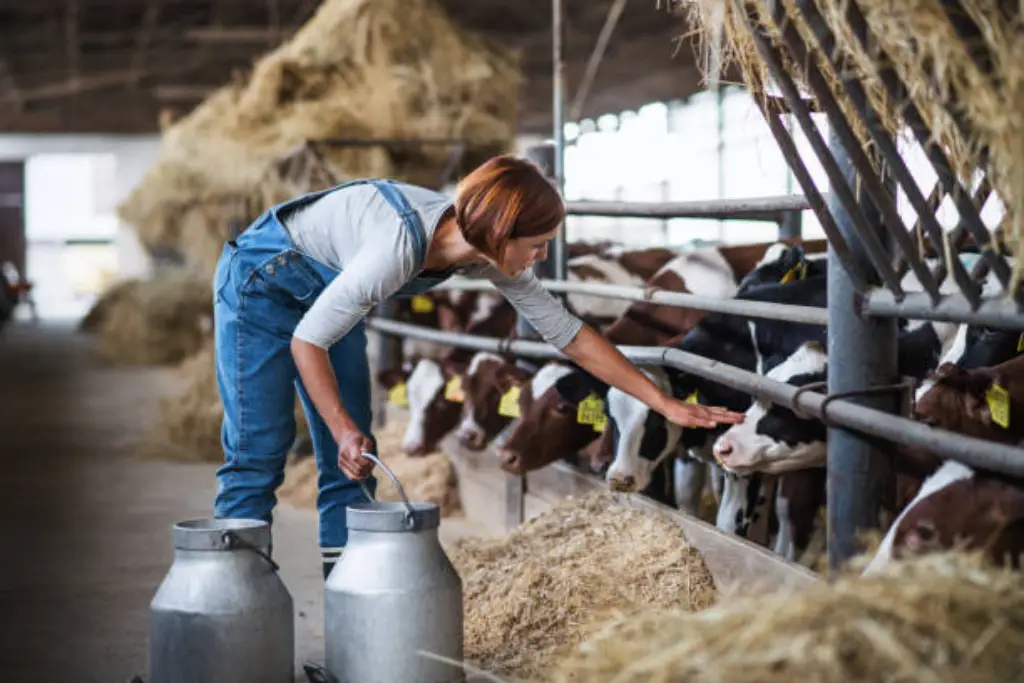
I was standing by a weathered wooden stake at the edge of the south field, one hand shading my eyes against the afternoon sun, watching Amy bend down to lift another crate of tomatoes onto the trailer. She moved with efficiency despite the heat—no wasted motion, no complaints, just steady work. The crate must have weighed thirty pounds, but she hoisted it like it was nothing, stacked it carefully with the others, then headed back for the next one.
My name is Mike Patterson. I’m forty-nine years old, and I built this farm with my own two hands over the past twenty-three years. Started with fifteen acres and a dream that most people called foolish. Now it’s a hundred and forty acres of vegetables, berries, and honest work. Every fence post, every irrigation line, every foot of soil improvement—I was there for it. This place isn’t just my business. It’s my life’s work, my legacy, and lately I’d been thinking hard about what happens when I can’t do this anymore.
That morning, I’d accidentally overheard Amy on her phone during her break. She’d been standing in the hallway by the equipment shed, her voice low and strained in a way that made it clear she thought she was alone.
“Mom, how much are we still short for Dad’s chemo?” Pause. “Six hundred dollars. Got it.” Another pause, longer this time. “I’ll pick up extra shifts somewhere. I’ll figure it out. Just please don’t let Dad miss a treatment, okay? Please.”
The desperation in her voice had hit me square in the chest. I’d backed away quietly, not wanting to embarrass her, but the conversation stayed with me all morning like a stone in my shoe.
Now, watching her work through the afternoon heat without slowing down, I made a decision.
My wife Sandra walked up beside me, wiping her hands on a towel. She’d been sorting cucumbers in the packing shed. “You see that girl loading crates?” I asked, nodding toward Amy.
“Yeah, I see her.” Sandra squinted across the field. “What’s up?”
“I heard her dad’s doing chemo,” I said quietly. “They’re still six hundred dollars short for his treatment. Today’s payday.” I paused, watching Amy heft another crate. “I’m gonna give her an extra five hundred and sixty dollars in her envelope and see if she brings it back.”
Sandra’s head snapped toward me so fast I heard her neck crack. “You’re going to do what?”
“Test her honesty. If she returns the money, I’ll pay all of her dad’s hospital bills.” I took a breath. “And I’ll make her the one running this place when I step back.”
My wife’s face went through several expressions in rapid succession—confusion, disbelief, and finally something close to anger. “Are you out of your mind?” she hissed, keeping her voice low. “That money is never coming back, Mike. Never. You’d be better off buying fertilizer and seed, or finally fixing those drip lines in the west field that keep bursting.”
I shook my head slowly, still watching Amy work. “I’m testing her character, Sandra. This farm doesn’t need more tools or equipment. It needs someone I can trust to carry it forward. Someone with integrity.”
Sandra followed my gaze to Amy, and her expression hardened. “Her family is already a mess, Mike. Look at her. Those boots are falling apart—you can see the mud caked on where the sole’s coming loose. Her work pants are ripped in three places. She probably needs every penny she makes just to survive.” She crossed her arms. “She’s not giving that money back. She can’t afford to.”
Her words irritated me more than they should have. “Being broke doesn’t make someone bad,” I said firmly. “Stop judging people by how they look or what they’re wearing. Some of the best people I’ve ever known didn’t have two nickels to rub together.”
Sandra opened her mouth to argue, then closed it again. She knew my history. Knew I’d grown up with nothing, that my own father had worked himself into an early grave trying to provide for us. She knew why this mattered to me.
“Fine,” she said after a moment, her voice tight. “It’s your money. But don’t say I didn’t warn you when she keeps it.”
I didn’t respond. I was already thinking about how to set up the test.
Amy had started working for us seven weeks ago, showing up in response to the help-wanted sign I’d posted at the feed store. She’d been nervous during the interview, twisting her hands together, but her eyes had been direct and honest when she answered my questions. She’d admitted right away that she didn’t have farm experience, but she was willing to learn and she needed the work desperately.
“I’m a hard worker,” she’d said. “I promise you that. Just give me a chance to prove it.”
I’d hired her on the spot, something Sandra had questioned at the time. But Amy had proven herself from day one. She showed up fifteen minutes early every single morning, stayed late when needed without being asked, and tackled every job I gave her with the same steady determination. She didn’t complain about the heat, the heavy lifting, or the dirt. She just worked.
I’d learned pieces of her story over the weeks. She was twenty-three, living with her parents in a rented trailer on the edge of town. Her dad had been a long-haul trucker until the cancer diagnosis six months ago. Now he couldn’t work, the medical bills were crushing them, and Amy was doing everything she could to help keep them afloat. She picked up shifts at a diner three nights a week on top of her farm work, which meant she was probably getting four or five hours of sleep on a good night.
The remarkable thing was that none of this showed in her work. She never seemed tired or distracted. Every task was done right the first time. She was teaching herself about the different crops, asking intelligent questions, remembering everything I told her. Several times I’d caught her staying late to research something on her phone—proper tomato pruning techniques, signs of plant disease, optimal harvest timing.
She was exactly the kind of person I’d been hoping to find.
Around four o’clock, I made my way to the small office in the equipment shed—really just a converted storage room with a desk, a filing cabinet, and a fan that barely worked. I pulled out the cash box where I kept the weekly payroll and counted out Amy’s wages. She made fourteen dollars an hour, and she’d worked thirty-eight hours this week. That came to five hundred and thirty-two dollars.
I counted out five hundred and sixty dollars extra and added it to her envelope. My hand hesitated over the bills for just a moment. Sandra was probably right that Amy would keep it. Anyone in her situation would be tempted. Six hundred dollars stood between her father and his cancer treatment. Five hundred and sixty dollars would almost cover that gap. What daughter wouldn’t take that money and run?
But I sealed the envelope anyway and wrote her name on the front in my careful print.
This wasn’t really about the money. It was about finding someone who would do the right thing even when the wrong thing would be so easy, so understandable, so justified. The farm needed that kind of person. I needed that kind of person.
Twenty minutes later, I called Amy into the office. She appeared in the doorway, her face flushed from work, her dark hair escaping from its ponytail in damp strands. There was a smudge of dirt on her cheek.
“Hey, Amy. You worked hard today.”
“Hey, boss.” Her smile was genuine, lighting up her tired face. “I really like this job. Thank you for giving me a chance. The crates are all loaded, and I restacked the storage area like you asked. Everything should be organized by harvest date now.”
I slid the envelope across the desk. “Payday. This is your money for the week.”
Her eyes lit up immediately, and I saw relief flood her features. “Oh my god. Perfect.” She picked up the envelope, gripping it tightly. “We really needed this right now. This couldn’t be better timing.”
I leaned back in my chair, studying her face. “You want to count it right here? Make sure it’s all there?”
She waved me off with her free hand. “No, I trust you, boss. You’ve always been fair with me.”
“Not even gonna look?” I pressed. “What if I made a mistake and shorted you?”
“Nope.” She shook her head, still smiling. “Really. You’re a good man. I can tell. God bless you.”
I nodded slowly. “Alright then. You can go. Have a good evening.”
She gripped the envelope so hard it wrinkled slightly in her hand. “You too, boss. Thank you again. This job has been a real blessing for my family.”
Then she turned and left, the door clicking shut behind her.
I sat there for a moment in the silence, listening to her footsteps fade as she headed to her old beat-up Honda in the parking area.
The door opened again almost immediately. Sandra slipped inside, her expression a mixture of triumph and disappointment. “She’s keeping that five hundred and sixty dollars,” she whispered. “I watched her face, Mike. She’s not coming back. She’s only been here seven weeks. Why would she return money she desperately needs? You just gave away five hundred and sixty dollars.”
I didn’t say anything. Part of me wondered if Sandra was right. Part of me hoped she wasn’t.
“I’m going to finish up in the packing shed,” Sandra said when I didn’t respond. “Try not to give away any more money to employees who aren’t going to give it back.”
After she left, I sat alone in the office for a long time, thinking about trust and testing and the weight of decisions that could change people’s lives.
The next morning arrived hot and cloudless. I was out in the fields by six a.m., checking the irrigation system in the berry section. The strawberries were at peak season, which meant we were harvesting seven days a week and I was constantly worried about water pressure and coverage.
Amy’s car pulled into the lot at quarter to seven—fifteen minutes early, like always. I watched from a distance as she got out, and even from fifty yards away I could see something different in her posture. She walked toward the equipment shed with purpose, her hand clutching something.
My heart started beating faster.
Sandra was coming out of the house with two thermoses of coffee. “Your employee is here,” she said, her tone carefully neutral. “Early as usual.”
“I see her.”
We both watched as Amy reached the shed and then stopped, looking around. She spotted me across the field and started walking in my direction.
“She’s probably going to ask for an advance,” Sandra muttered. “Or tell you some sob story about needing more hours.”
But I was already walking toward Amy, meeting her halfway across the field. Sandra followed a few paces behind.
Amy’s face was serious, almost troubled. In her hand was the envelope I’d given her yesterday, visibly thicker than it should have been.
“Boss,” she said as soon as I was within earshot. “We need to talk about this.” She held up the envelope.
“What’s wrong?” I asked, keeping my voice neutral.
“You made a mistake with my pay.” She opened the envelope and pulled out the stack of bills, her hands shaking slightly. “When I got home last night and counted it—I know I said I trusted you and didn’t need to count it, but my mom made me because we needed to know exactly how much we had for Dad’s treatment—there was way too much money in here.”
She counted out bills on top of the envelope. “Five hundred thirty-two dollars is what I earned this week. That’s what I was expecting. But there was…” She counted again, carefully. “One thousand and ninety-two dollars in here. That’s five hundred sixty dollars too much.”
She held the extra money out to me, her hand steady despite the trembling. “I don’t know what happened—maybe the bills stuck together when you were counting, or maybe you grabbed the wrong stack, or maybe you were paying someone else and grabbed my envelope by mistake. But this isn’t mine. I can’t keep it.”
Behind me, I heard Sandra’s sharp intake of breath.
I looked at Amy’s face—at the dark circles under her eyes that spoke of too many sleepless nights, at the worry lines that shouldn’t be there on someone so young, at the desperate hope and fear warring in her expression.
“You sure about that?” I asked quietly. “That’s a lot of money. You could use it, couldn’t you?”
Her eyes widened. “Of course I could use it. My dad needs…” She stopped, swallowed hard. “But it’s not mine. It’s your money. You worked hard for it, just like I work hard for mine. Taking money that doesn’t belong to me would be stealing, no matter how much we need it.”
“Even if I never noticed?” I pressed. “Even if I’d just thought I made a mistake in my own records?”
She looked genuinely shocked. “Even then. Especially then.” She thrust the bills toward me again. “Please take it back, boss. I can’t—I won’t—keep money I didn’t earn.”
I took the money from her slowly, feeling the weight of the bills and the much greater weight of what this moment meant.
“Amy,” I said, and my voice came out rougher than I intended. “That money wasn’t a mistake.”
She blinked, confusion crossing her face. “What?”
“I put that extra money in your envelope on purpose. I heard you on the phone yesterday talking about your dad’s treatment, about being six hundred dollars short. I wanted to see what you’d do if you found extra money in your pay.”
The color drained from her face. “You… you tested me?”
“I did.”
“Oh my god.” She took a step back, and I could see hurt and embarrassment flooding her features. “You tested me. You thought I might be a thief.”
“No,” I said firmly. “I thought you might be exactly what you turned out to be. Someone with integrity. Someone who does the right thing even when it costs you, even when no one would know, even when you desperately need to do the wrong thing.”
Tears sprang to her eyes. “I don’t understand.”
Sandra stepped forward, and I was surprised to see that her expression had completely changed. She looked stricken, ashamed. “Amy, my husband needs to tell you something.”
I nodded and pulled a folded piece of paper from my pocket—something I’d prepared last night, hoping I’d get to use it. “Amy, I’m forty-nine years old. I built this farm from nothing, and it’s time for me to start thinking about the future. I need someone to help run this place, someone I can teach everything to, someone who’ll eventually take over when I can’t do it anymore.”
Her eyes went wide.
“I need someone I can trust completely. Someone with the kind of character that can’t be taught or bought. Someone who’ll treat this farm and our customers and our workers with honesty and respect.” I handed her the paper. “I want that person to be you.”
She unfolded the paper with shaking hands. It was a job offer—assistant farm manager, with a salary that was triple what she was currently making.
“I can’t accept this,” she whispered, but her eyes were fixed on the numbers.
“You already passed the only test that matters,” I said. “The rest I can teach you. Yes, you’re young and you don’t have much experience yet. But you work harder than anyone I’ve ever hired. You’re smart and you ask good questions. You care about doing things right. And now I know you’re honest to your core.”
I pulled another envelope from my pocket—this one much thicker. “This is five thousand dollars. It’s not a gift and it’s not a loan. Consider it a signing bonus for your new position. I want you to take care of your dad’s treatment. All of it. Whatever he needs. And I want you to stop working nights at that diner so you can focus on learning this farm.”
“I can’t—” she started, but her voice broke.
“You can,” Sandra said gently, and I looked at my wife in surprise. Her eyes were wet. “Mike was right and I was wrong. I judged you by your clothes and your situation instead of your character. I’m sorry for that. Please take the job. This farm needs you.”
Amy’s hands trembled as she held both pieces of paper—the job offer and the envelope. “Why would you do all this for me?”
“Because twenty-seven years ago, I was broke and desperate and someone gave me a chance I didn’t deserve,” I said. “I failed his test at first, but he gave me another shot, and it changed my entire life. I’ve been waiting years to find someone worth passing that forward to. Someone who reminded me of who I was trying to become back then.”
I held out my hand. “What do you say? Want to learn how to run a farm?”
She stared at my hand for a long moment. Then she carefully folded both papers, put them in her pocket, and shook my hand firmly. “Yes, sir. I do. Thank you. You won’t regret this.”
“I know I won’t.”
She wiped at her eyes, leaving a streak of dirt across her face that somehow made her look younger and older at the same time. “My dad is going to cry when I tell him. He’s been so worried, so stressed about the bills and about me working so hard. This is going to…”
Her voice failed completely, and she just stood there crying in the middle of my field, holding a five-thousand-dollar envelope and shaking with relief and joy and exhaustion.
Sandra stepped forward and pulled her into a hug—something my practical, unsentimental wife almost never did. “Go take care of your father,” she said softly. “Come back Monday ready to learn. And Amy? Thank you for being exactly who you are.”
That was four years ago.
Amy’s father finished his treatment and went into remission. Amy worked alongside me every single day, learning every aspect of the farm. She was a natural—quick to learn, impossible to discourage, innovative in ways I’d never considered. She started a farm stand that brought in thirty percent more revenue. She negotiated better contracts with our buyers. She implemented a crop rotation system I’d been too stubborn to try that increased our yields by twenty percent.
Last month, on my fifty-third birthday, I officially made her a partner in the farm. Sandra and I sat down with her and the lawyers and signed over forty percent ownership, with the understanding that she’d buy us out completely over the next ten years.
She cried then too, just like she had that morning in the field.
“I still can’t believe you tested me like that,” she said afterward, half-laughing through her tears. “Five hundred sixty dollars. You must have been so nervous I’d keep it.”
“I was,” I admitted. “But I was more nervous you’d return it, and then I’d have to live up to what I promised.”
“Best five hundred sixty dollars you ever spent,” Sandra said dryly. “Even though she gave it back.”
Amy looked between us. “Can I ask you something? Why five hundred sixty specifically? Why not just an even six hundred, if that’s what my dad needed?”
I smiled. “Because six hundred would have been too perfect. It would have covered exactly what you needed. That would have been too much temptation—it would have felt like a sign from God, maybe. But five hundred sixty? That was just close enough to be incredibly tempting, but not quite enough to solve the whole problem. It made it harder, not easier, to do the right thing. That’s what I needed to know.”
She shook her head slowly. “You’re a sneaky old man, you know that?”
“That’s why you’re going to be so good at running this place,” I said. “Because you understand that the real tests in life are never easy. They’re never convenient. And they almost never come when you’re prepared for them.”
She was quiet for a moment. “What would you have done if I’d kept the money?”
Sandra and I looked at each other. “I would have been sad,” I said honestly. “Disappointed. I would have let you keep working here, because I’m not cruel and I know you needed the job. But I would have known I needed to keep looking for someone else to trust with the farm’s future.”
“And I would have felt terrible about judging you so harshly,” Sandra added. “I learned something that day too.”
“Which was?”
“That my husband has better instincts about people than I do. And that integrity isn’t about what you have or don’t have. It’s about who you are when you think no one’s watching.”
Amy reached across the table and took both our hands. “Thank you for watching. Thank you for the test. Thank you for believing I’d pass it even when I didn’t know it was happening.”
“Thank you for being worth believing in,” I said.
Now, when I stand at that old wooden stake at the edge of the south field and watch Amy directing the harvest crews, negotiating with buyers, planning next season’s crops, I think about tests and trust and the moments that change everything.
I think about five hundred sixty dollars and a young woman who chose integrity over survival.
And I think about how the best investments you can make aren’t in equipment or land or even crops.
They’re in people who prove themselves worthy of trust when everything in their life says they should do otherwise.
That’s the real harvest. That’s what makes all of this worth it.
That’s what I’ll remember when I’m gone and Amy’s name is on the deed instead of mine—that I found someone who understood what this place really needed wasn’t better irrigation or newer tractors.
It needed someone who knew that doing the right thing matters more than doing the easy thing, even when the difference costs you everything you can’t afford to lose.
She passed that test four years ago in a field under a hot sun, holding five hundred sixty dollars she desperately needed but refused to keep.
And she’s been passing it every single day since.

Adrian Hawthorne is a celebrated author and dedicated archivist who finds inspiration in the hidden stories of the past. Educated at Oxford, he now works at the National Archives, where preserving history fuels his evocative writing. Balancing archival precision with creative storytelling, Adrian founded the Hawthorne Institute of Literary Arts to mentor emerging writers and honor the timeless art of narrative.