The Suitcase in the Lake
Part 1: The Discovery
I was on my way home after a completely routine medical checkup—nothing serious, just my quarterly visit to monitor my blood pressure and cholesterol levels. The doctor had given me a clean bill of health for a woman of sixty-three, told me to keep up with my walking routine, and sent me on my way with a smile.
I sat in the back seat of the taxi, watching the city slide past my window, thinking about nothing in particular. Maybe what I’d make for dinner. Whether I should finally tackle the garden this weekend. The small, comfortable thoughts of someone whose biggest worry is choosing between chicken or fish.
Then, at a stoplight, I noticed a car in the lane beside us. A silver Honda Accord, relatively new, with a small dent in the rear bumper from where my son had backed into a mailbox last winter.
Maya’s car.
That immediately struck me as odd. Their home was in Riverside, a good forty-minute drive in the opposite direction. Maya worked at a dental office downtown, which was also nowhere near this area. This neighborhood was on the outskirts of the city—industrial buildings, abandoned warehouses, not much else. Certainly not somewhere my daughter-in-law would have any reason to be on a Wednesday afternoon.
At first, I thought I must be mistaken. There were thousands of silver Hondas in the city. But as the taxi pulled forward, I got a clearer view of the license plate.
KLM-4782
My son’s vanity plate—his initials plus their wedding date. There was no mistake.
A strange feeling settled into my stomach, something between curiosity and concern. I pulled out my phone and dialed Maya’s number before I could overthink it.
She answered on the second ring. “Hi, Mom!” Her voice sounded strange—tight, artificially bright, like someone forcing enthusiasm while under stress.
“Maya, hello dear. How are you? Where are you right now?”
There was the briefest pause. “I’m at home. Just got back from the grocery store. I’m planning to bake a cake this afternoon—that lemon pound cake you like.”
I looked out the window. Maya’s car was three vehicles ahead of us now, definitely moving, definitely not parked in her driveway forty minutes away.
She was lying to me. Directly, deliberately lying.
My instinct was to tell her I could see her car right now, to ask her what was really going on. But something stopped me—that same uncomfortable feeling in my gut that had prompted the call in the first place.
“That sounds wonderful, dear,” I said, keeping my voice light and normal. “I might stop by this evening if that’s alright.”
“Of course! I’ll save you a slice.” Another pause. “I should go—the oven’s preheating. See you tonight!”
She hung up quickly, almost too quickly.
I sat back in the seat, staring at the silver Honda ahead of us, my mind racing through possibilities. An affair was the obvious answer. A secret meeting with a lover in some discreet location. It would explain the lie, the nervousness in her voice, the remote location.
My son Marcus and Maya had been married for five years. They’d always seemed happy—not perfect, but what marriage is? They laughed together, took weekend trips, talked about starting a family soon. But I’d been married for thirty-five years before my husband passed. I knew that people could seem perfectly content while harboring secret dissatisfactions.
“Excuse me,” I said to the driver, a middle-aged man who’d been quietly humming along to the radio. “I know this is unusual, but could you follow that silver Honda? The one about three cars ahead?”
He glanced at me in the rearview mirror, eyebrows raised. “You want me to follow that car?”
“Yes. Please. I’ll pay extra.” I tried to sound calm, authoritative, like this was a perfectly reasonable request.
He shrugged. “You’re paying the fare, lady. Just don’t ask me to do anything illegal.”
We followed Maya’s car through increasingly sparse traffic as the urban landscape gave way to semi-industrial wasteland. Fifteen minutes passed. Twenty. We were well outside the city now, driving along a two-lane road bordered by overgrown fields and scattered trees.
Finally, Maya’s car signaled and turned onto a smaller road. A weathered sign read: Lake Morrison – Public Access
The taxi driver slowed down. “You want me to keep following?”
“Yes, but stay back a bit. Don’t get too close.”
We turned onto the access road. It was narrow, pitted with potholes, clearly not well-maintained. Trees pressed in from both sides, creating a tunnel of green that blocked most of the afternoon sun.
After about a mile, we emerged at an old bridge—a narrow concrete structure spanning a section of Lake Morrison. The lake itself looked dark and still, surrounded by dense forest. There were no other cars, no people, no signs of life except for the distant call of a crow.
Maya’s car pulled to a stop near the middle of the bridge.
“Pull over here,” I told the driver, gesturing to a small clearing about fifty yards back from the bridge. “And keep the engine running.”
I watched through the car window as Maya got out of her Honda. She was wearing jeans and a dark jacket, her hair pulled back in a ponytail. She looked around carefully—left, right, behind her—scanning the area like someone who didn’t want to be seen.
Then she opened her trunk.
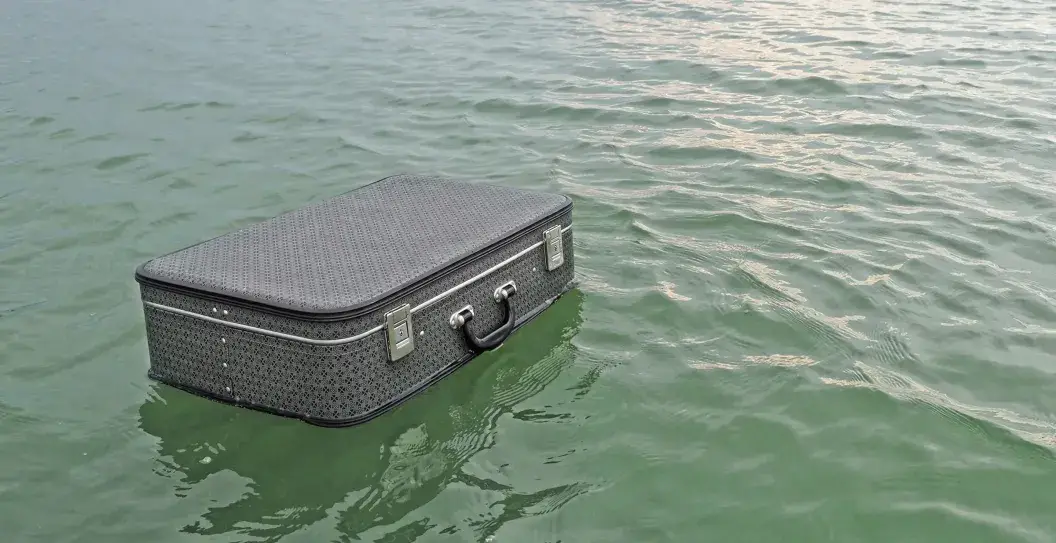
With visible effort, she pulled out a large suitcase. It was brown, old-fashioned, the kind with hard sides and metal clasps. The kind nobody used anymore. She struggled with the weight, using both hands to maneuver it out of the trunk.
She carried it to the railing of the bridge, looked around one more time, and then—with a swift, practiced motion—heaved it over the edge.
I heard the splash even from fifty yards away.
Maya stood there for a moment, staring down at the water. Then she got back in her car, did a three-point turn, and drove back toward the main road.
I sat frozen in the taxi, trying to make sense of what I’d just witnessed.
“Did that lady just throw a suitcase in the lake?” the driver asked, turning to look at me with confused concern.
“Yes,” I said quietly. “She did.”
“That’s… weird, right? That’s weird.”
“Very weird,” I agreed.
If Maya was having an affair, why throw a suitcase in a lake? If she was just disposing of old belongings, why drive forty minutes to a remote location instead of donating them or using a dumpster?
Nothing about this made sense.
“Can you wait here for about thirty minutes?” I asked the driver. “I’ll pay for your time. I just… I need to check something.”
He looked uncertain. “Lady, I don’t know what’s going on here, but—”
“Please. Just wait. If I’m not back in thirty minutes, you can leave.”
I got out of the taxi before he could argue further.
Part 2: What the Water Revealed
I walked down to the edge of the lake, my sensible walking shoes sinking slightly into the muddy bank. The afternoon sun was warm on my back, but I felt cold.
The suitcase had already drifted about fifteen feet from where it had landed. The current was carrying it slowly toward the eastern shore where reeds grew thick and tall.
I looked around for something to help me retrieve it. Near the bridge support, I found a long branch that had fallen from one of the overhanging trees. It would have to do.
I waded into the water, grateful I was wearing pants and not a dress. The lake was cold—much colder than I’d expected—and the bottom was slick with decades of accumulated silt and algae.
The water reached my knees, then my thighs. I extended the branch, trying to hook it on the suitcase handle. It took three attempts, but finally I managed to snag it and slowly drag it back toward shore.
When I got it onto dry land, I stood there for a moment, dripping and breathing hard. My heart was pounding—from exertion, yes, but also from a growing sense of dread I couldn’t name.
The suitcase was heavy, heavier than it should have been if it only contained old clothes or books. Water streamed from its seams, creating dark puddles on the ground.
I knelt beside it, my wet pants clinging uncomfortably to my legs. The clasps were old-fashioned, the kind you had to press and slide. My hands were shaking as I opened them.
The lid lifted with a wet, sucking sound.
Inside were clothes. Maya’s clothes—I recognized them immediately. A beige house sweater she wore constantly around their home, with small flowers embroidered on the collar. A pair of gray sweatpants. A white t-shirt.
All of them were soaked, heavy with lake water. And all of them were stained.
Dark red stains that the water hadn’t managed to wash away. Some were large, spreading across the fabric in irregular patterns. Others were smaller, like splatter marks.
Blood. These were blood stains.
My hands felt numb as I pushed the wet clothes aside, feeling deeper into the suitcase. My fingers touched something wrapped in what felt like a kitchen towel.
I pulled it out carefully and unfolded the towel.
A knife. A chef’s knife, about eight inches long, with a black handle. I recognized it too—it was from the set I’d given Maya and Marcus as a wedding gift five years ago. I’d used that exact knife myself when I cooked dinner at their house.
The blade still had traces of dark residue in the small gap where the blade met the handle. Residue that looked like dried blood.
I sat back on my heels, staring at the contents of the suitcase, my mind refusing to process what I was seeing.
This wasn’t about an affair. This wasn’t about disposing of old clothes.
Maya had thrown away bloody clothes and a knife. She’d driven to a remote location to hide evidence.
Evidence of what?
The most obvious answer made me feel physically sick. But I forced myself to think through it logically.
If Maya had hurt someone—if she’d killed someone—where was the body? Was it also in the lake? Had she made multiple trips? Was this just the first disposal I’d happened to witness?
And who? Who would Maya hurt? She was a dental hygienist, quiet and kind. She volunteered at the animal shelter. She sent birthday cards to distant relatives. This wasn’t someone capable of violence.
But the evidence was literally in my hands, dripping lake water onto my shoes.
I pulled out my phone. It was wet around the edges but still functioning. I should call the police. That was the obvious, right thing to do.
I started to dial 911, then stopped.
If I called the police, they would investigate. They would arrest Maya. My son’s wife would be taken away in handcuffs. Marcus would be destroyed. Their life together would implode.
And what if there was an explanation? What if this was self-defense? What if Maya had been protecting herself from something I didn’t understand?
But even as I thought it, I knew I was making excuses. People in genuine self-defense situations didn’t throw evidence in lakes. They called the police. They sought help.
I looked up at the bridge, at the spot where Maya had stood moments ago. She’d looked around carefully before throwing the suitcase—not the panicked movements of someone traumatized, but the calculated actions of someone trying to hide something.
I closed the suitcase and pulled it further onto the shore, hiding it behind a large rock where it wouldn’t be visible from the road. Then I walked back to the taxi, my mind churning with impossible choices.
Part 3: The Dinner
The taxi driver took one look at my soaked, muddy condition and didn’t ask any questions. I gave him my address and sat in silence for the entire forty-minute drive home, staring out the window without seeing anything.
When I got home, I stripped off my wet clothes, took a long hot shower, and tried to think clearly.
I had three options:
- Go to the police immediately with what I’d found
- Confront Maya directly and demand the truth
- Do nothing and pretend I’d never seen anything
Each option felt wrong in a different way.
I sat on my bed in my bathrobe, phone in hand, and called Marcus.
“Hey, Mom,” he answered cheerfully. “What’s up?”
“Hi, sweetheart. I just wanted to check—are you and Maya free for dinner tomorrow night? I thought I’d make that pot roast you love.”
“Let me check with Maya.” I heard muffled conversation, then he came back on. “Yeah, we’re free! That sounds great. Six o’clock?”
“Perfect. See you both then.”
I hung up and stared at the wall. Tomorrow night, I would watch them carefully. Watch Maya. See if there were any signs of guilt, fear, trauma—anything that might help me understand what had happened.
The next evening, I prepared dinner with meticulous care. Pot roast, roasted vegetables, fresh rolls, apple pie for dessert. I set the table with my good china.
Marcus and Maya arrived exactly at six. Marcus looked the same as always—tall, slightly scruffy, wearing the cardigan I’d bought him last Christmas. Maya looked… normal. That was what frightened me most. She wore a blue dress, had her hair down, and smiled warmly when she hugged me.
“Something smells amazing,” she said, handing me a bottle of wine. “Thank you so much for inviting us.”
I searched her face for signs of stress, guilt, fear. I found nothing but pleasant contentment.
During dinner, I watched her carefully. The way she laughed at Marcus’s jokes. The way she talked about a difficult patient at work. The way she ate her food with normal appetite.
She seemed completely, utterly normal.
“So, Maya,” I said casually as I refilled her wine glass. “What did you do yesterday afternoon? I tried calling but you were busy.”
She didn’t even hesitate. “I went to the grocery store, came home, baked that lemon cake I mentioned. Then Marcus came home and we watched a movie. Very exciting Wednesday.” She smiled.
The lie came so easily. So naturally.
“The cake was delicious, by the way,” Marcus added. “You should come by and try some, Mom.”
I nodded, smiling, feeling like I was participating in some surreal play where everyone knew their lines except me.
After dinner, while Maya was in the bathroom, I pulled Marcus aside in the kitchen.
“Is everything okay with you two?” I asked quietly.
He looked surprised. “Yeah, of course. Why?”
“I don’t know. I just… you’d tell me if something was wrong, wouldn’t you?”
He put his hand on my shoulder. “Mom, we’re fine. Really. Maya’s been a little stressed with work lately, but nothing serious. Is something bothering you?”
“No, no. Just being a worried mother, I suppose.”
But as I watched them leave that night, saw Maya wave cheerfully from the car window, I knew I couldn’t just let this go.
The next morning, I drove back to Lake Morrison.
Part 4: The Truth
The suitcase was still where I’d left it, hidden behind the rock. In daylight, I could see it more clearly—water-damaged and covered in mud.
I opened it again, forcing myself to examine everything more carefully this time.
I took photos of each item with my phone. The bloody clothes. The knife. Then I noticed something I’d missed before—a small zippered pocket in the lining of the suitcase.
Inside was a piece of paper, also wet but still partially readable. It looked like a receipt.
Morrison County Hospital Emergency Department Patient: Rodriguez, Carlos Date: [two days ago] Diagnosis: Multiple stab wounds to abdomen and chest Status: Deceased
My hands went numb.
Carlos Rodriguez. I knew that name. He was Maya’s ex-boyfriend from before she met Marcus. They’d dated for about a year, maybe five or six years ago. It had ended badly—I remembered Maya mentioning once that he’d been controlling, that the breakup had been difficult.
I pulled out my phone and searched for news about Carlos Rodriguez.
The article was from yesterday:
LOCAL MAN FOUND DEAD IN APARTMENT Police Investigating Possible Homicide
Carlos Rodriguez, 34, was found dead in his apartment Wednesday evening by a neighbor who noticed his door was ajar. Police say Rodriguez suffered multiple stab wounds. No suspects have been named. Anyone with information is asked to contact…
I sat down heavily on a rock, the phone slipping from my fingers.
Maya had killed her ex-boyfriend. That was the only explanation that fit all the facts.
But why? Had he threatened her? Had he shown up at her work, her home? Had she been protecting herself?
Or had there been another reason—something darker, more calculated?
I picked up my phone and this time I did call the police.
“I have information about the Carlos Rodriguez murder,” I told the operator.
Epilogue
The police found fingerprints on the knife that matched Maya’s. They found Carlos’s DNA on the clothes. They found security footage from near Carlos’s apartment showing Maya’s car parked outside that Wednesday afternoon.
When they arrested her, Maya confessed immediately.
Carlos had been stalking her for months, she said. Showing up at her work. Sending threatening messages. Saying that if he couldn’t have her, no one would. She’d gone to his apartment to confront him, to tell him to stop. He’d attacked her. The knife had been in his kitchen. She’d grabbed it in self-defense.
The prosecutor argued it was premeditated murder. The knife came from Maya’s own kitchen—she’d brought it with her. The wounds suggested a sustained attack, not a desperate defensive act.
The jury deliberated for three days.
They found her guilty of second-degree murder.
Fifteen years to life.
Marcus hasn’t spoken to me since the trial. He believes I destroyed his life, that I should have trusted Maya, that I should have come to them first instead of going to the police.
Maybe he’s right. Maybe I should have.
But every time I doubt myself, I think about that suitcase sinking into the dark water. I think about the calculated way Maya looked around before throwing it. I think about how easily she lied to me on the phone.
And I know that I made the only choice I could live with.
Some secrets are too heavy to carry.
Some truths are too important to hide.
Even when they destroy the people you love.
THE END
This story explores the impossible choices we face when we discover terrible truths about those we love. Sometimes doing the right thing means losing everything. Sometimes the cost of justice is measured in broken families and shattered trust. And sometimes, a chance sighting changes everything.

Lila Hart is a dedicated Digital Archivist and Research Specialist with a keen eye for preserving and curating meaningful content. At TheArchivists, she specializes in organizing and managing digital archives, ensuring that valuable stories and historical moments are accessible for generations to come.
Lila earned her degree in History and Archival Studies from the University of Edinburgh, where she cultivated her passion for documenting the past and preserving cultural heritage. Her expertise lies in combining traditional archival techniques with modern digital tools, allowing her to create comprehensive and engaging collections that resonate with audiences worldwide.
At TheArchivists, Lila is known for her meticulous attention to detail and her ability to uncover hidden gems within extensive archives. Her work is praised for its depth, authenticity, and contribution to the preservation of knowledge in the digital age.
Driven by a commitment to preserving stories that matter, Lila is passionate about exploring the intersection of history and technology. Her goal is to ensure that every piece of content she handles reflects the richness of human experiences and remains a source of inspiration for years to come.