I stood in the shadow of the massive crystal chandelier, my fingers adjusting the same arrangement of white roses for the third time in five minutes. They didn’t need adjusting. They were perfect—I’d made sure of that hours ago. But standing here, pretending to work, gave me something to do with my hands and a reason to stay in the corner where I could see everything without being seen.
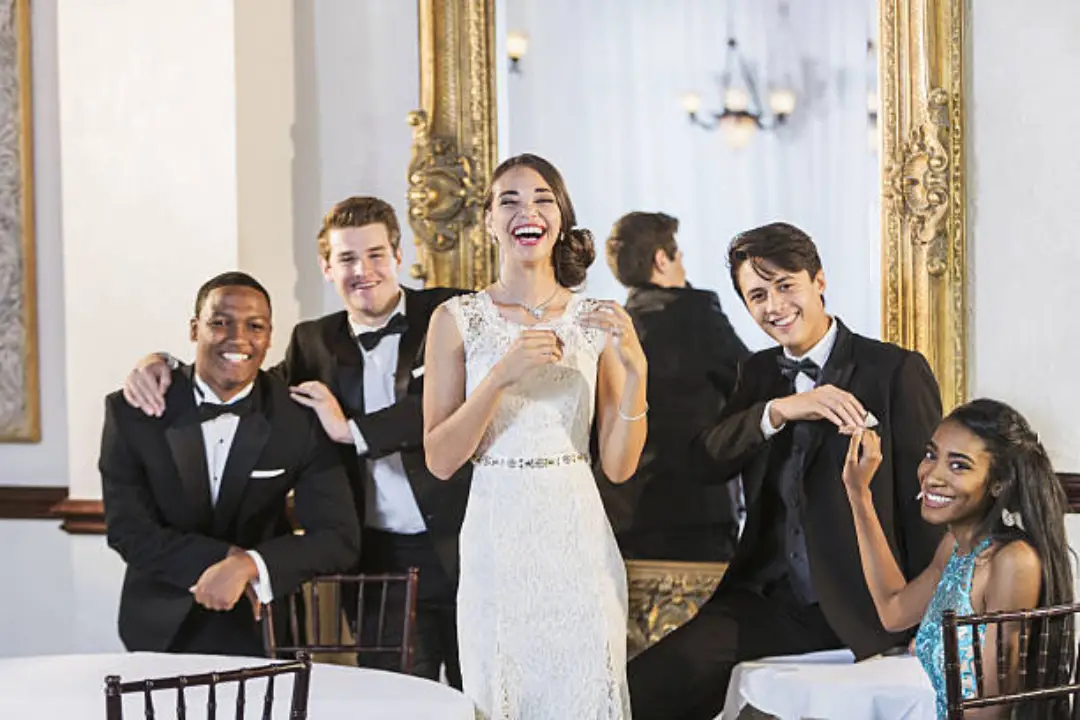
The grand ballroom stretched before me in all its elegant glory. Soft light cascaded from the chandeliers onto tables draped in pristine white linen. The marble floor gleamed like glass, reflecting the shimmer of crystal glasses and the glint of expensive jewelry. Everything was perfect, exactly as I’d planned it to be. After thirteen years working at this wedding hall, I knew every detail that separated a good event from an unforgettable one.
But this wasn’t just another event. This was my little brother’s wedding.
And the irony of that wasn’t lost on me—I’d spent more than a decade orchestrating perfect days for complete strangers, yet watching Jack’s wedding unfold felt like standing on train tracks, watching the headlight approach, unable to move.
At the center of the room, Grace Miller spun slowly while her bridesmaids fussed over the train of her dress. She was stunning in a way that seemed almost unfair. Her ivory gown fitted perfectly at the waist before flowing around her feet like water. Her dark hair fell in glossy waves over her shoulders, and delicate pearl earrings caught the light each time she turned her head. She looked like she’d stepped out of a bridal magazine—the kind of image that makes other women sigh with envy.
I could see it in the faces of my coworkers. The catering staff whispered “She’s so beautiful” behind their hands. The sound crew kept stealing glances. Even our venue manager, who’d witnessed hundreds of brides over the years and prided himself on being completely unimpressed, had commented, “That one’s something special.”
If you didn’t know her, you’d believe she was perfect in every way.
But I knew her. And I knew better.
My name is Elina Johnson, and at thirty-two years old, I’m unmarried—a detail that seems to fascinate everyone who learns it. “Still single?” they ask, with that particular mixture of pity and judgment that makes you want to throw something. I’ve worked at this wedding hall since I was nineteen, long enough that I know where every electrical outlet is hidden, which floorboards creak, exactly where the carpet always snags women’s heels, and which caterers can be trusted during a crisis.
This place has become my second home. Sometimes, if I’m being brutally honest with myself, it’s my only real home. It’s where I’ve spent countless weekends and holidays, watching other people’s families celebrate their happiest moments while my own family slowly disintegrated and then rebuilt itself in a different, smaller shape.
My family consists of just my brother and me now. We weren’t always just two.
We used to be four.
When I was in high school, my parents’ marriage deteriorated from uncomfortable silence to explosive arguments with terrifying speed. I still remember the night my father left with perfect clarity—the slam of the front door that shook the walls, the sound of my mother’s breathing turning harsh and ragged in the kitchen, the way I stood frozen in the hallway holding Jack’s hand while he asked in a small, frightened voice, “Is he coming back?”
I’d wanted desperately to say yes. I’d wanted to lie to him, to protect him from the truth. But I couldn’t make the words come out.
Dad never came back. Not for birthdays or Christmas. Not when Mom was exhausted from working double shifts just to keep the electricity on. Not when Jack graduated middle school or when I got into music college. He vanished from our lives so completely that sometimes I wondered if we’d collectively imagined him, if he’d ever really been there at all.
Mom tried her best after that. She really did. She worked mornings at a bakery that smelled perpetually of cinnamon and yeast, nights at a small diner where the regulars knew her name, and somehow in between she still found time to make sure we ate vegetables, to sign our school forms, to sit beside me at the battered upright piano in our tiny living room and say, “Again, Elina. This time with more feeling.”
She loved listening to me play. She was the first person who ever told me I was special, that I had something rare.
“You’re going to make people cry one day,” she’d say, pressing a kiss to the top of my head while my fingers moved over the keys. “In the best way possible.”
A few years after my father abandoned us, Mom died in a car accident on an ordinary rainy afternoon. There’s a particular kind of silence that exists only in hospital waiting rooms—I learned that silence the hard way, sitting in a molded plastic chair with my fingernails digging crescents into my palms while a doctor spoke words I didn’t fully process: “impact,” “internal bleeding,” “nothing we could do.”
Jack was sixteen then. I was nineteen.
I remember walking out of that hospital into bright afternoon sunlight and feeling like the entire world had tilted slightly off its axis. Cars passed on the street. People laughed on the sidewalk. Somewhere in the distance, someone was playing music from a radio. And inside my head, there was this one howling thought that drowned out everything else: It’s just us now.
We had no grandparents nearby, no aunts or uncles who could step in and take responsibility. Our father was nothing more than a name on a birth certificate and a vague memory of aftershave. We were completely alone.
College had been the plan—my plan. I’d been accepted to a prestigious music conservatory overseas, the kind of institution you see in documentaries about musical prodigies. It was the type of school where practice rooms had floor-to-ceiling windows overlooking gardens, where guest lecturers were world-renowned performers, where graduates went on to play in symphony halls across Europe. The acceptance letter had arrived just three weeks before Mom died, and I’d read it so many times I’d memorized every word.
After the funeral, I stared at that letter, then at my brother’s face—pale and lost and so much younger than sixteen—and the choice became brutally, painfully clear.
Sometimes the most important decisions in life aren’t really decisions at all. They’re inevitabilities you simply recognize and accept.
I didn’t go to music college.
I went straight to work instead, picking up whatever jobs I could find: serving coffee at a café where my feet ached after every shift, working retail where customers treated me like I was invisible, teaching beginner piano lessons to children in a neighbor’s cramped living room. I applied to the wedding hall on a whim after seeing a flyer taped to a community board. I didn’t think I’d get the job—I lied about my experience and wore Mom’s only decent blazer to the interview, the sleeves slightly too short for my arms.
They hired me anyway.
“It’s mostly weekends,” the manager had warned. “Long hours, demanding clients, last-minute crises. Think you can handle that?”
“Yes,” I’d answered without hesitation, because I had to. Because there was no other option.
Jack, though—my little brother was always different from me. Sharper, more focused, quieter in his ambitions. He worked hard in school not because anyone forced him to, but because he seemed to genuinely believe in a future that I’d stopped allowing myself to imagine. He earned a full scholarship to a good university—a genuine miracle considering our financial situation.
I remember sitting with him on the edge of his bed the day the acceptance letter arrived, watching him hold it in trembling hands.
“You’re going,” I’d said firmly, before he could start making excuses.
“What about you?” he’d asked, his voice cracking. “You wanted music college. You were supposed to—”
“It’s your turn now,” I interrupted gently but firmly. “Mine will come later.”
I didn’t believe it when I said it. But I needed him to believe it, needed him to go forward without the weight of guilt holding him back.
He went. He studied business and economics, subjects that bored me but fascinated him. He graduated with honors. He got a job at a well-known corporation, the kind where just saying the company name made distant relatives we barely talked to suddenly send congratulatory messages.
I was proud of him in a way that physically hurt sometimes—proud enough that it felt like my chest might crack open.
He was living proof that Mom’s sacrifices hadn’t been meaningless. That mine hadn’t been either.
And now, he was getting married.
I’d heard about Grace before I actually met her. Jack talked about her in the shy, careful tone of someone who still couldn’t quite believe his luck, who was afraid that speaking too loudly about his happiness might jinx it.
“She’s the daughter of an executive at my company,” he’d told me one night over takeout containers of cold noodles, his cheeks faintly pink. “But she’s not snobby about it, you know? She’s actually… nice. Down to earth. Kind.”
“Beautiful?” I’d asked, teasing him the way big sisters are supposed to.
He’d ducked his head and laughed, embarrassed. “That too.”
“She plays piano,” he’d added another time, and I’d seen his eyes light up. “Like, really plays. She went to some prestigious music college overseas, one of those places you see in documentaries. She teaches private lessons now, gives recitals. You’d like her, I think. You’d have a lot to talk about.”
Would I? I wanted desperately to believe him.
The first time our families met for dinner, it was at an upscale restaurant near the city center—the kind of place with wine lists longer than the food menu and waiters who seemed to glide rather than walk. I’d arrived fifteen minutes early out of habit. Being early meant I could get my bearings, settle my nerves, make sure I didn’t accidentally trip over invisible social expectations.
Grace walked in exactly on time with her parents. If I’d thought she looked beautiful in the photos Jack had shown me, seeing her in person was something else entirely. She was tall without being intimidating, with posture that spoke of years of deportment training. Her dress was simple but clearly expensive—you could tell by the way the fabric draped. Her makeup was flawless. She looked like a woman who had never once in her life worried about an overdue bill or wondered if she could afford groceries and rent in the same month.
“Elina!” she’d exclaimed when she spotted me, and her smile seemed genuine. “You must be Elina! I’ve heard so much about you.”
She’d taken my hands in hers, squeezed them warmly, her eyes bright with what looked like authentic interest.
“I’ve heard so much about you,” she repeated. “Jack talks about you constantly.”
I glanced at my brother, who had turned red to the tips of his ears.
“Oh, does he now?” I replied, trying to match her warmth. “I hope only the good things.”
“Of course,” she laughed, and it sounded musical. “Only that you’re incredibly hardworking and strong and that he wouldn’t have made it this far without you.”
Something inside me softened at those words. Maybe she really was as wonderful as Jack had described.
We were seated at a private table, and the conversation flowed easily at first. Grace’s parents were clearly proud of their daughter, and why wouldn’t they be? They talked about her piano recitals, her competition wins, her graduation concert at the music conservatory overseas where the dean had personally complimented her performance. I smiled and nodded, genuinely interested. Music was still a painful subject for me, an old wound that hadn’t quite healed, but it was also a language I understood better than almost anything else.
“Our Grace has always been exceptionally talented,” her father said with a booming laugh, patting her hand affectionately. “She won top prizes in so many competitions. Though there was always this one girl…” He trailed off, frowning slightly. “This one competitor who kept taking first place. Very frustrating for our Grace, wasn’t it, sweetheart? What was that girl’s name again? It was on the tip of my tongue…”
I felt my fork still in my hand, suddenly heavy.
“Oh?” I said casually, keeping my voice neutral. “That must have been challenging.”
Grace’s posture, which had been pleasantly relaxed, stiffened almost imperceptibly. Her smile remained fixed on her face, but something in her eyes went cold and flat.
“Yes, yes,” her father continued, completely oblivious to the shift in his daughter’s demeanor. “There was this one American girl at the conservatory. Always taking first place, every single competition. What was her name…?”
“We don’t need to talk about that, Daddy,” Grace interrupted quickly, her tone light but her jaw visibly clenched. “Let’s not bore everyone with old stories that don’t matter anymore.”
The subject changed, and I filed the moment away in the back of my mind as a curious detail, nothing more.
About an hour into the dinner, my phone buzzed with a call from my manager at the wedding hall. I excused myself politely, bowing slightly to the table.
“Work call,” I explained apologetically. “I’ll just step out for a moment.”
I walked into the hallway outside our private dining room, taking the call near the restrooms. My manager was dealing with a last-minute crisis about table arrangements for that weekend’s event—a bride who’d decided the round tables felt “too communal” and wanted everything changed to long rectangular ones with less than forty-eight hours’ notice. I talked her through solutions, promised to handle it personally, and hung up feeling the familiar weight of other people’s problems settling onto my shoulders.
When I turned back toward the dining room, Grace emerged from the women’s restroom. She nearly walked straight into me.
“Oh,” I said, startled. “Grace. I’m sorry, I didn’t mean to startle you. Thank you again for tonight—dinner has been lovely. I really appreciate everything your family is doing for Jack.”
She looked at me, and for just a moment, her expression was completely different from the warm, open face she’d shown at the table. Her eyes swept over me slowly, taking in my simple blouse that I’d ironed carefully that morning, my skirt that was professional but plain, my shoes that I’d polished but couldn’t hide were several years old. I became suddenly, acutely aware of the faint frayed edge on my sleeve that I’d tried to trim earlier.
Her lips curved into something that wasn’t quite a smile.
“Attending today’s meeting is a high school graduate,” she murmured, so softly I almost didn’t catch the words.
The phrase was so unexpected, so out of nowhere, that for a moment I didn’t even register that she was talking about me. Her tone wasn’t kind or neutral—it was dismissive, superior, like she was categorizing me as something lesser.
Before I could respond, before I could even fully process what she’d said, she turned and hurried back into the dining room, her expression brightening again like someone putting on a familiar mask.
I stood there in the hallway alone, my chest suddenly tight, wondering if I’d misheard. Maybe she’d said something else. Maybe I was being oversensitive, projecting my own insecurities about my education onto an innocent comment. Maybe I’d imagined the disdain in her voice.
I took a deep breath, smoothed my expression into something neutral, and returned to the table.
Grace was all smiles again, offering to refill my water glass, asking if I wanted to see the dessert menu, complimenting me on how responsible I was to work so hard while also being there for family.
Maybe I really had imagined it. It was easier to believe that than to accept what my instincts were screaming.
But as the weeks turned into months and Grace and I began meeting regularly to plan wedding details, I realized with growing certainty that I hadn’t imagined anything at all.
Her true nature didn’t emerge all at once in some dramatic revelation. Instead, it slipped through in small cuts—comments that seemed innocent on the surface but left wounds that accumulated over time.
The first official planning meeting, I’d reserved one of the hall’s smaller conference rooms. I’d laid out brochures, sample menus, floral catalogs, fabric swatches—everything organized in neat sections so she could easily see all her options. I’d double-checked every detail because she was Jack’s fiancée, because I wanted things to go smoothly, because some part of me still hoped we could build a real relationship.
Grace stepped into the room wearing a soft pink dress that probably cost more than my monthly rent, trailing expensive perfume. She looked around the carefully arranged materials, then at me, her head tilting slightly.
“You don’t resemble Jack at all, do you?” she said, studying my face with clinical interest. “He’s very attractive. Don’t you think so?”
The implication hung in the air, unspoken but unmistakable: and you’re not.
I forced a smile. “People say we look alike, actually. Maybe you just haven’t seen him first thing in the morning with bedhead and glasses.”
She laughed, but the sound was hollow, empty of warmth.
As we worked through the planning materials, she made small observations that seemed designed to sting. “You’re really good at this kind of detailed work,” she said while signing a form, her tone almost patronizing. “But I guess when you don’t go to college, you just jump straight into the workforce, right? You must have started working very young. That must have been difficult.”
I nodded, because it was true. It shouldn’t have hurt. But the way she said it—as if working instead of studying was a personal failing rather than a sacrifice born of necessity—made my throat tight.
Another time, when we were selecting music for the ceremony, she’d smiled and said, “If you have time to help other people get married, why don’t you spend that energy worrying about yourself? Oh, but you’re only a high school graduate, so maybe you’re not very bright. And you lack proper manners because you were raised by a single mother. It must be hard to find a suitable partner with that background.”
She delivered it in the same conversational tone someone might use to comment on the weather, as if she were stating obvious facts rather than landing deliberate blows.
For a moment, I couldn’t breathe. The insult itself was bad enough, but the casual way she’d spoken about my mother—my mother, who had literally worked herself to death to keep us fed and housed and loved—made something dark and furious coil in my chest.
I should have snapped back. I should have defended Mom’s memory. I should have walked out and told Jack exactly what kind of person he was planning to marry.
But Jack’s face appeared in my mind—Jack, who talked about Grace with such hope, such happiness. Jack, who’d had so little joy in his life and deserved this one good thing. If I told him and he didn’t believe me, or if he believed me but it destroyed his relationship with his boss’s daughter and cost him his job…
So I swallowed the anger, swallowed the hurt, and smiled tightly.
“We should finalize the flower arrangements,” I said, my voice steady only through sheer force of will.
The comments didn’t stop. They multiplied.
“Oh, this bridesmaid dress might be too refined for someone like you,” she remarked while flipping through options. “You’d feel completely out of place wearing something this elegant.”
“Do you even understand how much a wedding like this costs?” she asked another time with a tinkling laugh. “Oh, of course you wouldn’t. It’s not like you’d ever be able to afford one on this scale.”
“I’m the one who always won top prizes in piano competitions,” she boasted while adjusting her expensive watch, examining her perfect manicure. “I’m not like you, who just finished high school and ran off to work. We’ve lived very different lives, haven’t we?”
Every sentence was a needle, carefully placed to cause maximum damage.
I’d go home at night to my small apartment with its secondhand furniture and unpaid dreams, and I’d replay her words until they echoed in my skull. Sometimes I’d sit at my old keyboard—a cheap electronic one I’d bought years ago—and try to play, but my fingers would freeze on the keys, paralyzed by the weight of everything I’d given up.
But I said nothing to Jack. I told myself I was protecting him. That maybe Grace was just insecure beneath all that polish, that marriage would settle her, that as long as she treated him well, I could endure whatever she threw at me.
I was catastrophically wrong on every single count.
The months crawled by. The wedding date approached like an oncoming storm.
I threw myself into the preparations with obsessive dedication. I triple-checked seating arrangements to make sure no family feuds would erupt. I worked late coordinating with the florist for special centerpieces. I personally negotiated with suppliers for better champagne at a lower cost. Every detail had to be perfect—not just because it was my job, but because it was Jack’s day.
I could have taken the day off. Any reasonable person would have. No one at the hall would have blamed the groom’s sister for wanting to simply attend as family rather than work. But the truth was, I felt more comfortable behind the scenes. The hall was the one place where I knew exactly what to do, where I had control, where I understood the rules.
So I arrived that morning in my staff uniform—black skirt, white blouse, name tag pinned precisely in place, hair pulled back in a neat bun. I helped arrange chairs in perfect rows. I tested microphones and sound systems. I walked through the timeline with the MC, my clipboard in hand like armor.
Except this wasn’t just another event. This was my brother’s life about to change forever.
The guest list was impressive and intimidating in equal measure. As the daughter of a company executive, Grace had a whole contingent of corporate VIPs attending. We’d treated them accordingly—special lounge area, extra staff, premium wines. By midday, the hall buzzed with expensive perfumes, the clink of crystal, the sound of laughter that came easily to people who’d never worried about money.
My plan was simple: work until just before the ceremony, then slip away to change into the simple blue dress I’d bought specifically for today, and join the family table as Jack’s sister rather than as staff.
That was the plan.
Forty minutes before the ceremony was scheduled to begin, I ducked into one of the smaller dressing rooms to touch up my makeup. The mirror above the vanity reflected my face in flattering light, but I could still see the fine lines at the corners of my eyes, the shadows beneath them from too many late nights, the weariness that makeup couldn’t quite conceal.
“Not bad,” I muttered to my reflection. “Could be worse.”
I was fixing my eyeliner when the door opened and two women entered, deep in animated conversation. They were around Grace’s age, both beautiful, both dressed in pastel designer dresses that probably cost more than I made in a month.
I recognized them vaguely from the rehearsal dinner—Grace’s friends from her music conservatory days.
They didn’t notice me at first. I shifted slightly to the side of the mirror, making myself small and unobtrusive, a skill I’d perfected over years of being staff rather than guest.
“Did you see the ring again?” one of them said, digging through her clutch. “The diamonds are so massive I nearly went blind looking at it.”
“She showed it to me three times this week alone,” the other replied with a laugh. “Though honestly, I’d probably be the same way. It’s gorgeous. And the groom is actually cute too.”
“He’s too innocent though,” the first one said, and something in her tone made my skin prickle. “I kind of feel bad for him, you know?”
The question left my lips before I could stop it. “Why?”
They both jumped, spinning to look at where I stood.
“Oh!” one pressed a hand to her chest dramatically. “You scared me. I didn’t realize anyone else was in here.”
“I’m sorry,” I said quickly, keeping my voice professional. “I work here at the hall. I’m also Jack’s sister, actually. Elina.”
Their expressions shifted immediately—polite smiles appearing, shoulders straightening slightly in that way people do when they realize they’re talking to someone connected to the situation.
“Oh, you’re the sister!” the taller one said. “I’m Sophie. This is Mia. It’s nice to meet you.”
“Nice to meet you both,” I replied automatically, my customer-service voice firmly in place.
They exchanged a glance that made my stomach drop.
“Um,” Sophie said, lowering her voice. “Maybe we shouldn’t…”
“Oh, don’t be ridiculous,” Mia cut her off, turning to look at me directly. Her eyes held something that looked like sympathy. “She should know. It’s better if she knows.”
A chill slid down my spine like ice water. “Know what?”
Mia took a breath. “Look, I don’t want to cause problems, but… you know Grace is dating another guy, right? Has she told your brother yet?”
The room seemed to tilt sideways. The fluorescent lights suddenly felt too bright, too harsh.
“What?” The word came out as barely more than a whisper.
“I heard he’s some guy she met at a nightclub,” Sophie added, adjusting a bracelet on her wrist with studied casualness. “Apparently Grace has been complaining to people that her parents were pressuring her to get married to someone ‘suitable,’ so she picked your brother because he’s safe and good on paper. She said—and I’m quoting directly here—that she’s getting married today ‘just to keep up appearances.'”
My throat went completely dry. “That’s… that can’t be true. She wouldn’t…”
“I honestly thought she’d tell him before today,” Mia said, shaking her head. “I mean, she had to tell him eventually, right? But clearly…” She gestured vaguely toward the door, toward the wedding preparations happening just outside. “That didn’t happen.”
“If it’s true, I feel really sorry for the groom,” Sophie murmured. “He seems like a genuinely nice guy. He has no idea what he’s walking into.”
My heart hammered so loudly in my ears that I could barely hear anything else.
It can’t be true, I told myself desperately. It has to be a misunderstanding. A rumor taken out of context. Someone’s idea of a sick joke.
But deep in my gut, in that place where instinct lives before rational thought can suppress it, I already knew it wasn’t a joke at all.
Grace’s casual cruelty toward me suddenly made horrible sense. The way she talked constantly about appearances and status. The disdain she showed toward anyone with less money, less prestige, less pedigree. The comments about my education, my background, my mother.
I’d ignored so many red flags, dismissed so many warning signs, told myself that as long as she loved Jack, I could tolerate everything else.
But what if she didn’t love him? What if she’d never loved him?
What if my brother was about to legally bind himself to a lie?
I wanted to run to Jack immediately, to grab him by the shoulders and beg him to call everything off. I wanted to storm into Grace’s dressing room and demand the truth, to force a confession out of her in front of everyone.
But I was standing there in my staff uniform, not the dress of a family member. I had no proof—just the word of two women I barely knew, sharing gossip they’d overheard. If I made a scene based on rumor and it turned out to be false, I’d ruin Jack’s wedding day for nothing. Even if it was true, confronting Grace now, minutes before the ceremony, would create a chaos that would humiliate Jack in front of his boss, his colleagues, everyone who mattered to his career.
The door swung open again, and another staff member poked her head in.
“Elina, we need you in the main hall,” she said urgently. “Guests are starting to be seated and the coordinator is asking for you specifically.”
My window to act slammed shut like a prison door.
I walked out into the corridor on autopilot, my mind a chaotic mess of half-formed plans and desperate thoughts, none of which led anywhere useful.
Maybe I could pull Grace aside privately before the ceremony. Maybe she’d confess and we could postpone everything quietly. Maybe Jack would somehow figure it out on his own. Maybe the earth would open up and swallow the whole building.
By the time I reached the main hall, the ceremony had already begun.
I found myself standing at the family table, my staff badge tucked discreetly out of sight, wearing my simple blue dress that suddenly felt pathetically inadequate amid all the designer gowns and tailored suits. Jack looked so handsome in his suit, nervous and glowing with that particular radiance that only grooms have when they believe everything they’ve dreamed of is finally falling into place.
Grace walked down the aisle to soft, lyrical music played by a string quartet. Her veil floated behind her like a cloud. Every guest turned to watch, sighing appreciatively at the vision she made. Her father looked proud and dignified as he escorted her. Her mother dabbed delicately at her eyes with a monogrammed handkerchief.
I stared at Grace, searching desperately for some sign—some flicker of guilt, some hesitation in her step, some crack in the perfect facade.
I saw nothing but practiced, flawless grace.
The ceremony proceeded like clockwork. Vows were exchanged in voices that carried beautifully through the hall’s acoustics. Rings were slipped onto fingers with appropriate reverence. They kissed, and everyone applauded with genuine enthusiasm.
Each round of applause felt like a nail being hammered into a coffin.
The reception that followed was objectively beautiful—I’d made sure of that. The food was excellent, the wine flowed freely, the speeches were heartfelt and funny in all the right places. Grace laughed at appropriate moments, touched her new husband’s arm affectionately, charmed his colleagues with interested questions about their families and careers.
Watching her perform, I could almost convince myself I’d imagined everything.
Almost.
As the reception reached its midpoint, the MC announced a series of musical performances. A string quartet of Grace’s conservatory friends played a soulful piece that made some guests sway in their seats. Another friend sang, her trained voice filling the hall with operatic beauty.
“Such incredibly talented people,” someone at our table murmured admiringly. “No wonder Grace is such an accomplished musician herself.”
Then, as the applause from the last performance faded, Grace took the microphone from the MC with a brilliant smile.
Her eyes sparkled as she looked around the hall, clearly enjoying being the center of attention.
“Everyone,” she said, her voice sweet and perfectly amplified, “thank you so much for those wonderful performances. They meant the world to us. Now, I have a very special surprise that I’ve arranged.”
I felt an inexplicable prickle of unease run down my spine.
Jack glanced at her, his expression puzzled—clearly this was news to him too.
Grace turned deliberately toward the family table. Toward me.
“Now,” she continued, and I could have sworn I saw the slightest quirk of satisfaction at the corner of her mouth, “my dear sister-in-law will present a performance on the piano for us all.”
For half a heartbeat, I didn’t register that she meant me.
Then every single head in the entire hall swiveled toward our table. Toward me.
I froze completely, feeling the blood drain from my face so quickly that the room seemed to blink in and out of focus.
The piano—a glossy black grand that probably cost more than I’d make in five years—sat at the far end of the hall. Its lid was closed. It was positioned there because we always kept a piano at weddings, just in case, but no one had mentioned using it. No one had asked me to play. No one had warned me this was coming.
I had never told Grace that I could play. She knew absolutely nothing about my musical background, about the years of training, about the conservatory acceptance I’d turned down.
Which meant this wasn’t an invitation or an honor.
It was a trap, carefully set and now sprung.
The ceremony hall staff members glanced between us with confusion written clearly on their faces. Several of my coworkers looked bewildered—why would the groom’s sister, who was also staff, suddenly be performing?
I heard the MC murmur something uncertain into his microphone, his voice trailing off awkwardly when he realized the script had been abandoned and he was no longer in control.
My heart slammed against my ribs so hard it hurt.
I hadn’t played seriously in years. Not on a real stage, not in front of hundreds of people, not when everything was on the line. My fingers hadn’t touched a quality grand piano in over a decade.
“Elina,” Grace said, her voice dripping with false encouragement while her eyes glittered with malicious anticipation, “come on now. Everyone is waiting for you.”
I stayed frozen in my seat, my hands gripping the edge of the tablecloth so tightly I could feel the fabric cutting into my palms.
“Grace,” I managed, my voice low and strained, “you never told me about this. I didn’t prepare anything.”
“Oh, did I forget to mention it?” She widened her eyes theatrically, the picture of innocent surprise. “I’m so sorry about that. But surely you can play something simple, can’t you? Just a little piece for your brother on his special day?”
The way she phrased it was calculated perfectly. She was making it sound like I was being difficult, like I was refusing a simple, reasonable request to contribute to my own brother’s happiness.
And the implications were clear in her tone: she fully expected me to humiliate myself. To freeze. To stumble. To reveal myself as incompetent in front of everyone who mattered.
Heat rose in my chest—a volatile mixture of rage, shame, and fear all twisted together until I couldn’t separate one from the other.
Before I could formulate any response, she walked over to where I sat, her heels clicking sharply against the marble floor, and grabbed my arm. Her fingers dug into my skin hard enough that I knew there would be bruises tomorrow—small, finger-shaped marks hidden beneath my sleeve.
“Come this way,” she said brightly, loudly enough for nearby tables to hear, but her grip was iron.
She dragged me toward the piano, and I stumbled along because refusing would create an even bigger scene.
“Hey,” I hissed under my breath as we walked, trying to keep my voice low enough that only she could hear. “You didn’t tell me anything about this. This isn’t fair.”
She leaned in close, her lips nearly touching my ear, her voice dropping to a venomous whisper that no one else could possibly hear.
“When I look at you, I can’t help but get angry,” she breathed. “All I want to do is annoy you. Make you suffer.”
The words were so petty, so nakedly cruel, that for a second I almost laughed at the absurdity.
“Is that the only reason you’re treating me like this?” I managed, my voice trembling despite my best efforts. “Just because you hate me?”
“Yeah,” she said, and I could hear the smile in her voice. “That’s exactly right.”
We reached the piano. I stared at the closed lid, seeing my reflection warped and distorted in its polished surface.
“My dear Elina,” she added in a singsong whisper, the microphone safely distant now, “the ceremony will be completely ruined if you refuse to perform. What do you think will happen if I cry in front of my father right now? He’ll call off the marriage immediately. And then what? Jack works at his company. No wedding means no job. Do you really want your precious little brother to get fired because of you?”
She said it as casually as if she were discussing the weather forecast, as if she were commenting on the flower arrangements.
I swallowed hard, my vision narrowing to a tunnel. “You wouldn’t do that.”
“How can I really want to marry such a boring man anyway?” she continued, almost cheerfully, her whisper taking on a confessional quality. “To be honest, I have another boyfriend. I only married Jack because my parents were being too annoying about me settling down.”
The words hit me like a physical blow to the chest.
To be honest, I have another boyfriend.
It was exactly what her friends had said. The same casual confession. No longer rumor or gossip.
Cold, hard fact.
She’d just confirmed everything, admitted it directly to my face, secure in the knowledge that I couldn’t do anything about it without destroying my brother’s career and happiness.
Inside me, something that had been bending under the accumulated weight of her insults for months finally snapped clean through.
While I was still processing her confession, still trying to formulate any kind of response, the hall staff sprang into action. They were reacting to Grace’s public announcement, scrambling to set up for an unexpected performance. One sound technician rushed over to position a microphone near the piano. Another staff member carefully lifted the heavy lid, adjusting the music stand.
“Let’s see what you’ve got,” Grace murmured, stepping back and arranging her face into an expression of supportive encouragement for the watching crowd.
I sat down on the bench because there was literally nothing else I could do. My body moved on autopilot, trained by years of practice to respond to the sight of a piano by assuming exactly this posture—back straight, shoulders relaxed, hands hovering above the keys.
But my hands trembled violently in my lap, shaking so hard I had to press them together to stop it.
The guests were whispering now, curious and confused in equal measure.
“Does she actually play?”
“I didn’t know the sister was musical.”
“Oh, this should be interesting.”
Grace positioned herself where she’d have a clear view of what she expected would be my humiliation, her expression carefully crafted to look supportive from a distance, but I could see the curl of satisfaction at the corner of her mouth.
“Maybe it’s too much to ask of someone who only graduated high school,” she said, her voice carrying just far enough that nearby tables might catch the words. “Perhaps you’ve never even properly touched a grand piano like this.”
I stared at the keys spread before me. Black and white. Eighty-eight keys that I’d spent a lifetime learning to love.
I’d fallen asleep with sheet music under my cheek. I’d woken up with my fingers unconsciously practicing scales in the air above my blankets. I’d lived for those moments on stage when everything else in the world fell away and there was nothing but me and the sound blooming beneath my hands, when I became something more than just myself.
I hadn’t been that girl in such a long time. But she was still there, buried deep inside me, waiting.
A staff member I’d worked with for years approached cautiously, her face creased with worry. “Elina, are you feeling all right?” she whispered, leaning close. “You look so pale.”
I forced a shaky smile. “I’m… fine. Thank you.”
Grace watched, her eyes glittering with barely suppressed glee. “Play the piano if you’re really Jack’s sister,” she said mockingly, folding her arms across her chest. “But it seems I was mistaken about you. Maybe you’re just a fake after all.”
The guests’ whispers grew louder, more uncertain.
My heart pounded so hard I felt it in my throat, in my temples, in my fingertips.
I thought of my mother, standing beside our old upright piano in our cramped living room, her hands warm and encouraging on my shoulders even when she was exhausted from double shifts.
“Again, Elina,” she’d say patiently. “You can do better than that. Don’t just play the notes—feel them.”
I thought of the acceptance letter from the music conservatory overseas, its embossed logo gleaming in the corner. I thought of practice rooms with perfect acoustics and floors polished to mirrors. I thought of the smell of resin and old sheet music, the sound of my own name being called before I walked onto stage, the weight of medals hung around my neck, the flash of cameras capturing victory.
I thought of all the competitions where I’d stood on risers receiving awards.
And I thought of Grace Miller, whose name I’d heard announced for second or third place so many times I’d lost count.
My pulse began to slow. My breathing steadied.
I felt someone move behind me, felt a protective presence.
Then my brother’s voice cut through the nervous murmurs of the crowd.
“Don’t you know who my sister is?”
It wasn’t loud. He didn’t shout. But something in the tone—protective, angry, certain—made the entire hall go quiet.
I looked up.
Jack was standing near the family table now, his expression no longer confused or uncomfortable. He looked furious in a way I’d rarely seen, like someone who’d just realized they’d been watching a person they loved be hurt and had finally seen it clearly enough to react.
Grace’s smile faltered for the first time. “What?” she stammered, laughing weakly. “I was just—”
But I was no longer listening to her.
I took a long, slow breath, feeling it fill my lungs completely.
Then, without another word, I placed my hands on the keys.
The opening notes of Liebestraum—Dream of Love—floated into the hall, soft and achingly clear.
It’s played at weddings so often it’s almost become clichéd, predictable. But I’d loved this piece since I was a child, since the first time I’d heard it drift from a radio in our kitchen. It was the song Mom always requested when she wanted to relax on our threadbare couch and close her eyes, when she needed to escape into beauty for just a few minutes.
My fingers knew this piece better than they knew almost anything.
At first, they trembled. I stumbled slightly on a single note in the opening phrase, my nerves still raw and jangling.
Then the muscle memory slid into place like a key turning in a lock.
The entire hall faded away. The people, the whispers, the watching eyes—all of it dissolved.
There was only the piano. Only the melody unraveling under my touch like thread from a spool, the harmonies weaving around it in patterns I’d practiced until they lived in my bones. The hall’s acoustics were absolutely perfect; the sound bloomed rich and full, wrapping around the guests like an embrace, filling every corner with music.
I poured everything into it—every insult I’d swallowed and smiled through, every sacrifice I’d made without complaint, every regret over the career I’d abandoned, every ounce of love I carried for my brother, every atom of fury I felt for the woman who was trying to destroy his life for nothing more than convenience and appearances.
The notes soared. My hands moved across the keys with increasing confidence, remembering techniques I’d practiced ten thousand times, finding the emotional core of each phrase.
Somewhere in the middle of the piece, the shaking stopped completely. My hands steadied. My arms relaxed. My back straightened. I wasn’t Elina-the-high-school-graduate or Elina-the-wedding-hall-staff or Elina-who-gave-up-her-dreams.
I was the pianist I had been trained to be. The musician I still was, buried beneath years of other people’s needs.
When the last note faded into profound silence, there was one perfect, crystalline heartbeat where no one moved.
Then the entire hall erupted into thunderous applause.
It wasn’t polite clapping. It was loud, enthusiastic, genuine—people whistling, some even rising to their feet. I saw my coworkers standing near the back of the hall, their eyes shining with tears. One of the catering staff I’d worked alongside for years wiped at her face, laughing through her crying.
“I had no idea she could play like that,” someone said nearby, their voice carrying in the settling quiet. “Why on earth is she working here as staff?”
Another voice, hushed and awed: “That was more beautiful than any of the professional performances earlier.”
I stood up from the bench slowly, deliberately, my pulse still racing but my hands steady now. My shoulders rose and fell with each deep breath.
The applause washed over me like a wave, and for just a moment, I let myself feel it—the validation, the recognition, the proof that I hadn’t lost what I’d once been.
Across the hall, Grace stood frozen, her face bright scarlet. Her lips were pressed into a thin, bloodless line. Her jaw clenched so hard I could see the muscles jumping. She looked like someone who had just swallowed poison and was struggling not to spit it out.
“You were trembling and nervous earlier,” she said, her voice sharp now, cutting through the applause. “How could you possibly play that well?”
I turned to face her fully, a small, calm smile touching my lips.
“I didn’t mention it before,” I said clearly, my voice carrying in the settling quiet, “but I studied piano at a music conservatory overseas.”
A collective murmur rippled through the assembled guests like wind through grass.
Grace’s eyes widened, her face going from red to pale in an instant. “That’s… you couldn’t have…”
I named the institution. Spoke it clearly, letting each syllable land.
The name hung in the air like a detonation.
Gasps followed, spreading through the crowd in waves. Even people who had never studied music, who couldn’t read a note of sheet music, recognized that name. It was the kind of school featured in documentaries about classical music, the kind of institution that produced world-renowned performers.
Grace staggered backward a step, as if I’d physically pushed her.
“That’s the conservatory I wanted to attend but couldn’t get into,” she blurted, her voice strangled with shock and something that looked horribly like fear. “How could someone like you—from a single-mother family with no money—possibly attend a place like that?”
Even in her disbelief, the contempt dripped from every word.
I tilted my head slightly, studying her. “I started taking piano lessons when I was very young,” I explained, keeping my tone pleasant but firm, educational rather than defensive. “I was fortunate to have teachers who believed in me. I earned scholarships. I had sponsors. People who saw potential and chose to invest in it. That’s how.”
I paused, letting that information settle over the crowd.
“However,” I added more quietly, “when my mother died, I had to withdraw from the conservatory to come home and make sure my brother could finish his education. That’s why I work at this wedding hall. Not because I lacked talent or ambition or intelligence. Because I made a choice about what mattered more.”
The words flowed out of me, years of unspoken explanation condensing into a few clear sentences. I hadn’t planned to say all of this, hadn’t intended to lay my history bare in front of hundreds of strangers. But once I started, it felt necessary—like lancing a wound that had festered too long.
The hall had gone completely silent again.
I could see Grace’s parents whispering frantically to each other, their expressions troubled, their eyes darting between me and their daughter with growing concern.
Near the stage, one of Grace’s conservatory friends—Mia, I thought her name was—stared at me with narrowed eyes, as if trying to place a memory that was hovering just out of reach, tantalizingly familiar.
Suddenly, her eyes went wide. Her mouth fell open.
“Wait,” she said loudly, her voice cutting through the silence. “Is she… is she by any chance Elina Garcia?”
My spine stiffened at the name—my maiden name, the one I’d carried before my parents’ divorce, before Mom changed our surnames to Johnson to distance us from my absent father.
“Oh my god,” Mia continued, half to herself and half to everyone within earshot. “If that’s who this is, she’s so incredibly accomplished that we can’t even begin to compete. At our conservatory, when people talked about Elina Garcia from the States, she was legendary. Known for being an absolutely brilliant pianist.”
A buzz of recognition ran through the musicians scattered throughout the guests. Several of them leaned forward in their seats, their eyes alight with dawning awareness.
“Wait, I’ve heard of her,” someone whispered. “She won practically every major competition in her division.”
“Didn’t she perform at that prestigious gala when she was barely eighteen?”
Grace turned to me slowly, her movements mechanical, shock etched deeply into every line of her face.
“Are you…” she started, then had to stop and swallow. “Are you by any chance the Elina Garcia who won all the awards in the international piano competitions?”
Her voice trembled. I could see her hands shaking.
I shrugged lightly, almost casually. “I don’t know if I won all the awards,” I said honestly. “But it’s true that I won many of them, yes. That’s correct.” I paused for just a heartbeat before delivering the final piece. “I was the girl who always stood in front of you on the podium at every competition we both entered.”
The words felt like closing a circle that had started years ago in concert halls half a world away, in practice rooms with dawn light streaming through tall windows, in moments of victory I’d barely let myself savor because I was always focused on the next challenge.
Grace stared at me with an expression that cycled rapidly through shock, recognition, horror, and something that might have been understanding.
For years, she’d been consumed by jealousy of a competitor who kept beating her. A name on results sheets. A figure who stood in front of her on podiums while photographers snapped pictures. Someone faceless who had become a symbol of her own perceived inadequacy.
She’d spent months—months—belittling and insulting that same person, never realizing who I was.
The irony was almost poetic.
“I—” she began, but before she could formulate a complete thought, the MC approached me with the microphone, his face flushed with a mixture of excitement and uncertainty.
“That was a truly wonderful performance,” he said, bowing slightly in a gesture of respect. “Would you like to say something to our guests?” He held the microphone out toward me.
I took it. My hand didn’t shake at all.
I stood there for a long moment, looking out at the hall full of people. At tables laden with untouched wedding cake and half-empty champagne flutes. At guests who had witnessed everything from Grace’s surprise announcement to my performance to the revelation of my past.
My brother’s eyes met mine across the distance. In them, I saw confusion giving way to understanding, hurt beginning to crystallize into something harder.
I took a breath and spoke into the microphone, my voice steady and clear.
“Please listen, everyone. Grace is having an affair with another man.”
The words dropped into the silence like stones into still water, sending ripples of shock expanding outward.
Gasps erupted from multiple directions. Champagne glasses paused halfway to lips. Conversations died mid-sentence.
Grace’s parents’ mouths fell open in perfect synchronized horror. Jack went rigid, his face draining of all color until he looked like a statue carved from pale marble.
“No!” Grace cried out instantly, snapping out of her shocked state. “That’s not true! She’s lying! She’s just talking complete nonsense because she’s jealous of me. She’s always been jealous—”
I held up one hand, calm and deliberate.
“Earlier,” I said into the microphone, my voice cutting through her protests, “right before I sat down to play the piano, Grace leaned in close and said something to me. I thought people might try to deny it later, might claim I misheard or was making things up. So I did this.”
I pulled my phone from the pocket of my dress. I’d slipped it there when I’d changed earlier, a habit from long days when I needed to be constantly reachable. When Grace had been dragging me to the piano, whispering her threats and confessions, I’d felt it pressing against my hip—a small rectangle of possibility.
While she’d been speaking poison into my ear, my fingers had moved almost of their own accord, muscle memory from years of quickly accessing my phone during work emergencies.
One press. Record.
Now my thumb moved across the screen with deliberate slowness, making sure everyone could see what I was doing. I connected to the hall’s speaker system via Bluetooth—something I knew how to do because I’d set up this exact system dozens of times for wedding speeches and toasts.
The sound technician, catching on to what was happening, nodded once and turned up the volume.
Grace’s recorded voice filled the hall, crystal clear and unmistakable:
“To be honest, I have another boyfriend. I only married him because my parents were too annoying about me settling down.”
You could have heard a pin drop onto the marble floor.
The silence that followed was the kind that feels physical, that presses against your eardrums.
Grace’s face turned from pale to chalk white to flushed red and then to something ugly and mottled in between.
“That… that’s…” she stuttered, her voice rising toward hysteria. “You edited that somehow. She manipulated the recording. She—”
“You disgraceful, shameless brat!”
The roar came from her father. He surged to his feet so violently that his chair clattered backward, toppling onto the floor. His face was a mask of pure fury, veins bulging at his temples, his carefully maintained composure shattered completely.
“Daddy, I—” Grace began, her voice suddenly small and childlike.
“I’ll never forgive you for this,” he thundered, not caring that every single person in the hall was watching, not caring about the social embarrassment or the professional implications. “We trusted you. We arranged this marriage for you. We invited all these important people. And you dare to humiliate us like this? To humiliate this young man and his family?”
“Papa, please, I can explain—”
“You are no longer my daughter,” he said, and the coldness in his voice was somehow worse than the shouting. Each word fell like a judge’s gavel.
Her mother covered her mouth with a trembling hand, tears streaming down her carefully made-up face, mascara beginning to run in black rivulets. “Grace… how could you do this? How could you be so cruel?”
As if released by some invisible signal, Jack stepped forward. His movements were stiff, mechanical, like someone moving through deep water.
“How dare you deceive me like this?” he said quietly.
It wasn’t the volume that made everyone fall silent again—it was the tremor in his voice, the barely controlled emotion of someone realizing that the foundation of their world had just crumbled into dust.
“I’m not marrying you,” he added, his voice growing stronger. “This is over.”
“Jack, no, please!” Grace stumbled toward him, reaching out with desperate hands. “I love you, I swear I love you—”
“Do you?” he snapped, his voice cracking. “Because you just told my sister that I’m boring. That you have another boyfriend. That you were only marrying me because your parents were ‘too annoying.’ Those are your own words, Grace. Your own voice.”
Grace’s gaze whipped toward me, and for just a moment, pure hatred blazed in her eyes—raw and undisguised.
“You weren’t supposed to tell him,” she hissed at me, momentarily forgetting about the microphone, forgetting that everyone was listening.
Jack’s expression darkened further. “Apologize to my sister,” he said, his voice turning to ice. “Right now. You’ve been insulting her all this time, haven’t you? Every single meeting, every planning session. I should have seen it. I should have known.”
She blinked rapidly, tears beginning to spill over. “I… I was just…”
“Apologize,” he repeated, shoving her hand away as she tried to grab his sleeve. “Now.”
The hall felt airless, charged with an electric tension that made it hard to breathe.
Grace turned to face the assembled crowd, her carefully styled hair beginning to come loose from its pins, her perfect makeup starting to streak.
“Please forgive me, everyone,” she said loudly, bowing awkwardly to the watching guests. “Please, I’m so sorry.” She turned toward her parents, toward Jack, bowing again and again. “Please forgive me.”
But through all of this, she hadn’t directed a single word to me.
“You’ve been insulting me for months,” I said quietly into the microphone, not out of cruelty but because the truth needed to be spoken aloud, needed to exist in the world rather than just in my memory. “And now you expect me to forgive you without even acknowledging what you did to me specifically.”
Her lip trembled. Her hands twisted together.
“How will I ever be able to live on my own,” she wailed suddenly, her voice rising in genuine panic, “if Papa and Jack both abandon me? I can’t rely on my boyfriend—he’s useless with money. He spends everything he has. I can’t survive on his income. I’ll have absolutely nothing!”
There it was, finally. The core truth beneath all the tears and pleas.
Not I hurt you and I’m sorry. Not I betrayed your trust and I regret it.
Just naked fear of losing her comfortable, easy life.
“I don’t care about your life,” I said, my patience exhausted, every word deliberate. “You insulted me repeatedly for only graduating from high school. You trampled on my mother’s memory—my mother who died working herself to exhaustion for us. You tried to threaten my brother’s career to manipulate me. You thought you could take everything for granted, that there would never be consequences. I’m not going to forgive you. Not today, not ever. Never show your face in front of us again.”
She stared at me as if I’d physically struck her.
More tears spilled over, dragging black mascara in dramatic streaks down her cheeks. Her perfect bridal makeup smeared and ran, making her look almost like a child who’d gotten into her mother’s cosmetics and made a mess.
For just a moment—one fleeting instant—a small part of me felt something that might have been pity.
But it was immediately drowned by the memory of every cruel comment, every dismissive laugh, every time she’d mocked my background or my mother’s sacrifices.
I felt nothing for her now except a vast, empty relief that the truth was finally out.
Grace’s legs buckled underneath her. She sank to the floor in a puddle of expensive silk and tulle, sobbing openly. Her relatives rushed forward en masse, concern overriding their embarrassment. Two of her uncles lifted her up bodily, half-carrying, half-dragging her toward the exit as she pleaded through her tears.
“Papa, Mommy, please, I’m so sorry, I didn’t mean it, please don’t leave me, please…”
Her father didn’t turn around. Didn’t look at her.
Her mother couldn’t meet her eyes.
The heavy doors closed behind them, and Grace’s sobbing faded down the corridor until it was gone completely.
The hall remained frozen in that awful silence for what felt like an eternity.
Then, slowly, people began to move again. Some guests whispered about leaving discreetly, gathering their belongings. Others approached Jack, placing supportive hands on his shoulder, offering quiet words of comfort and apology.
“I’m so sorry you had to go through this,” one of his colleagues said earnestly. “She fooled everyone. You couldn’t have known.”
Grace’s parents stood near the stage, bowing deeply to the guests over and over, their voices hoarse with repeated apologies. “We’re terribly, terribly sorry. Please forgive our daughter’s inexcusable behavior. The wedding is cancelled, of course. We will cover all expenses, and we will ensure that everyone is compensated for their time and trouble…”
I handed the microphone back to the MC, who looked like he desperately wished he could disappear into the floor.
After the guests had been carefully escorted out and the hall finally fell quiet, the space felt eerily empty despite all the beautiful decorations still in place. The tables still gleamed with untouched dessert plates and elaborate centerpieces. The flowers still smelled sweet and fresh. But the air was heavy with the ghost of what had just happened, thick with the weight of exposed lies and shattered illusions.
I found Jack standing alone near the far wall, his jacket unbuttoned, his tie pulled loose and askew, staring at the closed doors through which his bride had disappeared.
“Hey,” I said softly, approaching him carefully.
He turned to me, and I saw that his eyes were red-rimmed but dry. He looked exhausted, hollowed out.
“I’m so sorry,” he said hoarsely, the words tumbling out too fast, too desperate. “I’m so sorry if I made you feel bad because I fell for that woman, because I brought her into our lives. I should have seen it. I should have noticed something was wrong. I should have listened better, should have protected you from her—”
“You didn’t do anything wrong,” I interrupted gently but firmly, reaching out to touch his arm. “She fooled you. She fooled everyone, Jack. That was her specialty.”
“I feel so incredibly stupid,” he admitted, his voice breaking slightly. “I thought she was kind. I thought she understood me. I introduced her to you, brought her into your workplace, and she treated you like garbage. I can’t believe I didn’t see it happening.”
I shook my head. “You can’t blame yourself for someone else’s lies and manipulations. You trusted her. That’s not a character flaw, Jack. That’s just who you are—someone who believes in people, who sees the best in them. Don’t let her take that away from you.”
I’d always admired that quality in him—his ability to trust, to hope, to believe in the possibility of good things even after everything we’d been through.
He sank heavily into a nearby chair, burying his face in both hands and rubbing roughly at his eyes. “I need to sort out my feelings right now,” he said after a long moment, his voice steadier, more controlled. “But I’ll get back on my feet soon. I have to. There’s absolutely no way I’m letting her ruin the rest of my life too.”
I believed him completely.
The aftermath unfolded in pieces over the weeks and months that followed, each development reaching me through various channels.
Grace’s parents, humiliated in front of so many important business contacts and social connections, cut her off financially. They cancelled all support—the allowance she’d lived on, the money for her piano studio, the credit cards, everything. They made it brutally clear that if she wanted to live as an independent adult, she’d have to figure out how to do it on her own.
Her boyfriend—the one from the nightclub—dumped her almost immediately when he realized the money had dried up. According to Mia, who felt guilty enough to keep me updated on the situation, he’d always been more interested in Grace’s access to expensive restaurants, designer gifts, and exclusive clubs than in Grace herself. Without those perks, she had nothing to offer him.
Grace cycled through a series of part-time jobs, struggling to adjust. For someone who had always lived in comfort, who had never worried about bills or budgets, the realities of minimum wage work came as a severe shock. She struggled with long hours, demanding customers, managers who didn’t care about her family name or her conservatory degree. The work was hard. The pay was minimal.
Without her parents’ financial support, she could no longer afford rent on her spacious apartment in a fashionable neighborhood. She moved into a much smaller, cheaper place on the outskirts of the city. The grand piano she’d once boasted about—the expensive instrument she’d used as a prop for her supposed superiority—now took up too much space in her tiny studio and represented too many painful memories. She sold it at a loss.
As for her reputation in certain circles, the wedding hall incident became a whispered legend. Not in newspapers or headlines—these kinds of private disasters rarely are—but in the quiet conversations between executives, in the careful gossip of music teachers, in the warnings that mothers gave to daughters behind closed doors.
“Don’t be like that Miller girl,” they’d say, shaking their heads. “Talent and pedigree mean nothing without character.”
Jack, meanwhile, threw himself into his work with renewed dedication and focus. He showed up early every day, stayed late, worked weekends when necessary. He refused to let the whispers and curious glances at the office derail his career. If anyone tried to tease him or make jokes about the “disastrous wedding,” he shut it down immediately with a look that made it clear the topic was not open for discussion.
Within a year of that terrible day, he was promoted to a senior position. His dedication and performance spoke far louder than any gossip ever could.
As for me, the wedding hall began booking me regularly as a pianist for ceremonies and receptions. At first it was small things—a prelude piece while guests found their seats, gentle background music during dinner service. But word spread quickly in the close-knit community of engaged couples and wedding planners.
“That woman—the one who played at the Johnson wedding,” they’d say. “The groom’s sister. We want her specifically.”
My schedule filled with performance requests. I still worked my regular staff shifts, but my time at the piano grew steadily. Each time I played, each time my fingers found the keys and the music flowed, I felt another piece of the person I’d been at the conservatory slot back into place, like a puzzle being slowly reassembled.
One afternoon, several months after the wedding, I found myself alone in the empty hall during a quiet period between events. I sat at the grand piano and played through pieces I hadn’t touched in years—Chopin nocturnes that required delicate touch, Debussy preludes that demanded color and imagination, the complex Bach fugues my professors had agonized over with me.
My fingers stumbled at first, searching for patterns they’d once known by heart. But slowly, carefully, they began to remember.
In those quiet moments, I’d think of my mother and whisper to her memory. “I hope you can see me. I hope you’re not disappointed that I gave up the conservatory. I hope you understand why, and I hope you’re proud of what I’ve done instead.”
Sometimes I’d think of Grace too, and of the path her life had taken. Not with satisfaction or vindictiveness, but with a kind of quiet recognition that everyone’s choices have consequences, that cruelty eventually finds its way back to its source.
But mostly, I thought about the music itself. About how, if I’d stayed at the conservatory and continued down the path of competitions and international recitals, I might have lost sight of why I’d started playing in the first place. I might have become consumed by the need to be the best, to beat the person standing next to me, to accumulate awards and accolades.
Instead, I’d ended up here, playing for moments rather than for medals. Playing to make a grandmother smile when she heard her favorite waltz. Playing to calm a nervous bride before she walked down the aisle. Playing to give people a soundtrack for the happiest days of their lives.
I leaned into that purpose with everything I had.
Years passed. The wedding hall promoted me to an official position as in-house pianist with significantly better pay. Jack found genuine love with someone kind and real. And I continued to play, continued to be part of other people’s joy.
People still sometimes ask me, “Why do you work here? You could be playing in concert halls, performing on international stages.”
And I smile, because I know the answer now in a way I couldn’t have when I was younger.
“I like being part of people’s happiest days,” I say honestly. “Not the center of attention. Just the music that helps them remember.”
When couples request Liebestraum at their weddings now, I play it without hesitation, my fingers moving through the familiar patterns with confidence and grace. The notes fill the hall, gentle and powerful all at once, carrying the same melody that once exposed a terrible lie and saved my brother from a catastrophic mistake.
But I’m not trembling with rage or fear anymore.
I’m just playing. Finally, fully, myself again.
I am Elina Johnson—once Garcia. High school graduate. Former conservatory student. Wedding hall staff. Pianist. Sister. Survivor of the wedding that never was.
And somehow, against all odds, I’m exactly where I’m supposed to be.

Adrian Hawthorne is a celebrated author and dedicated archivist who finds inspiration in the hidden stories of the past. Educated at Oxford, he now works at the National Archives, where preserving history fuels his evocative writing. Balancing archival precision with creative storytelling, Adrian founded the Hawthorne Institute of Literary Arts to mentor emerging writers and honor the timeless art of narrative.