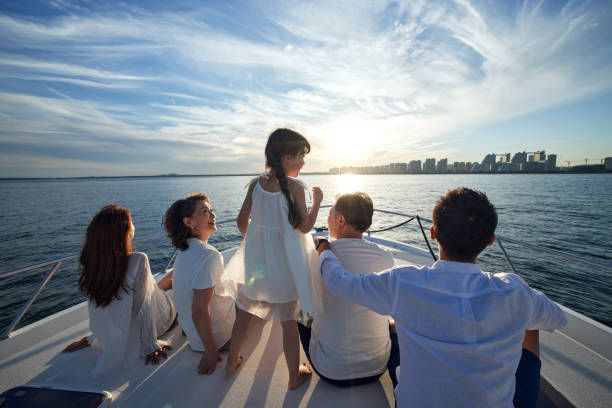
The Day My Husband’s Sister Cut Me from the Family Yacht Trip and Forgot One Tiny Detail: I Was the One Who Bought the Boat
The morning started the way most mornings did in our California house—with the particular quality of light that comes through west-facing windows around nine AM, golden and soft, turning the white marble countertops into something almost warm. I stood in the kitchen holding my favorite mug, the one with the chip on the handle that I refused to replace because it fit my grip perfectly, watching that light slide across the counter while my coffee went from hot to lukewarm.
I wasn’t doing anything important. Just scrolling my phone the way you do when you’re not really looking for anything specific, just filling time, letting the algorithm decide what deserved my attention. Instagram stories, mostly. A friend’s new puppy. Someone’s vacation photos from somewhere tropical. An influencer I followed for no good reason talking about their morning routine.
Then I saw it.
A boomerang video from my niece, Madison. She was twenty-two, recently graduated, the kind of effortlessly pretty that came from good genes and expensive skincare. In the video, champagne glasses clinked together—real champagne, not prosecco, you could tell by the bubbles and the color. People laughed in the background, their faces partially visible. And behind them, docked in what I immediately recognized as Newport Beach based on the distinctive harbor and the angle of the light, was a white yacht.
Not just any yacht. The yacht. The Preston family yacht, though they’d never actually called it that officially. Just “the boat” in that casual way rich people have of diminishing expensive things to make them seem more accessible, more normal.
The caption read: “Family getaway tradition loading. Can’t wait to set sail ⛵️✨ #PrestonLegacy #FamilyFirst”
My thumb stopped mid-scroll. Hovered over the screen without pressing anything. Just frozen there while my brain processed what I was seeing.
The annual Preston family yacht trip. The tradition that had started five years ago, right after I’d bought the yacht. The event that happened every summer, always in July, always the same week, planned months in advance with the kind of military precision usually reserved for state dinners or royal weddings.
The trip I’d been invited to exactly twice since marrying into this family seven years ago.
I tapped the post to see the full image. Then swiped to the next story. And the next. A whole series of them, posted by different family members, all showing the same scene from different angles. Faces I knew well, all dressed in that effortless resort casual that only looks easy if you spend significant time and money making it look that way.
My mother-in-law, Patricia, wearing white linen and oversized sunglasses, holding a mimosa with the yacht’s name visible on a life preserver in the background. My husband’s cousins—the ones who lived in Connecticut and only came to California for “special occasions.” Their partners, including some I’d met only once or twice at weddings or funerals. Even Aunt Dorothy, who famously “didn’t like boats” and got seasick in swimming pools, was there, smiling gamely with a ginger ale.
Everyone. The entire Preston family ecosystem, from the core members to the peripheral relatives who usually only appeared on Christmas cards.
Everyone except me.
I checked the family group chat out of habit, even though I already knew what I’d find. Or rather, what I wouldn’t find. The chat had been called “Preston Legacy Voyagers” originally—Patricia had named it that the first year they’d planned the trip, back when I was still included, still part of the inner circle, still someone whose presence was assumed rather than debated.
But I wasn’t in that chat anymore. I’d noticed my disappearance from it about six months ago, right around the time I’d declined to attend Patricia’s birthday luncheon because of a work commitment I couldn’t reschedule. The chat had simply vanished from my phone, which meant someone—I had a pretty good idea who—had removed me.
No new invite. No text to my personal number. No “Hey, are you coming this year?” No “We’re finalizing plans, want to weigh in on the itinerary?” Nothing.
Just silence. Not the loud kind of silence that demands acknowledgment. The quiet, heavy kind that lands in your chest and sits there, making it slightly harder to breathe, making everything feel slightly off-balance.
I set my coffee down on the counter, my hand not quite steady, and realized I’d been standing in the same spot for probably ten minutes, just staring at my phone screen, watching stories from a family trip I wasn’t on, featuring a yacht I’d bought with my own money.
That afternoon, my phone buzzed with a new message. I almost didn’t look at it—I’d been alternating between staring at my laptop pretending to work and staring out the window at nothing—but the preview on the screen showed it was from Valora.
My sister-in-law. My husband Devon’s older sister. The self-appointed guardian of the Preston family legacy, the keeper of traditions, the one who always knew exactly how things should be done and wasn’t shy about correcting anyone who deviated from her vision.
I opened the message.
It was a screenshot. Of a cabin assignment list. The kind of detailed spreadsheet that Valora loved to create, with color-coding and formulas and more organization than NASA used to plan moon landings.
I scanned the list quickly, looking for my name. Found it. Or rather, found where my name used to be.
Cabin 3, which Devon and I had shared during the two trips I’d been invited on, the best cabin on the yacht with the most space and the best view, now listed different occupants. My name was there, visible in the edit history, but crossed out. Struck through with a single neat line.
Underneath, in Valora’s characteristic neat typing:
Belle – confirmed ✓
Belle. Her yoga instructor. The willowy blonde woman who taught classes at the studio Valora had invested in, who posted inspirational quotes over sunset photos, who’d once asked me at a family gathering if I was Devon’s assistant before someone corrected her.
Belle was in my cabin. On my yacht. For my family’s trip.
A minute later, another message came through. This time actually directed at me, not accidentally sent.
“Hey! Just realizing we might’ve missed reserving a spot for you on the yacht this year Things filled up SO fast and I didn’t want to assume you’d want to come since you’ve been so busy with work lately. My mistake! Hope we can catch up after! Would love to hear about everything you’ve been up to! “
I read it three times, parsing the careful language. The emoji that softened the blow. The excuse about being busy that made my exclusion sound like consideration rather than dismissal. The “my mistake” that wasn’t really an apology. The promise to “catch up after” that we both knew would never happen.
My hands were steady as I set the phone down. My jaw wasn’t. I could feel the muscles there tightening, my teeth pressed together, the beginning of a headache forming behind my eyes.
The next morning, an email arrived. Subject line: “Preston Family Yacht Charter – Trip Update”
I opened it even though I knew, somehow, what it would say.
Dear Ms. Morrison,
We’re writing to confirm a modification to your reservation for the yacht charter scheduled for July 15-22. Your cabin assignment (Cabin 3, Premium Suite) has been cancelled at the request of the primary booking contact.
The cancellation was requested on June 28th, which falls outside our standard modification window. As per our policy, no refund will be issued for last-minute changes. However, since you were not the party requesting the cancellation, we wanted to notify you directly.
If you have any questions or concerns about this modification, please contact our office.
Sincerely, Newport Charter Services
June 28th. Almost three weeks ago. Long before Valora’s “just realizing” text. Long before the “things filled up so fast” excuse.
This hadn’t been a mix-up. It hadn’t been an oversight. It hadn’t been a scheduling conflict or a miscommunication or any of the other soft words we use to make cruelty sound accidental.
It had been a decision. A deliberate, calculated choice to remove me from the family trip, made weeks in advance, coordinated with the charter company, executed with the kind of planning that Valora brought to everything she considered important.
I sat at the kitchen counter—the same spot where I’d stood yesterday morning, the same spot where I’d had countless breakfasts and dinners and late-night conversations with Devon—and just stared at the email while my coffee went cold again.
The truth settled over me like fog, obscuring everything else, making it hard to see past the basic fact: I had been erased. Not just from a trip, but from the family. Quietly. Efficiently. With spreadsheets and booking confirmations and emoji-filled texts that made it all seem reasonable.
That evening, Devon came home from the office around seven, loosening his tie as he walked in, immediately gravitating to his phone to check stock alerts and market closes and whatever else he monitored with the kind of attention most people reserve for loved ones.
“Did you know your family’s planning another yacht trip?” I asked, keeping my voice carefully neutral, light, like I was asking about weekend plans rather than my systematic exclusion from his family.
“Yeah,” he said, not looking up from his phone. “Mom mentioned it last week. Said they’re still finalizing the list.”
“Am I on the list?”
That got his attention. He looked up, his expression shifting from preoccupied to confused. “What? Of course you are. Why wouldn’t you be?”
“I haven’t received an invite.”
“Well, you know how Valora is with her planning. She’s probably just waiting until everything’s confirmed before sending out official invites. Don’t assume the worst, okay? That’s not helpful.”
Don’t assume the worst. That phrase he used whenever I raised concerns about his family, whenever I pointed out slights or exclusions or the hundred small ways they made it clear I wasn’t quite one of them. As if my noticing was the problem, not the behavior itself.
I nodded. Didn’t show him the messages. Didn’t mention the email from the charter company. Just nodded and changed the subject and pretended everything was fine the way I’d learned to do over seven years of marriage to a man whose family came first, second, and third, with our actual relationship somewhere further down the list.
But inside, something shifted. Something that had been folding itself small, making itself accommodating, trying to fit into spaces that were never designed for it—that something stopped folding.
Because here’s the part no one ever said out loud, the detail that got quietly edited out of the family narrative:
That yacht they loved to call “the family boat”? The one that had become central to the Preston legacy, that appeared in Instagram posts and Christmas cards and Valora’s carefully curated photo albums?
I bought it.
Not we. Not Devon and I together. Not the Preston family trust or Patricia’s inheritance or anyone else’s money.
I bought it. With my money. From my business.
Five years ago, after building my consulting firm from nothing, after five brutal years of eighty-hour weeks and sleeping at my desk and eating takeout over spreadsheets and saying no to vacations and social events and anything that wasn’t focused on growing my client base and revenue.
After finally reaching the point where the numbers made sense, where profit wasn’t theoretical but real, where I could afford something significant without financing or payment plans or crossing my fingers and hoping.
I didn’t go on a shopping spree. Didn’t buy designer clothes or expensive jewelry or any of the things women are supposed to want when they finally have money.
I walked down to a marina in Newport Beach, toured several yachts with a broker who took me seriously because I was paying cash, and chose one that felt right. Forty-two feet. Three cabins. Beautiful teak decking. Big enough for extended trips but manageable enough that it didn’t require a full crew.
I paid for it myself. Signed the paperwork. Took possession. Named it “Serenity’s Edge” because that’s where I’d been, on the edge of peace, finally achieving something I’d worked for.
And then I’d made a mistake. A mistake I understood now, five years later, sitting in my kitchen with cold coffee and a deleted cabin reservation.
I’d shared it. With Devon’s family. Invited them to use it. Suggested the annual trip that became their tradition.
Because that’s what you do when you marry into a family, right? You share. You include them. You try to build bridges and create connections and prove that you belong.
Except somewhere along the way—so gradually I didn’t notice until it was complete—the narrative changed. My yacht became the family boat. My purchase became their legacy. My generous sharing became their assumed right.
The story of how they acquired the yacht got vaguer over time. Patricia would tell people at parties that “we have a family yacht,” letting them assume old money and inherited wealth rather than a daughter-in-law’s success. Valora posted photos tagged #PrestonLegacy as if the yacht had been passed down through generations rather than purchased five years ago by someone who wasn’t born a Preston.
And I—the actual owner, the person whose name was on the title and the insurance and the dock fees—got edited out of the story. Gradually. Quietly. Until my presence on the trips became optional, then unwelcome, then actively prevented.
The yacht I’d bought had become the symbol of a family I apparently wasn’t really part of.
A few days later, Patricia hosted a family dinner. I wasn’t invited to that either—another oversight, another scheduling conflict, another assumption that I’d be too busy with work.
But several family members streamed it on Instagram Live, because nothing says “intimate family gathering” like broadcasting it to your followers.
I watched it on my phone, alone in my living room, while Devon was allegedly working late but probably actually at the dinner he hadn’t thought to mention to me.
Patricia stood at the head of the table, glass of wine in hand, doing what she did best—holding court, making speeches, weaving the family narrative.
“As we prepare for our annual voyage,” she said, her voice carrying that particular cadence of someone accustomed to being listened to, “I want to remind everyone what this tradition means. It’s not just about a week on the water. It’s about preserving what makes our family special. About maintaining the legacy that’s been built over generations.”
She paused for effect. The camera panned across the table, showing nodding heads and raised glasses.
“We only bring the people who really understand what this legacy means,” Patricia continued. “The people who honor our values, who respect our traditions, who are truly part of the Preston family in spirit as well as name.”
Everyone smiled. Murmured agreement. Clinked glasses.
I watched it all through my phone screen, this speech about legacy delivered on a trip I’d been excluded from, featuring a yacht I’d purchased, by a woman whose son I’d married seven years ago.
The speech about “really understanding what this legacy means” was particularly rich coming from someone who’d conveniently forgotten who’d made the legacy possible in the first place.
Something inside me clicked into place. Like a lock turning. Like a door opening. Like the moment when you stop trying to solve a puzzle and realize the pieces were never meant to fit.
I stopped asking myself why they didn’t include me.
I started asking myself why I kept waiting for them to.
Why I kept making myself smaller, quieter, more accommodating, trying to fit into a space that was never going to expand to hold me.
Why I kept accepting crumbs and calling it consideration.
Why I kept letting them rewrite the story of my own accomplishments to fit their narrative.
That evening, I did something I hadn’t done before. I opened the Preston family group chat—not the Voyagers one I’d been removed from, but the larger family chat that included more distant relatives and was harder to quietly edit me out of.
I typed one message:
“I’ll see you in Newport. I trust there will be room.”
No emojis. No explanation. No softening language or apologetic tone.
Just a statement of fact. I would be there. There would be room.
Because it was my yacht.
I hit send before I could second-guess myself, then immediately opened a new browser window and booked a car service to Newport Beach for the morning of the fifteenth. Not a rental car that would require me to drive and park and deal with logistics. A car service, the kind where someone else handles everything and you can sit in the back seat and think about what you’re about to do.
I didn’t pack like I was going on vacation. No swimsuit. No resort wear. No cute matching sets “for photos.” I packed a simple navy dress—professional but not business formal. A blazer in case it was cool on the water. Comfortable shoes. And the kind of quiet resolve that shows up when you’re done begging for space at a table you helped pay for.
The morning of July fifteenth arrived with typical California coastal weather—hazy and soft, the marine layer not quite burned off yet, the sun trying to break through. I was ready by seven AM, though the car wasn’t scheduled until nine. I sat in the living room with my small suitcase by the door, drinking coffee and not checking my phone, not reading the family group chat to see if anyone had responded to my message.
Devon had left early for a “breakfast meeting” that I suspected was actually a warning session with his mother and sister about my impending arrival. He’d tried to talk to me about it the night before, suggesting that maybe I should “give them space this year,” that my “surprise appearance might make things awkward.”
I’d just looked at him until he’d stopped talking.
The car arrived exactly on time. The driver loaded my bag, held the door open, and we pulled away from the house Devon and I owned together but that had never quite felt like mine.
The drive to Newport Beach took just under an hour. I spent it watching the landscape change from suburban developments to increasingly expensive real estate, the houses getting larger and more carefully designed, the cars in the driveways more expensive, the trees more deliberately placed.
The marina where the yacht was docked was at the end of a street lined with million-dollar homes, tucked behind a gate that required either a code or confirmation from a slip owner. I gave my name—my legal name, Morrison, not Preston—and the gate opened.
The morning air smelled like salt water and sunscreen and money that doesn’t need to announce itself. The marina was beautiful in that carefully maintained way of spaces that cater to people who can afford to keep boats that cost more than most houses.
I stepped out of the car, smoothed my navy dress, and started down the dock toward slip 47, where Serenity’s Edge was moored.
That’s when I saw them.
A cluster of Prestons gathered at the base of the gangway, champagne flutes already in hand even though it wasn’t quite ten AM yet. My sister-in-law Valora stood at the center, perfectly styled in white linen pants and a navy striped top that probably cost what some people paid for rent. Her hair was blown out, her makeup flawless, her whole appearance screaming effortless wealth that actually required significant effort.
My mother-in-law Patricia stood beside her, wearing oversized sunglasses and holding a mimosa, looking like she was posing for a lifestyle magazine spread about how to age gracefully when you have unlimited resources.
My husband Devon hovered a step behind them, his eyes flicking between me and them, his expression caught between guilt and anxiety and something that might have been embarrassment.
For half a second, everything froze. A tableau of family drama, perfectly framed against the backdrop of the yacht and the harbor and the California morning.
Valora’s smile stalled mid-laugh. Her champagne flute paused halfway to her lips. Her eyes found me, narrowed just a fraction—the kind of micro-expression you’d miss if you weren’t looking for it, the moment of recognition followed by calculation followed by the decision to pretend everything was fine.
I didn’t slow down. Didn’t stop to greet them or explain my presence or apologize for the awkwardness. I just kept walking at the same steady pace, my small suitcase rolling behind me, my blazer over my arm, my expression neutral.
Bodies shifted automatically, like a choreographed dance. Valora angled her shoulder slightly, creating a physical barrier. Patricia took a small step to the side, not quite blocking the gangway but making it clear I’d have to actively push past them to board. Devon stayed where he was, frozen, clearly having no idea how to handle this situation.
The unspoken message was clear: You’re not supposed to be here. This is our space now. You should leave.
I didn’t stop. Didn’t acknowledge their positioning or their body language or the champagne-fueled confidence that usually made people defer to the Preston family’s wishes.
I walked straight past them and onto the ramp leading up to the yacht’s deck. The wood under my feet felt steady and solid in a way my place in that family never had. Real. Tangible. Mine.
At the top of the ramp, one of the crew members—a young woman in a navy blazer with the Newport Charter Services logo—stepped forward. She had her tablet ready, probably checking off guests as they boarded, managing the logistics of getting everyone settled.
She looked at me, then at her tablet, then back at me. For a second I thought there might be a problem, that maybe Valora had somehow managed to completely remove me from all the lists, all the documentation, all the official records.
But then the crew member smiled. A genuine smile, warm and professional and slightly relieved, like she’d been waiting for me specifically.
She gave me a small, respectful nod and, loud enough for the whole dock to hear—loud enough that everyone in that frozen tableau behind me could hear clearly—said:
“Welcome aboard, ma’am. We’ve been waiting for you to arrive—the owner is now on board.”
Every conversation behind me went quiet at once. Complete, absolute silence. The kind of silence that follows an explosion or a revelation or the moment when everyone realizes they’ve fundamentally misunderstood the situation.
I didn’t turn around. Didn’t watch their faces. Didn’t need to see the moment of comprehension spreading through the group like a shock wave.
I just smiled at the crew member and said, “Thank you. It’s good to be here.”
Then I walked onto my yacht, into the main salon where the air conditioning was already running and everything was exactly as it should be, and finally—finally—felt at home.
Behind me, I could hear the silence breaking. Valora’s voice, sharp with confusion: “What does she mean, owner? Devon, what is she—”
Patricia, interrupting: “This must be some kind of mistake. The boat is part of the family—”
And Devon, his voice small and miserable: “It’s not a mistake. The yacht belongs to her. It always has. She bought it. Five years ago. I thought you knew.”
“You thought we KNEW?” Valora’s voice climbed an octave. “How would we know? You never said—she never said—”
“She didn’t think she needed to,” Devon said. “It was a gift. She was sharing it with the family. She didn’t realize you’d think it was… that you’d assume…”
I moved further into the salon, out of easy earshot, though I could still hear the rising voices, the shock and anger and dawning realization that they’d excluded the actual owner of the yacht from the family yacht trip.
The crew member who’d greeted me followed at a respectful distance. “Ma’am, would you like me to show you to your cabin? I’ve had it prepared according to the original reservation.”
“That would be lovely, thank you.”
She led me down the narrow hallway to Cabin 3—the premium suite, the one with the most space and the best view, the one Valora had reassigned to Belle the yoga instructor.
“I took the liberty of moving the previous occupant’s belongings to a different cabin,” the crew member said with a small smile that suggested she’d enjoyed that task. “I hope that was appropriate.”
“Very appropriate. Thank you.”
The cabin was perfect. Sunlight streaming through the portholes. The bed made with crisp white linens. My favorite details exactly as I’d requested them when I’d first purchased the yacht—the reading lights positioned just right, the drawer space organized efficiently, the small details that made a space feel like yours.
I set my suitcase down and sat on the edge of the bed, letting myself feel the gentle rocking of the yacht, hearing the water against the hull, breathing in the familiar smell of salt and teak and the particular scent of a well-maintained vessel.
On deck, the voices had gotten louder. More people arriving, being briefed on the situation, adding their confusion and opinions to the chaos. I could hear Aunt Dorothy saying, “Well, this is awkward,” in her particular way of stating the obvious while somehow making it sound profound.
I could hear Belle—poor Belle who’d been caught in the middle of this—asking, “Should I leave? I feel like I should maybe leave?”
And I could hear Valora, attempting to regain control of the narrative: “Everyone just calm down. I’m sure we can work this out. This is still a family trip. We just need to have a conversation about expectations and—”
A knock on my cabin door interrupted the distant chaos.
“Come in,” I called.
Devon entered, looking like he’d aged five years in the last ten minutes. His tie was loosened, his hair disheveled from running his hands through it, his expression somewhere between apologetic and desperate.
“We need to talk,” he said.
“Do we?”
“They didn’t know. About the yacht. I thought they knew but I guess I never explicitly said—and they assumed—”
“They assumed it was family money. Family legacy. Family everything. And you let them assume that.”
“I didn’t realize—”
“You didn’t want to realize,” I interrupted. “Because if you admitted I’d bought it, you’d have to admit I’d earned it. That I’d succeeded. That I’d contributed something significant to this family that had nothing to do with being your wife and everything to do with being myself.”
Devon sank into the small chair by the porthole. “What do you want me to say?”
“I want you to say that you see me. Actually see me. Not as an accessory to your family. Not as someone who should be grateful to be included in their events. But as a person who bought this yacht, who shared it generously, who deserved basic respect in return.”
“I do see you—”
“Do you? Because when your sister excluded me from this trip, you told me not to assume the worst. You made it my problem for noticing instead of her problem for doing it. You chose their narrative over my reality.”
He was quiet for a long moment. “You’re right. I did. I always have. It was easier to ask you to be understanding than to ask them to be decent.”
“And now?”
“Now I’m standing in a cabin on a yacht my wife owns, listening to my family realize they’ve been assholes to someone who’s been nothing but generous to them, and I don’t know how to fix it.”
“You can’t fix it, Devon. That’s not how this works. They need to decide who they want to be. And you need to decide who you want to be married to—me, or their approval.”
Another knock. This time, the crew member’s voice: “Ma’am? The captain would like to confirm—are we proceeding with the scheduled departure, or would you prefer to delay?”
I looked at Devon. Then at the porthole showing the dock, where I could see Valora and Patricia and the rest of them still gathered, still arguing, still trying to figure out how to regain control of a situation that was never theirs to control.
“Tell the captain we depart on schedule,” I called back. “Anyone who’s not on board in thirty minutes gets left behind.”
The crew member’s voice carried a smile: “Understood, ma’am.”
Devon stared at me. “You’re serious.”
“Completely. This is my yacht. This was supposed to be a family trip. And family means making room for everyone, not excluding people because they’re inconvenient.”
“But my mother—Valora—”
“Have thirty minutes to decide if they want to be on this trip or not. Their choice.”
I stood up, smoothed my dress, and walked past Devon toward the door. Before leaving, I turned back.
“For what it’s worth, Devon, I hope you stay. I hope we can use this week to figure out if our marriage is worth saving. But that requires you to actually show up for it. To choose us over them. Can you do that?”
He didn’t answer. Just sat there looking lost and conflicted and like he was finally, maybe, starting to understand what he’d been complicit in.
I left him there and went up to the deck.
The scene that greeted me was something between chaos and comedy. Valora stood at the gangway, clearly torn between her pride and her desire to be on the yacht trip she’d spent months planning. Patricia hovered nearby, her mimosa forgotten, her expression cycling between indignation and calculation.
Belle had already left—I could see her walking back up the dock with her bags, probably relieved to escape the family drama she’d unwittingly become part of.
The other family members—the cousins, the extended relatives, the hangers-on—were scattered along the dock in small clusters, speaking in low voices, clearly unsure what the protocol was for boarding a yacht when you’d just discovered the owner you’d excluded was actually on board and making the rules.
The captain approached me—Captain Jensen, a weathered man in his sixties who’d been managing charter trips out of Newport for thirty years.
“Ms. Morrison,” he said quietly. “I’ve been briefed on the situation. How would you like to proceed?”
“Everyone who wants to come is welcome,” I said. “But they board understanding whose yacht this is and whose generosity made this trip possible. No one gets to rewrite that story anymore. Can you make that clear?”
“Consider it done.”
He walked to the gangway and, in his authoritative captain’s voice that carried across the marina, announced: “Attention Preston party. We depart in twenty-five minutes. Anyone boarding does so as a guest of the owner, Ms. Morrison. Anyone not comfortable with those terms is welcome to make other arrangements. Luggage goes in the forward hold. Life vests are located in the salon. Questions can be directed to the crew.”
It was beautiful in its directness. No room for negotiation or reframing. Just facts.
Slowly, in ones and twos, people started boarding. The cousins first, looking sheepish but game. Aunt Dorothy, who paused to give me a small nod of acknowledgment. The extended family members who’d probably never thought much about who owned what, just showed up where they were invited.
Patricia boarded looking like it caused her physical pain, her expression frozen in something between dignity and defeat. She walked past me without speaking, disappeared into the salon with her mimosa clutched like a security blanket.
Valora was last. She stood at the bottom of the gangway for a long moment, clearly warring with herself. Pride versus pragmatism. The desire to make a statement versus the desire to be on the trip she’d planned.
Finally, she started up the ramp. When she reached the deck, she stopped in front of me.
“This is my fault,” she said, the words clearly costing her. “I should have… I didn’t realize… I made assumptions that were wrong.”
It wasn’t quite an apology. But it was acknowledgment. Which was more than I’d expected.
“Yes,” I said simply. “You did.”
“Can we—can we start over? This week?”
“We can try. But starting over means actually seeing me, Valora. Not as an obstacle to your vision of family legacy. Not as someone to manage or exclude. As a person who’s been part of this family for seven years and who deserves basic respect.”
She nodded slowly. “I can do that. I think.”
“Then welcome aboard.”
She moved past me into the salon. I heard her greeting other family members, her voice subdued, missing its usual commanding certainty.
Devon appeared at my elbow. “Thank you,” he said quietly. “For not just canceling the whole trip. For giving everyone another chance.”
“I didn’t do it for them,” I said. “I did it because this yacht was meant for family gatherings. Real family. The kind that includes everyone, that makes space, that recognizes contributions. I’m hoping this week we can figure out if that’s what the Prestons actually are.”
“And us?”
“We’re part of that question. But Devon, if I have to keep proving I belong—to your family or to you—I won’t. I’m done making myself smaller. This week either shows me I have a place in this family, or it shows me I need to make a different choice.”
He nodded, understanding finally settling over his features. “Fair enough.”
The engines rumbled to life beneath our feet. Captain Jensen’s voice came over the intercom: “All passengers aboard. Departing Newport Beach Marina in five minutes.”
I walked to the bow, away from the salon where the Preston family was gathering, away from the tension and the awkwardness and the beginning of whatever reckoning was about to happen.
The morning had burned off the marine layer. The sky was clear blue now, the water sparkling, the coast stretching out in both directions with its beaches and cliffs and expensive homes perched on valuable land.
As we pulled away from the dock, leaving the marina behind, I felt something shift. Not resolution—this week was going to be complicated and uncomfortable and probably full of difficult conversations. But possibility. The possibility that honesty might matter more than performance. That reality might trump narrative. That I might finally be seen as I actually was instead of how they wanted me to be.
The yacht cut through the water smoothly, heading south along the coast. Behind me, I could hear the family settling in, voices carrying on the breeze, the clink of glasses, the beginning of the trip they’d planned without me.
Except now I was here. In my space. On my terms. Finally claiming what had always been mine.
And whatever happened this week, they would all know one fundamental truth: the yacht they’d called “the family boat” had an owner. And she wasn’t going anywhere.
THE END

Adrian Hawthorne is a celebrated author and dedicated archivist who finds inspiration in the hidden stories of the past. Educated at Oxford, he now works at the National Archives, where preserving history fuels his evocative writing. Balancing archival precision with creative storytelling, Adrian founded the Hawthorne Institute of Literary Arts to mentor emerging writers and honor the timeless art of narrative.