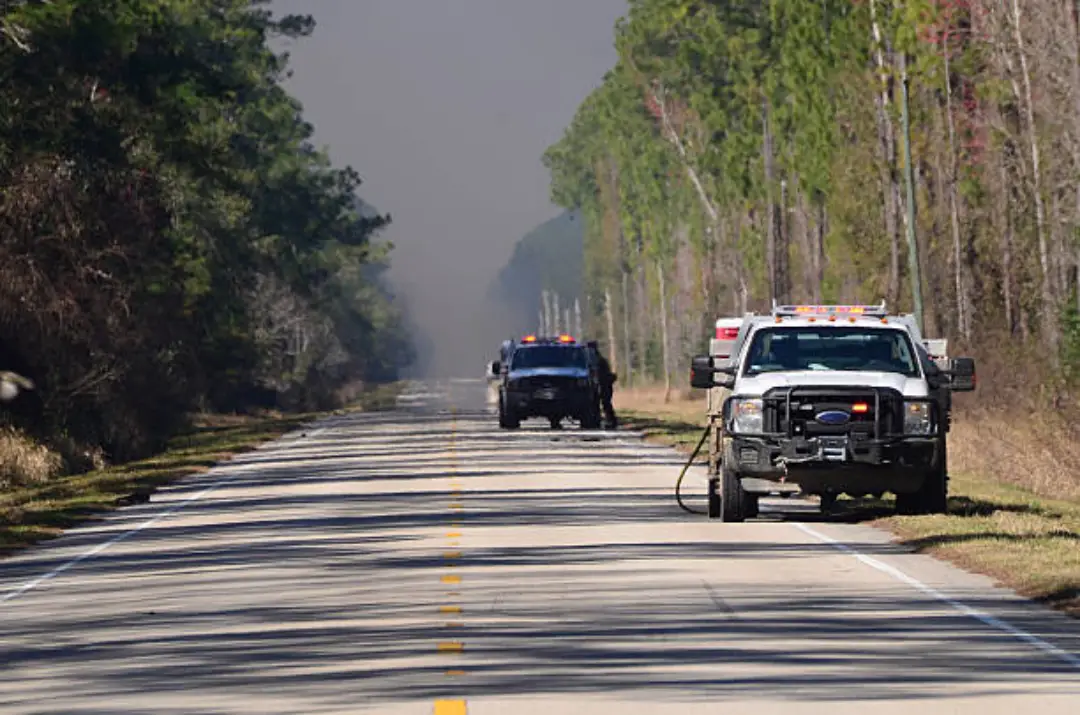
The windshield wipers fought a losing battle against the storm as I gripped the steering wheel of my Navy supply truck, counting down the miles to Norfolk Base. Sixteen hours on resupply duty, and all I wanted was a hot shower and six hours of sleep. Lightning cracked over the Virginia marshland, turning the highway into a river of rain and regret. My name is Lieutenant Emily Hayes, Navy Logistics Division, and that night I thought the only battle I’d face was exhaustion. I was catastrophically wrong.
Through the gray wall of water, a pair of hazard lights flickered weakly on the shoulder between Franklin and Suffolk. At first I thought it was abandoned debris, but as I slowed, a figure emerged through the sheets of rain—a man waving both arms in desperation. Behind him, through fogged glass, I caught a glimpse of a woman and a small child huddled together in the back seat of a disabled SUV.
The Navy manual in my glove compartment was clear: no unauthorized stops during classified transport. But my conscience whispered something different, something louder than regulations. I could already hear my commanding officer’s voice in my head cataloging the violation, but my foot was already pressing the brake. I eased the truck onto the shoulder, hazard lights blinking, and stepped out into the downpour.
The man shouted over the wind, “Engine’s dead! No cell signal out here!” I motioned him back to his car and knelt in the mud, my flashlight cutting through steam rising from the flooded engine compartment. The smell of burnt wires and coolant told me everything I needed to know—this vehicle wasn’t going anywhere tonight.
I trudged back to his window, rain streaming down my face. “You’re not getting anywhere on your own. Nearest tow service is closed, and the next town’s twenty miles through this storm.”
His face fell with the weight of understanding. “We’ll freeze out here.”
“Not if I can help it.” From my toolbox, I hauled out heavy-duty chains—standard Navy issue for rough terrain. The man tried to protest, probably worried about cost, but I cut him off with a tired smile. “Sir, consider this a logistics exercise. No charge.”
The storm howled while I hooked the SUV to my truck, my uniform clinging to my skin, water filling my boots. When everything was secure, I climbed back into the cab and checked the mirror. Their headlights glowed faintly behind me through the deluge.
We moved at a crawl down the empty highway, forty minutes of careful driving until the glow of a roadside motel appeared through the mist. Relief washed through me as I pulled into the parking lot, unhooked the chains, and checked the SUV one final time. The man stepped out, drenched but with eyes bright with gratitude.
“I don’t have much cash,” he said, fumbling with his wallet. “At least let me pay you for fuel.”
I shook my head firmly. “Not necessary, sir. Get your family warm. That’s all that matters.”
He studied me for a moment as if memorizing my face. “What’s your name, Lieutenant?”
“Hayes. Emily Hayes.”
He nodded slowly, something unreadable crossing his expression. “You’ve done more than you know.”
I climbed back into my truck, exhausted beyond measure. As I started the engine, lightning flashed again, illuminating his silhouette beside the motel sign. He raised a hand in farewell. I returned the gesture and drove off into the storm, not knowing that simple exchange would change everything.
The base gate appeared near dawn, and I rolled through with a weary wave at the sentry. Inside the logistics hangar, I filed my report mechanically, my mind already on sleep. But a note was waiting on my desk: Report to Captain Briggs. 0700 sharp. My stomach sank. That meant trouble.
The next morning came far too soon. Captain Briggs’s office smelled like burnt coffee and disappointment. He didn’t look up when I entered and saluted, just slid a document across his immaculate desk. It was a formal reprimand for disobedience of standing order 7A—no unsanctioned civilian interaction during active transport.
“You understand what this means, Lieutenant?” His voice was clipped, precise, cutting.
“Yes, sir.”
He leaned back, his perfect ribbons aligned with mathematical precision. “You jeopardized classified cargo and compromised our timeline for what? A stranded family?”
“With respect, sir, there was a child—”
“A child does not override Navy protocol.” He slammed his pen down, the sound sharp in the small room. “You’ve been one of our better officers, Hayes. But I cannot allow sentiment to dictate logistics. You’re reassigned to base operations—desk duty—until further notice.”
The punishment hit harder than any physical blow. Base operations meant paperwork, no convoys, no field missions. Just walls and fluorescent lights. “Yes, sir.”
As I turned to leave, Lieutenant Miller—my peer and constant rival—smirked from the doorway with his coffee mug. “Tough break, Hayes. Next time, try saving the world on your own time.”
I brushed past him without a word, swallowing the anger that threatened to spill over.
The logistics office felt like a prison after weeks on the road. Rows of computers hummed under harsh lights that never changed, never cared about day or night. My new supervisor, Chief Petty Officer Laram, was professionally distant. “You’ll be entering inventory data until further notice. Try to keep your head down, Lieutenant. People talk.”
Every evening, I ran the same loop around the base perimeter to clear my head, the Atlantic wind sharp and punishing. I kept seeing that child’s face through the rain, the way her small hands had pressed against the fogged glass. I wasn’t proud. I wasn’t heroic. I was just someone who couldn’t drive past a family in danger, and apparently that was a punishable offense in modern military logistics.
A week later, Captain Briggs made an example of me during morning briefing, holding up my reprimand for the entire room to see. “This is what happens when protocol is ignored. Logistics is not charity—it’s precision.” Miller shot me a look of barely concealed amusement. I stayed silent, jaw tight, counting down the minutes until I could escape.
After the meeting, Chief Morales—an older mechanic with decades of service and oil-stained hands—found me near the hangar. “Rough morning, ma’am?”
“You could say that.”
He lit a cigarette, smoke curling into the morning light. “Back when I was your age, I stopped a convoy once. Saved a kid from a wrecked car on I-64. Got written up too.” He smiled faintly. “Nothing good came of it officially, but I’d do it again. Sometimes the uniform forgets it’s worn by people.”
His words stayed with me long after he walked away.
Two weeks passed in a blur of mind-numbing routine. Then one evening, as I lingered by the pier watching the sunset burn across the water, a young ensign jogged up with a clipboard. “Lieutenant Hayes, Captain Briggs requests your presence immediately.”
My pulse quickened—another reprimand? Possible discharge? I followed him back through the corridors, my boots echoing ominously on the tile. Inside Briggs’s office, the atmosphere felt different—tense but uncertain. Two chairs faced his desk. One was occupied.
A man rose as I entered, and the world seemed to tilt sideways. Gray hair, calm eyes, unmistakable presence. His uniform gleamed with four silver stars—the insignia of an admiral.
“Lieutenant Hayes,” Briggs said stiffly, clearly as surprised as I was nervous. “Allow me to introduce Admiral Warren, Deputy Chief of Naval Operations.”
The Admiral extended his hand, and his eyes held a faint, knowing glimmer that made my breath catch. “Good morning, Lieutenant. I believe we’ve met before.”
Recognition crashed through me like thunder—the storm, the stranded car, the man who’d asked my name. My heart hammered as Captain Briggs blinked, oblivious to the undercurrent of tension filling the room.
“Admiral Warren is here to review our logistics program,” Briggs continued, his voice carrying the careful tone of someone auditioning for promotion.
But the Admiral wasn’t looking at Briggs. His gaze stayed on me—calm, measured, unmistakably familiar. I saluted sharply, mind racing. “Sir, yes, sir.”
He returned the salute. “Let’s talk about protocol, shall we?”
Three days of uncertainty followed while the Admiral conducted his review. The entire base buzzed with nervous energy as he examined personnel files, operational reports, and disciplinary records. My name apparently came up more than once. Then the summons arrived: report to command briefing room at 1400 hours.
The room was filled with tension when I arrived. Captain Briggs stood at the head of the long oak table flanked by senior officers, looking supremely confident. Admiral Warren sat at the far end, reading from a folder—my folder.
“Lieutenant Hayes,” Briggs announced, “we’re reviewing base operations for procedural discipline. The Admiral wanted to examine cases of field deviation.”
I stood at attention, forcing calm. “Yes, sir.”
Warren glanced up, eyes meeting mine briefly. “This report says you disobeyed a standing order during active supply transport. Is that correct?”
“Yes, sir. I stopped to assist civilians stranded in a storm.”
Briggs jumped in quickly. “Admiral, the infraction was clear-cut. She jeopardized cargo integrity and violated chain-of-command authority.”
The Admiral didn’t respond immediately. He closed the folder deliberately and folded his hands. “Tell me, Captain—was any cargo lost?”
“No, sir.”
“Was anyone injured?”
“No, sir.”
“Was the mission ultimately completed?”
“Yes, sir.”
“Then the only failure here was moral judgment,” Warren said quietly, his voice carrying the weight of four decades of service. “I’m still deciding whether it was yours or hers.”
The room went absolutely still. Briggs’s jaw tightened visibly. “Sir, I—”
“Captain Briggs,” the Admiral interrupted, standing slowly, his presence filling the space like gravity itself. “When I was a junior officer, my CO taught me something I never forgot. Leadership isn’t measured by who follows orders blindly. It’s measured by who can make the right call when orders fall short.” He turned to me. “You made a hard call that night, Lieutenant.”
“Yes, sir,” I said, voice steady despite my pounding heart. “I’d make it again.”
Warren nodded once, a faint smile touching his lips. “That’s exactly what I thought.” He gathered the folder and left the room without another word. The door closed behind him with quiet, deliberate finality.
Briggs stood frozen, color draining from his face. I saluted and exited, stepping into sunlight that felt different somehow—cleaner, brighter.
The next morning brought an email marked urgent: Report to Admiral’s quarters, 1000 hours. I knocked on the door of his temporary office with trembling hands.
“Enter,” came his voice.
Inside, Admiral Warren stood by the window overlooking the bay. He turned when he heard me, and the formality of our previous encounters seemed to soften. “Lieutenant Hayes. Thank you for coming. Have a seat.”
I sat carefully, unsure what was coming. He studied me quietly for a moment. “You’re probably wondering why you’re here.”
“Yes, sir.”
He picked up my personnel file. “Twelve years of service. Two commendations for crisis logistics in Bahrain. One NATO humanitarian deployment. No disciplinary actions until two weeks ago.” He looked up. “Tell me about that night on Route 58.”
I chose my words carefully. “There was a family stranded in the storm, sir. A man, his wife, and their child. The vehicle was disabled, no signal, middle of nowhere. I knew stopping violated transport protocol, but I couldn’t leave them there.”
“Why not?”
“Because doing nothing would have felt worse than breaking a rule, sir.”
The Admiral leaned back, and for a long moment he was silent. Then, softly: “That family you helped—the man, the woman, the child—they were mine.”
The air seemed to vanish from the room. He continued quietly, his voice carrying emotions he kept carefully controlled. “My daughter and grandson were driving back from DC that night. I’d warned them about the weather, but they wanted to surprise me for my birthday. Their car broke down an hour from base. You found them before hypothermia did.”
I couldn’t speak. All I could see was that child’s frightened face in the rain.
He walked around the desk and stood beside me. “You didn’t know who they were. You stopped anyway. You risked your career to help strangers. I’ve read your report and Captain Briggs’s assessment.” His tone hardened slightly. “He called your decision reckless. I call it leadership.”
“Sir, I didn’t expect anything. I wasn’t trying to—”
“I know,” he interrupted gently. “That’s exactly why it matters.” He pressed a button on the intercom. “Send in Captain Briggs.”
My heart jumped. The door opened and Briggs entered, stiff-backed, clearly unprepared.
“Admiral, sir,” Briggs began. “If this is about the operational audit—”
“Sit down, Captain.” Warren’s voice carried absolute authority.
Briggs obeyed, tension visible in every line of his posture.
The Admiral folded his arms. “Two weeks ago, one of your officers disobeyed protocol to save three lives—one of whom was my daughter. You reprimanded her, reassigned her to desk duty, and publicly humiliated her in front of her peers.”
Briggs stiffened. “Sir, my actions were within regulation—”
“I know,” Warren cut in. “That’s the problem. You enforce order, Captain. That’s your job. But order without judgment isn’t discipline—it’s blindness. You’ve created a culture where fear replaces initiative, where officers are punished for compassion.”
Briggs’s face paled. “Sir, I—”
“Enough.” The single word could have cut steel. “As of now, I am relieving you of command pending review. You’ll report to Fleet Operations in DC for reassignment. Do you understand?”
“Yes, sir,” Briggs said hoarsely, the words barely audible.
The Admiral turned to me. “Lieutenant Hayes, you are temporarily assigned as acting operations officer until further notice. You’ll oversee all humanitarian logistics reviews starting today.”
I was stunned. “Sir—”
He smiled faintly. “Consider it restitution. I want your instincts guiding this base. And Hayes—thank you. You didn’t just save my family. You reminded me what the word honor actually means.”
When I stepped outside, the morning sunlight broke through the clouds. For the first time in weeks, I could breathe without the weight of judgment crushing my chest.
Six months later, I stood in a hangar bay for a small ceremony—no bands, no press, just sailors who understood what the moment meant. Admiral Warren pinned the silver oak leaf of Commander rank on my shoulder himself, then leaned in slightly. “Some lessons take a storm to be remembered. You’ve taught one to the entire chain of command.”
He addressed the assembled unit with quiet authority. “Every rule we write exists for a reason, but no rule, no procedure, no checklist will ever outweigh the value of a human life. Commander Hayes knew that when others forgot. Let this base remember that leadership isn’t measured in perfect reports—it’s measured in moral courage.”
Silence filled the hangar, reverent and complete.
The Admiral had done more than vindicate my decision. He’d established the Samaritan Rule—a standing directive that any officer who stops to render aid, even in violation of orders, will not be punished if lives are saved. It became part of official Navy doctrine, a recognition that compassion and duty aren’t opposites but partners.
My new role was running Project Samaritan, a humanitarian logistics initiative coordinating Navy and civilian resources during natural disasters. Our motto, painted on every transport truck, came from something Admiral Warren had once said: Order serves people or it serves nothing.
A year after that storm, I received a letter from Captain Briggs. His handwriting was neat, old-fashioned.
Commander Hayes, I heard about the program you’re running. You were right. I was wrong. I spent my career thinking leadership meant control. You showed me it means conscience. I’ve applied for a volunteer post with the Red Cross. Maybe it’s time I learned what real logistics looks like.
I set the letter down slowly, feeling only closure where bitterness might have lived.
Late one evening, as I reviewed mission plans in my office, I pulled out the framed photo Admiral Warren had given me after his retirement ceremony—a grainy security camera image from that motel parking lot, my truck’s headlights bright against the rain, the stranded SUV beside it. On the back, written in his careful hand: For when the storms return, so you remember what courage looks like in the dark.
The storms did return. They always do. Hurricane Nadine. The Dismal Swamp fires. A nor’easter that stranded a school bus full of debate team students on a flooded causeway at three in the morning. Each time, we rolled out—not because regulations required it, but because people needed help and we had the means to provide it.
During one particularly brutal deployment, a young ensign named Rodriguez asked me, “Ma’am, how do you know which rules can bend?”
“You don’t,” I said honestly. “You learn which purpose can’t.”
She nodded like I’d given her coordinates to something essential.
The Samaritan Rule didn’t make everyone happy. There were hearings, oversight committees, senators who worried about liability and cost-benefit analyses. During one congressional session, a senator with a expensive tie asked me to justify rescue operations that couldn’t be graphed on a spreadsheet.
“We count everything we can measure,” I said calmly. “And we accept that the column marked ‘human’ is always going to break the curve.”
“Commander, the Navy is not a social work agency,” he said, annoyed.
“No, sir. It’s a service. The second word in our name isn’t a loophole—it’s the entire point.”
In the back row, a junior staffer stopped typing and just looked at me with an expression that suggested hope might still have a place in government work.
Two years after that night on Route 58, I drove back to the same stretch of highway. The motel still stood, its neon sign humming old hymns into the twilight. A sedan pulled in slowly, and a woman stepped out—Admiral Warren’s daughter Eliza, her hair longer now but her eyes unchanged. Beside her, a boy carried a sketchbook.
“Commander Hayes?” she asked.
“Yes, ma’am.”
“I’m Eliza Warren. This is my son Noah.” The boy opened his sketchbook to show me a drawing of a truck, a chain, and a rain-soaked road. Above it, in a child’s careful letters: SOME PEOPLE STOP.
My throat tightened. “Thank you for this.”
“Thank you for not driving past,” she said quietly. “Dad says you built a policy out of one decent act.”
“It was already the right thing to do,” I said. “We just wrote it down so others would know it’s okay to do the same.”
We stood in that parking lot for a few more minutes, three people connected by a storm and the decision to stop when it would have been easier to keep going.
Admiral Warren passed away three years later, peacefully, surrounded by family. His funeral was military but intimate—sailors who’d served with him, officers he’d mentored, and a surprising number of people who’d been helped by programs he’d championed. At the reception, Eliza handed me his old brass compass, the one he’d given me years before.
“He wanted you to have this permanently,” she said. “He always said it was off by a degree, and that you’d correct for it by instinct.”
I held the compass carefully, feeling its weight. “I’ll do my best.”
“You already have,” she said.
I still run Project Samaritan. We’ve expanded to twelve states, coordinating disaster response and humanitarian logistics across the Eastern Seaboard. The team includes active duty personnel, reservists, and volunteers—people who understand that sometimes the rulebook needs to be informed by conscience rather than the other way around.
On my office wall hangs Noah’s drawing, right beside the operational risk matrix and the official Samaritan Rule directive. It’s an odd pairing that somehow works perfectly—a child’s reminder of why we do this work positioned next to the bureaucratic framework that allows us to keep doing it.
Late at night, when the base is quiet and the only sound is the distant hum of generators and the Atlantic wind against the windows, I sometimes think about that moment on Route 58. The rain hammering the windshield, the split-second decision to stop, the weight of chains in my hands, the grateful relief in a stranger’s eyes.
I broke protocol that night. I disobeyed a direct standing order. And in doing so, I saved three lives, launched a career I never expected, and helped establish a doctrine that has since protected dozens of service members who made the same choice I did.
The Navy taught me to follow orders. That storm taught me when not to. And Admiral Warren taught me that real leadership is knowing the difference.
People often ask if I’d do it again, knowing what I know now—the reprimand, the desk duty, the public humiliation, all of it. My answer is always the same: without hesitation. Because at the end of the day, rules exist to serve people, not the other way around. And any regulation that punishes compassion has forgotten why it was written in the first place.
Some people stop when they see someone in need. Others drive past because it’s easier, safer, more convenient. I’m grateful—deeply, permanently grateful—that on one rain-soaked night in Virginia, I chose to be the kind of person who stops.
And I’m even more grateful that I serve in a Navy that eventually learned to celebrate that choice rather than punish it.
The compass on my desk is still off by a degree. I’ve never had it fixed. It reminds me that perfect precision isn’t the goal—doing the right thing is. And sometimes, the right thing means breaking the rules to honor the purpose behind them.
That’s not rebellion. That’s leadership.
And it’s a lesson I’ll carry for the rest of my life.

Adrian Hawthorne is a celebrated author and dedicated archivist who finds inspiration in the hidden stories of the past. Educated at Oxford, he now works at the National Archives, where preserving history fuels his evocative writing. Balancing archival precision with creative storytelling, Adrian founded the Hawthorne Institute of Literary Arts to mentor emerging writers and honor the timeless art of narrative.
This is an inspiring story that I am so glad that I took the time to read. I believe in looking for the good in people. I have said my whole life that making someone smile each day makes it a good day. If we could all just take a moment to be kind, what a wonderful we told it would be. Thanks again for sharing this story.