The Anniversary Dinner They’ll Never Forget
On our eighth anniversary, my husband insisted that only I prepare a feast for thirty-eight guests, while he was tucked away at a hotel with the woman from his office. I smiled and said, “Of course,” and a few hours later I was at the airport, leaving thirty-eight covered plates lined up like a perfectly behaved secret. When those covers were lifted, the room finally learned who had been doing the smiling.
My name is Natalie Harper. I’m thirty-three years old, and until very recently, I lived what looked like a comfortable life in Lansing, Michigan, with my husband Carter and his deeply involved family who never quite accepted me but had learned to tolerate my presence.
The beginning of the end started on a Sunday morning in October when my kitchen still smelled like lemon cleaner and the neighborhood looked deceptively harmless in the golden autumn light. I was drinking coffee at my kitchen table, reviewing financial projections for a client, when my phone rang.
Melody Harper. My mother-in-law.
I considered not answering—I usually did when her name appeared on my screen—but ignoring Melody only delayed the inevitable and usually made things worse.
“Hello, Melody,” I said, keeping my voice pleasant and neutral.
“Natalie.” Her tone was polite, the kind of polite that always landed like a weight on my shoulders. “I hope I’m not interrupting anything important.”
Subtext: whatever I was doing couldn’t possibly be important.
“Not at all,” I lied. “What can I do for you?”
“It’s about your anniversary,” she said. “Eight years with Carter. That’s quite a milestone.”
I waited, knowing there was more coming.
“I’d like to host a celebration dinner. Next Saturday evening. A proper party with Carter’s business associates, family, close friends. Thirty-eight guests total.”
“That’s very generous, Melody. Thank you.”
“I want it to be elegant. Memorable. The kind of event that reflects well on Carter’s position at the firm.”
Still waiting for the other shoe to drop.
“And, Natalie…” Here it came. “I’d like you to prepare the meal. Just you. I think it would be more meaningful if the dinner came from the wife rather than being catered by strangers.”
I felt my grip tighten on my coffee cup. “Just me? For thirty-eight people?”
“You’re so capable,” she said smoothly. “And you work from home, so you have the flexibility. I’ve already sent you a guest list and some menu suggestions. Nothing too complicated—just elegant and impressive.”
Work from home. As if my career as a personal financial consultant was a hobby I did between loads of laundry rather than a legitimate profession that paid half our bills.
I should have argued. Should have reminded her that the last time I’d handled an event like this alone—Carter’s promotion celebration two years ago—I’d ended up shaking with exhaustion for days while everyone else acted like my effort was background noise, expected and unremarkable.
Instead, I heard myself say, “Of course. I’d be happy to.”
Because saying no in the Harper family had always come with a price. Passive-aggressive comments about being “unwilling to contribute.” Questions about whether I was “really committed to supporting Carter’s career.” Pointed remarks about other wives who “understood what it meant to be part of a family.”
After I hung up, I sat at my kitchen table staring at the email Melody had sent with her guest list and menu suggestions—a complex three-course meal that would require days of preparation.
Elegant salad with pear, goat cheese, and candied walnuts. Herb-crusted chicken with roasted vegetables and twice-baked potatoes. Individual New York cheesecakes with berry compote.
For thirty-eight people. To be prepared by me alone while also managing my actual job and maintaining the house and presumably looking beautiful and gracious when guests arrived.
I opened my laptop and started making lists, because that’s what I do when I’m cornered—I organize, I plan, I execute. I’d learned over eight years of marriage that the path of least resistance was often the only path that didn’t end in family warfare.
Two days later, on Tuesday evening, I was reviewing financial reports for a client when my phone buzzed with a text from Emily, my best friend since college.
Emily: Is Carter home tonight?
I glanced at the empty house. Carter had left an hour ago, mentioning something about a birthday dinner for a coworker.
Me: No, coworker’s birthday celebration. Why?
Emily: Call me. Now.
My stomach dropped. Emily didn’t use that tone unless something was wrong.
I called immediately. “What’s going on?”
“I’m downtown at that wine bar on Washington. Remember how I mentioned my sister works at the Hyatt Place?”
“Yes…”
“She just texted me a photo. Natalie, I’m so sorry, but you need to see this.”
My phone buzzed with an incoming image. I opened it with hands that had suddenly gone numb.
The photo was slightly grainy, taken from a distance, but crystal clear in what it showed: Carter, wearing the navy suit I’d pressed for him that morning, standing at the front desk of the Hyatt Place hotel, leaning over the counter to kiss a woman I recognized immediately.
Sierra Walsh. His secretary. Twenty-six years old, blonde, always impeccably dressed, always at his side during office events with a professional smile and attentive demeanor.
Not professional now. The kiss was deep, intimate, familiar—the kiss of two people who’d done this many times before.
I stared at the image, waiting for the emotional devastation to hit. The tears, the rage, the heartbreak.
Instead, I felt something else entirely. A strange, cold clarity. Like a door I’d been pushing against for years had suddenly stopped resisting, swinging open to show me exactly what I’d been refusing to see.
“Natalie?” Emily’s voice, worried. “Are you okay? Say something.”
“How long do you think this has been going on?” I asked, surprised by how steady my voice sounded.
“I don’t know. But Nat, the way they were standing together, the way he kissed her—this isn’t new.”
I looked at the anniversary dinner menu still open on my laptop. The elaborate meal Melody expected me to prepare. The celebration of eight years of marriage to a man currently checking into a hotel with another woman.
“Thanks for telling me,” I said to Emily. “I need to go.”
“Wait, what are you going to do?”
“I’m going to think,” I said. “I’ll call you tomorrow.”
I hung up and sat very still in my empty house, looking at the photo of my husband’s betrayal, and for the first time in eight years of accommodating and compromising and swallowing my needs for the sake of family harmony, I let myself feel angry.
Not hysterical. Not devastated. Just coldly, clearly, purposefully angry.
I picked up my phone and made a call to someone I hadn’t spoken to in over a year—Samuel Martinez, a former client who’d hired me to organize his finances during a difficult divorce. We’d stayed in touch casually, and I knew from our conversations that he now worked as a private investigator specializing in discreet domestic cases.
“Natalie Harper,” he said when he answered, sounding pleased. “It’s been a while. Everything okay?”
“I need your professional help,” I said. “How quickly can you meet?”
We met the next morning at a small café near a bowling alley on the outskirts of town, the kind of place where nobody we knew would ever go. I slid my phone across the table showing the photo Emily had sent.
Samuel looked at it once, his expression unchanged. “Your husband?”
“Yes. And his secretary. That was taken last night at the Hyatt Place downtown.”
“What do you want from me?”
“Evidence. Documentation. Everything you can find. How long this has been going on, where they meet, whether there are others. I want facts, not suspicions.”
“And then?”
“Then I’ll decide what to do with them.”
He nodded slowly. “I can do that. But Natalie, this kind of work takes time. At least a week, maybe two, to build a comprehensive picture.”
“I have a week,” I said. “There’s an anniversary party on Saturday. I need everything you can get me by Friday.”
“That’s tight.”
“Can you do it?”
He studied me for a moment, probably assessing whether I was serious or just angry and impulsive. Whatever he saw in my face convinced him.
“I can do it,” he said. “But you need to act completely normal during this time. Don’t confront him, don’t change your behavior, don’t give him any reason to suspect you know. Let him think everything is fine. Let them both relax and get careless.”
“I can do that.”
“One more thing.” He reached into his briefcase and pulled out two small black boxes. “These are recording devices. Audio only, very small, very discreet. If you can plant them where they meet—car, hotel room, his office—they’ll give us conversations, not just suspicions.”
I looked at the innocent-looking objects—one small enough to hide in a purse or attach to a keychain, the other designed to look like a phone charger.
“Is this legal?” I asked.
“In Michigan, you can record conversations you’re a party to. These are a gray area. The recordings might not be admissible in court depending on how they’re obtained, but they’ll give you truth. What you do with that truth is up to you.”
I took the devices.
Over the next five days, I became an actress in my own life. I smiled at Carter over breakfast. Asked about his day. Pressed his shirts. Responded to his perfunctory kisses and half-attentive conversations like everything was normal.
I planted one recording device in his car, hidden in the console under a stack of old receipts. The other I placed in his home office, disguised as a phone charger plugged into an outlet he never used.
And I prepared for the anniversary dinner like the dutiful wife Melody expected me to be.
I shopped for ingredients. Tested recipes. Made detailed preparation schedules. Cleaned the house until it gleamed. Bought fresh flowers for the tables.
Meanwhile, Samuel worked. He followed Carter and Sierra. Photographed them at three different hotels over four days. Documented a pattern of afternoon “meetings” that lasted exactly two hours and always ended with them leaving separately.
He also discovered something I hadn’t expected: Sierra wasn’t the first. There had been at least two other affairs over our eight-year marriage, both with women from Carter’s office, both lasting several months before ending.
The recordings from the devices I’d planted were even more damning. Conversations between Carter and Sierra about how “convenient” it was that I was so busy with the anniversary dinner preparation. How I was “clueless” and “too focused on my little consulting business” to notice what was happening. How they were planning a weekend trip together to Chicago the following month.
On Friday evening, Samuel met me at the same café and handed me a thick folder.
“Everything you asked for,” he said. “Photos, recordings, timeline, documentation. It’s all here. The pattern is clear and long-standing. What are you going to do?”
I looked at the folder, eight years of marriage reduced to evidence of systematic betrayal.
“I’m going to leave,” I said simply.
“The party is tomorrow.”
“I know.”
On Saturday morning, I woke up at five a.m. and began cooking. Carter was still asleep, would sleep until nine because he “needed rest before the big evening.”
I prepared the pear and goat cheese salad—thirty-eight individual servings plated beautifully. I made the herb-crusted chicken, roasted the vegetables, assembled the twice-baked potatoes. I baked thirty-eight individual cheesecakes and made fresh berry compote.
It took me six hours of continuous work, but by eleven a.m., everything was ready, covered, and arranged in my dining room which Melody had helped set up the day before.
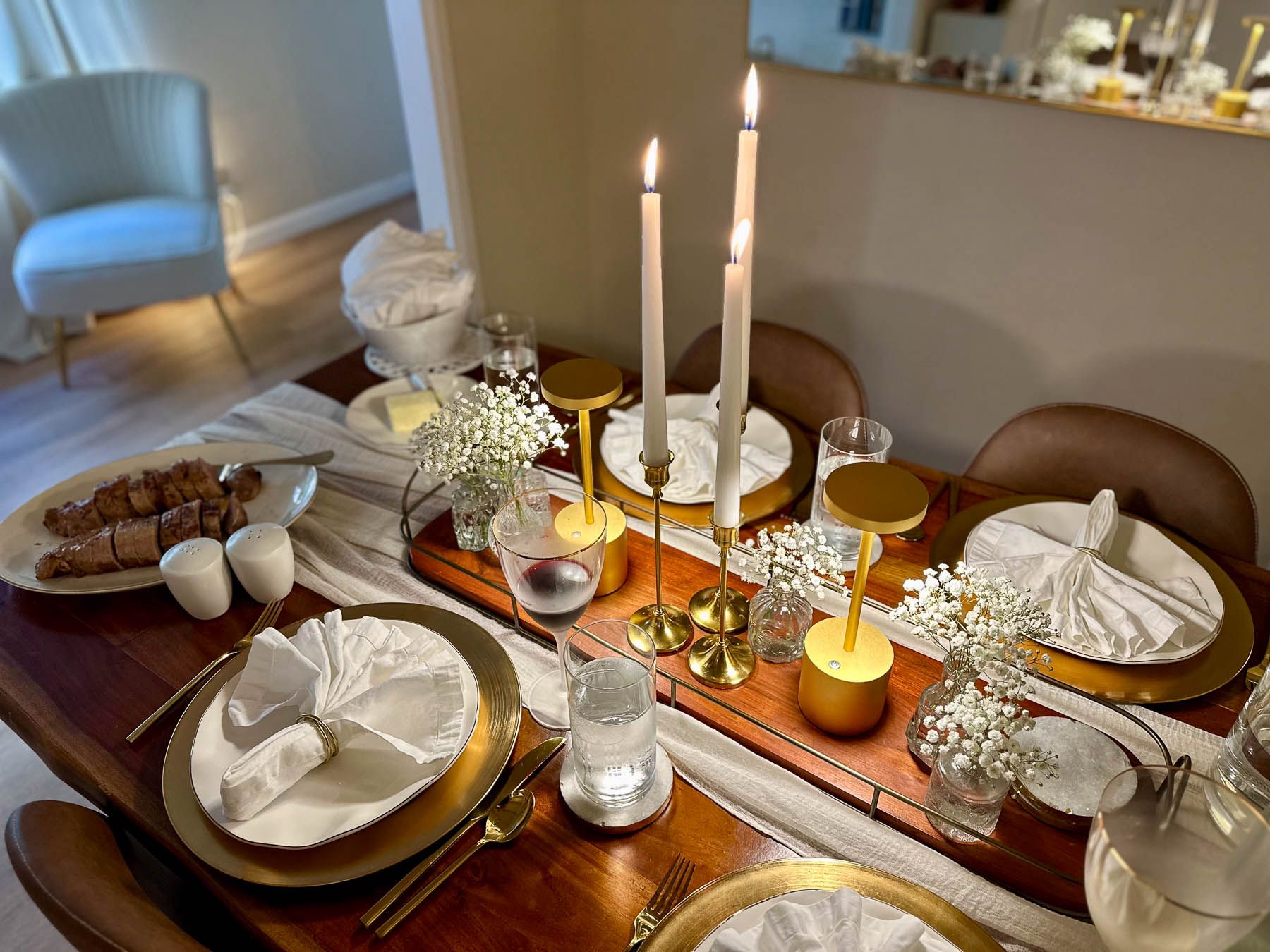
Thirty-eight place settings. Thirty-eight gleaming silver plate covers. Candles waiting to be lit. Flowers arranged perfectly. Everything looked exactly like the elegant anniversary celebration Melody had requested.
Carter woke around nine-thirty, wandered into the kitchen, poured coffee, and barely glanced at my work.
“Looks good,” he said absently, scrolling through his phone. “What time are people arriving?”
“Six,” I said. “You should probably shower and get ready.”
“I have some errands to run first,” he said. “I’ll be back by five.”
Errands. Right.
At noon, while Carter was out at his “errands” (Samuel would later confirm he’d met Sierra for lunch at a restaurant forty minutes away), I loaded two suitcases into my car. Everything essential—documents, laptop, clothes, personal items, the folder Samuel had given me.
I left my wedding ring on the kitchen counter with a brief note:
Carter, Enjoy your anniversary dinner. I’ve prepared everything exactly as requested. —N
Then I called Emily. “Can you pick me up at the airport in Portland? I’m coming to stay with you for a while.”
“Oh my god, you’re really doing this?”
“I’m really doing this.”
“I’ll be there. Text me your flight details.”
At one p.m., I drove to Capital Region International Airport. Carter had actually offered to drive me that morning, still believing my cover story about visiting my supposedly ill mother in Portland, but I’d declined, saying I’d take my own car and leave it in long-term parking.
He’d kissed my forehead in that distracted, perfunctory way he’d developed over the years—the gesture of a man checking off a task rather than expressing affection.
I parked, checked my bags, went through security, and boarded a flight to Portland while my kitchen timer sat on the counter at home, set to go off at 5:45 p.m.—fifteen minutes before guests would start arriving.
The timer would remind someone to light the candles.
It would also trigger something else.
Because underneath each of those thirty-eight gleaming silver plate covers wasn’t the elegant meal I’d spent the morning preparing.
The real food was safely stored in coolers in my car at the airport, destined for a women’s shelter Emily had helped me contact.
What was under those covers was something entirely different.
I’d spent Friday evening, while Carter was out meeting Sierra, preparing thirty-eight identical presentations.
Each plate held a printed photograph—large, clear, impossible to miss. Carter and Sierra kissing at the Hyatt Place. Carter and Sierra entering a hotel together. Carter and Sierra in his car, her hand on his leg.
Beneath each photo was a printed message:
HAPPY ANNIVERSARY Eight years of marriage. Three documented affairs. Countless lies.
The food Natalie prepared is being donated to charity. This is what you’re being served instead: THE TRUTH.
Natalie Harper has left the building. Carter, your secretary is lovely. I’m sure you’ll be very happy together. To everyone else: I’m sorry you came for dinner and got a scandal instead. But I’m not sorry you finally know who you’ve been celebrating all these years.
And at the bottom of each message, in smaller print:
P.S. Melody, thank you for insisting I prepare this dinner alone. I couldn’t have orchestrated this reveal without your help.
I landed in Portland at 4:30 p.m. local time (6:30 p.m. in Lansing) and turned my phone on to find thirty-seven missed calls and countless text messages.
From Carter: confusion, then anger, then panic. From Melody: outrage, then hysteria. From various family members: shock, questions, demands for explanation.
One text from Emily, who I’d secretly invited to the dinner as my witness: OMG. The covers came off at 6:15. You should have seen their faces. Melody actually fainted. Carter turned white. Half the guests left immediately. The other half took photos. This is LEGENDARY.
I turned my phone off and let Emily drive me to her apartment, where I would stay for the next three months while I filed for divorce, moved my consulting business entirely online, and started building a life that didn’t require me to smile while being diminished.
The divorce was ugly. Carter tried to claim I’d humiliated him publicly, that I’d destroyed his reputation at his firm (he was asked to resign two weeks after the dinner party), that I’d orchestrated a cruel and vindictive revenge scheme.
My lawyer presented the folder Samuel had compiled. The photos. The recordings. The evidence of three separate affairs and eight years of systematic deception.
Carter’s lawyer advised him to settle quickly and quietly before I decided to make everything public beyond the thirty-eight dinner guests who already knew.
I got the house—which I immediately sold. Half of all marital assets plus a significant settlement for emotional distress. Full documentation of his infidelity that protected me from any claims of fault in the divorce.
Melody tried to call me seventeen times. I never answered. Eventually, she sent a letter. A long, rambling attempt at explanation that somehow managed to make Carter’s affairs my fault for not being “attentive enough” and my public reveal of them a worse crime than the actual betrayal.
I threw it away unread after the first paragraph.
Some of Carter’s family members reached out with apologies, admitted they’d suspected something was wrong, said they wished they’d spoken up.
I thanked them politely and didn’t maintain contact. Because where were those suspicions when I was being told to prepare elaborate dinners alone? When I was being treated like my career didn’t matter? When I was being diminished at every family gathering?
Six months after the anniversary dinner, I was living in Portland permanently, running my financial consulting business entirely remotely with a client base that had actually grown after word spread about my “creative problem-solving skills.”
Emily and I were having coffee when my phone rang. Unknown number. I almost didn’t answer, but something made me pick up.
“Natalie Harper?” A woman’s voice, uncertain.
“Yes?”
“My name is Jessica Thornton. You don’t know me, but… I was at your anniversary dinner. Guest number twenty-two. I came with my husband, who works with Carter.”
I waited, unsure where this was going.
“I just wanted to call and say thank you.”
“Thank me?”
“What you did—exposing the truth like that, refusing to keep covering for him—it was brave. And it made me realize I’d been doing the same thing in my own marriage. Making excuses, pretending everything was fine, accepting behavior I shouldn’t accept.”
“I’m sorry to hear that,” I said carefully.
“No, I’m grateful. I filed for divorce last month. Best decision I ever made. And I wanted you to know that what you did mattered. Not just for you, but for people watching who needed to see someone refuse to keep smiling through their own diminishment.”
After we hung up, I thought about that phrase: refuse to keep smiling through their own diminishment.
That’s exactly what I’d been doing for eight years. Smiling while being told my work didn’t matter. Smiling while being expected to sacrifice my time and energy for other people’s convenience. Smiling while my husband built a life of deception and my in-laws built a narrative where I was always slightly insufficient.
The anniversary dinner wasn’t revenge, though it certainly looked like it.
It was the moment I stopped smiling.
The moment I chose truth over peace.
The moment I decided that if I was going to prepare a feast for thirty-eight people, they were going to get exactly what they deserved: not elegant food and polite fiction, but the unvarnished reality they’d all been complicit in ignoring.
Carter tried to reach out six months after the divorce was finalized. A long email about how he’d “made mistakes” and “hoped we could find forgiveness” and “maybe start fresh.”
I deleted it without responding.
Because forgiveness isn’t about pretending wounds didn’t happen.
And starting fresh doesn’t mean going back to someone who repeatedly chose to hurt you.
A year after the anniversary dinner, I was thriving. My business had doubled. I’d made new friends who valued me for myself rather than as an accessory to someone else’s ambitions. I’d started dating casually, nothing serious, just remembering what it felt like to be seen and chosen and appreciated.
Emily and I still laughed about the dinner sometimes. About Melody fainting. About the guests who took photos like they were documenting a celebrity scandal. About the perfect timing of thirty-eight silver covers being lifted simultaneously to reveal thirty-eight identical truths.
“Do you regret it?” Emily asked me once. “The way you did it? Some people think you should have just left quietly.”
I thought about it. About the satisfaction of watching truth emerge from under those gleaming covers. About the freedom of finally, definitively refusing to protect people who’d never protected me.
“Not even a little bit,” I said.
Because the hardest part wasn’t leaving.
The hardest part was all those years of staying.
Of smiling.
Of pretending.
Of preparing elaborate feasts for people who never once asked if I needed help.
The anniversary dinner was just the moment I stopped doing the hard thing and started doing the right thing.
And if that meant thirty-eight people had to have their elegant evening disrupted by reality?
Well.
Sometimes the truth isn’t elegant.
But it’s always worth serving.
THE END

Lila Hart is a dedicated Digital Archivist and Research Specialist with a keen eye for preserving and curating meaningful content. At TheArchivists, she specializes in organizing and managing digital archives, ensuring that valuable stories and historical moments are accessible for generations to come.
Lila earned her degree in History and Archival Studies from the University of Edinburgh, where she cultivated her passion for documenting the past and preserving cultural heritage. Her expertise lies in combining traditional archival techniques with modern digital tools, allowing her to create comprehensive and engaging collections that resonate with audiences worldwide.
At TheArchivists, Lila is known for her meticulous attention to detail and her ability to uncover hidden gems within extensive archives. Her work is praised for its depth, authenticity, and contribution to the preservation of knowledge in the digital age.
Driven by a commitment to preserving stories that matter, Lila is passionate about exploring the intersection of history and technology. Her goal is to ensure that every piece of content she handles reflects the richness of human experiences and remains a source of inspiration for years to come.