The Workshop That Wouldn’t Fall
My future son-in-law scoffed, declaring, “Tomorrow I’ll bring my development team” to clean out my forty-year-old woodworking shop—I didn’t argue, I just sent a text message, and at exactly ten o’clock, the entire road was suddenly packed with cars.
My name is Thomas Garrett. I’m sixty-three years old, and I’ve lived on this piece of land beside Lake Simcoe in Ontario for most of my adult life. The workshop behind my house isn’t just a building to me—it’s forty years of sawdust and cedar, of quiet mornings and patient craftsmanship, of the kind of steady work that keeps a man grounded when life tries to shake him loose.
The workshop is more than wood and nails. It’s memory made solid.
My late wife Sarah helped me raise those walls in 1985, back when our daughter Emma was still learning to walk and the world felt full of possibility and promise. We’d saved for two years to buy the materials, spent weekends that spring measuring and cutting and hammering together, laughing when things didn’t fit quite right, celebrating when the frame finally stood square and true.
Sarah painted the door bright red because she said it needed personality. She hung the old ship’s bell outside so she could ring it when dinner was ready, the sound carrying across the yard and pulling me back from whatever project had absorbed my attention.
Even now, eighteen years after cancer took her from us, when I slide my palm across the workbench she helped me sand smooth, I can almost hear her laugh in the grain of the wood. Can almost smell the lemonade she’d bring out on hot afternoons. Can almost feel her presence in the space we built together.
Emma grew up in the shadow of that workshop. Grew up kind and smart and grounded, the kind of daughter who checks on her old man between twelve-hour shifts at the hospital, who still remembers the smell of varnish on my hands and the sound of the table saw on Saturday mornings.
She’d spend hours out there with me as a child, “helping” in the way children do—mostly making sawdust angels and asking endless questions about why wood needed to be measured twice and cut once. As she got older, she actually learned. By sixteen, she could operate every tool in the shop safely. By twenty, she’d built her own bookshelf, precise and beautiful, that still stands in her apartment today.
The workshop was where we talked about her mother after she died. Where we figured out how to be a family of two instead of three. Where Emma cried about her first heartbreak and I taught her that some things, like good joinery, just take time to heal properly.
So when she called me six months ago, voice bright with excitement, saying she’d met someone special, I was genuinely happy for her. Emma deserved happiness. Deserved love. Deserved someone who saw how extraordinary she was.
Then she brought Derek home to meet me.
Derek Mitchell. Thirty-four years old. Toronto real estate developer. The kind of man who wears expensive watches and designer shoes, who speaks in calculated sentences that sound friendly but land like negotiations.
He had slick hair styled with product that probably cost more than my monthly pension. He drove a Mercedes that looked like it belonged in a showroom rather than on rural roads. And he had that particular confidence that comes from never having been told no in a way that stuck.
Our first meeting was cordial enough. He complimented the house—”charming,” he called it, which is what people say when they mean “outdated but salvageable.” He asked about my work history, my hobbies, my plans for retirement, questions that felt more like an intake interview than conversation.
But it was the way he looked at my property that made my instincts prickle with warning. His eyes catalogued everything with the cold assessment of someone calculating value. Waterfront access. Lot size. Development potential.
He didn’t see a home. He saw an opportunity.
Over the following months, as his relationship with Emma grew serious, Derek’s visits became more frequent and his questions more pointed. How much land did I own? What were the zoning regulations? Had I considered what the property might be worth to developers? Did I really need all this space for just one person?
I answered politely but vaguely, uncomfortable with the direction of his interest but not wanting to cause friction with my daughter’s boyfriend.
Then three weeks ago, he proposed to Emma. She called me crying happy tears, and I was genuinely pleased for her despite my reservations about Derek. Emma loved him, and who was I to judge? Maybe I was just being an overprotective father. Maybe his professional interest in real estate was bleeding into personal conversations in ways he didn’t realize were inappropriate.
I told myself to give him the benefit of the doubt.
That benefit ended on a Tuesday morning in October when Derek showed up alone, unannounced, and walked straight through my kitchen like he’d already bought the place.
I was making coffee when I heard his Mercedes pull up outside. Through the window, I saw him get out alone—no Emma—and approach my door with purposeful strides.
“Tom,” he said when I answered, deliberately using the shortened version of my name despite knowing I prefer Thomas. “Got a minute? We need to talk.”
He didn’t wait for an invitation, just walked past me into the kitchen, accepting the coffee I offered out of ingrained politeness despite my growing irritation.
He stood at my kitchen window, staring out at the workshop with the calculating expression I’d come to recognize and distrust.
“Beautiful property,” he said. “Wasted on a single-family dwelling, honestly. You’ve got what, two acres here? Waterfront access? In this market, the potential is incredible.”
“I’m not interested in selling,” I said firmly.
He turned to face me with a patient smile, the kind you give children who don’t understand complex adult matters.
“I know change is hard, especially at your age,” he said, as if sixty-three made me ancient and confused. “But you’re being sentimental, Tom. That workshop out there—it’s just a hobby space now. When’s the last time you actually built something? When’s the last time you even used half those tools?”
My jaw tightened. I’d completed a dining table last month, a commission for a young couple in town. I used my tools every week, sometimes every day. But Derek wasn’t actually interested in facts. He’d already decided what reality was.
“I’m getting married to your daughter,” he continued, settling into a chair at my kitchen table like we were having a friendly chat. “That makes us family. Family looks out for each other, makes smart decisions together. And the smart decision here is obvious.”
He pulled out his phone and showed me photographs—architectural renderings of luxury condos, lakefront developments, property listings with eye-watering prices.
“I’ve got investors ready to move on this,” he said. “We’re talking premium lots, luxury builds, the kind of project that transforms a whole area. Your property is the keystone piece. The location is perfect, the access is ideal, and frankly, you’re sitting on a goldmine you’re not using.”
“I’m using it to live,” I said quietly. “This is my home.”
“This is real estate,” he corrected. “And you’re letting emotion cloud your judgment. Look, I get it. Your wife helped build that workshop. Emma grew up here. There’s history. But history doesn’t pay the bills, and it doesn’t provide for your future.”
“My future is fine,” I said, my voice harder now.
“Is it?” He leaned forward, dropping the friendly pretense. “You’re sixty-three, Tom. How much longer can you realistically maintain this place? What happens when you can’t handle the upkeep anymore? When winter comes and the pipes freeze because you’re too old to deal with it properly? You’re one bad fall away from needing assisted living, and then what? Emma has to drop everything to take care of a house she doesn’t want?”
The manipulation was breathtaking in its audacity. Painting himself as the practical one, the caring future son-in-law looking out for everyone’s best interests, while systematically dismissing everything that actually mattered to me.
“I’ve found you a perfect condo in town,” he continued, pulling up more photos. “Maintenance-free, accessible, close to shops and medical facilities. One bedroom, because let’s be honest, you don’t need more. We’d handle the move, obviously. And the proceeds from selling this place would set you up comfortably for whatever time you have left.”
Whatever time I have left. As if I was already halfway to the grave, an inconvenient obstacle between him and his development dreams.
“I’m not selling,” I repeated, standing up to signal the conversation was over.
Derek stood too, but he didn’t move toward the door. Instead, he stepped closer, lowering his voice to something almost threatening despite the continued smile on his face.
“You don’t really have a choice here, Tom. I’ve already talked to my development team. They’re excited about the project. We’ve run preliminary surveys, checked zoning regulations, lined up financing. This is happening. The only question is whether you cooperate and make this easy, or whether we do it the hard way.”
“What hard way?” I asked, my voice dangerously quiet.
“Emma wants me to be happy,” he said simply. “She loves me. And she understands that sometimes we have to make difficult choices for the greater good. She knows her old dad is being stubborn about this, stuck in the past. With a little time, she’ll see that moving you into something more appropriate is actually the kindest option.”
The threat was clear. He’d use my daughter—manipulate her love for both of us—to pressure me into surrendering my home and my workshop and my life.
“Get out,” I said.
“Tomorrow at ten,” Derek said, ignoring my order, heading toward the door on his own schedule. “My development team is coming to assess the property properly. We’ll need access to everything, including that workshop. I’d appreciate it if you could clear out any personal items you want to keep. We’ll dispose of the rest. Some of those tools might have vintage value—I’ll have someone appraise them, give you fair market price.”
He paused at the door, one hand on the frame, looking back with that infuriating patient smile.
“This is progress, Tom. Evolution. You can’t stop it. You can only decide whether you’re going to adapt gracefully or make everyone miserable by clinging to something that’s already gone.”
Then he left, climbing into his Mercedes and driving away like he’d just closed a successful business meeting.
I stood in my kitchen for a long time after his taillights disappeared, feeling something cold and certain settling in my chest.
Not fear. Not even anger, exactly.
Clarity.
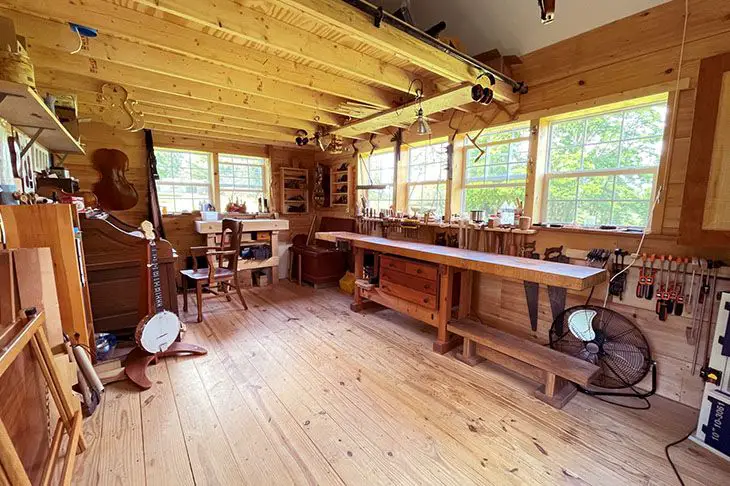
I walked out to the workshop, my feet following the path worn smooth by forty years of daily passage. Inside, everything was exactly as I’d left it—tools hanging on pegboards Sarah had helped install, workbenches scarred by decades of projects, the smell of cedar and varnish and machine oil that had soaked into the very walls.
In the corner sat an unfinished rocking chair, the one I’d been working on for months. Tiny butterflies were carved into the arms, delicate and detailed, created for the grandchild Emma might have someday. Each butterfly had taken hours, carved with patience and love and hope for a future I might not see but wanted to contribute to anyway.
This wasn’t “just a hobby space.” This was my life’s work. My connection to Sarah. My gift to future generations. My refuge and my purpose.
Derek could threaten all he wanted. Could manipulate and pressure and scheme.
But he’d made one critical miscalculation.
He assumed I was isolated. Alone. Powerless.
He was wrong.
I pulled out my phone and opened a group chat I hadn’t used in months—a list of names that represented forty years of friendship, community, and shared history.
The Simcoe Woodworkers Guild. Thirty-seven members, ranging in age from twenty-five to seventy-eight, scattered across Ontario but connected by a love of craftsmanship and a fierce loyalty to each other.
We’d formed the guild in 1987, meeting monthly to share techniques, showcase projects, support each other’s businesses. Over the decades, we’d become more than a professional organization. We’d become family—the kind that shows up when someone needs help, no questions asked.
I typed one sentence: “Need the guild at my place tomorrow, 10 AM. Someone’s trying to take the shop.”
I didn’t elaborate. Didn’t need to. These were people who understood what a workshop meant, what forty years of work represented, what it felt like to have outsiders dismiss your life’s passion as disposable.
The responses came within minutes.
“I’ll be there.” – Frank, who’d lost his own shop to a commercial development three years ago and still regretted not fighting harder.
“Count me in.” – Margaret, whose furniture business had started in a space smaller than mine.
“Wouldn’t miss it.” – James, who I’d mentored twenty years ago when he was just starting out.
“On my way.” – Patricia, who lived four hours away but apparently didn’t care.
One by one, all thirty-seven members responded. Some with just a thumbs up emoji. Others with longer messages of support and outrage. But every single one confirmed they’d be there.
I didn’t ask them to bring anything. Didn’t coordinate a strategy or plan a confrontation.
I just needed them there. Needed Derek to see that I wasn’t alone, wasn’t powerless, wasn’t an isolated old man he could steamroll.
That evening, Emma called.
“Dad, Derek mentioned he stopped by today. He said you two talked about your future plans?”
Her voice was tentative, carefully neutral in that way that meant she knew something was wrong but didn’t want to assume.
“Did he mention he’s planning to demolish my workshop?” I asked.
Silence on the other end. Then, quietly, “What?”
I explained everything. Derek’s unannounced visit, his threats, his development plans, his assumption that he could simply erase my life because it was inconvenient for his profit margins.
“Dad, I—I didn’t know,” Emma said, and I could hear tears in her voice. “He said he was going to talk to you about future planning, about making sure you were set up for retirement. He never said anything about development or forcing you to move.”
“He’s good at telling people what they want to hear,” I said gently. “He told you one thing, told me another, and probably tells his investors something else entirely.”
“I can’t believe—” She stopped, breathing hard. “I need to talk to him.”
“You do what you need to do,” I said. “But Emma? Don’t let him manipulate you into thinking I’m being unreasonable. This is my home. My choice. And I’m not going anywhere.”
“I know, Dad. I know. I’m so sorry. I’ll handle this.”
But I knew she couldn’t, not really. Derek had shown me who he was—someone who saw people as obstacles and homes as opportunities. Emma confronting him would just make him adjust his strategy, become more subtle, more manipulative.
No, this needed to be resolved tomorrow, in a way he couldn’t talk or scheme his way around.
I didn’t sleep much that night. Spent most of it in the workshop, running my hands over familiar tools, remembering Sarah’s laugh and Emma’s childhood questions and forty years of quiet, purposeful work.
As sunrise painted the lake gold, I made coffee and stood on my porch, waiting.
At nine-thirty, I heard the first vehicle. Frank’s truck pulled into my driveway, followed immediately by Margaret’s van. Then James arrived with three younger guild members I’d never met but who’d apparently heard about the situation and wanted to help.
By nine forty-five, my driveway, yard, and the road in front of my house were packed with vehicles. Trucks, vans, sedans, even one ancient station wagon held together with rust and determination.
Thirty-seven woodworkers, standing in loose groups around my property, drinking coffee from thermoses, talking quietly among themselves, waiting.
Some had brought tools—not as weapons, just as symbols of their trade. Others had brought nothing but themselves and their solidarity.
At nine fifty-eight, Derek’s Mercedes appeared at the end of the road.
I watched his expression change as he got closer and realized the driveway wasn’t empty. Watched confusion shift to irritation as he pulled up and saw the crowd of people standing between him and the workshop.
He parked on the road—no room in the driveway—and got out slowly, his confident smile already reassembling itself like armor.
“Tom,” he called, walking toward me with forced casualness. “I see you have company. Were you planning some kind of neighborhood gathering I should know about?”
“Guild meeting,” I said simply.
Behind him, another vehicle pulled up—a large van with “Apex Development Solutions” printed on the side. Three men in business casual got out, carrying tablets and measuring equipment, looking confused by the crowd.
“Derek?” one of them called. “Is this the right property?”
“Yes,” Derek said, his smile tightening. “Just give us a minute.”
He walked closer to me, lowering his voice. “What exactly are you trying to prove here, Tom? Did you really rally your little craft club to throw some kind of tantrum? This is business, not a hobby convention.”
Frank stepped forward. He was seventy-two, built like a bear, with hands that had shaped wood for half a century and a voice that didn’t need to be loud to carry authority.
“Business?” he said. “You think you’re conducting business here?”
“I’m conducting a property assessment for a legal development project,” Derek said, his tone hardening. “Which has nothing to do with you or any of these people. This is between me and Tom.”
“You’re wrong,” Margaret said, joining Frank. “This is between you and everyone who understands what that workshop represents. What forty years of work means. What home means.”
Derek looked around at the assembled crowd—thirty-seven faces ranging from young apprentices to elderly masters, all wearing the same expression of quiet, unmovable resistance.
“You can’t stop progress,” Derek said, but his voice had lost some of its certainty.
“Progress,” James repeated, and he laughed without humor. “You keep using that word. I don’t think you know what it means. Building things that last, teaching skills to the next generation, creating beauty and utility with your hands—that’s progress. What you’re proposing is just destruction with a profit margin.”
One of the development team members approached Derek nervously. “Sir, maybe we should reschedule? There seems to be some kind of dispute—”
“There’s no dispute,” Derek snapped. “These people are trespassing. They have no legal right to block this assessment.”
“We’re not trespassing,” I said calmly. “They’re my guests. On my property. Which I own. And which is not for sale, not for development, and not subject to any assessment by you or your team.”
“Emma and I are getting married,” Derek said, his voice rising. “That makes this family business. You can’t just—”
“Family?” Frank interrupted. “Family doesn’t threaten. Family doesn’t manipulate. Family doesn’t try to steal someone’s life work for profit.”
“I’m not stealing anything! I’m offering fair market value for—”
“Nothing,” I said firmly. “You’re offering fair market value for nothing, because I’m not selling. And I don’t care how many times you threaten, manipulate, or pressure me. This is my home. These are my friends. And you need to leave.”
Derek’s face flushed red. He looked at his development team, at the crowd of woodworkers, at me standing firm on my own porch.
“Fine,” he spat. “Enjoy your little victory. But when Emma sees how unreasonable you’re being, when she understands that you’re putting sentiment over her future happiness—”
“Derek.”
We all turned. Emma’s car was pulling up, parking hastily on the shoulder of the road. She got out and walked straight toward Derek with an expression I recognized from her childhood—the one that meant someone had crossed a line and was about to face consequences.
“What are you doing here?” Derek asked, his voice suddenly uncertain.
“What am I doing here?” Emma’s voice was sharp enough to cut. “My dad called me last night and told me everything. Everything you said, everything you threatened, everything you tried to do.”
“I was handling it,” Derek said, reaching for her arm. She stepped back.
“You were threatening my father. You were trying to steal his home. You were using our relationship as leverage to manipulate him. That’s not handling anything—that’s being cruel and greedy and manipulative.”
“Emma, you don’t understand the business implications—”
“I understand that you lied to me. You told me you were having a conversation about retirement planning. You never mentioned development, or forcing him to move, or any of this.”
“I was protecting you from—”
“From what? From knowing that my fiancé is the kind of person who would destroy someone’s life work for profit? From knowing that you see my father as an obstacle instead of a person?”
Derek’s confident facade was crumbling. He looked around at the crowd, at Emma’s furious face, at me standing quietly on my porch, and seemed to realize that his schemes had fallen apart completely.
“This could have been good for everyone,” he said weakly.
“It was only ever good for you,” Emma said. “And I think you should leave now.”
“What about us?” Derek asked, and there was genuine confusion in his voice, as if he couldn’t understand how his actions might have consequences.
Emma pulled off her engagement ring and held it out to him.
“There is no us,” she said. “Not anymore. I can’t marry someone who would treat my father this way. Who would lie to me. Who values money over people.”
Derek stared at the ring in her outstretched hand like he couldn’t process what was happening.
“You’re making a mistake,” he finally said.
“The only mistake I made was not seeing who you really were sooner,” Emma replied. “Take the ring. Take your development team. And don’t come back.”
For a moment, I thought Derek might argue further. But something in Emma’s expression—the absolute certainty, the closed door—finally penetrated.
He took the ring, pocketed it without looking at it, and walked back to his Mercedes. His development team hurried to follow, piling into their van without a word.
We all watched as both vehicles drove away, disappearing down the road.
The silence that followed was profound. Then Frank started clapping—slow, deliberate, proud. Margaret joined him. Then James. Then all thirty-seven members of the guild, applauding not for victory over Derek but for something more important: for standing firm, for community, for the principle that some things matter more than profit.
Emma walked over to me, tears streaming down her face, and wrapped me in a hug.
“I’m so sorry, Dad,” she whispered. “I should have seen it sooner. I should have protected you.”
“You did protect me,” I said, holding her tight. “When it mattered most, you chose what was right over what was easy. That’s all anyone can ask.”
The guild members started filtering away gradually, each stopping to shake my hand or pat my shoulder, offering quiet words of support and solidarity before heading home to their own workshops and lives.
Frank was the last to leave.
“Good stand, Thomas,” he said. “Proud of you.”
“Couldn’t have done it without all of you,” I said.
“That’s what guild means,” he replied. “That’s what community means. You’d do the same for any of us.”
After everyone left, Emma and I sat on the porch, drinking coffee, watching the lake catch the afternoon light.
“I really thought I loved him,” she said quietly.
“Maybe you loved who you thought he was,” I suggested. “That’s not your fault.”
“How did you know? What he was really like?”
“He looked at this place and saw opportunity,” I said. “I needed him to look at it and see home. That’s the difference between someone who values things and someone who values people.”
Emma was quiet for a while. Then she asked, “Can I help you finish that rocking chair? The one with the butterflies?”
I smiled. “I’d like that.”
We spent the rest of the afternoon in the workshop, Emma learning the delicate work of finish sanding while I told her stories about her mother and the early days of the guild and the countless projects that had filled these walls with purpose.
As the sun set and we finally called it a day, Emma paused at the workshop door—the one Sarah had painted red forty years ago.
“Dad? Thank you for not giving up on this place. For not letting him bully you into thinking it didn’t matter.”
“It does matter,” I said simply. “Some things are worth fighting for. Even when the fight is hard.”
She nodded, understanding settling into her expression.
Three months later, the rocking chair was finished—complete with its delicate butterfly carvings, smooth runners, a seat sanded to silk perfection. I gave it to Emma for Christmas, not for a grandchild that didn’t exist yet, but for her. A reminder that some gifts take time, that patience and care create things that last, that home is built slowly and protected fiercely.
She cried when she saw it. Ran her fingers over the butterflies and said it was the most beautiful thing she’d ever received.
“Better than a diamond ring?” I asked, only half-joking.
“Better than anything,” she said firmly.
Derek sent a few messages in the weeks after, trying to apologize and reconcile, but Emma blocked his number. Last I heard, his development project fell through when other property owners in the area—many of them friends of guild members—refused to sell.
Emma still comes by every week. Sometimes we work on projects together. Sometimes we just sit and talk. The workshop still smells like cedar and varnish, still holds forty years of memory and purpose.
And when I slide my palm across the workbench Sarah helped me build, I can still almost hear her laugh, proud and clear, celebrating not just what was saved, but what was chosen: family, community, and the understanding that some things matter more than profit.
Progress, real progress, isn’t about destroying the past for the future.
It’s about honoring what came before while building something worth passing on.
THE END

Adrian Hawthorne is a celebrated author and dedicated archivist who finds inspiration in the hidden stories of the past. Educated at Oxford, he now works at the National Archives, where preserving history fuels his evocative writing. Balancing archival precision with creative storytelling, Adrian founded the Hawthorne Institute of Literary Arts to mentor emerging writers and honor the timeless art of narrative.