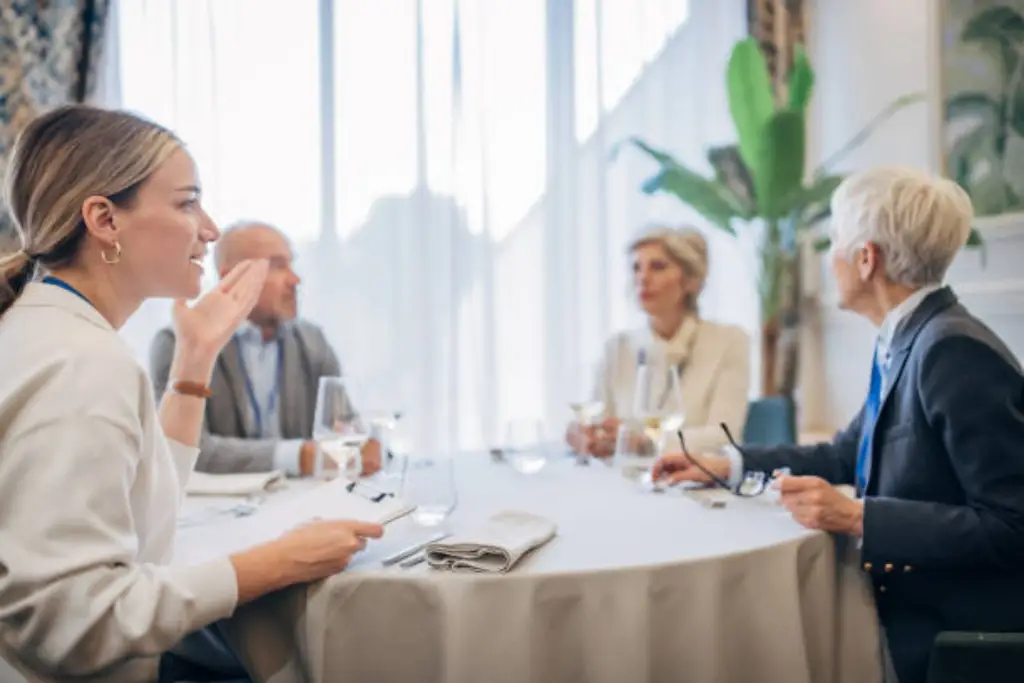
The private dining room at Marcello’s hummed with the kind of carefully orchestrated ambiance that only expensive restaurants can provide. Soft jazz filtered through hidden speakers, mixing with the gentle clink of crystal wine glasses and the murmur of overlapping conversations. Small Edison bulbs hung from brushed brass fixtures, casting everything in a warm, flattering glow that made the white tablecloths look like fresh snow and turned everyone’s skin golden.
My daughter sat at the head of the long table like royalty ascending a throne.
Maya looked absolutely radiant. Her valedictorian sash draped perfectly across her navy dress, the deep blue fabric making her brown skin seem to glow from within. Her dark hair fell in loose waves over her shoulders, and tucked behind her left ear was a small white flower—a gardenia—that one of my cousins had placed there after the ceremony. She hadn’t removed it, and somehow that single detail made my chest ache with pride.
She was laughing at something Uncle James had said, her hand resting lightly on the stem of her water glass, and I found myself memorizing the moment. The way her eyes crinkled at the corners. The way her shoulders had finally relaxed after months of tension. The way she looked so utterly, completely happy.
Around the table, phones were constantly appearing and disappearing. Aunts leaned across plates of Caesar salad to snap photos. Cousins recorded videos with running commentary. Everyone wanted to capture this moment, to freeze it in time, to prove they had been part of Maya’s triumph.
“There she is! The star of the family!”
“Maya, hold up your sash! Let me get a better angle!”
“Smile, sweetheart! This is going on Facebook!”
I watched it all from my seat in the middle of the table, occupying that strange middle ground I’d become so familiar with over the years. Not quite with the older generation at the far end, not quite with Maya and the younger cousins at the head. Somewhere in between, close enough to be included in both conversations, fully belonging to neither.
It should have been the happiest day of my life. In many ways, it was.
Four years. Four long, grueling years of watching Maya push herself to the absolute limit. Morning lectures and afternoon lab sessions. Evenings spent shelving books at the campus library to earn extra money. Midnight study sessions fueled by cold pizza and increasingly desperate amounts of coffee. Video calls where I could see the exhaustion etched into her face, hear the tremor in her voice before exams, feel the weight of her determination through the phone screen.
And now: a perfect 4.0 GPA. An academic record that made university administrators shake their heads in amazement. A full scholarship to one of the nation’s top medical schools. And earlier today, during the commencement ceremony, the university president himself had shaken her hand and said, “We’ll be reading about you one day, Dr. Patel.”
I had cried. Not delicate, photogenic tears, but the kind that left my mascara running and my throat raw. Maya had laughed and handed me tissues from the bouquet I’d brought her, and we’d stood there in our little bubble of joy while thousands of people milled around us.
“You must be so proud,” Aunt Linda said now, raising her wine glass in my direction from several seats down the table. She’d been watching me watch Maya, a knowing smile on her face.
Proud. The word felt laughably inadequate. Proud was what you felt when your child remembered to say thank you or won a spelling bee. What I felt was something entirely different—something vast and terrifying and beautiful all at once. Like my chest had been cracked open and filled with equal parts light and fear.
“I am,” I managed, my voice steady despite the emotion churning beneath it. “More than I can possibly express.”
Linda beamed and turned her attention back to Maya, launching into another enthusiastic round of congratulations. She was gifted at that—keeping energy high, smoothing over awkward moments before they could fully form, maintaining the pleasant veneer that family gatherings required. It was a talent that had proven useful at more than a few potentially explosive holiday dinners.
Down at the opposite end of the table, my mother sat with her spine perfectly straight, her hands folded around the stem of her wine glass like it was a scepter she had no intention of actually using. Her lips were pressed into a thin line that might pass for a smile if you didn’t know her well enough to read the tension in her jaw.
I knew her. I’d spent forty-two years learning to decode every micro-expression, every subtle shift in posture.
She had barely acknowledged Maya at the ceremony. A brief nod when we arrived at the venue. A stiff, obligatory hug when I insisted. A murmured “congratulations” that carried about as much warmth as a January morning. She’d spent most of the ceremony checking her phone, and when Maya’s name was called as valedictorian, she’d clapped exactly three times before letting her hands fall back into her lap.
Next to her, my father hunched in his chair, his shoulders rounded in sharp contrast to her rigid posture. His reading glasses had slipped down his nose, and he was squinting at his phone, pretending to be absorbed in something vitally important. He always did that when he was uncomfortable—created imaginary urgency, phantom emails that desperately needed his attention right this very second.
The waiter appeared with our entrees, moving between chairs with the practiced grace of someone who’d done this thousands of times. Plates landed in front of us—seared salmon, perfectly cooked steaks, house-made pasta, vegetables arranged like small works of art. The conversation shifted naturally, as it had all evening, to Maya’s future.
“What specialty are you thinking about?” someone called from the middle of the table. “Cardiology? You’d be amazing in cardiology!”
“Oh, or pediatrics!” another cousin chimed in. “You’re so good with kids, Maya.”
“Actually,” Uncle James said, scooting his chair closer with genuine interest lighting up his face, “her senior research project was on cardiac regeneration. She was telling me earlier—what was it exactly? Something about stem cells?”
Maya’s face brightened the way it always did when she talked about her research. “Stem cell-based therapies for improving post-infarction recovery,” she explained, the technical language flowing as naturally as breathing. “We’re looking at ways to minimize scar tissue formation after heart attacks. The early results are really promising.”
“See?” James said, gesturing around the table like he’d personally supervised her entire education. “Brilliant. She definitely gets her intelligence from our side of the family.”
Laughter rippled around the table, light and easy.
Then my mother spoke.
“She gets her intelligence from our side of the family.” Her voice cut through the pleasant chatter like a knife through silk. The words were loud enough that several conversations faltered mid-sentence, attention turning toward her. “Though intelligence doesn’t pay bills, does it?”
The temperature in the room seemed to drop. Or maybe it was just me, suddenly cold despite the warm restaurant air.
Maya’s smile remained fixed on her face, but I saw her fingers tighten around her fork. Saw the way her shoulders tensed beneath that beautiful navy dress.
“That’s very true,” Aunt Linda said carefully, her tone deliberately bright, desperately trying to redirect. “Medical school is expensive. But with Maya’s scholarship—”
“I have a full scholarship,” Maya interjected, her voice polite but firm. She’d always been good at standing her ground. “Tuition, books, and a living stipend. The program is extremely generous.”
My mother waved her hand dismissively, as if Maya had just informed her that water was wet. “I’m not talking about Maya’s expenses,” she said. Her gaze swept away from my daughter and landed squarely on me. “I’m talking about forty-two-year-old women who think an education entitles them to live rent-free.”
The air left my lungs in a rush.
Around the table, people suddenly became very interested in their food. Uncle James stared at his salmon like it held the secrets of the universe. Cousins exchanged quick, nervous glances—the silent family language for Oh no, here we go again.
“Mom,” I said quietly, forcing my voice to remain steady. “This is Maya’s celebration dinner.”
“Exactly,” she said, her tone sharpening to a fine point. I knew that voice. I’d grown up with it. It was the sound of doors closing, of minds made up, of conversations that were really just monologues. “Which makes it the perfect time to discuss adult responsibilities.”
The waiter, who had been approaching with another bottle of wine, slowed when he registered the tension. He took one look at our table, at my mother’s rigid posture and my white knuckles, and retreated without a word.
“You’re forty-two years old,” my mother continued. Every eye at the table was on her now—or on me. I could feel their stares like physical pressure. “You have a college degree. You have work experience. And yet you still live in our house, contributing nothing.”
A muscle jumped in my jaw. Beside me, Maya drew in a breath so quiet I almost didn’t hear it. Our eyes met, and I gave the tiniest shake of my head: Don’t. This isn’t your fight.
“I contribute to the household,” I said evenly. Carefully. I’d had years of practice keeping my voice level under pressure.
I did not raise my voice. I did not roll my eyes. I did not slam my hand on the table, even though some small, furious part of me desperately wanted to.
“Buying groceries occasionally doesn’t count as contribution,” my mother said, adding a small laugh that sounded performative even to my ears. She glanced around the table, inviting everyone to share in her assessment. “Your father and I have been discussing this. We’ve been more than generous, allowing you to live rent-free while you raised Maya. But she’s graduated now.”
Her gaze flickered toward Maya’s sash before returning to me, hard as polished stone.
“She’ll be moving to medical school housing in a few months. There’s no reason for you to continue taking advantage of our generosity.”
Aunt Linda set her fork down with exaggerated care. “Maybe,” she ventured carefully, “this is a conversation better suited for a private moment?”
“Why?” My mother’s eyebrow arched. “We’re all family here. Everyone should understand the situation.” She spread her hands as if she were presenting something perfectly reasonable. “No more free living. Starting tomorrow, you’ll pay market rent, or you’ll find somewhere else to go.”
Uncle James cleared his throat awkwardly. “What’s, um… what’s market rent in your neighborhood these days?” The question was directed at my father, perhaps hoping he might be more reasonable.
“Twenty-eight hundred dollars a month,” my father said without hesitation. His voice was quiet, but he’d clearly done his research. “That’s fair for the area.”
I reached for my water glass with a hand that was, somehow, remarkably steady. The room tilted slightly around me as I took a slow sip, ice cubes clinking against crystal. Maya had gone absolutely rigid beside me, her shoulders pulled back, the bright sash across her chest suddenly feeling obscenely cheerful against the tension.
“That seems reasonable,” Aunt Linda said after a moment, though her expression said otherwise. She was trying to keep the peace, to find middle ground. “Everyone should contribute to household expenses.”
“Exactly,” my mother said, triumphant. “We’ve carried this financial burden long enough. Forty-two years old and you’ve never owned property, never built equity. Living off family charity while the rest of us work.”
Her voice wasn’t just cutting—it was practiced. This was a speech she’d refined over time, told herself in various forms, built brick by brick to construct a narrative that allowed her to sleep at night.
The cousins were all staring at their plates now, fascinated by the patterns in the porcelain. Uncle James raised a hand to signal for the waiter—whether for more wine or a fire extinguisher, I couldn’t tell.
“I think that’s fair,” my father added, finding his voice and some volume. “You’ve had plenty of time to get established. Maya’s success proves we provided a good environment.” He smiled like that settled everything. “But it’s time for you to stand on your own feet.”
My water glass made a soft click as I set it back on the table. I let my gaze travel the length of the gathering—the aunts leaning forward, the cousins pretending not to listen, Maya frozen at the head of the table like a queen presiding over a trial she never asked to witness.
The leather portfolio rested beside my chair where I’d set it earlier, its edges worn smooth from years of use. I’d brought it intending to give Maya her trust fund documents after dessert, somewhere quiet and private where we could celebrate together without an audience.
I hadn’t planned to use the other documents. Not tonight. Not like this.
But then again, I hadn’t planned on my parents demanding rent at my daughter’s graduation dinner either.
“You’re absolutely right,” I said.
My mother’s head jerked back slightly, surprise registering across her features. She’d been prepared for resistance, for argument, for tears. Not agreement.
“This is the perfect time,” I continued, reaching for the portfolio, “to discuss property ownership and financial responsibilities.”
I opened it carefully, my fingers moving over familiar colored tabs—blue for tax documents, green for mortgage statements, yellow for insurance, red for legal papers. The organization soothed me somehow, that careful order in the face of chaos.
Maya was watching me with wide eyes, her dinner completely forgotten. Uncle James leaned forward, curiosity overriding his discomfort.
“Since we’re discussing rent and property ownership,” I said, pulling out the first document, “I think everyone should understand the complete financial situation.”
My mother’s eyes narrowed. “What are you talking about?”
“The house you’re currently living in,” I said clearly. “The four-bedroom colonial at 847 Maple Street.”
The address hung in the air like an incantation.
“You want to charge me twenty-eight hundred dollars a month,” I continued, my voice steady, “to live in that house.”
“It’s our house,” my father said immediately, his voice firmer than it had been all evening. “We’ve owned it for thirty years.”
I slid the first document across the pristine white tablecloth. It traveled the length of the table until Uncle James picked it up. I watched his brow furrow as he scanned the text, watched his mouth open slightly in surprise.
“This is a property deed,” he said slowly. “Dated fifteen years ago.”
“Let me see that,” my mother snapped, snatching it from his hands. The paper trembled slightly in her grip.
“What does it say?” Aunt Linda asked, her voice barely above a whisper.
I pulled out the next set of papers, feeling something unfurl in my chest—not quite triumph, not quite bitterness. Something sharper and cleaner: truth.
“Fifteen years ago,” I said, “when you were three months from foreclosure, you came to me asking for help.”
Complete silence fell over the table.
“I had just received my inheritance from Grandma Patricia,” I continued. “Two hundred forty thousand dollars.”
I didn’t need to look at the bank statements to remember. That number was burned into my memory—the largest sum I’d ever seen in my account, appearing like magic three days after her funeral.
“You used that money to save our house,” my father said quickly. “We paid you back.”
“You paid back seventy thousand dollars over three years,” I corrected. “Then the payments stopped.”
My mother opened her mouth to interrupt, but I didn’t give her space.
“You said business was slow. You needed time. I said it was fine—we’re family. I wasn’t going to let you lose your home.”
My mother’s eyes dropped back to the deed, flipping through pages as if searching for different words, a different outcome.
“This doesn’t mean anything,” she said. “It’s just paperwork.”
“It means everything,” Uncle James said quietly. He was reading over her shoulder now. “This deed transfers full ownership. She didn’t just loan you money. She bought the house.”
Murmurs rippled around the table. I could feel the mental recalibration happening, relationships and histories being rewritten in real-time.
I pulled out more documents—bank statements with highlighted entries, property tax receipts, mortgage payment records, insurance policies. Fifteen years of evidence, neatly organized and undeniable.
“When you couldn’t pay me back,” I said, “we agreed to a different arrangement. You transferred the deed to me. In exchange, you could continue living there without paying rent.”
The words settled over the table like snow.
“The agreement was clear,” I continued. “I would cover the mortgage, property taxes, and insurance. You would maintain the property and contribute to utilities. It seemed fair. It kept everyone housed.”
Aunt Linda’s elbow was practically in her mashed potatoes as she leaned forward. “You’ve owned their house for fifteen years?” Her voice was incredulous.
“The mortgage will be paid off in three more years,” I said. “I’ve been making payments of eighteen hundred dollars monthly, plus roughly six thousand annually in property taxes, plus homeowners insurance. Over fifteen years, I’ve invested approximately four hundred and thirty thousand dollars in that property.”
My mother’s face had gone from pale to a mottled, angry red. She looked like she might vibrate out of her chair.
“You never told anyone,” she said, her voice raw.
“You asked me not to,” I reminded her gently. “You said it would be humiliating if people knew you’d nearly lost the house. I respected your privacy.”
My father stared at the documents spread across the table like evidence at a trial. His hand rested on one corner, as if the papers might blow away.
“We thought…” He swallowed hard. “We assumed…”
“You assumed I was living off your charity,” I finished for him. “When actually, I’ve been providing housing for you. While raising my daughter as a single mother. While working full-time as a database administrator.”
I needed them to understand this part.
“I work remotely,” I added. “That’s why I’m always home. Not because I’m unemployed. Not because I’m lazy. I work forty-five hours a week managing databases for a tech company. I’ve been with them for twelve years. I just do it from the dining room table instead of a cubicle.”
Maya’s expression shifted then—from shock to something fiercer. Pride, maybe. Or vindication. The set of her jaw changed, her shoulders straightening as if she’d been bracing against an impact that finally made sense.
“This can’t be legal,” my mother said. “We’ll fight this.”
Uncle James shook his head, still examining the documents. “It’s completely legal. I can see the notary stamps, the county registrar’s seal. This deed is legitimate and properly recorded. She owns the house.”
I reached into the portfolio one final time. My fingers lingered on the last envelope. I’d debated bringing it, had argued with myself during the entire drive to the restaurant. How much to reveal? How much to protect?
In the end, I’d chosen to protect myself.
“This is from my attorney,” I said, sliding the envelope toward my father. “I had her draw it up last week, just in case this conversation happened.”
His hand shook as he opened it. I watched his eyes move across the legal language, watched comprehension dawn slowly across his features.
“What does it say?” my mother demanded.
“It’s an eviction notice,” he said, his voice barely a whisper. “Thirty days to vacate the property.”
The eruption was immediate. Gasps, exclamations, dropped silverware. One cousin muttered an oath before his wife elbowed him silent. Voices overlapped—questions, protests, shock—until Uncle James raised both hands like a teacher calling for order.
“Everyone needs to calm down,” he said firmly.
“You can’t do this,” my mother said, pointing a shaking finger at me. “We’re family.”
“You just demanded I pay twenty-eight hundred dollars a month,” I said, my voice still level, still calm, “to live in my own house. In front of my daughter. On her graduation day. After allowing me—no, encouraging me—to believe you saw me as a burden for fifteen years.”
“We didn’t know,” my father said desperately. “If you’d just explained—”
“I did explain,” I said, and now my voice had an edge. “Every year when I filed my taxes. Every time the insurance needed renewing. Every conversation about property maintenance. You chose not to acknowledge it because it was easier to see me as dependent.”
Maya spoke for the first time since the documents had appeared.
“Grandma,” she said, her voice steady and clear, “you’ve been telling people for years that Mom lives in your house rent-free. I’ve heard you. At Thanksgiving. At birthdays. At my high school graduation.”
“We believed it was true,” Aunt Linda said weakly.
“Nobody asked questions,” I said. “Nobody wondered how a database administrator with a steady six-figure income and a significant inheritance could possibly need housing charity for fifteen years.”
The waiter appeared at the edge of our private room, hovering uncertainly with dessert menus.
“Should I… come back?” he whispered to Uncle James.
“Yes,” James said. “Please.”
The waiter retreated gratefully.
“So what happens now?” my father asked. He looked older suddenly, diminished. “Where are we supposed to go?”
I began sliding the documents back into the portfolio, one by one, rebuilding my armor with each click of the metal clasp.
“You have thirty days to find alternative housing,” I said. “After that, I’ll be preparing the property for sale. Given current market values in the neighborhood, I expect to clear approximately six hundred thousand dollars after the remaining mortgage is paid.”
“This is revenge,” my mother hissed. “Over one comment about rent.”
I laughed—quietly, bitterly. Not because it was funny, but because the alternative was screaming.
“This is about fifteen years of disrespect,” I said. “Fifteen years of being treated as a burden while funding your lifestyle. Fifteen years of watching you take credit for supporting Maya and me while I paid every bill.”
“We raised you,” my mother said, her voice rising. “We fed you, clothed you, put a roof over your head for eighteen years. Doesn’t that count for something?”
“It counts for the fifteen years of free housing I’ve already provided,” I said. “But respect is a two-way street. And you demanded rent at my daughter’s graduation dinner, in front of our entire family, without any acknowledgment of reality. That was your choice.”
“For what it’s worth,” Uncle James said carefully, “I think you’ve been more than fair. Fifteen years of free housing far exceeds any childhood obligation.”
“Don’t you dare take her side,” my mother snapped.
“I’m not taking sides,” he said. “I’m reading legal documents and doing basic mathematics. She’s been subsidizing your life for fifteen years. She has every right to stop.”
Maya reached across the table and took my hand. Her palm was warm, her grip strong.
“Can we go home now?” she asked softly.
I looked at her—my brilliant daughter, my greatest achievement, the girl who’d fallen asleep in my lap while I balanced checkbooks and cried over spreadsheets. The worry lines on her forehead seemed wrong next to the glow of accomplishment in her eyes.
“Yes,” I said, standing. “I think we’re done here.”
“Wait,” my father said, half-rising. “Wait, please. Can’t we talk about this? Work something out? There has to be—”
“You had fifteen years to acknowledge reality,” I said. “You chose pride over honesty. Now you have thirty days to make different choices.”
I helped Maya with her coat, the valedictorian sash catching the light as she slipped her arms through the sleeves. Uncle James stood and pulled her into a hug.
“Congratulations again, sweetheart,” he said quietly. “Don’t let our adult drama ruin your accomplishment.”
“Thank you,” Maya said. Then, even more quietly: “And thank you for always being kind to my mom.”
His eyes were suspiciously bright as we walked away.
The restaurant’s main dining room was full of normal people having normal celebrations—birthdays, anniversaries, business dinners. We walked through them and out into the parking lot, where late afternoon sun glinted off car windows and made everything look ordinary and bright and bizarrely normal.
Maya slid into the passenger seat of my car and closed the door carefully. Once I was behind the wheel, she turned to me.
“You really own the house?” she asked.
“I really own the house,” I confirmed.
“And you’ve been paying for everything?” Her voice trembled with anger and awe tangled together.
“Everything. The mortgage. Taxes. Insurance. That new roof three years ago. The water heater that died last winter. When the upstairs bathroom needed replumbing and Grandma complained the house was ‘falling apart,’ I paid for that too.”
She stared at me for a long moment, then leaned over the center console and hugged me fiercely enough to knock my sunglasses askew.
“Why didn’t you say something sooner?” she whispered.
“Because they’re still my parents,” I said, straightening my glasses. “And I kept hoping they’d eventually see me clearly without being forced to.”
“But they didn’t.”
“No,” I agreed. “They didn’t.”
We drove home in silence, the kind that feels full rather than empty. Maya’s graduation program lay on the console between us, her name printed in bold under “Valedictorian.”
The house appeared as we turned onto Maple Street—familiar gray siding, white trim, the maple tree my father planted when I was ten casting dappled shadows across the lawn. Stone lion statues flanked the front steps, my mother’s idea of “elegant landscaping.”
It looked exactly as it always had. But as I pulled into the driveway, it felt different. Not because anything physical had changed, but because the truth of its ownership had finally been spoken aloud.
Later that night, after we’d eaten leftover takeout instead of restaurant desserts, after Maya had gone upstairs to call her friends and process the day, I stood alone in the living room.
A framed photo on the mantle showed my parents in their thirties, my mother’s hair darker, my father’s shoulders broader. They held a baby—me—with delight and exhaustion in equal measure.
“You did the best you could with what you had,” I told their frozen faces. “And I’m doing the best I can with what you gave me. Even when it hurts.”
I thought of Grandma Patricia then—her small apartment that always smelled like jasmine tea and old books. The way she’d pressed my hands between hers the week before she died.
“Promise me you’ll use this money to build something solid,” she’d said. “Something that’s yours. Not for show. For security.”
“I did, Grandma,” I whispered into the quiet room. “I really did.”
My phone buzzed. A text from Uncle James: Your attorney’s contact info? I’ll help them find something they can actually afford. They need a reality check.
I sent him the information, adding: Thank you. Really.
His reply came immediately: It’s past time someone stood up for you.
I looked around the living room—at the secondhand couch I’d reupholstered, the bookshelf I’d assembled at midnight while Maya slept, the coffee table with its faint water rings from years of family gatherings. Every object was a small testament to quiet, invisible labor.
The portfolio sat on the coffee table. Inside was one more document I hadn’t shown anyone—an offer from a property management company. Their estimate: forty-two hundred dollars monthly in rental income once my parents moved out. More than enough to cover the remaining mortgage and start building real profit.
Enough to help with Maya’s incidental expenses during medical school. Enough to pad my retirement. Enough to finally breathe.
Around eleven that night, headlights swept across the living room curtains. The familiar outline of my parents’ sedan pulled into the driveway.
The engine cut off. But instead of the sound of their key in the lock, there was only silence. They sat in the darkened car for several long minutes.
Then both doors opened. They walked together to the front porch—and instead of using their key, they rang the doorbell.
It was a small acknowledgment, but it meant everything.
I opened the door.
My mother stood with her chin lifted, eyes wet and hard at the same time. My father hovered behind her, looking smaller and older than I’d ever seen him.
“May we come in?” my mother asked.
She had never asked that question before. Not once in fifteen years.
“For now,” I said. “Yes.”
They entered slowly, looking around the entryway as if seeing it for the first time—the scuffed baseboards, the ceramic bowl where Maya dropped her keys, the framed photo of Maya and me from last summer’s beach trip.
We sat in the living room. They perched on the edge of the couch. I remained standing, needing the height, the angle, the physical reminder that I didn’t have to shrink anymore.
“We were scared,” my father said finally. “Back when we nearly lost the house. I couldn’t sleep. I imagined the neighbors watching us pack. Your mother—” He glanced at her. “We were ashamed.”
“Your father made poor business decisions,” my mother said sharply. “But we were handling it.”
“No, we weren’t,” my father said quietly. “We were drowning.”
I remembered that phone call. Sitting in my tiny apartment, surrounded by laundry, my laptop glowing with spreadsheets of my own struggling finances. My mother’s voice brittle and sharp, explaining that they had thirty days before foreclosure.
“When you agreed to help,” my father continued, “it felt like a miracle. And a humiliation.”
“I didn’t mean to humiliate you,” I said.
“But it did,” my mother admitted. “Every mortgage statement with your name. Every tax form listing you as owner. Every time I saw mail addressed to you about our house.”
“So you pretended I was the one being supported,” I said. “Because that narrative hurt less.”
“Yes,” she said. The honesty was almost shocking.
“At first I told myself it was balanced,” she continued. “We raised you, you helped us. But then years passed. And you were always here—working, cooking, cleaning, raising Maya. Making me feel…” She searched for words.
“Unnecessary?” I suggested.
“Replaced,” she corrected. “Like the house no longer needed me.”
“So you told a story where you were still the provider,” I said softly.
“It was easier than admitting we needed our daughter to save us,” she said.
We sat in heavy silence.
“That story only worked because I let it,” I finally said. “Because I thought you’d eventually grow out of needing it. I wanted you to be proud of me, not resentful.”
“I was proud,” my father said. “When you got promoted. When Maya excelled. When you—”
“If you were proud,” I interrupted, “you never said it loud enough to drown out calling me a burden.”
He flinched.
Maya appeared at the top of the stairs, listening.
“Today, in front of your granddaughter,” I continued, “you demanded rent at my own house. You called me a freeloader. Publicly. Without hesitation.”
“We’ve been carrying this shame for years,” my mother said. “We just… we couldn’t…”
“Acknowledge reality,” I finished. “I know. But I can’t keep playing this game. Not at the cost of my dignity.”
“Where will we go?” my father whispered.
“James is going to help you find something you can afford,” I said. “A smaller house. An apartment. Something within your actual means. You won’t be homeless—I’m not cruel. But I can’t keep subsidizing a lie.”
“You’re my daughter,” my mother said. “You should take care of us.”
“I have taken care of you,” I said. “For fifteen years. Quietly. Thoroughly. Without humiliating you publicly. I won’t apologize for finally insisting that my care doesn’t cost me my self-respect.”
Maya came down the stairs then.
“Grandma,” she said, “you know what I remember most? You telling people Mom was lazy. That she was lucky you ‘let’ her stay here. Every holiday. Every birthday.” Tears ran down her cheeks. “And I believed you when I was little. But then I started noticing that Mom fixed everything that broke. Mom paid for everything I needed. Mom worked late into the night. Mom handled every single bill.”
“Maya, sweetheart—” my father started.
“You took her story and rewrote it so she was the villain instead of the hero,” Maya said. “In front of me. For years.”
My mother stared at her granddaughter, something cracking in her expression.
“Thirty days,” my mother finally said flatly. “You’ll give us that.”
“The notice already did,” I confirmed. “I won’t throw your things out. I won’t change the locks tonight. I’ll even help you organize if you want. But in thirty days, this house will be mine in every way that matters.”
They left shortly after, walking slowly to their car. My mother paused at the door, looking back.
“Thank you,” she said stiffly. “For not letting us lose it back then.”
It was the closest she’d come to gratitude in fifteen years.
“You’re welcome,” I said.
After they drove away, Maya slipped her hand into mine.
“Are you okay?” she asked.
I listened to the house around us—the refrigerator humming, the clock ticking, a dog barking in the distance. Ordinary sounds wrapping around an extraordinary day.
“I don’t know yet,” I admitted. “But I’m more okay than I expected to be.”
Much later, alone in my room—my room, in my house—I let myself feel everything. Grief for the parents I’d wanted. Relief at finally dropping the burden. Pride in who I’d become. And fierce, shining joy for the daughter whose success I’d witnessed under this roof.
Family, I thought as I turned off the light, isn’t defined by who tells the loudest story.
It’s defined by who shows up. Who pays the price. Who stays honest when lying would be easier.
By that measure, this house had always been mine.
The world had just finally been invited to see it.

Ethan Blake is a skilled Creative Content Specialist with a talent for crafting engaging and thought-provoking narratives. With a strong background in storytelling and digital content creation, Ethan brings a unique perspective to his role at TheArchivists, where he curates and produces captivating content for a global audience.
Ethan holds a degree in Communications from Zurich University, where he developed his expertise in storytelling, media strategy, and audience engagement. Known for his ability to blend creativity with analytical precision, he excels at creating content that not only entertains but also connects deeply with readers.
At TheArchivists, Ethan specializes in uncovering compelling stories that reflect a wide range of human experiences. His work is celebrated for its authenticity, creativity, and ability to spark meaningful conversations, earning him recognition among peers and readers alike.
Passionate about the art of storytelling, Ethan enjoys exploring themes of culture, history, and personal growth, aiming to inspire and inform with every piece he creates. Dedicated to making a lasting impact, Ethan continues to push boundaries in the ever-evolving world of digital content.