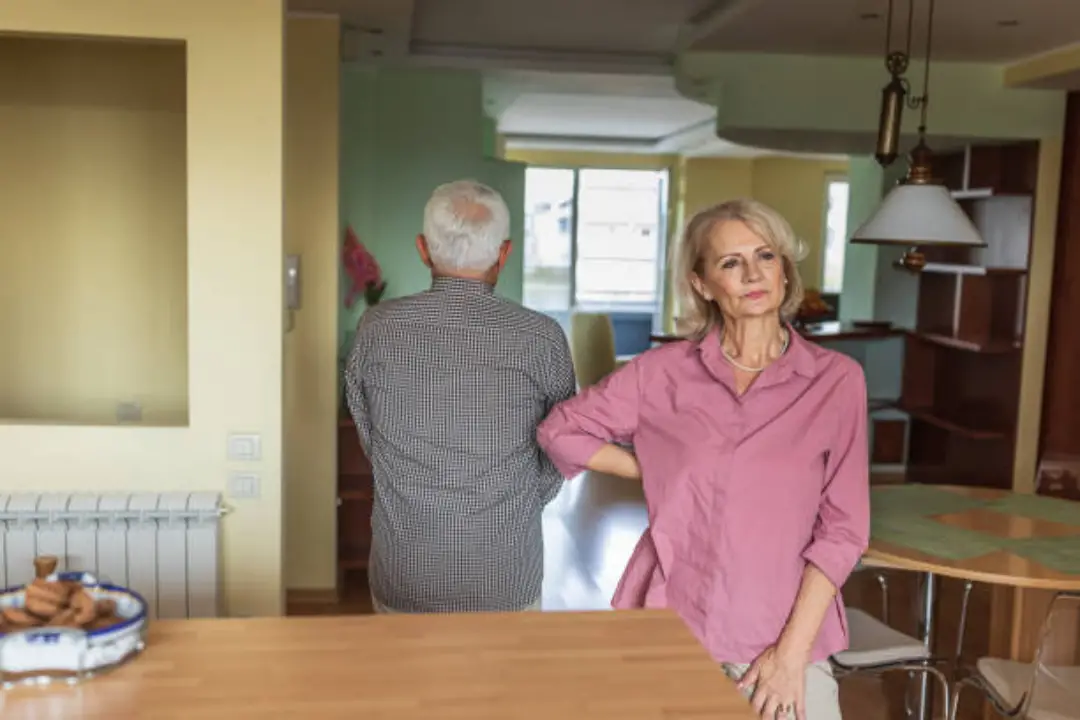
When my son said with contempt, “Mom, pack your bags. You’re moving out today. You have one hour left,” I knew I was being abandoned. The part that kept my spine straight was simple: they had no idea I’d already changed everything yesterday.
I had just folded the last piece of laundry when Avery walked in, her steps sharp enough to cut the air. She didn’t look at me—she looked at the basket in my hands as if my touch contaminated it. Then, without warning, she slammed her palm against the edge and sent the entire load crashing to the floor. Socks, shirts, towels scattered like debris after an explosion.
She pointed at me with a cold, triumphant smile. “Pack your bags. Today, you’re moving out. You have one hour, May.”
Before I could process her words, Luke stepped behind her, arms crossed, eyes flat and distant—nothing like the warm brown eyes his father had possessed. “Where you’re going?” he said, letting out a low, dismissive snort. “A grave for leeches like you.”
My breath caught, but I stayed still. I had survived worse storms. Yet his words carried something final, something practiced—something he’d wanted to say for a long time.
Avery leaned closer, her voice dripping with contempt. “You’ve leeched off us long enough. That old-person smell of yours sticks to everything. It’s depressing.”
“It’s depressing,” Luke echoed, as if proud to agree. “You make life slower for everyone. Even the kids avoid you. You drag the whole house down with that limp.”
None of it was true, but lies told with confidence have a way of sounding real.
Avery stepped around me, kicking one of Luke’s shirts out of her path. “Honestly, May, you’re lucky we kept you this long. You cling like a barnacle.”
My hands trembled slightly, not from fear but from disbelief at how easily cruelty flowed from their mouths.
Avery’s hatred for me had never come from anything I actually did. It sprouted from places so petty I sometimes wondered if she simply needed an enemy and chose me because I was the easiest target. She’d never forgiven me for refusing to lend her money years ago when she wanted a flashy new car her credit couldn’t support. Another time, I’d gently suggested that posting suggestive videos of her daughter online might not be safe. She’d exploded, accusing me of shaming her motherhood.
But the biggest wound was the house. My house. When Avery discovered that every deed, tax record, and home loan was in my name alone—that Luke didn’t have automatic claim to it—she looked at me as if I were an obstacle to her future. From that moment, her resentment grew teeth.
I’d spent my life trying to stay useful anyway. I’d worked decades as a hospital seamstress, fixing uniforms and making small blankets for newborns. Every holiday, I sewed Luke gifts by hand. When he went to college, I sold my sewing machine and even my wedding ring to help pay his tuition. I never told him what it cost me.
Then came the accident—a hip fracture that stole my speed but not my will. I still folded clothes, washed vegetables, wiped counters. But to Avery, the moment I slowed down, I became a burden. To Luke, I became an inconvenience he didn’t have the courage to defend.
Still, the cruelest blow wasn’t directed at me. It was directed at the children. Avery told them not to hug me too long because “Grandma is fragile and confused.” She whispered that I was sick, that being around me would make them sad. I watched sweet Chloe hesitate before running into my arms, and that hesitation cut deeper than any insult.
Then came the moment that changed everything.
I was heading toward the kitchen when I heard Avery’s voice from the living room, sharp and urgent as she spoke into her phone. “Last week we already set everything in motion. She won’t be here long.”
I froze. My mind raced. Last week—something had happened. Something they hadn’t told me. Something they believed would push me out of this house forever.
As I stood there listening to Avery plot my disappearance as easily as one might plan a grocery list, a strange calm settled inside me. Not resignation. Clarity.
It started small—too small for anyone but a woman who’d learned to survive by noticing shifts in the air. Luke suddenly insisted on being the only one with the mailbox key, dangling it on his keyring as if it were nothing. “It’s easier if I grab the mail,” he said, avoiding my eyes the way guilty men avoid mirrors.
Every evening he brought in envelopes, but whenever I reached for ones addressed to me, Avery swooped in. “Old people forget to check mail. Let me help you.” She stressed the word help like a threat.
The first real sting came when I found a credit card statement tucked between towels—my name on it, with a nine-hundred-dollar charge from a jewelry store I’d never entered. When I brought it to Avery, she laughed with pitying condescension. “Maybe you bought something and forgot. Memory loss starts exactly like that.” Then she tapped her temple—hard, deliberate.
A few days later, I heard noises from the garage—metallic scraping, paper shifting, a drill whirring. Then Avery’s warning whisper: “Not now—she’s coming.” When I approached, the door slammed shut, locked. My own garage, suddenly off-limits.
But the moment that shattered my remaining illusions came at 1:48 a.m. when I passed Luke’s office and heard his voice—soft, tender, nothing like the clipped tone he used with me. “I love you. I promise I’ll fix the house situation soon. Trust me, Mara.”
The name hit me like a slap. Another woman. And the house situation. My house.
The next morning, while retrieving a dropped towel near the utility closet, I shifted a storage bin and the lid fell open. Dozens of sheets slid out—my handwriting copied again and again, loop after loop, stroke after stroke. Someone practicing my signature.
My legs gave out momentarily. This wasn’t random. It was rehearsal. Careful, intentional preparation for something that required my name. Something I would never willingly agree to.
That evening, some quiet instinct pulled me toward Luke’s old laptop, dusty on a high closet shelf. After a few wrong guesses, I typed Chloe’s name. It opened immediately.
The first deleted file stunned me completely. A photo of Luke smiling brighter than I’d seen in years, holding a curly-haired toddler, beside a woman—Mara—with her hand on his back. In the corner, written in glittery marker: “Daddy, Luke, and us.”
A second life. Not the family under my roof. A secret one he was funding with pieces of my life.
I scrolled through messages. “Did you tell your wife about selling your mom’s house? We need the money.”
My chest tightened. This was what Avery meant when she said everything was already in motion. Luke had promised to sell my home to fund his secret life.
I clicked another file—a scanned document torn in half. Slowly, the shape emerged: a home-sale contract with my house listed, and where my signature should have been, a slanted imitation matching those practice sheets.
Then I saw a note: “Cognitive test appointment needed before legal authority form.”
They were setting the stage to declare me incompetent. They wanted to strip my decisions, my property, my identity—and wrap it in paperwork that would make their betrayal look reasonable.
But the worst discovery was a security camera folder Luke had forgotten existed. He’d installed it months earlier, paranoid about missing snacks. The cloud kept everything.
I opened the first video. Avery stood in the kitchen pulling my medication bottle out and placing it deliberately on the top shelf, far too high for me to reach. “She needs to struggle,” she muttered. “It makes her look confused.”
Another clip showed Luke yanking our grandson by the arm so hard the boy nearly fell. “Stop defending her,” he snapped, raising his hand before Avery stepped in—not from concern, but annoyance. “Do not leave marks. Not until after she’s out.”
The final video showed Avery whispering to Luke, “Just break her mentally. Then she’ll agree to anything.”
Something settled deep inside me. Not fear. Resolve. The cloud had recorded everything. Their secrets belonged to me now.
I closed the laptop gently, almost tenderly, as if thanking it for telling the truth.
That night, I placed four small recording devices throughout the house—inside the hollow wooden angel on the mantel, behind a framed photograph, beneath Avery’s favorite couch cushion, inside the basket where Luke threw his keys.
I waited in my room with lights off, listening as the recordings synced to my phone. Their voices came through with clarity sharper than glass.
Luke’s voice, low and impatient: “I opened two more accounts under her name today. Smaller transfers, so the bank doesn’t flag anything.”
Avery’s heels clicked. “Good. I changed her mailing address to my P.O. box last week. She won’t see a single statement until this is over.”
Luke: “Her handwriting match is almost ready.”
Avery laughed. “After the mental test, she won’t have any rights left. That doctor barely listens. I’ll tell him she gets confused, and he’ll sign the impairment form. Once she’s declared incompetent, we don’t even need her agreement.”
Then Luke’s phone rang. His voice changed instantly to something tender. “Hey. I know. Once the house sells, Mara and I will be free.”
The garage went silent. Avery’s footsteps stopped. “What did you just say?”
“Once the house sells, Mara and I—”
The impact exploded through the speakers. A slap, hard.
“You have someone else?” Avery shrieked. “Someone else and a child?”
Luke groaned. “Avery, stop—”
Another slap. “You’d sacrifice your own mother for a woman who doesn’t even want you? For your secret life, you’d throw her in a nursing home?”
Luke didn’t deny it. He just kept saying Mara’s name like a lifeline.
Avery lost control completely. “You used me. You used your own mother for what? For some cheap woman who calls you daddy?”
“We needed the money,” Luke shouted back, panicked. “That house is the only asset worth anything.”
“So you steal from the woman who raised you?” Avery screamed. “You disgust me.”
Every word. Every slap. Every confession. Captured by microphones they didn’t know existed.
The alliance that had spent months constructing a plan precise enough to erase a lifetime cracked loud enough for the world to hear.
I sat back in my chair and pressed stop. “Thank you,” I whispered. “This is enough.”
More than enough.
But I wasn’t finished. The next morning, I called Evelyn March, an attorney a friend had recommended years ago. Within twenty-four hours, she’d moved every asset into an ironclad living trust that Luke and Avery could never access, modify, or control.
“You’re fully protected,” Evelyn confirmed. “They can’t touch anything.”
The family meeting came days later. Avery knocked once on my door, then pushed it open. “Downstairs. Now.”
Luke waited at the dining table with papers neatly arranged. He didn’t look up when I approached. “Mom, we need to address your living situation. Your mind is declining. You’re forgetting things. The safest option is for you to move into a care facility. You’ll be relocated in thirty days.”
Avery leaned forward. “One month is generous. I wanted you out this week.”
I said nothing, and my silence felt like power.
Avery circled the table slowly. “Older people ruin the energy of a home. This Christmas is the last Christmas you’ll ever spend here.”
Luke slid a form toward me. “The cognitive test is already scheduled. Once the doctor confirms the decline, he’ll sign off on everything.”
My phone buzzed. A message from Evelyn: “Living trust finalized. They can no longer access, modify, sell, or control any asset under your name. You’re fully protected.”
I read it twice, letting the words settle warm and deep.
Avery rolled her eyes. “Is that one of your dumb reminders?”
“No,” I said, slipping the phone back.
Luke sighed with dramatic exhaustion. “We’re trying to do what’s best for you.”
For the first time, I felt something rise inside my chest. Not fear. Power.
“I’m smiling,” I said calmly, “because it’s fascinating how people can believe they’ve won when they don’t even know the game ended yesterday.”
Luke blinked, confused. Avery stepped back, uneasy.
“Game over,” I whispered. “For both of you.”
Christmas Day arrived wrapped in artificial cheer. Luke had decorated enthusiastically—lights, garlands, candles—everything polished to disguise the rot beneath.
Relatives filled the living room, balancing plates while making small talk, unaware the house had nearly become my coffin.
Luke clinked his glass. “A toast to freedom without burdens.” His eyes landed on me too long.
I rose slowly and walked toward the Christmas tree. My hand reached for the star—the hollow ceramic ornament that had been listening for weeks. I flicked the tiny switch hidden at its base.
The speakers Avery had set up for holiday music connected automatically.
Luke’s voice, crisp and clear: “Once she’s in the nursing home, the house is ours. Mara and I can finally start fresh.”
The room froze completely.
Avery’s voice followed: “She’ll agree to anything once we break her mentally.”
Murmurs erupted. Heads turned.
More clips played: “You changed the mailbox address, right?” “Keep practicing her handwriting.” “Open more accounts under her name.”
Luke shouted, “Mom—turn that off!”
I didn’t move. The next clip rolled: Avery taunting, “Old people are useless. No one will believe her.”
Then Luke’s whisper to his secret woman: “I’ll sell the house soon, Mara. My mom won’t be here much longer.”
Avery lunged toward the tree, but relatives blocked her path, disgust carved into their faces.
Then the cloud backup from Luke’s hidden camera projected onto the TV. Avery pushing my medication out of reach. Luke yanking our grandson. Avery whispering, “Just break her mentally. Then she’ll agree to anything.”
Gasps erupted from every corner.
A hard knock hit the front door. Two police officers and a financial crimes investigator stepped inside.
“Luke Turner. Avery Turner. You are under arrest for elder fraud, identity theft, coercion, and intentional exploitation.”
Avery staggered backward. “No—you don’t understand—”
“We heard everything,” the investigator said. “Your attorney provided verified recordings.”
Luke spun toward me. “Mom—you set us up.”
“No,” I said quietly. “You set yourselves up. I just pressed play.”
They cuffed Luke first. Avery screamed at him. “You planned this! I just did what you told me!”
“You pushed me into it!” Luke twisted in his restraints.
“You wanted it for your mistress!” Avery shrieked.
Evelyn March entered the room with a thick envelope. “Mrs. Turner, it’s time.”
She read aloud: “This is the last will and testament of William Turner, written forty years ago. Clause fourteen: Any heir who mistreats, exploits, or attempts to dispossess my wife shall forfeit all rights to inheritance immediately and permanently.”
The investigator looked up sharply.
“The house belongs solely to May,” Evelyn confirmed. “And per the clause, Luke and Avery must vacate within seventy-two hours.”
Someone whispered, “Good.”
Luke’s knees buckled. As officers led him outside, he turned with a broken expression. “Mom. Please say something.”
I stepped closer. “Good luck, son. You’ll need it where you’re going.”
His face collapsed.
Justice arrived slowly, like frost creeping along window edges—quiet but undeniable. On sentencing day, I sat in the courtroom’s second row, hands folded, back straight.
The judge read through charges with a voice carved from stone: elder abuse, identity theft, mail fraud, financial coercion, conspiracy.
“For the severity of your actions, the premeditated nature of the fraud, and the harm inflicted upon your mother, this court sentences you, Luke Turner, to six to ten years in state prison.”
Luke’s knees buckled.
The judge turned to Avery. “Though you did not execute the majority of financial acts, you participated knowingly in coercion and psychological abuse. Due to evidence from Child Protective Services, this court finds you unfit for custody. Custody of the children will be transferred to their great-grandmother, May Turner, for temporary guardianship.”
Avery crumpled. “No. You cannot take my children.”
But the social worker already stood with two small backpacks.
As for Mara—Luke’s secret woman—investigators tried contacting her. Within hours of that attempt, she terminated her lease, cleared her apartment, wiped her social media, and disappeared. She never visited Luke, never wrote, never acknowledged knowing him.
Worse, investigation revealed the little girl in the photo wasn’t his daughter at all—not biologically, not legally. She’d simply been leverage to keep him paying.
When detectives told him, Luke broke down completely—a raw, embarrassed wail. He’d lost his home, his children, his wife’s loyalty, his freedom, his imaginary future, and even the lie he’d used to justify betraying me.
I moved into my small cabin in early spring. The air felt lighter there, untouched by malice. The children visited every weekend. They laughed more, slept better, stopped flinching at raised voices.
One rainy afternoon, Chloe whispered, “Grandma, we feel safe here.”
Those five words washed over me like sunlight.
One evening months later, the phone rang. The prison number blinked. My heart tightened, but I answered.
“Mom.” Luke’s voice was scraped raw. “I’m so sorry. I ruined everything. I don’t know why I became this person.”
He sobbed quietly. “I miss the kids. Avery hates me. Mara never loved me. I have nothing. Mom… please say something.”
The wind rattled softly outside.
“Luke,” I whispered, “I raised you to be kind. What you became was your choice.”
He cried harder, defeated.
“I wish I had been the son you deserved,” he finally trembled.
The line clicked off.
I held the silent phone to my chest, feeling neither triumph nor grief—only the stillness that comes when winter settles, making room for spring.
Life in the cabin settled around me like a warm quilt. The world smelled of pine and clean earth. Days passed slowly, but in a way that heals rather than hurts.
Every Saturday, the cabin door burst open with laughter as Evan and Chloe ran into my arms. “Grandma, we missed you,” they said the same way every time—arms tight, faces buried in my shoulder.
Their social worker told me, “Children surviving chaos gravitate toward the safest person they know.”
I didn’t tell her how much it healed me to realize I was still that person for them.
One evening, my phone buzzed. A message from Evelyn: “Everything is finalized. No one will ever control your life again.”
I sat down slowly, letting those words settle. My home protected. My accounts secured. My autonomy restored. My life finally mine again.
I stepped outside onto the porch. The forest breathed around me. The evening air brushed gently against my face. The world felt wide and steady, like a place that still had room for me.
I thought about everything Luke and Avery had said, all the ways they tried to convince me I was shrinking, fading, irrelevant. I thought about the insults, the isolation, the rehearsed handwriting, the attempt to steal my mind, my home, my identity.
And then I thought about standing in front of relatives on Christmas morning, pressing play on the truth they tried so hard to bury.
I wasn’t proud of what they became, but I felt no guilt for surviving them.
My Aunt Rose opened the door behind me. “Tea’s ready.”
“I’ll be in,” I replied.
But I stayed a moment longer, staring at the horizon, feeling strength blooming quietly in my chest—strength I hadn’t recognized while living in fear.
The final truth rose inside me, clear and steady, the way only a woman who has walked through fire can speak it.
All my life they told me my silence made me weak. They said quiet women were easy to control, easy to push aside, easy to erase.
But they never understood what lived inside the quiet. Silence never surrenders. Silence was where I watched, where I learned, where I gathered every piece of strength they thought I lacked.
And when the time came to stand up, my silence became the loudest justice they had ever heard.
That is how my story ends—not broken, not lost, not small, but free. Free in a world that finally made room for me. Free with children who chose love over fear. Free with dignity intact.
No one will ever steal from me again.
They mistook my silence for weakness. But silence—that was when I was strongest.

Sophia Rivers is an experienced News Content Editor with a sharp eye for detail and a passion for delivering accurate and engaging news stories. At TheArchivists, she specializes in curating, editing, and presenting news content that informs and resonates with a global audience.
Sophia holds a degree in Journalism from the University of Toronto, where she developed her skills in news reporting, media ethics, and digital journalism. Her expertise lies in identifying key stories, crafting compelling narratives, and ensuring journalistic integrity in every piece she edits.
Known for her precision and dedication to the truth, Sophia thrives in the fast-paced world of news editing. At TheArchivists, she focuses on producing high-quality news content that keeps readers informed while maintaining a balanced and insightful perspective.
With a commitment to delivering impactful journalism, Sophia is passionate about bringing clarity to complex issues and amplifying voices that matter. Her work reflects her belief in the power of news to shape conversations and inspire change.