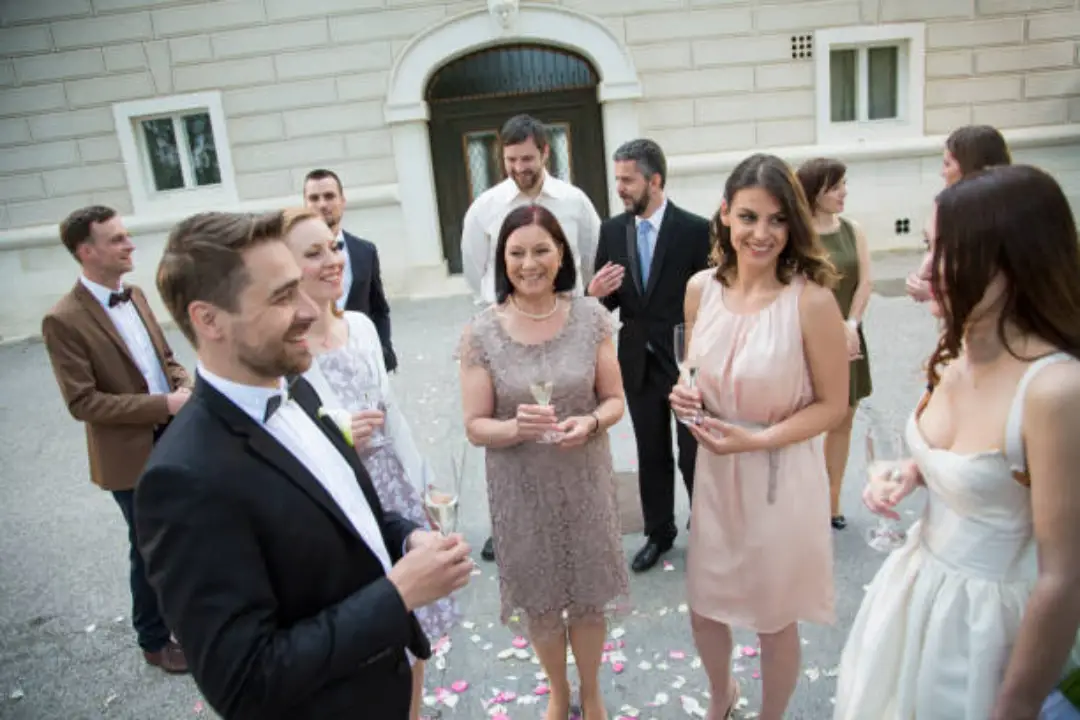
I hadn’t felt my heels touch the polished marble floor when I stepped into the wedding reception hall. All I could feel was my heartbeat hammering against my ribs and the weight of two hundred strangers’ conversations pressing against my skin like summer heat. The room smelled like champagne and gardenias, and a crystal chandelier threw fractured light across white linens and towering floral centerpieces. Everything glowed soft and golden, like a scene from someone else’s carefully curated life.
Then my sister’s maid of honor saw me.
She froze mid-step, champagne flute suspended in her manicured hand, the practiced smile sliding off her face so fast it would have been comical if my stomach wasn’t twisting itself into knots. Her eyes widened, her mouth forming a small, shocked circle.
“What are you doing here?” she hissed, the words cutting through the ambient music and laughter like a knife through silk.
Conversations nearby faltered. Heads turned. A ripple of awareness spread through the room like a stone dropped in still water.
Brooke—my sister, my ghost of a sister—turned toward the commotion. Her white dress shimmered under the chandelier light, the tulle skirt fanning around her like something from a fairy tale. For half a second, her face went completely blank, like her brain refused to process what her eyes were seeing. Then the color drained from her cheeks, leaving her pale beneath her carefully applied blush.
Her lips parted. “Someone call security,” she choked out, her voice rising with each word. “She’s not supposed to be here.”
The words carried farther than she’d intended. People stopped mid-sentence, forks hovering over salads, champagne glasses pausing halfway to lips. The DJ glanced up from his laptop, his professional smile faltering.
My mother materialized beside Brooke with the speed of someone who’d spent decades managing crises behind closed doors. I recognized her even across the crowded room—same chestnut hair twisted into an elegant chignon, same pearl necklace at her throat, same posture like a woman who’d built her entire life around the idea that nothing was ever wrong as long as you pretended hard enough.
She rushed toward me, heels clicking sharp, angry beats against the marble. Her eyes were wild, bright with something very close to panic.
“Emma, you need to leave now,” she snapped under her breath, like she could still control this situation if she just kept her voice low enough, kept the facade intact a few moments longer.
I hadn’t seen them in eleven years, and they wanted me gone in eleven seconds.
My name is Emma, and I’m thirty years old. The last time I stood in the same room as my family, I was nineteen and still naive enough to believe that truth mattered more than convenience, that if you just stood your ground and refused to lie, eventually justice would prevail. That was before my sister Brooke accused me of trying to steal her fiancé, before my parents chose her story over my denials, before I learned that family isn’t always the people who share your blood—sometimes it’s the people who believe you when everyone else has decided you’re lying.
His name was Derek. He was all easy smiles and charm, the kind of man who made parents beam with pride at family dinners. Brooke had paraded him around our house like a trophy, the perfect future husband with the perfect job and the perfect manners that made my mother sigh contentedly and say things like, “Finally, something to be proud of.”
The night everything fell apart had started out like any other family celebration. Our parents had thrown an engagement party for Brooke and Derek—catered appetizers, a custom cake, twinkling lights strung across the backyard. I’d worn a dress Brooke had glanced at and called “almost cute,” which was as close to a compliment as she ever gave me. I’d spent most of the evening helping servers refill chip bowls and making sure elderly relatives had somewhere comfortable to sit, staying out of the spotlight the way I’d learned to do.
Toward the end of the night, I’d escaped to the kitchen for a glass of water and a moment of quiet. Derek was there, leaning against the counter, his tie loosened, cheeks flushed from champagne and conversation.
“Hey, Emma,” he’d said casually, like we were friends instead of polite strangers connected by my sister. “You look nice tonight.”
It wasn’t flirtatious. It wasn’t loaded with meaning. It was the kind of absent-minded compliment people make at parties when they’re trying to be polite. He’d added, almost as an afterthought, “You’re smart. You’ll go far in life.”
I’d smiled awkwardly, unsure how to respond to compliments I wasn’t used to receiving. “Thanks,” I’d managed, grabbing my water and heading back outside.
That was it. The entire interaction. Thirty seconds, maybe less. No touching. No kissing. No scheming or seduction or any of the things Brooke would later claim happened.
What I didn’t know was that Brooke had been watching from the doorway. What I didn’t see was the expression on her face when she saw Derek talking to me, saw him smile at me the way she thought should be reserved exclusively for her. What I didn’t hear was the conversation they had later, behind closed doors, when she demanded proof that he’d never look at her younger sister that way.
I only knew that two hours later, my parents called me into the living room with voices that made my stomach drop.
My mother’s eyes were red-rimmed from crying. My father’s jaw was clenched so tight I could see the muscle jumping in his cheek. Brooke sat on the couch, trembling, mascara streaked down her face. Derek stood beside her, one hand on her shoulder.
“She tried to kiss me,” Derek said, his voice flat, not quite meeting my eyes. “I pushed her away. I told her I love Brooke.”
Brooke sobbed into her hands, her shoulders shaking.
The room tilted. “That’s not what happened,” I’d said, my voice thin and frightened. “I went to get water. He said I looked nice. That was it. That’s all that happened.”
My father stood up, his face flushed with anger. “Are you calling him a liar?”
I looked at Derek, willing him to meet my eyes, to tell the truth. He stared at the floor. I looked at Brooke, at my parents, at the three people who should have known me well enough to know I wouldn’t do what they were accusing me of.
“Yes,” I whispered. “Because he is lying.”
That was the night my family decided who I was. Not based on nineteen years of knowing me, of watching me grow up quiet and responsible and careful never to cause trouble. Based on five minutes of a story that was never true.
I was labeled a liar. Jealous. Desperate for male attention. An embarrassment.
My parents gave me an ultimatum, standing side by side like a united front. “Apologize and admit what you did,” my mother said, her voice trembling with what I now recognize as performative emotion, “or you’re not our daughter anymore.”
“I didn’t do anything,” I’d answered, and I meant it with every cell in my body.
They cut me off. Financially. Emotionally. Completely.
At nineteen, I moved out with two suitcases, a phone with a cracked screen, and three hundred dollars I’d saved from my part-time job at a grocery store. My father had closed the front door behind me with the same finality you hear when a judge’s gavel hits wood, sealing a verdict that can’t be appealed.
I spent the next eleven years building a life from nothing.
I slept on a friend’s couch for three months while I worked three different part-time jobs—stocking shelves at a drugstore at night, answering phones at a dentist’s office during the day, cleaning offices on weekends. When other people my age were posting pictures from college parties and spring break trips, I was learning to stretch a box of pasta into four meals and studying how to navigate a world where no one was going to bail me out if I failed.
Eventually, I enrolled in community college, paying for one class at a time, semester by semester. I graduated with an associate degree in health administration and took an entry-level job at a medical office. I learned how insurance worked, how to manage schedules, how to talk calmly to frightened patients and demanding doctors. Now I coordinate a busy practice, handling everything from billing to patient intake to making sure supplies are ordered before we run out.
I never married. Dating felt complicated when the last time a man had paid attention to me around my family, it had ended with my exile. I kept my circle small—two close friends from school, a neighbor who brought over casserole sometimes, coworkers who knew me as reliable Emma who always remembered birthdays and never forgot to double-check lab results.
I wasn’t glamorous. I wasn’t the success story people write articles about. But I had something my family didn’t: the truth, and the quiet dignity of knowing I’d survived without compromising it.
Two weeks ago, I opened my mailbox and found a heavy cream-colored envelope with my name written in elegant calligraphy. No return address, just a local postmark. My hands shook as I opened it.
Inside was a wedding invitation. My sister Brooke and someone named Ryan Castellano.
The venue was an exclusive country club I’d driven past a hundred times but never imagined entering. The kind of place with manicured golf courses and membership fees that required two commas. I stared at the engraved lettering, at my sister’s name, and felt something twist in my chest—not quite pain, not quite anger, something more complicated.
Tucked inside was a small note, handwritten: “You deserve to be there. Come.”
No signature. No explanation.
For three days, I left that invitation on my kitchen table and tried to ignore it. I cooked dinner around it. I paid bills next to it. I pretended it wasn’t pulling at me like gravity every time I walked past.
My friend Maya came over with Thai takeout and her usual bluntness. “What’s that?” she asked, picking up the invitation.
“Trash,” I said automatically.
She opened it, her eyes scanning the details. Then she looked at me with an expression I couldn’t quite read. “Your sister’s getting married.”
“Apparently.”
“You’re not going?”
“I haven’t seen them in eleven years,” I said. “They made it crystal clear they didn’t want me in their lives. Showing up at her wedding feels… insane.”
Maya looked at the note. “‘You deserve to be there,'” she read aloud. “Someone thinks you do.”
“Could be a prank. Could be her setting me up for more humiliation. Could be—”
“Emma,” Maya interrupted gently. “You’ve been carrying what they did to you for over a decade. Maybe this is your chance to face it. Not for them. For you. You don’t have to forgive them. You don’t have to make peace. You can just walk in, exist in that space as the person you’ve become, and walk out knowing you survived without them.”
That night I lay awake staring at my bedroom ceiling, remembering the last time I’d been in a formal dress under my parents’ roof. Remembering my father’s voice when he’d said, “You’re not our daughter anymore,” like he was disowning a business partner instead of the child he’d raised.
In the morning, I checked the box marked “accepts with pleasure” and dropped the RSVP in the mailbox with hands that wouldn’t stop trembling.
I knew showing up would cause chaos. But I also knew I had nothing left to lose, and maybe, just maybe, something to gain.
The day of the wedding, I stood in front of my mirror in a pale blue dress I’d bought on sale and altered myself. It wasn’t designer, but it fit well enough. My hair was darker now than it had been at nineteen, twisted into a simple updo. I did my own makeup—nothing dramatic, just enough to look like I hadn’t cried twice that week while debating whether to actually attend.
I almost turned around three times during the drive. The neighborhoods got nicer as I got closer—big stone houses with three-car garages and professional landscaping, the kind of area my mother used to talk about wistfully. “When Brooke settles down, it’ll be in a community like this,” she’d say. Never “when Emma settles down.” Just Brooke.
At the country club gates, a guard checked my name against his list and waved me through. No lightning bolt. No divine intervention. Just admission to a world I’d never quite belonged to.
The reception hall was already full when I arrived. I’d missed the ceremony on purpose. The maid of honor spotted me first, then Brooke, then my mother, and everything unfolded in a blur of shocked faces and harsh whispers.
“Emma, you need to leave,” my mother hissed, her fingers digging into my arm. “You shouldn’t have come.”
“I was invited,” I said quietly. “My name was on the list.”
Security never came. Instead, the wedding planner—stressed and clearly trained to handle drama without creating scenes—directed me to table twelve in the far back corner. “Extended family,” she said apologetically.
Extended family. I’d been extended right out of the picture.
I sat with distant cousins who didn’t recognize me at first, people who’d last seen me as a teenager. During cocktail hour, I overheard my aunts whispering by the bar.
“Can you believe she had the nerve to show up after what she did to Brooke?”
A cousin I barely remembered approached me directly. “Why would you come here? Don’t you have any shame?”
“I was invited,” I repeated calmly. “I have every right to be here.”
My father appeared next, his voice low and angry. “Your sister has been dreading this day because of you for eleven years. You ruined her first engagement. Couldn’t you at least stay away from this one?”
I blinked. “First engagement?”
His face changed. He’d said too much. He turned and walked away quickly.
First engagement. Brooke never married Derek. I knew that much from snippets I’d gathered over the years, but I’d never known why or when it ended.
I found my Aunt Cheryl by the dessert table, the only relative who’d ever looked at me like she wasn’t entirely sure about the official story. “Aunt Cheryl, what happened with Brooke and Derek?”
She sighed. “She called it off six months after you left. Never said why.”
“Did she ever admit I didn’t do what she said?”
Cheryl looked away. “No. But there were questions. Things didn’t quite add up.”
During dinner, Brooke stood to give a toast. Her voice was sweet, practiced, with an edge underneath like a blade wrapped in silk.
“Family is everything,” she said, her eyes finding mine across the crowded room. “Real family stays loyal no matter what. Some people betray that loyalty, but we move on. We forgive even when they don’t deserve it.”
Two hundred heads turned to stare at me. My mother stood, raising her glass. “To loyalty. To real family.”
I noticed the groom then. Ryan looked uncomfortable, his jaw tight, his posture stiff. He glanced at me with an expression I couldn’t quite place—something between confusion and concern, like he was seeing a piece of a puzzle that didn’t fit the picture he’d been shown.
After the toast, I escaped to the garden. The night air was cool, scented with roses and cut grass. Fairy lights hung between trees like captured stars. I gripped the stone terrace railing and tried to steady my breathing.
“Emma?”
I turned. A woman in a navy dress stood nearby, silver hair styled in a simple bob, kind eyes studying my face.
“I’m Patricia,” she said. “Ryan’s mother.”
My throat went dry. I nodded.
She glanced back toward the reception, then stepped closer. “I’m the one who sent you the invitation,” she said quietly. “I think you deserve to know the truth about your family.”
Before she could continue, the photographer’s voice called for family photos. My mother made a show of it: “Immediate family only. People who’ve actually been part of this family.”
I watched from a distance as they posed, smiling, perfect. My younger brother Josh glanced at me once—he’d been thirteen when I left, now twenty-four, probably barely remembering me as anything but the sister no one mentioned.
Later, Brooke announced the bouquet toss. A cousin grabbed my arm. “Come on, you’re single, right? No one wanted you.”
I reluctantly joined the group on the dance floor. Brooke turned, saw me in the crowd, and made deliberate eye contact. She threw the bouquet hard in the opposite direction.
Then, loud enough for everyone to hear: “Oops. Sorry, Emma. I wasn’t aiming for people who sabotage relationships.”
Guests gasped. Some laughed nervously. My face burned.
I fled to the bathroom, gripping the marble sink until the woman in the mirror stopped looking like she was about to shatter. On my way back, I heard voices in a side hallway—Brooke and my mother.
I stopped, hidden around the corner.
“I knew she’d show up,” Brooke’s voice was sharp. “She’s always been desperate for attention.”
My mother responded, “Should we have Ryan’s mother removed for inviting Emma?”
Brooke laughed. “Let her stay. Let her see how happy I am. How perfect my life is without her dragging me down.”
My mother’s voice dropped. “Do you think she knows about Derek?”
Brooke’s tone turned cold. “Doesn’t matter. No one would believe her anyway. They didn’t then. They won’t now. Ryan doesn’t know anything about Emma. I told him she was jealous and unstable. He feels sorry for me.”
My hands clenched. Nothing had changed. She was still lying, still manipulating, still controlling the narrative.
I returned to my table where Patricia discreetly handed me a folded note: “Meet me in the library. 10 minutes. Bring your phone.”
The venue’s small library was empty when I slipped inside. Patricia waited with someone else—a man I recognized immediately despite the years that had passed.
Derek.
What my family didn’t know was that two years ago, Derek had reached out to me on Facebook with a message that began: “I need to apologize. What I said about you eleven years ago wasn’t true.”
He’d confessed everything. Brooke had overheard him complimenting me that night and flew into a jealous rage. She’d demanded he prove his loyalty by backing up her fabricated story. He’d been young, manipulated, and agreed. The relationship became increasingly toxic until he broke it off six months later. He’d carried the guilt for eleven years.
I had screenshots of his entire confession saved on my phone—detailed, dated, impossible to deny.
In the library, Derek’s voice shook. “I’m so sorry, Emma. I was a coward. I let her destroy your life.”
Patricia spoke firmly. “My son deserves to know who he’s marrying.” She explained that Brooke had been controlling and manipulative throughout their relationship—lying, gaslighting, isolating Ryan from friends. When Derek contacted her with the truth, she’d investigated and found the pattern unmistakable.
“This will destroy the wedding,” I said. “Humiliate her in front of everyone.”
“She humiliated you for eleven years,” Patricia replied. “And she’ll do the same to Ryan.”
A voice came from the doorway. “I remember that night.”
Josh stood there, my little brother, now grown. “I was only thirteen, but I remember. Emma wasn’t even near Derek. I tried to tell you. You sent me to bed.”
Patricia arranged for a private meeting—my parents, Brooke, Ryan, just us. Fifteen minutes to finally tell the truth.
When we gathered in the small room, Brooke was furious. “What is this? I’m in the middle of my wedding.”
“I’m only going to say this once,” I said, my voice steady. “Eleven years ago, I didn’t do what Brooke said I did.”
Brooke scoffed. “Still can’t accept responsibility.”
“Derek is here,” I said. “He wants to tell you something.”
Derek stepped forward. Brooke went white.
“I lied,” he said, voice shaking. “Brooke asked me to lie, and I did. Emma never made a move on me. It never happened.”
I pulled out my phone, showed them the screenshots—Derek’s confession from two years ago, detailed and damning.
“This could be faked,” my father tried weakly.
Josh stepped forward. “I was there. I saw everything. Emma was with me and the younger cousins the whole time. I tried to tell you. You said I was too young to understand.”
Ryan, silent until now, looked at Brooke. “Is this true?”
She was crying, desperate. “They’re ganging up on me on my wedding day.”
Patricia added quietly, “Brooke has been isolating Ryan from friends, lying about me, controlling every aspect of his life.”
Ryan removed his boutonniere and set it on the table. “I need time to think.” He walked out.
Brooke collapsed, her perfect bride image shattered. The reception ended abruptly, guests leaving confused.
In the parking lot, my parents approached me. My mother’s voice trembled. “We made a terrible mistake.”
My father’s voice was broken. “We should have listened. We should have believed you.”
“You should have,” I said quietly. “I was your daughter.”
My mother reached for me. “You still are. Please—”
I stepped back. “I need time.”
Josh hugged me tightly. “I’m sorry I didn’t speak up sooner.”
“You were a kid,” I said. “This wasn’t your fault.”
Three weeks later, Ryan emailed: “Wedding is off. Thank you for your courage.”
My mother started texting: “Can we talk, please?”
I didn’t respond immediately. I took my time. Set boundaries. Eventually, I agreed to coffee with Josh only. Slowly, carefully, I began rebuilding a relationship with my brother on my terms.
My parents and sister remained at a distance. Maybe forever. Maybe not.
I spent eleven years believing I’d lost everything. But standing in that room, finally telling the truth, I realized I’d gained something they never had: freedom from their lies.
I didn’t need them to validate me. I just needed them to know the truth.
And now they did.
Sometimes truth takes years to surface. Sometimes it takes a wedding, a borrowed dress, and the courage to walk into a room full of people who decided you were guilty without a trial.
But it’s always, always worth telling.
Because your story matters. Your truth matters. And no one—not family, not time, not shame—can take that away from you once you decide it belongs to you.
I drove away from that country club with tears streaming down my face, but for the first time in eleven years, they weren’t tears of grief. They were tears of relief. The weight I’d been carrying—the weight of being called a liar when I’d told the truth, of being erased from my own family—finally lifted.
The truth had surfaced. And I was finally, completely free.

Lila Hart is a dedicated Digital Archivist and Research Specialist with a keen eye for preserving and curating meaningful content. At TheArchivists, she specializes in organizing and managing digital archives, ensuring that valuable stories and historical moments are accessible for generations to come.
Lila earned her degree in History and Archival Studies from the University of Edinburgh, where she cultivated her passion for documenting the past and preserving cultural heritage. Her expertise lies in combining traditional archival techniques with modern digital tools, allowing her to create comprehensive and engaging collections that resonate with audiences worldwide.
At TheArchivists, Lila is known for her meticulous attention to detail and her ability to uncover hidden gems within extensive archives. Her work is praised for its depth, authenticity, and contribution to the preservation of knowledge in the digital age.
Driven by a commitment to preserving stories that matter, Lila is passionate about exploring the intersection of history and technology. Her goal is to ensure that every piece of content she handles reflects the richness of human experiences and remains a source of inspiration for years to come.