Thanksgiving Truths
Thanksgiving night smelled like rosemary and warm bread, the kind of smell that’s supposed to mean family. My daughter, Chloe, and I cooked all afternoon in our small kitchen—just the two of us—because I still believed in the ritual. I believed that if you kept setting the table, eventually people would show up and act like they cared.
Chloe mashed potatoes with serious concentration, her dark hair falling forward as she worked the masher with determined strokes. I basted the turkey and pretended the tightness in my chest was just stress, not disappointment waiting to happen. The kitchen was warm, almost too warm, and the windows had fogged up from all the cooking. Outside, the November sky had turned that deep blue-gray that comes just before full darkness.
At 6:05 p.m., my phone buzzed on the counter.
My sister, Lauren: I’m sick, so I’m sitting this one out.
I stared at the message for a long second, my thumb hovering over the screen. Lauren had been “sick” for birthdays. “Sick” for graduations. “Sick” whenever she didn’t feel like being around me unless she needed something—money to borrow, someone to watch her kids, a shoulder to cry on when her life fell apart.
But when things were good? When she wanted to celebrate? I was invisible.
Chloe watched my face from across the kitchen island. “Aunt Lauren isn’t coming?” she asked quietly.
“Looks like it,” I said, forcing a smile that didn’t belong to me, the kind of smile I’d perfected over years of pretending everything was fine.
I texted back something polite—Feel better. We’ll save you a plate.—because I had spent most of my life swallowing the obvious truth to keep the peace. My thumbs moved automatically, typing words I didn’t mean, offering kindness to someone who had never returned it.
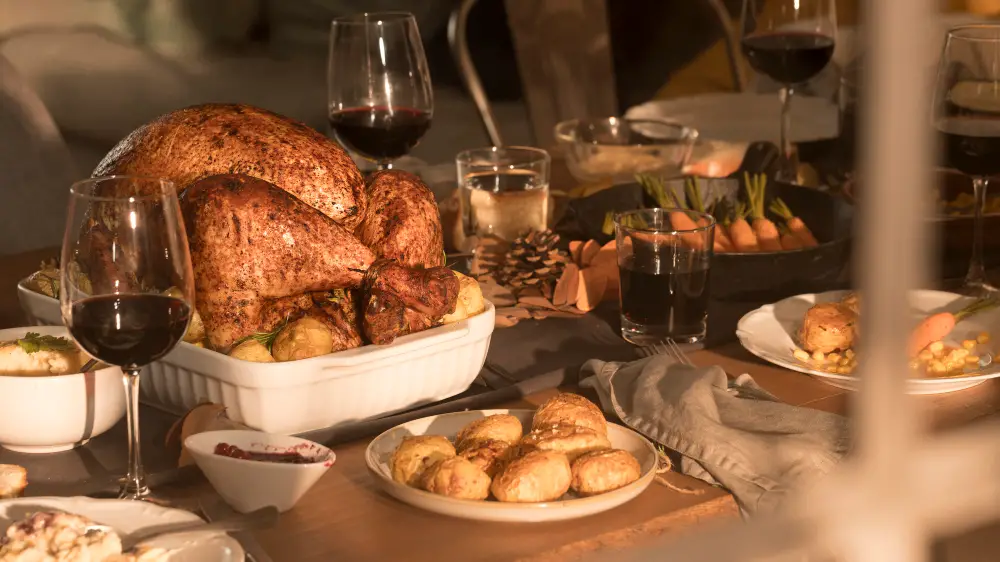
We sat down at the table anyway. Two plates. Two glasses. The extra chairs pushed in like they were embarrassed to be empty. The turkey sat in the center, golden and perfect, surrounded by dishes we’d spent hours preparing. Green bean casserole. Cranberry sauce. Sweet potato pie. Enough food for eight people, made by two.
I tried to make it normal. I asked Chloe about school. I laughed at a joke she made about her history teacher. But the silence around us was loud, and every few minutes my eyes drifted to my phone, waiting for my parents to text, to call, to say they were running late but on their way.
Nothing.
At 6:42 p.m., Chloe’s phone buzzed.
She glanced down, and her expression changed—fast, like she’d been slapped. Her eyes widened, then narrowed. Her jaw tightened.
“Mom,” she whispered, voice tight, “look at this livestream.”
I frowned. “Livestream?”
She turned the screen toward me, her hand shaking slightly.
A social media page loaded, and there it was in bright, cruel clarity: a high-end restaurant—gold lighting, white tablecloths, crystal glasses catching the glow of expensive chandeliers. The kind of place that required reservations weeks in advance.
And at the center of the frame, smiling and toasting like they were starring in their own perfect life:
My sister.
My mother.
My father.
Lauren leaned into the camera with a wine glass raised and laughed, cheeks flushed, her hair done in soft curls that must have taken an hour. My mom clinked glasses with her, wearing the pearl necklace I’d given her for her birthday three years ago—the one she said she loved but never wore when she visited me. My dad smiled that relaxed, satisfied smile he never wore in my home, the one that said he was exactly where he wanted to be.
A caption floated above the video: “Thanksgiving with my favorite people ❤️”
My stomach turned to ice. The room tilted slightly. I gripped the edge of the table.
Chloe watched my face, reading every micro-expression, every betrayal registering in my eyes. Then she did something I didn’t expect.
She tapped the screen and turned it black—clean, decisive, like she was closing a door.
She set the phone down gently beside her plate and said, very quietly, “Mom… I’ll take care of it.”
I stared at her. “Chloe, what do you mean?”
She didn’t answer right away. She picked up her fork, took a slow bite of turkey, and chewed like she was practicing calm. Then she looked up at me with eyes too steady for a seventeen-year-old and said, “They think you won’t do anything because you’re kind.”
My throat tightened. “Chloe—”
She reached across the table and covered my hand with hers. Warm. Certain. Steady.
“I’m not going to let them keep humiliating you,” she said softly. “Not anymore.”
And in that moment, I realized the strangest part of betrayal isn’t the cruelty itself.
It’s the way it teaches your child to stop being a child.
Chloe didn’t explode. She didn’t cry. She didn’t rant the way I expected a teenager to.
She stood up, cleared her plate like it was any normal dinner, and carried the dishes to the sink with a quiet focus that made my skin prickle with something between pride and fear.
“Sweetheart,” I said carefully, following her into the kitchen, my footsteps uncertain, “what are you planning?”
Chloe turned on the faucet and rinsed a plate slowly, methodically. “I’m planning to stop them from rewriting the story,” she said.
“The story?”
She nodded, her profile sharp in the kitchen light. “Aunt Lauren just told everyone she’s sick,” she said, voice flat. “So if you post anything about being alone, they’ll say you’re dramatic. If you say you’re hurt, they’ll say you’re trying to guilt them. They already have their version ready.”
My mouth went dry, because she was right.
That’s exactly what always happened.
Last Christmas, when they’d promised to come over for dinner and then canceled at the last minute because Lauren “forgot” she’d made other plans, I’d posted a sad face emoji. Just one. My mother had called me an hour later to tell me I was “making everyone uncomfortable” and “being passive-aggressive.”
When I’d quietly mentioned feeling left out during my father’s birthday celebration—the one I wasn’t invited to—Lauren had told the entire family I was “playing the victim.”
The narrative was always the same: I was too sensitive. I was imagining things. I was the problem.
Chloe reached into her pocket and pulled out her phone again, unlocking it with her thumb.
“Do you remember when Grandpa got sick last year and Aunt Lauren posted ‘I’m taking care of the family’ even though she never visited?” Chloe asked.
I swallowed. “Yes.”
She’d posted photos from the hospital—photos taken during the one visit she made in three weeks, while I’d been there every single day, holding my father’s hand through tests and treatments and long, silent afternoons. But Lauren’s post had gotten three hundred likes, and suddenly everyone thought she was the devoted daughter.
“I learned something that day,” Chloe said. “People believe what they see first.”
She tapped the screen, not in anger—methodically, like a surgeon choosing tools.
She didn’t write a mean post. She didn’t tag them with insults. She did something smarter.
She opened the livestream again, screen-recorded the full minute—my sister’s face, my mother’s toast, my father’s smile—and then she captured screenshots of the earlier text message: I’m sick, so I’m sitting this one out.
Then she opened a new post, typed a single sentence, and showed it to me before she hit publish.
“Happy Thanksgiving. Just a reminder: if someone says they’re ‘too sick to come,’ but you see them out celebrating elsewhere, you’re not imagining the disrespect.”
No names. No accusations. No drama.
Just truth with receipts.
“Chloe,” I whispered, terrified and impressed at once. “This will start a war.”
Chloe shrugged slightly, her jaw set. “They started it,” she said.
She posted it to her story—where every cousin, every family friend, and, most importantly, my sister’s circle would see it within minutes.
My phone began buzzing almost immediately.
First, a message from my cousin: Are you okay?
Then my aunt: What is this about?
Then, ten seconds later, Lauren: DELETE THAT RIGHT NOW.
My mother called right after. I watched her name flash on my screen and felt my stomach knot with old, familiar dread.
Chloe looked at it, then looked at me.
“Don’t answer yet,” she said softly. “Let them feel what it’s like to not control the room.”
My chest tightened. I hated conflict. I’d spent my entire life smoothing edges so nobody would accuse me of being difficult. I was the peacekeeper, the one who apologized even when I’d done nothing wrong, the one who made myself smaller so everyone else could be comfortable.
But watching Chloe—my child—become the shield I never asked her to be…
I let the call go to voicemail.
The phone rang again immediately. This time it was Lauren.
Chloe watched it ring, her expression unreadable.
“She’s panicking,” Chloe said quietly. “Because for the first time, she can’t control the narrative.”
The ringing stopped. A text came through: Mom, answer the phone. We need to talk about what Chloe just posted. This is ridiculous.
Another buzz. My father this time: Call your mother back. Now.
Not “Are you okay?” Not “I’m sorry.” Just commands.
Chloe’s phone started buzzing too. She glanced at it and laughed—a short, bitter sound. “Aunt Lauren’s messaging me directly now.”
She showed me the screen.
Chloe, this is between adults. Take that post down immediately. You don’t understand the situation.
Chloe typed back with steady fingers: I understand perfectly. You lied. The screenshots don’t lie.
She hit send and set her phone face-down on the counter.
“Now what?” I asked, my voice smaller than I wanted it to be.
“Now,” Chloe said, turning to face me fully, “you decide what kind of relationship you actually want with them.”
The calls and messages continued for the next hour. My phone lit up like a Christmas tree—cousins asking what happened, family friends sending concerned messages, and my immediate family oscillating between outrage and damage control.
My mother’s voicemail was cold: “I don’t know what’s gotten into you and Chloe, but this public humiliation is unacceptable. We need to discuss this as a family. In private. The way adults handle things.”
Lauren’s texts grew increasingly frantic:
You’re making me look like a monster
I WAS feeling sick, I just felt better later
You’re ruining Thanksgiving for everyone
Mom is crying because of what Chloe posted
Are you happy now?
Chloe read them over my shoulder and snorted. “Notice how none of them are apologies.”
She was right. Not one message acknowledged the hurt they’d caused. Not one person said, “I’m sorry we excluded you.” It was all about how I was making them feel, how I was causing them problems, how I needed to fix their discomfort.
Around 8 p.m., my phone rang again. This time, it was my aunt Margaret—my mother’s sister, someone I’d always felt was more reasonable than the rest.
Chloe nodded at me. “Answer that one.”
I picked up, my hand shaking slightly. “Hello?”
“Sweetheart,” Aunt Margaret said, her voice gentle, “I saw Chloe’s post. Are you okay?”
The kindness in her voice made my throat close up. “I… I don’t know.”
“Your mother called me,” she continued. “She’s very upset. But before I talk to her, I need to know—is what Chloe posted true? Were they really at a restaurant while telling you they couldn’t come?”
I closed my eyes. “Yes.”
Aunt Margaret was quiet for a long moment. “That’s what I thought. Your mother has a habit of… rewriting history. I’ve watched her do it for years.”
My eyes opened. “You have?”
“Honey, you’re not crazy. You’re not too sensitive. And you’re not imagining the favoritism.” She sighed. “I’ve tried to talk to your mother about it before. She doesn’t listen. She sees what she wants to see.”
Tears started sliding down my face. I hadn’t realized how desperately I’d needed someone—anyone—to validate what I’d been experiencing.
“What should I do?” I whispered.
“What do you want to do?” Aunt Margaret asked. “Not what will keep the peace. Not what will make everyone else comfortable. What do you actually want?”
I looked at Chloe, who was watching me with those steady, knowing eyes.
“I want them to acknowledge what they did,” I said. “I want a real apology. And I want them to stop treating me like I’m disposable.”
“Then tell them that,” Aunt Margaret said. “And if they can’t do those things, then you know where you stand.”
After I hung up, Chloe hugged me—tight and fierce.
“I’m proud of you, Mom,” she whispered into my shoulder.
I held her and cried, not from sadness, but from the strange relief of finally, finally being honest.
Around 9 p.m., my mother called again.
This time, I answered.
“Mom,” I said, my voice steadier than I expected.
“Finally,” she snapped. “Do you have any idea what you and Chloe have done? Your sister is devastated. Your father is furious. The entire family is talking about us.”
“Good,” I said.
Silence.
“Excuse me?” my mother said, her voice dangerous.
“I said good,” I repeated. “Maybe they should talk about it. Maybe they should know the truth.”
“The truth?” She laughed—sharp and bitter. “The truth is that you’re turning your daughter into a weapon against your own family. The truth is that you’re being vindictive and petty.”
“The truth,” I said, my voice rising, “is that you chose a restaurant over your own daughter on Thanksgiving. The truth is that Lauren lied about being sick, and you went along with it. The truth is that you’ve been doing this for years, and I’ve been pretending it’s okay.”
“We were going to come by later—”
“Don’t,” I cut her off. “Don’t lie to me. You weren’t coming. You never planned to come. And if Chloe hadn’t found that livestream, you would have let me believe Lauren was actually sick, and you would have gone on pretending you care.”
My mother’s voice turned cold. “If that’s how you feel, then maybe it’s best if we take some space from each other.”
My heart squeezed, but I didn’t back down. “Maybe it is.”
“Fine,” she said. “But don’t come crying to me when you realize you’ve alienated your entire family over nothing.”
“It’s not nothing to me,” I said quietly. “And that’s the problem. It was never nothing to me.”
I hung up before she could respond.
My hands were shaking, my heart pounding, but I also felt something I hadn’t felt in years: free.
Chloe sat beside me on the couch and took my hand.
“You did good, Mom,” she said.
“I just blew up my relationship with my entire family,” I said, half-laughing, half-crying.
“No,” Chloe corrected. “You just stopped pretending you had a relationship that was already broken.”
The next few days were strange.
Some family members reached out with support—cousins who admitted they’d noticed the favoritism, friends who said they were proud of me for finally standing up for myself.
Others sent angry messages, accusing me of ruining the family, of being selfish, of turning Chloe against them.
My mother and father didn’t contact me at all.
Lauren sent one final text: I hope you’re happy. You’ve destroyed this family.
I didn’t respond.
On the Saturday after Thanksgiving, Aunt Margaret invited Chloe and me to her house for leftover turkey sandwiches. We sat in her sunny kitchen, and she told stories about my mother’s behavior over the years—the favoritism, the gaslighting, the way she rewrote history to suit her narrative.
“I should have said something sooner,” Aunt Margaret said. “I’m sorry I didn’t.”
“It’s not your job to fix my family,” I said.
“No,” she agreed. “But it is my job to tell you that you deserve better. And so does Chloe.”
Chloe smiled at her. “Thanks, Aunt Margaret.”
As we drove home that afternoon, Chloe said, “Mom, can I ask you something?”
“Of course.”
“Are you sad? About cutting them off?”
I thought about it carefully. “I’m sad about what I wanted us to be,” I said. “But I’m not sad about stepping away from what we actually were.”
Chloe nodded. “That makes sense.”
“Are you okay?” I asked. “With everything that happened?”
She looked out the window at the gray November sky. “I’m okay,” she said. “I just… I got tired of watching them hurt you. And I got tired of you letting them.”
“I’m sorry you had to see that,” I said.
“Don’t be sorry,” she said. “You taught me something important.”
“What’s that?”
She turned to look at me, her expression serious. “You taught me that kindness without boundaries is just self-destruction. And you taught me that I never want to treat people the way they treated you.”
My throat tightened. “You’re a good kid, you know that?”
She grinned. “I know. You raised me.”
Christmas came and went without a word from my parents or Lauren.
I’d be lying if I said it didn’t hurt. There were moments—opening presents with just Chloe, cooking dinner for two again—when I felt the absence like a physical ache.
But there were also moments of unexpected joy.
Aunt Margaret invited us to her house for Christmas dinner, where we met her friends and her neighbors—people who welcomed us without judgment, who asked about our lives with genuine interest, who made us feel like we belonged.
Chloe and I started new traditions. We watched terrible holiday movies and made hot chocolate with too many marshmallows. We drove around looking at Christmas lights and sang off-key to carols on the radio.
And on New Year’s Eve, as we watched the ball drop on TV, Chloe raised her glass of sparkling cider and said, “To fresh starts.”
I clinked my glass against hers. “To fresh starts.”
“And to never letting people make you feel small again,” she added.
“To that too,” I agreed.
In February, I got an unexpected message.
It was from my mother: Your father is in the hospital. Heart attack. Thought you should know.
No apology. No acknowledgment of the months of silence. Just information, delivered like a news bulletin.
Chloe watched me read it. “What are you going to do?”
I thought about it for a long time. “I’m going to visit him,” I said. “Because I don’t want to regret not going. But I’m not going to pretend everything is okay.”
“Want me to come with you?” Chloe asked.
“No,” I said. “This is something I need to do alone.”
The hospital was sterile and cold, smelling of antiseptic and anxiety. I found my father’s room on the third floor, the door half-open.
My mother sat in a chair beside his bed, looking older and smaller than I remembered. Lauren stood near the window, her arms crossed.
When I walked in, they both looked up.
“You came,” my mother said, her voice neutral.
“I did,” I said.
My father was asleep, monitors beeping softly beside him. He looked fragile in a way that startled me—the strong, distant man I’d known reduced to this.
I sat in the chair on the other side of his bed. “How is he?”
“Stable,” my mother said. “They think he’ll recover.”
We sat in awkward silence for several minutes.
Finally, Lauren spoke. “Are you going to apologize?”
I looked at her. “For what?”
“For that post. For embarrassing the family. For ruining Thanksgiving.”
“No,” I said simply.
My mother’s head snapped up. “No?”
“No,” I repeated. “I’m not going to apologize for telling the truth. And I’m not going to apologize for finally setting boundaries.”
“Boundaries?” Lauren scoffed. “You call what Chloe did ‘boundaries’? She humiliated me online.”
“You humiliated yourself,” I said. “By lying about being sick and then broadcasting your actual plans to the entire internet.”
My mother stood up. “I didn’t come here to fight.”
“Neither did I,” I said. “I came because, despite everything, he’s still my father. But I’m not going to pretend the last few months didn’t happen. And I’m not going to go back to being the person you could ignore and disrespect whenever it was convenient.”
“So that’s it?” my mother asked. “You’re just going to hold a grudge forever?”
“I’m not holding a grudge,” I said, standing to face her. “I’m protecting myself. There’s a difference.”
Lauren shook her head. “You’re being dramatic.”
“And you’re being cruel,” I replied. “You always have been. But I don’t have to accept it anymore.”
I looked down at my father, still sleeping peacefully despite the tension crackling around him.
“I hope he recovers,” I said. “And I’ll check in on his progress. But unless you’re willing to acknowledge what you did—really acknowledge it, with a real apology—I can’t have a relationship with you. It’s not healthy for me, and it’s not healthy for Chloe.”
I walked toward the door, my heart pounding but my steps steady.
“Wait,” my mother said.
I stopped but didn’t turn around.
“I…” She struggled with the words. “Maybe we could have been… more thoughtful.”
It wasn’t an apology. It was barely an acknowledgment.
I turned to look at her. “Call me when you’re ready to have an honest conversation,” I said. “Until then, I need to focus on the family that actually shows up for me.”
I left the hospital and sat in my car for several minutes, crying and shaking and feeling utterly exhausted.
Then I called Chloe.
“How’d it go?” she asked.
“Hard,” I said. “But I didn’t back down.”
“Good,” she said. “I’m proud of you, Mom.”
“Thanks, bug. I’ll be home soon.”
“I’ll make hot chocolate,” she said. “The kind with too many marshmallows.”
I smiled through my tears. “Perfect.”
EPILOGUE
It’s been a year since that Thanksgiving.
My father recovered from his heart attack, and I visit him occasionally—short, polite visits where we talk about surface-level things and avoid the deeper wounds.
My mother and I exchange cards on birthdays and holidays, but we don’t call. We don’t pretend to be close.
Lauren and I don’t speak at all. I’ve made peace with that.
What surprised me most was how much my life improved when I stopped trying to force relationships that were never meant to work.
I have more time for the people who actually value me. Aunt Margaret has become a true friend and surrogate mother figure. I’ve reconnected with old friends I’d neglected while trying to chase my family’s approval.
And Chloe? She’s thriving.
She got into her first-choice college with a full scholarship. She’s confident and outspoken and refuses to tolerate disrespect from anyone.
Sometimes I worry that I’ve made her too hard, too defensive.
But then I remember that night—Thanksgiving night—when she looked at me with fierce love and said, I’ll take care of it.
She didn’t do it because I was weak.
She did it because she was strong enough to protect us both.
And that’s not a burden I placed on her.
That’s a gift she gave me.
The gift of seeing myself through her eyes—not as someone who deserves to be hurt, but as someone worthy of being defended.
These days, our Thanksgivings are smaller but infinitely warmer.
Last year, it was Chloe, me, Aunt Margaret, and three of her neighbors who didn’t have family nearby.
We laughed until our sides hurt. We ate until we couldn’t move. And when we went around the table saying what we were grateful for, I said, “I’m grateful for the family I chose.”
Chloe squeezed my hand and added, “And I’m grateful Mom finally chose herself.”
The table went quiet for a moment, everyone understanding the weight behind those words.
Then Aunt Margaret raised her glass and said, “To choosing yourself. And to the people brave enough to let you.”
We all clinked glasses—mismatched, imperfect, real.
And I realized something profound: I’d spent so many years trying to earn my family’s love that I’d forgotten I already had everything I needed.
A daughter who would go to war for me.
Friends who showed up without conditions.
And finally, after thirty-eight years, the courage to walk away from people who only wanted me when it was convenient.
That Thanksgiving night—the night my sister lied, my parents chose a restaurant over me, and my daughter turned off the livestream and said, I’ll take care of it—that was the night everything changed.
Not because my family finally loved me the way I deserved.
But because I finally loved myself enough to stop begging them to.
And that, it turns out, was the greatest gift of all.
THE END
A story about the moment we stop accepting crumbs from people who should be giving us the whole meal—and the surprising freedom that comes when we finally walk away from tables where we were never truly welcome.

Lila Hart is a dedicated Digital Archivist and Research Specialist with a keen eye for preserving and curating meaningful content. At TheArchivists, she specializes in organizing and managing digital archives, ensuring that valuable stories and historical moments are accessible for generations to come.
Lila earned her degree in History and Archival Studies from the University of Edinburgh, where she cultivated her passion for documenting the past and preserving cultural heritage. Her expertise lies in combining traditional archival techniques with modern digital tools, allowing her to create comprehensive and engaging collections that resonate with audiences worldwide.
At TheArchivists, Lila is known for her meticulous attention to detail and her ability to uncover hidden gems within extensive archives. Her work is praised for its depth, authenticity, and contribution to the preservation of knowledge in the digital age.
Driven by a commitment to preserving stories that matter, Lila is passionate about exploring the intersection of history and technology. Her goal is to ensure that every piece of content she handles reflects the richness of human experiences and remains a source of inspiration for years to come.