The Floor She Refused to Kiss
Mia lowered herself slowly toward the floor, her knees trembling as they bent. Around her, the opulent dining room of Le Ciel seemed to hold its breath.
Inside Le Ciel, time seemed to freeze. The clinking of silverware faded into an uneasy hush. The soft jazz playing through hidden speakers became a mockery of elegance. The lights that once reflected warmly off gold accents and crystal chandeliers suddenly felt cold—like silent witnesses to something everyone pretended not to see.
The Wagyu steak lay on the polished marble floor, the most expensive cut on the menu, now ruined. The plate had shattered into jagged pieces, white porcelain scattered like broken teeth. The red wine reduction sauce had spread outward in a dark pool, staining the white marble like a wound that refused to clot.
All eyes were on Mia.
Investors in tailored Armani suits paused mid-conversation, their wine glasses suspended in air. Women adorned with diamonds worth more than Mia’s annual salary stopped eating, their perfectly painted lips parted in anticipation. Chefs watched from behind the mirrored kitchen wall, their white uniforms stark against the gleaming stainless steel. Fellow waitresses stood frozen with fear at the edges of the room, grateful it wasn’t them, ashamed they were grateful.
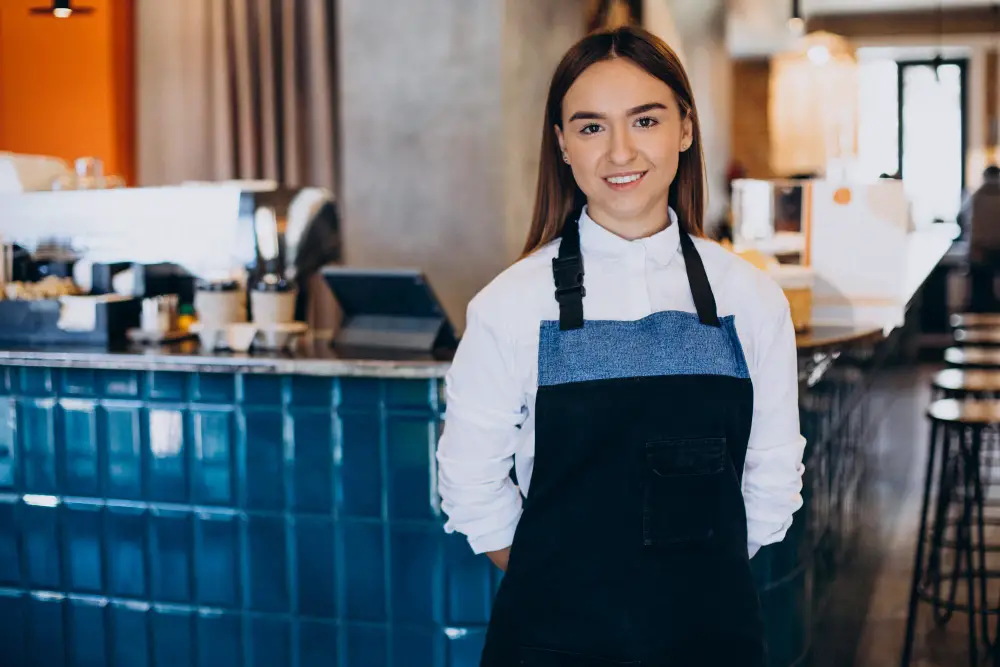
Mia knelt on the cold marble, her black uniform dress pressing against her legs, her white apron—starched that morning with such care—now crumpled and stained.
Mr. Gozon smiled. It was the smile of a man who had done this before and would do it again.
“Well?” he muttered sharply, his voice carrying across the silent room. “Hurry up. Don’t waste my guests’ time. Eat it. Like the dog you are.”
The words hit like a slap. Several diners shifted uncomfortably, but no one spoke. No one ever spoke.
Mia inhaled deeply, the air catching in her throat. Her hands touched the floor, fingertips grazing the cold marble, trembling. Tears traced down her cheeks, hot against her skin, blurring her vision—but something inside her shifted, as if a long-closed door had begun to open.
She thought of her father.
Dr. Rafael Alonzo had been one of Manila’s most respected cardiologists before he died three years ago. He’d worked in a public hospital, refusing lucrative offers from private clinics because, as he’d told Mia countless times, “The people who need me most can’t afford to pay.”
When a pharmaceutical company offered him two million pesos to prescribe their medication exclusively—medication that was inferior but more profitable—he’d refused. When a politician’s wife demanded he bump her son ahead of critical patients, he’d said no. When colleagues told him he was being foolish, sacrificing his family’s comfort for strangers, he’d smiled and said, “Dignity isn’t negotiable.”
He’d died of a heart attack at his desk, surrounded by patient files, having given everything to people who could never repay him.
And he’d left Mia with nothing but student loans, medical bills, and the memory of a man who never bowed.
Mia had been working three jobs to finish her business degree. Morning shift at a call center. Afternoon tutoring rich kids who barely listened. Evenings at Le Ciel, the most prestigious restaurant in the city, where she’d somehow landed a position after dozens of rejections.
Three days. She’d worked at Le Ciel for exactly three days.
And now she was on her knees.
She did not reach for the meat.
Instead, she rose.
One step back. Then another. Her back straightened, vertebra by vertebra. Her chin lifted. Her hands, still trembling, moved to the knot of her apron.
Mr. Gozon’s expression darkened, confusion giving way to anger. “What do you think you’re doing?”
Mia said nothing. She slowly untied the apron from her waist—no anger, no rush, no dramatic flourish—and laid it gently over the broken plate and ruined steak, covering them like a burial shroud.
A ripple of whispers spread across the dining room like wind through grass.
“What is this?” Gozon hissed, stepping forward. “Have you lost your mind? Do you know how many people would kill for your position?”
Mia met his eyes. For the first time since stepping into Le Ciel three days ago, she did not bow. She did not look away. She did not flinch.
Her voice trembled—but it was steady enough.
“You’re fired.”
The room erupted.
Someone gasped. A woman laughed nervously. A man whispered, “Did she just—”
Gozon laughed, loud and cruel, his face reddening. “Me? Fired? Who do you think you are, you little—”
A single clap cut through the noise.
Slow. Deliberate. Sharp.
It came from the far end of the room—from the investors’ table, the VIP section that Mia had been told never to approach unless summoned.
A man in a gray suit stood. White hair, perfectly groomed. Piercing blue eyes. A presence that commanded attention without effort. Authority that needed no volume.
Laurent Duval.
Founder of Duval Hospitality Group, the corporation that owned Le Ciel and forty-seven other establishments across Southeast Asia. A man whose net worth was measured in billions, whose decisions affected thousands of employees, whose mere presence at a restaurant was enough to send managers into panic.
Gozon went pale, the color draining from his face as if someone had pulled a plug. “S-Sir Laurent… I didn’t know you were here—”
“Obviously,” Laurent said coolly as he stepped forward, his Italian leather shoes clicking against the marble with each deliberate step. “I came unannounced. I wanted to see how my flagship restaurant operated when no one was performing for me.”
Each footfall echoed like judgment.
The restaurant fell into absolute silence. Even the kitchen had gone quiet, chefs abandoning their stations to watch through the glass.
Mia stood shaking—but no longer crying. She couldn’t quite believe what was happening. She’d heard of Laurent Duval, of course. Everyone in the hospitality industry had. But she’d never seen him, never expected to see him, and certainly never imagined her first encounter would be like this.
“Mr. Gozon,” Laurent continued, stopping three feet from the manager, “explain to me why you chose to humiliate an employee in front of paying guests. Explain the business logic of that decision.”
Gozon stammered, his confident cruelty evaporating. “I—I was maintaining discipline, sir. She dropped a plate. She was careless—”
“She slipped on a wet spot,” a voice called out from the kitchen. One of the chefs, an older man with graying hair, stepped forward. “I saw it. Someone spilled water near table seven and didn’t mark it. She didn’t see it.”
Gozon’s jaw tightened. “That’s irrelevant—”
“Is it?” Laurent asked. “Because from where I was sitting, I saw you engineer a public humiliation. I saw you take pleasure in it. I saw fear in the eyes of every staff member in this room. That’s not discipline, Mr. Gozon. That’s something else entirely.”
Laurent’s companion stood as well—a woman in her fifties, elegant in a way that had nothing to do with her designer dress and everything to do with the way she carried herself.
Isabelle Duval.
Co-owner of the Duval Hospitality Group. Laurent’s sister. And, according to industry rumors, far less forgiving than her brother.
She approached with measured steps, her eyes fixed on Gozon like a predator assessing prey.
“That’s not all,” Laurent continued. “I also heard you use words like ‘eat it’ and ‘dog.’ I heard you tell a human being, an employee under your supervision, to debase herself for your entertainment.”
Gozon swallowed hard, sweat beading on his forehead. “Sir, I didn’t mean—it was a joke—she needs to learn—”
SLAP.
The sound rang sharply through the dining room, silencing even the whispers.
It wasn’t Laurent.
It was Isabelle Duval.
She’d struck Gozon across the face with her open palm, the blow delivered with precision rather than passion. Gozon stumbled backward, his hand flying to his reddening cheek, his eyes wide with shock.
“In this business,” Isabelle said coldly, her voice cutting like a scalpel, “we do not tolerate people who play with another person’s dignity. We deal in hospitality, Mr. Gozon. Do you know what that word means? It comes from the Latin ‘hospes’—host and guest. It implies mutual respect. Care. Safety.”
She stepped closer to him, her voice dropping but somehow becoming more terrifying.
“You have created an environment of fear. I can see it in every staff member’s face. They’re not afraid of making mistakes—they’re afraid of you. That makes you a liability, not a leader.”
She turned to Mia, and her expression softened fractionally. “Your name?”
“M-Mia,” she managed to say, her voice small.
“Full name.”
“Mia Alonzo.”
Isabelle paused, recognition flickering across her face. “Alonzo…” A faint smile touched her lips. “Any relation to Dr. Rafael Alonzo?”
Mia’s eyes widened. “Yes. He was my father.”
“Was?” Laurent asked gently.
“He passed away three years ago. Heart attack.”
Laurent and Isabelle exchanged a glance, some unspoken communication passing between them.
“The cardiologist who refused bribes worth millions to save his patients?” Laurent asked.
“Yes,” Mia whispered.
“The man who testified against hospital administrators who were selling donor organs to the highest bidder, even though he knew it would cost him his career?” Isabelle added.
“Yes.”
Laurent nodded slowly, something like respect in his eyes. “I’m not surprised you stood up. It’s in your blood.”
He turned back to Gozon, and his expression hardened again.
“As of this moment, you are no longer the manager of Le Ciel.”
“Sir, please—” Gozon’s voice cracked. “I’ve worked here for eight years. I’ve increased profits by forty percent. I’ve—”
“You’ve created a toxic workplace,” Laurent cut him off. “You’ve prioritized fear over excellence. You’ve mistaken cruelty for strength. And you’ve done it all while representing my brand, my values, my family name.”
“Just one more chance—I’ll change—I’ll—”
“Security,” Isabelle said, her voice flat and final.
Two guards appeared from the entrance—large men in dark suits who’d been standing discretely by the door. They approached Gozon with professional efficiency.
As they took his arms, Gozon seemed to realize the full weight of what was happening. He was being escorted out of the restaurant he’d ruled like a petty tyrant. In front of investors. In front of staff. In front of the entire Manila social elite who would spread this story through every country club and boardroom in the city by morning.
He twisted toward Mia, his face contorted with rage and humiliation.
“You think you won?!” he screamed as the guards pulled him toward the exit. “You’re nothing but a waitress! A poor little waitress playing dress-up in a world you’ll never belong in! You’ll be back on the streets in a week!”
Laurent stopped, turning slowly. His voice, when he spoke, was quiet but carried to every corner of the room.
“No,” he said calmly. “She’s not ‘just a waitress.’ She’s a person. A person with more integrity in her little finger than you’ve shown in eight years.”
The doors closed behind Gozon, cutting off his protests.
Silence settled over the restaurant like snow.
Then applause—thunderous, sincere, spontaneous. It started with one of the investors, an elderly woman in pearls, and spread through the entire dining room. The entire restaurant stood, clapping for a twenty-four-year-old waitress who’d worked there for three days.
Mia gasped, overwhelmed, her legs suddenly weak. She’d been running on adrenaline, but now that the confrontation was over, the full enormity of what had just happened hit her like a wave.
She’d just lost her job. Again. The best-paying job she’d ever had, gone in less than a week. How would she pay rent? How would she finish school? How would she—
Isabelle approached her, and Mia instinctively straightened despite her shaking legs.
“Do you still want to be a waitress?” Isabelle asked.
Mia blinked, confused. “I—what?”
“There’s an opening,” Isabelle said, and there was something in her eyes—approval, maybe, or recognition. “Management training program. Six months of intensive education in every aspect of restaurant operations. Then placement in one of our establishments as an assistant manager. If you’re willing.”
Mia’s mouth opened but no sound came out. She looked at Laurent, certain this was some kind of test or joke.
“But I’ve only worked here three days,” she finally managed. “I don’t have experience. I don’t have—”
“Dignity,” Laurent replied, “has nothing to do with time. Neither does character. You showed both tonight. The question is: do you want to learn the business, or do you want to keep your head down and hope no one notices you?”
Mia thought of her father, of the way he’d lived his entire life making the harder choice, the right choice, even when it cost him.
“I want to learn,” she said.
“Good,” Isabelle said. She pulled a business card from her purse—heavy cardstock with embossed lettering. “My driver will pick you up tomorrow morning at nine. Headquarters. Don’t be late.”
Mia collapsed into a chair—weak, not from fear, but from the sheer impossibility of hope suddenly becoming real.
Outside, rain began to fall, drumming against the windows.
Inside, someone had risen.
The next morning felt like stepping into a dream someone else was having.
Mia woke in her tiny rented room in Quezon City—a space barely larger than a closet, with bare walls, a narrow bed, and books stacked everywhere. Business management. Organizational psychology. Leadership theory. She had studied them quietly for years, reading in the breaks between shifts, highlighting passages on the jeepney rides to work, believing that someday, somehow, education would be her way out.
Her phone buzzed at 7:30 AM.
Unknown Number.
Good morning, Mia. This is Isabelle Duval. Driver arrives at 9 a.m. Headquarters is in Makati. Business casual. Don’t be late.
Mia stared at the message, half-convinced she’d imagined last night. But her feet were still sore from standing, and when she looked in the mirror, her eyes were still red from crying.
It had happened.
She showered in the communal bathroom down the hall, dodging the broken tiles and the perpetually dripping faucet. She put on her only business outfit—a navy blue blazer she’d bought secondhand, a white blouse, black slacks. She looked at herself in the cracked mirror and saw her father looking back. Same dark eyes. Same stubborn jaw. Same foolish belief that the world could be better if you refused to accept its ugliness.
“Don’t let me down, Dad,” she whispered.
The driver arrived exactly at nine in a black Mercedes that looked impossibly clean on the dusty street. Neighbors stared from windows. Mrs. Santos from the corner store came out to gawk.
The ride to Makati took forty minutes through Manila’s chaotic traffic. Mia sat in the backseat, watching the city transform from crowded markets and jeepneys to gleaming towers and manicured parks. This was the Manila she’d only seen from a distance—the Manila of money and power, the Manila her father had deliberately chosen not to be part of.
Duval Headquarters felt like another world—all glass and steel, soaring ceilings, calm precision. The lobby had a fountain, actual trees growing inside, and art on the walls that probably cost more than her father’s lifetime salary.
Everyone moved with purpose here. No shouting. No panic. Just quiet efficiency.
But whispers followed her as she walked to the elevator.
“That’s the waitress…”
“The one from Le Ciel last night…”
“Did you see the video? It’s everywhere…”
Mia’s stomach dropped. “Video?”
The receptionist, a young woman with kind eyes, leaned in. “Someone recorded it on their phone. It’s viral. Three million views already.”
Mia felt sick. Her face was out there, her moment of defiance or stupidity—she still wasn’t sure which—broadcast to millions of strangers.
The elevator ride to the twentieth floor felt eternal.
In the conference room sat Laurent, Isabelle, and five senior executives she didn’t recognize. They all stopped talking when she entered.
“Sit,” Isabelle said, gesturing to a chair.
Mia sat, trying not to show how intimidated she was.
“We didn’t hire you out of pity,” Isabelle said without preamble. “Let’s make that clear from the start.”
“I know,” Mia replied, though she wasn’t entirely sure she believed it.
“We hired you,” Laurent added, leaning forward, “because you showed something no MBA can teach. Something we’ve been trying to instill in our managers for years and failing.”
“What?” Mia asked.
“Courage with discipline,” Isabelle said. “Not just standing up, but standing up with control. You didn’t scream. You didn’t make a scene. You didn’t attack. You simply refused to participate in your own humiliation. That’s rare.”
One of the executives, a stern-looking woman in her sixties, spoke up. “But understand this: courage alone won’t succeed here. You need to learn the business. Accounting. Operations. HR. Supply chain. Customer psychology. We’re going to throw everything at you, and most people break.”
“I won’t break,” Mia said.
The woman smiled slightly. “We’ll see.”
“You’ll start at the bottom,” Laurent warned. “Not as a waitress—you’ve done that. But you’ll rotate through every department. Purchasing. Inventory. Kitchen. Cleaning. You’ll learn this business from the foundation up. It won’t be glamorous.”
Mia smiled for the first time. “I’m used to that.”
The weeks that followed were brutal.
Mia worked twelve-hour days, sometimes longer. Monday and Tuesday in accounting, learning to read P&L statements and balance sheets until numbers blurred together. Wednesday in HR, sitting through termination hearings and harassment complaints, seeing the ugly underside of corporate life. Thursday and Friday in operations, tracking inventory, monitoring suppliers, learning the thousand small decisions that kept a restaurant functioning.
The reports were impossible to finish. The expectations were crushing. And everywhere she went, she felt eyes on her. Some curious. Some resentful. Many hostile.
Especially from Victor Hale.
Victor was a senior operations manager, a man in his forties who’d risen through the ranks by being competent and ruthless. He’d been friends with Gozon—they’d come up together in the company, and he made no secret of his contempt for Mia.
“You don’t belong here,” he sneered one afternoon when she brought him a report he’d requested. “One dramatic scene and you think you’re special? You think refusing to eat off the floor makes you qualified to run a business?”
Mia met his gaze steadily. “And you? What were you taught? That humiliating people makes you powerful?”
Victor’s eyes narrowed. “Be careful, little girl. You have powerful friends now, but friends don’t last forever.”
He was right to warn her.
Two months into the training program, funds went missing.
It started small—discrepancies in the purchasing accounts. A thousand pesos here, three thousand there. Amounts small enough to be overlooked as clerical errors but adding up to over two hundred thousand pesos across six weeks.
The finance department noticed. An investigation was launched.
And somehow, the trail led to Mia.
Purchase orders with her signature. Approvals from her training account. Timestamps that matched her schedule.
“This doesn’t make sense,” Mia told Isabelle in an emergency meeting. “I’ve never approved purchases over ten thousand pesos. I don’t even have that authority.”
“The logs say otherwise,” the head of finance said, laying out printed reports. “Your credentials were used to approve these transactions.”
“Then someone used my credentials,” Mia insisted. “Someone who had access to my login.”
“That’s a serious accusation,” Laurent said carefully. “Do you have proof?”
“Not yet,” Mia admitted. “But I will.”
That night, instead of going home, Mia stayed at the office. She pulled every transaction record from the past three months. She cross-referenced timestamps with security logs. She tracked IP addresses. She looked for patterns.
And slowly, a picture emerged.
The approvals using her credentials all came from a single computer terminal—one in the operations department. And they all happened during the twenty-minute windows when Mia was in mandatory training sessions, times when her absence could be verified.
Someone was setting her up.
Someone who knew her schedule. Who had access to the operations terminal. Who had motive to see her fail.
She pulled the user logs for that terminal.
One name appeared again and again during those exact time windows.
V. Hale.
Victor Hale.
Mia spent the next week building her case. She documented every instance, cross-referenced them with her own calendar, pulled security footage showing Victor at that terminal during times when purchases were being approved under her name.
At the next board meeting, her hands shook as she presented her findings, but the data didn’t.
“This is the proof,” she said, laying out the documents. “Someone has been systematically stealing from the company and framing me for it. That someone is Victor Hale.”
Silence fell over the conference room.
Victor’s face went red, then white. “This is ridiculous! She’s desperate, making wild accusations to save herself—”
“The security footage doesn’t lie,” Isabelle said coldly, reviewing the evidence. “Neither do the IP logs. Neither does the pattern of approvals that exactly match times when Mia was in training sessions with witnesses.”
Laurent leaned back in his chair, his expression unreadable. “Victor, you’ve been with this company for eighteen years. You’ve been a competent manager. Why would you risk everything to frame a trainee?”
Victor’s composure cracked. “Because she doesn’t deserve to be here! She’s nobody! She’s a waitress who got lucky, who made a scene, who—”
“Who showed more integrity in three days than you’ve shown in eighteen years,” Isabelle finished. “The problem isn’t the system, Victor. It’s greed. It’s ego. It’s the belief that your years of service entitle you to cheat.”
“I want to speak to my lawyer,” Victor said.
“You’ll need one,” Laurent replied. “You’re terminated, effective immediately. We’re also filing criminal charges for embezzlement and fraud.”
Security escorted Victor out. Unlike Gozon’s dramatic exit, this one was quiet, almost sad. A man who’d built a career over nearly two decades, destroyed in minutes because he couldn’t accept that someone he considered beneath him might actually be worthy.
After Victor was gone, Laurent turned to Mia.
“You could have come to us immediately with your suspicions,” he said. “You could have asked for help. Why didn’t you?”
“Because I needed to prove it wasn’t me,” Mia said. “I needed to show I could solve problems, not just create them.”
Isabelle smiled—a real smile, warm and approving. “You’re learning.”
Three years later.
Le Ciel had changed.
The same gold accents, the same crystal chandeliers, the same marble floors. But the atmosphere was different. The fear was gone. Waitstaff moved with confidence, not terror. Chefs called out orders without being screamed at. Mistakes were learning opportunities, not grounds for humiliation.
Mia stood in the top-floor conference room of Duval Headquarters, looking down at the Manila skyline. She wore a tailored suit now, her hair professionally styled, but she still kept her father’s old watch in her pocket—a reminder of where she’d come from.
“Why do you think we promoted you?” Isabelle asked, joining her at the window.
“Because I work hard?” Mia offered.
“Lots of people work hard. We promoted you because you remember. You remember what it’s like to be on the floor, to be powerless, to be afraid. That makes you a better leader.”
“I’m not powerful,” Mia said quietly. “I just… I climb so others don’t have to kneel.”
Isabelle squeezed her shoulder. “That’s exactly why you’re powerful.”
That evening, Mia returned to Le Ciel—not as a manager on inspection, but as a guest. She’d made reservations under a different name, wanting to see how the restaurant operated when they didn’t know she was watching.
The service was excellent. Warm but professional. Efficient but not rushed.
Then she saw it—a young waitress, barely twenty, carrying a tray of wine glasses. She stumbled slightly, and one glass tipped, spilling red wine across the white tablecloth of a businessman’s table.
The girl froze, her face going pale with terror.
The businessman’s face reddened, his mouth opening to complain.
Mia stood and walked over before anyone else could react.
“It’s okay,” she said gently to the waitress, whose name tag read “Ana.” “Accidents happen. Let’s get this cleaned up.”
She helped Ana gather the broken glass, smiling at the businessman. “Sir, we’ll comp your meal and bring you a fresh bottle—our premium selection, with our apologies.”
Ana’s eyes filled with tears—not from fear, but from relief. “Thank you,” she whispered.
“You’re safe here,” Mia said. “Remember that. You’re safe.”
After the incident was handled, Mia pulled Ana aside.
“How long have you been working here?” she asked.
“Two weeks,” Ana said. “I’m so sorry, I was nervous, I didn’t mean to—”
“Stop apologizing,” Mia said gently. “Two weeks is nothing. You’re learning. Everyone makes mistakes. The question is: are you being treated with respect while you learn?”
Ana nodded. “Yes. The manager is really kind. Nothing like the stories I heard about the old manager.”
“Good,” Mia said. “That’s how it should be.”
As Mia left the restaurant, her phone buzzed with a message from an unknown number.
I saw what you did tonight at Le Ciel. I heard what you did to Victor Hale. I heard about the changes you’re making in the company. If you’re really trying to change this industry, if you’re really trying to make it better… I want in. I’m a chef. I’ve worked in twelve restaurants. I’ve seen things that would make your stomach turn. But I’ve also seen what you’re building. Let me help. – Marcus Chen
Mia stood on the sidewalk outside Le Ciel, the Manila night warm around her, the restaurant glowing behind her like a beacon.
She looked up at the building where she’d once knelt, where she’d once been told to degrade herself for the amusement of a petty tyrant.
She remembered the floor. The cold marble under her hands. The choice she’d made.
And she realized something profound: some stories don’t end with victory. They don’t end with revenge or vindication or even justice.
They rise—and in rising, they make room for others to rise too.
Mia typed a response to Marcus.
Coffee tomorrow. Let’s talk about changing the industry together.
She hit send and walked toward the street, hailing a taxi.
Behind her, Le Ciel glowed in the Manila night—no longer a temple of fear, but a place where dignity was the first item on the menu.
And somewhere, she thought, her father was smiling.
Not because she’d become successful. Not because she’d climbed the corporate ladder or proven her worth to people who’d doubted her.
But because when it mattered most, when everything was on the line, when kneeling would have been easier than standing—
She’d chosen to stand.
And that choice had rippled outward, changing not just her life, but the lives of everyone who came after her.
Ana would serve tables without fear.
Marcus would cook without abuse.
Hundreds of employees across dozens of restaurants would go to work knowing that dignity wasn’t negotiable, that humanity wasn’t conditional, that their worth wasn’t determined by the whims of petty tyrants.
Because one woman had refused to eat off the floor.
And in refusing, had fed something far more important:
Hope.
THE END
A story about the moment you decide your dignity is worth more than your job—and the unexpected revolution that begins when you stand up, not just for yourself, but for everyone who comes after you.

Lila Hart is a dedicated Digital Archivist and Research Specialist with a keen eye for preserving and curating meaningful content. At TheArchivists, she specializes in organizing and managing digital archives, ensuring that valuable stories and historical moments are accessible for generations to come.
Lila earned her degree in History and Archival Studies from the University of Edinburgh, where she cultivated her passion for documenting the past and preserving cultural heritage. Her expertise lies in combining traditional archival techniques with modern digital tools, allowing her to create comprehensive and engaging collections that resonate with audiences worldwide.
At TheArchivists, Lila is known for her meticulous attention to detail and her ability to uncover hidden gems within extensive archives. Her work is praised for its depth, authenticity, and contribution to the preservation of knowledge in the digital age.
Driven by a commitment to preserving stories that matter, Lila is passionate about exploring the intersection of history and technology. Her goal is to ensure that every piece of content she handles reflects the richness of human experiences and remains a source of inspiration for years to come.