The Sanctuary
The first thing I noticed was the flag.
Not the big one hanging on somebody’s porch down the street—this was the tiny stars-and-stripes keychain swinging from my own spare key, tapping softly against the steering wheel every time my hand shook.
Sinatra hummed low from my car speakers, the kind of smooth croon you put on when you want to pretend your life is calm. An iced tea sweated in the cupholder, cold enough to fog the plastic lid. My moving checklist lay on the dashboard like a promise. Today was supposed to be simple: unlock the front door, watch my moving truck pull up, carry in my boxes, breathe for the first time in years.
Instead, there was a moving truck already in my driveway.
And none of the men hustling across the lawn were carrying my things.
That was the moment my million-dollar sanctuary stopped feeling like a dream and started feeling like a crime scene.
I sat there for an extra beat, staring through the glass wall of the living room as if I could blink hard enough to rewrite what I was seeing.
A faded sofa. A gaudy gold display cabinet that looked like it had been rescued from the clearance aisle of a bad idea. A battered refrigerator, dented at the corner.
I knew that furniture.
It belonged to my sister.
“More to the right,” a man’s voice snapped, sharp and entitled, echoing from the terrace. “Don’t scratch it. That’s my new office and home, you know.”
Steve.
My brother-in-law. Self-proclaimed CEO. Professional dreamer. Serial failure with expensive taste.
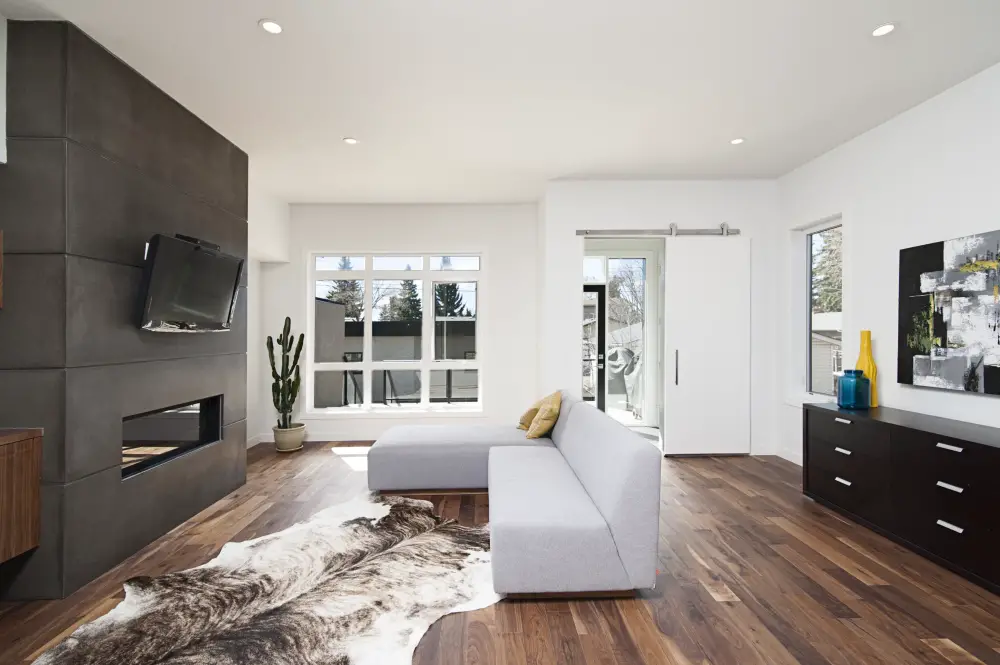
Through the massive window, I saw Lucy—my sister—chasing her three kids across the solid wood floors I had just paid to have custom-finished. Floors that still smelled faintly of wax. Floors they were running on with shoes that looked like they’d come straight from a playground.
My throat tightened so hard it hurt.
I had done everything the responsible way. I’d been quiet about the purchase. I’d kept the closing date to myself. I’d told my family I was “moving soon” without giving the address, because I wanted one thing in my adult life that wasn’t a group project.
And somehow, they were already inside.
My fingers went cold around my phone.
Before anger could climb all the way up my spine, something colder kicked in—training.
Six years in construction-adjacent work teaches you a lot. Mostly that if you show up emotional, you lose. If you show up prepared, you win.
So I hit Record.
The little red dot appeared on my screen.
And I started documenting the moment my family tried to move into my house like it was theirs.
Because I’d made myself a promise months ago—one I didn’t say out loud to anyone, but it had shaped every decision I’d made.
If they ever tried to take what I built, I wouldn’t fight them with feelings.
I’d fight them with paperwork.
I finally opened my car door and stepped out into the crisp afternoon. Oakwood Hills sat up on the slope like it had been carved for people who never checked their bank accounts. Clean sidewalks. Neat hedges. The kind of neighborhood where mailboxes looked curated.
I walked toward the front door with my keys in my fist.
“Hey!” a mover barked the moment I reached the porch. “You there. You’re in the way. Move.”
He didn’t recognize me, because why would he? In his world, homeowners didn’t show up in dusty boots and a practical jacket.
I didn’t answer. I didn’t flinch.
I stepped around him, pushed open my own front door, and walked into the living room.
Greasy fast-food bags sat on the Italian quartz island I’d spent months choosing. Crumpled napkins. Soda cups leaving rings.
And right beside them sat Lucy, swirling a drink like this was a vacation rental.
“Oh, Jenny,” she chirped when she saw me, smiling wide and bright. “You’re here already. I was hoping to make it a surprise. Did Mom tell you?”
I stared at her. Not at the smile—at the audacity behind it.
“Lucy,” I said, and even I was surprised how calm my voice sounded. “What is going on here?”
She blinked like she didn’t understand the question.
“What do you mean? Didn’t Mom explain? You weren’t seriously planning to live alone in a house this big, were you? That would be such a waste.”
The words landed like wet cement.
“We’ve been struggling,” Lucy continued, still smiling. “Our current place doesn’t have enough bedrooms for the kids. And Steve said for his new business, he needs an address that looks… you know… successful.”
“Successful,” I repeated.
“Exactly.” Her tone warmed, as if she thought she was persuading me with logic. “We’re family, Jenny. It’s only natural to help each other out, right?”
Behind her, one of her kids pressed a muddy palm against the custom glass wall.
A slow pulse started behind my eyes.
“I never agreed to this,” I said. “Tell the movers to stop. Take all of your furniture back outside. Now.”
Lucy’s smile twitched, but she recovered fast.
“Jenny,” she said, softer, like she was talking to someone unreasonable, “don’t be dramatic.”
That sentence—don’t be dramatic—was the same sentence my family used every time I tried to draw a line.
And it was the moment I realized this wasn’t a misunderstanding.
It was a strategy.
Steve stomped in from the terrace like he’d been waiting for his cue.
“Hey, hey,” he said, holding his hands up as if he was calming a wild animal. “Don’t get so worked up. We’re family, aren’t we? Sure, you might be paying the mortgage, but it’s our job to make good use of this amazing environment.”
“Our job.”
He nodded, dead serious. “If I invite clients here, my business will take off in no time. And when it does, I’ll even pay you some maintenance fees.”
Maintenance fees.
I looked at him and felt something inside me go quiet.
Six years.
Six years of sweat-soaked mornings, mud-stained jeans, being talked down to by men who assumed I was somebody’s assistant. Six years of my hands getting rougher, dirt under my nails so permanent I stopped trying to scrub it out. No vacations. No designer bags. No weekend brunches. Every cent saved, every dollar stacked like bricks.
And to Steve, my house was a prop.
A stage set.
A backdrop for his next big pitch.
“How did you even get into this house?” I said, voice low. “I locked the front door last night. I got the keys from the realtor and I locked it myself.”
Lucy’s eyes glittered.
She reached into her pocket and pulled out a key.
Not just any key.
A key on a familiar keychain.
Tiny stars. Tiny stripes.
The little flag I was still clenching in my own fist.
“This key,” Lucy said, waving it in my face with a triumphant kind of sweetness, “I got it from Mom.”
My stomach dropped.
“She said you’re so busy with work you probably wouldn’t have time to prepare,” Lucy continued. “So your family should go in first and get the house ready for living.”
For living.
The words blurred.
Because I remembered the moment I handed my mother that spare key weeks earlier.
Diane had shown up at my apartment with that practiced, wounded smile.
“Jenny,” she’d said, hand on her chest like she was begging for air. “I just want to help. I can clean when you’re not home. Water your plants. Make sure you don’t get overwhelmed.”
And when I hesitated, she’d tilted her head.
“Why would you keep your own mother out?”
The guilt had been automatic. It always was.
So I’d given her a key.
And I’d put it on a cheap keychain with a little American flag on it, like some dumb symbol of trust.
I had never imagined she would hand it straight to my sister.
My hand shook as I lifted my phone.
I called my mother.
She picked up on the second ring, cheerful as a morning show host.
“Oh, Jenny! You arrived? Lucy and her family should be there helping you out. Surprised?”
“Why did you give her the key?” I hissed.
There was a beat of silence, then my mother’s voice cooled into something sharper.
“Calm down. You really only think about yourself, don’t you?”
I stared across my kitchen at Lucy, still smiling.
“Mom,” I said, trying to keep my voice steady, “they’re moving their furniture into my house without my permission. Make them stop. Right now.”
My mother exhaled, dramatic.
“Jenny, you don’t need a house that big. Just maintaining it will be a burden. Lucy has three children. Steve’s business needs a respectable address to attract investors. This is a chance for the whole family.”
“The whole family,” I repeated.
“It’s incredibly selfish to monopolize a house like that all by yourself.”
My grip tightened on the phone.
“You mean like the time you asked Dad to pour his retirement savings into Steve’s crypto plan?” I said. “Or the fancy restaurant that went bankrupt in three months?”
Steve’s head snapped toward me like he’d been slapped.
“Hey! Don’t drag up the past. That was just the market. It had nothing to do with my abilities.”
I held up a hand, keeping the phone at my ear.
“This time is different,” Steve insisted, stepping closer. “My AI consulting business is already catching attention. I can’t meet investors using some run-down rental address. I need the Oakwood Hills brand.”
Lucy nodded. “That’s right. Sharing this house is your natural duty.”
“And don’t forget,” my mother cut back in, “even the money you earned comes from the fact that we raised you and paid for your education. That means your assets are the family’s assets too.”
The sentence hit like a door slamming.
Because it wasn’t about space.
It wasn’t about kids.
It was about ownership—of me.
I opened my mouth to answer, and my mother hung up.
Just like that.
In the sudden quiet, Lucy and Steve turned back to the movers like the conversation had been a minor interruption.
Lucy pointed toward the hallway.
“We’ll put the kids in the left rooms. The big bedroom is ours. Steve needs an office with good light. Jenny, you can use the basement storage.”
I stood in the center of my own living room, listening to my sister plan my life like she was rearranging furniture at a store.
My phone was still recording.
And a quiet little switch inside my mind clicked over.
Because I hadn’t become a homeowner by being naive.
The alarms had gone off weeks ago, back when my mother begged for that spare key.
I’d known her patterns.
So I had smiled.
“All right, Mom,” I’d said. “That would be a big help.”
And I had handed her the key.
But that same afternoon, I’d sat in an attorney’s office—Peter Morgan, property law, calm eyes, tidy desk.
“I need you to prepare something,” I told him.
He’d lifted an eyebrow.
“How dramatic do you want to get?”
“Not dramatic,” I said. “Thorough.”
I slid documents across his desk: the deed with only my name on it, bank statements showing my down payment, the wire confirmation for closing costs, and an affidavit stating no one else had permission to enter the property.
“My family might try to occupy my home against my will,” I said. “If it happens, I want zero wiggle room.”
Peter Morgan didn’t laugh.
He simply nodded and said, “Then we build the wall now, before anybody tries to climb it.”
He drafted a formal notice of trespass. A demand for immediate removal. A file ready to be served.
And he put notarized copies in a clean white envelope.
That envelope was inside my bag.
The whole time.
Lucy’s voice pulled me back.
“Jenny, Steve says we should order catering tonight. We need a little housewarming. You’ll cover the bill, of course.”
I looked at her expression—the expectation, the confidence, the way she’d already spent my peace like it was hers.
And I felt my internal waiting period end.
I didn’t answer.
I unlocked my phone and called Peter Morgan’s direct line.
He picked up fast.
“Jenny?”
“It’s happening,” I said.
“I figured. Proceed?”
“Proceed,” I told him.
I ended the call, and Lucy frowned.
“Who are you talking to?”
Steve squinted at me. “Is there something wrong with this house? A violation?”
“Oh,” I said, and my voice surprised even me with how steady it was. “There’s a very big problem.”
I reached into my bag.
I pulled out the pristine white envelope.
Morgan Law Offices.
The moment Lucy saw the logo, her smile finally cracked.
“Wait a minute,” she blurted.
Steve took a step back.
“What is that?”
I set the envelope on the quartz like it belonged there.
“There’s one rule in this house,” I said. “Nothing exists here without my permission. Not even a piece of trash.”
In the distance, sirens began to wail.
Red and blue lights reflected against the glass wall.
Steve rushed to the window.
And froze.
Three uniformed officers stepped onto the lawn.
A knock thudded through the front door.
“Police. We received a report. Is anyone inside?”
Lucy launched herself forward and opened the door wide.
“Oh, officers,” she said sweetly. “Thank goodness you’re here. There’s been a suspicious person lurking. It’s actually my sister. She’s overwhelmed and trying to interfere with our move.”
Steve stepped in too, chin up.
“I’m the homeowner,” he announced boldly. “Steve Watson. I just relocated. I apologize for my sister-in-law causing trouble.”
The officer didn’t take his hand.
Instead, he looked past Steve, past Lucy, and locked eyes with me.
“Are you the one who called?”
“Yes,” I said.
I walked forward, opened the envelope, and laid out three documents on the island with deliberate care.
“My name is Jenny Ford. I’m the sole legal owner of this property.”
The officer’s gaze dropped to the top page.
Notarized.
Deed.
My name.
No one else.
“These are copies of the deed,” I continued. “Proof that the house was purchased entirely with my personal funds. And this—” I lifted the third document—”is a formal notice of trespass and demand for immediate removal, prepared and signed by my attorney.”
The room went quiet.
“These individuals entered the property without my permission,” I said, keeping my voice calm. “They moved their belongings inside. I told them to leave. They refused. I’m requesting police-assisted removal.”
The officer took the papers and read them slowly.
Lucy’s face drained.
After a long minute, the officer looked up.
“According to this deed, the sole owner is Jenny Ford.”
His gaze cut to Lucy and Steve.
“Your names are not listed anywhere.”
Lucy’s voice went high.
“That can’t be right. We have a key. Our mother gave it to us. We’re family.”
The officer’s tone stayed even.
“Possession of a key does not establish ownership. Once the owner tells you to leave, staying becomes trespassing.”
Steve’s confidence buckled.
“Look, this is a misunderstanding—”
The officer lifted a hand.
“Stop the movers. All items brought into the property must be removed immediately.”
Lucy stepped forward, eyes bright with anger.
“We’re not done yet. You can’t do this.”
The officer checked his watch.
“You have fifteen minutes. If you refuse to comply, you will be escorted to the station.”
Fifteen.
A number so small it shouldn’t have had power.
But it did.
The movers suddenly remembered they didn’t get paid enough for family drama.
They turned around and started carrying Lucy’s furniture back out.
Fast.
Lucy made a noise—half scream, half gasp—and tried to block them.
“Stop!”
The officer stepped between her and the workers.
“Ma’am, step back.”
Steve’s face went gray.
And that was the pivot—the moment the power dynamic flipped.
The neighborhood watched through curtains.
Lucy’s cheeks burned as she stuffed toys into trash bags.
Steve grabbed the ugly gold cabinet himself, grunting as he hauled it out.
Then tires screeched at the end of the driveway.
My mother spilled out like a storm.
“Jenny! What do you think you’re doing?”
She looked at the police cars like they were the problem.
“Call them off. Right now. Aren’t you ashamed dragging a family matter into public?”
She lunged toward the papers on the island.
The officer blocked her with an arm.
“Ma’am, step back.”
My mother blinked, offended by the boundary.
She turned on her polished smile.
“Officers, I’m terribly sorry. My daughter is under stress and isn’t thinking clearly. This house was planned for our family’s future. She purchased it on our behalf.”
She lifted her chin. “In reality, it belongs to all of us.”
The officer didn’t smile back.
“These documents list one owner. Jenny Ford.”
“That’s impossible,” my mother snapped. “Jenny, call your father. He won’t allow this.”
I looked at her, really looked.
“Mom,” I said, steady, “the only shame here is that you handed out my key like party favors.”
Lucy made a sharp noise.
“Jenny, you’re ruining us. The neighbors are watching.”
I nodded slightly.
“I know.”
The officer pointed toward the truck.
“Fifteen minutes.”
Lucy’s hands shook as she grabbed boxes.
Steve didn’t argue anymore. He just moved.
When the last piece of furniture crossed my threshold, the truck gate slammed shut with a metallic bang.
Steve and Lucy loaded their kids into their car and drove off.
My mother stood in the middle of my kitchen, staring at me like I’d become a stranger.
“You’re frightening,” she said quietly. “What kind of daughter does this to her own family?”
I could’ve answered with anger.
Instead, I reached into my pocket.
I pulled out the spare keychain—the tiny American flag.
I held it up between us.
“This,” I said, “was trust.”
My mother’s eyes flicked to it.
“And you treated it like leverage.”
Her lips trembled, but she didn’t apologize.
That was when my phone vibrated.
Dad.
I didn’t answer.
“Diane,” the officer said, “you need to leave the property.”
My mother’s face hardened.
“You’ll regret this. You’ll be alone.”
The door clicked shut behind her.
Silence filled the house.
Not the awkward silence of a family dinner.
Real silence.
Mine.
I walked to the window and watched the police cars back out of my driveway.
Then I looked down at my phone.
29 missed calls.
From my father.
And a flood of texts from relatives I hadn’t spoken to in months.
I didn’t read them.
I opened my contacts.
And I blocked every single family number.
One by one.
It was strangely peaceful, like turning off a room full of shouting televisions.
Over the next few days, I finished what I’d started.
I recovered every spare key I’d ever handed out.
I destroyed them.
At the front door, I installed a top-tier biometric system—fingerprint and iris access. No codes to share. No “emergencies” to exploit.
Peter Morgan filed the paperwork we’d prepared.
Formal notices.
No-contact directives.
Clear language.
No loopholes.
Months passed.
Oakwood Hills returned to its usual quiet.
Through the family grapevine, I heard the updates anyway.
Lucy and Steve ended up in a cramped apartment on the outskirts. The school transfer paperwork they’d bragged about? A joke.
Steve’s “AI consulting” pitch didn’t survive the real world. Investors don’t like headlines, and they definitely don’t like police lights in an upscale driveway.
My parents weren’t celebrated as martyrs. The whispers weren’t kind.
And when my mother tried to call me from an unknown number, Peter Morgan’s office returned the message with one sentence.
“All communication must go through counsel.”
My sanctuary stayed untouched.
The glass walls reflected sunrise and stormlight alike.
Every time I walked across my own floors, I felt the steadiness of something earned.
One evening, I sat on the back steps with my dog, Max. The air smelled like cut grass and distant rain. Sinatra played softly from a speaker inside.
I watched Max chase a tennis ball across the yard I’d designed with my own hands.
And I thought about that tiny flag keychain.
The first time, it had been a symbol of trust.
The second time, it had been evidence.
Now, it was something else.
I clipped it onto my own keyring—the only key it would ever hang from again.
Not as an apology.
Not as a souvenir of betrayal.
As a reminder.
Freedom isn’t a feeling.
It’s a boundary you defend, even when people call you cold for building it.
TWO YEARS LATER
The conference room at Portland Community Legal Services was smaller than I’d expected, but it felt right. Warm lighting. Comfortable chairs arranged in a circle. A table in the corner with coffee and donated pastries.
Twelve women sat around the room, some nervous, some exhausted, all carrying the particular weight that comes from having family treat your boundaries like suggestions.
I stood at the front, holding a small folder.
“Thank you all for coming,” I said. “My name is Jenny Ford, and two years ago, my family tried to move into my house without my permission while I was supposed to be moving in myself.”
A few heads nodded. Someone made a small sound of recognition.
“They had a key I’d given my mother for emergencies,” I continued. “She handed it to my sister, who showed up with movers, furniture, and a plan to stay permanently. When I asked them to leave, they told me I was selfish. When I called the police, they told me I was cruel.”
I paused, looking at each face.
“But here’s what I learned: boundaries aren’t cruelty. They’re architecture. And just like a house, they only stand if you maintain them.”
I opened the folder and pulled out a simple handout.
“This is a resource guide,” I said. “It includes contact information for property attorneys who do sliding-scale consultations, templates for formal trespass notices, instructions for documenting violations, and a list of local therapists who specialize in family estrangement and financial abuse.”
I handed the stack to the woman closest to me, who took one and passed it along.
“Two years ago, I didn’t know any of this existed,” I said. “I thought I was the only person dealing with family members who believed my success was their right. I thought setting boundaries made me a bad daughter, a bad sister, a bad person.”
I looked down at my hands—still rough from work, still marked by six years of building things from the ground up.
“But I was wrong. Setting boundaries made me free.”
After the meeting, a young woman approached me. She looked about twenty-five, eyes red from crying.
“My brother moved into my apartment while I was on a work trip,” she said quietly. “He changed the locks. When I called the police, he showed them a fake lease he’d made. They couldn’t do anything without proof.”
My chest tightened.
“Do you own the apartment or rent it?”
“I own it,” she said. “I have the deed. But he’s telling everyone I invited him and now I’m trying to kick him out for no reason.”
I pulled out my phone and opened my contacts.
“This is Peter Morgan’s office number,” I said. “Tell them I referred you. He’ll know what to do.”
Her eyes filled with tears.
“Thank you,” she whispered.
“You’re not alone,” I told her. “And you’re not wrong for protecting what’s yours.”
As I drove home that evening, I thought about the path that had brought me here.
The house in Oakwood Hills wasn’t just a sanctuary anymore.
It was proof.
Proof that you could survive betrayal without becoming bitter.
Proof that you could enforce boundaries without losing yourself.
Proof that sometimes the family you build is stronger than the family you’re born into.
When I pulled into my driveway, Marlene Caldwell was watering her roses next door.
She waved.
I waved back.
She’d become more than a neighbor. She’d become the kind of family I’d chosen—someone who respected boundaries, who showed up consistently, who understood that love doesn’t mean unlimited access.
Inside, Max greeted me like I’d been gone for years instead of hours.
I sat on the floor and let him climb into my lap.
The house around me was exactly as I’d left it. Clean. Organized. Mine.
On the kitchen counter, my keys sat next to a stack of mail.
The tiny flag keychain caught the evening light.
I picked it up and turned it over in my palm.
Three meanings.
Trust. Evidence. Reminder.
But now it meant something else too.
Victory.
Not over my family.
Over the belief that I owed anyone my peace as payment for their approval.
I set the keys down and walked to the glass wall.
Outside, the sun was setting over Oakwood Hills, painting the sky in shades of amber and rose.
My yard—the one I’d designed, planted, and maintained—moved gently in the evening breeze.
And I understood something I hadn’t fully grasped on moving day.
A house is just walls and windows until you defend it.
A boundary is just a line until you enforce it.
And freedom is just a word until you pay the price for it.
I had paid.
In blocked numbers and legal fees.
In family gatherings I’d never attend again.
In whispered judgment from people who thought keeping the peace was more important than keeping your dignity.
But I had also gained.
A home that was truly mine.
A life that belonged to me.
And the knowledge that I could build something worth protecting—and actually protect it.
Max nudged my hand.
I smiled down at him.
“Come on,” I said. “Let’s check the garden.”
He stood, tail wagging.
I walked to the back door.
Fingerprint.
Click.
The door opened.
And the quiet that followed wasn’t loneliness.
It was the sound of a boundary holding.
It was the sound of a life well-built.
It was the sound of a woman who’d learned that sometimes the greatest act of love is refusing to let people destroy what you’ve created.
I stepped outside into my own backyard, under my own sky, on my own land.
And for the first time in my entire life, I felt completely, utterly, peacefully free.
THE END
A professional reminder that boundaries are not cruelty—they are the foundation upon which sustainable relationships and genuine self-respect are built. In protecting what we’ve earned, we teach others how to treat us. And sometimes, the most loving thing we can do is refuse to participate in our own diminishment.

Lila Hart is a dedicated Digital Archivist and Research Specialist with a keen eye for preserving and curating meaningful content. At TheArchivists, she specializes in organizing and managing digital archives, ensuring that valuable stories and historical moments are accessible for generations to come.
Lila earned her degree in History and Archival Studies from the University of Edinburgh, where she cultivated her passion for documenting the past and preserving cultural heritage. Her expertise lies in combining traditional archival techniques with modern digital tools, allowing her to create comprehensive and engaging collections that resonate with audiences worldwide.
At TheArchivists, Lila is known for her meticulous attention to detail and her ability to uncover hidden gems within extensive archives. Her work is praised for its depth, authenticity, and contribution to the preservation of knowledge in the digital age.
Driven by a commitment to preserving stories that matter, Lila is passionate about exploring the intersection of history and technology. Her goal is to ensure that every piece of content she handles reflects the richness of human experiences and remains a source of inspiration for years to come.