The Ring That Broke Everything
I never thought I’d be grateful for accidentally leaving a video call running, but sometimes karma works in mysterious ways.
My name is Bella, and this is the story of how my stepmother tried to destroy my mother’s memory—and how her own greed became her downfall.
My childhood was far from perfect, but it was filled with love. We lived in a modest two-bedroom house on Maple Street where the kitchen faucet dripped and the front porch sagged slightly, but none of that mattered because my mom, Daisy, made everything magical.
She had this way of humming off-key while she cooked Sunday morning pancakes, her auburn hair catching the sunlight streaming through our small kitchen window. Our dining table was scratched and wobbled on one leg, but somehow it always had room for unexpected guests—neighbors who dropped by, friends from church, anyone who needed a warm meal and warmer conversation.
Mom collected vintage china from estate sales and thrift stores. Not because we could afford expensive antiques, but because she said every piece had a story. Her prize possession was a complete set that had belonged to my great-grandmother—delicate white plates with hand-painted blue and pink roses that had survived the Great Depression, World War II, and decades of family gatherings.
“These plates have seen more love than most people,” Mom used to say as she carefully washed them by hand. “They’ve held birthday cakes and Christmas dinners and comfort food during hard times. That’s what makes them precious.”
Then came February 14th, two years ago. Not Valentine’s Day in our house—the day my world split in half.
The phone rang at 2:13 AM, shrill and urgent in the winter silence. I was working in London at the time, managing social media for a tech startup. The voice on the other end was my neighbor, Mrs. Patterson, crying so hard I could barely understand her.
“Bella, honey, you need to come home. Your mama… she had a heart attack. She’s gone, sweetheart. She’s gone.”
Sudden cardiac arrest. No warning signs, no chance to say goodbye. One moment my forty-eight-year-old mother was reading in her favorite armchair, and the next she was gone, leaving behind a half-finished romance novel and a cup of chamomile tea that had grown cold while my father tried desperately to revive her.
I quit my job without notice and flew home the next day. Dad had aged a decade in twenty-four hours. He wasn’t eating, wasn’t sleeping, wasn’t even changing clothes. The man who’d been my mother’s partner for twenty-three years was lost without her, wandering around their house like a ghost haunting his own life.
So I moved back home. Found remote work doing digital marketing for small businesses so I could be there for him. I cooked the meals Mom used to make, using her recipes written in her careful handwriting. I made sure Dad showered and ate and remembered to take his blood pressure medication.
I thought losing Mom was the worst thing that could happen to our family.
I was wrong.
Lori Hendricks appeared six months after the funeral, like a vulture who’d been circling just out of sight, waiting for the right moment to swoop in.
She volunteered at our church, ran the grief support group that met every Thursday night in the fellowship hall. Soft-spoken, always dressed in muted colors, she had this way of appearing whenever someone needed a tissue or a sympathetic ear.
“Grief is God’s way of showing us how much we’ve loved,” she’d say in her gentle voice, her hand resting lightly on my father’s shoulder. “But He doesn’t want us to walk through the valley alone.”
She started bringing Dad casseroles. Tuna noodle, chicken and rice, beef stroganoff—all the bland, comforting food that widows learn to make for grieving men who’ve forgotten how to feed themselves. She’d stay for coffee afterward, listening to him talk about Mom, offering Bible verses about healing and hope.
“You’re such a good man, John,” she’d murmur. “Daisy was lucky to have you. Any woman would be blessed to have a husband so devoted.”
I watched her work with growing unease. The way she positioned herself as his salvation. How she gradually shifted the conversation from his grief to his future. The careful timing of her visits—always when I was grocery shopping or running errands, so she could have him to herself.
“Don’t you think it’s time to start living again?” she’d ask him after three months of casseroles and coffee. “Daisy wouldn’t want you to waste away missing her.”
Six months and two weeks after my mother’s funeral, Lori became my stepmother in a small ceremony at the church where she’d convinced my father that God had brought them together to heal each other’s loneliness.
Everyone said Dad was lucky to find companionship so quickly. Nobody questioned how rapidly comfort had transformed into control.
And nobody noticed how systematically she began erasing my mother from our house.
It started small. Subtle changes that my grieving father didn’t even notice.
The family photos on the living room mantel disappeared first, replaced by generic landscape prints from HomeGoods. When I asked about the missing pictures, Lori smiled sweetly and explained that she’d thought it was “time for something more current.”
“Where are the photos of Mom?” I pressed.
“Oh, I put them away,” she said airily. “I thought they might be… painful for your father to see every day.”
But Dad hadn’t asked for them to be removed. He’d actually been comforted by seeing Mom’s smile every morning when he came downstairs for coffee.
Mom’s perfume bottles vanished from the master bathroom, replaced by Lori’s aggressive floral scents. Her favorite coffee mug—a chipped ceramic piece I’d made in middle school art class—disappeared from the kitchen cabinet.
“I was cleaning and accidentally broke it,” Lori explained when I asked. “I felt terrible, but it was so old and damaged already.”
That mug had survived ten years of daily use, multiple moves, and countless trips through the dishwasher. It didn’t just accidentally break.
Mom’s reading chair, a comfortable blue recliner where she’d spent countless evenings with her books, was donated to Goodwill without consultation.
“It was taking up so much space,” Lori told Dad when he finally noticed it was gone. “And the fabric was so worn. I thought you’d be more comfortable with something newer.”
She replaced it with a stiff beige armchair that matched her idea of proper living room décor but had never held my mother’s warmth.
Each erasure was explained away with reasonable-sounding excuses, presented as acts of care for my father’s wellbeing. And Dad, still deep in grief and grateful for any kindness, didn’t question her decisions.
But I saw what she was doing. Lori was systematically removing any trace of the woman who’d called this house home for two decades, replacing my mother’s gentle presence with her own cold authority.
The final straw came when I returned from a grocery run to find cardboard boxes stacked in the garage, labeled “Daisy’s Dishes” in Lori’s neat handwriting.
“What is this?” I asked, my heart hammering as I looked at the boxes containing my great-grandmother’s china.
Lori was organizing the kitchen cabinets, replacing Mom’s dishes with her own modern white dinnerware. “Oh, that old stuff? It was taking up too much space. Very impractical for everyday use.”
“Those aren’t old stuff. They’re family heirlooms. They belonged to my great-grandmother.”
“Well,” Lori said with that cold smile I was learning to hate, “they’re not my family. This is my kitchen now, and I prefer things that match.”
“This isn’t your house. It’s my father’s house. And those dishes belonged to my mother.”
Her mask slipped for just a moment, revealing something hard and possessive underneath. “Your mother doesn’t live here anymore, Bella. I do. And I think it’s time you accepted that this is my home now.”
That night, after Dad went to bed, I moved those boxes back into the house. I hid them in my bedroom closet where Lori couldn’t touch them, but I didn’t confront her directly. Dad was still fragile, still dependent on her daily care, and I didn’t want to cause him more pain by starting a family war.
I told myself I was being patient, strategic. But really, I was afraid of how much power she’d already gained over my father’s life.
I should have acted sooner. Because Lori’s appetite for control wasn’t satisfied with dishes and photographs.
She wanted my mother’s engagement ring.
Three weeks ago, I came home from my evening jog to find Lori standing in my doorway, holding a small velvet box that made my blood freeze.
“What’s this?” she asked, her voice deceptively casual.
“That’s Mom’s engagement ring.” I moved toward her, but she stepped back, keeping the box just out of reach.
“Why isn’t it with the other family jewelry?”
“Because it’s mine. Mom gave it to me before she died.”
This was true. During one of her last hospital stays, when the doctors were still optimistic about her treatment, Mom had pressed the ring into my hand with shaking fingers.
“Bella, sweetheart, I want you to have this when the time is right,” she’d whispered. “Not because I’m giving up, but because I want you to know… this ring represents a love story. Someday, when you’re ready to write your own love story, I want you to carry a piece of mine with you.”
It wasn’t an expensive ring—a simple gold band with a modest diamond that had been all my father could afford when he was twenty-three years old. But it represented thirty years of shared breakfasts and inside jokes and hands held through difficult times. It was the symbol of the love that had created me, that had made our small house feel like the center of the universe.
Lori’s eyes narrowed. “I’m your father’s wife now. As his spouse, I should have his first wife’s jewelry.”
“That ring was a promise from my mother to me. It has nothing to do with your marriage to Dad.”
“Everything in this house has to do with my marriage,” she said coldly. “I’m the woman of this house now. That ring belongs to me.”
“No, it doesn’t.”
She smiled, but it was sharp and threatening. “We’ll see about that.”
I started carrying the ring with me everywhere after that conversation, keeping it in a small pouch in my purse. I didn’t trust her not to search my room when I was out.
But I should have known she wouldn’t give up easily.
Last Tuesday afternoon, I was on a video call with the church memorial committee, planning the special prayer service for Mom’s one-year anniversary. Six committee members were on the screen while I sat at the kitchen table with my laptop, browsing online flower arrangements and discussing hymn selections.
That’s when I heard the garage door rumble open.
Lori was supposed to be at her book club until five, but it was only three-thirty. I muted my microphone and listened as her heels clicked across the kitchen floor above my head, moving with unusual urgency toward the garage.
Then came the sound of crashing.
Not accidental crashing, like someone dropping something. Deliberate crashes, metal against concrete, cardboard ripping.
“Excuse me for just a moment,” I said to the committee, unmuting myself. “I think something’s happening upstairs.”
I left the laptop open and climbed the stairs from our finished basement, my heart pounding as the crashing sounds grew louder.
Lori stood in the doorway between the kitchen and garage, holding the box labeled “Daisy’s Dishes.” Her perfectly styled hair was disheveled, her face flushed with rage, and her eyes held a wildness I’d never seen before.
“Lori?” I said carefully. “What’s going on?”
She turned to face me, and I saw pure hatred in her expression. “Give me the ring.”
“What?”
“You heard me. Give me your mother’s engagement ring, or I’m going to smash every single piece of her precious china.”
My mouth went dry. “You wouldn’t.”
“Try me.” She reached into the box and pulled out one of the hand-painted plates, holding it up like a weapon. “I’m done being patient with you, Bella. I’m done pretending to care about your feelings or your mother’s memory. I want that ring, and I want it now.”
Behind me, my laptop was still open, the video call still active. Through my panic, I realized the committee members could probably hear everything that was happening.
“Lori, put the plate down. Let’s talk about this.”
“I don’t want to talk!” she screamed. “I want what’s rightfully mine! I’m married to your father, which makes me the rightful heir to his first wife’s jewelry!”
“That’s not how inheritance works, and you know it.”
She lifted the plate higher. “I’m going to count to three. If you don’t give me that ring, this plate goes into the wall.”
I glanced back at my laptop screen. All six committee members were staring in shock, their faces frozen in various expressions of horror and disbelief. Without taking my eyes off Lori, I reached behind me and angled the laptop screen to capture her clearly.
“Three,” Lori said.
“Lori, please think about what you’re doing—”
“Two.”
“Those plates are irreplaceable. They’re over a hundred years old—”
“One.”
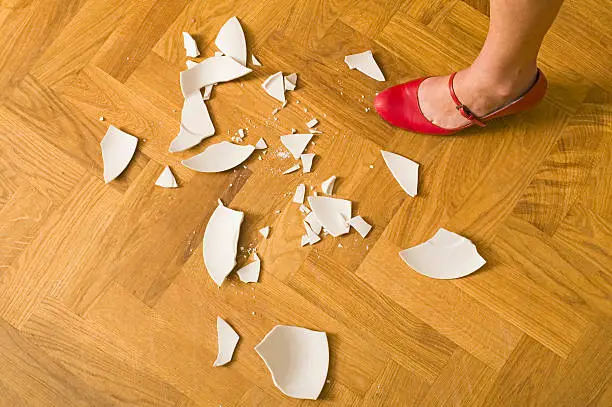
The crash was deafening. Porcelain exploded against the kitchen wall, sending fragments skittering across the tile floor. One of my great-grandmother’s plates—survived the Dust Bowl, World War II, decades of family celebrations—destroyed in an instant of pure spite.
I heard gasps from my laptop speakers. The committee members were witnessing this in real-time.
Lori smiled with savage satisfaction and reached for another plate. “Still feel like being stubborn?”
“You’re destroying my mother’s things.”
“I don’t care about your mother!” she hissed, her mask of sweetness completely gone. “Your mother is dead! I’m alive! I’m John’s wife now, and I deserve to have what she had!”
“The ring isn’t yours to take.”
She hurled another plate against the wall. The sound of shattering porcelain was like a physical blow.
“Every single one of these will be destroyed unless you hand over that ring right now,” she threatened, reaching for a third plate.
I could see my laptop screen reflected in the kitchen window. The committee members were frantically typing, probably texting other church members about what they were witnessing.
“You’re insane,” I said.
“Am I? Or am I just tired of being disrespected in my own home by a spoiled brat who can’t accept reality?”
She threw another plate. Then another.
Each crash felt like a piece of my heart being torn away. These weren’t just dishes—they were tangible connections to my family’s history, to women who’d come before me, to Sunday dinners and Christmas mornings and ordinary Tuesday nights that had been made special by my mother’s love.
And Lori was destroying them out of pure greed and malice.
“Your mother is gone, Bella!” she screamed, hurling another plate. “It’s time you stopped living in the past and accepted that this is my house now!”
Suddenly, her phone started buzzing. Insistently, repeatedly.
She ignored it at first, too caught up in her destructive rage. But the buzzing wouldn’t stop.
Finally, she grabbed her phone, and I watched her face go white as she read the screen.
“From Pastor Mike,” she read aloud without thinking. “‘Lori, what are you doing? We can see everything!’ From Grace: ‘This is horrible! Someone needs to call John immediately!'”
Lori looked up at me, her eyes wide with dawning realization. “What did you do?”
More messages flooded her phone. Text after text from church members who were watching her meltdown in real-time.
Then Dad’s contact photo appeared on her screen—the ringtone we both knew meant serious business.
“John?” she answered, her voice suddenly small and frightened. “I can explain—”
I couldn’t hear Dad’s side of the conversation, but I watched Lori’s face crumble as he spoke.
“It’s not what it looks like,” she said desperately. “Bella was being disrespectful, she wouldn’t give me the ring that rightfully belongs to—”
She went quiet, listening.
“She provoked me! She’s been undermining me since the day I moved in!”
More silence on her end. Her hands started shaking.
“John, please, just let me explain when you get home—”
She hung up and stared at me with pure hatred. “You recorded me.”
“I was on a video call with the church memorial committee,” I said, keeping my voice steady despite my racing heart. “You came in screaming and smashing my mother’s dishes. I didn’t set this up—you walked into it.”
“You manipulative little—”
“They’re still watching,” I interrupted, pointing to my laptop where six horrified faces stared back at us.
Lori grabbed her purse and fled upstairs to the master bedroom, slamming the door hard enough to shake the house.
I turned back to my laptop, where Pastor Mike was trying to restore order to the committee meeting.
“Bella, dear,” he said gently. “Are you hurt? Do you need us to call the police?”
“I’m okay,” I said, looking at the destruction around me. Porcelain shards covered the kitchen floor like snow. Four of my great-grandmother’s plates were completely destroyed, their fragments mixed with Lori’s rage.
“We saw everything,” said Grace, one of the longtime church members. “That was absolutely unacceptable behavior.”
“I’m so sorry this happened during our meeting,” I said.
“Don’t you dare apologize,” Pastor Mike said firmly. “What we witnessed was abuse, pure and simple. And it will have consequences.”
Twenty minutes later, Dad came home.
I’d never seen him so angry. He walked into the kitchen, looked at the broken dishes scattered across the floor, and his jaw clenched so tight I could hear his teeth grinding.
“Where is she?” he asked.
“Upstairs.”
He sat down heavily at the kitchen table and put his head in his hands. “Bella, I am so sorry. I had no idea she was capable of this.”
“Dad, she’s been doing things like this for months. Smaller things. I didn’t want to worry you while you were still grieving.”
He looked up at me with pain and guilt in his eyes. “Your mother’s dishes. She destroyed your mother’s dishes.”
“Some of them. We might be able to save pieces, put some back together.”
“The ring,” he said suddenly. “She wanted your mother’s ring?”
“She said she deserved it because she’s your wife now.”
Dad’s expression hardened into something I’d never seen before. “She’s not going to be my wife much longer.”
“Dad, you don’t have to make any decisions right now. You’re upset—”
“I’m not upset, Bella. I’m clear-headed for the first time in months.” He stood up, his decision made. “Your mother loved you more than life itself. That ring was her promise to you. Lori had no right to demand it, and she sure as hell had no right to destroy your great-grandmother’s dishes when you refused.”
He pulled out his phone. “I’m calling her down here. She’s packing her things tonight.”
The conversation lasted fifteen minutes.
Lori tried everything—tears, apologies, explanations, accusations. She claimed I’d been disrespectful from day one, that I’d made her feel unwelcome in her own home, that she’d only wanted the ring because it would make her feel like part of the family.
“I was stressed,” she sobbed. “I didn’t mean to break anything. I just… I just wanted to belong.”
“By erasing the woman I loved?” Dad asked quietly. “By destroying her memory piece by piece?”
“I love you, John. I can change. We can work this out in counseling—”
“Pack your things,” Dad said. “You have one hour.”
She looked at me with venom so pure it made me step backward. “This is your fault. You poisoned him against me from the beginning.”
“No, Lori,” I said. “This is what happens when you show people who you really are.”
She left that night with two suitcases and her car, leaving behind the modest engagement ring Dad had given her and taking nothing else.
The next morning, Dad called his attorney and filed for divorce.
Word travels fast in a small church community.
By Thursday, everyone knew what had happened. The video of Lori’s meltdown had been shared among church leadership, and an emergency board meeting was called.
Lori was removed from her position leading the grief support group. Several families came forward with their own stories of her manipulative behavior—how she’d pressured recent widowers to donate their late wives’ belongings to charity, how she’d tried to convince elderly members to change their wills in favor of the church (with her managing the donations), how she’d systematically isolated vulnerable people from their families.
“She targeted your father specifically,” Pastor Mike explained when he called to check on us. “Grief counseling gave her access to people at their most vulnerable moments. What she did to your family… we found out she tried similar approaches with other recent widowers.”
The community that had once praised Lori’s compassion now saw her for what she really was—a predator who’d used faith and grief as weapons to manipulate traumatized people.
But the most satisfying consequence came two weeks later, when Mia, my friend from high school, called with an update.
“Did you hear about Lori?” she asked.
“What about her?”
“She tried to join St. Matthew’s across town—you know, that big church with the wealthy congregation? She applied to run their bereavement ministry.”
“And?”
“Pastor Mike called their leadership personally. Told them exactly what kind of person she is. They rescinded the offer.”
Word had spread beyond our small church. Lori’s reputation in our tight-knit community was destroyed, her access to vulnerable people cut off completely.
Karma had worked swiftly and thoroughly.
That evening, I sat on my bedroom floor surrounded by the fragments of my great-grandmother’s dishes. Some pieces were too small to salvage, but others could be repaired with careful gluing and patience.
Dad knocked and came in, carrying a tube of porcelain adhesive he’d bought at the hardware store.
“Can I help?” he asked.
We spent the next three hours working together, fitting pieces back together like a complex puzzle. Some plates could be completely restored, their cracks barely visible once the glue dried. Others were missing too many pieces to be functional, but we saved what we could, arranging the fragments in shadow boxes that would preserve their memory if not their original form.
“They’re still beautiful,” Dad said as we placed the restored pieces in our dining room china cabinet.
“They’re broken,” I replied, touching one of the visible crack lines.
“So are we,” he said gently. “But we’re still here. We’re still standing. And we’re still a family.”
I leaned against his shoulder, both of us looking at the dishes that had survived so much history only to be nearly destroyed by one woman’s greed.
“I’m sorry I couldn’t protect them better,” I said.
“You protected something more important,” Dad replied. “You protected your mother’s dignity. Her place in this house. Her place in our hearts.”
Six months later, our house feels like home again.
Dad replaced Mom’s reading chair with one that looks similar but is strong enough to hold him comfortably. He framed some of his favorite photos of Mom and placed them throughout the house—not as shrines to grief, but as celebrations of love that death couldn’t diminish.
The church community has rallied around us. People bring meals not out of pity, but out of genuine care. Dad has started dating again—slowly, carefully, with someone who knew and respected Mom, who would never dream of erasing her memory.
I still carry Mom’s engagement ring with me everywhere. Someday, when I’m ready to write my own love story, I’ll wear it proudly. But for now, it’s safe in its velvet pouch, a tangible reminder that real love doesn’t demand the destruction of what came before.
The restored dishes sit in our dining room cabinet, their visible cracks telling a story of survival and repair. They’re not the same as they were before Lori’s rage, but they’re still here. Still beautiful. Still holding the memory of all the love they’ve witnessed.
Some people see broken things as irreparable damage. But I’ve learned that sometimes the cracks are what let the light in—proof that we can be damaged and still be valuable, still be cherished, still be home.
Lori thought she could erase my mother’s presence and claim her place. She thought grief made us weak, vulnerable to her manipulation.
She was wrong about everything.
Love doesn’t disappear when someone dies—it transforms into memory, into tradition, into the strength to protect what matters most. And sometimes, when someone tries to destroy that love, the community rises up to defend it.
The ring that almost broke everything ultimately saved us all.
Sometimes the people who hurt us most are the ones who underestimate our strength. Bella learned that protecting love sometimes means fighting for it—and that true family isn’t always blood, but the people who stand with you when others try to tear you down.

Lila Hart is a dedicated Digital Archivist and Research Specialist with a keen eye for preserving and curating meaningful content. At TheArchivists, she specializes in organizing and managing digital archives, ensuring that valuable stories and historical moments are accessible for generations to come.
Lila earned her degree in History and Archival Studies from the University of Edinburgh, where she cultivated her passion for documenting the past and preserving cultural heritage. Her expertise lies in combining traditional archival techniques with modern digital tools, allowing her to create comprehensive and engaging collections that resonate with audiences worldwide.
At TheArchivists, Lila is known for her meticulous attention to detail and her ability to uncover hidden gems within extensive archives. Her work is praised for its depth, authenticity, and contribution to the preservation of knowledge in the digital age.
Driven by a commitment to preserving stories that matter, Lila is passionate about exploring the intersection of history and technology. Her goal is to ensure that every piece of content she handles reflects the richness of human experiences and remains a source of inspiration for years to come.