The House in the Mountains
The black sedan appeared at the bottom of my driveway at exactly 2:37 on a Saturday afternoon.
I know the time because I was standing at my kitchen window, arranging wildflowers in a mason jar, and I’d just glanced at the clock thinking I had the whole weekend stretching ahead of me, quiet and mine.
Then I saw the car climbing the gravel drive with the kind of confidence that belongs to people who believe every door will open for them.
The tires crunched over stones. Two doors slammed—not quite synchronized, but close enough that I knew there were two people and they’d arrived with purpose.
I set down the flowers and watched.
The figures emerged from the car like actors taking the stage. My son Preston, tall and familiar even at this distance, moving with that measured stride he’d developed in his thirties, like every step was a business decision. And beside him, Evangelene, his wife of eight years, her designer heels clicking against gravel like a metronome counting down to something.
They hadn’t called in months.
Not on my birthday in March. Not for Thanksgiving. Not once just to ask how I was settling into this new life, if I was sleeping well up here alone in the Colorado Rockies, if I needed anything.
Silence for months.
And now here they were, pulling luggage from the trunk.
Big suitcases. The kind you pack for a long stay.
I took a slow breath and walked to the door.
But to understand what happened next—what happened when they crossed my threshold and saw what was waiting in that main hall—you need to understand how I got here.
How a fifty-nine-year-old woman ends up alone in a mountain house while her only son drives up unannounced with bags packed and assumptions loaded.
My name is Margaret. People who know me well call me Maggie.
I spent thirty-three years married to a man named Robert, Preston’s father. We built a decent life together—a house in suburban Denver, steady jobs, a son we raised to be successful and independent. Robert was a good man. Reliable, hardworking, devoted to providing for us.
But he was also emotionally distant in ways I didn’t fully recognize until after he was gone. He loved through action—fixing things, paying bills, maintaining the lawn—but not through words or presence. We coexisted more than we connected.
He died of a heart attack four years ago, sudden and shocking, in the garage while changing the oil in his truck.
I found him there.
The grief was complicated. I mourned him, genuinely. But I also mourned the marriage we never quite had, the conversations we never got around to, the life I’d put on hold waiting for him to notice I was lonely.
Preston took his father’s death hard. He threw himself into work, into his marriage with Evangelene, into anything that kept him from feeling the loss. And in the process, he seemed to forget that I was grieving too.
After the funeral, after the estate was settled, after everyone went back to their normal lives, I was alone in a house full of Robert’s things and our shared history, trying to figure out who I was without him.
It took me two years to even begin.
I sold the house. It was too big, too full of memories, too much a monument to a life that was over. I downsized to a small apartment in Denver, started traveling a bit, reconnected with old friends.
And I started to heal.
Preston didn’t understand. He thought I should keep the house, should stay in the familiar neighborhood, should remain available for babysitting when he and Evangelene eventually had children.
“You’re being impulsive, Mom,” he’d said when I told him about selling. “You’re making big decisions too quickly.”
“I’ve been thinking about this for two years,” I’d replied calmly.
“But Dad loved that house.”
“Dad’s gone, Preston. And I need to build a life that works for me now.”
He didn’t like it, but he couldn’t stop me.
The real change came eighteen months ago when my sister Helen called with news.
Our Aunt Josephine, a woman I’d loved dearly but hadn’t seen in years, had passed away. She’d been living in a small mountain town about ninety minutes outside Denver, up in the high country where the air is thin and the views are spectacular.
And she’d left me something.
Her house.
Not a mansion. Not a luxury villa. Just a modest but beautiful mountain home on five acres of pine forest and wildflower meadows, with a view of the peaks that made your heart ache in the best way.
“She wanted you to have it,” Helen told me. “She said in her will that you were the only one who ever understood what it meant to need space to breathe.”
I drove up to see it the following weekend, winding through mountain roads, climbing elevation until my ears popped and the air smelled like snow even though it was August.
The house sat at the end of a gravel drive, tucked into the trees like it had grown there naturally. Wood and stone, big windows, a porch that wrapped around two sides. Simple. Honest. Perfect.
I walked through it slowly, touching the pine walls, standing in the main room with its vaulted ceiling and stone fireplace, looking out at mountains that seemed to hold up the sky.
And I felt something I hadn’t felt in years.
Peace.
I moved in three months later.
Preston was… not supportive.
“You’re moving to the middle of nowhere?” he’d said when I told him. “At your age?”
“I’m fifty-seven, not eighty-seven. And it’s not the middle of nowhere. It’s ninety minutes from Denver.”
“It’s isolated. What if something happens to you?”
“Then I’ll handle it. Or I’ll call for help. People live in the mountains all the time, Preston.”
“But why? What’s wrong with Denver? What’s wrong with being close to family?”
That question stung more than he probably intended.
“When’s the last time you visited me, Preston? When’s the last time you invited me to dinner that wasn’t a holiday obligation?”
He’d gone quiet.
“I’m not moving away from you,” I said more gently. “I’m moving toward something I need. There’s a difference.”
But he didn’t see the difference. To him, my choice to live up here was a rejection of him, of the life we’d built, of the role he’d assigned me.
Evangelene was even less understanding.
“It seems selfish,” she’d said at a family dinner shortly before I moved, her voice carrying that particular tone that made criticism sound like concern. “Removing yourself from family support systems. What if we need you?”
“For what?” I’d asked.
“Well, when we have children eventually. It would be nice to know grandma was nearby.”
“You don’t have children yet. And when you do, I’ll still be their grandmother, whether I live in Denver or in the mountains.”
She’d given me a look that said I was being difficult, then changed the subject.
That was the last real conversation we’d had before I moved.
Life in the mountains was everything I’d hoped for.
I joined the local community—a tight-knit group of people who valued independence and neighborliness in equal measure. I volunteered at the small library in town. I started hiking, really hiking, building strength and confidence on trails that wound through aspen groves and opened onto vistas that made problems seem small.
I learned to manage a wood stove, to drive in snow, to appreciate silence.
I made friends. Real friends, not acquaintances from Robert’s work or Preston’s school events. People who knew me as Maggie, just Maggie, with no qualifier or context.
I started painting again, something I’d loved in my twenties and abandoned for thirty years. My little studio—just a corner of the main room with good light—filled up with canvases of mountains and meadows and skies.
I was, for the first time in decades, genuinely happy.
Preston called occasionally, brief and perfunctory. “Just checking in. Everything okay up there?”
“Everything’s wonderful.”
“Good. Okay. Talk soon.”
That was it. No real conversation. No interest in my life beyond confirming I hadn’t frozen to death or been eaten by a bear.
Evangelene never called at all.
I told myself I didn’t mind. Told myself that adult children have their own lives, that I shouldn’t expect them to be constantly involved in mine.
But it hurt anyway.
Three months ago, something shifted.
I got a call from Helen, my sister, who still lived in Denver and kept her ear to the ground about family gossip.
“Have you been telling people you bought some kind of luxury property?” she asked.
“What? No. I inherited Aunt Jo’s house. I’ve been living here for over a year.”
“Well, somehow the story has gotten twisted. I heard from Cousin Diana who heard from someone at the country club that you’d come into money and bought a villa in the Alps.”
I laughed. “The Alps? Helen, I live in Colorado.”
“I know that. But you know how these things get exaggerated. The Rockies become ‘the Alps.’ A modest inheritance becomes ‘coming into money.’ And suddenly you’re living some glamorous isolated life.”
“That’s ridiculous.”
“I know. But I thought you should know the rumor’s out there. Diana said Preston and Evangelene were asking about it.”
That made me pause. “Preston knows exactly where I live and what I inherited. Why would he be listening to rumors?”
“Maybe he’s hearing a version he likes better than the truth.”
After we hung up, I felt uneasy. It was such a small thing, a silly rumor that had nothing to do with reality. But something about knowing Preston was hearing these stories and not just calling me to verify bothered me.
I didn’t reach out to correct it though. If he wanted to know the truth, he had my number.
The weeks passed. I forgot about the rumor, got busy with my life—a local art show where I sold three paintings, a hiking trip with friends to a remote lake, preparations for winter.
I stopped expecting Preston to call.
And then, that Saturday afternoon, the black sedan appeared in my driveway.
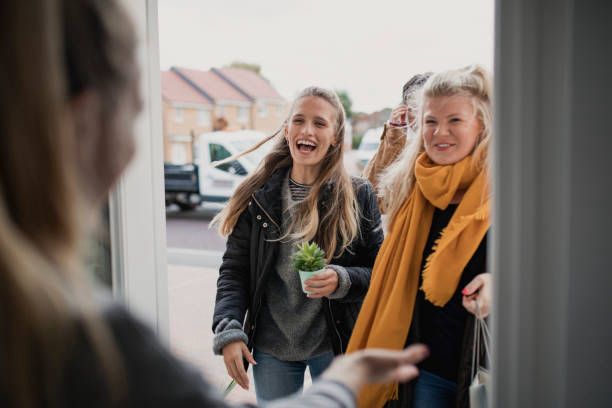
I opened the door before they could ring the bell.
Preston stood on my porch in expensive casual wear—designer jeans, a tailored jacket, the kind of outfit that said “I’m relaxing but I still have standards.” He looked older than when I’d last seen him, more tired around the eyes.
Evangelene stood beside him in clothes that probably cost more than my monthly grocery budget, her red lips curved in a smile that didn’t reach her eyes.
“Mother,” Preston said, like we’d planned this visit. Like this was normal.
“Preston. Evangelene.” I kept my voice neutral. “What brings you up here?”
“We heard you bought a luxury villa in the Alps,” Evangelene said, her tone light and teasing but with an edge underneath. “We came to live with you and make peace.”
She said it like it was a joke, but her eyes were serious, scanning my porch, looking past me into the house.
“Live with me?” I repeated.
“Well, visit,” Preston corrected, but not convincingly. “We thought it was time we reconnected. Spent some quality time together. Saw this new place of yours.”
Behind them, the sedan’s trunk was still open, revealing two large suitcases and several smaller bags.
This wasn’t a weekend visit. This was a planned extended stay.
“You didn’t call,” I said.
“We wanted to surprise you!” Evangelene’s brightness was aggressive, demanding I match her energy.
I didn’t.
“Help with the bags, Mother,” Preston said, already walking back to the car, assuming my agreement.
I stood in the doorway and watched them. Watched the way they moved like people who’d already decided how this would go. Watched Evangelene’s eyes catalog my property—the house, the land, the view—and calculate its value.
And I understood.
They’d heard the rumors about wealth and luxury. They’d heard “Alps” and “villa” and decided there was something here worth claiming. After months of silence, after showing no interest in my actual life, they’d come running the moment they thought I had something they wanted.
Something hot and clear rose up in my chest. Not quite anger. More like clarity.
I could turn them away right now. Could tell them to leave, that they hadn’t called in months and they didn’t get to just show up and demand entry.
But I didn’t.
Instead, I stepped aside.
“Come in,” I said quietly.
Because I wanted them to see.
I wanted them to see the truth they’d been too disinterested to ask about for eighteen months.
They hauled their luggage onto the porch with the casual entitlement of people who believed this space was already theirs. Preston grunted with the weight of the larger suitcase. Evangelene’s heels clicked across the wooden planks.
“It’s quaint,” Evangelene said, glancing around at the handmade quilts on the porch rail, the wildflowers in their jar, the American flag lifting gently in the mountain breeze. “Very… rustic.”
Her tone made “rustic” sound like a flaw she was being polite about.
They stepped through my front door, rolling their luggage behind them, already looking around for the luxury they’d been promised by gossip and assumption.
The entryway was simple. Pine walls, a bench for removing boots, hooks for coats. Beyond it, the main hall opened up—vaulted ceiling with exposed beams, the stone fireplace I’d cleaned and maintained myself, windows that framed the mountains like living paintings.
But it wasn’t the architecture they were looking at.
It was what hung above the fireplace.
A large portrait, professionally painted, in a simple but elegant frame.
The portrait showed three people: Aunt Josephine in the center, my sister Helen on one side, and me on the other. We were outdoors, mountains in the background, all of us smiling genuinely, caught in a moment of real joy.
Below the portrait, mounted on a simple wooden plaque, were words engraved in Aunt Jo’s handwriting:
“This house belongs to Margaret, who understands that home is not about wealth—it’s about peace. To my niece, who earned her solitude through years of service to others. May you finally serve yourself.”
And below that, a smaller frame containing the deed to the property, clearly showing:
- The house’s modest assessed value: $285,000
- The inheritance: clearly stated as a family transfer, no purchase
- The location: Colorado, USA
- The date: eighteen months ago
No villa. No Alps. No luxury purchase.
Just a simple mountain house, inherited from a loving aunt, lived in quietly by a woman who wanted peace.
Preston and Evangelene had stopped in the center of the main hall, staring at the wall like it had betrayed them.
The silence stretched out, broken only by the soft ticking of the grandfather clock in the corner—another of Aunt Jo’s pieces, marking time in a house that had never pretended to be anything other than what it was.
Evangelene’s smile faltered. Her red lips parted slightly, but no words came out.
Preston’s jaw tightened in that way it did when he realized he’d made a mistake but didn’t want to admit it.
I set my bundle of wildflowers down on the entry table and looked at them both.
“Did you really think,” I said quietly, “that I wouldn’t notice you only came back when you thought I had money?”
Preston found his voice first. “Mom, that’s not—we didn’t—”
“You didn’t call on my birthday,” I interrupted, my voice still calm. “You didn’t call for Thanksgiving. You didn’t call once in the past six months just to see how I was doing, if I was happy, if I needed anything.”
“We’ve been busy—”
“Too busy for a phone call? A text? But somehow, the moment you heard a rumor about a luxury villa, you found time to pack suitcases and drive ninety minutes up a mountain.”
Evangelene had recovered enough to try her charm. “Maggie, I think there’s been a misunderstanding—”
“No,” I said firmly. “I think there’s been perfect understanding. You heard I might have something valuable, and you came to claim a piece of it. That’s very clear.”
“That’s not fair,” Preston said, color rising in his cheeks. “We came to reconnect. To make peace. You’ve been so distant—”
“I’ve been distant?” The words came out sharper than I intended. “Preston, I moved up here eighteen months ago. You’ve visited exactly twice. The first time was to try to talk me out of moving. The second was to drop off mail you’d received at your house by mistake. You stayed for twenty minutes.”
He looked away.
“And Evangelene,” I continued, turning to her, “you told me moving here was selfish. You implied I was abandoning family. But you never once called to see how I was settling in, never asked about my life here, never expressed any interest unless you thought there was something in it for you.”
Her face had gone rigid. “I don’t have to stand here and be attacked—”
“You’re right. You don’t. The door’s behind you.”
Preston stepped forward, hands raised in a placating gesture. “Mom, please. Can we just talk about this? We made a mistake, okay? We shouldn’t have believed gossip. But we’re here now. Can’t we start over?”
“Start over?” I looked at him—my son, who I’d raised and loved and supported through every phase of his life—and felt something finally break free. “Preston, I don’t think you understand what you’re asking.”
“I’m asking for a chance to reconnect with my mother.”
“No. You’re asking me to pretend the last eighteen months didn’t happen. To pretend you didn’t ignore me until you thought I had something you wanted. To pretend that’s acceptable behavior.”
“I’m sorry,” he said, and for the first time, he sounded like he might actually mean it. “I’m sorry I didn’t call more. I’m sorry I let time get away from me. I’m sorry I… I didn’t show up for you the way I should have.”
The apology hung in the air.
Part of me wanted to accept it immediately, to smooth this over, to make everyone comfortable the way I’d spent decades doing.
But I’d learned something in the mountains, in this house, in the quiet months of building a life that was mine.
I’d learned that accepting crumbs of affection while pretending they were a feast only left me starving.
“I appreciate the apology,” I said. “But I need you to understand something. I’m not lonely up here. I’m not isolated. I have friends, community, purpose. I have a life I built deliberately, not one I settled for. And that life doesn’t include dropping everything the moment you decide you want to be involved again.”
“What are you saying?” Evangelene asked, her voice tight.
“I’m saying you can’t stay here. Not now. Not until we rebuild trust, and that takes time and effort, not just an apology delivered because you got caught.”
“You’re turning us away?” Preston looked genuinely shocked. “We drove all the way up here—”
“Uninvited. Unannounced. With suitcases packed and assumptions loaded.”
“I can’t believe this,” Evangelene muttered, grabbing her suitcase handle. “Come on, Preston. She’s made her position very clear.”
But Preston was staring at me like he’d never seen me before. “When did you become so hard?”
The question hit differently than he probably meant it to.
“I’m not hard,” I said quietly. “I’m just no longer soft in ways that hurt me. There’s a difference.”
They left.
Not gracefully. Evangelene was tight-lipped and angry, loading bags back into the trunk with sharp movements. Preston looked lost, like he’d walked into the wrong house and couldn’t figure out how to find his way back.
At the car, he paused. “Mom… can we talk? Really talk? Soon?”
“When you’re ready to have a real conversation about real things, call me,” I said. “Not when you think I have something you want, but when you actually want to know me.”
He nodded slowly. “Okay. I’ll… I’ll call.”
“I hope you do.”
They drove away, the sedan reversing down the gravel drive, leaving dust hanging in the afternoon air.
I stood on my porch and watched them go, feeling a complicated mix of sadness and relief.
That night, I called Helen.
“They showed up,” I said. “Preston and Evangelene.”
“Oh no. What happened?”
I told her everything—the suitcases, the assumptions, the portrait on the wall, the conversation.
“Good for you,” Helen said fiercely when I finished. “Good for you for not backing down.”
“It didn’t feel good. It felt hard.”
“That’s because you’ve spent most of your life making things easy for other people. Hard is what happens when you finally choose yourself.”
“Do you think Preston will actually call?”
“I don’t know, honey. But if he doesn’t, that tells you everything you need to know. And if he does, you’ll handle it. You’re stronger than you think.”
After we hung up, I sat on my porch, wrapped in a blanket, watching the stars emerge over the mountains.
The house was quiet behind me. My house. My peace. My hard-won life.
And for the first time in a long time, I felt like I’d made the right choice—not just about the house, but about boundaries, about self-respect, about refusing to shrink myself to make others comfortable.
Preston did call. Two weeks later.
Not to apologize again—we’d already done that. But to actually talk. To ask about my life, my painting, my friends in the mountains. To listen when I answered.
It was awkward at first. Stilted. But it was real.
“I didn’t realize how much I’d pulled away,” he admitted during that first call. “After Dad died, I just… shut down. And I shut you out in the process.”
“I know,” I said. “Grief does that sometimes.”
“That’s not an excuse though.”
“No. But it’s an explanation. And I appreciate you recognizing it.”
We talked more after that. Not every day, but regularly. Real conversations where he asked questions and I shared answers, where we built something new instead of trying to resurrect something dead.
Evangelene took longer. She called six weeks after their visit, her voice stiff and formal.
“I wanted to apologize,” she said. “For the assumptions. For the… entitlement.”
“Thank you.”
“Preston says you’re doing really well up there. That you’re happy.”
“I am.”
A pause. Then: “I think I was jealous. Of your freedom. Of the choice you made to just… leave everything and start over. I don’t know if I’d have the courage.”
That admission surprised me. “It wasn’t about courage. It was about survival. I was drowning in the life I had.”
“Still. It took something to walk away from it.”
We didn’t become close. But we became cordial. Respectful. Honest in small ways.
And three months after that initial visit, Preston asked if he could come back up—just him, just for a day, just to talk.
I said yes.
He arrived on a Saturday morning, alone, with no luggage. Just himself.
We hiked one of my favorite trails, climbing through pine forest to a meadow where you could see three mountain ranges. Preston was winded by the elevation—Denver sits high, but this was higher—and we sat on a fallen log to catch our breath.
“I get it now,” he said, looking out at the view. “Why you’re here.”
“Yeah?”
“It’s beautiful. But more than that, it’s… yours. In a way the house in Denver never was.”
“That house was ours,” I said gently. “Yours, mine, your dad’s. A family house. This is mine.”
“And you needed that.”
“I did.”
He was quiet for a while, then: “I’m sorry I didn’t see that before. I’m sorry I made it about me—about what I needed from you—instead of about what you needed for yourself.”
“I accept your apology.”
“Can we try again? Not the way we were before, but… something new?”
I looked at my son—middle-aged now, finally starting to understand complexity—and felt hope.
“Yes,” I said. “We can try.”
It’s been a year since that confrontation in my main hall.
Preston visits once a month now. Sometimes with Evangelene, sometimes alone. We hike, we talk, we’re building something genuine.
He doesn’t stay long—this is my space, my sanctuary—but the visits are real.
Last month, Evangelene asked if I’d teach her to paint. We spent an afternoon at my kitchen table with watercolors, making terrible mountains and laughing about it, and I saw glimpses of who she might be when she’s not performing.
I still live alone. Still paint. Still hike. Still treasure my quiet mornings and starlit evenings.
But I’m not isolated. I’m just selective about who I let into my peace.
Because I learned something that day, watching my son and daughter-in-law stand in front of that portrait, confronting the gap between their assumptions and reality.
I learned that the people who love you will make the effort to know you.
And the people who don’t aren’t entitled to your space just because they share your blood.
I learned that “family” isn’t a permission slip to cross boundaries.
And most importantly, I learned that choosing yourself isn’t selfish.
It’s sacred.
The house in the mountains taught me that. Aunt Josephine’s gift wasn’t just property—it was permission to finally, fully, live for myself.
And I’m never giving that back.
THE END

Lila Hart is a dedicated Digital Archivist and Research Specialist with a keen eye for preserving and curating meaningful content. At TheArchivists, she specializes in organizing and managing digital archives, ensuring that valuable stories and historical moments are accessible for generations to come.
Lila earned her degree in History and Archival Studies from the University of Edinburgh, where she cultivated her passion for documenting the past and preserving cultural heritage. Her expertise lies in combining traditional archival techniques with modern digital tools, allowing her to create comprehensive and engaging collections that resonate with audiences worldwide.
At TheArchivists, Lila is known for her meticulous attention to detail and her ability to uncover hidden gems within extensive archives. Her work is praised for its depth, authenticity, and contribution to the preservation of knowledge in the digital age.
Driven by a commitment to preserving stories that matter, Lila is passionate about exploring the intersection of history and technology. Her goal is to ensure that every piece of content she handles reflects the richness of human experiences and remains a source of inspiration for years to come.