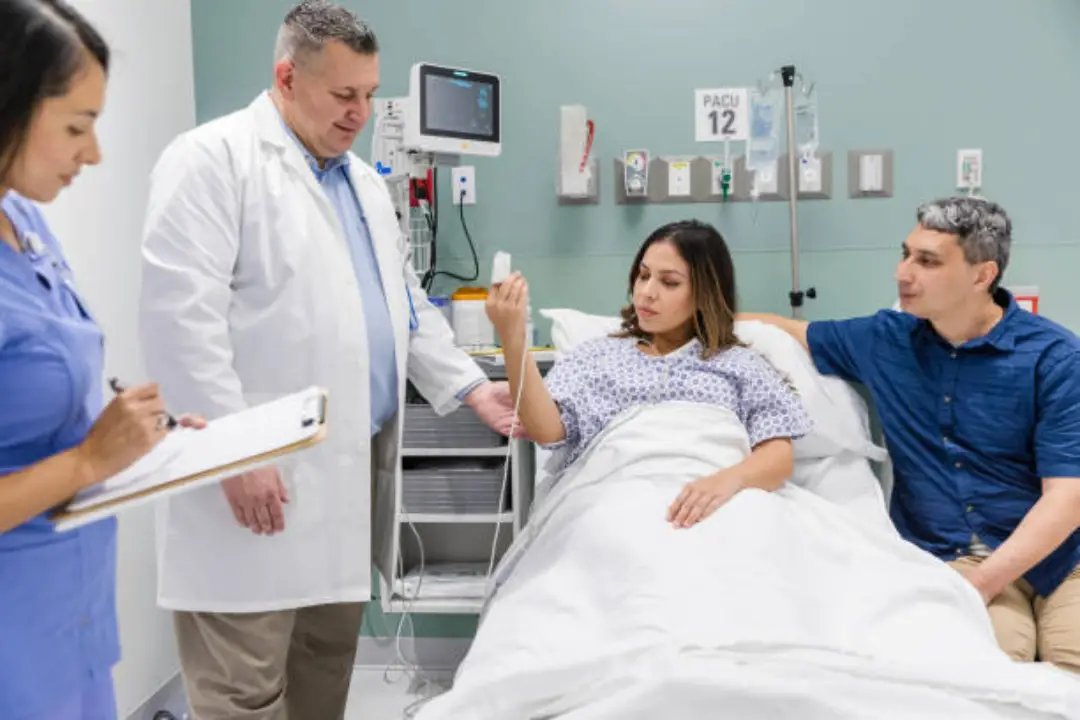
The room was too white, bathed in harsh fluorescent light that seemed designed to expose every weakness. The air carried the sharp, sterile smell of disinfectant that clung to everything like a second skin. Hospital sheets were pulled so tight across my legs they might as well have been restraints, hiding any sign of vulnerability beneath their crisp, industrial facade.
The heart monitor beside me maintained its irritating rhythm. Beep. Beep. Beep. Each electronic pulse marked time in the most expensive, coldest way possible.
My right leg was immobilized in an orthopedic boot that seemed impossibly large. The doctor had promised I would walk again with time and physical therapy. His voice had been confident, reassuring even. Time, he said, was the key ingredient to recovery.
Time was all I had now. What I didn’t have was patience for humiliation.
I heard rushed footsteps echoing down the hallway before the door swung open with a forceful push. These weren’t the steps of someone coming out of love or concern. They were the steps of someone coming to finish a job, to check an unpleasant task off a to-do list.
My husband, Ethan, entered first. He didn’t really look at me, just through me, as if I were already a ghost. In his hand, he carried a cheap manila envelope, the kind you can buy at any office supply store for a few dollars. Behind him, my mother-in-law Helen appeared, looking completely lost and out of place in the sterile medical environment. She clutched her purse tightly against her chest and avoided my eyes with the practiced skill of someone who had spent a lifetime dodging uncomfortable truths.
Her mouth trembled slightly, but she said nothing. In her family, I had learned early on, silence was a form of worship. Speaking uncomfortable truths was tantamount to blasphemy.
Ethan dragged a plastic chair across the linoleum floor with a screech that made me wince. He dropped the envelope on the bedside table with deliberate casualness, as if he were setting down his keys after a long day at work rather than presenting divorce papers to his hospitalized wife. A pen was attached to the envelope with a string, as if even the pen were a captive participant in this transaction.
He opened the envelope slowly, methodically, with the air of someone performing a rehearsed action. The petition was already prepared. My name, social security number, the date—all filled in with perfect, mechanical precision. His signature at the bottom was slightly crooked, betraying a nervousness he was trying to hide. I recognized the haste in those hurried letters.
“Sign it,” he said flatly.
It wasn’t a request. It was an order delivered with the confidence of someone who believed he held all the power in the room.
He leaned close to my face as if I were deaf, his cologne mixing unpleasantly with the antiseptic smell. “I want a perfect wife. Not a burden in a wheelchair.”
A burden.
The word didn’t wound me the way he probably intended. Instead, it confirmed something I had suspected for months, maybe years. And when something is finally confirmed, it ceases to be painful. It becomes a decision point, a moment of clarity that cuts through all the confusion and doubt.
My mother-in-law cleared her throat softly, a small sound in the vast silence of the ICU. Her eyes said this was wrong, fundamentally wrong, but her body language said she wouldn’t do anything to stop it. She stood there, complicit in her silence, a witness to her son’s cruelty.
“And the expenses?” I asked, keeping my voice steady despite the emotions churning inside me.
He let out a short, joyless laugh that barely qualified as human. “Pay your own hospital bills.”
I stared at him for exactly three seconds, not to ask for an explanation or to beg for reconsideration, but to record the scene with absolute clarity. I knew, somewhere deep in my core, that I would need to remember this moment in perfect detail. Every word, every gesture, every cruel expression on his face.
He crossed his arms over his chest, waiting for my desperation. Waiting for tears, for pleading, for the theatrical breakdown he had probably imagined on his drive to the hospital.
I didn’t give it to him.
Instead, I looked at the paper like I would examine any other contract—with a careful, analytical eye. He thought I was weak, that my injured body meant my mind was compromised. He thought I would beg or negotiate or fall apart in front of him.
But I remembered something very simple, something fundamental about the world we live in.
In America, a piece of paper is worth more than a promise. A signature is worth more than a speech. And a properly executed legal document is a weapon that can’t be taken back.
My mind flashed back to the notary public’s office near the Capitol building in Austin. Three years ago, I had been there to get my signature notarized for a major contract for my company. The notary had asked for my ID, stamped the document with her official seal, and kept a copy of my signature on file. I had left that office with a certainty about the power of documentation.
A signature is an identity. A signature is proof of intent, of consent, of participation in the legal world.
That day, Ethan had laughed in the car about my seriousness. “You take these things too seriously,” he’d said, shaking his head as if my attention to detail was amusing.
I had taken them seriously. And that’s precisely why I had built everything he now wanted to strip away from me.
In the ICU, I held the pen with a hand marked by four needle punctures from various IVs. My mother-in-law held her breath, literally stopped breathing as she waited to see what would happen next. My husband stood motionless, waiting for the scene of a broken woman finally accepting defeat.
I signed immediately.
Without a tremor, without tears, without asking for more time or trying to negotiate. I wrote my full legal name exactly as it appeared on my official documents and on all the company’s contracts. The kind of name a notary would recognize without a second thought. The kind of signature that proved mental competence and clear intent.
When I finished, I handed the pen back to him and looked directly into his eyes. “It’s done,” I said simply.
He blinked, genuinely surprised that I hadn’t made the scene he’d expected. Then his smile appeared—that cold, satisfied smile of someone who believes they’ve won an easy victory.
“Great,” he said, relief evident in his voice. He picked up the paper as if lifting a weight from his shoulders. “It’s better for both of us this way.”
I didn’t answer. There was nothing to say to someone who had just revealed himself so completely.
My mother-in-law finally managed a short, breathless sentence. “You’ll get better, Sophia.”
I could have said many things in response. I could have pointed out the irony, the hypocrisy, the complete disconnect from reality. Instead, I just looked at her and let the silence speak for itself.
Ethan stood up, adjusted his shirt with an air of finality, and walked toward the door. When he opened it, I saw that rush again—the hurried movements of someone running toward another life, another woman, another cheap dream built on the rubble of this one.
He left without looking back. My mother-in-law followed with shorter, uncertain steps, carrying a guilt she didn’t know where to put down.
When the door finally closed behind them, the room seemed larger somehow, as if their departure had created physical space. The beep of the monitor became sharper, more insistent. A lump formed in my throat—not from love, but from memory.
I remembered who I had been in that marriage. I was the woman who paid the down payment on our condo when his business failed spectacularly. I was the woman who held his hand at his father’s funeral, supporting him through grief while managing my own sorrow. I was the woman who bought his mother’s expensive prescriptions when her insurance lapsed, never complaining about the cost.
I was the woman who endured his embarrassing jokes at neighborhood barbecues, laughing along to keep the peace, to maintain appearances, to be the perfect wife he claimed to want.
And still, in the end, I became nothing more than a burden to him.
I closed my eyes and took a deep breath, trying to center myself. The voice of my neighbor, Carol, popped into my head. Carol was nearly sixty and spoke with a unique blend of affection and brutal honesty that only comes with age and experience.
“Honey,” she had once told me over coffee, “if a man wants to leave, you let him go. But you don’t let him take your dignity with him.”
I pushed the call button with more force than necessary. A young nurse came in, tired and worn down, with dark circles under her eyes that no amount of concealer could hide.
“Everything okay, ma’am?” she asked with practiced concern.
“Everything’s fine,” I replied, my voice sounding too calm, almost eerily composed. “I need to speak with hospital administration immediately, and I need my cell phone.”
She hesitated for just a moment, probably wondering what kind of emergency required both administration and a phone, but she brought me the device without further question.
When the phone landed in my hand, I felt its weight like holding a key to a locked door. I opened my contacts and scrolled to a name I hadn’t called in months.
Jessica Martinez. My lawyer.
I hit the call button and listened to it ring twice before she answered with her characteristic efficiency. “Sophia?”
I didn’t break down. I didn’t cry or explain the emotional devastation. I simply stated the facts. “Jessica, he brought me divorce papers in the ICU. I signed them. My full legal name, completely lucid, with witnesses present.”
There was a brief silence on the other end of the line. I could almost hear the gears turning in her sharp legal mind.
Then her voice came through, low and firm with barely contained satisfaction. “Then he just handed you exactly what you need. He thought he was cornering you, but he gave you proof of his intent, his cruelty, and his haste. This is going to work in your favor, Sophia.”
I looked at the closed door and pictured Ethan walking away from the hospital, probably already on his phone to some woman, believing he had won this round decisively.
I smiled—a small, cold smile that felt foreign on my face. “I want him to understand something,” I said slowly, choosing each word with care. “My name on that paper isn’t the end of our marriage. It’s the beginning of his reckoning.”
I hung up the phone and sat in the quiet of the hospital room, listening to the steady beep of the monitor. In a hospital, everything is recorded. Time, names, witnesses, signatures, medical decisions. Everything leaves a paper trail, a digital footprint, evidence that can’t be erased or explained away.
And in that envelope, besides my carefully executed signature, was his full legal name—the name he used to open accounts, sign contracts, and present himself as a respectable businessman. The name that was now going to be used to prove exactly who he really was beneath the veneer of respectability.
I wasn’t shattered. I was waking up from a long sleep, seeing reality with startling clarity for the first time in years.
The next morning arrived with the same relentless beeping monitor and a strange heaviness pressing on my chest. It wasn’t shortness of breath or a medical emergency. It was shame—deep, corrosive shame for every time I had made myself smaller to fit into that marriage, every compromise I had made, every insult I had swallowed with a smile.
The nurse came in early, opened the blinds to let in the Austin morning light, and the world outside flooded the room as if it hadn’t been fundamentally altered by the destruction of my life.
“How are you feeling today, Mrs. Miller?” she asked, adjusting my IV drip with practiced efficiency.
“I’m fine,” I replied automatically.
It was a lie, but it was the kind of lie that holds you together when the truth would make you fall apart.
My phone buzzed on the bedside table, vibrating insistently against the hard surface. Unknown number. I answered cautiously.
“Mrs. Sophia Miller?” The voice was professional, dry, devoid of emotion.
“Speaking.”
“I’m calling from the hospital administration department. We need to discuss your health insurance coverage. It appears there is a significant discrepancy. The policy holder modified several key details approximately two weeks ago. Some of your procedures now require additional authorization that hasn’t been obtained.”
I felt my stomach drop, a sickening sensation of free fall. Policy holder. The insurance policy was in Ethan’s name. I had left it that way for convenience, for trust, because it seemed easier when he handled those administrative tasks.
When you trust someone completely, you hand them little keys to your life without realizing it—until the day they use those keys to lock you out.
“Who authorized these modifications?” I asked, though I already knew the answer with absolute certainty.
“The changes were requested through our online portal with proper password authentication and confirmation. They were made by Mr. Ethan Miller, the primary policy holder.”
Of course. Ethan. My husband. The man who had just handed me divorce papers and told me I was a burden.
I didn’t respond immediately. I took a deep breath, steadying my voice so the trembling rage inside me wouldn’t be audible. “What does this mean for my current treatment?”
“It means that until this situation is regularized, certain costs will become the direct responsibility of the patient. We’ll send you detailed information via email.”
The call ended with polite corporate language that barely masked the financial threat. I thanked her as if discussing a simple bureaucratic mix-up, then hung up and sat in heavy silence, staring at nothing.
He didn’t just want to leave me. He wanted me to pay for the privilege of staying alive.
The door to my room opened and Carol walked in carrying a grocery bag and wearing the expression of someone who has lived long enough not to be frightened by tragedy. She approached slowly, quietly set the bag on the visitor’s chair, and came directly to my bedside.
“Good morning, honey,” she said gently.
“Good morning,” I replied, feeling my voice crack slightly despite my best efforts.
Carol took my hand with the gentle care of someone holding something precious and fragile. “I heard what happened,” she said without asking for confirmation. “That man did what he did.”
I didn’t cry, not because I was particularly strong, but because I felt dry inside—the kind of emotional desiccation that only comes when something fundamental dies within you.
Carol opened her grocery bag and began unpacking its contents with motherly efficiency. A bottle of coconut water, a new ceramic mug with flowers painted on it, crackers, and a thermos of homemade broth that probably contained more love than anything the hospital cafeteria could provide.
“I brought you some real food,” she explained. “Home food. Hospital food leaves a metallic taste in your mouth that lingers for days.”
I almost laughed at the normalcy of the gesture, the simple kindness in the middle of catastrophe.
“Thank you, Carol,” I said, meaning it more deeply than she probably realized.
She sat down in the plastic visitor’s chair and looked at me with eyes that had seen too much of life to be fooled by polite lies. “Sophia, look at me,” she said firmly, squeezing my hand. “You did nothing wrong.”
“I signed the papers,” I said softly, as if admitting to a crime. “I just signed them without fighting.”
Carol didn’t even blink. “You signed because he cornered you, and because you’re smart. You weren’t going to give him a theatrical scene he could use against you later, were you?”
I swallowed hard, appreciating her understanding. “He tampered with the health insurance,” I said, finally speaking the ugly truth out loud. “I just found out this morning.”
Carol’s face twisted with disgust. “Coward,” she said with venom. “That’s what weak men do when they can’t face their own choices.”
She took a deep breath and lowered her voice to almost a whisper, as if sharing a dangerous secret. “I saw him, Sophia. Two nights ago, while you were lying here recovering from surgery.”
My entire body went on alert, every nerve ending suddenly focused. “What did you see?”
“He came back to your building, to your home, the one you’re still paying for. And he wasn’t alone.” Carol paused, letting the implication sink in. “A young woman. Pretty, put together. Perfect manicure, expensive designer purse. She walked in laughing—actually laughing out loud like she owned the place.”
The image burned itself into my mind with painful clarity. It wasn’t jealousy I felt. It was the profound insult of it all—the complete disrespect for everything we had built together.
Because I was still in a hospital bed, still unable to walk, still fighting to survive. And he was already introducing someone else into the life we had shared, as if I no longer existed, as if I were already a ghost haunting a past he’d rather forget.
“He told the building’s doorman she was a friend,” Carol continued, her voice heavy with knowing. “But he was holding her by the waist. I’m not stupid, and neither are you.”
I closed my eyes for a long moment, feeling pain that had nothing to do with my injured leg. Because no matter how rational I tried to be, no matter how clear-headed, I was still a wife. I was still a woman who had plans, who had imagined a future, who had believed in promises made years ago.
And that future had been occupied by a stranger as if I were nothing more than an old piece of furniture being replaced.
“Sophia,” Carol said, gently cupping my face with her weathered hands. “Crying doesn’t make you weaker. But you can’t cry in front of him. Not now. Not ever again.”
I opened my eyes and looked at her, seeing the fierce protective love there. “I’m not going to cry,” I said, and realized with some surprise that it was true. I was past the point of crying. I had moved beyond tears to something harder, more focused. I was at the point of decision and action.
My phone buzzed again on the bedside table. I picked it up and saw a text message from Ethan. Just three words, delivered with characteristic arrogance:
We need to talk.
I laughed—a silent, bitter laugh that felt like breaking glass inside my chest. He had kicked me out of his life in the ICU, handed me divorce papers with cruel efficiency, and now he wanted to talk? Now he wanted communication?
I didn’t reply to his text. Instead, I opened my banking app with steady fingers and began scrolling through recent transactions. That’s when I saw them—scheduled transfers from my company’s main operating account. Small amounts, carefully divided, almost discreet. The kind of transfers no one would notice in the middle of chaos and crisis.
But I noticed them.
I swiped the screen and found two more suspicious transactions. Then another. All going to an account I didn’t recognize, an account that had never been part of our financial ecosystem.
My heart grew unnaturally calm, settling into a cold certainty. The same man who had called me a burden, who had abandoned me in my most vulnerable moment, was using my company as his personal ATM, stealing from me while I lay immobilized in a hospital bed.
I called Jessica immediately. She answered on the second ring, her voice alert despite the early hour. “I knew you’d call back soon,” she said.
“He tampered with the health insurance,” I said without preamble. “And there are unauthorized scheduled transfers from the business account. Multiple transactions to an unknown recipient.”
Jessica took a sharp breath. “He’s trying to drain what he thinks is rightfully his. But legally, Sophia, that company is yours. You built it before the marriage, and you’ve maintained sole ownership throughout.”
“I know,” I said quietly.
“Good,” she confirmed. “Because that makes this theft, not marital asset division.”
I closed my eyes and pictured Ethan somewhere—probably in a rented apartment with that woman Carol had described, toasting with cheap champagne, believing he had outsmarted me, convinced he had won this game.
“Jessica,” I said slowly, choosing my words with surgical precision, “explain something to me in simple terms. Pretend you’re explaining it to Carol, not to another lawyer.”
Jessica let out a short chuckle. “Alright. Here’s the situation in plain English. He thought he was catching you at your weakest moment. But you signed those divorce papers with your full legal name while clearly of sound mind and body. That completely destroys any narrative that you were incapacitated or coerced.”
She paused for effect. “Furthermore, the fact that he made you sign in the ICU, in front of witnesses, actually helps prove his intent, his calculated cruelty. It shows premeditation.”
“And his name on the document?” I asked, already knowing the answer but needing to hear it confirmed.
“His full legal name is the anchor that ties him to everything. It’s proof of identity. He can’t claim later that someone else signed, that it wasn’t him, that he didn’t understand what he was doing. It’s like having the document notarized—it confirms the real person, the real intent, the real legal responsibility.”
I felt a small, cold smile forming on my face. “Then I’m going to make sure he feels the full weight of what he’s done,” I said.
“Feel what, exactly?” Jessica asked.
“That I am not a burden,” I replied. “I’m a woman who knows exactly what she’s worth.”
Over the following weeks, I focused on the slow, painful work of physical recovery. The physical therapist came daily, pushing me harder than I thought possible. Each session was agony—my muscles screaming, my injured leg protesting every movement, sweat pouring down my face as I struggled to accomplish tasks that had once been effortless.
But I kept going. Not because I was particularly brave, but because every step I took was a step away from the woman I had been—the woman who had accepted less than she deserved, who had made herself small, who had believed that love meant endless sacrifice.
Meanwhile, Jessica worked quietly in the background, building a case with the methodical precision of an architect designing a building meant to withstand hurricanes. Bank records, insurance modification logs, witness statements, hospital documentation—every piece of evidence carefully catalogued and preserved.
Ethan tried calling several times. I never answered. He sent text messages that progressed from demanding to pleading to angry. I read each one with clinical detachment and deleted them without responding.
One afternoon, Jessica arranged a meeting with Ethan and his hastily hired attorney. She insisted I attend, though I dreaded seeing him again.
“Trust me,” Jessica said when I expressed my reluctance. “You need to be there. You need to look him in the eye and let him see that you’re not broken.”
We met at a neutral location—a conference room in a downtown office building. I arrived early, using my cane for support but walking on my own, refusing the wheelchair. Appearance mattered, and I needed Ethan to see that I was recovering, that his cruel prediction of permanent disability was wrong.
When Ethan walked in with his lawyer, I saw the flash of surprise on his face. He had expected to see me diminished, defeated. Instead, I sat at the conference table with perfect posture, wearing professional business attire, my makeup carefully applied, every inch the successful businesswoman I had always been.
Jessica laid out the evidence with devastating efficiency. The insurance tampering, documented with time stamps and digital signatures. The unauthorized transfers, traced to an account in Ethan’s name. The divorce papers signed in the ICU, which Jessica argued demonstrated cruel and calculated behavior rather than a mutual decision.
Ethan’s lawyer, a nervous young man who clearly realized he was in over his head, tried to mount a defense. “My client was under tremendous stress. The marriage had been deteriorating for months. He simply wanted a clean break.”
Jessica smiled coldly. “A clean break doesn’t involve tampering with your spouse’s health insurance while she’s hospitalized. A clean break doesn’t involve stealing from her business account. These aren’t the actions of someone seeking a fair divorce. These are the actions of someone attempting financial abuse.”
I watched Ethan’s face as the reality of his situation sank in. He had believed he held all the power, that my injury made me vulnerable and easy to manipulate. He had underestimated me completely.
“What do you want?” Ethan finally asked, looking directly at me for the first time since entering the room.
I met his gaze steadily. “I want exactly what’s fair. The company remains entirely mine—you have no claim to it since it existed before our marriage and you never contributed to its operation. You will return every cent you took from the business account. You will restore my health insurance to its original status and cover your portion of the medical bills from my hospitalization.”
I paused, letting the weight of my words settle. “And if you contest any of this, Jessica will file a formal complaint documenting your insurance fraud and theft. You’ll face criminal charges in addition to the civil litigation.”
Ethan’s lawyer whispered urgently in his ear. I watched the color drain from Ethan’s face as he finally understood the corner he had backed himself into.
“Fine,” he said quietly, all his earlier arrogance gone. “I’ll sign whatever you want.”
Jessica slid the settlement agreement across the table. Ethan signed it without reading it thoroughly, his hand shaking slightly. When it was done, he stood up quickly, eager to escape.
As he reached the door, I spoke one last time. “Ethan.”
He turned, looking at me with something that might have been shame or might have been resentment.
“You wanted a perfect wife,” I said quietly. “What you needed was to become a decent human being. I hope someday you figure out the difference.”
He left without responding, and I knew I would likely never see him again.
Six months later, I stood in my apartment without any assistance, my leg fully healed, my life completely reconstructed. The company had thrived in the aftermath of the divorce, freed from the dead weight of a partner who had never truly contributed.
Carol came over for coffee on a Saturday morning, bringing homemade pastries and her particular brand of wisdom.
“You look different,” she observed, studying my face with her characteristic directness.
“I feel different,” I admitted. “Lighter, somehow. Like I’ve been carrying weight I didn’t even realize was there.”
Carol smiled, reaching across the table to squeeze my hand. “That’s what freedom feels like, honey. It doesn’t always come with fireworks and celebration. Sometimes it just feels like you can finally breathe properly.”
She was right. I had spent years making myself smaller, quieter, more accommodating, believing that was what love required. I had confused sacrifice with partnership, endurance with commitment.
But real love doesn’t demand that you diminish yourself. Real partnership doesn’t require one person to carry all the weight while the other takes all the credit.
I had learned an expensive lesson, paid for with pain and humiliation and months of recovery. But I had emerged stronger, clearer, more certain of my own worth.
The divorce papers Ethan had thrown at me in the ICU, meant to be a weapon of humiliation, had become something else entirely—proof of his cruelty, evidence of his intent, the foundation of my legal victory.
He had wanted a perfect wife, some idealized version of a woman who existed only in his imagination—beautiful, compliant, decorative, and never inconvenient.
What he got instead was a real woman—strong, intelligent, resilient, and absolutely unwilling to be discarded like garbage.
I didn’t win because I was perfect. I won because I refused to be erased, because I understood that signatures and documentation and legal processes matter, because I had built something substantial that couldn’t be stolen with a few unauthorized bank transfers.
As I sat with Carol that morning, drinking excellent coffee in the apartment I now owned outright, I felt something I hadn’t experienced in years: genuine peace. Not the absence of conflict, but the deeper peace that comes from knowing exactly who you are and refusing to apologize for it.
The beeping of hospital monitors had been replaced by the quiet sounds of my own life—the coffeemaker burbling in the kitchen, birds singing outside the window, Carol’s warm laughter filling the room.
I had been called a burden, treated as disposable, abandoned in my most vulnerable moment.
But I had survived. More than survived—I had prevailed.
And that knowledge, that certainty of my own strength and worth, was worth more than any marriage built on convenience and conditional love could ever be.
The story didn’t end with revenge or public humiliation. It ended with something far more powerful: quiet dignity, legal justice, and the simple freedom to build a life on my own terms.
Ethan had given me divorce papers in the ICU, believing he was ending our marriage on his terms.
What he actually gave me was freedom—and the documented proof I needed to protect everything I had built.
Sometimes the greatest victory isn’t winning a battle. It’s realizing you never needed to fight in the first place—you just needed to stand firm and let the truth speak for itself.
And that’s exactly what I did.

Adrian Hawthorne is a celebrated author and dedicated archivist who finds inspiration in the hidden stories of the past. Educated at Oxford, he now works at the National Archives, where preserving history fuels his evocative writing. Balancing archival precision with creative storytelling, Adrian founded the Hawthorne Institute of Literary Arts to mentor emerging writers and honor the timeless art of narrative.