The Empty Chair
At Thanksgiving, my parents removed my seat from the table. My mom said, “There’s no room for disappointments.” As I walked out, I dropped an envelope on Dad’s plate and said, “Happy Thanksgiving. I finally know why you hate me.” The room went silent. What they discovered next made 23 relatives gasp.
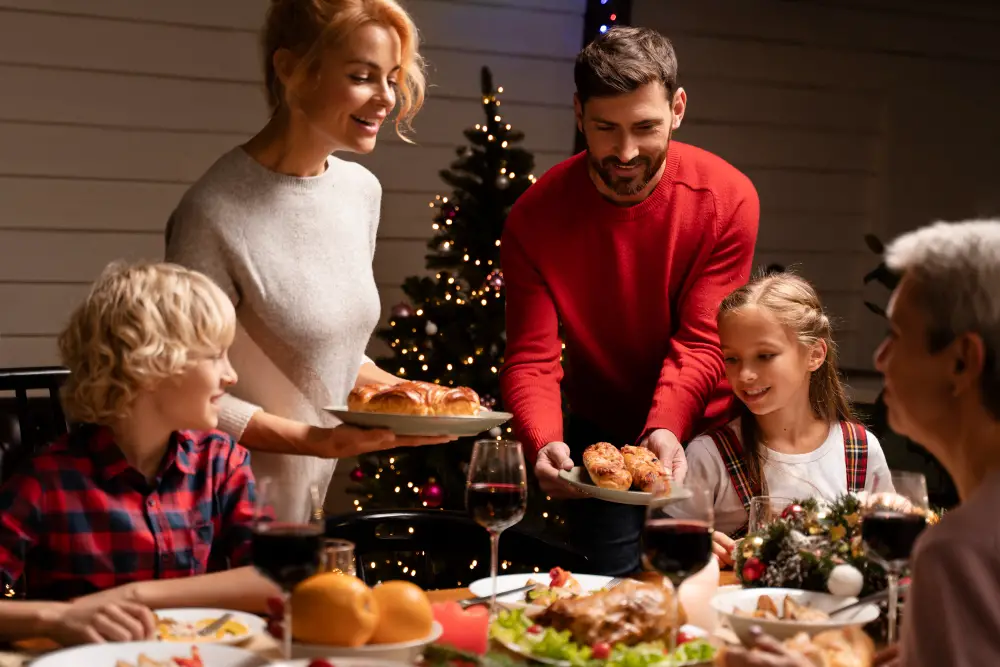
The house on Maplewood Drive smelled of roasted turkey, sage stuffing, and the cloying, cinnamon-spiced scent of performative happiness. It was the smell of a magazine cover brought to life, a scent I had spent thirty-two years trying to scrub from my skin.
I stood on the front porch, the November wind biting through my wool coat, balancing my grandmother’s pecan pie in one hand. It was still warm, the lattice crust golden and fragile, smelling of caramelized sugar and the only genuine love I had ever known in this family.
I opened the door without knocking.
The noise hit me first—the clatter of silver against fine china, the crystalline laughter of aunts and cousins, the low rumble of uncles discussing football. Twenty-three people were gathered in the dining room. My mother, Diane, held court at the head of the table, her smile tight and practiced, like a wire trap waiting to snap.
I walked into the dining room, expecting the usual hush that accompanied my arrival—the pause where the family recalibrated to accommodate the “difficult” daughter. But today, the silence was different. It wasn’t awkward; it was absolute.
I scanned the long mahogany table, counting the place settings. Twenty-three chairs. Twenty-three name cards written in my sister Clarissa’s looping calligraphy.
There was no chair for me.
My spot, usually near the kitchen door where I could be summoned easily to refill water glasses, had been erased. In its place sat a high-end baby gift basket, wrapped in cellophane.
“You’re late,” my mother said, not looking up from her plate. She sliced her turkey with surgical precision.
“I’m ten minutes early,” I replied, my voice steady despite the thudding of my heart against my ribs. “Where is my seat?”
My father, Harold, stared into his wine glass, swirling the dark red liquid as if divining a future where he didn’t have to exist in this moment.
“We ran out of room, Regina,” my mother said, finally lifting her eyes. They were blue and flat, like a frozen lake. “You can eat in the kitchen after we’re finished. Honestly, with your attitude lately, it’s better this way.”
“My attitude?” I took a step closer. The pie felt heavy in my hands, a tangible anchor to the woman who was no longer here to defend me.
“There is simply no room at this table for disappointments,” she said.
The words hung in the air, suspended over the candied yams and the green bean casserole. A fork clattered onto a plate. My sister Clarissa, glowing with pregnancy and self-satisfaction, covered a giggle with a napkin.
In any other year, I would have crumbled. I would have retreated to the kitchen, eaten my cold turkey in silence, and washed the dishes while they toasted to their success. I would have internalized the shame, believing it was my rightful inheritance.
But this year was different. This year, I had a ghost on my side.
I didn’t cry. I didn’t scream. I simply walked to the head of the table, past the stunned faces of my aunts and uncles, and set the pie down next to the centerpiece. Then, I reached into my coat pocket and pulled out a thick, cream-colored envelope sealed with red wax.
I placed it gently on my father’s dinner plate, covering his untouched food.
“Happy Thanksgiving, Dad,” I said, my voice ringing clear in the silent room. “I finally understand why you hate me.”
Harold looked up, his face gray and slack. “Regina, what are you doing?”
“The DNA results inside answered the questions I’ve been asking my whole life,” I told him, looking around the table, meeting every pair of averted eyes. “But they also raised one bigger question. One that nobody in this room has the courage to answer.”
I leaned in, bracing my hands on the table. “Open it.”
The Revelation
The dining room was silent now, save for the ticking of the grandfather clock. My father held the envelope I had dropped on his plate. His hands were shaking so hard the paper rattled.
“What is this?” Clarissa demanded, her voice shrill. “Regina, you are ruining my announcement!”
“Open it, Dad,” I said, ignoring her.
Harold tore the seal. He pulled out the papers. I watched his eyes scan the lines. I saw the moment the comprehension hit him. The color drained from his face, leaving him looking like aged parchment.
“Harold?” My mother’s voice wavered. “Harold, don’t read that. It’s nonsense. Regina is hysterical.”
But he kept reading. His lips moved silently, forming words he couldn’t speak aloud. When he finally looked up at me, his eyes were wet.
“How long have you known?” he whispered.
“Three weeks,” I said. “Since Grandma Eleanor’s lawyer called me about her estate.”
My grandmother had died two months earlier. She was the only person in this family who’d ever made me feel like I mattered, who’d called me on birthdays, who’d shown up at my college graduation when my parents “couldn’t make it.” When her lawyer contacted me, I assumed it was about some small keepsake, maybe her recipe box or the quilt she’d been making.
Instead, he’d handed me a letter and a DNA test kit.
The letter was short: Regina, my darling girl. If you’re reading this, I’m gone, and it’s time you knew the truth. Your father has carried a burden for thirty-two years, and so have you, though you didn’t know it. Take this test. Compare it to mine. Then decide what to do with the answer. I love you more than you’ll ever know. You were never the disappointment they made you feel like. You were the miracle. —Grandma Eleanor
I’d taken the test that same day. Sent in the sample. Waited two weeks that felt like two years.
The results came back on a Tuesday. I’d read them in my car in the lab parking lot, and everything I’d ever known about myself had shattered like dropped china.
Now, sitting in my father’s trembling hands, was the proof.
“What does it say?” my Uncle Frank asked, breaking the silence. “Harold, what’s in there?”
My father didn’t answer. He just stared at the paper, his jaw working silently.
So I answered for him.
“It says that Harold isn’t my biological father,” I said, my voice carrying across the stunned silence. “It says that my DNA is a 50% match to Grandma Eleanor, just like it should be. But it’s a 0% match to Harold.”
Gasps rippled through the room. Clarissa’s hand flew to her mouth. My mother went rigid, her fork frozen halfway to her lips.
“It also says,” I continued, pulling out a second sheet of paper from my own pocket, “that I am a 50% match to someone else in the family database. Someone whose DNA was on file because he’d done a genealogy project five years ago.”
I turned to look at the man sitting three seats down from my father. My Uncle James, Harold’s younger brother. He’d gone completely white, his eyes wide with something that looked like terror.
“Uncle James,” I said quietly. “Would you like to explain? Or should I?”
Thirty-Three Years Ago
The room erupted. Everyone started talking at once—questions, accusations, denials. My Aunt Carol, James’s wife, stood up so fast her chair fell backward. My mother sat frozen, staring at nothing.
“Quiet!” My father’s voice cut through the chaos like a knife. He stood, the papers still clutched in his hand, and the room fell silent again.
He looked at James. “Tell her.”
James’s mouth opened and closed. No sound came out.
“Tell her,” Harold repeated, his voice breaking. “She deserves to know. She’s deserved to know for thirty-two years.”
My mother finally moved. “Harold, don’t. Please. Not like this. Not in front of everyone.”
“In front of everyone?” Harold’s laugh was bitter. “Diane, she just announced it in front of everyone. The secret we’ve been keeping, the lie we’ve been living—it’s out. So tell her. Tell her why I could never look at her without seeing what you did.”
My mother’s face crumpled. For the first time in my life, I saw her cry real tears.
“It was one time,” she whispered. “One stupid, drunken time. We’d been fighting, Harold. You’d been working late every night for months. I felt invisible. James was there, and he listened, and we both had too much wine, and—”
“And you got pregnant,” Harold finished, his voice hollow. “And you weren’t sure whose child it was. But you hoped it was mine. We both hoped.”
He looked at me, and I saw something in his eyes I’d never seen before—not hatred, not disappointment, but pain. Deep, ancient pain that had calcified into something that looked like cruelty.
“When you were born,” he continued, “I told myself it didn’t matter. I told myself I would love you anyway, that you were mine regardless of biology. But every time I looked at you, all I could see was the worst night of my marriage. The betrayal. The lie.”
“So you punished me,” I said, and my voice was steady even though my hands were shaking. “For something that happened before I was even born. You punished me for existing.”
“I tried,” he said, and tears were streaming down his face now. “God, Regina, I tried. But every milestone, every birthday, every time you looked at me with James’s eyes—I couldn’t do it. I couldn’t separate you from what happened. And I hate myself for it.”
The silence that followed was different from before. This one wasn’t shocked or scandalized. It was heavy with grief, with decades of unspoken pain, with a family fractured by a secret that had been eating them alive.
Uncle James finally found his voice. “I didn’t know,” he said, looking at me with tears in his eyes. “Regina, I swear to God, I didn’t know. If I had known—”
“What?” I interrupted. “What would you have done? Raised me? Acknowledged me? Or would you have done exactly what you did—pretended I didn’t exist?”
“That’s not fair—”
“Fair?” My voice rose for the first time. “Fair? I spent thirty-two years wondering why my father hated me. Why my mother looked at me like I was a stain she couldn’t scrub away. Why Clarissa got everything and I got nothing. I thought there was something wrong with me, something fundamentally broken that made me unlovable.”
I turned to look at the whole table, at all these relatives who’d watched me be erased year after year and said nothing.
“I went to therapy for ten years,” I said. “I was diagnosed with depression at sixteen. I tried to kill myself when I was nineteen because I was so convinced that I was worthless, that I didn’t deserve to take up space in the world.”
My mother made a sound like a wounded animal.
“And all of you knew,” I continued, looking at my aunts and uncles. “Maybe not the specifics, but you knew something was wrong. You watched them treat me like I was invisible, and you said nothing. You did nothing.”
“We thought it was a family matter,” Aunt Margaret said weakly. “We didn’t want to interfere—”
“You didn’t want to interfere with a child being emotionally abused?” I asked. “That was your choice? To protect your own comfort instead of protecting me?”
No one answered. The turkey was getting cold. The candles were burning down. And thirty-two years of family dysfunction was finally, brutally, exposed.
The Letter
I reached into my other pocket and pulled out the second thing my grandmother had left me. An envelope addressed to everyone at this table, to be opened “at Thanksgiving, if Regina chooses.”
I’d chosen.
“Grandma Eleanor left this,” I said, setting it on the table. “She knew. She’d always known. And before she died, she wanted you all to know that she knew.”
My mother’s hand trembled as she reached for it. She opened the envelope with shaking fingers and pulled out several pages of my grandmother’s careful handwriting.
She read aloud, her voice breaking:
To my family,
If you’re reading this, Regina has finally learned the truth. The truth that I’ve carried for thirty-two years, watching my granddaughter suffer for a sin that was never hers.
Harold, my son: I love you. But you failed that little girl every day of her life. You let your pain turn you into someone cruel, and you convinced yourself it was justified. It wasn’t. It never was.
Diane: You made a mistake. One night, one terrible choice. But you compounded that mistake by spending three decades making your daughter pay for it. You could have left Harold. You could have told the truth. Instead, you built a prison for all three of you, and Regina has been serving a sentence for a crime she didn’t commit.
James: You are Regina’s biological father, and you never had the courage to find out. You could have asked. You could have taken a DNA test years ago. You knew there was a possibility, but you chose ignorance because it was easier.
To the rest of you: You are not innocent bystanders. You watched this family destroy a child, year after year, and you did nothing. You smiled and nodded and passed the mashed potatoes while Regina sat in the corner, invisible and hurting.
I have made my will accordingly. Regina will inherit my house, my savings, and everything I own. Not because she deserves it more than anyone else, but because she deserves something. She deserves to know that at least one person in this family saw her, loved her, and believed she had value.
The rest of you can divide the guilt among yourselves.
— Eleanor
The silence after my mother finished reading was absolute. The candles flickered. Someone’s phone buzzed, ignored. Outside, a car drove past, its headlights briefly illuminating the room before plunging us back into the amber glow of chandelier light.
Clarissa was crying now, her earlier smugness completely evaporated. Uncle James had his head in his hands. Aunt Carol had left the room. My father sat staring at nothing, tears streaming down his weathered face.
“I’m leaving now,” I said into the silence. “I’m taking Grandma’s pie, and I’m going to eat it in my new house—the one she left me. The one with enough rooms for the family I’m going to build. A family that doesn’t make love conditional.”
I picked up the pie, still warm, still smelling like the woman who’d been the only light in my dark childhood.
“Regina,” my father said, his voice cracking. “Please. Don’t go. We can… we can fix this. We can try to fix this.”
I looked at him—really looked at him—maybe for the first time in my life without the desperate hope that he might finally see me.
“You had thirty-two years to fix this,” I said softly. “You chose not to. That’s on you.”
Walking Away
I walked out of that house on Maplewood Drive and didn’t look back. Behind me, I heard voices rising—arguments, accusations, the sounds of a family finally confronting what they’d been hiding for three decades.
I got in my car, set the pie carefully on the passenger seat, and drove away.
My phone started ringing before I’d made it to the highway. My mother. Then Clarissa. Then numbers I didn’t recognize—relatives wanting to explain, to apologize, to beg me to come back and “work this out.”
I turned my phone off.
At my grandmother’s house—my house now—I sat in the kitchen that smelled like her lavender sachets and old books. I cut myself a large slice of pecan pie and ate it slowly, savoring every bite.
The house was quiet. Peaceful. Empty of expectations and disappointment and the weight of being someone’s shameful secret.
For the first time in my life, I felt like I could breathe.
Six Months Later
I didn’t speak to my parents or Uncle James for six months. They tried—letters, emails, showing up at the house. I didn’t answer. I’d spent thirty-two years trying to earn their love. I was done.
But I did agree to meet with a family therapist, on the condition that I could bring someone with me. Someone who’d been conspicuously absent from that Thanksgiving table.
Dr. Reeves had kind eyes and a no-nonsense approach. She sat in her office with me on one side and my father, mother, and Uncle James on the other.
“Before we begin,” she said, “I want to make something clear. Regina is not here to forgive you. She’s not here to make you feel better about what you did. She’s here because she’s trying to heal, and she needs answers to do that.”
My mother nodded, clutching a tissue. My father stared at his hands. Uncle James looked like he’d aged a decade.
“Why didn’t you tell me?” I asked. The question I’d been carrying for six months. “When I was old enough to understand, why didn’t you just tell me the truth?”
“Because we were ashamed,” my mother said, her voice small. “I was ashamed of what I’d done. Harold was ashamed that he couldn’t get past it. James was ashamed that he’d never asked. We built this whole life around the shame, and you got buried under it.”
“Did you ever love me?” I asked my father—the man who’d raised me but never been able to see me.
He looked up, and his eyes were raw. “I wanted to. God, Regina, I wanted to so badly. But every time I tried, I’d see James. I’d see that night. I’d feel the betrayal all over again. And I know that’s not an excuse. I know that’s my failure, not yours. But yes. Somewhere, under all the pain and anger, there was love. I just… I couldn’t reach it.”
“And now?” I asked. “Now that the secret’s out, now that Grandma forced you to face it—is it different?”
He was quiet for a long moment. Then: “Now I just feel like I wasted thirty-two years hating the wrong person. I should have been angry at James, at Diane, at myself. But it was easier to be angry at you. Because you couldn’t fight back. Because you were just a kid who wanted her father to love her.”
“I did,” I said, and my voice broke for the first time. “I wanted that so badly. I tried so hard to be good enough, smart enough, quiet enough, helpful enough. And nothing I did mattered because the problem was never me. The problem was you.”
“I know,” he said, and he was crying openly now. “I know, and I’m sorry. I’m so, so sorry.”
Uncle James spoke for the first time. “I want to get to know you,” he said. “If you’ll let me. I’m not trying to replace Harold as your father—I know I don’t have that right. But I’d like to try to be… something. Uncle, friend, whatever you’re comfortable with.”
I looked at him—at my biological father who’d never known he had a daughter. “Why didn’t you take a DNA test when Grandma suggested it five years ago?”
“Because I was afraid,” he said simply. “Afraid of what it would mean for my marriage, my family, my relationship with Harold. I chose cowardice, and you paid the price for that. I can’t undo that. But I can try to do better now.”
Dr. Reeves let the silence sit for a moment. Then she looked at me. “Regina, what do you need from them?”
I thought about it. About thirty-two years of emptiness, of wondering why I wasn’t enough, of believing the lie that I was the disappointment.
“I need you to understand that you can’t fix this,” I said finally. “You can’t apologize enough or explain enough or try hard enough to undo what you did. That damage is permanent. I will carry it for the rest of my life.”
They all nodded, accepting the verdict.
“But,” I continued, “I also need you to understand that I’m okay. Grandma made sure of that. She left me the house, the money, and most importantly, the truth. She gave me the tools to build a life that doesn’t depend on your approval or your love. I don’t need you to complete me anymore.”
“So where does that leave us?” my mother asked.
“I don’t know,” I said honestly. “Maybe nowhere. Maybe somewhere. But it’s going to be on my terms now, not yours. If we have a relationship going forward, it’s because I choose it, not because I’m desperate for crumbs of affection.”
One Year Later
I didn’t cut them off completely. That would have been easier, cleaner, but it also would have meant letting their choices continue to define my life.
Instead, I built boundaries. Careful, deliberate boundaries that protected the person I was becoming.
I had coffee with Uncle James once a month. We didn’t call it father-daughter time. We just talked—about books, movies, his work as an engineer, my work at the nonprofit I’d started using part of Grandma’s inheritance. Sometimes it was awkward. Sometimes it was surprisingly easy. We were learning each other slowly, without the weight of expectation.
I had lunch with my mother every few months. She was in therapy now, working through her own guilt and shame. She’d apologized a hundred times in a hundred different ways. I’d accepted the apologies but not the absolution. Some things can’t be absolved.
My father was harder. The damage between us went deeper. We emailed occasionally—short, careful messages that acknowledged the past without trying to rewrite it. He’d sent me a birthday card last month with a note inside: I’m proud of the woman you’ve become. I’m sorry I wasn’t there to help you become her.
I’d cried when I read it. Not because it fixed anything, but because it was honest.
Clarissa and I barely spoke. She’d sent a long apology email after Thanksgiving, explaining that she hadn’t known the full story, that she’d just followed our parents’ lead in treating me as less-than. I’d written back: Not knowing doesn’t mean you didn’t participate. You had eyes. You could have asked questions. You chose not to.
She hadn’t responded. Maybe someday we’d find our way back to some version of sisterhood. Maybe not. I was learning to be okay with maybe.
The rest of the family had fractured in predictable ways. Some people sided with me, appalled by what had happened. Others defended my parents, saying I was being too harsh, that families make mistakes. I’d learned to identify who was worth keeping and who wasn’t.
But the biggest change was in me.
I’d stopped carrying the question of why I wasn’t enough. Because I finally understood: I had always been enough. More than enough. The deficiency was never mine.
Thanksgiving, One Year Later
I hosted Thanksgiving at Grandma’s house—my house. I invited twelve people: friends I’d made over the years, colleagues from work, my therapist (who’d become a friend), and Uncle James with his wife Carol, who’d apologized tearfully and genuinely last spring.
I did not invite my parents. Maybe next year. Maybe never. The door wasn’t locked, but it wasn’t wide open either.
We gathered around Grandma’s old table, extended with two extra leaves to fit everyone. The turkey smelled perfect. The pie was cooling on the counter—made from Grandma’s recipe, the one she’d taught me when I was ten and she was the only person who seemed to notice I existed.
Before we ate, I raised my glass.
“I want to thank you all for being here,” I said. “Last year at this time, I was standing in a dining room where there was no chair for me. Where I was told there was no room for disappointments.”
Everyone had heard the story. I’d told it one night over wine when someone asked why I didn’t talk to my parents.
“But this year,” I continued, “I’m standing in my own home, surrounded by people who see me, who value me, who don’t make me earn my place at the table. And I’m grateful. For all of you. For Grandma Eleanor, who made this possible. And for the strength to walk away from people who couldn’t love me properly.”
“To Regina,” Uncle James said, raising his glass. “And to second chances.”
“To Regina,” everyone echoed.
We ate. We laughed. We told stories. And when dinner was over and people were helping clean up, Uncle James pulled me aside.
“I got you something,” he said, handing me a small wrapped box.
I opened it carefully. Inside was a silver necklace with two charms: a small house and a tiny pie.
“The house is for your new beginning,” he said. “The pie is for Eleanor. So you can keep her with you.”
I put it on immediately, feeling the weight of it against my chest. “Thank you.”
“No,” he said, his voice thick. “Thank you. For giving me a chance I don’t deserve. For letting me be part of your life, even just a small part.”
“You’re my father,” I said, testing out the words. They felt strange but not wrong. “Biologically, anyway. We’re still figuring out what that means. But I’m glad you’re here.”
He hugged me, and I let him, and it felt like something healing, even if it wasn’t quite forgiveness.
Two Years Later
My mother called me on a random Tuesday. “Your father’s in the hospital,” she said, her voice shaking. “Heart attack. He’s stable, but… Regina, could you come?”
I went. Not because I owed them anything, but because I’d learned that healing isn’t linear, and sometimes you make choices that surprise yourself.
Harold looked small in the hospital bed, hooked up to machines that beeped and hummed. When he saw me, his eyes filled with tears.
“You came,” he whispered.
“I came.”
My mother stepped out, leaving us alone.
“I’ve been thinking,” he said slowly, “about what Grandma Eleanor wrote in that letter. About how I failed you every day. She was right.”
“I know she was.”
“I want you to know something.” He took a shaky breath. “I’m glad you’re my daughter. Not because of biology—that doesn’t matter. But because you grew up to be good despite us, not because of us. You’re strong and kind and brave, and that’s all you. That’s all Regina.”
Something in my chest loosened, just slightly.
“I don’t know if we’ll ever have a real relationship,” he continued. “I don’t know if I deserve one. But I needed you to know: you were never the disappointment. We were.”
I sat with him for an hour. We didn’t talk much. But I held his hand, and he held mine back, and it wasn’t forgiveness exactly, but it was something. Something like closure, or maybe a door left slightly ajar.
When I left, my mother was in the hallway. “Thank you for coming.”
“I didn’t come for you,” I said honestly. “I came for me. Because I needed to know if I could face him without falling apart. And I could.”
“You’re stronger than both of us ever were,” she said quietly.
“I had to be.”
Present Day
I’m thirty-five now. Three years since that Thanksgiving when my world broke open and rebuilt itself into something better.
I still live in Grandma’s house. I’ve made it mine—painted the walls, planted a garden, filled it with the sounds of the life I’m building. Last month, I started fostering a teenager named Maya whose parents kicked her out for being gay. She sits at my grandmother’s table now, doing homework, and I make her Grandma’s pie on Sundays.
I’m teaching her what I learned: that family isn’t always blood, that love doesn’t have to be earned, that being seen is a basic human right.
Uncle James comes by every week. We’re still figuring out our relationship, but it’s real now, built on truth instead of secrets. His other children—my half-siblings—know about me now. We’re slowly, carefully getting to know each other.
My parents and I have something resembling peace. We’re not close. We probably never will be. But we’re honest now, and sometimes honesty is the best a broken family can do.
And Clarissa? She reached out six months ago, pregnant with her second child. Asked if I wanted to be part of her kids’ lives. I said yes, but on my terms. I won’t be the aunt who gets erased when it’s convenient. I’ll be the aunt who shows up and tells them they matter, the way Grandma Eleanor did for me.
Sometimes I think about that Thanksgiving three years ago. About standing in that dining room with no chair, being told there was no room for disappointments. About the moment I dropped that envelope on my father’s plate and watched their perfect family facade crack open.
I don’t regret it. Not for a second.
Because that was the day I stopped waiting for them to make room for me. That was the day I realized I didn’t need their table—I could build my own.
And I did.
And it’s big enough for everyone who deserves to be here.
Including me.
Especially me.

Lila Hart is a dedicated Digital Archivist and Research Specialist with a keen eye for preserving and curating meaningful content. At TheArchivists, she specializes in organizing and managing digital archives, ensuring that valuable stories and historical moments are accessible for generations to come.
Lila earned her degree in History and Archival Studies from the University of Edinburgh, where she cultivated her passion for documenting the past and preserving cultural heritage. Her expertise lies in combining traditional archival techniques with modern digital tools, allowing her to create comprehensive and engaging collections that resonate with audiences worldwide.
At TheArchivists, Lila is known for her meticulous attention to detail and her ability to uncover hidden gems within extensive archives. Her work is praised for its depth, authenticity, and contribution to the preservation of knowledge in the digital age.
Driven by a commitment to preserving stories that matter, Lila is passionate about exploring the intersection of history and technology. Her goal is to ensure that every piece of content she handles reflects the richness of human experiences and remains a source of inspiration for years to come.