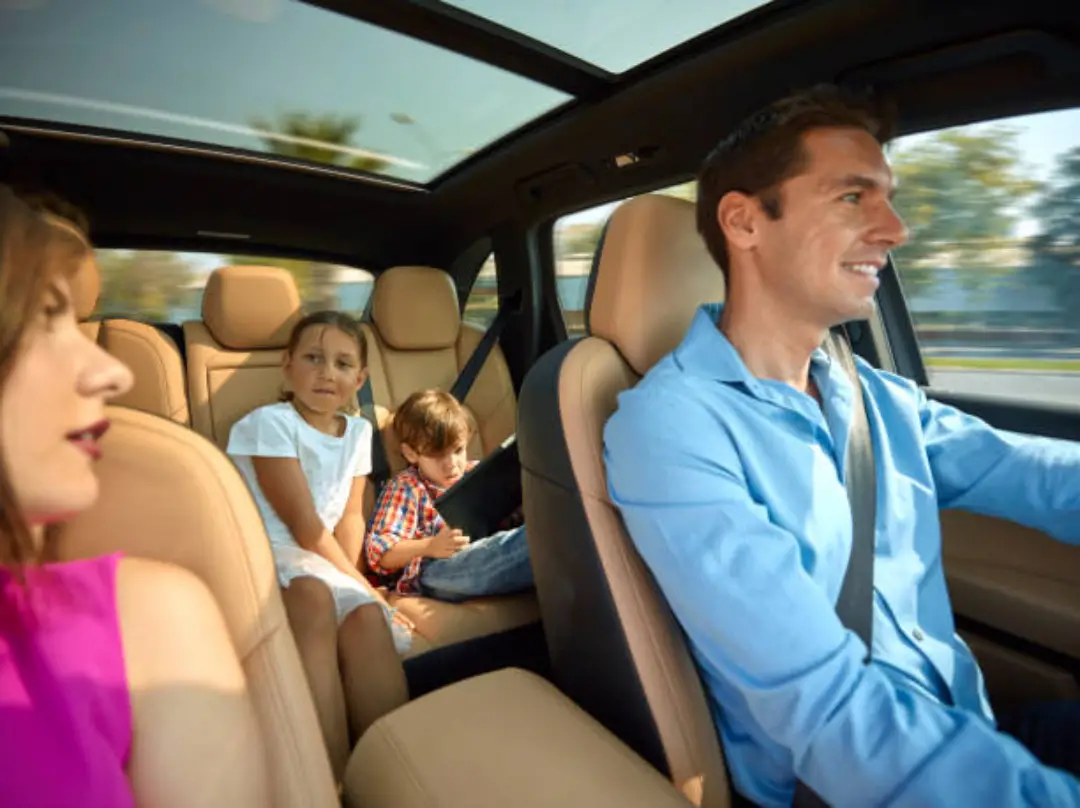
The plan was simple, almost boring in its predictability. Leave early, pack snacks for the kids, fill the travel mugs with coffee strong enough to survive a four-hour drive, cross into Michigan, hug relatives I hadn’t seen in two years, and pretend to enjoy someone’s questionable potato salad. It was supposed to be normal, the kind of family obligation you endure rather than enjoy but get through with minimal drama. Just another summer weekend, another reunion, another opportunity to smile through uncomfortable conversations and remind my children to say thank you.
I was driving, which I always did on long trips. Partly because I hated the way my husband James braked at the absolute last possible second, like he was perpetually surprised that red lights required stopping. Mostly because motion sickness was one of my many unfortunate talents, and being in control of the vehicle was the only reliable prevention. The kids were semi-conscious in the back seat—all three of them at ages five, seven, and ten—half-watching some animated movie about talking animals and half-arguing over invisible territorial lines drawn across the seat cushions. Tiny chaos in matching neck pillows. It was fine. Not magical, not miserable, just the ordinary chaos of family life.
Until James said it.
“Turn the car around. Now.”
I didn’t react immediately, or rather I did but not in any meaningful way. I laughed—or maybe it was more of a dismissive snort, one of those reflexive sounds you make when you think someone’s joking but the joke isn’t quite funny enough to deserve actual laughter.
“Why?” I asked, glancing at him briefly before returning my eyes to the highway stretching ahead of us.
He didn’t answer right away. He just stared straight ahead through the windshield, his jaw tight, his hands clenched in his lap. Then, quieter but more insistent: “Please. Just turn around.”
That’s when I knew with absolute certainty that this wasn’t a joke. My husband doesn’t do panic. His default settings are calm, occasionally tired, and mildly amused by life’s absurdities. I’ve watched him navigate a kitchen fire with less visible tension than I saw in his face right now. The muscles around his mouth were tight, his breathing deliberate and controlled like he was physically holding something back.
I took the next exit without another word. It was the last one before the Michigan state line, curving off gently to the right like the road itself was offering me a second chance at something I didn’t yet understand. The moment our tires left the highway and hit the exit ramp, James’s body relaxed incrementally. Not completely—just enough that I could see he’d been bracing himself for something, holding his breath against some invisible impact.
“Okay,” I said, my voice steady despite the anxiety beginning to crawl up my spine. “Want to tell me what’s going on?”
He shook his head, still not looking at me. “Just drive.”
“Drive where?”
“Anywhere. Anywhere but there.” His voice was flat, drained of its usual warmth.
The kids were starting to notice now. “Mom, are we going the wrong way?” my middle child asked from the back seat, confusion evident in her voice.
“We forgot something,” I said automatically, the lie coming easily because what else could I say? “We need to go back and get it.”
“What did we forget?”
“I’ll explain later, sweetie.”
My youngest piped up with perfect five-year-old logic: “Is it snacks? Because we have snacks.”
I didn’t answer. James remained silent, staring out the passenger window at scenery that probably didn’t register in his mind at all. We drove for twenty minutes, maybe longer, just miles of trees and small towns and the weight of unasked questions pressing against the back of my neck like physical pressure.
Then he spoke again. “Take the next turn.”
It led nowhere—a narrow access road with no signage and no apparent purpose, one of those places you only find when you’re lost or looking for something you’re not supposed to find. I pulled off onto the gravel shoulder, dust rising around the car in a small cloud.
He unbuckled his seatbelt with deliberate movements. “Stay here. I need to check something.”
“James—”
“Just stay here. Please.” He got out and walked to the back of the car, moving with the careful precision of someone approaching something dangerous.
I couldn’t see what he was doing from the driver’s seat, so I just sat there with my hands still gripping the steering wheel, my knuckles white, my heartbeat doing something strange and irregular in my chest. Fast and heavy, like it knew something my conscious mind hadn’t yet processed. The kids had gone quiet in the back, sensing that something was wrong even if they couldn’t articulate what.
After what felt like an eternity but was probably only two minutes, the trunk closed with a solid thunk. James came back to my window, his face pale, his expression carefully neutral in a way that scared me more than anger would have.
“Can you come out here?” he asked quietly.
“Why?”
“I need you to see something.”
He didn’t sound angry or scared—just tired and absolutely certain, like someone who’d just confirmed their worst suspicions and was now facing the consequences. I unbuckled, told the kids to stay put and keep watching their movie, and got out of the car on shaking legs.
James walked me to the back and opened the trunk without saying a word. He didn’t point or explain, just stepped back slightly so I could see what he’d found.
The red duffel bag my father had handed me that morning sat partially unzipped. James had folded back a sweatshirt on top to reveal what was underneath—packets wrapped in plastic, nestled between clothes, stuffed into what looked like a child’s toiletry bag. Not one or two. Multiple packets, not particularly well hidden, just there, waiting to be discovered by anyone who looked beyond the first layer of fabric.
I stared at it without fully understanding, then understanding all at once with a clarity that felt like falling through ice. This wasn’t medication or vitamins or anything with a legitimate purpose. This was the kind of thing that came with handcuffs, lawyers, prison sentences, and destroyed lives.
I didn’t speak because I couldn’t form words. Every muscle in my chest locked, my breath caught somewhere between my lungs and my throat. James carefully zipped the bag closed again, not touching the contents, just sealing it back up like a bomb that hadn’t detonated yet but still could.
“They put this in our car,” I finally managed to say, my voice thin and unfamiliar. “With our children.”
James nodded, his jaw tight.
“How did you know?” I asked, looking up at him with something between gratitude and horror.
He was quiet for a moment, staring at the closed trunk. “When your dad gave us the bag this morning, something felt wrong. The way he smiled, the way your mom wouldn’t quite meet my eyes. They were too relaxed, too cheerful, like people who’d just solved a problem they’d been worried about. I couldn’t stop thinking about it the whole drive. And then when I saw the sign for the state line…” He shook his head. “I didn’t know for certain. But I knew enough.”
And that was somehow worse—that he’d seen what I’d trained myself not to see, what I’d spent my entire adult life overlooking because looking directly at my family’s dysfunction was too painful.
The funny thing, if anything about this could be called funny, was that I’d always considered myself the responsible one in my family. Not just responsible in the pays-bills-on-time and remembers-to-floss kind of way, though yes, those too. I meant responsible in the deeper sense—the stable one, the reliable one, the person who didn’t explode or vanish or manipulate or lie for sport. The one who tried to be good, who offered help when she could afford to and boundaries when she couldn’t.
But looking back now with the kind of clarity that only comes from absolute betrayal, I could see that being the responsible one in my family was like being the designated driver at a demolition derby. They didn’t want help. They wanted cover, someone to clean up their messes and absorb their consequences, and I’d been providing that service for longer than I cared to admit.
It started when I was young. My parents were the kind of people who believed that appearing successful was more important than actual financial stability. Image mattered more than reality. If you looked prosperous, if you seemed generous, if your Christmas decorations were elaborate and your house had all the latest appliances, then you were doing well. It didn’t matter if the credit cards were maxed out or if the electricity got shut off that one winter. We were fine. That was the story, and everyone was expected to stick to the script or get written out entirely.
We had years when money was genuinely tight—I remember cereal for dinner and one parent or another “working late” most nights, which I later realized meant they couldn’t afford to feed all of us properly and were avoiding the shame of admitting it. But we also had years when they seemed flush with cash—new cars, new electronics, elaborate vacations they couldn’t afford but took anyway because the neighbors were watching. The money came and went like weather, unpredictable and uncontrollable. What never changed was the spending, the performance, the desperate maintenance of an image that had nothing to do with reality.
I once asked my father, when I was maybe eight or nine, why we didn’t save money during the good times to prepare for the bad ones. He’d looked at me like I’d suggested something vaguely offensive and said, “You don’t need to save if you know how to hustle.” That was his philosophy, his entire approach to life—there would always be another hustle, another scheme, another way to get what he wanted without paying the actual cost.
My sister inherited all of this—the hustle, the charm, the gravitational pull of someone who could light up a room while quietly unplugging everyone else’s sense of self-worth. She was the favorite child, which wasn’t even a secret or a source of family tension, just an accepted fact like the color of the sky. They liked her more because she was like them—charismatic, impulsive, allergic to planning or responsibility. I wasn’t like them. I was boring, they said. Too serious. Too rigid.
My mother once told me during Thanksgiving dinner, in front of extended family, that my problem was I “mistook discipline for personality.” Everyone had laughed. I’d smiled because what else do you do when you’re being humiliated at your own family gathering? You smile and change the subject and pretend it doesn’t hurt.
And the terrible part, the part I’m still unpacking in therapy years later, is that I believed them. When you grow up in that environment, you start to internalize the narrative they create about you. You become the role they’ve assigned. So I became the responsible one, the helper, the person they called when they needed someone to navigate insurance claims or fill out complicated forms or bridge the gap when my sister lost another job, which happened with predictable regularity.
I gave what I could. Not too much—I learned that boundary early—but enough to keep things from completely falling apart. Enough to not be labeled selfish or uncaring. Even when they made it hurt, even when they framed every “no” as evidence of my moral failure, I still gave. Because they were my parents. Because it felt easier than the alternative.
Then, about four months before this trip, the nature of their requests changed.
My sister’s son—my nephew, a sweet kid I genuinely cared about—was struggling in school. He was being bullied, they said. Not fitting in. Showing signs of anxiety and withdrawal. They’d had him evaluated, and apparently some therapist had recommended a smaller, more supportive environment. There was a private school they’d found, very exclusive, very expensive, and in their words, absolutely life-changing. They couldn’t afford it, obviously. They never could afford anything. But they’d managed to get him conditionally accepted if they could put down a deposit to hold his spot.
They just needed help. Just a little bit. Just to lock in this opportunity for a child who deserved better. They’d pay me back, of course. They always said they’d pay me back.
My stomach had sunk the moment the words came out of their mouths, because I knew this pattern. I knew how it started and exactly how it would end—with me out thousands of dollars and them resenting me for keeping track.
I said no. I said it as gently as I could, like you’d speak to someone holding something fragile and sharp. “I can’t pay for private school. I have three children of my own to think about. We don’t even do private school for our kids. I’m sorry, but I just can’t.”
They didn’t yell. They just went quiet and cold in that particular way that’s worse than shouting. My mother said, “Of course. I understand. You have rules.” The word “rules” came out dripping with contempt, like I’d cited some technicality to avoid basic human decency.
We didn’t speak for several weeks after that. Until the family reunion came up.
Suddenly everything was cheerful again, all forgiven or forgotten. They were thrilled we were coming, excited to see the grandchildren, looking forward to family time. They’d figured everything out—the school situation, their finances, all of it was miraculously handled. I didn’t ask how. I told myself it wasn’t my business anymore, that I’d set a boundary and stuck to it and that was healthy.
A few days before the trip, they asked if we’d be willing to transport an extra bag in our car. Their sedan was packed full with their own luggage and my sister’s family’s things, and we had the SUV with plenty of space. “Just one bag,” my father had said. “We’d really appreciate it.”
“Sure,” I’d agreed, because it seemed like a harmless request. “Just let me know what you need.”
The morning we left, as we were loading up the car, my father had appeared with the red duffel bag. “This is the one,” he’d said casually. “Just toss it in with your stuff. We’ll grab it when we get there.”
I’d taken it without thinking, without questioning, without examining. Just another bag. Just another favor. I’d thrown it in the trunk next to our suitcases and the kids’ backpacks and the cooler full of juice boxes and string cheese.
I hadn’t wondered why people who were supposedly struggling financially, who’d guilted me for not helping with school tuition, suddenly seemed so relaxed and happy. I hadn’t questioned the smile on my mother’s face as we backed out of their driveway, hadn’t thought twice about how my father waved like he didn’t have a care in the world.
Now, standing on this random access road in the middle of nowhere, staring at the closed trunk that contained evidence that could have destroyed our lives, I understood exactly why they’d been so cheerful.
We hadn’t been doing them a favor. We’d been their mules, their insurance policy, their fallback plan. If we got caught crossing state lines with whatever was in those packets, they could claim ignorance. They’d given us the bag, sure, but we’d agreed to take it. We’d loaded it in our car. We were responsible for checking what we transported, weren’t we?
And even if we tried to implicate them, who would believe us over them—the charming, likeable parents and grandparents who would cry and express shock that their own daughter would make such terrible accusations?
James was watching my face, reading the realization as it spread through my expression. “What do you want to do?” he asked quietly.
I turned and walked back to the driver’s seat, my legs feeling disconnected from my body. Got in. Closed the door. Started the engine. The kids were absorbed in their movie, oblivious to the catastrophe we’d just narrowly avoided.
“We’re taking it back,” I said.
James nodded. “I’ll come with you.”
We drove in silence, retracing the route we’d taken that morning, the highway signs now feeling ominous instead of ordinary. My phone started buzzing in the cup holder—first my mother, then my father, then again, then again. I didn’t answer. Neither did James. We already knew what they’d say. Where are you? What happened? Is everything okay? Did something happen to the car? Where’s the bag?
It took nearly two hours to get back to their house. I pulled into their driveway and parked, noticing that their car was gone—they’d probably already left for Michigan, expecting us to meet them there with their contraband safely transported across state lines.
James got the spare key from its hiding place—still taped to the back of the fake decorative rock my father had bought from some catalog years ago, the kind that also sold deer whistles and solar-powered garden frogs. We let ourselves in. The house smelled like stale coffee and the particular kind of mustiness that comes from poor ventilation and worse decisions.
We placed the red duffel bag in the front hallway, right inside the door where they couldn’t possibly miss it. Didn’t open it. Didn’t adjust it or add a note. Just set it down like a quiet accusation that didn’t need words.
James locked the door behind us. We got back in the car, still not speaking, because I think we both felt that talking would somehow contaminate the clarity of what we’d just done.
Later that evening, after we’d driven home and put the kids to bed and were sitting in our own living room trying to process what had happened, my phone rang. My mother’s name appeared on the screen. I stared at it for several seconds before answering.
“Sweetheart, we were so worried!” Her voice was bright and artificial, like this was a call about weekend plans. “We didn’t know what happened. You just disappeared. Are you okay? Did something happen to the car?”
I didn’t say anything, just held the phone to my ear and listened.
“Is everything all right with the kids?” Still nothing from me. Then, more carefully: “Where’s the bag?”
I let that question hang in the air for a long moment. Then I said, very calmly, “We dropped it off at your house. If it was that important to you, maybe you should have transported it yourself.”
The pause that followed told me everything I needed to know. She understood exactly what I was saying, and she knew that I understood exactly what she’d tried to do.
“I don’t know what you think—” she started.
“Don’t call again,” I interrupted. “We’re done.”
I hung up. That should have been the end of it, but of course it wasn’t. Nothing with my family ever ended cleanly.
They showed up at our house three days later, unannounced, ringing the doorbell like they were dropping off a casserole instead of trying to explain away attempted felony conspiracy. I knew it was them before I even looked through the peephole—there’s a particular kind of pressure that comes through a door when it’s people who think they’ve done nothing wrong.
I opened the door just enough to step outside, then closed it firmly behind me, creating a physical barrier between them and my children.
My mother smiled, tight and practiced. “We wanted to talk,” she said. “Clear the air.”
“We thought maybe there was a misunderstanding,” my father added, his hands in his pockets, trying to look casual and failing.
I crossed my arms and waited, saying nothing.
My mother hesitated, then: “We didn’t think you’d understand what was in the bag.”
“You mean the drugs?” I said flatly. “In the car with your grandchildren?”
Neither of them responded, which was answer enough.
“You put that in our trunk,” I continued, my voice level despite the rage burning in my chest. “You smiled and waved as we drove away, knowing exactly what you’d hidden in our car, knowing what would happen to us if we got caught. To me. To James. To your grandchildren.”
My father shifted his weight uncomfortably. “It wasn’t supposed to be a big deal. We were just—we needed help with some debt.”
“You wouldn’t help us,” my mother said, and there it was—their justification, their excuse. “We were desperate. We didn’t know what else to do.”
“So you decided to use us as drug mules?” I felt something cold and final settle in my chest. “You risked our lives, our freedom, our children’s safety because I wouldn’t give you money for private school?”
Neither of them spoke.
“We’re done,” I said. “Don’t call. Don’t come here. You don’t get to see the kids anymore. This is over.”
My mother’s expression shifted, and I could see her preparing to deploy her usual tactics—tears, guilt, the suggestion that I was being dramatic. Instead, she just said, “You’ll come around. You always do.”
I turned and went back inside, locking the door behind me. For the first time in my life, I didn’t wonder if she was right.
Three days later, I went to pick up my kids from school and discovered they weren’t there. The teacher smiled pleasantly and said, “Oh, they were already picked up. Your parents said you’d asked them to get the kids today.”
I don’t remember the drive to my parents’ house. I just remember being in the car and then suddenly being in their driveway, my hands shaking on the steering wheel.
Inside, it looked like a birthday party had exploded—toys everywhere, candy wrappers, balloons, a massive Lego set that cost more than our weekly grocery budget spread across the living room floor. My children were glowing, sugar-high and delighted, clutching new stuffed animals and action figures.
My parents were playing the role of perfect grandparents—my mother slicing cake, my father on the floor helping build something that beeped and flashed. It was surreal, like walking into a parallel universe where they actually cared about anyone besides themselves.
But this wasn’t love. This was strategy, emotional manipulation, weaponized affection. They’d never spoiled the kids like this before, not once in ten years. But now, suddenly, after I’d cut them off, here was Santa Claus with a credit card.
“We’re leaving,” I said from the doorway.
The kids whined. “But Grandma said we could stay for dinner!”
“We’re leaving now,” I repeated, my voice harder.
They didn’t understand, couldn’t understand. They were being told “yes” by people who’d spent their whole lives saying “no” to everyone except themselves, and they liked it. It was easy to like.
As we walked out, my mother called after me, her voice sing-song and poisonously sweet: “They’ll come back to us. Children always come back to the fun grandparents.”
That night, I didn’t wait for some dramatic moment of clarity. I just looked at James and said, “We need to move. Far away. Somewhere they can’t find us.”
He didn’t ask why or suggest therapy or tell me I was overreacting. He just said, “North Carolina. My company’s been trying to transfer me to the Charlotte office for two years. My parents are there. We could have actual support.”
“When can we go?” I asked.
“I can request the transfer tomorrow.”
Three months later, we were gone. New state, new schools, new life. We didn’t tell anyone where we went. We blocked phone numbers, deleted social media connections, and disappeared—not dramatically, just quietly, the way people do when they’re choosing survival over performance.
Six months into our new life, I got an email from my sister. Subject line: EMERGENCY. PLEASE READ.
I stared at it for a long time before opening it. The message was frantic and poorly written, the kind of thing someone types in a panic. The essential information: our parents had been arrested. Not for almost getting us arrested, but for doing exactly what they’d wanted us to do for them. They’d tried to transport drugs across a state line themselves, got caught at a checkpoint, and were now facing serious charges.
The email ended with a plea: “They need help. They need money for a lawyer. You have to put the past aside and show up. You’re family.”
I read that line three times. Then I hit reply and wrote exactly one sentence: “I showed up once. I’m not doing it again.”
I heard later, through family members who couldn’t help sharing gossip, that they’d taken a plea deal. Four years each. Not life-destroying, but not nothing—enough time to sit with consequences, if they were capable of that kind of reflection, which honestly I doubted.
The part of me that used to flinch when people talked about second chances is quiet now. We have a life here in North Carolina. It’s not perfect—no life is—but it’s ours. The kids laugh more. James sleeps better. His parents are kind, normal people who babysit without hidden agendas and give gifts without strings attached.
Sometimes people ask if I miss my family, if I ever think about reaching out, if I feel guilty. The answer is complicated. I miss the family I thought I had, the one that existed in my imagination where love wasn’t conditional and help wasn’t a currency to be traded. I don’t miss the reality.
Last week, my oldest asked me why we never see Grandma and Grandpa anymore, why we moved so far away. I thought about lying, about telling her some sanitized version that would preserve her innocence a little longer.
Instead, I told her the truth, age-appropriate but honest: “Sometimes people we love make choices that aren’t safe. And when that happens, even when it hurts, we have to protect ourselves and each other. That’s what we did.”
She thought about this for a moment, then nodded. “Because we’re a family,” she said. “We protect each other.”
“Exactly,” I said, and felt something loosen in my chest.
That red duffel bag saved our lives—not because of what was in it, but because James trusted his instincts enough to say “turn around” and I trusted him enough to listen. Everything that came after—the confrontation, the move, the rebuilding—was just the logical consequence of that single moment when we chose each other over the people who’d taught me that family meant obligation and sacrifice.
We chose different. We chose better. We chose to turn around.
And I’ve never looked back.

Lila Hart is a dedicated Digital Archivist and Research Specialist with a keen eye for preserving and curating meaningful content. At TheArchivists, she specializes in organizing and managing digital archives, ensuring that valuable stories and historical moments are accessible for generations to come.
Lila earned her degree in History and Archival Studies from the University of Edinburgh, where she cultivated her passion for documenting the past and preserving cultural heritage. Her expertise lies in combining traditional archival techniques with modern digital tools, allowing her to create comprehensive and engaging collections that resonate with audiences worldwide.
At TheArchivists, Lila is known for her meticulous attention to detail and her ability to uncover hidden gems within extensive archives. Her work is praised for its depth, authenticity, and contribution to the preservation of knowledge in the digital age.
Driven by a commitment to preserving stories that matter, Lila is passionate about exploring the intersection of history and technology. Her goal is to ensure that every piece of content she handles reflects the richness of human experiences and remains a source of inspiration for years to come.
I like Lila Hart’s posts, she tells a good story and doesn’t drag it out.