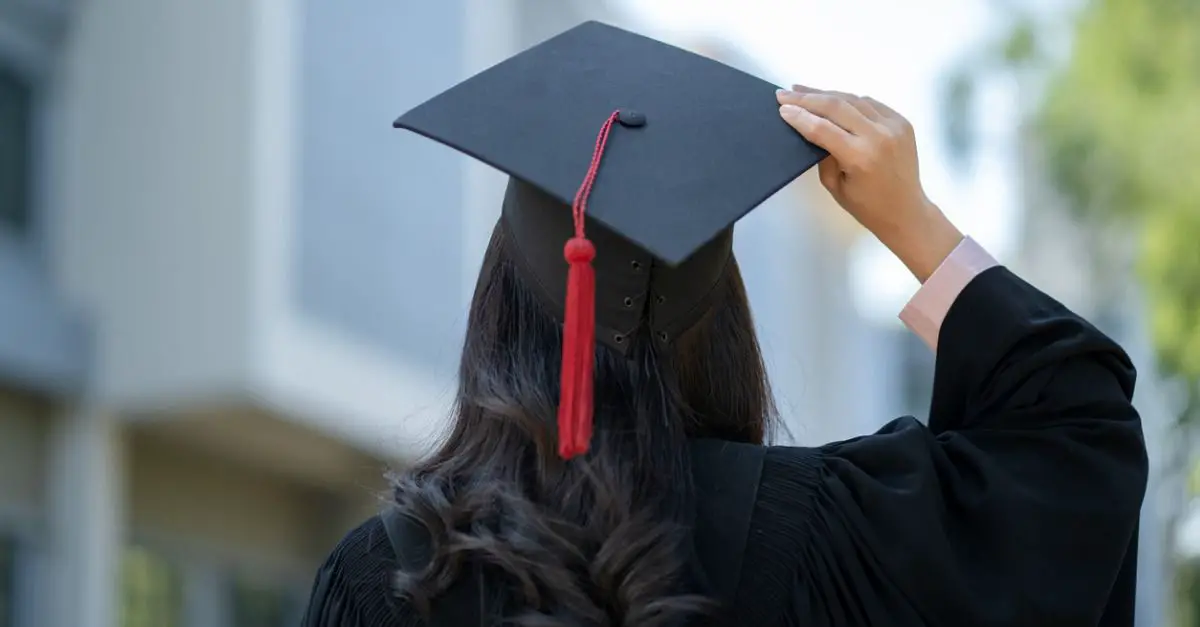
The Weight of Secrets
The California sun hung bright and merciless over the outdoor amphitheater that day, casting sharp shadows across rows of folding chairs where families sat clutching flowers and cameras. Somewhere in the distance, I could hear the faint hum of traffic on University Avenue, the occasional burst of laughter from graduates posing for photos, the rustle of programs being fanned against the heat. It was supposed to be perfect—the kind of day you remember in warm colors for the rest of your life. Instead, it became the day everything I’d been carrying finally came to light, the day I stopped running from the truth my family had spent years trying to bury. What happened on that stage wasn’t just about revenge or vindication. It was about finally understanding that some stories demand to be told, even when telling them costs you everything you thought you wanted.
My name is Natalie Richards, though by the end of that afternoon, even that name would feel like borrowed clothing. I’m twenty-two years old, a newly minted graduate of UC Berkeley with a degree in molecular biology and a future that should have felt wide open. Instead, I stood there in my cap and gown, feeling the weight of two decades pressing down on my shoulders like stones.
The ceremony had started three hours earlier, when the morning was still cool and possibility felt like something you could hold in your hands. I’d walked across campus with my best friend Maya, both of us laughing nervously, adjusting our tassels, taking selfies in front of the Campanile. My mother had texted me twice—once to say they’d arrived, once to ask where we were sitting. My father hadn’t texted at all, but that was normal. Communication from Richard Thorne Richards III was always filtered through assistants, secretaries, or my mother’s careful translations.
He’d flown in from Chicago at the last possible moment, arriving on a red-eye that morning and going straight to the hotel to “freshen up,” which meant he’d spent three hours in a conference call he considered more important than my graduation breakfast. My mother made excuses, of course. She always did. “Your father has significant responsibilities, Natalie. You know how demanding his position is.” His position as CFO of a pharmaceutical corporation that bore his family’s name, a position he wore like armor, a reminder that he came from money so old it had stopped counting generations ago.
I watched them arrive during the processional, when all the graduates were already seated and families were finding their places. My mother wore cream linen, pearls at her throat, her blonde hair swept up in the way she’d worn it for as long as I could remember. She looked elegant and untouchable, the way she always looked, like a woman from a different era who’d learned to survive by being decorative. My two younger brothers flanked her—Jason, nineteen and already molded in our father’s image, and Marcus, seventeen and still soft enough around the edges to sometimes meet my eyes with something like sympathy.
And then there was my father.
Richard Thorne Richards III, tall and silver-haired at fifty-six, moving through the crowd like he owned the air itself. He wore a dark suit despite the California heat, carried himself with the kind of posture that announces wealth before a word is spoken. People moved aside for him automatically. He had that effect—the ability to make spaces bend around his presence.
He sat four rows back, directly in my sightline if I turned my head just slightly to the left. I tried not to look. I tried to focus on the speeches, on the deans and professors welcoming us to the community of scholars, on the special guests who spoke about innovation and responsibility and the bright future ahead. But I kept feeling his gaze, that particular quality of attention that wasn’t quite pride and wasn’t quite interest—more like surveillance, like he was calculating the return on an investment that had underperformed.
When my name was called—”Natalie Marie Richards, Bachelor of Science in Molecular Biology, magna cum laude”—my friends erupted in cheers. Maya stood and screamed my name. The biology department students, all seated together, started a chant that made me laugh despite my nerves. I walked across that stage feeling the sun on my face, the dean’s handshake firm and warm, the diploma heavy with promise in my hands.
I looked out at the crowd as I walked back to my seat. My mother was clapping politely, a smile fixed on her face that didn’t quite reach her eyes. My brothers were both on their phones. And my father clapped exactly three times—precise, measured, dutiful. The sound of obligation, not celebration.
The ceremony continued. More names, more applause, more families crying and taking pictures. I sat there with my diploma in my lap, trying to feel something other than hollow. This was supposed to be my victory. Four years of eighteen-hour days, of working three part-time jobs to cover what my scholarship didn’t, of proving I could make it without relying on my father’s money or name or conditional approval. I’d done it. I’d survived. So why did I feel like I was still waiting for permission to exist?
The dean returned to the podium as we reached the final segment of the program. “Before we conclude,” she said, her voice warm through the speakers, “we have a tradition here at Berkeley. We invite family members to share a few words of congratulations with our graduates, to mark this moment of transition and celebration.”
It was optional, informal. Usually someone’s grandmother would stand and say something tearful, or a proud parent would share a story. It was meant to be sweet, communal, a final moment of connection before we all scattered into whatever came next.
My father stood.
I felt it before I saw it—that shift in the air when a storm system moves in. People around us noticed, turning to look at the distinguished man in the expensive suit rising to his feet. My mother’s hand flew to her purse strap and gripped it like a lifeline. Jason’s head snapped up from his phone. Marcus went very still.
“I have something to say,” my father announced, his voice carrying easily without amplification. He had that kind of voice—trained for boardrooms and country clubs, designed to command attention.
The dean looked uncertain but nodded, stepping aside.
My father didn’t walk to the podium. He didn’t need to. He simply stood there in the middle of his row, hands in his pockets, and looked directly at me.
“I won’t be supporting her anymore,” he said, each word crisp and clear in the afternoon air. “And she should stop telling people she’s a Richards. She’s not even my real daughter.”
The silence that followed was total.
You could feel it ripple outward like shock waves—the gasps, the whispers, the sudden turning of hundreds of heads. Phones lifted. Somewhere behind me, a woman said, “Did he just—?” and didn’t finish the sentence. The dean froze at the edge of the stage, her expression caught between horror and confusion.
I sat very still in my folding chair, my diploma sliding slightly in my suddenly numb hands. My lungs felt tight, like someone had wrapped wire around my ribs and pulled. My face stayed dry—I wouldn’t give him tears, not here, not ever—but my stomach dropped like an elevator with cut cables, plummeting into some dark space inside me that I’d spent years learning to ignore.
This was the weapon I’d always known he was holding. The secret he’d kept in reserve, the ultimate proof that I was conditional, that I existed in his world only at his discretion. And he’d chosen to deploy it here, at my graduation, in front of everyone I knew and hundreds of strangers, because he understood exactly how much it would hurt.
Because that’s who Richard Thorne Richards III was. A man who saw vulnerability and calculated how to exploit it. A man who treated love like a contract with terms that could be renegotiated at any time.
I turned my head slowly to look at my mother.
Diana Richards, née Sullivan, who’d spent my entire life playing translator between my father’s cruelty and reality. Who’d taught me to read his moods like weather patterns, to navigate around his anger, to make myself smaller so he’d have less to criticize. Who’d whispered “He doesn’t mean it” and “He’s under a lot of stress” and “Things will be better when—” filling in the blank with whatever current excuse kept the fantasy intact.
In that moment, under the California sun with the Bay breeze moving the banners overhead, my mother’s face went pale in a way I’d only seen once before. Her lips parted slightly. Her hand on her purse strap was white-knuckled. And in her eyes, I saw something I recognized because I’d been living with it myself for five years.
Fear. And guilt. And the sick understanding that some lies, once exposed, take everything down with them.
I’d first seen that look when I was seventeen years old, during the summer before my senior year of high school.
That was the summer I was supposed to be visiting colleges on the East Coast, touring campuses and imagining futures. Instead, I spent it at home in the Chicago suburbs, watching my parents’ marriage crack along fault lines I hadn’t known existed. My father was traveling constantly—Dubai, Singapore, London, always somewhere that required him to be gone for weeks at a time. My mother moved through our house like a ghost, drinking white wine at lunch and disappearing into her room for hours.
I stumbled onto the truth because I was looking for something else entirely.
I’d been trying to gather documents for my college applications—birth certificate, Social Security card, the bureaucratic proof of existence that turns you into a candidate for admission. My mother kept all of that in her desk, locked in a drawer I wasn’t supposed to open. But she’d been in bed all day with what she called a migraine, and I needed the papers, so I used the key I’d seen her hide years ago in a jewelry box.
The drawer held exactly what I was looking for—and also what I wasn’t.
Medical records. Old ones, from before I was born. Letters on letterhead from a fertility clinic I’d never heard of, discussing procedures and timelines and success rates. And underneath everything else, a file marked with my name that contained documents I didn’t fully understand at first—terms like “donor” and “genetic match” and “legal parentage” swimming in front of my eyes until the shape of the truth finally emerged.
I wasn’t Richard Thorne Richards III’s biological daughter.
I’d been conceived through IVF using a sperm donor because my father was infertile. My mother had been twenty-seven, desperate to save a marriage that was already fracturing. My father had agreed to the procedure but insisted on controlling every aspect—the clinic, the donor selection, the legal documents that would establish his paternity despite biology.
And it had worked. For twenty-two years, it had worked. I’d been raised as a Richards, given the name and the expectations and the constant pressure to be worthy of a legacy that wasn’t actually mine by blood. I’d spent my childhood trying to earn my father’s love, never understanding why it always felt just slightly out of reach, why his approval always came with conditions, why he looked at my brothers with something I never saw reflected back at me.
I sat on the floor of my mother’s study for hours that day, reading and re-reading the documents, trying to process what it meant. Part of me felt relieved—at least now I understood why I’d always felt like an outsider in my own family. Part of me felt betrayed—they’d lied to me for seventeen years, let me believe I was failing to measure up when the truth was I never had a chance.
When I finally confronted my mother, she cried and begged me not to tell my father I knew. “He’ll be so angry,” she said, gripping my hands. “You don’t understand how hard this has been for him, Natalie. He agreed to have you even though it hurt his pride. He’s done his best to love you despite everything.”
Despite everything. As if my existence was a burden he’d heroically shouldered.
I’d kept the secret because I didn’t know what else to do. I was seventeen, still financially dependent, still needing them to sign forms and write checks for college applications. So I swallowed the truth and went back to performing the role of grateful daughter, all while beginning to understand that my father’s conditional love wasn’t a character flaw—it was a feature of a relationship built on a lie.
I also started building my own insurance.
Over the next year, I made copies of everything in that drawer. I contacted the fertility clinic and requested records, discovering I had rights to certain information once I turned eighteen. I hired a genealogy service to track down my biological father using the limited donor information available. And I compiled everything into a file that I kept hidden, waiting for the day I might need it.
Because I understood something about Richard Thorne Richards III that my mother never wanted to admit: he was a man who valued control above all else, and he would use any secret, any vulnerability, any piece of leverage to maintain it. If I didn’t have my own leverage, I would always be at his mercy.
I just never imagined he’d make his move at my graduation.
Standing on that stage now, hearing him erase me with a sentence, I felt something in me go quiet and steady. Not calm, exactly—more like the stillness before action, the moment when you stop debating and start doing.
The crowd was still processing his words. My classmates looked confused, sympathetic, voyeuristically fascinated. My professors looked uncomfortable. The dean had started moving toward the microphone, probably planning to intervene and restore some dignity to the proceedings.
I stood before she could reach it.
The movement drew everyone’s attention back to me. I walked slowly to the podium, my graduation gown swishing around my legs, my hands steady despite the adrenaline flooding my system. The Bay breeze caught my tassel and moved it across my cheek. Somewhere behind me, Maya whispered, “Nat, what are you doing?”
I wrapped my fingers around the microphone and looked out at hundreds of faces. Then I let my gaze land on my father, standing there in his dark suit, already looking slightly smug, like he’d landed a blow and was waiting to see me crumble.
“If we’re doing honesty today,” I said, my voice carrying clear and steady across the amphitheater, “then let’s do all of it.”
My father’s jaw tightened. Jason stared at the floor. Marcus’s eyes were wide. And my mother—my mother looked at me with an expression I’d never seen before, something between pleading and resignation, like she knew exactly what I was about to do and had been dreading this moment for years.
I reached into my graduation gown, where I’d tucked an envelope that morning. I’d brought it just in case, though part of me had hoped I wouldn’t need it. I’d imagined a different ending to this day—one where my father surprised me with actual pride, where the ceremony ended with normal family photos and dinners and a future that wasn’t built on weaponized secrets.
But Richard Thorne Richards III had chosen his path, and now I would choose mine.
I held up the envelope so the front rows could see it. Plain manila, sealed, with typed labels on the front. Nothing special about it except for what it contained.
“For years,” I said, still looking at my father, “you’ve held one story over my head. The story of my conception, my legitimacy, my right to be considered your daughter. You’ve used it as a threat, a boundary, a way to keep me small and grateful and controllable.”
I turned the envelope slightly, letting the sunlight catch it.
“But that story isn’t the only secret in our family.”
My mother’s lips parted like she was about to stop me, but no sound came out. She’d gone completely still, her face drained of color, one hand pressed against her chest.
I slid my thumb under the seal of the envelope, taking my time, letting the moment stretch. The amphitheater was so quiet I could hear the paper tearing, the slight rustle as I pulled out the documents inside.
My father took one step toward the aisle. Just one step, but it was enough. I saw something flicker across his face that I’d never seen before—not anger or disapproval or cold calculation, but actual fear. The realization that he wasn’t in control, that there were things even he couldn’t contain.
“These are DNA test results,” I said, holding up the first page. “Performed six months ago through a private laboratory. They confirm what I’ve known since I was seventeen—that Richard Thorne Richards III is not my biological father.”
Murmurs rippled through the crowd. My father’s face darkened, but I kept going.
“But these results confirmed something else, too. Something I discovered when I started tracing my biological father’s identity through genetic databases and fertility clinic records.”
I pulled out a second document, this one older, photocopied from originals I’d found in my mother’s desk.
“My biological father was a medical student named Thomas Chen. He donated sperm in 1999 to pay for his education. He’s now a cardiologist practicing in San Francisco. I’ve met him. He’s kind, brilliant, and wanted nothing more than to know I existed.”
My mother made a small sound, something between a gasp and a sob. But I wasn’t finished.
“Dr. Chen wasn’t your only choice when you selected a donor, was he, Dad?” I let the title drip with irony. “According to the clinic records, my mother selected several potential donors. But you insisted on Dr. Chen specifically. Do you want to tell everyone why?”
Silence. My father’s face had gone from dark to almost purple, his hands clenched at his sides.
“No? Then I will.” I held up another document. “Thomas Chen wasn’t just any donor. He was the son of Dr. Henry Chen, the colleague you forced into early retirement from Richards Pharmaceutical after he discovered you were falsifying clinical trial data for a blood pressure medication. Dr. Henry Chen tried to report you to the FDA. You destroyed his career, his reputation, and his marriage to keep him quiet.”
The gasps this time were audible. Several people in the front rows leaned forward. I saw phones appear, probably recording. The dean stood frozen at the side of the stage.
“Choosing his son as my biological father—that wasn’t an accident. That was your revenge. Your way of making sure that even if Dr. Henry Chen tried to fight back, you’d have leverage. ‘Come after me, and I’ll make sure everyone knows your son is the father of my illegitimate child. Come after me, and I’ll destroy what’s left of your family’s name.'”
I looked at my mother, who had tears streaming silently down her face.
“And you knew. You knew what he was doing, didn’t you? You knew he was choosing a donor not based on health or intelligence or any of the criteria normal parents use, but based on who he could hurt most effectively. And you went along with it because you always went along with everything.”
“That’s enough.” My father’s voice cracked across the space like a whip. “This is slander. These are private family matters being distorted by a resentful child who—”
“Who has documentation,” I interrupted, holding up the envelope. “Clinical trial records obtained through a Freedom of Information request. Testimony from researchers who worked under you. Correspondence between you and Dr. Chen that makes your blackmail very clear. And genetic proof linking me to a family you spent twenty-two years using as insurance.”
I looked back at the crowd, at all those faces staring at me.
“I spent my whole life trying to earn love from a man who sees people as tools. Who sees his own daughter—biological or not—as leverage in games I didn’t know we were playing. And today, at the moment that should have celebrated my accomplishments, he decided to humiliate me publicly because that’s who he is. A man who values control over connection, power over love.”
I folded the documents carefully and put them back in the envelope.
“So yes, I’m not your real daughter. Thank God for that. But I am Thomas Chen’s daughter. And unlike you, he actually wanted to know me. Unlike you, he’s proud of me without conditions. Unlike you, he understands what family actually means.”
I turned to the dean, who looked shell-shocked.
“I apologize for disrupting the ceremony. But I won’t apologize for telling the truth.”
Then I looked at my mother one more time.
“You could have protected me from him. You chose not to. I hope whatever you got out of this marriage was worth what you sacrificed to keep it.”
I stepped away from the podium and walked off the stage, my gown billowing behind me, the envelope still clutched in my hand. The amphitheater erupted—voices, questions, the scraping of chairs as people stood. I didn’t look back.
Maya caught up with me at the edge of the lawn. “Holy shit, Nat. Holy shit.”
I kept walking, my legs shaking now that the adrenaline was starting to fade. Behind us, I could hear the ceremony dissolving into chaos. The dean trying to restore order. Voices arguing. Someone calling my name.
“Is it true?” Maya asked, jogging to keep up. “All of it?”
“Every word.” My voice felt distant, like it belonged to someone else.
“And you’ve been carrying this alone for five years?”
I stopped walking and looked at her, at my best friend who’d been beside me through late-night study sessions and existential crises and every small victory and defeat of the past four years.
“Not entirely alone,” I said quietly. “I met Thomas—Dr. Chen—six months ago. We’ve been getting to know each other. Slowly. Carefully. He has a family, kids who are technically my half-siblings. They don’t know yet. We’re figuring it out.”
Maya pulled me into a hug, and I let myself hold on for a moment, let myself feel the weight of what I’d just done.
When we pulled apart, I saw my mother walking toward us across the lawn. She’d aged ten years in the past ten minutes, her makeup smeared, her composure shattered.
“Natalie.” Her voice was small, pleading. “Please. Can we talk?”
“About what, Mom? About how you let him use me as a weapon against a family you’d never met? About how you knew for twenty-two years what he was and stayed anyway?”
“I was trying to protect you. If I’d left, if I’d fought him, you would have lost everything. I thought if I kept the peace, if I just managed his moods—”
“You thought wrong.” I said it gently, because despite everything, I didn’t hate her. I pitied her. “You taught me that love means making yourself smaller. That survival means accepting cruelty as long as it’s delivered with money and status. I’m not angry, Mom. I’m just done.”
She reached for my hand, but I stepped back.
“Where will you go?” she whispered.
“I got accepted to a graduate program at Stanford. Full scholarship, stipend, the works. I start in the fall. And I have people who actually care about me—people who showed up because they wanted to, not because they were obligated.”
I glanced past her to where my father stood surrounded by several people, including a man I recognized as his lawyer. He was talking rapidly, probably already trying to control the narrative, to minimize the damage. He looked smaller somehow, diminished in a way that had nothing to do with distance.
“Tell Dad his threats don’t work anymore,” I said. “He can’t cut off money I’m not taking. He can’t disown a daughter who’s already gone. And if he wants to fight me on the clinical trial records, I’m happy to give them to the FDA and let them investigate properly this time.”
My mother’s face crumpled. “He’ll never forgive this.”
“Good. I don’t want his forgiveness. I want him to leave me alone.”
I turned to Maya. “Come on. Let’s get out of here.”
We walked away together, leaving my mother standing on the lawn in her cream linen and pearls, leaving my father and his lawyer and the wreckage of his carefully maintained image. Behind us, the ceremony was officially concluded, graduates and families streaming toward the parking lots, everyone talking about what they’d just witnessed.
My phone buzzed in my pocket. A text from a number I’d saved six months ago: “Watched the live stream. I’m so proud of you. When you’re ready, we’re here.”
Thomas Chen. My biological father. A man I was just beginning to know but who’d already shown me more genuine care than Richard Richards had in twenty-two years.
I texted back: “Thank you. I’ll call you tonight.”
Maya linked her arm through mine as we walked toward the parking structure where her car was waiting. “So what happens now?”
“Now?” I looked up at the sky, at the California sun still shining bright and merciless, at the future that suddenly felt less like a burden and more like possibility. “Now I start over. On my own terms. With people who actually choose me.”
“And the fallout?”
I thought about my father’s face when I’d pulled out that envelope, about the fear I’d finally seen flicker across his features. About my mother’s tears and my brothers’ confusion and the years of secrets finally dragged into light.
“Let it fall,” I said. “I’m not the one who built this house on lies. I’m just the one who finally stopped pretending it was a home.”
We reached Maya’s car, and I took one last look back at the amphitheater, at the crowd dispersing, at the place where I’d finally stopped being Richard Richards’ disappointing daughter and started being Natalie Richards—just Natalie, just myself, whoever that turned out to be.
The diploma in my hands felt heavier now, weighed down with meaning it hadn’t held an hour ago. Not because it proved I was smart enough or worthy enough to bear the Richards name, but because I’d earned it entirely on my own. Every late night, every sacrificed weekend, every moment of doubt and persistence—that was mine. Not his. Never his.
I got in the car, and as we pulled out of the parking structure into the afternoon traffic, I felt something unexpected unfurl in my chest. Not quite peace, not yet. But something like freedom. The terrifying, exhilarating freedom of having nothing left to lose.
My phone buzzed again. This time it was a text from Marcus, my seventeen-year-old brother: “I don’t know what all that meant, but I think you’re brave. When you’re ready to talk, I’d like to understand.”
I smiled and typed back: “I’d like that too.”
Maybe not everything was lost. Maybe some relationships could be rebuilt on different foundations, with honesty instead of secrets, with choice instead of obligation.
Or maybe not. Maybe some bridges needed to burn to clear space for something new.
Either way, I was done living in fear of my father’s approval, done shrinking myself to fit his narrow definition of acceptable, done performing worthiness for an audience that would never applaud.
The Bay Bridge stretched out ahead of us, afternoon sun glinting off the water, San Francisco rising in the distance like a promise. Somewhere in that city, Thomas Chen was probably telling his family what had happened, explaining to my half-siblings that they had a sister they hadn’t known existed. Somewhere behind us, Richard Thorne Richards III was probably calling crisis management consultants, trying to contain a story that was already spreading.
And I was here, in the middle, driving toward whatever came next with my best friend beside me and a diploma in my hands and a truth finally spoken.
Sometimes the end of one story is just the beginning of another.
Sometimes you have to burn down the life you thought you wanted to make room for the life you actually need.
Sometimes the only way forward is to stop apologizing for taking up space.
I looked at Maya, who was drumming her fingers on the steering wheel and humming along to the radio, and I felt a rush of gratitude for the family you choose, the people who show up not because they have to but because they want to.
“Thank you,” I said. “For being here. For everything.”
She glanced at me and grinned. “Are you kidding? That was the most epic graduation ceremony in Berkeley history. I wouldn’t have missed it for anything.”
We both laughed, and the sound felt like release, like permission to be messy and complicated and human.
The sun was beginning to lower toward the horizon, painting the sky in shades of gold and amber. Somewhere ahead of us was Stanford, graduate school, research that might change lives, a future built on my own foundation. Somewhere ahead of us were conversations with Thomas Chen, careful steps toward knowing a father who actually wanted to be known. Somewhere ahead of us was the hard work of healing, of learning who I was without the weight of impossible expectations.
But in that moment, driving across the bridge with the water sparkling below and the city bright ahead, I felt something I’d been chasing my whole life without knowing how to name it.
I felt real.
Not performed, not conditional, not someone’s weapon or insurance policy or disappointment.
Just real. Just myself. Just enough.
And that, I thought, was worth any ceremony, any diploma, any family name.
That was worth everything.
THE END

Adrian Hawthorne is a celebrated author and dedicated archivist who finds inspiration in the hidden stories of the past. Educated at Oxford, he now works at the National Archives, where preserving history fuels his evocative writing. Balancing archival precision with creative storytelling, Adrian founded the Hawthorne Institute of Literary Arts to mentor emerging writers and honor the timeless art of narrative.