My Parents Said “The Lake House Isn’t Worth Much,” Then Sold It to Pay for My Sister’s $150K Wedding. So I…
I’d led convoys through chaos in two different war zones, navigated supply routes through hostile territory, made life-or-death decisions with incomplete information and zero margin for error. I’d done two tours in Afghanistan and one in Iraq, came home with a Bronze Star and the kind of composure that comes from watching worse things than most people can imagine.
And still—nothing prepared me for my own driveway.
I came home expecting quiet. I’d been thinking about it for the last eight hours of driving from Fort Bragg in North Carolina up to northern New Hampshire: crisp lake air, a creaky dock that sang when you walked on it, and the kind of still water that lets your brain unclench after months of debriefing and transition counseling and the endless administrative maze of leaving active duty.
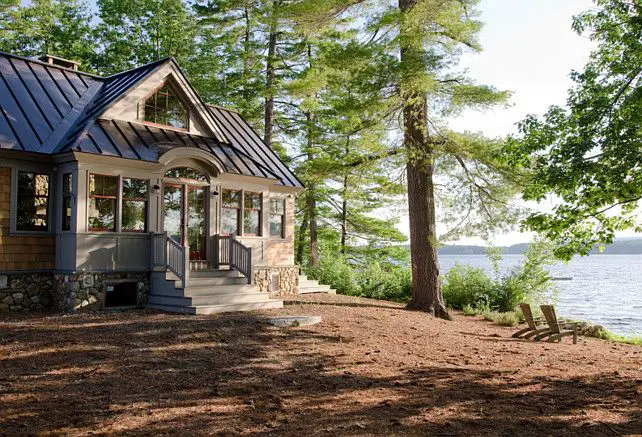
My grandfather’s lake house. The place he’d built with his own hands in 1967, the place where I’d spent every childhood summer, the place he’d left to me specifically in his will when he died three years ago. The one piece of stability I’d been holding onto through deployments and moves and the general chaos of military life.
Instead, my tires crunched over familiar gravel and I saw a moving truck backed up to my grandfather’s porch, its loading ramp extended like a tongue, swallowing everything I’d been coming home to.
Pine and cold wind hit me as I stepped out of my Jeep. October in New Hampshire: maple leaves skated across the driveway in small tornadoes, the smell of woodsmoke drifting from somewhere nearby. The lake beyond the house was that particular shade of gray that comes before winter, reflecting clouds that looked ready to drop snow.
Even the wooden sign at the gate—the one Grandpa had carved himself, “Bennett’s Landing” in his careful letters—was gone. Just empty posts where it used to hang.
Two movers carried out my grandfather’s rocking chair, the one he’d sat in every sunrise with his coffee and his binoculars, watching the loons. The chair where he’d taught me to tie fishing knots. The chair where he’d sat the summer I was seventeen and told me about his own military service in Vietnam, the only time he’d ever talked about it.
They carried it like it was any other piece of furniture instead of a relic, a sacred object, a physical repository of memory.
A woman in a real estate blazer pointed toward the boathouse, clipboard tucked under her arm, directing traffic like this was a normal Tuesday. A man about my dad’s age checked off items on a tablet, tracking inventory with the casual efficiency of someone who’d done this a hundred times.
“Excuse me,” I called, keeping my voice steady the way I’d learned to do when addressing subordinates or superiors or anyone in between. Level. Clear. Controlled. “What’s going on here?”
The woman turned with a bright, polite smile, the kind real estate agents perfect over years of pretending every transaction is delightful. “Hi there! Are you with the new owners?”
“I’m with this house,” I said, walking closer. “I’m Clara Bennett. This property is mine.”
The smile flickered. The man stepped forward, sensing conflict, probably wanting to de-escalate before it became a scene.
“Robert Peterson,” he said, extending his hand in that automatic way people do before they realize the other person isn’t going to shake it. “And this is Linda, my wife.” He glanced back at the truck, then at me again, reassessing. “There must be some confusion. We purchased the property three weeks ago. We just closed last Friday.”
My throat tightened. Three weeks ago I’d been in North Carolina, finishing my terminal leave, clearing post, preparing for this drive. Last Friday I’d been on the road, stopping overnight in Virginia, completely unaware that anything was wrong.
“Purchased it from who?” I asked, though some part of me already knew. Already felt the shape of the answer forming.
He hesitated, like he didn’t want to say it out loud, like he could sense this was going to be painful. “From Thomas and Margaret Bennett.”
For a beat, my lungs forgot what they were supposed to do.
Thomas and Margaret Bennett. My parents.
“Those are my parents,” I said, and my voice sounded strange to my own ears. Flat. Empty.
Linda’s expression shifted from polite confusion to genuine concern. “Oh. Oh no. We truly didn’t know there was… we had no idea there was a family situation. The realtor said everything was clear. That the sellers had full rights to the property.”
Robert opened a leather folder, the kind people use for important documents, and pulled out a stack of papers. “We have all the documentation. The title search, the deed transfer, everything. It’s all right here.” He tapped a page with a careful finger, apologetic but firm. “And… your signature is listed as a co-owner who consented to the sale.”
I took the papers, hands steady even when my stomach wasn’t. Years of training: maintain composure under pressure, gather information before reacting, assess the situation fully before making decisions.
I flipped through the pages—title insurance, purchase agreement, settlement statement showing a sale price of $425,000—until I found what I was looking for.
There it was. My name. Clara Marie Bennett. With a signature next to it.
Neat, confident, familiar in shape… and yet not familiar at all.
It didn’t look like the way I sign. My signature had changed over the years, evolved through military paperwork and official documents, developed a particular abbreviated quality. This signature was rounder, more careful, more like the way I used to write in high school.
It didn’t feel like me.
Behind them, another box came out of the cabin, taped and labeled in my mother’s handwriting: “Kitchen – Fragile.” As if my grandfather’s mornings and stories and the physical evidence of his entire life could be packed into cardboard and relocated to wherever my parents had decided to store them.
“I need a moment,” I said quietly, handing the folder back to Robert.
Not because I was confused. Not because I didn’t understand what had happened.
Because something inside me went very still—like a switch flipped from hoping to seeing, from giving them the benefit of the doubt to recognizing exactly what they’d done.
I slid my own folder back into my bag, stepped aside from the line of boxes and furniture being carried out of my grandfather’s house, and pulled out my phone.
My sister’s wedding schedule was already pinned on my screen. I’d gotten the detailed itinerary three months ago: a destination wedding in Charleston, South Carolina, scheduled for two weeks from now. Every day mapped out—rehearsal dinner, ceremony, reception, farewell brunch. The kind of wedding that appeared in magazines, that cost more than most people’s annual salary.
Madison’s wedding. The wedding my parents had been talking about nonstop for the past year. The wedding I’d politely declined to participate in after my mother made it clear my role would be minimal (“You understand, honey, Madison wants a specific aesthetic and the military uniform would just look out of place in the photos”).
And right then, a single name popped into my mind—the one person my parents never expected me to call. The one person who’d been cut out of family events and holidays for the past decade. The one person who’d see exactly what this was and would know exactly what to do.
Uncle Jack. My father’s older brother. The lawyer.
I walked back to my Jeep, far enough from the moving truck that the Petersons wouldn’t hear, and dialed.
He answered on the second ring. “Clara? Is that really you?”
“Hi, Uncle Jack. I need help.”
“What’s wrong?” His voice shifted immediately from surprised pleasure to professional concern.
“I just drove up to Grandpa’s lake house. The one he left me in his will. There are people moving furniture out. They say they bought it three weeks ago. From my parents. They have a deed transfer with my signature on it.”
Silence. Then, very quietly: “Those motherfuckers.”
“I didn’t sign anything,” I said. “I’ve been at Fort Bragg. I haven’t been back to New Hampshire since Grandpa’s funeral.”
“Stay right there,” Jack said. “Don’t leave the property. Don’t let them move anything else if you can help it. I’m two hours away but I’m getting in my car right now. And Clara? Take pictures of everything. The truck, the people, the documents, all of it.”
“Already on it,” I said, pulling up my camera.
“Of course you are,” he said, and I could hear the grim smile in his voice. “You’re Bill Bennett’s granddaughter. He’d be proud as hell of you right now. And absolutely furious at his son.”
After I hung up with Jack, I walked back to where the Petersons were supervising the move. They’d stopped loading, probably sensing that something was wrong, that this wasn’t a simple misunderstanding.
“Mr. Peterson, Mrs. Peterson,” I said. “I need to be very clear about something. I did not sign any documents authorizing the sale of this property. I’ve been in North Carolina for the past four months. That signature isn’t mine.”
Linda’s hand went to her mouth. “Oh god. You’re saying this is fraud?”
“I’m saying my attorney is on his way and we need to stop this move immediately. Nothing else leaves this property until we sort this out.”
Robert nodded slowly. “The realtor assured us—”
“I’m sure she did,” I said. “But the realtor was working with people who didn’t have the legal right to sell this house. My grandfather left it to me. Solely to me. Not to my parents. The deed should have been in my name only since his death three years ago.”
“Jesus,” Robert said. He turned to the movers. “Stop loading. Everything stays where it is. We need to—” He looked at his wife. “We need to call our lawyer too.”
For the next hour, we stood in an awkward triangle of tension while the movers sat in their truck and the furniture sat half-in, half-out of the house like a interrupted exhale. I took photos of everything—the documents, the truck, the items that had been removed. I called the local police non-emergency line and explained the situation. They sent an officer to take a report.
When Uncle Jack’s truck pulled into the driveway at 3:47 p.m., I felt something in my chest unclench slightly. He looked older than the last time I’d seen him—more gray in his hair, deeper lines around his eyes—but the same sharp intelligence in his expression, the same confidence in the way he moved.
He hugged me quickly, fiercely. “Let me see the documents.”
I handed him the folder. He read in silence for several minutes, his jaw getting tighter with each page.
“This is forged,” he said flatly. “I know Clara’s signature. This isn’t it. And more importantly, your parents had no legal authority to sell this property. Your grandfather’s will was explicit—the lake house goes to Clara Marie Bennett, free and clear, no co-ownership, no strings attached.”
He turned to the Petersons, his voice professional but sympathetic. “I’m sorry you got caught in the middle of this. But this sale is void. The sellers didn’t have legal ownership to transfer.”
Robert closed his eyes. “We paid $425,000. We sold our condo in Boston. We were planning to retire here.”
“You’ll get your money back,” Jack said. “This is fraud, which means your title insurance should cover it. But you need to contact your attorney immediately and you need to stop taking possession of anything from this property.”
The Petersons left an hour later, shell-shocked and furious. The movers unloaded everything back into the house—though nothing was in the right place anymore, everything jumbled and confused like the property itself had been shocked by the betrayal.
After they were gone, Jack and I stood on the porch looking out at the lake. The sun was setting, turning the water gold and orange, the same view my grandfather had loved.
“Tell me what happened,” Jack said.
So I did. I told him about the last three years—how after Grandpa died, my parents had offered to “handle the estate” while I was deployed. How I’d been grateful at the time because I was in Afghanistan and couldn’t exactly take leave for probate court. How they’d assured me everything was being taken care of, that the lake house would be maintained, that I shouldn’t worry about anything.
How I’d sent them money monthly for property taxes and maintenance. How they’d sent me photos occasionally of the house, assuring me everything was fine.
How I’d never questioned it because they were my parents and you’re supposed to be able to trust your parents.
“When did Madison’s wedding get planned?” Jack asked.
“About a year ago. She got engaged last November. The wedding is in two weeks. November 15th in Charleston.”
“And when did they start talking about money being tight?”
I thought about it. “Around February. Mom mentioned that the wedding costs were adding up. That Madison had expensive taste. That they were trying to help as much as they could but it was straining their finances.”
“Did they ask you for money?”
“Not directly. But there were hints. Comments about how hard it was being retired, how their savings weren’t going as far as they’d hoped. I sent them five thousand dollars in March to help with wedding costs.”
Jack made a sound somewhere between a laugh and a growl. “And then they turned around and sold a $425,000 property that wasn’t theirs to sell. Clara, I need to ask you something directly. Did your grandfather ever discuss the will with you?”
“Yes. A few months before he died. He told me he was leaving me the lake house. He said he knew I’d take care of it, that I understood what it meant. He said…” I had to stop, my voice catching. “He said some people see property as something to spend or sell, but I saw it as something to preserve. That I had his sense of stewardship.”
“Did he say anything about your parents?”
“He said he was leaving them other assets but not the lake house. I asked why and he just said they’d understand his reasoning.”
“They understood his reasoning,” Jack said. “They just didn’t like it. And now I’m guessing they’ve spent the past three years resenting you for it.”
We went inside. The house was chaos—furniture in wrong rooms, boxes stacked everywhere, the systematic dismantling of a life interrupted mid-process. But it was still standing. Still mine.
Jack started making calls. To his office, to other attorneys, to the county clerk’s office which was still open. I could hear him from the kitchen, his voice sharp and professional, using phrases like “fraudulent conveyance” and “forged signature” and “criminal charges.”
I walked through the house, touching things. Grandpa’s bookshelf, now tilted against the wrong wall. His fishing rods, bundled together like they were going somewhere. The kitchen table where we’d played cards during thunderstorms.
On the mantle, behind a box, I found a framed photo that the movers hadn’t reached yet. Me and Grandpa, taken the summer I was twelve. Both of us holding fish, grinning at the camera, the lake sparkling behind us.
My grandfather’s handwriting on the back: “Clara’s first bass. July 1998. She’s got the patience of a natural fisherman and the heart of a warrior. I’m proud to know her.”
I sat down on the floor, photo in my hands, and let myself feel it. All of it. The betrayal. The violation. The calculated cruelty of stealing something specifically because they knew what it meant to me.
My phone rang. My mother’s number.
I answered.
“Clara! Honey! We’ve been trying to reach you. Are you still planning to arrive on Thursday for the wedding rehearsal? Madison really wants you there even though you’re not in the wedding party.”
Her voice was bright. Cheerful. Completely normal.
Like she hadn’t just sold my house out from under me.
“I’m at the lake house,” I said.
A pause. Brief but noticeable. “Oh? Why?”
“Because I finished my transition out of the military and I drove up here to move in. To the house Grandpa left me. Except I found a moving truck and people who say they bought the property from you three weeks ago.”
Another pause. Longer this time.
“Clara, honey, we can explain—”
“Did you forge my signature on property transfer documents?”
“We didn’t forge anything. We… we had you sign some papers a few years ago. You probably don’t remember. You were home on leave and you signed a bunch of estate documents—”
“I never signed anything authorizing you to sell this house.”
“Well, technically, you gave us power of attorney—”
“I gave you limited POA for the specific purpose of handling Grandpa’s initial estate paperwork while I was deployed. That power of attorney expired three years ago and it explicitly excluded selling or transferring real property. I have a copy right here in front of me.”
Silence. I could hear her breathing, could imagine her face, could see the exact moment she realized I wasn’t going to let this go.
“Clara, we needed the money. Madison’s wedding—”
“Costs $150,000 according to the venue contract I found online,” I said. “And you sold a $425,000 house to pay for it. Where’s the other $275,000?”
“That’s not your concern—”
“It is absolutely my concern because you STOLE MY HOUSE.”
“Don’t you dare take that tone with me. We’re your parents. We’ve sacrificed everything for you and your sister—”
“You sacrificed my inheritance. Specifically. Deliberately. The one thing Grandpa wanted me to have.”
“Your grandfather was unfair in that will. He left almost everything to you and barely anything to your father. We were correcting an injustice—”
“By committing fraud.”
My father’s voice in the background: “Is that Clara? Give me the phone.”
Shuffling sounds. Then my father: “Clara, you need to calm down. Yes, we sold the property. We needed the funds and frankly, you weren’t using it. You’ve been in the military for years, never here, never maintaining it. We’ve been paying for upkeep—”
“With money I sent you every month specifically for that purpose.”
“The costs were more than you were sending. We were subsidizing—”
“You were stealing. And now you need to return the $425,000 to the buyers because this sale is void. Uncle Jack is here and he’s already filed paperwork with the court.”
“Jack?” My father’s voice went cold. “You called Jack? After everything—”
“After everything YOU did, yes, I called the family attorney. The one you’ve been excluding from holidays because he had the audacity to tell you that you were wrong about something ten years ago.”
“Clara, if you pursue this, you’re going to destroy this family.”
“You destroyed it when you forged my signature.”
“We’re giving you a choice right now. You can let this go, come to your sister’s wedding, and we can move forward. Or you can make this ugly and lose your family forever.”
I looked around the violated house, at my grandfather’s possessions in boxes, at the photo of us still in my hand.
“I’m making it ugly,” I said. “See you in court.”
I hung up.
Jack came out of the office, phone still pressed to his ear, but he was smiling grimly. “That was the county clerk. They’re pulling all the transfer documents. We’ll have preliminary evidence of forgery by Monday. I’m also filing an emergency injunction to freeze any funds from the sale that haven’t been spent yet.”
“They spent at least $150,000 on Madison’s wedding.”
“Then Madison’s wedding is going to get a lot less expensive,” Jack said. “Or it’s going to get cancelled entirely when the vendors find out the money’s frozen.”
Over the weekend, Jack and I worked to document everything. We pulled every piece of paperwork related to Grandpa’s estate. We found the original will—which clearly and explicitly left the lake house to me, with no co-ownership, no conditions, nothing that would give my parents any claim to it.
We found the limited power of attorney I’d signed while deployed—which explicitly stated it could not be used to sell real property and which had expired according to its own terms three years ago.
We found emails between my mother and the realtor, discussing listing prices and closing dates. Emails where my mother had forged responses from an email address that looked like mine but wasn’t—clara.m.bennett.army@gmail.com instead of my actual army email.
“They created a fake email account,” Jack said, staring at his laptop. “To impersonate you in communications with the realtor. That’s… that’s beyond regular fraud. That’s conspiracy.”
By Monday morning, we had enough evidence to file criminal complaints in addition to the civil suits. Jack filed everything: fraud, forgery, identity theft, theft by deception. He filed to void the sale. He filed for a restraining order preventing my parents from disposing of any assets until the case was resolved.
And then, just to be thorough, he filed a civil suit against them for the full value of the property plus damages and attorney fees.
The calls started almost immediately. My mother, crying, begging me to drop the charges. My father, furious, threatening to countersue for defamation. Madison, hysterical, screaming about how I was ruining her wedding.
I didn’t answer any of them.
On Tuesday, a process server delivered the legal documents to my parents at their home in Massachusetts. According to the server’s report, my father threw the documents on the ground and my mother had to be physically restrained from attacking the server.
On Wednesday, the court granted the emergency injunction. All funds from the house sale that were still in my parents’ accounts were immediately frozen.
Which apparently included the final payment to Madison’s wedding venue.
Madison called me seventeen times that day. I listened to exactly one voicemail:
“Clara, please, I’m begging you. I had nothing to do with what Mom and Dad did. I didn’t know about the house. But my wedding is in nine days and the venue is threatening to cancel because the final payment bounced. Please. I know you’re angry but don’t punish me for their mistakes. Please.”
I almost felt sorry for her. Almost.
But then I remembered the engagement party I hadn’t been invited to. The wedding party I’d been explicitly excluded from. The constant comments about how my military career was “fine” but not as important as Madison’s marketing job. The way my entire family had made it clear that I was secondary, auxiliary, someone who showed up but never quite belonged.
I didn’t call her back.
On Thursday, I got a call from a number I didn’t recognize. Against my better judgment, I answered.
“Ms. Bennett? This is Andrea Mills, I’m representing your parents. I’d like to discuss a settlement.”
“Talk to Jack,” I said.
“I have. He’s… he’s not being reasonable. His demands are excessive. Your parents made a mistake but they don’t deserve to lose everything—”
“They stole a $425,000 property. They committed fraud. They forged my signature. They impersonated me via email. Those aren’t mistakes. Those are crimes.”
“They’re willing to make restitution—”
“Full restitution is the return of my property and reimbursement of all legal costs. Plus I want a formal admission of guilt and a public apology. Non-negotiable.”
“Ms. Bennett, if we go to trial, this will be in the public record. Your parents will likely face criminal charges. Your father could lose his professional license. Your mother—”
“Should have thought about that before committing multiple felonies to fund my sister’s wedding.”
“You’re being vindictive—”
“I’m being appropriate. They committed crimes. There are consequences. That’s how the world works.”
I hung up.
Jack called an hour later, laughing. “Andrea Mills just called me again. She said you were ‘unreasonably hostile’ and ‘clearly not thinking clearly.’ I told her you were a decorated combat veteran with more clarity of thought than anyone I’ve ever met, and that if her clients had any sense they’d take whatever deal I was offering before I withdrew it.”
“What deal are you offering?”
“Full reimbursement to the buyers—$425,000 plus their relocation and legal costs. Public admission of fraud. Formal written apology to you. And they pay all your legal fees. In exchange, you won’t pursue criminal charges.”
“That’s generous.”
“It’s more than they deserve. But it gets you your house back without a trial, which could take years.”
On Friday—one week before Madison’s scheduled wedding—my parents agreed to the settlement.
They had to take out a massive loan to come up with the money. They had to sell their car and downsize their house. My father had to cash out part of his pension.
And Madison’s wedding was cancelled. Or rather, drastically reduced to a small ceremony in my parents’ backyard with about twenty guests instead of 200, with grocery store sheet cake instead of a five-tier custom creation, with a playlist instead of a band.
I didn’t attend.
On November 15th, the day that should have been Madison’s extravagant Charleston wedding, I was at the lake house with Uncle Jack, Aunt Sarah (who I’d also reconnected with), and a few veteran friends I’d served with. We had a bonfire on the beach. We roasted marshmallows and told stories and watched the stars come out over the lake.
“Your grandfather would be proud,” Jack said, handing me a beer.
“I keep thinking about what he said. About stewardship. About understanding what this place meant.”
“He knew,” Jack said. “He knew your parents would try to take it if they could. That’s why he was so specific in the will. He was trying to protect you.”
“He did protect me. Even after he was gone.”
We sat in silence for a while, watching the fire, listening to the lake lap against the shore.
“They’re telling everyone you’re the villain,” Sarah said quietly. “That you destroyed your family over money. That you’re cold and cruel and military service made you hard.”
“Let them,” I said. “The people whose opinions I care about know the truth.”
“Madison’s pretty devastated apparently.”
“Madison’s an adult who benefited from stolen money and is only upset because she got caught.”
“Fair point.”
My phone buzzed. A text from a number I’d blocked—my mother must have gotten a new phone.
“I hope you’re happy. You’ve destroyed your sister’s happiness, bankrupted your parents, and torn this family apart. I will never forgive you.”
I showed it to Jack. He snorted. “You should forward that to me. It’s good evidence that they haven’t actually accepted responsibility.”
“I’m just going to delete it,” I said. “And block the new number. I’m done giving them space in my head.”
Over the next few months, the story filtered through the extended family. Most of my relatives sided with me once they heard the full truth. My mother’s sister called to apologize for believing the initial narrative. My father’s cousins reached out to express support.
A few family members—the ones who’d always enabled my parents, who’d always made excuses for their behavior—cut me off entirely. I grieved those relationships briefly and then realized I was mostly relieved.
Madison sent me one letter, six months after the cancelled wedding. She’d apparently married her fiancé in a courthouse ceremony and was working on rebuilding her life. The letter was… not quite an apology, but an acknowledgment that she’d been caught up in something she didn’t fully understand and hadn’t asked the right questions.
I appreciated the attempt. I didn’t respond.
I stayed in the lake house. I renovated it slowly, carefully, restoring things my grandfather had built and updating things that needed updating. I got a job consulting for a defense contractor—remote work that let me stay here, in this place, in this peace.
I learned to fish again, relearning the patience my grandfather had taught me. I kayaked in the mornings. I hiked in the afternoons. I read on the porch in the evenings.
I built a life that felt like mine, in a place that was indisputably, legally, permanently mine.
And I learned something important: family isn’t just biology. It’s respect. It’s trust. It’s people who protect what you love instead of stealing it.
My parents chose to betray that trust. They chose to steal. They chose to commit crimes rather than respect my grandfather’s wishes and my inheritance.
And I chose to hold them accountable.
I don’t regret it. Not for a second.
Some people say I’m cold. That I’m unforgiving. That I destroyed my family over a house.
But it wasn’t just a house. It was a legacy. It was a trust. It was my grandfather saying “I see you, Clara, I know who you are, and I want you to have this piece of permanence in a life that’s been nothing but temporary.”
And it was my parents saying “we don’t care what your grandfather wanted, we don’t care what you’ve earned, we don’t care about your trust or your future—we care about what we want right now.”
So no, I don’t regret protecting what was mine.
I regret that protection was necessary. I regret that my parents put me in that position. I regret that they chose greed over integrity, theft over respect, their wants over my inheritance.
But I don’t regret standing up for myself.
My grandfather taught me stewardship. The military taught me courage. And my parents taught me that sometimes the people who are supposed to protect you are the ones you need protecting from.
I learned all those lessons.
And I’m still here, in this house, on this lake, in this peace I fought for.
That’s worth more than any family that would sell it.
THE END

Ethan Blake is a skilled Creative Content Specialist with a talent for crafting engaging and thought-provoking narratives. With a strong background in storytelling and digital content creation, Ethan brings a unique perspective to his role at TheArchivists, where he curates and produces captivating content for a global audience.
Ethan holds a degree in Communications from Zurich University, where he developed his expertise in storytelling, media strategy, and audience engagement. Known for his ability to blend creativity with analytical precision, he excels at creating content that not only entertains but also connects deeply with readers.
At TheArchivists, Ethan specializes in uncovering compelling stories that reflect a wide range of human experiences. His work is celebrated for its authenticity, creativity, and ability to spark meaningful conversations, earning him recognition among peers and readers alike.
Passionate about the art of storytelling, Ethan enjoys exploring themes of culture, history, and personal growth, aiming to inspire and inform with every piece he creates. Dedicated to making a lasting impact, Ethan continues to push boundaries in the ever-evolving world of digital content.