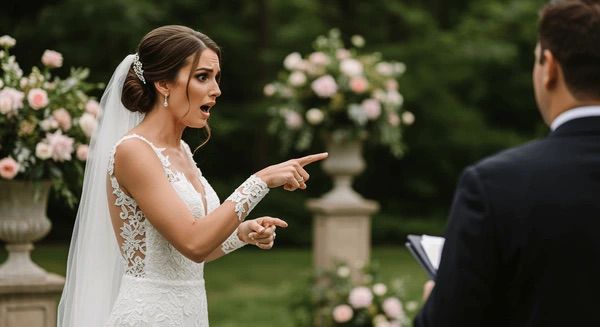
At My Son’s Wedding, I Walked Into the Reception and Froze. My Reserved Seat—Right Next to Him—Had Been Replaced with a Trash Can.
My name is Linda Parker, and on the day of my only son’s wedding, I was supposed to sit beside him in the front row, smiling through tears of joy and pride. I’d imagined this day since Jason was a little boy playing with toy cars in our cramped living room. I’d pictured myself in a beautiful dress—nothing too expensive, but nice—watching him promise forever to someone who loved him as much as I did.
Instead, when I walked into the reception hall of the Oakmont Country Club, carrying the clutch purse I’d saved three months to buy, wearing the dress I’d picked out specifically because Madison had told me not to “dress too cheap,” I froze in the doorway.
My seat, the one with a little ivory card that had said Mother of the Groom in elegant gold script when I’d checked during the rehearsal dinner, had been replaced with a silver trash can.
There it was, shining under the string of fairy lights that cost $800 and that I’d helped pay for when the venue demanded payment up front. Right where my chair should have been, right next to where Jason would sit with his new bride, was a gleaming metal garbage bin with a white bow tied around it.
Laughter rippled through the room like a wave. Actual laughter, not nervous titters but full-throated amusement. Phones came out. I watched in slow motion as at least a dozen people pulled out their cell phones and started recording, angling for the best shot of my humiliation.
Someone actually started a video, pointing the camera at me and then panning to the trash can, narrating in a whisper: “Oh my God, they replaced the mother-in-law’s seat with a trash can. This is savage.”
Madison—my new daughter-in-law, married to my son for all of forty-five minutes—twirled in her lace mermaid gown that had cost $4,200 and that I’d contributed $600 toward when her parents claimed they were “tapped out” after paying for the venue. She looked at me and smirked, her professionally made-up face glowing in the soft lighting, her eyes glittering with something that looked an awful lot like triumph.
“Oh, come on, Linda,” she said, and her voice was loud enough for everyone to hear, projected like she was on a stage. “It’s just a joke. Don’t be so dramatic. You’re always so sensitive about everything.”
Her bridesmaids—five women I’d never met before the engagement party, all wearing identical rose-colored dresses that cost $300 each—snickered behind their hands. One of them whispered something to the others and they laughed harder, not even trying to hide it.
Jason, my son, my only child, the boy I’d raised alone after his father walked out when he was three, glanced over from where he stood near the head table. He had an uncertain smile on his face, like he wasn’t sure if he should laugh or intervene, like he was caught between his new wife’s expectations and whatever vestigial loyalty he still felt toward his mother.
He chose uncertainty. He chose to do nothing. He just stood there, looking uncomfortable but not uncomfortable enough to actually say something, to tell his bride that this had gone too far, to remove the trash can and demand my proper seat be returned.
His new in-laws—Madison’s parents, both real estate agents who’d spent the entire engagement talking about their vacation home in Hilton Head and their timeshare in Cabo—shook their heads with amused expressions, as if humiliating the groom’s mother was top-tier comedy, as if this was the kind of wedding prank that would be fondly remembered for years.
My face burned. I felt the heat spreading from my chest up my neck, felt my cheeks flaming red, felt the weight of two hundred pairs of eyes watching me, waiting to see what I would do, how I would react to being publicly degraded at my own son’s wedding.
I had worked double shifts at the diner to help pay for this wedding when Jason and Madison were short on cash. I’d picked up every extra shift Dottie would give me, worked through my days off, stood on my feet for twelve hours at a time serving pancakes and coffee to truck drivers and families, my lower back screaming, my ankles swelling in my non-slip shoes.
I’d bought the flowers when the florist demanded a bigger deposit two weeks before the wedding and Madison had called me crying, saying the whole thing was going to be ruined because they didn’t have the extra $800. I’d put it on my credit card, the one I’d almost paid off, and told her not to worry about it.
I’d even paid the final bill for the photographer—$1,200 that Jason had promised to have but didn’t when the day came—because Madison had been in tears again, saying all the photos would be ruined if they didn’t have the professional she’d been planning on for months.
All together, I’d put nearly $5,000 into this wedding. Five thousand dollars I didn’t have, on a salary of $32,000 a year, because my son had asked and I couldn’t say no to my son.
Yet here I was, standing in the doorway of the reception hall, staring at a trash can with a white bow where my seat should have been. The punchline to a joke I hadn’t known I was part of.
A guest at a nearby table whispered—not quietly enough—”Guess we know what they think of her.”
Another voice, male, amused: “Trash belongs with trash, I guess.”
I felt the words like slaps, each one landing harder than the last.
I could’ve swallowed it. God knows I’d swallowed a lot since Madison came into Jason’s life eighteen months ago. I’d swallowed her snide comments about my job, about how it must be “nice to have such a simple life” and how she “couldn’t imagine just serving food for a living.” I’d swallowed her insistence that I “not dress too cheap” at the wedding, her suggestions that maybe I should do something about my hair, her hints that perhaps I should lose a few pounds before the photos.
I’d swallowed her eye rolls whenever I picked up my grandson, Liam, from daycare on the days I had off. My grandson, the four-year-old boy who called me Nana and who drew me pictures and who was the light of my life.
The boy who, according to the papers in my purse, wasn’t my grandson at all.
My hands were shaking as I stood there, and it wasn’t just from the humiliation, wasn’t just from the laughter still echoing through the room, wasn’t just from watching my son choose his bride’s cruel joke over his mother’s dignity.
It was the white envelope in my purse. The one I’d been carrying around for three weeks, ever since the results came back. The one I’d been trying to figure out how to handle, when to tell Jason, how to break his heart as gently as possible.
I hadn’t planned to do this. I’d told myself I’d wait, talk to Jason privately after the honeymoon, find a way to tell him that the child he’d been raising for four years, the boy he’d named after his grandfather, the son he’d fought for custody of when he and Madison briefly broke up two years ago—that boy wasn’t biologically his.
But as Madison posed for pictures next to that trash can, draping herself over it like it was a prop in a comedy sketch, wrapping her arm around my son’s neck and pulling him in for a kiss while people laughed and took photos, something inside me snapped.
Not broke. Broke would suggest damage, something unintentional.
This was deliberate. This was a decision. This was me choosing, finally, after years of swallowing and accommodating and making myself smaller, to stop protecting people who didn’t protect me.
I stepped forward, my heels clicking on the polished hardwood floor of the country club, each step measured and deliberate. I reached into my clutch and pulled out the white envelope, the one from Ancestry DNA Labs, the one with results that had been eating at me for twenty-one days.
The band, which had been playing some jazzy version of a pop song, quieted. The saxophone player actually stopped mid-note, the sound dying awkwardly. People turned, sensing something was about to happen, that shift in energy that occurs right before a bomb goes off.
“They think I’m a joke,” I said, and my voice was surprisingly steady, surprisingly calm, surprisingly clear. Not the voice of someone who’d just been humiliated, but the voice of someone who’d just made a decision and was going to see it through.
I tore the envelope open, the sound of paper ripping loud in the suddenly quiet room, and lifted the papers high enough for people at nearby tables to see the official letterhead.
“So let’s see who’s really funny tonight,” I said, looking straight at Madison, meeting her eyes, watching her expression shift from smug amusement to confusion to the first flickers of concern.
“They stopped laughing when I stood up, lifted the DNA test results, and said, ‘Then let’s see who’s really a joke… starting with your “son.”‘”
The room went silent. Not the polite quiet of people listening to a toast, but the shocked silence of people who’ve just witnessed a car crash, who can’t quite process what they’re seeing, who are frozen between horror and fascination.
Madison’s face went white. Actually white, the color draining so fast I thought she might faint. Her hand, which had been resting on Jason’s shoulder, dropped to her side.
Jason looked at me like I’d just started speaking a foreign language. “Mom, what are you—”
“I’m talking about Liam,” I said, still holding the papers up. “The boy you think is your son. The boy Madison told you was yours when she got pregnant four years ago, right after that weekend you two spent in Savannah. The boy you’ve been raising and loving and paying child support for.”
I looked down at the papers, though I’d memorized the key section weeks ago: Probability of Paternity: 0%. Jason Parker is excluded as the biological father of Liam Parker.
“According to Ancestry DNA Labs, there is a zero percent chance that Jason is Liam’s biological father,” I said, my voice carrying through the silent room. “Zero. Percent.”
Someone gasped. Actually gasped, like we were in a soap opera.
Madison started shaking her head, her professionally styled hair swinging. “That’s not—you had no right—how did you even—”
“I had every right,” I said. “I’m his grandmother. Or at least, I thought I was. You remember that ancestry kit I gave Liam for his birthday? The one you said was such a sweet idea? The one where we could find out about his heritage, see if he had any genetic health risks?”
I watched the memory click into place on her face. Three months ago, Liam’s fourth birthday. I’d given him the kit because Madison had been going on and on about wanting to know Liam’s “genetic background” for health reasons. I’d thought I was being helpful.
“I swabbed his cheek like the instructions said. And then, because I’m a curious grandmother, I decided to do one too. To see if we shared any genetic markers, to see what traits he might have gotten from our side of the family.”
I pulled out the second page of the report, the one that showed the relationship analysis.
“According to this, Liam and I share zero DNA. Not the 25% we should share if he were my biological grandson. Zero. Which means he’s not Jason’s son.”
Jason was staring at Madison now, his face cycling through emotions too fast to track. Confusion. Disbelief. The beginning of understanding. The start of betrayal.
“Maddie?” His voice cracked on her nickname. “Is this true?”
Madison’s mouth opened and closed. Her bridesmaids had gone silent, no longer snickering. Her parents had stood up from their table, her father’s face red, her mother’s hand pressed to her chest.
“I—it’s not what it looks like,” Madison stammered. “Linda is trying to ruin our wedding. She’s always hated me, always tried to come between us—”
“Is Liam my son?” Jason’s voice was louder now, harder. “Yes or no, Madison. Is he mine?”
The silence stretched. Every person in that room was leaning forward, waiting.
“Biology isn’t everything,” Madison finally said, and her voice had changed, had gone from defensive to pleading. “You love him. He loves you. You’re his father in every way that matters. Who cares about some stupid DNA test?”
“I care!” Jason shouted, and I watched my son’s face crumble, watched twenty-four years of him holding himself together start to fracture. “I care that you lied to me! I care that I’ve been raising another man’s child thinking he was mine! Who, Madison? Who’s the father?”
Madison’s face twisted, and for a second I almost felt sorry for her. Almost.
“It was one time,” she whispered. “That weekend in Savannah. You and I had that fight, remember? You said you needed space. I went to a bar, I met someone, it was a mistake—”
“You’ve been lying to me for four years,” Jason said, his voice hollow now, all the anger draining into something worse. Grief. “Four years, Madison. We got back together because you were pregnant. I proposed because you were having my baby. I fought for custody. I pay child support. I rearranged my entire life because I thought I was a father.”
“You are a father!” Madison was crying now, mascara running, her perfect makeup ruined. “Liam calls you Daddy! He loves you! That makes you his father!”
“Based on a lie,” Jason said quietly.
He turned to me, and I saw my son looking at me the way he used to when he was little and something scared him, when he needed me to fix it, to make it better, to tell him everything would be okay.
“You knew,” he said. “For three weeks, you knew.”
“Yes,” I said. “I didn’t know how to tell you. I didn’t want to hurt you. I was trying to figure out the right time, the right way—”
“But you chose my wedding,” he said, and there was something in his voice I couldn’t read. Not quite accusation. Not quite gratitude. Something in between.
“I chose the moment where your wife humiliated me in front of two hundred people,” I said. “I chose the moment where I realized I was done protecting people who don’t protect me. I’m sorry, Jason. I’m sorry you had to find out this way. But I’m not sorry for telling you the truth.”
The wedding coordinator—a stressed-looking woman in a black suit who’d been hovering near the kitchen doors—approached cautiously.
“Should we… should I tell the caterers to hold dinner?” she asked.
No one answered her.
Jason was still staring at Madison, who was sobbing now, her bridesmaids trying to comfort her while simultaneously backing away like her situation might be contagious.
“I need to sit down,” Jason said finally.
He walked to the head table, but instead of sitting in his designated seat next to his bride, he walked to where the trash can stood. He picked it up—bow and all—carried it to the side of the room, and set it down by the wall.
Then he took my proper seat—the chair that had been removed and replaced with garbage—from where it had been stashed behind a decorative screen, and placed it back where it belonged.
“Mom,” he said quietly. “Sit down.”
I walked over on shaking legs and sat in my chair, the Mother of the Groom chair, the place I’d earned, the place I’d always deserved.
Jason sat next to me. Not next to Madison. Next to me.
The room was so quiet I could hear my own breathing.
“I need you to tell me everything,” Jason said, looking at the DNA results I’d set on the table between us. “From the beginning. When you got suspicious, why you tested, all of it.”
So I told him.
I told him about how, three months ago, I’d given Liam the ancestry kit for his birthday, genuinely thinking it would be fun, educational, something Madison had specifically said she wanted to do. I told him about swabbing Liam’s cheek and then deciding to do my own test, excited about the idea of seeing our shared genetic heritage.
I told him about the results coming back, about sitting in my tiny apartment staring at my computer screen, reading and rereading the words: No shared DNA detected. Relationship to Liam Parker: None.
I told him about doing a second test with a different company, thinking there must have been a mistake, some kind of sample contamination. About getting the same results.
I told him about the sleepless nights, the way I’d stared at Liam during our daycare pickups, looking for any resemblance to Jason, trying to convince myself the tests were wrong.
“But he doesn’t look like you,” I said quietly. “He never did. I told myself it was because he looked like Madison, but Jason, he doesn’t look like her either. He has dark hair when you’re both blond. He has brown eyes when you both have blue. I dismissed it because genetics are complicated, but now…”
Jason nodded slowly, processing.
“The timeline,” he said. “We broke up for two weeks in March, four years ago. When we got back together, she told me she was pregnant a month later.”
“The fight in Savannah,” I said.
“We fought because I caught her texting someone,” Jason said, the memory clearly coming back to him. “She said it was just a friend, that I was being paranoid and controlling. We broke up. Then two weeks later she called crying, said she’d made a terrible mistake, that she loved me. We got back together. A month after that, she told me she was pregnant and that it happened the weekend in Savannah, before we broke up.”
He laughed, but there was no humor in it. “She played me. She knew exactly when it happened, knew it wasn’t mine, and she played me.”
Madison had been standing near the head table, her mother’s arm around her shoulders. She stepped forward now, her face blotchy from crying.
“Jason, please,” she said. “Let me explain properly. Not here. Not like this. Come outside, we can talk—”
“No,” Jason said flatly. “We’re done talking. We’re done with everything.”
“We just got married!” Madison’s voice pitched up into something close to hysteria. “You can’t just—it’s not legal to—you can’t get divorced on your wedding day!”
“Watch me,” Jason said. “I’ll have the papers filed on Monday. And Madison? I’ll be filing for custody of Liam too.”
“What?” Madison’s face went white again. “You just found out he’s not yours! You can’t—”
“I’ve been his father for four years,” Jason said, and his voice broke on the words. “I’ve been there for every nightmare, every doctor’s appointment, every scraped knee. I’ve taught him to ride a bike and helped him learn to read and held him when he cried. That doesn’t stop being true just because we don’t share DNA.”
He stood up, looking at Madison with an expression I’d never seen on my son’s face before. Cold. Decided. Final.
“But you’re done using him as a meal ticket. You’re done lying about who his father is. And you’re done humiliating my mother.”
He turned to the room at large, to the two hundred guests who’d been watching this unfold like it was theater they’d paid admission for.
“I’m sorry you all came here for a wedding,” he said. “There isn’t going to be one. Not anymore. Please, enjoy the food and the open bar. It’s all paid for.”
He looked at me. “Mom, can we go?”
I stood up, picked up my clutch and the DNA results, and walked out of the Oakmont Country Club with my son.
Behind us, the room erupted into noise—gasps and exclamations and the immediate buzz of people pulling out phones to text and call and share what they’d just witnessed. I heard Madison sobbing, heard her mother’s voice raised in anger, heard her father demanding to know what was going to happen to all the gifts.
But I didn’t turn around.
Jason and I walked through the elegant lobby, past the shocked-looking desk staff, out into the parking lot where the evening sun was setting over manicured golf courses and reflecting off expensive cars.
“Your apartment or mine?” I asked.
“Yours,” Jason said. “I don’t want to go back to the place I shared with her right now.”
We drove in silence to my small apartment in the older part of town, the one-bedroom place I’d lived in for twelve years because I couldn’t afford anything bigger on a diner salary. Jason followed me in his car—he’d driven himself to the wedding in the morning—and we both trudged up the stairs like we’d aged forty years in the last two hours.
I made coffee. Strong, black coffee that neither of us really wanted but that gave us something to do with our hands.
Jason sat at my small kitchen table—the same table where he’d done his homework as a teenager, where we’d had so many dinners together, where I’d taught him to play cards and helped him fill out college applications—and put his head in his hands.
“I’m such an idiot,” he said.
“No,” I said firmly. “You were lied to. That’s not the same thing.”
“I should have known. The way she always got weird when I talked about Liam’s features, how she’d change the subject whenever I mentioned genetics or heredity. The way she insisted on being the one to take him to all his doctor’s appointments, like she didn’t want me seeing his medical records.”
“She was careful,” I said. “She knew what she was doing.”
“Four years,” Jason said, and his voice cracked. “Four years of my life based on a lie. Do you know how many decisions I made because I thought I was a father? I turned down a job in Seattle because I didn’t want to be that far from my son. I stayed in a relationship that wasn’t working because I thought Liam needed both parents. I gave her money every month. I rearranged my entire life.”
He looked up at me with red-rimmed eyes.
“And the worst part? I love him. I love Liam so much it hurts. He’s not mine, but I love him anyway. What kind of mess does that make me?”
“It makes you a good man,” I said quietly. “It makes you someone who loves a child not because of biology but because of connection. That’s not a mess, Jason. That’s being a real father.”
“But I can’t—” His voice broke completely. “I can’t keep seeing him and pretend everything’s fine. Every time I look at him now, I’ll know. I’ll know he’s not mine. I’ll wonder who his real father is. I’ll wonder if Liam will grow up looking like some stranger I’ve never met.”
“So you fight for custody anyway,” I said. “You fight for him legally, as his adoptive father or through some other legal avenue. You don’t let Madison use this to take him away from you. Because you’re right—you’ve been his father for four years. That matters. That counts.”
Jason was quiet for a long time, staring into his coffee.
“She put you next to a trash can,” he said finally. “At my wedding. She humiliated you in front of everyone, and I just stood there.”
“You didn’t know what to do,” I said.
“I should have known. I should have immediately told her to stop, gotten your proper seat, stood up for you. Instead I just…” He gestured helplessly. “I’ve been a terrible son.”
“You’ve been a son in a difficult position,” I said. “Caught between your mother and your wife. It’s hard to navigate. But Jason, the trash can? That was Madison showing you exactly who she is. Believe her.”
He nodded slowly.
“I’m filing for divorce Monday,” he said. “And I’m calling a family lawyer about Liam. I don’t care what the DNA says—he’s my son in every way that matters. I’m not letting her take him away from me just because she lied about who his father is.”
“Good,” I said.
“And Mom?” He looked at me, really looked at me for the first time in months. “I’m sorry. For everything. For not standing up for you, for letting Madison treat you badly, for taking you for granted. You’ve sacrificed so much for me, and I’ve been treating you like you don’t matter.”
“You matter to me,” I said. “You always have. Even when you make mistakes. Even when you don’t stand up for me. You’re my son. That doesn’t change.”
“I want to be better,” he said. “I want to be the kind of man who protects his mother, not the kind who watches her get humiliated and does nothing.”
“Then be better,” I said simply. “Starting now.”
We sat in my small kitchen drinking coffee until it got dark, talking about next steps, about lawyers and DNA tests and custody arrangements and the mess that his life had become.
At some point, Jason’s phone started buzzing—texts and calls from Madison, from her parents, from friends who’d been at the wedding. He turned it off without reading them.
“I’ll deal with it tomorrow,” he said. “Tonight I just want to sit with my mom and pretend the world makes sense.”
So that’s what we did.
In the weeks that followed, the story spread through our small social circle like wildfire. The wedding that ended before it began. The DNA test reveal. The trash can. People took sides—some saying I’d been cruel to expose Madison that way, others saying she’d deserved it, still others saying the whole thing was a mess that could have been handled privately.
I didn’t care what they said.
Jason filed for divorce on Monday morning. Madison contested it, of course, claiming he couldn’t just annul a marriage over something that happened before they were married, that he’d known about Liam the whole time.
But Jason’s lawyer was good. They argued fraud, misrepresentation, that the entire basis of the marriage—Jason believing Liam was his biological son—was a lie that Madison had perpetrated for four years.
The divorce was granted three months later.
The custody battle for Liam was harder. Madison fought tooth and nail, claiming that since Jason wasn’t the biological father, he had no legal right to custody. But Jason had been listed on Liam’s birth certificate. He’d been acting as the father for four years. And when the judge asked Liam—in a private session, age-appropriately—who his daddy was, Liam said “Jason” without hesitation.
Jason got joint custody. Not as much as he wanted, but enough. Enough to still be Liam’s father in the ways that counted.
I got to keep being Nana, even though genetically I wasn’t. Because love, it turns out, doesn’t always follow bloodlines.
Six months after the wedding that wasn’t, Jason came over for dinner. He’d lost weight, looked tired, but there was something different in his eyes. Something clearer.
“I’ve been thinking,” he said over the pot roast I’d made—his favorite. “About that trash can.”
“What about it?”
“Madison meant it to humiliate you. To put you in your place, to show everyone that you didn’t matter. But instead, it backfired completely. It showed everyone exactly who she was. It gave you the perfect moment to reveal the truth. In a weird way, that trash can was the best thing that could have happened.”
I thought about it. About standing in that reception hall, feeling the weight of humiliation, making the split-second decision to stop protecting people who didn’t protect me.
“I guess that’s true,” I said.
“You could have told me privately,” Jason said. “About the DNA test. You could have pulled me aside before the wedding, saved me from marrying her, handled it quietly.”
“Yes,” I agreed. “I could have.”
“Why didn’t you?”
I set down my fork and looked at my son.
“Because you needed to see it,” I said. “You needed to see what she was capable of. If I’d told you privately, she would have spun some story, convinced you I was lying, driven a wedge between us. But seeing her replace my seat with a trash can, seeing her laugh while people mocked me, seeing her show exactly who she was? That was a gift. A terrible, humiliating gift, but a gift nonetheless.”
Jason nodded slowly.
“She’s trying to get back together,” he said. “She sends me messages saying she’s changed, that she understands she made mistakes, that we could work it out.”
“What do you say?”
“I block the numbers,” he said simply. “Every time. Because you were right—when someone shows you who they are, believe them. And she showed me exactly who she is.”
We finished dinner. Jason helped me wash dishes, standing at my sink in my tiny kitchen, just like he used to when he was a kid and it was his assigned chore.
“I love you, Mom,” he said as he was leaving. “Thank you for loving me enough to tell me the truth, even when it hurt.”
“I love you too,” I said. “Always have. Always will.”
As I watched him drive away, I thought about that trash can. About the moment that was supposed to break me but instead freed me. About the humiliation that turned into liberation.
Sometimes the worst moments of our lives are also the most necessary.
Sometimes being treated like trash is exactly what we need to remember that we’re not.
And sometimes, the best revenge isn’t calculated or planned.
It’s just the truth, spoken clearly, at exactly the right moment.
THE END

Adrian Hawthorne is a celebrated author and dedicated archivist who finds inspiration in the hidden stories of the past. Educated at Oxford, he now works at the National Archives, where preserving history fuels his evocative writing. Balancing archival precision with creative storytelling, Adrian founded the Hawthorne Institute of Literary Arts to mentor emerging writers and honor the timeless art of narrative.