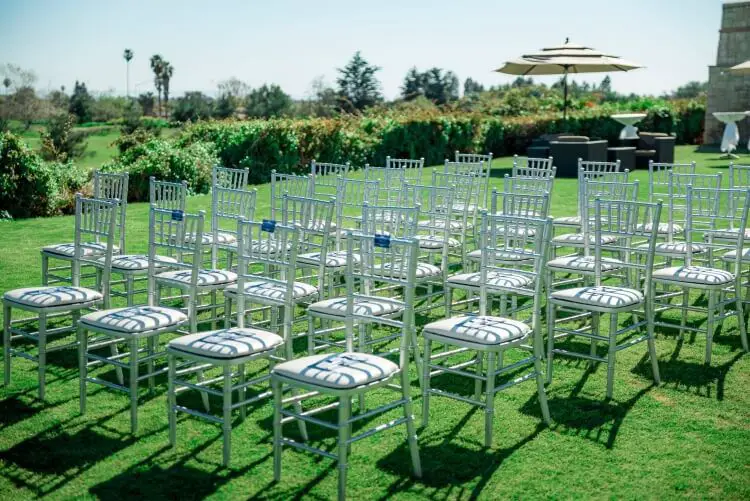
Row Fourteen
The estate sat outside Chicago, one of those North Shore properties where old money whispers instead of shouts, where manicured lawns stretch for acres and iron gates make you feel like you should apologize for breathing too loud. The kind of place I’d seen in magazines but never imagined I’d actually visit, let alone for my own son’s wedding. White chairs arranged in perfect rows. White roses climbing architectural trellises. A string quartet playing something classical and expensive-sounding that floated over trimmed boxwood hedges like auditory proof of refinement.
I arrived early anyway—forty-five minutes before the ceremony was scheduled to begin—because that’s what I do. I’m early to everything, a habit formed over decades of single motherhood when being late meant disappointing a child who was already watching the door, already wondering if this would be another time Mom didn’t show up. My dress was pressed, navy blue with a modest neckline because I’d been told the wedding was formal and I didn’t want to embarrass anyone by underdressing. My shoulders were squared in that particular way I’d learned to hold myself when I needed to look more confident than I felt, the posture of someone who’d survived parent-teacher conferences and hostile landlords and medical bills that couldn’t possibly be right.
In my cul-de-sac back in Aurora—the small suburb where I’d raised my son in a two-bedroom ranch house with vinyl siding and a chain-link fence—the HOA mailbox is where neighbors trade flyers about block parties and exchange smiles that actually mean something. Here, at this estate with its valet line and security checkpoint, the smiles didn’t reach anyone’s eyes. They were the kind of smiles wealthy people perfect for photographs, all teeth and no warmth, the social equivalent of a firm handshake that establishes hierarchy while maintaining plausible deniability.
My name is Margaret Lawson. I’m sixty-one years old. I worked as an administrative assistant at a manufacturing company for thirty-seven years, the kind of job where you show up at seven-thirty and leave at five and your retirement party gets exactly forty-five minutes before people need to get back to actual work. I raised my son Daniel alone after his father left when Daniel was three, walked out one Tuesday morning for cigarettes and never came back, leaving me with a toddler and a rent payment I couldn’t make on my own.
I worked overtime. I skipped meals so Daniel could have seconds. I bought clothes at Goodwill and pretended they were new. I helped with homework at kitchen tables covered in bills I was afraid to open. I attended every parent-teacher conference, every school concert, every soccer game, sitting in bleachers with other parents who had partners and newer cars and the kind of financial cushion that meant unexpected expenses were inconveniences rather than catastrophes.
And I got him through. High school with decent grades. College on scholarships and student loans and work-study programs. Business school, where he met people whose families had vacation homes and investment portfolios and the kind of casual wealth that Daniel started adopting like a second language.
Then he met Vanessa.
Vanessa Hartwell, whose family owned the kind of businesses that show up in the business section of the Tribune, whose mother sat on charity boards and whose father played golf with people who made decisions that affected entire industries. Vanessa, who was beautiful and polished and had never in her life worried about whether the electricity would stay on through the end of the month.
Daniel had warned me, in his way, that this wedding would be different from what I was used to. “It’s going to be formal, Mom. Like, really formal. Vanessa’s family is… they’re particular about these things. Just, you know, follow the lead of the other guests. Don’t try to talk to everyone. Let the event flow naturally.”
Translation: Don’t embarrass me. Don’t remind anyone that I came from a two-bedroom ranch house in Aurora instead of whatever gilded childhood Vanessa’s family assumes I provided.
I’d swallowed that conversation the way I’d swallowed a thousand small humiliations over the years, telling myself it was just wedding stress, that Daniel was nervous, that every groom wants everything to be perfect. But standing in this estate garden, watching other guests arrive in designer clothes and expensive jewelry, being directed to seats near the front by coordinators with headsets and clipboards, I felt the familiar weight of not belonging settling over my shoulders like a coat I couldn’t take off.
My son found me near the garden arch where the ceremony would take place. He was in a tuxedo that probably cost more than my monthly mortgage payment, his hair perfectly styled, his posture carrying that new confidence he’d developed since moving in Vanessa’s circles—the confidence of someone who’d learned to belong in spaces like this.
“Mom.” He hugged me, but it was fast—too fast, the kind of hug you give someone at a networking event when you need to keep moving. His suit fit like it had been custom-made for a body that had been shaped by personal trainers rather than the youth soccer leagues I’d scrimped to pay for. When I tried to hold his gaze, to really look at him and maybe see some trace of the boy I’d raised, he looked past me, scanning the crowd like he was already trying to outrun this moment.
“You look beautiful,” I said, because he did. My son, all grown up, about to marry into a family that had the kind of money and status I’d only ever seen on television.
“Thanks. You too. That dress is… nice.” Nice. The word landed like a stone. Not beautiful, not elegant, just nice. The kind of compliment you give when you can’t think of a real one.
Then Vanessa appeared, gliding across the lawn with her bridesmaids trailing behind her like elegant ducklings. Her dress was probably more expensive than my car. Her makeup was flawless. Her smile was radiant and completely empty of anything resembling genuine warmth.
She took my hands in hers like we were close, like we’d spent years building a relationship instead of having exactly four awkward dinners where I’d tried to find common ground and failed. She leaned in close—close enough that I could smell her perfume, something French and expensive—and she whispered with a smile that never moved from her perfectly lipsticked mouth:
“Please… don’t make us look bad today.”
Not “welcome,” not “thank you for coming,” not “I’m so glad you could be here.” Just a warning dressed in politeness, delivered with the kind of smile that said she expected compliance and wouldn’t tolerate anything less.
Before I could respond—before I could even process what she’d just said—a coordinator materialized beside us, a young woman with a headset and a clipboard and the efficient manner of someone trained to manage situations without making them look managed.
“Mrs. Lawson? Let me show you to your seat.” Her eyes flicked over me quickly, cataloging and dismissing in the same glance. Not family, not important, just another body that needed to be positioned correctly for photographs.
She pointed down the aisle with a pen, not looking at me, already moving to her next task. “Row fourteen. Right beside the service area.”
Row fourteen.
The words hung in the air like an accusation. Not “a few rows back” or “on the groom’s side” or any of the normal descriptions of wedding seating. Row fourteen. A number so specific it had to be deliberate. And beside the service area—the place where staff moved in and out, where the mechanics of the event were barely concealed behind curtains and flower arrangements.
I looked down the aisle. Vanessa’s family occupied the first three rows—women in designer suits and statement jewelry, men in custom tuxedos, the kind of people who looked like they belonged in spaces like this because they’d been attending events like this their entire lives. The next several rows held what I assumed were important friends, business associates, people who mattered enough to sit close but not close enough to be family.
And then, far in the back, past the photographers and floral arrangers and the subtle but unmistakable boundary between important and incidental, was row fourteen.
I could see it from where I stood—the last row before the service corridor, the seats that would have an obstructed view of the ceremony because they were positioned beside the opening where staff moved in and out with covered carts and equipment. I saw the metal flash when the curtain moved. I heard the soft clink of china, the quiet efficiency of people trained to be invisible.
And apparently, I was supposed to be invisible too.
I looked toward the front of the ceremony space. My son stood there in perfect light, positioned precisely where the photographer had told him to stand, surrounded by his groomsmen who all looked like they’d stepped out of a catalog. He didn’t turn around. Not once. He didn’t even try to pretend he hadn’t seen where they were placing me. He knew. He’d probably agreed to it. Maybe even suggested it.
Row fourteen. Not family. Not honored guest. Just the inconvenient reminder of a past he’d worked very hard to rewrite.
So I did what I’ve done my whole life when faced with situations that couldn’t be changed: I swallowed the hurt and walked.
I kept my chin up all the way to row fourteen because the only thing worse than being pushed to the margins is letting the people who put you there watch you crumble. I walked past the important guests who glanced at me with mild curiosity, past the coordinator who was already focused on her clipboard, past my son who was very carefully not looking in my direction.
I sat down in row fourteen, beside the service corridor where I could hear the soft voices of caterers coordinating timing and logistics. I folded my hands in my lap like I belonged anywhere I chose to sit, like this was exactly where I wanted to be, like I hadn’t just been publicly relegated to the status of an embarrassing obligation.
The whispers found me anyway.
“Is that… his mother?”
“Why is she back there?”
“I heard she’s… you know… not really from their world.”
I stared straight ahead, focusing on the arch covered in white roses, telling myself I could get through one ceremony without asking for anything I clearly wasn’t meant to have. One ceremony. A few hours. Then I could go home to my two-bedroom ranch house with its vinyl siding and chain-link fence and never have to feel this particular flavor of humiliation again.
Then the chair beside me moved.
A man sat down—older, maybe late sixties, with silver hair and a black suit that fit with the kind of perfection that suggested either great expense or military precision. He had the bearing of someone important, the kind of calm authority that makes other people unconsciously adjust their posture. He didn’t look lost. He didn’t scan the rows looking for a better seat or a familiar face. He settled into the chair beside me like he’d been placed there deliberately, like row fourteen was exactly where he intended to be.
He turned slightly, just enough that his words would reach me and no one else, and murmured in a voice that was low and steady and somehow both gentle and commanding:
“Let’s pretend we came together.”
My throat tightened. I didn’t know him—at least, I didn’t think I did, though there was something familiar about him that I couldn’t quite place. But the moment he spoke, the temperature of the room changed in a way I could feel even if I couldn’t explain.
Heads turned. Conversations that had been flowing smoothly suddenly stuttered and stopped. The pity I’d felt radiating from the guests around me—poor woman, stuck in the back, clearly doesn’t belong—drained away and got replaced by something sharper: curiosity mixed with caution, the social recalculation that happens when someone who seems important validates someone you’d written off.
Up front, at the altar, my son looked down toward the back rows.
His face went pale—fast, unmistakable—like he’d just seen a ghost or a creditor or some part of his carefully constructed life that he’d thought was safely buried. His gaze locked on the man beside me, then snapped to me, then back to the man again, like he was trying to decide which was worse: that his mother was sitting in row fourteen, or that she was sitting next to whoever this man was.
Vanessa followed his stare, her smile tightening in that way smiles do when they’re held by force of will rather than genuine emotion. Her mother leaned toward her, whispering something urgent. The coordinator with the headset was suddenly moving through the crowd with purpose, heading toward our row.
I leaned a fraction of an inch toward the man, my voice barely a whisper. “I don’t understand. Who are you? Why—”
His hand covered mine where it rested on the armrest between us. Light pressure, steady, almost protective without being presumptuous or dramatic. “You don’t have to understand yet,” he said quietly. “Just breathe. Let them wonder.”
The officiant stepped up to the microphone and asked everyone to stand for the entrance of the bride.
And as I rose from my seat in row fourteen, the man rising beside me with that same calm authority, I realized something fundamental had already shifted. Because for the first time all day, the eyes on me weren’t communicating pity or dismissal or the social equivalent of “stay small and don’t cause problems.”
They were asking questions: Who is he? Why is he with her? And why did the groom look absolutely terrified when he saw them together?
The ceremony passed in a blur. I stood when everyone stood, sat when everyone sat, but I wasn’t really processing the words being spoken or the vows being exchanged. I was too aware of the man beside me, of the whispers rippling through the rows in front of us, of my son’s eyes repeatedly flickering back toward us with an expression I’d never seen on his face before—not anger exactly, but fear mixed with confusion mixed with something that looked almost like guilt.
When the ceremony ended and the happy couple processed back down the aisle, Daniel’s eyes met mine for a split second. I tried to read what I saw there—was it apology? Accusation? Panic? But then he was past us, Vanessa on his arm, both of them smiling for the photographers, and the moment was gone.
The coordinator who’d seated me earlier appeared as guests began filing toward the reception tent. “Mrs. Lawson? If you’d like to proceed to the reception, you’re at table—” she consulted her clipboard with the precision of someone for whom seating charts were serious business, “—table twenty-three. Near the catering entrance.”
“She’s with me,” the man said, his voice carrying just enough authority that the coordinator actually looked up from her clipboard. “We’ll be at table four.”
“I’m sorry, but the seating chart—”
“Has been updated.” He pulled out his phone, showed her something I couldn’t see. “Check with the bride’s father. He’ll confirm.”
The coordinator’s expression cycled through confusion, irritation, and then careful neutrality as she processed whatever she’d seen on his phone. “Of course. My apologies. Table four is—”
“I know where it is.” He offered me his arm. “Shall we?”
I took his arm because I didn’t know what else to do, and because some part of me was desperate to understand what was happening, and because the alternative was standing alone in row fourteen while everyone else moved on to cocktails and celebration.
We walked through the garden toward the massive white tent where the reception was being held. Other guests moved aside as we passed, the same way people move aside for someone important, someone who commands space without demanding it.
“Who are you?” I whispered as we walked.
“Someone who knows what it’s like to be underestimated by people who should know better,” he said. “And someone who thinks your son needs to remember where he came from.”
“You know Daniel?”
“Not personally. But I know his type. And I know the kind of people who treat their parents like embarrassing secrets.” He paused as we reached the entrance to the tent. “My name is James Morrison. I knew your late husband.”
I stopped walking. “Robert? You knew Robert?”
“We served together. Vietnam. Different units, but we crossed paths several times. He saved my life once, actually, during an ambush outside Da Nang. Pulled me behind cover while I was frozen with fear, stayed with me until the medics arrived. I never got to thank him properly—by the time I tracked down his unit, he’d already rotated back to the States.”
“Robert died thirty-three years ago. Car accident when Daniel was three.”
“I know. I’ve been trying to find his family for years, to thank them, to tell them about the man he was before he came home and life got complicated. I finally tracked you down about six months ago. I’ve been watching from a distance, trying to figure out how to approach you without it being strange. And then I saw the wedding announcement in the Tribune, saw where it was being held, and realized this was my opportunity.”
We entered the tent. Table four was near the front, close to the head table where Daniel and Vanessa would sit. A reserved sign sat in the center. James removed it smoothly and pulled out a chair for me.
“This isn’t our table,” I said, my voice shaking slightly. “They put me at table twenty-three. Near the catering entrance. Again.”
“And I put you here. At a table that was supposed to be for Vanessa’s grandmother and her friends, but Grandmother Hartwell is ninety-two and decided at the last minute that she didn’t want to attend. So the table is empty. Or it was, until I made a substantial donation to the Hartwell Foundation this morning and suggested that perhaps there was space for Robert Lawson’s widow at a more appropriate location.”
“You donated money to get me a better seat?”
“I made a donation I was planning to make anyway, and I attached a condition that ensured you wouldn’t spend your son’s wedding hidden in the back like an embarrassing secret. There’s a difference.”
A server appeared with champagne. James took two glasses, handed me one. Around us, other guests were finding their seats, the social choreography of a formal wedding reception playing out with practiced precision.
And then Daniel was there, standing beside our table with Vanessa behind him, both of them smiling for the photographer who was capturing “candid” moments that were anything but.
“Mom,” Daniel said, his voice tight. “I see you’ve… moved tables.”
“Your mother is sitting with me,” James said calmly. “I’m James Morrison. I served with your father in Vietnam. I’ve been hoping to meet you for years, to tell you about the man who saved my life and who would be very proud of what you’ve accomplished.”
Daniel’s face went through a series of expressions too quickly to catalogue. “I didn’t know my father had any friends from the war. He never talked about it.”
“Many of us didn’t. The war wasn’t popular, and the men who served it were often treated poorly when we came home. But your father was a good man. A brave man. And I owed him a debt I never got to repay. So when I found out his widow and son were alive, I wanted to meet you. To thank you for being his family. To make sure you understood what kind of man he was.”
Vanessa’s hand tightened on Daniel’s arm. “That’s… very kind of you, Mr. Morrison. But perhaps we could discuss this another time? Today is rather busy.”
“Of course. We’ll talk later. At the head table, I assume? Or will you be too busy for your mother there as well?”
The question landed like a slap. Daniel flushed red. Vanessa’s smile went rigid.
“I don’t know what you’re implying—” Daniel started.
“I’m not implying anything. I’m stating facts. You seated your mother in the last row, beside the service entrance, because you were embarrassed by her. Because she doesn’t fit the narrative you’ve constructed about your life. Because the people here don’t know you grew up in a two-bedroom ranch house with vinyl siding, that your mother worked overtime at a manufacturing company to pay for your college applications, that she skipped meals so you could have seconds.”
“That’s not fair—”
“What’s not fair is treating the woman who sacrificed everything for you like an inconvenient obligation to be hidden away. What’s not fair is making her feel small on a day that should celebrate family. What’s not fair is forgetting that the only reason you’re standing here in this tent, marrying into this family, is because a woman working an administrative assistant’s salary found ways to give you opportunities she never had.”
The tent had gone quiet. Conversations had stopped. Heads were turned toward our table. Vanessa’s mother was approaching, her expression thunderous.
“Daniel,” I said quietly, finding my voice for the first time, “it’s okay. I don’t need to make a scene. I just came to see you get married. That’s all I wanted.”
“That’s not all you deserved,” James said firmly. “You deserved a seat in the front row. You deserved to be honored as the mother of the groom. You deserved better than row fourteen and table twenty-three and whispered warnings not to make anyone look bad.”
Vanessa’s mother arrived, all expensive perfume and barely contained fury. “Mr. Morrison, I don’t know who you think you are—”
“I’m James Morrison. CEO of Morrison Defense Systems. You might have heard of it—we manufacture the guidance systems for about forty percent of the military’s precision munitions. I’m also a major donor to several charities your family supports, including the Hartwell Foundation, to which I donated five hundred thousand dollars this morning with the condition that Robert Lawson’s widow be treated with the respect she deserves at her son’s wedding.”
Mrs. Hartwell’s fury transformed into careful calculation. Half a million dollars was apparently enough to warrant reconsideration of her outrage.
“I see. Well. Perhaps there was some confusion about the seating arrangements. These things happen at large events.”
“There was no confusion. There was deliberate disrespect. But it can be corrected going forward. Starting with proper acknowledgment during the toasts.”
Daniel was staring at me now, really looking at me for the first time all day. I saw something crack in his expression—the careful façade he’d been maintaining splintering to reveal the boy underneath, the one who used to hold my hand in parking lots and tell me about his day and say “I love you, Mom” without calculation or shame.
“Mom, I’m sorry,” he said, his voice breaking. “I’m so sorry. I was trying to fit in, trying to make Vanessa’s family comfortable, and I forgot—I forgot what matters. I forgot who you are. What you did for me.”
“You forgot where you came from,” I said quietly. “But I understand why. These people, this world—it’s seductive. It makes you want to belong so badly that you’re willing to cut away the parts of yourself that don’t fit. Even if those parts are the foundation of everything you are.”
Vanessa looked like she wanted to disappear. Mrs. Hartwell looked like she was calculating damage control. James looked satisfied in a quiet, determined way.
And Daniel looked like he was finally seeing himself clearly for the first time in years.
The reception continued. I stayed at table four. James told stories about my late husband that made him real in ways I’d forgotten—the man before the war changed him, before coming home broke something inside him that never quite healed. Daniel joined us for part of dinner, leaving the head table to sit with his mother, and we talked—really talked—for the first time in months.
Toward the end of the evening, during the toasts, Daniel stood and said something that wasn’t in the planned remarks. “I want to thank someone I should have thanked from the beginning. My mother, Margaret Lawson, who raised me alone, who worked multiple jobs, who sacrificed everything to give me opportunities she never had. Mom, I’m sorry I forgot that today. I’m sorry I let other people’s opinions matter more than you do. I love you. Thank you for everything.”
It wasn’t enough to erase the hurt of row fourteen or the whispered warning not to make them look bad. But it was a start.
After the reception, James drove me home to Aurora in his Town Car, both of us quiet, processing the strange day.
“Why did you really do this?” I asked as we pulled up to my small house with its vinyl siding and chain-link fence. “It can’t have just been about thanking Robert’s family.”
“I did it because I know what it’s like to be treated like you don’t matter by people who should know better,” he said. “I grew up poor, Margaret. Really poor. Joined the military because it was the only way out. Built my company from nothing. And I’ve spent fifty years watching people treat service and sacrifice like it’s something to be ashamed of instead of honored. Your son forgot that. He needed to be reminded.”
“Thank you. For remembering Robert. For what you did today.”
“Your husband saved my life. Making sure his widow was treated with dignity at her son’s wedding was the least I could do.”
I got out of the car and walked to my front door, turned and waved as James drove away. Inside, my house was small and quiet and mine. No marble floors, no vaulted ceilings, no catering staff. Just home.
My phone buzzed. A text from Daniel: “Can I come by tomorrow? I want to talk. Really talk. I miss you, Mom.”
I texted back: “Yes. I’d like that.”
It would take time to rebuild what had been damaged. Trust doesn’t return overnight. But maybe, finally, my son was ready to remember that the woman in row fourteen was the same woman who’d worked overtime to pay for his college applications, who’d skipped meals so he could have seconds, who’d loved him unconditionally even when he forgot how to love her back.
Maybe row fourteen, as humiliating as it was, had been necessary. A wake-up call delivered by a stranger who understood that some debts transcend money and status. That honoring the people who sacrificed for you isn’t optional or conditional—it’s the foundation of being human.
I fell asleep that night in my small house, thinking about Robert—the man I’d loved and lost, the father Daniel never really knew, the soldier who’d saved a stranger’s life in a jungle forty years ago and had somehow, through that act of courage, saved mine today too.
Sometimes the people who matter most are the ones sitting in row fourteen.
And sometimes it takes a man in a black suit and a half-million-dollar donation to remind everyone else of that truth.
THE END

Sophia Rivers is an experienced News Content Editor with a sharp eye for detail and a passion for delivering accurate and engaging news stories. At TheArchivists, she specializes in curating, editing, and presenting news content that informs and resonates with a global audience.
Sophia holds a degree in Journalism from the University of Toronto, where she developed her skills in news reporting, media ethics, and digital journalism. Her expertise lies in identifying key stories, crafting compelling narratives, and ensuring journalistic integrity in every piece she edits.
Known for her precision and dedication to the truth, Sophia thrives in the fast-paced world of news editing. At TheArchivists, she focuses on producing high-quality news content that keeps readers informed while maintaining a balanced and insightful perspective.
With a commitment to delivering impactful journalism, Sophia is passionate about bringing clarity to complex issues and amplifying voices that matter. Her work reflects her belief in the power of news to shape conversations and inspire change.