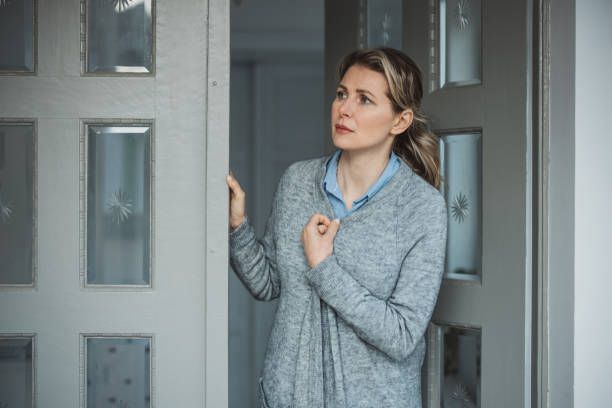
The House They Didn’t Expect
After ten years of never missing a single gathering, my family cruelly excluded me from our annual Fourth of July reunion. Three weeks later, when they showed up unannounced at my new house in Cedar Falls, their faces turned pale as I opened the door and said with perfect calm, “I’m glad you’re here. We need to talk about what you’ve been telling people about me.”
Because they weren’t supposed to be standing on my porch. Not this porch, anyway—not the wide wraparound veranda of the historic Morrison estate, with its white columns and hanging ferns and view of Main Street that made it impossible to miss, impossible to ignore, impossible to pretend didn’t exist.
They were supposed to be back at Grandpa Joe’s farmhouse on the edge of town, the one with red, white, and blue bunting tied to the split-rail fence every Fourth of July like clockwork. Uncle Frank was supposed to be flipping burgers in that ridiculous stars-and-stripes apron he’d worn for fifteen years, the one with ketchup stains that never quite washed out. Kids were supposed to be running barefoot through the same field where we’d set up volleyball nets since we were little, their shrieks of laughter carrying across the corn. Paper plates were supposed to be stacked on folding tables under the oak tree, Costco trays of potato salad and macaroni sweating in the Nebraska July heat, somebody arguing about who forgot the buns again.
That reunion—that specific tradition, that one sacred day—was our family’s center of gravity. The thing that made Cedar Falls feel like home no matter how far any of us had scattered, no matter how different our lives had become from the ones our grandparents lived in this same small town.
So when I found the photos online—dated July 4th, posted by my cousin Jessica with the caption “Best. Family. Ever.”—and realized the whole gathering had happened without me, without a word, without even the courtesy of an excuse, my stomach dropped so fast it felt like I’d missed a step on a staircase and was still falling.
No invitation in the mail. No “Hey, you still coming?” text in the family group chat. No casual phone call from Aunt Sarah checking if I needed a ride from the airport.
Just… silence. Deliberate, coordinated silence that could only mean one thing: I’d been excluded on purpose.
I called my sister Diana first, because surely there had to be some kind of mistake. Maybe the invitation got lost in the mail. Maybe they’d sent it to my old address. Maybe the date had changed and nobody thought to tell me. Maybe there was a perfectly reasonable explanation that would make this horrible feeling in my chest go away.
Diana answered on the fourth ring, her voice carrying that particular flat quality that meant she knew exactly why I was calling and had prepared herself for it.
“Oh, the reunion,” she said when I asked, her tone casual in a way that felt deliberately cruel, like I’d asked about a dentist appointment instead of a family tradition that had defined our summers for decades. “We decided you probably wouldn’t be interested this year.”
I actually laughed at first—a short, disbelieving sound—because she had to be joking. “Diana, I haven’t missed one in ten years. Why would I not be interested?”
“Yeah, well,” she said, with that little dismissive edge I’d started hearing more often in the past year, “you live in California now. You’re doing your big tech thing out there. We figured you had better things to do than hang out with small-town people. You know, since you’re so busy being successful and important.”
The way she said “successful” made it sound like an accusation. Like an insult.
“That’s not—Diana, that doesn’t make any sense. I always come home for the reunion. I’ve flown back from California for the past three years specifically for this. Why would this year be different?”
“Maybe you should ask yourself that,” she said, her voice going harder. “Maybe you should think about how you’ve changed since you left. How you talk to us now. How you make us feel like we’re not good enough anymore.”
“I’ve never—”
But she’d already hung up, leaving me staring at my phone in my quiet San Francisco apartment, laptop still open on my coffee table, the city lights blinking through my window like they always did, the elevator chime down the hall marking someone else’s normal evening while mine had just tilted sideways into something I didn’t understand.
The next day was worse. Because it wasn’t just Diana. I called my cousin Rachel, my uncle Frank, my aunt Sarah—and every single one of them had the same story, delivered with the same rehearsed quality, like they’d all gotten together and decided on a script.
I’d “changed.” I’d become “different.” I “looked down on them.” I thought I was “too good for Nebraska” now that I lived in California and worked in tech. I’d made comments—though no one could quite remember what comments, specifically—that made them feel judged and inferior.
And every time I tried to explain, tried to defend myself, tried to point out that I’d never said or thought any of those things, the conversation ended the same way: with them cutting me off, their voices going cold, the line going dead right where the truth should have fit.
That’s when a name kept coming up in every conversation, mentioned almost casually, like an afterthought that wasn’t an afterthought at all.
My brother Marcus.
The “concerned” brother. The “responsible” brother. The one who’d apparently been having worried conversations with everyone about how much I’d changed, how I’d become dismissive of my roots, how I was embarrassed by my family’s simple life now that I was making Silicon Valley money.
Marcus, who’d stayed in Cedar Falls after college, who’d married his high school sweetheart, who worked at the same insurance agency our grandfather had worked at, who showed up at Grandma Helen’s house every Sunday for dinner like he deserved a medal for basic family obligation.
I didn’t want to believe it. Not at first. Marcus and I had been close growing up—not best friends, exactly, but solid siblings who’d had each other’s backs. He’d driven me to the airport when I first moved to California. He’d called to congratulate me when I got my first real tech job. He’d seemed genuinely happy for me.
But then a memory surfaced from last Christmas, the last time I’d been home. Grandma Helen mentioning her will in that casual, offhand way elderly people do when they’re pretending it’s not a big deal but actually testing the waters. Saying something about how she wanted to make sure her estate was “divided fairly among those who really care about family and Cedar Falls.”
And Marcus had been sitting right there, nodding along, making comments about how important it was to stay connected to your roots, how money wasn’t everything, how some people valued family over career advancement.
Looking at me when he said it. Making sure Grandma Helen was looking at me too.
Suddenly the pieces started arranging themselves into a pattern I couldn’t ignore. Marcus positioning himself as the loyal son who stayed. Me being cast as the daughter who left and got too big for her small-town origins. The timing of my sudden exclusion from the family reunion, right around when Grandma Helen had started talking more seriously about her estate planning.
Grandma Helen, who owned a significant amount of commercial real estate in Cedar Falls. Grandma Helen, whose late husband had invested wisely in the early days of the town’s development. Grandma Helen, who was ninety-two and in declining health and probably wouldn’t be around for many more Christmases.
I felt sick. Surely Marcus wouldn’t—couldn’t—manipulate the entire family just to position himself as the favorite grandchild for inheritance purposes. Surely I was being paranoid, reading conspiracy into coincidence.
But the sick feeling wouldn’t go away. And the more I thought about it, the more I realized that whether Marcus had orchestrated this deliberately or had just let his own resentments shape how he talked about me to the family, the result was the same: I’d been written out of my own story. Someone else was telling my narrative, and everyone was believing it because I wasn’t there to defend myself.
So I did something I almost never do when my feelings are hurt, when I’ve been wronged, when I want to react emotionally and immediately.
I got quiet.
I stopped calling family members trying to explain myself. I stopped posting on social media about my California life. I stopped sending the group chat updates about my work or my apartment or anything that could be twisted into evidence of my supposed superiority complex.
Instead, I started asking questions. Careful questions. Strategic questions.
I called Grandma Helen directly—not to complain about Marcus, not to defend myself, just to check in, to tell her I loved her, to ask about her health and her life. And in the course of those conversations, I learned some interesting things.
Like the fact that Marcus had been visiting her not just on Sundays, but three or four times a week. Taking her to appointments. Helping her with paperwork. Talking to her about family matters and who could be trusted and who really cared about Cedar Falls’s future.
Like the fact that he’d suggested she might want to “simplify” her estate planning, maybe consolidate some assets, make things easier for whoever ended up managing things after she was gone.
Like the fact that he’d mentioned, more than once, how sad it was that I’d become so focused on my career that I didn’t make time for family anymore. How I’d changed since moving to California. How I probably wouldn’t even want to be involved in Cedar Falls matters since I’d built such a different life out west.
Grandma Helen, to her credit, didn’t seem entirely convinced. “You don’t seem different to me, honey,” she said during one of our calls. “You seem like the same ambitious, driven girl you always were. Your grandfather would have been proud of what you’ve built.”
But I could hear the uncertainty in her voice. The seed of doubt that Marcus had planted with his constant, careful insinuations.
I also started asking questions of a different kind. Research questions. Business questions. Because while Marcus was busy positioning himself as the “true heir” who’d stayed loyal to Nebraska, he had absolutely no idea what had actually been happening in my life out west.
He still pictured me as a regular tech worker, probably. Someone with a decent job, paying San Francisco rent, trying to look successful on Instagram while actually living paycheck to paycheck like most people our age in expensive cities.
He didn’t know that my “decent tech job” had been at a startup that had just been acquired for a sum that made my stock options worth serious money. Not retire-forever money, but change-your-life money. Build-something-real money.
He didn’t know that my “California life” wasn’t a phase I’d grow out of or a career experiment that would eventually fail. It was the foundation for what I’d really wanted to do—which was build something of my own, something meaningful, something that would let me live on my own terms.
And he definitely didn’t know that I’d already been planning to come back to Cedar Falls long before the reunion exclusion. That I’d been tired of San Francisco’s pace and prices. That I’d been looking at properties back home, researching what it would take to establish myself in my hometown not as the girl who left and failed, but as someone who’d gone out, succeeded, and chosen to come back.
The reunion exclusion didn’t change my plans. It just clarified them. It stripped away any remaining illusion that I could simply show up and be welcomed back into the fold without addressing the stories that had been told about me in my absence.
So I accelerated my timeline. Made some calls. Pulled some strings. Made an offer on a property I’d been watching for six months, a property that everyone in Cedar Falls knew and most people considered impossibly out of reach for someone our age.
The Morrison estate. A Victorian mansion on Main Street, built in 1887 by the town’s founder, carefully preserved through generations, featuring on every historic walking tour and Christmas postcard for the past century. Four thousand square feet, original hardwood floors, stained glass windows, a wraparound porch that could host fifty people easily, gardens that took up half a city block.
The kind of house that made people slow down when they drove past, just to look. The kind of house that defined “old money” and “established family” in a small town. The kind of house that Marcus, with his insurance job and his modest lifestyle, could never dream of affording.
The kind of house that sent a very clear message: I haven’t failed. I’m not ashamed. I’m not hiding. I’m here, I’m staying, and you don’t get to write my story anymore.
The acquisition took three weeks to finalize. I flew back to Cedar Falls on a Tuesday, met with the real estate agent, signed papers, and got the keys to a house that would change every conversation about who I was and what I’d become.
I moved in immediately—not with all my stuff from California, just enough to make it clear this wasn’t a vacation rental or a real estate investment I’d flip for profit. This was my home. My statement. My line in the sand.
I hired local contractors—people who’d known my family for years—to help with some immediate updates and repairs. I bought furniture from Cedar Falls shops instead of having things shipped from California. I made sure everyone in town knew that Grandma Helen’s supposedly “too-good-for-Nebraska” granddaughter had just bought the most prominent house on Main Street and planned to stay.
The word spread fast in a town of 8,000 people. By the end of the first week, I’m sure everyone knew. Including Marcus.
I hadn’t finished unpacking when my doorbell rang on a Saturday afternoon. I’d been arranging furniture in the front parlor, trying to decide if the antique settee looked better under the window or near the fireplace, when the chime echoed through the high-ceilinged rooms.
I looked through the original stained-glass sidelight and saw two vehicles in my circular gravel driveway.
Marcus’s beat-up truck, the same one he’d driven since college, now with a car seat visible in the back.
Diana’s sedan, newer but still modest, practical, the kind of car you buy when you’re being sensible about money.
And standing on my porch, looking uncertain and uncomfortable and definitely not expecting what they were about to find, were my brother and sister.
I took a breath, smoothed my shirt, and opened the door.
Their expressions went through several rapid changes when they saw me standing there in the doorway of the Morrison estate: confusion (what is she doing here?), recognition (oh, she’s inside, so maybe she’s renting it or house-sitting?), and then—when they looked past me into the marble-floored foyer with its crystal chandelier and mahogany staircase—shock bordering on horror as they realized this wasn’t a rental.
This was mine.
“Hey,” I said, my voice calm and friendly in a way that took genuine effort. “I’m glad you’re here. We need to talk about what you’ve been telling people about me.”
Marcus recovered first, though his face was still pale, his eyes still taking in the house behind me like he couldn’t quite process what he was seeing. “What are you—how did you—you bought this place?”
“Yes. Last week. I’ve been meaning to let the family know, but I wanted to get settled first. Come in.”
I stepped back and gestured them inside, watching as they walked into my house like they were entering a museum, like they were afraid to touch anything. Diana’s eyes went immediately to the chandelier, the original artwork on the walls, the period furniture I’d been arranging. Marcus kept staring around like he was looking for proof this was fake somehow, that I was pranking them, that this couldn’t possibly be real.
I led them into the front parlor and gestured to the chairs I’d just been rearranging. “Sit. Please.”
They sat, still looking shell-shocked. I remained standing, maintaining the subtle power dynamic of being the host, the owner, the person who controlled this space.
“So,” I said, crossing my arms and leaning against the fireplace mantel. “I’ve spent the past few weeks having really interesting conversations with our family members. Apparently I’ve become quite the snob since moving to California. I look down on everyone. I’m embarrassed by my small-town roots. I think I’m too good for Cedar Falls now.”
Marcus started to speak, but I held up my hand.
“Let me finish. This narrative about who I’ve become—it’s very detailed. Very consistent. Everyone tells basically the same story about me. Which is interesting, because I don’t actually remember saying or doing any of the things I’m accused of. So I started wondering: where did this story come from? Who’s been telling it?”
Diana was looking at the floor. Marcus was looking at me, his jaw tight.
“Marcus,” I said quietly. “You want to explain why the entire family thinks I’m ashamed of them? Why I was excluded from the reunion based on assumptions about my character that aren’t true?”
“I never said—” he started, but his voice lacked conviction.
“You never explicitly said I was a snob,” I agreed. “You’re too smart for that. You just expressed concern. You worried out loud about how much I’d changed. You made sad little comments about how I was always too busy for family now. You planted seeds, and you let other people draw their own conclusions. And somehow those conclusions all aligned perfectly with making you look like the loyal, devoted grandchild while I became the ungrateful one who left and forgot where she came from.”
“That’s not—” Diana tried, but I cut her off.
“The timing is interesting too,” I continued. “This narrative really accelerated about six months ago. Right around when Grandma Helen started talking more seriously about her estate plans. Right around when it started to matter who was seen as the ‘real’ family, the ones who cared about Cedar Falls, the ones who deserved to inherit the legacy she and Grandpa built here.”
Marcus’s face flushed red. “If you’re accusing me of manipulating Grandma Helen—”
“I’m not accusing you of anything,” I said calmly. “I’m stating facts. You’ve been spending a lot of time with her. You’ve been helping her with paperwork and appointments. You’ve been positioning yourself as the responsible grandchild. And somehow, in the process, I’ve been repositioned as the selfish one who abandoned the family for California money. Interesting how that works out in your favor, isn’t it?”
“We thought you were happy in California,” Diana said weakly. “We thought you didn’t want to be bothered with small-town stuff anymore.”
“Did you?” I looked at her directly. “Or did you want to believe that because it made you feel better about excluding me? Because it made it easier to justify?”
Silence. Heavy and uncomfortable.
“Here’s what’s going to happen,” I said, my voice still calm but carrying an edge now. “You’re going to go back to everyone in this family and you’re going to tell them the truth. That I didn’t change. That I didn’t become a snob. That I’m still the same person I’ve always been, just with different professional opportunities. You’re going to tell them that you made assumptions about me based on where I live instead of who I actually am.”
“And if we don’t?” Marcus said, trying to sound defiant but mostly sounding defensive.
“Then I’ll tell them myself. But I’ll also tell them about this conversation. About why you were really so eager to paint me as the family villain. About how convenient it was for you that Grandma Helen started to see me as someone who’d abandoned Cedar Falls right when inheritance became a topic of conversation.”
“You can’t prove—”
“I don’t have to prove anything, Marcus. I just have to make people think about it. Make them wonder about your motives. Make them question whether they got the real story about me or the version you wanted them to hear.”
I walked to the window, looked out at Main Street, at the town I’d loved my whole life despite leaving it for a while. “I came back here because I wanted to. Because I missed this place. Because I built something out there that gave me the freedom to choose where I wanted to live, and I chose home. But I’m not going to let you or anyone else make me feel ashamed of the path I took to get here.”
“You bought the Morrison estate,” Diana said quietly, like she was still processing it. “How can you even afford—”
“My startup was acquired,” I said simply. “I had stock options. I did well. Really well. Not that anyone in the family bothered to ask about my actual career instead of just assuming I was some mid-level tech worker trying to look impressive on social media.”
Marcus was staring at his hands. Diana was crying quietly.
“I don’t want to fight with you,” I said, my voice softening slightly. “You’re my family. But I need you to understand something: I’m not the same person you remember from high school, the one who needed your approval or protection. I’m not asking permission to come home or begging to be included. I’m here. I’m staying. And you can either accept that and rebuild our relationship on honest terms, or you can keep believing the story about me that was never true. But you don’t get to write my narrative anymore.”
I walked back to where they were sitting, looked down at both of them. “The reunion next year—I’ll be hosting it. Here. This house is big enough for the whole family. If you want to come, you’re invited. But everyone gets invited. No exclusions. No power plays. No using family gatherings as weapons.”
Marcus finally looked up at me. “You’re really staying? This isn’t just… making a point?”
“I’m really staying. I’m opening a consulting business here. Helping local companies with digital strategy and tech implementation. I’m investing in Cedar Falls because I believe in this town. I’m building a life here because this is where I want to be.”
“Does Grandma Helen know?” Diana asked.
“I’m having dinner with her tomorrow. She’ll be the first family member I tell officially. Well, besides you two, since you showed up unannounced.” I paused. “Out of curiosity—why did you come here today? How did you even know I was in town?”
Marcus and Diana exchanged a look. Finally Marcus said, “We heard you’d bought a house. We thought… we thought maybe you were in over your head. Trying to prove something. We came to… I don’t know. Confront you? Convince you to go back to California? Make sure you weren’t making a huge mistake?”
“You came to save me from myself,” I said, almost smiling at the irony. “The desperate sister who’d obviously overextended herself trying to show off.”
“Something like that,” he admitted quietly.
“Instead you found out I’m actually successful. Actually capable. Actually exactly who I’ve been telling you I am for the past three years, if anyone had bothered to listen.”
More silence. Then Diana spoke, her voice small: “I’m sorry. We were wrong about you. I was wrong about you. I let Marcus’s version of events replace what I actually knew about you. That was weak of me.”
It was the most honest thing anyone in my family had said to me in months.
“Thank you,” I said simply.
Marcus took longer to come around, but eventually he nodded. “I might have… suggested things. About you. To people. Because I was jealous. Because you left and succeeded and I stayed and felt like I was just… treading water. And when Grandma started talking about the future, I wanted to make sure she saw value in the choice I made. Staying. Being here. I’m sorry.”
It wasn’t a full confession. It wasn’t everything I knew he’d done. But it was something. A crack in the defensive wall. A possibility of rebuilding.
“Okay,” I said. “We can work with that.”
They left about an hour later, after I’d given them a tour of the house and we’d had a surprisingly honest conversation about expectations and assumptions and the stories we tell ourselves about each other. It wasn’t a full reconciliation—trust like that takes time to rebuild—but it was a start.
That night, I sat on my wraparound porch as the sun set over Main Street, watching Cedar Falls settle into its evening routine. Lights coming on in shops. Families walking home from the park. The comfortable, quiet rhythm of a small town that had been here long before I was born and would be here long after I was gone.
I thought about the reunion I’d been excluded from. The hurt and confusion that had come from being written out of my own family’s story. The anger I’d felt at being cast as the villain in a narrative I hadn’t even known was being told.
But I also thought about what I’d built—not just the business success or the acquisition money or this beautiful house, but the clarity that came from knowing exactly who I was regardless of what stories other people told. The strength that came from choosing my own path and owning the consequences. The freedom that came from not needing anyone’s permission or approval to come home.
Next July, there would be another reunion. Not at Grandpa Joe’s farmhouse with its folding tables and Costco trays, but here, at the Morrison estate, with its wraparound porch that could hold fifty people easily, its gardens big enough for volleyball and badminton and whatever games the kids wanted to play, its kitchen large enough to actually cook for everyone instead of relying on paper plates and prepackaged food.
Some people might not come. Some might hold onto their assumptions about me being a snob, might be too proud to admit they were wrong. And that would be okay. Painful, but okay.
Because I wasn’t doing this to prove anything to anyone anymore. I was doing it because it was the right thing to do. Because family gatherings should include everyone. Because nobody should have to wonder if they’re welcome at their own family’s table.
And because my grandmother’s granddaughter—the one who’d gone out into the world and built something real—had come home not as someone who’d failed and needed saving, but as someone who’d succeeded and chosen to invest that success in the place she’d always loved.
The house Marcus couldn’t afford to buy. The life he couldn’t imagine living. The success he’d tried to diminish by telling stories that turned out to be nothing but his own insecurity projected onto me.
I pulled out my phone and sent a message to the family group chat—the one that had been suspiciously quiet around me for months:
“Hey everyone. I’m back in Cedar Falls permanently. Bought a house on Main Street. Would love to host Sunday dinner this week for anyone who wants to come. We have a lot to catch up on.”
The responses started coming in within minutes. Surprise. Confusion. Curiosity. And from Grandma Helen, bless her: “I knew you’d come home eventually, honey. That California sunshine is nice, but it’s not Nebraska. See you Sunday. I’ll bring my famous potato salad.”
I smiled at my phone, at this small beginning, at the possibility of rebuilding what had been broken.
The reunion had excluded me. But I’d built something better than inclusion on someone else’s terms.
I’d built a home that was undeniably, unarguably, completely mine. And I’d invited everyone to join me there—not as a power play, not as revenge, but as an act of radical hospitality that said: This is who I really am. Come see for yourself.
Some would come. Some wouldn’t. But at least nobody could say they didn’t have a choice. At least nobody could claim I’d abandoned them or looked down on them or thought I was too good for Cedar Falls.
I was here. In the biggest house on Main Street. With the doors open and the porch light on.
Come home or don’t. But you can’t say I didn’t make room for you.
That was the only story that mattered now. The one I was writing myself.
THE END

Lila Hart is a dedicated Digital Archivist and Research Specialist with a keen eye for preserving and curating meaningful content. At TheArchivists, she specializes in organizing and managing digital archives, ensuring that valuable stories and historical moments are accessible for generations to come.
Lila earned her degree in History and Archival Studies from the University of Edinburgh, where she cultivated her passion for documenting the past and preserving cultural heritage. Her expertise lies in combining traditional archival techniques with modern digital tools, allowing her to create comprehensive and engaging collections that resonate with audiences worldwide.
At TheArchivists, Lila is known for her meticulous attention to detail and her ability to uncover hidden gems within extensive archives. Her work is praised for its depth, authenticity, and contribution to the preservation of knowledge in the digital age.
Driven by a commitment to preserving stories that matter, Lila is passionate about exploring the intersection of history and technology. Her goal is to ensure that every piece of content she handles reflects the richness of human experiences and remains a source of inspiration for years to come.