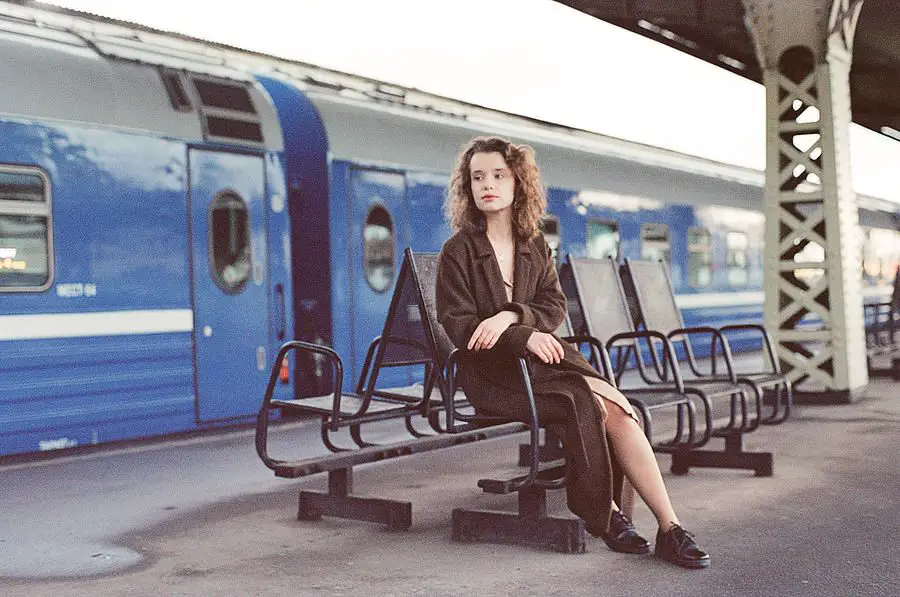
The Train Station Where My Childhood Ended
The Amtrak station in Cincinnati had a particular acoustics that made everything sound harder than it was—the click of heels on tile floors amplified into gunshots, the garbled announcements echoing off the high ceilings until they became unintelligible noise, the rumble of arriving trains felt in your chest before you heard them with your ears.
I was thirteen years old, standing in that cavernous space in a blue hoodie that was already too small but that I refused to give up because it had been a gift from my grandmother before she died. My small backpack pressed against my spine, stuffed with things a thirteen-year-old thinks are essential for a weekend trip—a change of clothes, my phone charger, a book I’d been pretending to read for English class, a bag of gummy bears I’d already eaten half of on the bus ride there.
I was clutching the backpack straps like they could keep me anchored to something solid, to something that made sense, because even then—even before everything fell apart—I had the feeling that I was standing on the edge of something I didn’t have words for yet.
My sister Vanessa was eighteen, five years older but somehow decades more confident. She carried herself like someone who already knew how every story ended, who’d read ahead in the book while the rest of us were still stumbling through the introduction. She wore her certainty like armor—in the way she stood, the way she spoke, the way she moved through the world like she owned space that other people just borrowed.
We’d taken the bus from our hometown of Lebanon, Ohio, about forty minutes north. The plan—Vanessa’s plan, because I’d learned early that Vanessa made the plans and I followed them—was to spend the weekend with our cousin Marcus in the city. Mom was working a double shift at the hospital where she was a nursing assistant, and she’d given Vanessa permission to take me along, trusting her oldest daughter to be responsible.
“Stay here,” Vanessa said, pointing to a metal bench near the platform doors. She was already half-turned away from me, her attention caught by something across the concourse I couldn’t see. “I’m grabbing drinks from that café. You want hot chocolate, right?”
“Okay,” I said, because I still believed that people who spoke like they had a plan actually had a plan. Because I was thirteen and Vanessa was eighteen and that meant she knew things I didn’t.
She took three steps away, then glanced back over her shoulder. Her eyes were bright with that particular kind of older-sister confidence that always felt like a dare, like she was testing me to see if I’d measure up to some standard she’d never actually articulated.
“Let’s see how you do handling things for a minute,” she said, and there was something in her voice that should have warned me. Something sharp under the casual tone. “You always say you can take care of yourself. Prove it.”
I tried to smile, because I didn’t want to be the kid who made everything serious, who couldn’t take a joke, who needed constant reassurance. “I can,” I said, with more confidence than I felt.
She disappeared into the crowd moving through the concourse—commuters heading home from work, families dragging luggage toward platforms, teenagers clustered around their phones. The café she’d mentioned was visible from where I sat, a small counter with an overwhelmed barista and a line of about five people.
Ten minutes passed. I watched the line move, watched people receive their orders and walk away. Vanessa wasn’t among them.
Maybe she’d gone to the bathroom first. Maybe she’d run into someone she knew. Maybe the line was longer than it looked from where I was sitting.
Twenty minutes. The platform doors opened and closed as trains arrived and departed. Business people with briefcases. College students with massive backpacks. An elderly couple holding hands and moving so slowly it looked like they were wading through water.
Still no Vanessa.
I pulled out my phone and texted her: Where are you?
The message showed as delivered but not read.
Thirty minutes. The bench was getting uncomfortable, the metal edge digging into the backs of my thighs. I stood up, stretched, sat back down. Checked my phone. Still nothing.
I told myself she’d gotten distracted. Vanessa was like that—easily pulled off course by something more interesting, someone more exciting. She’d probably run into a friend, lost track of time. She’d be back any minute, apologetic and laughing, with hot chocolate that had gone lukewarm.
Forty-five minutes. An hour.
The café had closed its shutters for the evening. The crowds had thinned. The announcements had changed from arrivals to last calls, from welcomes to warnings.
I called Vanessa’s phone. It rang three times and went to voicemail. Her voice, recorded months ago in a moment when she’d been in a good mood: “Hey, it’s V! Leave a message and maybe I’ll call you back.”
“Vanessa, where are you? I’m still at the bench. Did something happen? Call me back.”
I waited. My phone stayed dark and silent.
I called again. This time it went straight to voicemail, like she’d turned it off. Or blocked my number.
The first real tendrils of fear started creeping up my spine. This wasn’t Vanessa being late. This was something else.
Then my phone buzzed in my hand, making me jump. A text message. From Vanessa.
My heart leaped with relief for exactly the half-second it took to read the words.
You’ll be fine. Find your way home. Consider it a little challenge.
I stared at the screen until the words blurred. Read them again. Again.
No explanation. No directions. No “sorry, emergency came up” or “got lost, meet me at X location.” Just a dismissal. A test. A challenge.
Another message came through: You’re always saying you’re mature for your age. Time to prove it.
My hands were shaking now. I typed back: Vanessa, this isn’t funny. Where are you?
The message showed as delivered and read. Those three dots appeared that meant she was typing.
They disappeared.
No response came.
I waited fifteen more minutes, staring at my phone, willing her to explain, to apologize, to say this was a joke that had gone too far.
Nothing.
The station was getting quieter now. The last few commuters of the evening rushing to catch their trains. A janitor starting to mop the far end of the concourse. Security guards making their rounds with bored expressions that said they’d seen everything and nothing surprised them anymore.
I was thirteen years old, in a train station in a city I didn’t know well, with less than twenty dollars in my pocket and a sister who’d apparently decided to abandon me as some kind of character-building exercise.
I walked up to the ticket counter on legs that felt disconnected from my body. The clerk was a middle-aged man with glasses and a name tag that said “Robert.” He looked up from his computer screen with the polite disinterest of someone asked the same questions a thousand times a day.
“Can I use a phone?” My voice came out smaller than I intended.
He studied me for a moment, taking in my age, my obvious distress. His expression softened slightly. “Pay phone’s broken. You can use this one for local calls.”
He slid a landline across the counter, an old-style phone with buttons instead of a touchscreen, tethered to the desk with a coiled cord.
I dialed Vanessa’s number first. It went straight to voicemail again. I didn’t leave another message.
Then I called my mother’s cell phone. It rang and rang before going to her voicemail too: “This is Linda. Leave a message.”
“Mom, it’s me. I’m at the train station in Cincinnati and Vanessa left me here. She’s not answering her phone. I don’t know what to do. Please call me back.”
I tried her number again. This time the automated voice told me her mailbox was full.
I hung up the phone and looked at Robert, who was pretending not to listen while obviously listening. “Is there a bus station nearby?”
“Greyhound’s about six blocks that way,” he said, pointing. “Last bus to Lebanon leaves at 10:45. You got a ticket?”
I shook my head.
“You got money for a ticket?”
“Not really,” I admitted. A bus ticket would cost at least fifteen dollars, probably more, and I had exactly seventeen dollars and thirty-two cents, which I knew because I’d counted it three times already.
Robert sighed, the kind of sigh that said he was about to do something his supervisor wouldn’t approve of. “Look, kid. I’m not supposed to do this, but there’s a youth shelter about four blocks away. They help kids who are… in situations. You want me to call them?”
A shelter. Like I was homeless. Like I was abandoned.
Which, I realized with a sick dropping feeling in my stomach, I effectively was.
“No,” I said quickly. “No, I’ll figure it out. Thank you.”
I went back to the metal bench and sat down, even though the station was mostly empty now and sitting there felt like accepting defeat. I couldn’t go to a shelter. That felt too permanent, too real. Like admitting that Vanessa had really done this, that my own sister had really left me stranded in a city after dark as some kind of test.
I pulled out my phone and went through my contacts. My mom wasn’t answering. Vanessa had blocked me or turned off her phone. My grandmother was dead. My father had left when I was six and I hadn’t heard from him since.
I had one cousin who lived in Cincinnati—Marcus, the one we were supposedly coming to visit. But I didn’t have his number in my phone. Vanessa had been the point of contact for that plan.
I had school friends, but none of their parents would drive forty-five minutes to pick me up from a train station at night, especially not when they’d have to explain to my mother why her thirteen-year-old was stranded in the city.
I was truly, completely alone.
The overhead lights in the station seemed to get brighter as the natural light from the high windows faded to black. The janitor worked his way closer to where I sat, his mop making rhythmic swishing sounds against the tile. A few stragglers hurried through toward late trains. The security guards changed shifts.
And I sat there, watching the platform doors like the act of watching could somehow turn time around, could make Vanessa walk back through them with an apologetic smile and a reasonable explanation.
But she didn’t come.
Around 9 PM, I counted what I had. Seventeen dollars and thirty-two cents in cash. A phone with 34% battery and no charger because I’d left it plugged in at home. Half a bag of gummy bears. A library receipt with nothing useful on it. A book I didn’t want to read. The blue hoodie I was wearing. And the quiet, terrible realization that I would have to be the one to move first.
That Vanessa wasn’t coming back.
That this wasn’t a test I could pass by waiting patiently.
That I had to save myself.
I made rules the way kids do when they’re trying to stay steady in a situation that’s spinning out of control:
Stay where there are people. Even if the station empties out, find the security guards, stay visible.
Keep your money split. I put ten dollars in my pocket, seven in my shoe, the change in my backpack.
Ask for help without apologizing for it. You’re not a burden for being in a bad situation someone else created.
Don’t cry in public. Save that for when you’re safe.
The security guard who’d been watching me from across the concourse finally walked over around 10 PM. She was a Black woman in her fifties with kind eyes and a no-nonsense expression. Her name tag said “Williams.”
“You been sitting here a long time, honey,” she said. Not unkind, just observational. “You waiting for someone?”
I could have lied. Could have said yes, my ride is coming any minute, I’m fine.
Instead, I told the truth. “My sister left me here. I don’t have a way home.”
Williams’ expression didn’t change, but something shifted behind her eyes. “Where’s home?”
“Lebanon. About forty minutes from here.”
“You got people there?”
“My mom. But she’s working a double shift at the hospital and her phone’s going to voicemail.”
Williams was quiet for a moment, thinking. Then: “There’s a youth services center that can help you. Get you a place to sleep tonight, contact your mom in the morning, make sure you get home safe.”
There was that word again. Shelter. Services. The things you needed when your family failed you.
“Or,” Williams continued, “I can let you stay here until morning. Technically against policy, but it’s warmer than outside and safer than a lot of places. Your call.”
I thought about it. A shelter meant authorities, meant explanations, meant my mother finding out the full extent of what Vanessa had done. It meant consequences for Vanessa, which part of me wanted but part of me was still too loyal to pursue.
“Can I stay here?” I asked quietly.
Williams nodded. “Stay on this bench. Don’t wander. If anyone bothers you, you come find me or Davidson—he’s the other guard on tonight. You understand?”
“Yes. Thank you.”
She squeezed my shoulder once and walked away, resuming her rounds but keeping me in her line of sight.
I spent the night on that metal bench, dozing fitfully, jerking awake every time someone walked past or a train rumbled through. I used my backpack as a pillow and my hoodie as a blanket and I did not cry, even though I wanted to.
I thought about Vanessa. About all the times she’d pushed me to be more independent, to stop “acting like a baby,” to prove I could handle things on my own. About how she’d always framed her absence—the times she forgot to pick me up from school, the times she bailed on plans we’d made—as teaching me self-reliance rather than abandonment.
I thought about my mother, who loved us but who worked so much she missed things. Who trusted Vanessa because Vanessa was eighteen and seemed confident. Who’d be devastated when she found out what had happened.
And I thought about myself, about the girl I’d been when I walked into this station earlier that day—still believing that family meant safety, that sisters looked out for each other, that the people who said they loved you wouldn’t use that love as a weapon.
That girl was gone now. Dissolved somewhere between the first hour of waiting and the moment I’d read Vanessa’s text. In her place was someone harder, warier, someone who was learning that trust was a gift you could revoke.
When morning came—gray and cold through the high windows—I used the station bathroom to wash my face and fix my hair. I bought a bottle of water and a granola bar from a vending machine, spending precious dollars but needing the fuel.
Then I approached the ticket counter again. Robert was back on shift, looking tired. He recognized me immediately.
“You still here?” Not judgmental, just surprised.
“Yeah. I need to get to Lebanon, Ohio. What’s the cheapest way?”
He typed something into his computer. “Bus is still your best bet. Fifteen-fifty for a one-way ticket. You got that now?”
I counted out my remaining money. Seventeen dollars and thirty-two cents minus the water and granola bar. I had just enough.
“Yeah,” I said.
Robert printed the ticket and handed it over. “Bus leaves in forty minutes. Platform’s outside, turn left.”
I took the ticket, and he looked at me for a long moment. “Whatever happened to you,” he said quietly, “it wasn’t your fault.”
Those words—simple, unexpected—almost broke my careful composure. I nodded, not trusting myself to speak, and walked away.
I boarded the bus with my remaining cents and my backpack and my new, harder self. I took a window seat and watched Cincinnati disappear as we drove north through neighborhoods I’d never seen before.
I didn’t text Vanessa. Didn’t call my mother. Didn’t reach out to anyone.
I just rode the bus home and made another rule, the one that would shape the next decade of my life:
When people show you who they are, believe them the first time.
And when they show you they’re willing to abandon you, don’t give them the chance to do it again.
The bus dropped me off in Lebanon around noon. I walked the mile and a half to our apartment complex, let myself in with the key I kept hidden in my backpack, and went straight to my room.
My mother got home around 4 PM, exhausted from her double shift. I heard her come in, heard her call out “Girls, I’m home!” in the tired voice that meant she’d be asleep within an hour.
I came out of my room. “Mom.”
She looked up, and her face went through a rapid series of expressions. “Baby, you’re home already? I thought you were staying through Sunday with Marcus.”
“Vanessa left me at the train station,” I said, my voice flat and factual. “Last night. She texted me to find my own way home.”
The color drained from my mother’s face. “What?”
I showed her the texts. Told her everything—the bench, the waiting, the security guard, the night spent in the station. I didn’t cry. I didn’t embellish. I just reported facts like I was giving a police statement.
My mother sat down heavily on the couch, her hands over her mouth. “Oh my God. Oh, baby, I’m so sorry. Where’s Vanessa now?”
“I don’t know. Her phone’s off.”
As if summoned by being named, Vanessa walked through the door twenty minutes later, laughing on her phone, carrying shopping bags from stores I recognized from downtown Cincinnati.
She’d gone shopping. While I’d spent the night on a metal bench, she’d been shopping.
My mother stood up with a fury I’d rarely seen from her. “Vanessa Marie, what the hell did you think you were doing?”
Vanessa’s smile faded. She looked between us, calculating. “What are you talking about?”
“You left your thirteen-year-old sister at a train station overnight.”
“I was teaching her independence,” Vanessa said, like it was obvious. Like it was reasonable. “She’s always saying she can take care of herself. I was proving she could.”
“She’s thirteen!” My mother’s voice cracked. “You don’t teach independence by abandoning a child in a city after dark!”
“She made it home fine, didn’t she?” Vanessa gestured at me. “She’s fine. I knew she would be.”
And there it was. The core of Vanessa’s philosophy laid bare: the outcome justified the method. I’d survived, therefore the test had been valid.
I looked at my sister—my beautiful, confident, cruel sister—and something in me went cold and quiet.
“I’m fine,” I agreed. “But I won’t forget this.”
Vanessa rolled her eyes. “Don’t be dramatic.”
My mother grounded Vanessa for a month, took away her car privileges, made her apologize. The apology was performative, delivered with the exasperated air of someone humoring an overreaction.
And I never trusted her again.
Not when she promised to do things. Not when she made plans. Not when she said the words “I love you” in that casual way that suggested obligation rather than feeling.
I became independent, just like she’d wanted. But not in the way she’d imagined. I became independent from her. From relying on her, believing her, wanting anything from her.
I got my first job at fourteen—babysitting, dog-walking, anything to have my own money so I never had to depend on someone who might decide to teach me a “lesson” instead of actually helping.
I got my license the day I turned sixteen and bought my own car with saved money—a beat-up Honda that was ugly but mine.
I applied to colleges far away, chose one in Oregon that put an entire country between us.
I built a life, brick by brick, name by name, friend by friend, carefully constructing something that didn’t require Vanessa to be in it.
My mother tried to bridge the gap sometimes. “She’s your sister. She made a mistake. Can’t you forgive her?”
But it wasn’t just a mistake. It was a revelation. It was Vanessa showing me exactly who she was and what I was worth to her—a test subject, a way to prove her theories about independence and resilience, someone whose suffering was acceptable if it served her purposes.
So I didn’t forgive her. I just… moved on. Built a life she wasn’t invited to.
Ten years passed. I graduated college with a degree in social work, driven by my experience in that train station to help kids who fell through the cracks of family systems. I got a job with a nonprofit in Portland. I made friends who showed up when they said they would. I dated people who treated plans as commitments rather than suggestions.
I visited my mother a few times a year, carefully timing my visits to avoid Vanessa’s. My mother gave me updates I didn’t ask for: Vanessa had a marketing job in Columbus. Vanessa was dating someone new. Vanessa was doing great.
Good for Vanessa.
I didn’t check her social media. Didn’t reach out on birthdays or holidays. Didn’t respond when she sent the occasional text—always casual, always acting like we were on normal-sister terms rather than estranged.
I built a life where that night in the train station was a story I could tell at dinner parties. “Yeah, my sister once left me overnight at a train station when I was thirteen. No, we don’t talk anymore. Yes, I’m fine.”
Until tonight.
I was in my apartment in Portland, comfortable in the life I’d built, making dinner and half-watching a documentary, when my phone started buzzing on the counter.
Vanessa. Calling.
I let it go to voicemail.
She called again immediately.
I declined it.
Again. And again. And again.
Thirty-seven missed calls in the span of twenty minutes. Each one making my phone light up, vibrate, demand attention in a way that felt violently intrusive.
I stared at the screen, my heart pounding with something between anger and dread. Vanessa didn’t call. We didn’t talk. That was our unspoken agreement—I stayed away, she pretended everything was fine.
What could possibly warrant thirty-seven calls?
The phone lit up again. Call number thirty-eight.
With shaking hands, I answered it.
Silence on the other end for a beat. Then Vanessa’s voice, and it sounded wrong. Shaky. Stripped of all her usual confidence.
“Riley.” My name in her mouth, careful and uncertain, like she was standing outside a door she was afraid to knock on.
“What’s wrong?” I asked, skipping past hello, past pretense. Because something was clearly, terribly wrong.
“It’s Mom,” Vanessa said, and her voice cracked. “She’s in the hospital. She had a stroke this afternoon. They… they don’t know if she’s going to make it.”
The world tilted sideways.
“What?” The word came out as barely a whisper.
“She collapsed at work. They called me because I’m her emergency contact. Riley, you need to come home. I know we don’t… I know things aren’t good between us, but Mom keeps asking for you. She needs both of us.”
Both of us. Like we were a unit. Like we were sisters who showed up for each other in emergencies.
“I’ll get the next flight,” I heard myself say.
“Thank you,” Vanessa said, and she sounded genuinely grateful, genuinely relieved. “Riley, I know I don’t have the right to ask, but—”
“I’m not coming for you,” I interrupted. “I’m coming for Mom.”
“I know. I understand. Just… please hurry.”
She hung up.
I stood in my kitchen for a long moment, phone in hand, dinner forgotten on the stove, documentary playing to an empty room.
Ten years. Ten years since that train station. Ten years since I’d decided Vanessa didn’t get to be in my life.
And now I was booking a flight back to Ohio, back to the place I’d worked so hard to leave, because my mother was dying and asking for me.
I packed quickly—enough clothes for a week, my laptop, phone charger, the essentials. I called my boss, explained the emergency, got immediate approval for family leave. I booked a red-eye flight that would get me to Columbus by morning.
And as I sat in my apartment waiting for my Uber to the airport, I thought about that night in the train station. About the thirteen-year-old girl who’d spent those hours learning that she couldn’t rely on the people who were supposed to protect her.
About how that night had shaped everything that came after—my fierce independence, my choice of career helping vulnerable kids, my inability to fully trust people who made promises.
About how I’d built a good life despite it all, but how that night still lived in me like a scar that ached when the weather changed.
I thought about Vanessa, and how I’d spent ten years successfully avoiding her, only to be pulled back by the one thing I couldn’t ignore: my mother’s need.
And I thought about what it would be like to see Vanessa again. To be in the same room with her. To have to navigate a family crisis with the person who’d taught me that family couldn’t be trusted.
I didn’t have answers. Just the knowledge that I was about to find out.
The Uber arrived. I grabbed my bag and headed for the airport, flying toward a past I’d worked so hard to leave behind.
Because my mother needed me.
And because some things—some responsibilities, some loves—survive even the deepest betrayals.
Even if the trust never does.
THE END

Ethan Blake is a skilled Creative Content Specialist with a talent for crafting engaging and thought-provoking narratives. With a strong background in storytelling and digital content creation, Ethan brings a unique perspective to his role at TheArchivists, where he curates and produces captivating content for a global audience.
Ethan holds a degree in Communications from Zurich University, where he developed his expertise in storytelling, media strategy, and audience engagement. Known for his ability to blend creativity with analytical precision, he excels at creating content that not only entertains but also connects deeply with readers.
At TheArchivists, Ethan specializes in uncovering compelling stories that reflect a wide range of human experiences. His work is celebrated for its authenticity, creativity, and ability to spark meaningful conversations, earning him recognition among peers and readers alike.
Passionate about the art of storytelling, Ethan enjoys exploring themes of culture, history, and personal growth, aiming to inspire and inform with every piece he creates. Dedicated to making a lasting impact, Ethan continues to push boundaries in the ever-evolving world of digital content.