At Mom’s 60th Birthday, My Cousin Asked Why a Hospital Had My Last Name on It—Then a Stranger Said, “You Saved My Daughter’s Life”
The chandeliers threw light everywhere. Crystal dripping from brass arms, wine glasses sparkling, polished marble floors that probably cost more than my car.
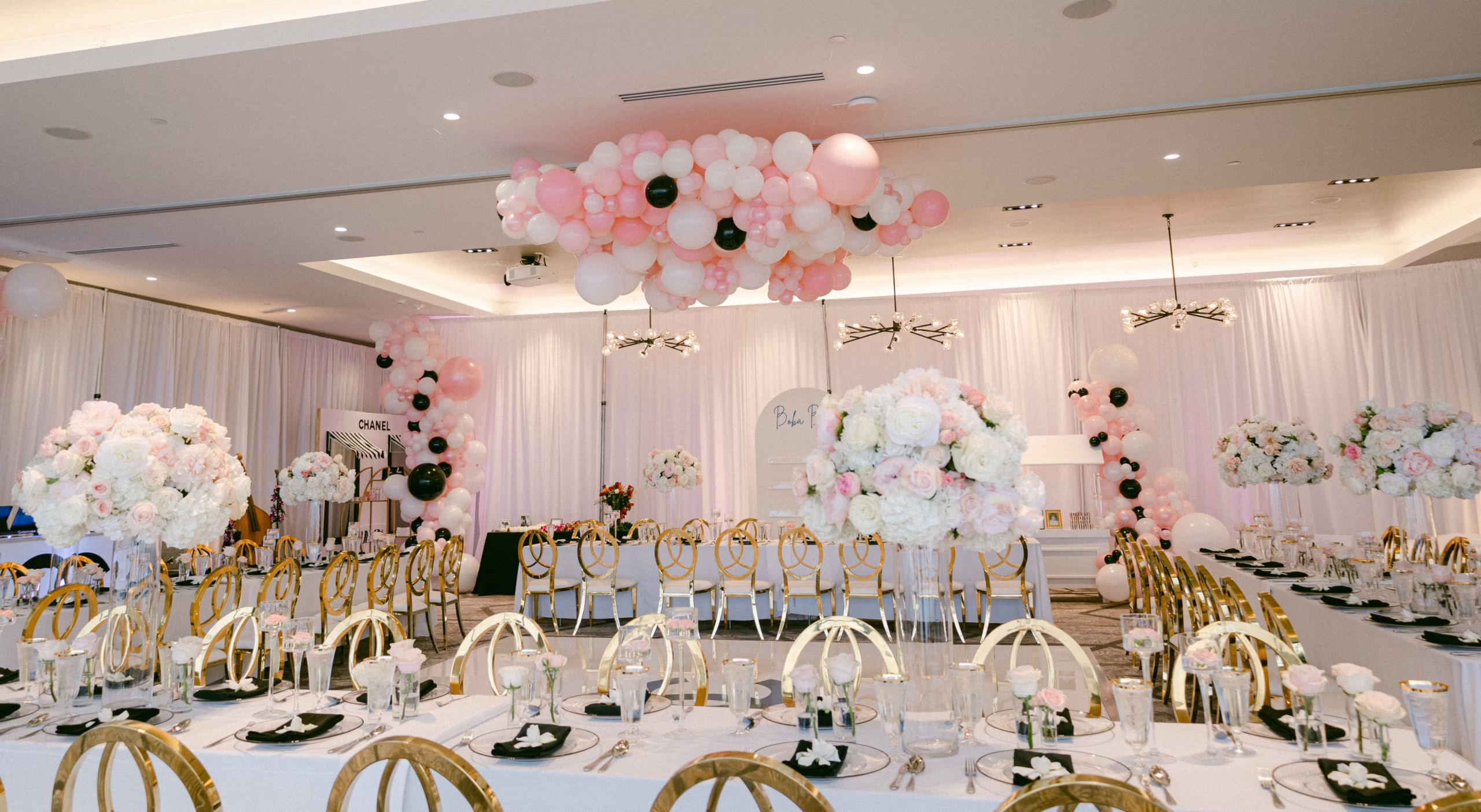
Forty people filled the private dining room at the Wellington. My mother’s sixtieth birthday. Everything perfect—white linens, fresh orchids, a string quartet in the corner playing something expensive that no one was really listening to.
I sat at the family table near the center, staring at my place card: Dr. Sophia Hartwell. The “Dr.” looked almost out of place, like someone had added it as an afterthought.
My brother’s card, two seats away, simply read Jonathan Hartwell. No title. He didn’t need one. In my family, Jonathan had always been the headline. I was the footnote.
He’d spent three months planning the party.
“We’re going all out for Mom,” he’d said on the phone two weeks earlier. “Private room at the Wellington, live music, custom cake—the works. You know how I am when I get into logistics mode.”
I’d stood at the window of my brownstone in Boston, still in scrubs from a twelve-hour day in the OR, surgical loupes hanging around my neck.
“I’m sure it’ll be beautiful.”
“We weren’t sure you could make it,” he’d added casually. “You’re always so busy with your little medical job.”
My little medical job.
I’d smiled into the phone anyway. “I’ll be there.”
Now I watched my mother open presents in her pale blue dress, perfectly coiffed blonde curls, pearl earrings catching the light.
Designer handbag from Jonathan—”Limited edition, Mom, I had to get on a waitlist.” Diamond tennis bracelet that scattered light in tiny sparks. A spa weekend for Dad.
My gift sat at the bottom. A simple cream envelope with a handwritten letter and a donation confirmation to her favorite children’s charity.
“Evelyn, you look absolutely radiant,” Aunt Patricia gushed, raising her glass.
My mother beamed, touching the new bracelet. “I’m just blessed. Jonathan arranged all of this. He’s always been so thoughtful.”
I sipped my sparkling water and said nothing. Twenty-eight years of saying nothing. It had become a habit, like breathing.
“It was nothing,” Jonathan said, though his smile said it was very much something. He leaned back in his tailored suit, expensive watch gleaming. “You deserve it, Mom.”
I’d learned early that in our family, achievements weren’t equal. They were weighed and measured against the question: Does Jonathan care about this?
He didn’t care about spelling tests or science fairs. He didn’t care about AP scores or scholarships or the Harvard acceptance letter that made my legs stop working.
He cared about his first car, his college fraternity, his climb through pharmaceutical sales. He cared about golf handicaps and season tickets and quarterly bonuses.
My parents cared about whatever he cared about with almost religious fervor.
It wasn’t that they disliked me. They loved me. They called me “sweetheart” and asked about my day.
They just didn’t see me. Not really.
“And my little doctor,” my mother added now, glancing at me with a fond smile. “Always so busy with her patients. We’re just lucky she could join us.”
Little doctor.
“How is the hospital, dear?” Aunt Patricia asked. “You’re still doing… what is it again? Kid’s stuff?”
“Pediatrics,” I said automatically. “Yes.”
“She’s a pediatric surgeon,” my cousin Marcus had corrected once. “That’s a pretty big deal.”
“Yes, yes,” Aunt Patricia had waved. “Surgeries, band-aids, I don’t know. All that blood. But you’ve always liked children, didn’t you babysit the Johnson twins?”
It had been easier to let them believe my days were cartoon stickers and primary-colored stethoscopes. The truth—that my hands had held tiny, faltering hearts, that my decisions drew the line between life and death—was too big for this table.
That truth lived somewhere else. In scrub rooms and surgical theaters, in the quiet moment before a procedure when I rested my hands on a draped body and silently promised, I will do everything I can.
The door opened with a soft swoosh.
Marcus stepped inside with his wife Emily. He worked in hospital administration at Cleveland Clinic. We’d reconnected three years ago at a medical conference, spent three hours at the hotel bar talking about OR efficiency and burnout and the terror of being the one everyone turned to when everything went wrong.
When he saw me, his face lit up.
“Sophia!” He weaved between chairs and pulled me into a warm hug. “I was hoping you’d be here.”
“Wouldn’t miss Mom’s birthday.”
He pulled back, hands on my shoulders. “Listen, before I forget—congratulations. The dedication ceremony was beautiful. I watched the livestream. The Hartwell Pediatric Center…” He grinned. “Your parents must be so proud.”
He said it loud enough for everyone at the table to hear.
Loud enough for my mother to freeze mid-laugh.
Loud enough for my father’s wine glass to stop halfway to his lips.
Loud enough for Jonathan to lean forward with a frown.
“What children’s wing?” he asked.
Marcus’s smile faltered. He glanced between us, clearly assuming this was a joke.
“The new pediatric surgery wing at Boston Memorial,” he said slowly. “They named it after Sophia. The Hartwell Pediatric Center. It was all over the medical news last month.”
He turned to my parents. “You were at the dedication, right?”
I could have told him the answer by the way my mother’s fork clattered against her plate. By the way my father made a soft, strangled sound. By the way Jonathan’s face went the color of unbaked dough.
The silence that fell was total.
“Thank you, Marcus,” I said finally, voice steady. “It was a lovely ceremony.”
My mother turned to me very slowly. “What is he talking about?”
Marcus looked between us, confusion deepening into dawning horror. “You… didn’t know?”
“No, what?” my father demanded. “Sophia works at a hospital. She’s a surgeon. What does that have to do with a building?”
Marcus looked at me, silently asking permission.
I gave him a small nod. “Go ahead.”
He swallowed. “Sophia donated two and a half million dollars to build the pediatric surgery wing. It was the largest individual donation in Boston Memorial’s history. They named the entire center after her.”
The number hit the table like a dropped stone.
Two and a half million.
There was an audible gasp—not just at our table but behind us too.
“Two point five… million?” Jonathan repeated, voice strangled. “That’s impossible. Where would Sophia get two point five million?”
“From her income,” Marcus said, almost impatient now. “Sophia is chief of pediatric surgery at Boston Memorial. She’s one of the highest-paid surgeons in Massachusetts.”
My mother’s hand flew to her chest. Her face went nearly as pale as the tablecloth.
“Chief of… surgery. Since when?”
“Four years ago,” I said quietly. “I mentioned it at Thanksgiving.”
A memory flickered: me in their living room, plate balanced on my knees. “Work’s been good. I actually got promoted—I’m chief of pediatric surgery now.”
My mother’s immediate “Oh, that’s nice, dear,” followed by: “Jonathan, tell us about that new car. Was it the BMW or the Mercedes?”
“You asked Jonathan about his new car,” I added now.
Jonathan shifted in his seat, mouth opening and closing.
Aunt Patricia leaned forward, eyes bright. “How much does a chief of surgery make?”
“Her base salary is eight hundred ninety thousand,” Marcus said. “But with surgical bonuses and consulting fees, she probably clears over a million annually. More with her textbook royalties.”
Textbook?
“Textbook?” my father echoed faintly.
Marcus nodded eagerly. “Sophia wrote the definitive textbook on pediatric cardiac surgery. It’s used in medical schools across the country. Across the world, actually. The second edition went international.”
My mother stared at me like she was seeing a stranger.
“You wrote a textbook?”
“Actually,” I said, “the second one came out last year. On minimally invasive techniques for infant heart defects.”
Jonathan swallowed hard. “I don’t understand. You’ve never mentioned any of this.”
“I have,” I said. “Multiple times. You weren’t listening.”
Marcus pulled out his phone, scrolling quickly. “Here. The article from the Boston Globe.”
He turned it toward my parents. “‘Dr. Sophia Hartwell, pioneer in pediatric cardiac surgery, donates $2.5 million for new children’s wing.’ There’s a photo of her at the dedication.”
On the screen, I stood in a navy dress, holding ceremonial scissors. A ribbon stretched in front of me, behind it a plaque with my name in bronze. Hospital executives flanked me. In the background, parents holding children with surgical scars, eyes shining.
My mother stared at the image. “That’s… really you?”
“Yes.”
“And you donated two and a half million dollars?”
“Yes.”
“From money you earned as a surgeon?” my father asked, voice rough.
“Yes.”
He set his wine glass down carefully. “Why didn’t we know about this?”
I placed my water glass next to my plate, aligning it with precision.
“Because you never asked,” I said.
My mother blinked.
“When I got accepted to Harvard Medical School, I called you. I was standing outside the campus coffee shop, holding the envelope. I said, ‘I got in.’ You said, ‘That’s wonderful, sweetheart,’ and then asked Jonathan how his fantasy football league was going.”
My father opened his mouth. No sound came out.
“When I matched at Johns Hopkins for residency—the most competitive pediatric program in the country—I called again. Mom, you said you were happy for me, then asked if I could come home that weekend to help Jonathan move into his new apartment.”
I remembered that day. Me in surgical scrubs, pushing boxes up stairs while Jonathan argued with a cable installer on the phone.
“When I was named chief of pediatric surgery, the youngest in Boston Memorial’s history, I came home for Thanksgiving. I sat right here and said, ‘Work’s been crazy. I actually got promoted to chief.’ You spent the rest of dinner talking about Jonathan’s promotion to regional sales manager.”
Aunt Patricia’s eyes shone with fascination and secondhand shame.
“I stopped trying to share my achievements about six years ago,” I said. “It was easier. Less painful. I just lived my life. Built my career. Saved children’s lives. I assumed you’d never know or care.”
Aunt Patricia leaned toward her husband and stage-whispered, “She’s a millionaire.”
“Multimillionaire, technically,” Marcus said before he could stop himself. “Sorry, Sophia.”
“What do you mean multimillionaire?” Jonathan demanded.
I sighed. “My total compensation over the past decade has been substantial. I’ve invested wisely. I own my home outright. A brownstone in Back Bay. I have significant retirement savings and a diversified portfolio.”
“And yes,” Marcus added, “she had enough to donate two and a half million and still have money left over.”
My mother made a sound like a wounded animal.
“Your daughter,” Marcus said quietly, frustration edged with anger, “is also one of the top five pediatric heart surgeons in the country. She’s saved hundreds of children’s lives. She’s trained the next generation of surgeons. The money is the least impressive thing about her.”
Coming from me, it would have sounded boastful. Coming from Marcus, who’d sat in OR galleries and watched surgeons work—it landed differently.
My mother’s tears finally spilled over.
“Why didn’t you tell us?” she whispered.
“I did tell you,” I said softly. “When I published my first paper in a major journal, I emailed you the link. You responded with a photo of Jonathan’s new boat.”
I remembered that email thread with painful clarity. Me: I’m first author in the Journal of Thoracic and Cardiovascular Surgery!
My mother: Look at your brother’s boat! Isn’t it gorgeous? We’re so proud.
“When I won the American Heart Association’s Young Investigator Award, I called to share the news. Dad put me on speaker. He said, ‘That’s great, honey,’ and then asked if I could call back because Jonathan was about to announce his engagement.”
“Every achievement I’ve had has been overshadowed by whatever was happening in your life,” I said, looking at Jonathan. “And I accepted it. I stopped expecting anything different.”
My throat felt tight, but my voice stayed level. “I built a career that fulfills me. Patients who need me. Colleagues who respect me. I didn’t need your validation anymore.”
I let the words settle.
At that moment, a voice spoke behind me.
“Excuse me.” A woman, hesitant, trembling. “I’m so sorry to interrupt. Are you Dr. Hartwell? Dr. Sophia Hartwell?”
I turned.
She looked younger than my mother but older than me. Dark hair pulled into a loose bun, strands escaping. Simple dress. Her eyes shone in a way I recognized immediately.
“Yes,” I said gently. “I’m Dr. Hartwell.”
“Oh my god.” Her hand flew to her mouth. “You… you saved my daughter’s life.”
The room blurred. Everything narrowed to this woman and the way her voice broke on daughter.
“Three years ago,” she said, stepping closer. “Emma. Emma Patterson. She had the heart defect, the complex one they said… they said she wouldn’t survive. You operated for fourteen hours. They told us to prepare ourselves…”
Her voice disintegrated. She swallowed, tried again.
“They said you were her only chance.”
I stood up, closing the distance by instinct.
“I remember Emma,” I said softly. “Tetralogy with pulmonary atresia and major aortopulmonary collateral arteries. She lost a lot of blood on the table. Strong kid. Stronger parents.”
She laughed through tears, nodding. “Yes. They kept saying all those words. We didn’t understand half of it, just that her heart was wrong.”
Her fingers brushed my forearm. “She’s perfect now. She’s healthy. She starts kindergarten next year.”
Her voice broke. “She runs. Everywhere. We can’t keep up with her. She talks about being a doctor when she grows up. She wants to help other kids the way you helped her.”
She laughed again, shaky. “I’m sorry. When I saw you, I had to say thank you. You gave us our daughter. You gave us everything.”
Then she hugged me.
Not a tentative social hug. A full-body, clinging, I remember the hospital cot while I prayed you’d tell me she was okay kind of hug.
I hugged her back.
For a moment, I wasn’t in the Wellington. I was back in the OR, overhead lights harsh and bright, Emma’s tiny chest open beneath my gloved hands. The perfusionist calling numbers. The anesthesiologist murmuring blood pressures.
I remembered the exact moment I’d eased the repaired heart back into place, the flutter of it under my fingers. The room holding its breath.
When her heart had started beating steadily on its own, someone behind me had exhaled loudly.
“That’s a good one for your next book, Hartwell,” my scrub nurse had said softly.
The woman pulled back, wiping her cheeks. “I’m so sorry for interrupting. Please, go back to your party. I just… I couldn’t not say something.”
“It’s okay,” I said. “I’m glad you did. Give Emma a hug for me.”
“I will. She’ll be so jealous I got to see you.”
She walked back to her table, where a man and a little girl watched us. The man mouthed “thank you” across the room. I nodded.
When I turned back to my family, the expressions that met me were indescribable.
My mother crying openly, mascara smudging. My father looking like someone had knocked the wind out of him. Jonathan with his hands flat on the table, knuckles white.
I looked at my mother. At my father. At my brother.
“I should go.”
The words surprised me. I hadn’t planned to leave early.
But standing there, still warm from a stranger’s hug, I realized something had shifted. There was no going back to where we’d been an hour ago.
“This is Mom’s birthday,” I said. “It should be a celebration.”
“Sophia, please,” my mother said, reaching out blindly.
I stepped just out of reach.
“I’m not angry,” I said, and as I said it, I realized it was true. “I let go of that anger a long time ago. I have a life I love. Work that matters. I’ve saved children’s lives and built something meaningful. I don’t need you to be proud of me.”
I paused, feeling my heart beat steadily in my chest.
“I’m proud of myself,” I said. “That’s enough.”
Marcus stood up. “I’ll walk you out. If that’s okay.”
I nodded.
We walked across the room together, past tables and polite conversations that had resumed because that’s what happens—no matter what earthquake is happening at one table, the rest of the world keeps eating dessert.
“I’m sorry,” Marcus said in the hallway. “I didn’t realize they didn’t know.”
“Don’t be sorry. You didn’t do anything wrong. You assumed my family knew what I’d accomplished. That’s reasonable.”
We stepped into the cooler hallway.
“They really had no idea?” he asked as the door closed softly behind us.
“None.”
He shook his head. “That’s wild.”
We walked past framed oil paintings, brass plaques gleaming.
“I’ve been chief of surgery for four years,” I said. “I’ve published over forty peer-reviewed papers. I’ve won national awards. I’ve saved hundreds of lives. And my parents thought I had a little medical job.”
When I said it out loud, it sounded almost funny. Some bitter, dark-edged punchline.
“What happens now?” Marcus asked as we reached the lobby.
I paused.
What happened now was that I would go back to Boston. I would wake up at four-thirty tomorrow, drink coffee, drive to the hospital in predawn blue-gray. I would scrub in on a three-year-old with a congenital heart defect, talk to terrified parents, walk into an OR where an entire team was waiting.
What happened now was that I would keep doing what I’d always done—whether my family knew about it or not.
“Now I go home,” I said. “I have surgery at six AM tomorrow. Three-year-old girl, double outlet right ventricle. Her parents are terrified, but I’ve told them we’ll get through it together.”
Marcus gave me a look between admiration and incredulity.
“Of course you have surgery at six AM tomorrow.”
“And your family?”
I looked up at the lobby’s chandelier.
“They’ll call. They’ll want to fix this. Not because they suddenly see me, but because they feel guilty. They’ll want me to make them feel better about ignoring me for twenty-eight years.”
I pulled out my phone. It buzzed in my hand.
Please come back. We need to talk.
I stared at the text, thumb hovering.
Then I pressed the side button and turned the phone dark.
“If they want a relationship,” I said quietly, “they’ll have to earn it. They’ll have to learn who I actually am. Not the daughter they overlooked. Not the sister they dismissed. The surgeon. The researcher. The person who built something meaningful while they weren’t watching.”
Marcus nodded slowly. “You’re pretty incredible, you know that?”
I smiled. “I do. That’s the difference. I don’t need them to tell me anymore.”
Outside, the night air hit me with coolness that felt almost clean.
I said goodbye to Marcus and walked to my rental car. As I drove away, the Wellington receding in the rearview mirror, I felt an unexpected lightness settle over me.
Not joy. Not relief. Something quieter.
Space where something heavy had been.
By the time I pulled up in front of my brownstone in Boston the next morning, the surreal glow of the party had faded.
I stood on the front steps, looking up.
When I’d first seen it six years ago, it had been a mess. Peeling paint, creaking stairs, a kitchen from the pager era. The real estate agent kept saying “potential” and “character” and “good bones.”
I’d walked through the narrow hallway and felt something click into place.
“I’ll take it.”
The closing paperwork listed me as sole owner: Dr. Sophia M. Hartwell. No co-signer. No parental contributions. Just me and a bank happy to accommodate a surgeon’s income.
Now, as I unlocked the door, the house smelled like home. Coffee, faintly. Lemon oil. A ghost of perfume from my last rushed exit.
I walked slowly through the rooms.
The kitchen gleamed—stone countertops, stainless steel. The fridge covered in magnets from conferences around the world. Zurich, where I’d given a keynote. Tokyo, where I’d demonstrated a new technique. A photo of me and my fellows, all grinning.
The living room was lined with bookshelves. Medical textbooks—my own volumes beside the ones that had shaped me. Between them, novels I read in slivers of time, poetry that steadied me. On one shelf, crystal plaques and glass awards caught morning light, throwing rainbows.
I paused in front of them.
American Heart Association Young Investigator Award.
Society of Thoracic Surgeons Distinguished Achievement.
Boston Memorial Hospital—Chief of Pediatric Surgery, in recognition of exemplary leadership.
A photo frame sat among them. In it, I stood surrounded by children, all with faint white lines peeking from shirt necklines. Surgical scars, healed but never entirely gone. One little boy held a handmade sign: THANK YOU DR. HARTWELL, letters uneven.
I touched the edge of the frame lightly.
In the study, my desk was covered in papers. Article drafts, lecture notes, a scribbled diagram of a new approach. On the wall hung framed journal covers with my name, and the program from the Hartwell Pediatric Center dedication.
My phone vibrated.
Five missed calls from Mom. Three from Dad. Two from Jonathan.
One text from Aunt Patricia: Call your mother. She’s hysterical.
I stared at the screen.
Then I clicked it off and set it face down on the desk.
They would either learn who I was now—the whole of me, not just the convenient parts—or they wouldn’t.
Either way, I would be in the OR at six AM tomorrow, standing over a tiny open chest, doing what I did best.
I looked around my study at the books and papers and the quiet hum of the life I’d built.
I didn’t need my mother to brag about me to her friends. I didn’t need my father to show up at conferences and clap too loudly. I didn’t need Aunt Patricia to tell everyone at Christmas how successful I was.
I had parents who sent me pictures of their kids on the first day of school, scars pale against sun-browned skin. I had colleagues who called me at midnight from across the country for advice because they trusted my judgment. I had a wing in a children’s hospital with my name on it because I’d wanted every scared family to know someone cared enough to build a place just for their children.
I didn’t need them to be proud of me.
I’d made myself proud.
And in the quiet of my brownstone on a Sunday afternoon, with my phone face down and the hospital only a short drive away, that was enough.

Lila Hart is a dedicated Digital Archivist and Research Specialist with a keen eye for preserving and curating meaningful content. At TheArchivists, she specializes in organizing and managing digital archives, ensuring that valuable stories and historical moments are accessible for generations to come.
Lila earned her degree in History and Archival Studies from the University of Edinburgh, where she cultivated her passion for documenting the past and preserving cultural heritage. Her expertise lies in combining traditional archival techniques with modern digital tools, allowing her to create comprehensive and engaging collections that resonate with audiences worldwide.
At TheArchivists, Lila is known for her meticulous attention to detail and her ability to uncover hidden gems within extensive archives. Her work is praised for its depth, authenticity, and contribution to the preservation of knowledge in the digital age.
Driven by a commitment to preserving stories that matter, Lila is passionate about exploring the intersection of history and technology. Her goal is to ensure that every piece of content she handles reflects the richness of human experiences and remains a source of inspiration for years to come.