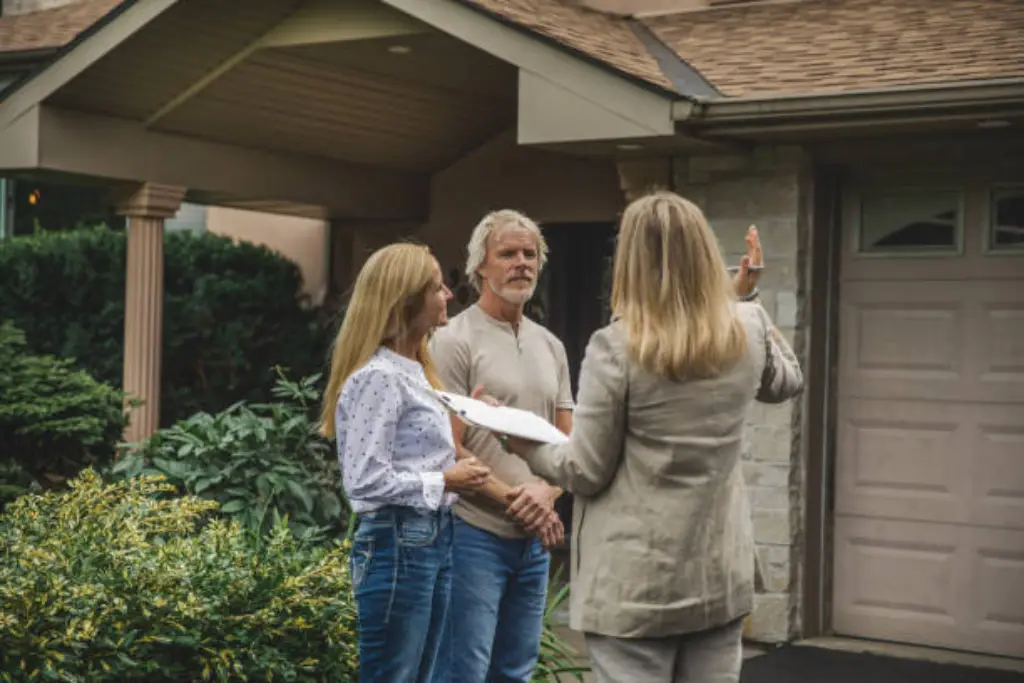
The sound of a suitcase hitting a manicured suburban lawn isn’t a simple thud—it’s a hollow, final crack that reverberates like a bone breaking, like something irreparable snapping in two. It was my Samsonite, the hard-shell silver one I’d carefully selected for our honeymoon in Italy eight years ago, back when Derek still looked at me like I mattered, back when promises still meant something. The suitcase landed with such violence that it bounced once before settling into the grass, sending a shockwave through the perfectly maintained silence of Maple Street.
I stood on the concrete sidewalk, still wearing my hospital scrubs, my nursing ID badge clipped to the fabric and weighing it down like a medallion of exhaustion. The heat of the late afternoon pavement radiated through the thin soles of my practical shoes, the ones I’d worn through a brutal twenty-four-hour shift. My body ached in places I didn’t know could ache. I hadn’t slept in what felt like days. The shift had been a relentless nightmare of trauma codes, grieving families clutching at my hands for answers I couldn’t give, and the particular kind of bone-deep weariness that comes from watching people die despite your best efforts.
I had driven home in a fog of fatigue, desperate for nothing more than the quiet sanctuary of my bedroom, a hot shower, and the oblivion of sleep. Instead, I came home to a performance, a spectacle, a public execution designed for maximum humiliation.
My husband Derek stood on our front porch like an actor on a stage, backlit by the golden afternoon sun. He wasn’t simply standing there—he was performing for an audience, his posture deliberate, his voice projected with theatrical precision. He dragged my second bag, the soft duffel with the broken zipper that I’d been meaning to replace for months, and shoved it down the three concrete steps with unnecessary force. It tumbled end over end, spilling its contents across the lawn in a chaos of fabric and personal belongings.
My mother’s vintage quilt—a kaleidoscope of hand-stitched fabrics from the 1950s that she’d sewn with arthritic fingers that could barely hold a needle—sprawled into the dirt like a fallen flag. My winter boots tangled with the fabric, and I could see the corner of a photo album peeking out, the one filled with pictures of my parents’ wedding, images of a love that had lasted forty-three years until death parted them.
“You’re done here, Sarah!” Derek’s voice boomed across the quiet street, pitched perfectly to carry to Mrs. Patterson’s kitchen window three houses down, to reach the Hendersons across the street, to ensure that every neighbor within earshot would hear his declaration. “I’ve had enough! Enough of the neglect, enough of the distance, enough of your pathetic devotion to a job that barely pays the bills! This is my house now! My life! You can figure out your own!”
He looked triumphant, like a conquering general claiming territory. He looked like a man who had rehearsed these lines in the mirror, who had practiced this moment until he got it exactly right. His chest was puffed out, his jaw set with what he probably thought was righteous determination.
Behind him, framed perfectly in the bay window of what had been our master bedroom—the window that overlooked the rose garden my mother had planted with her own failing hands fifteen years ago, when she still had the strength to dig in the earth—stood Vanessa.
Vanessa. Derek’s so-called “work wife,” the marketing coordinator he’d introduced me to at the office Christmas party nine months ago. I remembered her grip on my hand that night, too tight and slightly damp with nervous sweat. She had looked at me with what I’d interpreted as sympathy, telling me how “incredibly brave” I was to work such grueling hours while my mother was dying of pancreatic cancer. “Derek is such a saint to handle everything at home alone,” she had said, her voice dripping with false admiration. “I don’t know how he does it.”
Now she wasn’t hiding in shadows or sneaking around corners. She stood boldly in my bedroom window wearing my blue silk robe, the expensive one I’d bought for my thirtieth birthday to celebrate a milestone I’d hoped would mark the beginning of better things. She held a coffee mug in both hands—my mug, the chipped ceramic one that said “World’s Best Daughter” in faded letters, a gift from my mom the Christmas before the diagnosis that would eventually kill her. Vanessa sipped from it slowly, deliberately, watching me with heavy-lidded satisfaction that made my stomach turn.
I heard the electronic clicks before I registered what they meant. The neighborhood had awakened like a beast sensing blood in the water.
To my left, Mr. Kowalski, the retired pipefitter who had lived next door since before I was born, stood on his porch holding his smartphone up, recording every moment with the steady hands of a man who had operated machinery for forty years. He didn’t look away when I met his eyes. He didn’t lower the phone. His face was set in grim determination.
Across the street, the Hendersons—the retired couple who had lived there for three decades and still held hands when they walked their ancient golden retriever—were doing the same thing, their phones raised like weapons or shields. Even Jenny Morrison, the shy freelance editor who lived two doors down and usually avoided eye contact with everyone, had stepped onto her front steps, her smartphone recording the scene with unexpected boldness.
They were documenting what Derek clearly assumed would be my ultimate humiliation. The exhausted nurse, publicly discarded and dumped on her own lawn like garbage, replaced by a younger, fresher model who didn’t smell like hospital disinfectant and death.
But I didn’t cry. The tears I expected to feel, the ones I thought would come flooding out in a torrent of grief and rage and betrayal, were simply absent. In their place settled a cold, crystalline clarity that I’d never experienced before. It was a sensation like ice water flooding my veins, washing away confusion and leaving only perfect, terrible understanding.
I didn’t scream. I didn’t collapse dramatically to my knees. I didn’t give Derek and his audience the reality television breakdown he was so clearly anticipating, the spectacle that would justify his narrative of the crazy, unstable wife who couldn’t handle the pressure.
Instead, with hands that were surprisingly steady despite the exhaustion and shock, I reached into my scrub pocket and pulled out my phone. My fingers moved with practiced efficiency, scrolling to a contact I had saved three months ago under the innocuous name “Home Emergency.”
Three months ago, when Derek’s late nights at the office evolved into overnights at hotels whose names I recognized from credit card statements. Three months ago, when his cologne changed from the sandalwood I’d bought him for our anniversary to something cheap and musky that made my nose wrinkle. Three months ago, when he stopped asking how my dying mother was doing and started asking pointed questions about how long probate processes usually took and whether life insurance policies paid out immediately.
“This is Sarah Mitchell,” I said into the phone, my voice sounding foreign to my own ears—low, level, frighteningly calm. “The situation we discussed has occurred. The locks have been changed, and I’ve been physically removed from the property. I need you here now.”
The voice on the other end was deep and gravelly, textured with decades of cigarettes and courtroom battles. “I’m approximately five minutes from your location. Do not engage with him further. Do not enter the house. Just wait for me.”
“Understood,” I said, ending the call.
Derek was already heading back inside, probably to celebrate his supposed conquest with Vanessa, to laugh about how easy it had been to discard eight years of marriage like a worn-out piece of furniture. He slammed the heavy oak front door—the door my father had spent an entire summer meticulously refinishing by hand the year before a heart attack killed him at fifty-three, long before he could walk me down any aisle.
I walked calmly over to my fallen suitcase, righted it with care, and sat down on it like it was a throne. I crossed my legs, folded my hands in my lap, and waited with the infinite patience I’d learned from years of nursing, from countless hours sitting with dying patients, from understanding that some things simply take time to unfold.
Mrs. Patterson appeared almost immediately, hurrying across her lawn with surprising speed for a seventy-two-year-old woman with bad knees and a hip that clicked when she walked. She carried a folding chair in one hand and a sealed bottle of cold water in the other. She didn’t say a single word—didn’t offer platitudes or ask stupid questions about whether I was okay. She simply set up the chair next to me, cracked the seal on the water bottle with her arthritic fingers, handed it to me, and squeezed my shoulder with a grip like iron.
I looked up at Mr. Kowalski still standing on his porch, phone still recording. He caught my eye and gave me a single, sharp nod—a gesture of solidarity and understanding that spoke volumes. Jenny Morrison hadn’t lowered her phone either. Her face was grim, her jaw set in an expression I’d never seen on her usually timid features.
They knew. Somehow, without me saying a single word, without any explanation or context, they understood with perfect clarity that this wasn’t a simple breakup or a mutual parting of ways. This was warfare. This was cruelty. This was a man attempting to destroy a woman who had given him everything. And they had already chosen their side.
Exactly nineteen minutes later—I checked my watch, the practical Timex my mother had given me when I graduated nursing school—a silver sedan that had clearly seen better decades rattled up to the curb. It wasn’t a police cruiser, and it definitely wasn’t a luxury vehicle. It was purely functional transportation, much like the man who emerged from its slightly dented driver’s side door.
Richard Brennan wore a suit that was frayed at the cuffs and shiny at the elbows from years of wear. He carried a battered leather briefcase that looked like it had survived a small war, its surface scarred and scuffed from decades of being slammed on courtroom tables. He had the kind of face that was mapped with deep lines—not from age alone, but from witnessing every possible variation of human greed, stupidity, and cruelty that the legal system had to offer.
He walked toward me not with urgency, but with the inevitable purpose of a man who had done this exact thing a hundred times before and knew precisely how it would unfold.
“Mrs. Mitchell,” he said, extending a weathered hand for me to shake. His grip was firm, warm, reassuring. “I’m Richard Brennan, your mother’s attorney. I’m very sorry we’re meeting under these circumstances, but I’m not sorry we’re meeting today.”
He said it loudly, projecting his voice toward the houses where neighbors still watched, loud enough to drift through the open window where Vanessa was likely still wearing my robe and drinking from my mug.
“He’s inside,” I said simply, gesturing toward the house. “With her.”
Richard nodded, his expression never changing. He didn’t knock politely or ring the doorbell with tentative courtesy. He pressed the button three times in rapid succession—hard, insistent, the authoritative ring of someone who would not be ignored.
We heard heavy footsteps stomping through the foyer, the aggressive stride of a man who expected to intimidate whoever dared disturb him. The door swung open violently, and Derek filled the frame, his face flushed red with adrenaline and righteous anger. When he saw me standing on the sidewalk beside a strange man in a cheap suit, his expression twisted into a sneer.
“Who the hell are you?” Derek spat, his voice dripping with contempt. “This is private property, and you’re trespassing. If you don’t get her and her garbage off my lawn in the next sixty seconds, I’m calling the police.”
“Actually,” Richard said, his voice dropping into that terrifyingly calm register that experienced lawyers use right before they eviscerate someone, “you are the one who is trespassing on someone else’s property. And if you want to call the police, please do—it will save me the trouble and expense of doing it myself.”
Derek blinked, confusion cracking through his bravado. “Excuse me? What the hell are you talking about?”
Richard lifted his battered briefcase, unsnapped the worn clasps with practiced efficiency, and withdrew a thick manila envelope. “I am here in my capacity as legal representative of the rightful property owner. I am serving you with formal notice to vacate these premises. You have exactly seventy-two hours from this moment to remove yourself and your personal belongings.”
Derek’s face transformed from red to a confused purple, the color of a man whose world was beginning to tilt on its axis. “What are you talking about? This is my house. I’ve lived here for eight years. My name is on the—”
“Your name,” Richard interrupted with surgical precision, “is on absolutely nothing related to this property. Your name was removed from any and all documentation through a legal reconveyance process that was initiated and completed by Mrs. Eleanor Mitchell eighteen months prior to her death from pancreatic cancer.”
Derek froze completely, his body going rigid. “Eleanor? You’re talking about her mother?”
“The house was never jointly owned by you and your wife,” Richard continued, reciting facts with the emotionless precision of a court recorder. “This property was originally inherited by Eleanor Mitchell from her parents, Harold and Beatrice Thompson, in 1987 upon their deaths. Mrs. Eleanor Mitchell transferred sole ownership to her daughter, Sarah Elizabeth Mitchell, through a properly executed and recorded deed dated March 15th of last year. You currently have no legal right, claim, or interest in this property. You have no authority to change the locks, remove the owner’s belongings, or occupy the premises without explicit permission from the legal owner.”
I watched the color literally drain from Derek’s face like someone had pulled a plug. It was fascinating in a horrible way, like watching a slow-motion car crash. Behind him, Vanessa materialized in the hallway, drawn by the conversation. Her smug confidence was flickering like a candle in the wind, being steadily replaced by dawning confusion and concern.
“That’s… that’s completely impossible,” Derek stammered, his voice losing its aggressive edge. “Eleanor would have told me about something that important. Sarah would have mentioned it. We’re married—it’s community property under state law.”
“Not this property,” Richard corrected him with the patience of a teacher explaining basic arithmetic to a slow student. “And Mrs. Eleanor Mitchell was under no legal, ethical, or moral obligation to inform you of her private estate planning decisions. Given the extensive documentation we possess regarding your activities and behavior during her final illness, her discretion was not only warranted but remarkably wise.”
Richard pulled a second document from his briefcase, this one on official court letterhead. “This is a temporary restraining order, effective immediately upon service, which is occurring right now. You are expressly forbidden from disposing of, damaging, removing, or otherwise interfering with any property, fixtures, or belongings contained within these premises beyond your strictly personal clothing and toiletries. Any violation of this order will result in your immediate arrest and criminal prosecution.”
Derek snatched the papers from Richard’s extended hand, his eyes scanning frantically across the dense legal language. I saw the exact moment when reality penetrated his skull. His entire body went rigid, then seemed to sag, like a puppet whose strings had been cut. He looked up at me with eyes that were suddenly wide and frightened, betraying the panic that was beginning to set in.
“You knew,” he whispered, his voice cracking with accusation and disbelief. “You’ve known this whole time? This entire time?”
“I found out exactly three months ago,” I said, standing up from Mrs. Patterson’s folding chair and taking a step forward. “Mom’s attorney contacted me two weeks after the estate settled and probate closed. He sent me certified copies of everything—the new deed, the trust documents, the insurance policies.” I paused, letting the next words sink in. “And the private investigation report.”
“Investigation?” Vanessa spoke for the first time, her voice higher and shriller than I remembered from the Christmas party. She stepped forward onto the porch, pulling my blue robe tighter around herself like armor. “What kind of investigation?”
Richard smiled at her. It was not a pleasant smile. It was the smile of a shark that had just spotted blood in the water, the smile of a man who genuinely enjoyed this part of his job.
“Mrs. Eleanor Mitchell, knowing she had limited time remaining on this earth, hired a licensed private investigator approximately thirteen months before her death,” Richard explained with obvious relish. “She documented quite extensively and thoroughly the ongoing extramarital affair between Mr. Derek Mitchell and yourself, Ms. Vanessa Hartley. We have precise dates, specific locations, detailed descriptions of activities, and itemized receipts from hotel rooms that were charged to joint marital accounts.”
He pulled out yet another document, holding it up for both of them to see but not handing it over. “We have photographs,” Richard continued pleasantly. “Professionally taken, properly timestamped, and accurately geotagged. Including extensive documentation from the evening of March 3rd of last year. That was the night, Mr. Mitchell, when you told your wife you were working late at the office to help cover expenses for her mother’s escalating hospice care costs. In reality, you were registered at the downtown Marriott, room 347, with Ms. Hartley here.”
He paused for effect, letting the information settle. “That was also the exact same night that Mrs. Eleanor Mitchell fell in her bathroom at approximately 11:47 PM, sustaining a significant head injury that required emergency medical attention. Your wife, Sarah, had to call the ambulance alone and ride with her unconscious mother to the emergency room alone because you—her husband—weren’t answering your phone. You were otherwise occupied.”
The silence that followed was so complete and absolute that I could hear Mrs. Patterson’s wind chimes three houses away, could hear a dog barking somewhere down the block, could hear my own heartbeat pounding in my ears.
Derek actually stumbled backward, bumping into Vanessa. She flinched away from him violently, as if his touch had suddenly become contaminated, toxic.
“How much did Eleanor actually know?” Derek asked, his voice barely above a whisper, all the bravado completely evaporated. “How much did she find out before she died?”
“Everything,” Richard said simply. “She knew for approximately six months before she passed away. She watched you pretend to be the devoted, grieving son-in-law, attending family dinners and visiting the hospice, all while you were actively betraying her daughter behind closed doors. She meticulously documented your financial negligence, your systematic emotional abandonment, your elaborate patterns of deception. She made absolutely certain, with every legal tool at her disposal, that you would never be able to take anything else from Sarah beyond what you’d already stolen.”
Derek tried to rally, to find some foothold in this avalanche of disaster. He straightened his spine, attempting to salvage some shred of dignity or control. “Fine. So the house belongs to her. We’ll get divorced. I’ll receive my equitable share of the marital equity in the property settlement. I put money into this place over eight years—repairs, improvements, maintenance. That has value.”
Richard actually laughed. It was a dry, rasping sound completely devoid of humor, the laugh of a man who had heard every delusional claim imaginable.
“Mr. Mitchell, I’m afraid we’ve also uncovered some deeply concerning financial irregularities during our investigation,” Richard said, opening his briefcase once more. “Over the past three years, you have taken out several substantial loans using this property as collateral.”
Derek’s face, which had started to regain some color, went white again—not just pale, but actually white, like paper. “That’s… that’s perfectly standard practice. Homeowners do that all the time for various legitimate reasons.”
“Homeowners who actually own the home they’re borrowing against, yes,” Richard agreed reasonably. “But you didn’t own this property, Mr. Mitchell. You never owned it. Which means that when you executed those loan documents, you forged property ownership papers. More specifically, you forged your wife’s signature—the actual legal owner—on a substantial refinance application approximately two years ago, and again on a home equity line of credit roughly fourteen months ago.”
I felt my breath catch in my throat, felt the ground shift beneath my feet. This was the part I hadn’t fully understood until this exact moment, the piece of the puzzle Richard had mentioned on the phone but hadn’t explained in detail.
“According to the documentation provided by the lending institutions,” Richard announced, his voice carrying across the entire street, “we are looking at approximately one hundred and twenty-seven thousand dollars in fraudulent loans obtained through forgery and misrepresentation.”
The number hung in the air like a physical presence. $127,000. More than two years of my salary as a nurse. More than my mother’s entire life insurance policy.
“I needed that money!” Derek shouted, his carefully constructed facade finally shattering completely. “The business was having serious setbacks! There were unexpected expenses! I was going to pay it all back! I was fixing things, making it work!”
“By committing multiple felonies?” Richard asked with mock curiosity. “The lending institutions are being formally notified today through certified mail. They will be pursuing you personally and exclusively for full repayment of the outstanding balances. And because you obtained the funds through fraud, forgery, and material misrepresentation, that debt cannot legally be considered marital property. It belongs to you. Alone. Forever.”
I stepped forward, walking slowly up the driveway until I was standing face-to-face with the man I had shared a bed with for eight years, the man whose laundry I had washed, whose meals I had cooked during the rare moments I wasn’t working, whose lies I had somehow failed to see despite all the obvious signs.
“Mom knew everything,” I said softly, but clearly enough for everyone to hear. “She found the loan documents hidden in your home office filing cabinet while you were out with Vanessa last year. She had a security camera installed in the office without telling anyone. She watched you practice forging my signature repeatedly until you got it perfect enough to fool a notary.”
“She… she was dying,” Derek stammered desperately. “She was on heavy morphine for the pain. She couldn’t have been thinking clearly. She couldn’t have…”
“She was a mother,” I interrupted, my voice steady and sure. “And she spent her last conscious breaths and her final reserves of strength protecting me from you. From what you were planning to do. From what you were already doing.”
Vanessa was backing away now, physically distancing herself from Derek. I could see her doing the calculation in her head—no house, no equity, massive personal debt, potential criminal prosecution for fraud. The prize she had worked so hard to steal was suddenly revealed as a liability, a trap, a disaster.
“There is one more thing,” Richard said, reaching into his briefcase one final time.
“Oh God, what else could there possibly be?” Derek moaned, his voice defeated, broken.
“Not for you,” Richard said dismissively, not even looking at Derek anymore. He withdrew a cream-colored envelope, expensive stationery, and handed it directly to me. “Mrs. Eleanor Mitchell left specific instructions with our office and with the county recorder. She established a trigger system—if anyone attempted to change the property locks, file false ownership claims, or remove you from the premises, I was to come here immediately and give you this letter. She wanted you to have it today, in this moment.”
I took the envelope with trembling hands. My mother’s handwriting on the front was shaky but absolutely unmistakable, the letters formed by fingers that could barely hold a pen but refused to give up.
“Can I read this inside?” I asked, my voice cracking for the first time. “In my house?”
“It is your house, Sarah,” Richard said firmly. “You are the sole legal owner. You can do whatever you want, whenever you want.”
I walked past Derek without looking at him. He had become irrelevant, a ghost haunting a life he no longer had any claim to. I climbed the three steps to the porch. Vanessa was blocking the doorway, but when our eyes met, I saw fear there—genuine, animal fear.
“Move,” I said quietly.
She didn’t argue or sneer this time. She stepped aside quickly, pressing herself against the doorframe to avoid any contact.
I walked into my living room, and the first thing that hit me was the smell. My vanilla candles were there, but they were contaminated, masked by Derek’s cologne and Vanessa’s cloying perfume. The space smelled like violation, like invasion. But underneath it all, beneath the foreign scents, the house felt fundamentally solid. The walls were still the walls my father had built with his own hands. The floorboards were the ones my mother had paced while rocking me to sleep as a baby.
I sat down on the couch—my couch—and carefully opened the letter.
My Dearest Sarah,
If you are reading this letter in the circumstances I’ve arranged, then I was right about Derek, and I wish with all my heart that I had been wrong. I wish I could have left this world believing he was worthy of you, that my instincts were paranoid delusions brought on by pain medication. But a mother’s instinct is a powerful thing, perhaps the most powerful thing in the world.
The check enclosed with this letter is for $40,000. It represents money I saved by refusing the experimental treatments my oncologist recommended during my final three months. Those treatments might have bought me a few extra weeks, Sarah, maybe a month if I was extraordinarily lucky. But they would have left you drowning in medical debt, would have consumed the small inheritance I wanted to leave you.
I chose to leave this world a little sooner, with a little less suffering, so that I could give you something more valuable than a few extra days of my company. I chose to give you freedom. The freedom to walk away, to start over, to build a new life without being trapped by financial desperation.
Use this money wisely, my darling girl. The house remembers loyalty. It remembers who stayed through the hard times, who tended the garden, who loved it. Derek was always just a guest who overstayed his welcome.
There is one more surprise coming, though I hope it arrives in the next few minutes. Richard found something very interesting about your Vanessa during his background investigation. I assume she’s there with Derek right now? If so, watch the driveway carefully.
I love you more than all the stars in the sky. I always have. I always will. Mom
I looked up from the letter, tears finally streaming down my face in hot rivers. She had sacrificed literal days of her life—had chosen to die sooner—just to make sure I wouldn’t be financially destroyed. The weight of that sacrifice, that fierce maternal love, was almost too much to bear.
Outside, I heard the distinctive rumble of a heavy engine, something larger than a car.
I walked back to the front door, still clutching the letter and the check. A beat-up pickup truck had pulled up behind Richard’s sedan, its paint faded and its bumper held on with what looked like wire. A man stepped out—tall, broad-shouldered, wearing work clothes and looking exhausted in a way that went bone-deep. He held a manila folder of papers.
Vanessa, who had been whispering frantically with Derek on the lawn, froze completely. Her face drained of every trace of color, leaving her looking gray and suddenly much older.
“Vanessa,” the man said, his voice rough with fatigue and something that might have been grief. “We need to talk. Right now.”
“Who the hell are you?” Derek demanded, looking frantically between the stranger and Vanessa.
“My name is Thomas Morrison,” the man said, walking steadily up the driveway. “I am Vanessa’s legal husband. We’ve been married for twelve years this coming October.”
Derek’s jaw literally dropped open. “Husband? She told me she was divorced! She said her ex-husband was abusive and controlling!”
“That’s her standard script,” Thomas said wearily, sounding like a man who had explained this too many times. “She does this repeatedly. She targets men who appear to have assets or stable incomes, moves in quickly, establishes some kind of residency or common-law claim, and then tries to extract settlement money or property rights. She did it in Ohio three years ago. She did it in Pennsylvania before that. There might be others I don’t know about yet.”
Thomas finally looked at me, and his eyes were full of exhausted sympathy. “I’m genuinely sorry she dragged you and your family into this nightmare. But I’m here to serve her with divorce papers and emergency custody orders. Our two children, Emma and Jack, are waiting in the truck. They haven’t seen their mother in eight months, since she emptied our joint bank accounts and disappeared.”
Derek turned slowly to Vanessa, his face a mask of dawning horror and comprehension. “You’re… you’re a con artist? This was all a con?”
“Oh, grow up, Derek,” Vanessa snapped, dropping the act completely. Her face transformed, became hard and ugly and calculating. “You were an easy mark from day one. You were desperate to feel like a big man, like you mattered. It’s not my fault you were stupid enough to sign papers you didn’t bother reading, to commit crimes for someone you barely knew.”
She yanked off my blue silk robe and threw it onto the dirty porch floor like it was garbage. Underneath she wore jeans and a tank top, clothes suitable for a quick escape. She grabbed her designer purse from inside the doorway.
“I’ll sign your papers, Thomas,” she said to her husband with cold indifference. “But I’m not coming back to Ohio, and I’m sure as hell not playing mother to those kids.”
“That’s fine,” Thomas said quietly, sadly. “They’re better off without you. They deserve better than this.”
Vanessa marched to a nondescript sedan parked down the street—a car I’d never noticed before, which had probably been her escape vehicle all along—and peeled away without a backward glance, leaving only the smell of burning rubber.
Derek stood alone on the lawn that was no longer his. His girlfriend was a professional con artist. His house was gone. His debts were insurmountable. His crimes were documented. And his neighbors—Mrs. Patterson, Mr. Kowalski, Jenny Morrison, and others who had gathered—were all watching in silence, bearing witness to his complete and total destruction.
“I need to… I need to pack my things,” Derek said, his voice completely hollow, all fight gone.
“You have exactly seventy-two hours from this moment,” Richard reminded him, checking his watch. “The clock started seventeen minutes ago. I suggest you use your time wisely.”
Derek walked past me without meeting my eyes, shoulders slumped in defeat.
I looked at Thomas Morrison, this stranger who had traveled hundreds of miles to reclaim his life. “Thank you for coming all this way. I hope you and your children will be okay.”
“Your mother’s lawyer called me two weeks ago,” Thomas explained. “He gave me this address and explained the situation. He thought I deserved to know where my wife was, and that you deserved to know who she really was.” He managed a weak smile. “I hope you’re going to be okay too.”
“I will be,” I said, and for the first time in months, maybe years, I actually meant it.
Six months later, on a warm Saturday afternoon, I hosted the inaugural meeting of what we’d started calling the Second Chapter Society. It began modestly in my living room—just me, Jenny Morrison from down the street, and a nurse from my hospital ward who was navigating a nightmarish divorce. But word spread through networks of women who understood what it meant to be betrayed, who were rebuilding their lives from rubble, who needed to know they weren’t crazy or alone.
We used a portion of Mom’s money to hire a legal consultant who helped women check their own property deeds and credit reports, who taught them to recognize the warning signs of financial abuse, who helped them understand their rights. We created a safety net, a community, a lifeline.
The house had been thoroughly cleaned, every trace of Derek and Vanessa scrubbed away. I’d burned sage in every room, repainted the bedroom, replaced the mattress, reclaimed every inch of space as my own. The rose garden was blooming again, vibrant red flowers that my mother had planted opening their petals to the sun.
I sat on the porch steps with my coffee in my reclaimed “World’s Best Daughter” mug, watching the neighborhood come alive with the sounds of a Saturday afternoon. Derek had pleaded guilty to multiple counts of fraud to avoid prison time, and he was living in a basement apartment across town, working two jobs to pay back the lenders while his wages were garnished. I didn’t hate him anymore. I didn’t feel anything for him at all. He was just a lesson I’d learned, a ghost of a person I used to know.
The house was quiet, but it wasn’t empty. It was filled with memories of my mother’s fierce, protective love—a love so powerful it had reached from beyond the grave to save me, to give me freedom, to ensure I would survive.
The house remembered loyalty, remembered who stayed, who loved, who fought. And so did I.
THE END.

Adrian Hawthorne is a celebrated author and dedicated archivist who finds inspiration in the hidden stories of the past. Educated at Oxford, he now works at the National Archives, where preserving history fuels his evocative writing. Balancing archival precision with creative storytelling, Adrian founded the Hawthorne Institute of Literary Arts to mentor emerging writers and honor the timeless art of narrative.