The House They Gave Me to Fail
My name is Olivia Holloway, I’m twenty-eight years old, and three months ago my parents slid two envelopes across the same mahogany dining table they use for every “family announcement”—the table where they’d told us about college decisions, career disappointments, and all the other moments where my twin sister Meredith shined and I faded into the background like furniture nobody notices until they need somewhere to set their drink.
Meredith—my twin by birth, my parents’ favorite by choice—opened the thick envelope first. Her fingers, manicured and steady, pulled out a downtown lease agreement, a set of glossy photographs showing a renovated loft with exposed brick and floor-to-ceiling windows, and a brass key that caught the light like something from a jewelry commercial.
There were hugs. Happy shrieks. My mother’s hand on Meredith’s shoulder, squeezing with genuine pride. Talk of her “incredible new view” and “such a safe neighborhood” and “the perfect place to build your career.”
My envelope was thin. The kind of thin that announces disappointment before you even open it.
Inside was a rusty key—actually rusty, with flakes of oxidation coming off on my fingers—and an address written on a piece of notebook paper in my father’s blocky handwriting. 2847 Maple Ridge Road. Forty minutes outside the city, where the pavement turns to gravel and the mailboxes start leaning at angles that suggest they’ve given up.
My father didn’t look up when he said it. Just kept cutting his steak, knife scraping against the plate. “It needs work. But you’re handy. You’ll figure it out.”
That was it. That was my inheritance, my graduation gift, my reward for twenty-eight years of being the daughter who didn’t cause problems.
Meredith got a renovated loft in the art district, all utilities included, first month’s rent paid. I got a work assignment disguised as a gift.
But I nodded. Said thank you, because that’s what I do. That’s what I’ve always done when my family hands me less and calls it enough.
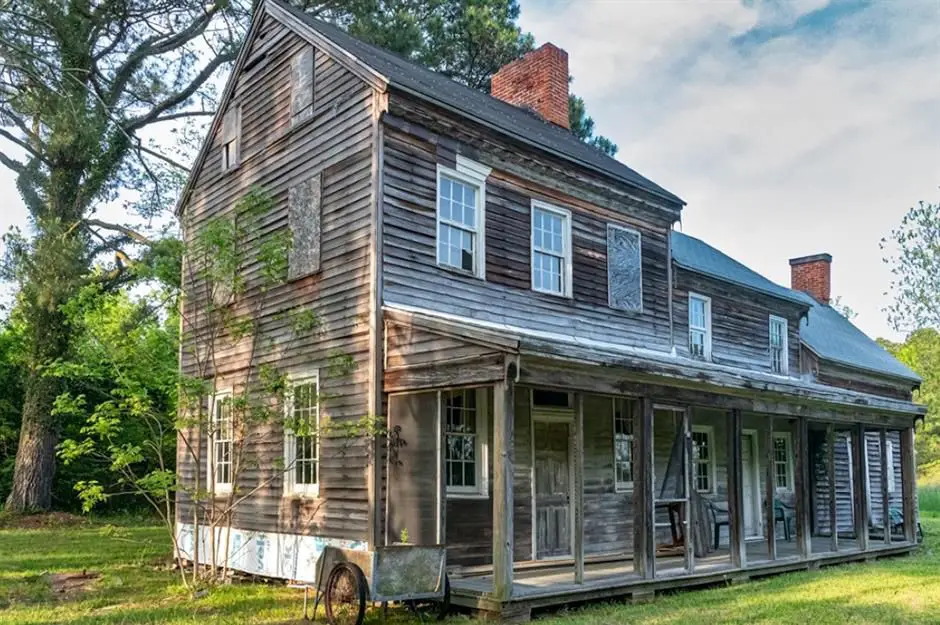
The house looked like it was tired of standing.
I pulled up to 2847 Maple Ridge Road on a gray Saturday morning with my truck, my tools, and a sinking feeling in my stomach that proved justified the moment I got out and really looked at the place.
A sagging roofline that dipped in the middle like a broken spine. Plastic sheeting duct-taped over windows that were missing glass. Porch steps that had half-collapsed, leaving a gap you could break your ankle in. Weeds taller than me swallowing what might once have been a yard. Siding that had faded to no particular color, peeling away from the frame in strips.
It looked like the kind of house people photograph for “before” pictures in renovation magazines—the cautionary tale, the disaster everyone shakes their head at.
Inside was worse.
The front door stuck, swollen with moisture. When I finally got it open, the smell hit me first—damp wood, old insulation, something that might have been mold or might have been dead rodents or might have been both. The floor bowed under my boot, boards flexing in ways that told me the subfloor was rotted through in places. Wallpaper hung in strips like dead skin. The kitchen cabinets were particle board from the seventies, water-damaged and literally disintegrating.
I could tell the wiring was going to be a problem before I even found the breaker panel—old cloth-wrapped wires, aluminum instead of copper, outlets that were probably fire hazards. The plumbing was equally ancient, pipes that groaned and probably leaked behind walls I couldn’t see yet.
The bathroom was a horror show of cracked tile and black mold. The bedrooms were small and dark, with windows painted shut and carpet that squelched when you stepped on it.
I sat on the one porch step that didn’t give way beneath me, opened the notebook I always carry, and did what I’ve always done when my family hands me less and expects me to be grateful.
I started building anyway.
I should explain: I’m a carpenter. Not a hobbyist, not someone who took a weekend workshop and bought a miter saw. A real carpenter—licensed, experienced, the kind who can frame a house, hang cabinets, restore historic trim, work with wood in ways that most people don’t have the patience or skill for.
I do cabinets, trim work, restoration projects. The kind of work that leaves sawdust in your hair and calluses on your hands and proof of your skill in every joint, every corner, every surface that you built to last.
I’d been working for a custom furniture company for six years, had built up a reputation, had regular clients who requested me specifically. I made decent money—not Meredith’s tech-job money, not my parents’ comfortable-retirement money, but enough to live on, enough to be independent.
Except I wasn’t independent, was I? Because I’d been living in a cramped apartment, saving money, waiting for something better. And now my parents had given me “something better” in the form of a house that would have been condemned if anyone from the county had bothered to look at it.
Over the next ten weeks, I poured everything I had into that ruin.
Twelve thousand dollars of my savings. Four hundred hours of my time, working nights and weekends, taking vacation days to frame walls and hang drywall. Every skill I’d learned over years of apprenticeship and practice.
I started with the foundation—jacked up the sagging corner, replaced rotted support beams, made sure the structure was sound before I touched anything cosmetic. Ripped out all the old subfloor and laid new plywood, making sure it was level, making sure it would last.
New electrical throughout—pulled permits, did it right, replaced every outlet and switch and wire. New plumbing where needed. A roof that finally stopped leaking, with proper flashing and ice shields and shingles that would hold for twenty years.
I gutted the bathroom down to the studs and rebuilt it—new tile, new fixtures, a shower that didn’t leak, ventilation that would prevent mold. Not fancy, but clean and functional and done right.
The kitchen got the most attention. I built white oak cabinets from scratch with dovetail joints because I needed one thing in my life to be solid, to be undeniably good, to be something no one could dismiss or minimize. I made my own countertops from butcher block, sanded and sealed them myself. Installed a farmhouse sink I’d found at a salvage yard and restored. Subway tile backsplash in a classic pattern that would never go out of style.
I refinished the original hardwood floors that had been hiding under that disgusting carpet—pine boards that were over a hundred years old, scarred and stained but beautiful once I’d sanded them down and applied new finish.
Replaced every window with energy-efficient vinyl units. Painted every wall a soft warm white that made the small rooms feel bigger. Added trim work—baseboards and crown molding—that I’d milled myself in my shop, paying attention to details that most people wouldn’t notice but that made the difference between a house and a home.
I planted flowers in the front yard. Ripped out the weeds and put in a small garden. Fixed the porch steps so they were safe and solid.
And slowly, over those ten weeks, the “before” started turning into “after.”
When it was done—really done, to a level of finish that I was genuinely proud of—I took some photos and posted them on social media. Just a simple before-and-after post, the kind that people share to show what hard work can accomplish.
The response was immediate and overwhelming.
Friends I hadn’t heard from in years commenting about how incredible it looked. Strangers asking if I did renovation work professionally, if I was available for hire. Old classmates from high school suddenly remembering I existed, sending messages about their own projects.
The post got shared. Then shared again. Renovation blogs picked it up. A local magazine reached out about doing a feature.
And that’s when my parents showed up.
They didn’t call first. Just pulled into my newly graveled driveway one Saturday afternoon in my father’s Mercedes, both of them dressed like they were going somewhere important after this.
My mother walked through the rooms I’d rebuilt without saying proud. Without saying beautiful. Without saying you did this yourself? with the kind of amazement that would acknowledge the skill and effort involved.
She touched the counters like she was counting inventory. Opened cabinets and closed them. Ran her hand along the window trim. Stood in the bathroom and looked around with an expression I couldn’t quite read.
“This turned out better than expected,” she said finally. Not to me. To my father. Like I was a contractor she’d hired, not her daughter.
My father stood in the living room—the room where I’d replaced every board in the floor, rebuilt the window casings, installed the crown molding that had taken me three days to get perfect—and looked around with the assessing gaze of someone calculating value.
“Meredith needs this house,” he said. Not as a question. As a statement of fact.
I laughed once, because it sounded impossible. Absurd. Meredith had her loft downtown, her perfect apartment with the view and the exposed brick. Why would she need this house?
“The loft isn’t working out,” my mother explained in that smooth voice she uses when she’s already decided something and is just informing you of the decision. “The building has issues. Noise. Security problems. She’s not comfortable there.”
“So she can break her lease,” I said. “Find a different apartment.”
“Don’t be difficult, Olivia,” my father said, and his voice had that edge that means the discussion is over, the decision is made. “The deed is still in my name. Legally, this is my property. You’ve done excellent work fixing it up, and we appreciate that. But Meredith needs this house, and you have forty-eight hours to move out.”
The words didn’t process at first. I heard them, but they didn’t connect to reality, didn’t make sense in any universe where I was a person who mattered, who had rights, who deserved basic respect.
“You’re joking,” I said.
“We’re not,” my mother said. “Meredith will be here Monday morning with movers. Please have your things out by then.”
“I put twelve thousand dollars into this house,” I said, my voice rising despite my best efforts to stay calm. “Four hundred hours of work. I rebuilt this place from the foundation up.”
“And it looks wonderful,” my mother said. “You should be proud. But the house belongs to your father, and he’s decided to give it to Meredith. You can’t expect us to let you keep something we gave you just because you improved it.”
“You gave me a wreck,” I said. “You gave me a condemned house and told me to figure it out. I turned it into something worth living in, and now you’re taking it away?”
“You’re being dramatic,” my father said. “You can find another apartment. You were living in an apartment before. This doesn’t change anything for you.”
Except it changed everything. It changed the twelve thousand dollars I didn’t have anymore. It changed the four hundred hours I’d never get back. It changed my understanding of exactly how little I meant to the people who were supposed to love me.
“Get out,” I said quietly.
“Olivia—”
“Get out of my house. Now.”
My father’s face hardened. “It’s not your house. That’s the point. And if you’re not out by Monday morning, I’ll have the sheriff remove you for trespassing.”
They left. And I stood in the middle of my beautiful living room, in the house I’d built with my own hands, and felt something inside me go very cold and very clear.
If you’ve ever had your hard work rebranded as “what the family decided,” if you’ve ever been told your effort doesn’t matter because someone else needs the results more than you do, you know the particular rage that comes from being erased like this.
The phone tree lit up almost immediately.
Aunts and cousins started calling. People who hadn’t checked on me once while I was hauling rotten boards and hanging drywall suddenly had lectures about “family loyalty” and “respecting your parents” and “not being selfish.”
“Meredith really needs this, Olivia,” my aunt Carol said in her most reasonable voice. “You know she’s had a hard time lately. Can’t you just be happy for your sister?”
“I need you to be the bigger person,” my cousin Jake texted. “Don’t make this harder than it has to be.”
Meredith herself sent a text that was a masterpiece of manipulation: Liv, I really need this. You don’t understand what I’ve been going through. The loft has been a nightmare and I’m barely sleeping and I just need somewhere safe and quiet. Please don’t make me beg. We’re sisters. Please.
I didn’t shout. I didn’t send long angry texts explaining why this was wrong. I didn’t try to make anyone understand.
I made one call. To the only person in my life who’d never treated me like a spare part, who’d never asked me to be smaller so someone else could be bigger.
Marcus Chen. My best friend since college, a real estate attorney who’d helped me review the paperwork when my parents had first given me the house.
“They’re taking it back,” I told him. “Giving it to Meredith. I have forty-eight hours.”
He listened, quiet for a beat, and I could hear him thinking, processing, moving into lawyer mode.
“Olivia,” he said carefully, “before you move a single box, before you do anything, I need you to answer a question. Whose name is actually on the land?”
I frowned. “My dad’s. He said the deed is in his name—”
“The land,” Marcus interrupted. “Not the house. The land. Do you have the original deed paperwork? The stuff they gave you when they transferred the property?”
I did. I’d kept everything in a folder, barely looked at it because I’d been too busy actually working.
I pulled it out now, spread the papers across my new butcher block counters, and started reading properly for the first time.
And that’s when I saw it.
The deed transfer. Signed. Notarized. Filed with the county three months ago.
The house had been deeded to my father. But the land—1.3 acres that the house sat on—had been deeded directly to me. In my name. Olivia Marie Holloway. Clear title. No co-owners. No contingencies.
“Marcus,” I said slowly, “the land is mine.”
“Then the house is yours,” he said. “Because a structure can’t exist separately from the land it’s built on. Your father might technically own the building, but since you own the land and he gave you access to improve the property, and you improved it with the reasonable expectation of continued use… Olivia, they can’t take this from you.”
Right then, I heard tires crunching on gravel.
I looked out my new kitchen window and saw Meredith’s car pulling into the driveway. A moving truck behind her. She’d brought help, brought boxes, brought the confidence of someone who’d never been told no in her entire life.
“Marcus,” I said quietly, “I need you to come out here. Now. And bring copies of every property law statute that applies.”
“I’m already in my car,” he said.
Meredith climbed out of her car wearing designer jeans and a cashmere sweater, looking like she was about to star in a home makeover show. She had two guys with her—movers, I assumed—and a stack of boxes visible through her back window.
She walked up to my porch like she already owned the place, smiling that smile she uses when she wants something. The smile that’s always worked on our parents, on teachers, on anyone who doesn’t see through it.
“Liv,” she said warmly, “I know this is weird, but thank you so much for understanding. The place looks amazing. You did such a good job. I promise I’ll take good care of it.”
I stood in my doorway—the door I’d replaced, hung myself, painted a soft gray—and looked at my twin sister. The person who’d shared a womb with me, who’d been given every advantage while I’d been given every test.
“You’re not moving in,” I said calmly.
Her smile faltered. “Mom said you were being difficult, but I thought—look, I know you’re upset, but Dad owns the house and he’s giving it to me. You don’t actually have a choice here.”
“Come inside,” I said. “Let me show you something.”
She followed me in, the movers trailing behind uncertainly. I led them to the kitchen—my kitchen, with the cabinets I’d built from scratch—and spread the deed paperwork across the counter.
“Dad owns the house,” I said. “You’re right about that. But I own the land. All 1.3 acres of it. And a house can’t exist without land to sit on.”
Meredith stared at the papers, her face going pale as the implications sank in.
“That means,” I continued, “that Dad can’t give you this house without my permission. Because I can revoke his access to my land anytime I want. I can tear down anything he owns that’s sitting on my property. I can charge rent for every square foot. I can put up a fence and lock the gate and there’s not a damn thing he can do about it.”
“You wouldn’t,” Meredith said, but her voice was uncertain.
“Try me,” I said. “I spent twelve thousand dollars and four hundred hours turning this wreck into something livable. I did that because I thought it was mine. Because I believed that when my parents gave me something, even something broken, it was actually a gift and not a loan they could revoke when something better showed up.”
“Liv, please—”
“No,” I said. “You don’t get to ‘please’ me. You don’t get to walk into the house I built and act like you deserve it more than I do. You got the loft. You got the nice apartment downtown, the one that Mom and Dad paid for, the one that required zero work from you. This house? This house was my work. My skill. My vision. And you’re not taking it.”
One of the movers cleared his throat. “Ma’am? Should we… should we leave?”
“Yes,” I said to him. “You should definitely leave.”
Meredith’s face had gone from pale to red. “I’m calling Dad.”
“Go ahead,” I said. “And I’ll call my lawyer. Who, by the way, is already on his way here with all the relevant property law documentation.”
She pulled out her phone with shaking hands and stepped outside. I could hear her voice rising, sharp and panicked, talking to our father.
The movers looked at each other, looked at me, and started backing toward the door.
“Sorry, miss,” one of them said. “We don’t get paid enough to be in the middle of family drama.”
“No one does,” I agreed.
By the time Marcus arrived twenty minutes later, Meredith was sitting on my porch steps crying while she talked on the phone, the movers were long gone, and I was inside making coffee like my life hadn’t just fundamentally shifted.
The next few days were a legal blur.
My father’s lawyer called. Marcus calmly explained that since I owned the land and had made substantial improvements to the property with the reasonable expectation of ownership, I had a strong legal claim to the entire house regardless of whose name was on the building deed.
My parents threatened to sue. Marcus explained that they’d lose, and probably end up owing me compensation for the improvements I’d made to their property that was sitting on my land.
My father offered to buy the land from me. I said no.
My mother called crying, saying I was tearing the family apart. I said they’d torn me apart first, piece by piece, every time they’d chosen Meredith over me, every time they’d given her more and expected me to be grateful for less.
Meredith sent increasingly desperate texts. I really need this house, Liv. You don’t understand. I can’t go back to the loft. Please.
I finally responded: You can’t have what I built. Find something else.
Three weeks later, my father’s lawyer sent papers officially transferring the house deed to my name in exchange for me not pursuing compensation for my improvements. It was framed as a generous gift. It was actually them accepting they’d lost.
The house—all of it, structure and land—was mine. Completely. Legally. Undeniably mine.
That was two months ago.
I’m writing this from my living room, the one I rebuilt from rotted boards and old dreams. The afternoon light is coming through the new windows, hitting the floor I refinished, making everything glow warm and golden.
My parents haven’t spoken to me since I refused to sell. They’ve made it clear through various relatives that I’m selfish, ungrateful, that I’ve ruined Meredith’s life by refusing to give her what she “needed.”
Meredith found a different apartment. A nice one, I hear. Not as nice as this house, but then again, she didn’t put four hundred hours into it.
And me? I’m turning this into exactly what I want it to be. Not what my parents think I should have. Not what Meredith needs more than me. Not a consolation prize or a work assignment.
A home. My home. Built by my hands, protected by my stubbornness, kept because I finally learned to value my own work as much as everyone else had been devaluing it.
I’ve started taking on renovation clients who find me through that viral before-and-after post. People who have old houses, broken houses, houses that need someone who understands that fixing something isn’t just about making it pretty—it’s about making it solid, making it last, making it worthy of the people who’ll live in it.
And every time I finish a project, every time someone looks at what I’ve built and says “this is incredible, you’re so talented,” I think about my parents sliding those two envelopes across their mahogany table.
Meredith got the easy gift. The one that required nothing from her except showing up and signing a lease.
I got the test. The one that required everything from me—money, time, skill, determination, the willingness to turn something worthless into something valuable.
They thought they were giving me less.
They were actually giving me the chance to prove that I could build something that couldn’t be taken away.
Something that was mine because I made it mine, not because someone handed it to me.
And in the end, that’s worth more than any downtown loft could ever be.
THE END

Ethan Blake is a skilled Creative Content Specialist with a talent for crafting engaging and thought-provoking narratives. With a strong background in storytelling and digital content creation, Ethan brings a unique perspective to his role at TheArchivists, where he curates and produces captivating content for a global audience.
Ethan holds a degree in Communications from Zurich University, where he developed his expertise in storytelling, media strategy, and audience engagement. Known for his ability to blend creativity with analytical precision, he excels at creating content that not only entertains but also connects deeply with readers.
At TheArchivists, Ethan specializes in uncovering compelling stories that reflect a wide range of human experiences. His work is celebrated for its authenticity, creativity, and ability to spark meaningful conversations, earning him recognition among peers and readers alike.
Passionate about the art of storytelling, Ethan enjoys exploring themes of culture, history, and personal growth, aiming to inspire and inform with every piece he creates. Dedicated to making a lasting impact, Ethan continues to push boundaries in the ever-evolving world of digital content.